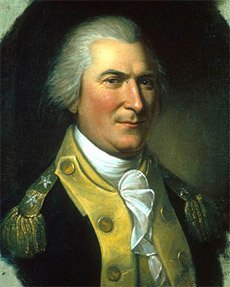
" During the six months before December of 1776, Commanding General, George Washington had retreated from nine consecutive battles with the British in New Jersey and had lost ninety percent of his army. Brigadier General, Arthur St. Clair answered the call with fresh troops, took over the leadership of a brigade and suggested the strategies of stealth which enabled Washington’s army to win the next three battles over the British in just nine days after Christmas in 1776. This drove the British out of New Jersey and avoided what could have been the end of the American Revolution.
St. Clair walked with the giants of the American Revolution…Washington, Franklin, Adams, Jefferson, Greene, Lafayette and others. And yet, for more than two centuries, history has been reluctant to mention that St. Clair…
• Became one of Washington’s most trusted of only 30 major generals.
• Built four armies for Washington
• Was the military strategist who helped Washington defeat the British in 1776-77.
• Was President when the U.S. Constitution and the Northwest Ordinance were drafted.
• Was America’s first and last foreign-born President.
St. Clair also …
• Stopped the Virginia governor from annexing what is now Pittsburgh (1774)
• Protected Pennsylvania settlers from Indian attacks incited by the British (1764-69).
• Assisted Governor Penn with development of Bedford and Westmoreland Counties (1764-74).
• Renounced his allegiance to Great Britain to become a Colonel in the Continental Army (1774).
• Established judicial system for six states of the Northwest Territory.
Amateur historian R.W. Dick Phillips has taken on the task of rediscovering the life and legacy of the Scottish-born Revolutionary War General and American Statesman Arthur St. Clair, while at the same time chronicling his family genealogy with facts on the Sinclair and St. Clair clans. Apart from a rather unique way of bullet pointing the highlights of St. Clair’s accomplishments and triumphs in the opening, it becomes quite apparent from the Preface, Introduction, and Chapter One that there are minor editing issues that have gone overlooked, as well as a general repetitive theme of grandstanding the Founder as an often undervalued and faultless hero, slighted by politics and forgotten to history. It is also made clear that the heirs and the present generation of Sinclair and St. Clair families have heavily endorsed and approved this biographical undertaking, which could lead the reader to be mindful of a potential bias in favor of their illustrious ancestor.
The book can be read rather quickly, with short chapters and separated parts that focus on different aspects of St. Clair’s life, but it can be quite confusing as Phillips fails to keep it chronologically structured. He begins with the Scottish ancestry and background of the Scottish Freemasons that St. Clair himself would eventually become a member of, and yet jumps in time from the next chapter to brief facts and events of his Congressional Presidency tenure of 1787, completely missing his journey of coming to America that Phillips set out to unfold.
Along with countless spelling and grammatical errors littered throughout which can be blamed on the publisher as previously mentioned, Phillips’ work can be all too repetitive—with constant reminders of his Scottish heritage being brought in to focus throughout the biography, themes of him being overlooked and dwarfed when compared to other soldiers and leaders, as well as perhaps overstating his friendship and bond with George Washington time and time again. The most frustrating aspect of the above mentioned faults as well as subsequent chapters on St. Clair’s military engagements is the fact that Phillips does not substantiate on relatively anything. He makes broad statements throughout the text indicating that St. Clair distinguished himself in the French and Indian War—with no further follow up or elaboration—or more specifically the repeated assertion that Washington “had already developed a respect for his courage in battle”, without going into any specific detail of the battles themselves:
Not that there is the slightest doubt about George Washington’s greatness, but if there were, the years spent researching Arthur St. Clair’s relationship with Washington during and after the Revolution would have certainly obliterated it. Most Americans really have no idea of the trust that existed between Washington and St. Clair and how they often counted upon one another to help solve major problems. Perhaps it has been in deference to Washington’s dozens of other generals that historians have seldom acknowledged the lifelong trust and mutual interdependence that existed between Washington and St. Clair; but they were much closer than people realize..
Sadly, the only time that Phillips actually goes into detail on any one of St. Clair’s military excursions is when he is boldly quoting from a previous biography on St. Clair, or from another general history like McCullough’s 1776, and recent biographies on George Washington and Nathanael Greene. He could take the time to check the sources used from such works and then reevaluate them in his own method and style, yet instead he paraphrases them, and we are yet again left with broad and vague assertions on a General whom unfortunately becomes more obscure as the biography continues. Even in the second half of the book, the reader still loses focus as one chapter explains his decision to retreat from Ticonderoga in 1777, yet the following chapter explains a brief account of St. Clair’s political career in Pennsylvania in 1771 and his subsequent participation in Dunmore’s War, to which there is no explanation for this glimpse back to his earlier years—one of many tangents that are all too frequent in The Invisible Patriot.
Unsurprisingly, Phillips takes an apologetic and defensive stance of St. Clair’s catastrophic blunder with the Native American threat in the Wabash in 1791, going as far as to call for extortion charges for then Secretary of War Henry Knox. Disregarding the bias, this is the moment where the biography could shine—yet Phillips misses the opportunity to go into the actual grit and terror of the battle—nor does he go into detail to discuss the inadequacy and lack of men and supplies that he mostly points the blame at. Illustrations are provided throughout the text, though sources listed at the end are scarce and should be considered with hesitation—the passion and admiration is fully evident—but nonetheless, this is a biography that should be avoided.
When you see what your ancestors have done or what they've gone through, it makes you grateful for what you have and appreciate what they did and survived.
How they paved the way for us to live how we do today, the sacrifices they made... all so we could be free to live on our terms.
Without their courage to do what they thought was right, who knows where we would be?
Wish I could go back and meet some of them ----
Wow, this was quite a read... I didn't know much about Arthur St Clair going into this, only bits and pieces of what my uncle told me or sent me emails with some info. I also have a card from when he was president of of the united states in Congress Assembled for 1787. (Making him America's first and last foreign-born president)
I never really seriously thought about my family history till I got somewhere in my 20s I think, my uncle Jim was the historian for Dad's side and I would email him from time to time with questions. I loved his enthusiasm and was amazed how far back and how much he had uncovered and continues to find (it also explains I think,my fascination with Ireland in one part of the family line).
I am a bit sheepish to admit In ever looked up Arthur St. Clair, not really sure why... but when I learned this book was coming out, I was really excited and when my friend Shaun got it for me as Christmas gift, I jumped into it right away.
This is Arthur St. Clair, nice portrait hmm?
From the book: "Arthur St. Clair is sometimes remembered as an unfortunate victim of circumstance, but he was so much more. He was an American patriot who always tried to do the right thing, regardless of the political consequences or personal agendas of lawmakers. He was courageous and his innovative military strategies helped Washington become known worldwide as the greatest military strategist of the time."
"Should not the benchmark by which we remember this patriot be his courage to stand for America against his former homeland, Great Britain, and for his outstanding courage under fire and his decades of service and personal sacrifice to America? And What about his unrelenting loyalty to his mentor Washington and to his adopted country, America, despite it's ill treatment of him? After all, he wasn't born here; he chose to live in America and he defended it's freedom till the end."
He was a very accomplished and fascinating man... he did so much for his country and yet, not very much of it is known. Most of his achievements have been largely ignored, and it's baffling to me how badly he was treated by congress and some of the other people back then.
He and Washington were close friends and he became one of Washington's most trusted generals.
Dick Phillips has done a wonderful job telling Arthur's story and presenting it in a style that makes it fun to read. It does jump back and forth some and there were a couple sections where information was repeated slightly but overall if it is a very informative read.
As I read along, I became very proud of my ancestor and the significant contributions he made to the Revolution. Among them: was arriving with two thousand fresh troops for Washington in New Jersey, suggesting the crossing of the Delaware on Christmas night..
He had a tremendous sense of honor and duty to his country, doing what he thought was right, sometimes at personal and financial cost to himself. He was never reimbursed for the money he advanced to the army and when he was Governor of the Northwest Territory.
I was surprised to learn of Dunmore's inciting the Indians to frighten the settlers out of Pennsylvania from the area now known as Pittsburgh. I vaguely recalled the name Dunmore and Dunmore's war from school but didn't remember the particulars.
Least now, this unknown Patriot's story can be told... highly recommend this book, even if you aren't a descendant. It's an important part of history that shouldn't be ignored.
The family line of St. Clair/Sinclair is a huge one (ours is descended from his daughter Louisa , an incredible person herself) and I don't envy the people doing research there haha, so many people to map and keep straight. ~~~~ My uncle's review off amazon, posted here with his permission: I am a 5th generation descendant of Arthur St. Clair through his daughter Louisa St. Clair Robb. I have for many years, done research on Arthur and Phoebe St. Clair's family and found that historical writers rarely even mentioned his name and if they did, only to mention St. Clair's Defeat or Ticonderoga retreat with little additional information. They completely ignored his many significant contributions to the Revolutionary War effort and his close association with George Washington and his many personal and financial sacrifices to the cause of freedom.. I was wondering when Arthur St. Clair would ever get his story told.
Well, Dick Phillips took it upon himself to really go back to original sources, sources that were certainly available to historians who chose to ignore them, and dug out the facts and many facts there are that show that Arthur St. Clair as a prominent patriot and founder of our United States of America. It seems that his intention was to do his best for his adopted country and when it came to choosing sides he chose to be an American taking his oath of allegiance at Valley Forge.. Serving in Congress from 1785-1787 and elected the President of the United States in Congress Assembled in 1787, saw to it that on his watch the Constitutional Convention was organized and his good friend, patriot and founder, George Washington was President of the Convention. During his term the 3rd most important founding document of the United States, the Northwest Ordinance was passed and he later would be elected by the Congress to be the first and only governor, 1788-1802. In the new Northwest Ordinance was placed a clause stating there would be no involuntary servitude (slavery) and as the Territory grew with a strong territorial legislature, there were efforts to remove that clause. However, St. Clair fought against it. The Anti-slavery clause in the Ordinance would be the first time that the U.S. government would place in a law an Anti-slavery provision. After Ohio became a state in 1803, the legislature tried to remove the anti-slavery provision from the law's of the State of Ohio, but, it was blocked by one lone vote. Receiving the newly written Constitution of the United States from George Washington, he, as President, had it sent to the state legislatures for ratification. We now have a true and factual account documented in one fine book THE INVISIBLE PATRIOT ARTHUR ST. CLAIR with the many contributions to our great country by Arthur St. Clair, Founder and Patriot, no longer invisible. Thank you, Dick Phillips, job well done!
Any descendants or others interested in the family history and genealogy of Arthur and Phoebe Bayard St. Clair, please email me at jrstclair@aol.com
The name of Arthur St. Clair should be well-known in the rolls of patriotic Americans who contributed to the founding of this country. Instead, comparatively few people have heard of him, and of those, the event that came most readily to mind and most handily to the history books was the disastrous Battle of Wabash.
However, historian R.W. Dick Phillips has made strides in rectifying this with his book.
Phillips traces St. Clair’s military and political career, touching on his Scottish ancestry and his role in the re-Revolutionary colonies, the struggle for independence and the formation of the government afterward. The author paints a fascinating picture of a man of patriotism and principals whose military skill and knowledge of the land proved crucial to the war, and whose impact was felt in the very formation of the Ohio Valley.
A list of his accomplishments is readily available and Phillips does a fine job of locating and compiling them. These include raising four armies for General Washington and leading them during a turning point of the war, as well as lending his hard-earned experience to Washington as one of his trusted advisors.
Among Phillips’ more interesting contentions is that Washington’s plan to famously cross the Delaware may have originated with St. Clair. As President of Congress, St. Clair was also technically the only foreign-born president of the United States, and as Governor of the Northwest Territory he was a key figure in shaping what would become a key series of states.
During all this time, Phillips outlines, St. Clair was focused always on the good of the nascent nation to which he had sworn his allegiance. This quality was perhaps his curse. While the other Founding Fathers were all very aware of their place in history and acted to secure their legacies in the minds of succeeding generations, St. Clair’s focus was always on discharging his duty.
In the end, political machinations would see him placed in an impossible situation during the Battle of Wabash and left taking the blame in the public’s perception afterward, despite a later investigation finding that the primary blame lay with a politician’s venal scheming.
In the end, Phillips does an admirable job drawing back a veil of omission that had rendered invisible a founding patriot due remembrance.
This looked like it might be interesting, until I noticed a glaring error in the blurb, and that causes me to wonder about the quality of research in this one.
In the blurb it states St. Clair, "Was President when the U.S. Constitution and the Northwest Ordinance were drafted." Due to another minor error previously I thought perhaps this was a typo and was intended to say he was present rather than President, until I saw this, "Was America's first and last foreign-born President."
Now, I'm certainly not an expert, but I do know there has never been a President St. Clair.
R.W. Dick Phillips's "Arthur St. Clair: The Invisible Patriot," is an overwrought, ponderous and, redundant account of the life of St. Clair. While St. Clair was an important Scots-American patriot, and is an underrated man in American history, this book does nothing to vindicate his work.
There are kernels of truth that Phillips' study mines. After all, even a blind pig detects an acorn sometimes.
I'm very interested in the time period and the subject, so I was excited to find this book. I gave it one star only because I could not give it zero stars. I read through the beginning and was very disappointed. It doesn't appear to be researched well. Phillips goes to great lengths to inform us of St. Clairs lineage and great deeds in order to remind us he shouldn't only be known for his infamous defeat but the author gets loose and repetitious with the facts right off the bat. That didn't instill confidence. Another reviewer mentions the misleading blurb about St. Clair being "President when the U.S. Constitution and the Northwest Ordinance were drafted." and "was America’s first and last foreign-born President". This should read that he was "President of the Continental Congress"... of which there were 14 men, including John Hancock, from 1774 until 1788. The author also asserts that one of St Clair's ancestors built Newport Tower in a pre-Columbian voyage to the New World. That's a fringe theory that's been debunked many times over. A quick internet search shows that carbon dating & other 19th & 20th century investigation of the mortar dates it to the mid 1600s. It was probably built by Benedict Arnold. No not THAT Arnold but an ancestor, the Governor of Rhode Island at the time. I thought that was a bit ironic. Stealing the glory of the ancestor of America's most infamous traitor and trying to give it to the ancestor of the General in charge of the worst American military defeat.
So I'm sorry Art, it was my hope...but this is not the modern bio we've been waiting for. Your legacy is still mostly St. Clair's Defeat with the footnote that you re-named Losantiville to Cincinnati. I suppose it's better to be remembered for anything than not remembered at all.