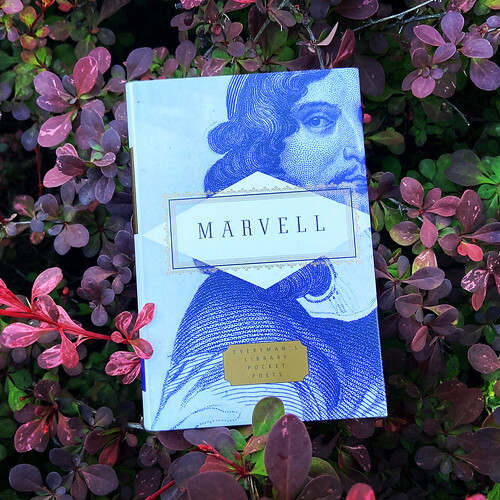
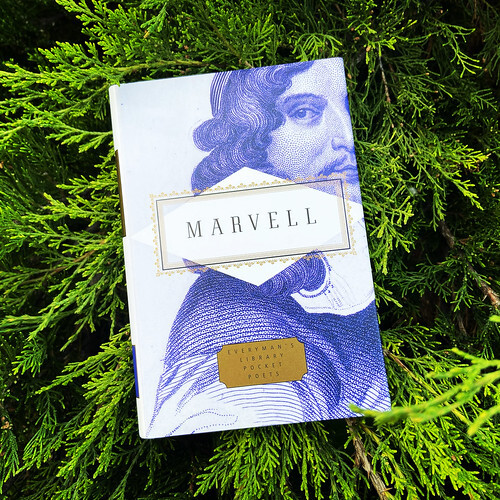
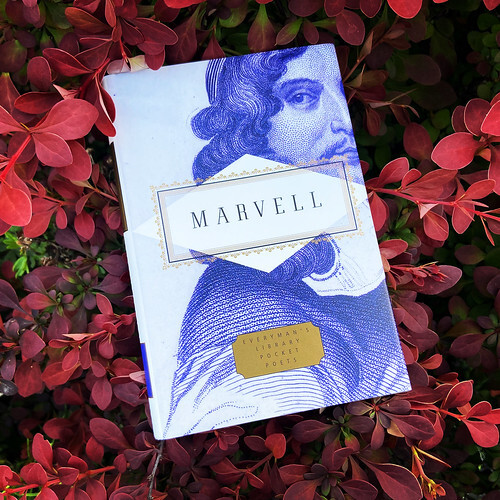
The great seventeenth-century metaphysical poet Andrew Marvell was one of the chief wits and satirists of his time as well as a passionate defender of individual liberty. Today, however, he is known chiefly for his brilliant lyric poems, including “The Garden,” “The Definition of Love,” “Bermudas,” “To His Coy Mistress,” and the “Horatian Ode” to Cromwell. Marvell’s work is marked by extraordinary variety, ranging from incomparable lyric explorations of the inner life to satiric poems on the famous men and important issues of his time–one of the most politically volatile epochs in England’s history. From the lover’s famous admonition, “Had we but World enough, and Time, / This coyness, Lady, were no crime,” to the image of the solitary poet “Annihilating all that’s made / To a green Thought in a green Shade,” Marvell’s poetry has earned a permanent place in the canon and in the hearts of poetry lovers.
A clergyman fathered Andrew Marvell, a parliamentarian. John Donne and George Herbert associated him. He befriended John Milton, a colleague.
The family moved to Hull, where people appointed his father as lecturer at church of Holy Trinity, and where grammar school educated the young Marvell. A secondary school in the city is now named after him.
Marvell's a worthy successor of Donne's to the post of Lord Wit, as exemplified in the former's poems about love, gardens and metaphysics. Like Donne, Marvell could write with a pen both learned and beautiful, but he also had a more florid style than his predecessor, which helps him occasionally to soar aloft. Finally, to round off the parallels, M. was a stickler for couplets, meaning that neither poet's ambitions lay in rhyme nor stanza form.
However, Marvell would take his metaphors much further than Donne, and showcased his learning with more vim, as showcased by such whoppers as "An Horatian Ode", the two poems dedicated to Cromwell and the two Painter poems. These works are riddled with allusions, without any sacrifice of the poetic effect. Granted, for me personally, it isn't always very interesting to read such context-dependent poems, especially of politicians, but the way Marvell pulls it off is really admirable.
In fact, my main complaint is not about Marvell but about this edition. It has no footnotes or explanatory notes whatsoever. How is one supposed to get a grasp of especially the poems under the title "Of Public Affairs" without copious notes to elucidate the copious references that Marvell is barraging at the reader? While the notes would definitely mar the initial reading experience due to the constant necessity to interrupt the flow, they would be better in the long run to gain proper appreciation of Marvell's talent. There were also a couple of times, when certain obsolete word choices would have warranted an explanation, though for the most part the verbiage is pretty understandable for anyone already familiar with the language of the times, and I must say I am somewhat glad that Everyman has retained the original spelling and not saturated the text with needless definitions.
As for Marvell's style, I can't say that I think his rhythm to be that impeccable. He constantly favours the couplets, which can give his longer poems a rather jejune air, and when these are delivered in a somewhat uneven rhythm, it can make the reading somewhat cumbersome in the long run.
But for the most part, it was apparent that Marvell has a great command of the nuances of the language and a keen mind to boot. I would not have minded if the compilation had focused more on the more general topics such as love and death and kept the political poems to a minimum, but at least one was given a proper idea of the scope of the poet's genius.
I received this book upon the passing of a great man, fellow writer, and my best friend. While age found us separated in a vast span of decades, he was still wise and gave his advice freely to guide me. In his will he wanted me to have some of his books. I am fortunate enough that this is one of them. I do not enjoy Andrew Marvell as much as I do Coleridge or Keats. But still he did have some amusing, thought provoking works. Just read Music's Empire or To His Coy Mistress and I guarantee you'll have a new favorite poet.
Marvell's poetry has a baroque musicality to it, with chamber orchestra intimacy. Intricate, labyrinthine layers of meaning burst forth from outwardly simple couplets. And also from devilishly complex couplets. The imagery is striking, the cleverness relentless and just when you think you've plumbed the depths, lo and behold, a deeper grotto appears amidst the coral.
About two-thirds of Marvell's output appears in this 46-poem collection (The Complete Works edited by Grosart credits him with 72 poems altogether). Most of his Latin verses are omitted, except four in translation, one of which, "The Garden", is Marvell's own English rendering of his "Hortus". But everything his poetic reputation rests upon graces this very presentable little volume.