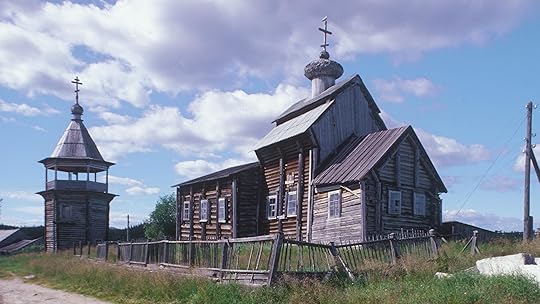
I have read many of Makine’s novels and it is obvious from his beautiful descriptive passages especially describing the countryside, and his characters that he is following in the tradition of the great Russian authors steeped in what is known as “the Russian Soul”. This term has been used in literature to describe Russian spirituality and the writings of many Russian writers such as Gogol, Tolstoy and Dostoyevsky offer descriptions of the Russian soul.
The Russian word "душа" (dushá), is most closely translated into the word soul. The Russian soul can be described as a cultural tendency of Russians to describe life and events from a religious and philosophical symbolic perspective. This word's widespread use and flexibility of its use in everyday speaking is one way in which the Russian soul manifests itself even today in Russian culture. In Russia a person's soul or dusha is the key to a person's identity and behavior and this cultural understanding that equates the person with his soul is what is described as the Russian soul. Sentimentality, sensitivity and guilt are general characteristics of the Russian soul. According to Dostoevsky, "the most basic, most rudimentary spiritual need of the Russian people is the need for suffering, ever-present and unquenchable, everywhere and in everything". The Russian soul has been described as: sensitive, revere, imaginative, an inclination to tears [but not publicly], compassionate, submissive mingled with stubbornness, patience that permits survival in what would seem to be unbearable circumstances, poetic, mysticism, fatalism, a penchant for walking in the dark, introspective, sudden unmotivated cruelty, mistrust of rational thought, fascination — the list goes on.
The concept of a Russian soul arose in the 1840s chiefly as a literary phenomenon. Famous author Nikolai Gogol and literary critic Vissarion Belinskii jointly coined the term after the publication of Gogol’s masterpiece Dead Souls in 1842. At the time, landowners often referred to their serfs as “souls” for accounting purposes.
The term “Russian soul” grew in prominence, and eventually became more clearly defined through the writings of authors such as Dostoevsky. This famous brand of nationalism, however, was the product of a continuous effort by Russia’s various classes to define a national identity.
Escaping from the artistic and literary milieu of his dissident friends in 1970’s Leningrad, who are slavish wannabe westerners, the narrator is offered a job documenting folkloric traditions in a far-flung region of the northern Soviet Union, he takes off, with all the bravado of the urban cynic hoping for material for his anti-Soviet satire. He expects to find "widespread drunkenness to the sound of loudspeakers broadcasting uplifting slogans". But the village of Mirnoe (which means peaceful in Russian) refuses to yield to his expectations. "I had come to escape from people who found our times too slow," he says, before realising that Archangel is frozen outside time.
A few hours' walk from the White Sea, it is a place of meandering paths through woody thickets, milky skies over isolated houses, and snow-capped bathhouses by the lake. Still, tranquil Mirnoe is a lonely place of solitary old women, either widowed or simply forgotten in the aftermath of the Second World War, all getting by quietly on the slim consolation that, thanks to their husbands, brothers or sons, Leningrad had not fallen.
Rising out of these melancholy mists is Vera. She was just 16 when she waved goodbye to her fiancé in 1945 and promised to wait for her soldier's return. Over the course of the next three decades, she has become a near-mythic figure, a fiancée immolated on the pyre of faithfulness.
The first time we see her, she is barefoot by a lake, hauling in fishing nets, her wet dress writhed round her tall body, so vigorous that, glimpsing her between the willow trees, the narrator thinks he has spotted a couple making love in the undergrowth.
On another occasion, Vera is coming out of the bathhouse when a sudden gust exposes a tantalising sliver of breast underneath the military greatcoat round her shoulders.
The young writer becomes obsessed with Vera. Initially, he watches from a distance, seeing her as a romantic heroine, still hopeful as she reaches for the post-box, still expectant as she glances out of her kitchen window. She is also tragic: "Give or take a few days and one less battle, he would have returned," and her life would have been so very different - "marriage, children, the smell of resin on fresh pine planks, clean linen flapping in the wind . . . if only". Above all, however, she is idealised, a woman beyond all desire, the woman waiting for the absent man she loved - and hence all the more desirable to the man present.
Andrei Makine's books are always suffused with beautiful descriptions of nature. He is totally a Romantic in his descriptions, and the Russian woods, steppes, and lakes come vividly to life in his books. For example his descriptions of an autumn trip across a lake in a rowboat, of ice breaking "with the sound of a harpsichord" in a well, or of gathering mushrooms, visiting the village school where Vera teaches. Nonetheless, a young man of 26 cannot shake off the effect of the accidental glimpses of Vera’s body, or the night when he spied on her at the bathhouse.
"The soft radiance of the moon made of her a statue of bluish glass, revealing even the moulding of collarbones, the roundness of breasts, the curve of hips, on which drops of water glistened. . . . She breathed in greedily, baring her body to the moon, offering it to the night, to the dark expanse of the lake.”
As the novel unfolds, the narrator thinks, “What if Vera turns out to be somewhat other than what he imagines or expects?” His reason for valuing this woman so highly seems connected to his own romantic situation. No matter how hard he tries to downplay it, it's clear he's scarred by an event in either 1974 or 1975 when his girlfriend had sex with first a friend of his and then an American journalist behind a stack of paintings at a bohemian party.
His friend Otar encourages him to treat women without respect, comparing them to sows in a pigsty. But Makine's narrator shakes off such misogyny, instead getting increasingly close to Vera. All of his preconceptions about her turn out to be false, as she proves to be better educated than he is, and blessed with a moral responsibility he finds elevating. When the two of them sleep together it moves him in a way he can barely comprehend, and the true meaning of this mysterious novel becomes even more elusive.