

What do you think?

Çocuğunuzun Beynine Hoşgeldiniz
Gebeliğin başlangıcından üniversiteye kadar zihnin gelişimi.
Çocuğunuz hiperaktif mi?
Enstrüman çalmayı öğrenmek çocukları daha zeki yapar mı?
Çocuklar rüyalarında ne görür?
Bu ve benzer birçok sorunun cevabı Çocuğunuzun Beynine Hoş Geldiniz'de.
Bu kitap gebeliğin başlangıcından üniversiteye kadar olan tüm dönemleri ele alıyor, çünkü her ne kadar bu konudaki pek çok kitap ilk üç yılla sınırlı kalsa da, beynin gelişimi çok daha uzun süre devam eder. Bir çocuğun beyninin gelişimi ve olgunlaşması, on yıllar süren karmaşık bir süreçtir. Çocuğunuzun beyni, üniversiteye gidene kadar gelişmeye ve çevresine uyum sağlamayı sürdürür. Dolayısıyla, çocuğunuz yenidoğan da olsa, bebek ya da ergen de olsa bu kitaptan yararlanabilirsiniz.
Çocuğunuz hiperaktif mi?
Enstrüman çalmayı öğrenmek çocukları daha zeki yapar mı?
Çocuklar rüyalarında ne görür?
Bu ve benzer birçok sorunun cevabı Çocuğunuzun Beynine Hoş Geldiniz'de.
Bu kitap gebeliğin başlangıcından üniversiteye kadar olan tüm dönemleri ele alıyor, çünkü her ne kadar bu konudaki pek çok kitap ilk üç yılla sınırlı kalsa da, beynin gelişimi çok daha uzun süre devam eder. Bir çocuğun beyninin gelişimi ve olgunlaşması, on yıllar süren karmaşık bir süreçtir. Çocuğunuzun beyni, üniversiteye gidene kadar gelişmeye ve çevresine uyum sağlamayı sürdürür. Dolayısıyla, çocuğunuz yenidoğan da olsa, bebek ya da ergen de olsa bu kitaptan yararlanabilirsiniz.
320 pages, Paperback
First published August 9, 2011
Ratings & Reviews
Friends & Following
Create a free account to discover what your friends think of this book!
Community Reviews
Displaying 1 - 30 of 101 reviews

March 3, 2012
(4.0) Good stuff, fairly well researched, more actionable and less nerdy than What's Going on in There
If interested, strongly recommend What's Going on in There? : How the Brain and Mind Develop in the First Five Years of Life, which I thought was even better...though more nerdy and more focused on the science than on recommendations for parents. This book is certainly more focused on giving parents actionable advice. In fact, they call out tips for parents in specific sections so they're easy to see (probably even easier in the paper version I imagine). I found these helpful and always justified with research in nearby text (though footnotes would be a LOT better here than the annoying notes at the end that refer back to text in the chapter...no page numbers, no notation in text to indicate there are citations available :( ).
The book debunks 'myths', shares interesting tidbits and has lots of DOs and DON'Ts that should be easy to understand and follow for any parent interested enough to read the book. And everything's backed up by research (I'm taking this a little on faith because of bad citation scheme--see above).
The only things I didn't like (except bad science--see below for that):
* the magazine-like quotation snippets injected in the middle of text. at least in ereader. they're really disruptive and don't help at all. We're already reading the book: don't need teasers!
* the cartoon figures. they don't add much, though i kinda like the style. but they just feel like fillers like we were trying to hit a certain page count (same with the teaser quotations).
But onto the good stuff!
Some of the corrections to misconceptions (kinda don't like using myth to mean that :( ):
* eating low-mercury sushi isn't bad for baby: freezing kills parasites and the omega 3s are so good for their developing brains!
* small amounts of caffeine are actually fine--they say up to equivalent of 3 cups of coffee per day!
* crawling is not prerequisite to walking (1/3 of jamaican babies don't; 100 years ago, 40% of american babies didn't)
* birth order correlation with personality type bunk when you control for family size and socioeconomic status
Some of the tidbits I liked:
* ages 3-8, children's brain tissue uses twice as much energy as adult (per gram tissue i think?). 5 year old: 1/2 of caloric needs go to brain
* 14 month old start to understand others' intent...will mimic intent (adult had hands wrapped up and tapped head to a box to get reward...toddler will use hands)
* seems children under 7 can pretty much learn to speak a language as well as a native. after that, decays till about 17, when ability is about the same through adulthood
* children don't really dream like adults till age six, and not till 8 or 9 do they reach frequency of adulthood
* even though boys get better math scores on SAT, women earn better grades in college math courses
* outdoor play significantly decreases chance of nearsightedness in children
* newborns see better in peripheral than foveal/central region!
* babies who are fed bitter non-milk (soy or non-soy formula) like broccoli more later on
* children can't recall prior mental states (e.g. hungry child once fed can't remember being hungry before) (age 3?)
* drama classes strongly correlated with better social adaptation and other social skills. perhaps due to trying to 'inhabit the character of another person'
* reminding people of stereotypes can affect performance: if they're included in positive stereotype they do better, if negative, they do worse
* testosterone improves mental rotation skills (even as short term as a testosterone injection in women!)
DOs:
* massaging, stretching, bathing infants, swinging, tossing, wearing in sling: sensory input and lots of muscle adjustments make stronger
* spinning infant in a chair speeds motor development
* can 'teach' sitting by putting child in sitting position, propping up
* when reading, ask open-ended questions (not just yes/no or pointing questions) and respond to baby's best attempts to communicate (whatever form they take) encourage communication/language skills
* have "conversations" with baby...taking turns, responding with comment or touch. this encourages baby to keep trying to communicate
* introduce children to secondary languages early (best is before 7)
* eat veggies during pregnancy (babies will like it more). mothers who drank carrot juice had babies who liked carrots more than those who didn't
* eat fish during pregnancy!
* combine new flavors with flavors baby likes (e.g. mix in with yogurt). they'll like the new flavors more eventually. or can give preferred flavor first, then the other within 9 seconds, but mixing seems easier. ;)
* work on multi-step tasks/games with children to help them learn self-control, planning, thinking about future, ignore/recover from distractions
* teach children to exercise self-control through structured games (e.g. board games) that force certain behavior to be fun
* play, enjoy what they do, get excited and engaged in certain activities, whatever they are helps them learn to self-regulate
* exercise at least 1 hour per day, moving around (active kids have higher IQs, not to mention health benefits)
* dora, blues clues for preschoolers okay, helps with language
* explicitly coach children on emotions: label and validate their emotions when they have them, suggest constructive ways to cope with them...these children are much better at regulating emotions later in life
* encourage frequent breaks during studying, vary times and places of study...learn much more that way. note: might do worse on practice problems/tests if spacing out, but more learning is taking place.
tie success/failure to effort, not innate characterstics. tell them they tried hard, studied hard, worked for it...rather than that they're so smart/athletic. they'll deal better with setbacks and try harder, be more successful
* TIME OUTs: studies of behavior extinction in lab animals. remove all attention so children don't associate bad behavior with getting more attention. immediately follow behavior with the time out. no lecturing (that's attention).
* small, consistent rewards for small achievements (pat on back, words of encouragement better than money, cookies). also give them control over parts of their lives: decide what's for dinner, stay up a few minutes late one night, pick destination for family outing.
* ignore unwanted behavior: ignore it and it will go away. if she whines, pretend you didn't hear. but you HAVE to stick with the approach and don't give in, they'll just learn to be persistent.
DON'Ts:
* chronic moderate noise during pregnancy can actually cause hearing loss (e.g. living near freeway)
* offer dessert as reward for eating well. they just prefer the dessert over whatever they have to eat
* even tease girls about weight: way more likely to be overweight have eating disorder
* encourage overly ambitious tasks/games, lest child become frustrated rather than feel achievement
* TV before 2.5: poor language development (babies/infants need interaction), and even then pick the right shows: dora, sesame street, blues clues good; teletubbies BAD
* be overprotective. overly protective parents of high-reactive children interfere with children's development of coping skills
Okay, unfortunately, there were some pretty bad math/science errors:
* "Imagine that genetic and environmental influences were independent of one another. In that case, you could guess the likelihood that a child born to criminal parents /and/ raised in a bad environment would commit a crime, simply by adding the two percentages to get 18.8 percent." They should know better...you kidding me? consider if it was 75% and 75%....easy probability stuff here
* "...sound, a set of pressure waves [good] that move through th air the way a splash ripples across a pond" you've got to be kidding me. those are actually two classic examples of two different kinds of waves, pressure vs transverse!
* had some cool figures, but they weren't all appropriate to this text (or were missing valuable captions...one in particular showing touch recepters but doesn't say what each one does (Meissner's corpuscle, Merkel's disk, Ruffni's ending, Pacinian corpuscle--what are they?)
* [talking about how play is fun in many species, and it wouldn't be that way unless it provided some advantage] "On these grounds, it seems that play must have an adaptive purpose, providing some survival advantage"...gets natural selection wrong: might be a reproductive advantage rather than survival!
If interested, strongly recommend What's Going on in There? : How the Brain and Mind Develop in the First Five Years of Life, which I thought was even better...though more nerdy and more focused on the science than on recommendations for parents. This book is certainly more focused on giving parents actionable advice. In fact, they call out tips for parents in specific sections so they're easy to see (probably even easier in the paper version I imagine). I found these helpful and always justified with research in nearby text (though footnotes would be a LOT better here than the annoying notes at the end that refer back to text in the chapter...no page numbers, no notation in text to indicate there are citations available :( ).
The book debunks 'myths', shares interesting tidbits and has lots of DOs and DON'Ts that should be easy to understand and follow for any parent interested enough to read the book. And everything's backed up by research (I'm taking this a little on faith because of bad citation scheme--see above).
The only things I didn't like (except bad science--see below for that):
* the magazine-like quotation snippets injected in the middle of text. at least in ereader. they're really disruptive and don't help at all. We're already reading the book: don't need teasers!
* the cartoon figures. they don't add much, though i kinda like the style. but they just feel like fillers like we were trying to hit a certain page count (same with the teaser quotations).
But onto the good stuff!
Some of the corrections to misconceptions (kinda don't like using myth to mean that :( ):
* eating low-mercury sushi isn't bad for baby: freezing kills parasites and the omega 3s are so good for their developing brains!
* small amounts of caffeine are actually fine--they say up to equivalent of 3 cups of coffee per day!
* crawling is not prerequisite to walking (1/3 of jamaican babies don't; 100 years ago, 40% of american babies didn't)
* birth order correlation with personality type bunk when you control for family size and socioeconomic status
Some of the tidbits I liked:
* ages 3-8, children's brain tissue uses twice as much energy as adult (per gram tissue i think?). 5 year old: 1/2 of caloric needs go to brain
* 14 month old start to understand others' intent...will mimic intent (adult had hands wrapped up and tapped head to a box to get reward...toddler will use hands)
* seems children under 7 can pretty much learn to speak a language as well as a native. after that, decays till about 17, when ability is about the same through adulthood
* children don't really dream like adults till age six, and not till 8 or 9 do they reach frequency of adulthood
* even though boys get better math scores on SAT, women earn better grades in college math courses
* outdoor play significantly decreases chance of nearsightedness in children
* newborns see better in peripheral than foveal/central region!
* babies who are fed bitter non-milk (soy or non-soy formula) like broccoli more later on
* children can't recall prior mental states (e.g. hungry child once fed can't remember being hungry before) (age 3?)
* drama classes strongly correlated with better social adaptation and other social skills. perhaps due to trying to 'inhabit the character of another person'
* reminding people of stereotypes can affect performance: if they're included in positive stereotype they do better, if negative, they do worse
* testosterone improves mental rotation skills (even as short term as a testosterone injection in women!)
DOs:
* massaging, stretching, bathing infants, swinging, tossing, wearing in sling: sensory input and lots of muscle adjustments make stronger
* spinning infant in a chair speeds motor development
* can 'teach' sitting by putting child in sitting position, propping up
* when reading, ask open-ended questions (not just yes/no or pointing questions) and respond to baby's best attempts to communicate (whatever form they take) encourage communication/language skills
* have "conversations" with baby...taking turns, responding with comment or touch. this encourages baby to keep trying to communicate
* introduce children to secondary languages early (best is before 7)
* eat veggies during pregnancy (babies will like it more). mothers who drank carrot juice had babies who liked carrots more than those who didn't
* eat fish during pregnancy!
* combine new flavors with flavors baby likes (e.g. mix in with yogurt). they'll like the new flavors more eventually. or can give preferred flavor first, then the other within 9 seconds, but mixing seems easier. ;)
* work on multi-step tasks/games with children to help them learn self-control, planning, thinking about future, ignore/recover from distractions
* teach children to exercise self-control through structured games (e.g. board games) that force certain behavior to be fun
* play, enjoy what they do, get excited and engaged in certain activities, whatever they are helps them learn to self-regulate
* exercise at least 1 hour per day, moving around (active kids have higher IQs, not to mention health benefits)
* dora, blues clues for preschoolers okay, helps with language
* explicitly coach children on emotions: label and validate their emotions when they have them, suggest constructive ways to cope with them...these children are much better at regulating emotions later in life
* encourage frequent breaks during studying, vary times and places of study...learn much more that way. note: might do worse on practice problems/tests if spacing out, but more learning is taking place.
tie success/failure to effort, not innate characterstics. tell them they tried hard, studied hard, worked for it...rather than that they're so smart/athletic. they'll deal better with setbacks and try harder, be more successful
* TIME OUTs: studies of behavior extinction in lab animals. remove all attention so children don't associate bad behavior with getting more attention. immediately follow behavior with the time out. no lecturing (that's attention).
* small, consistent rewards for small achievements (pat on back, words of encouragement better than money, cookies). also give them control over parts of their lives: decide what's for dinner, stay up a few minutes late one night, pick destination for family outing.
* ignore unwanted behavior: ignore it and it will go away. if she whines, pretend you didn't hear. but you HAVE to stick with the approach and don't give in, they'll just learn to be persistent.
DON'Ts:
* chronic moderate noise during pregnancy can actually cause hearing loss (e.g. living near freeway)
* offer dessert as reward for eating well. they just prefer the dessert over whatever they have to eat
* even tease girls about weight: way more likely to be overweight have eating disorder
* encourage overly ambitious tasks/games, lest child become frustrated rather than feel achievement
* TV before 2.5: poor language development (babies/infants need interaction), and even then pick the right shows: dora, sesame street, blues clues good; teletubbies BAD
* be overprotective. overly protective parents of high-reactive children interfere with children's development of coping skills
Okay, unfortunately, there were some pretty bad math/science errors:
* "Imagine that genetic and environmental influences were independent of one another. In that case, you could guess the likelihood that a child born to criminal parents /and/ raised in a bad environment would commit a crime, simply by adding the two percentages to get 18.8 percent." They should know better...you kidding me? consider if it was 75% and 75%....easy probability stuff here
* "...sound, a set of pressure waves [good] that move through th air the way a splash ripples across a pond" you've got to be kidding me. those are actually two classic examples of two different kinds of waves, pressure vs transverse!
* had some cool figures, but they weren't all appropriate to this text (or were missing valuable captions...one in particular showing touch recepters but doesn't say what each one does (Meissner's corpuscle, Merkel's disk, Ruffni's ending, Pacinian corpuscle--what are they?)
* [talking about how play is fun in many species, and it wouldn't be that way unless it provided some advantage] "On these grounds, it seems that play must have an adaptive purpose, providing some survival advantage"...gets natural selection wrong: might be a reproductive advantage rather than survival!

Read
March 12, 2018مراجعة محدّثة
كتاب مفيد جدا.. أتمنى على الأهل أن يقرؤوه حتى من قبل أن ينجبوا..
يتميّز بامتداد اهتمامه العمري من ما قبل الولادة إلى العشرينيات من العمر.. وعند بداية كل فصل يذكر أن المعلومات الواردة موجهة لعمر من كذا إلى كذا..
لم أقرأ الكتاب بشكل كامل للأسف وذلك لضيق الوقت حيث كنت قد استعرته وحان موعد تسليمه.
صوّرت منه الكثير جدا من الصفحات وسأرفعها لكم هنا لتعمّ الفائدة إن شاء الله.
فائدة عملية -على الهامش-: أهم ما يمكنك القيام به من أجل منع حدوث قصر النظر لدى طفلك -بإذن الله- هو أن تجعله يلعب خارج المنزل.
جمادى الآخرة - 1439
أصدقائي.. أترككم مع صفحات منتقاة من الكتاب:
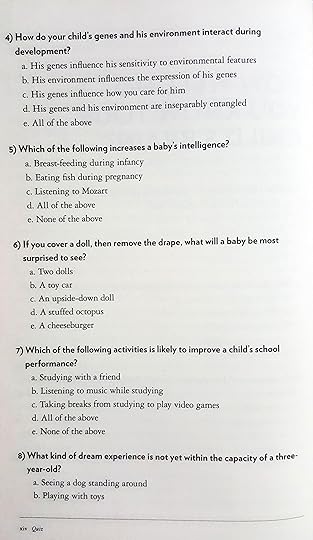
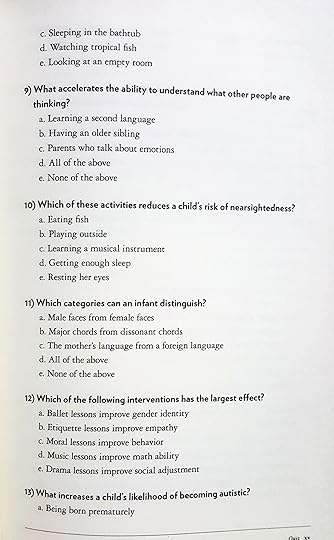
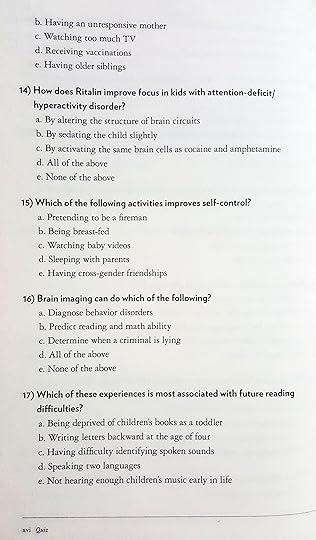
Quiz
يبين إلى أي مدى تصوراتك عن عقل طفلك صحيحة وصائبة:


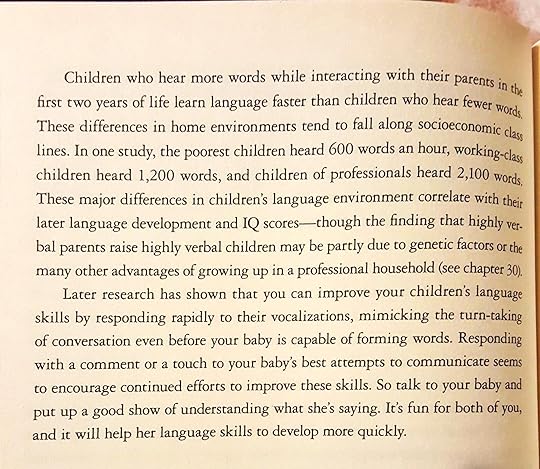
تعليم اللغات الأجنبية في سن مبكرة:


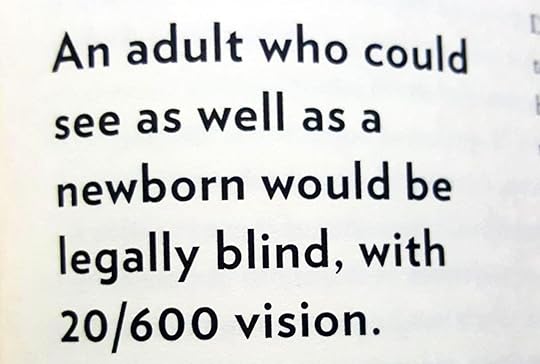
قوة إبصار الرضع ضئيلة جدا:
السيطرة والتحكم بالذات:


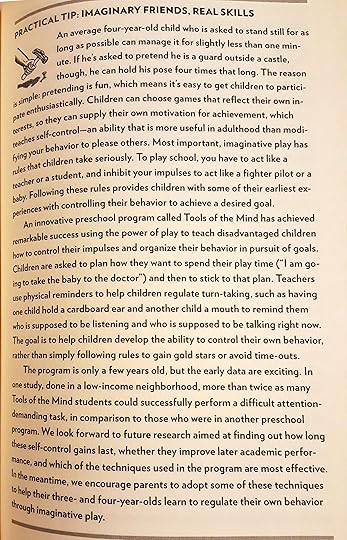
اللعب التخيلي:
أهمية اللعب خارج البيوت:


كتاب مفيد جدا.. أتمنى على الأهل أن يقرؤوه حتى من قبل أن ينجبوا..
يتميّز بامتداد اهتمامه العمري من ما قبل الولادة إلى العشرينيات من العمر.. وعند بداية كل فصل يذكر أن المعلومات الواردة موجهة لعمر من كذا إلى كذا..
لم أقرأ الكتاب بشكل كامل للأسف وذلك لضيق الوقت حيث كنت قد استعرته وحان موعد تسليمه.
صوّرت منه الكثير جدا من الصفحات وسأرفعها لكم هنا لتعمّ الفائدة إن شاء الله.
فائدة عملية -على الهامش-: أهم ما يمكنك القيام به من أجل منع حدوث قصر النظر لدى طفلك -بإذن الله- هو أن تجعله يلعب خارج المنزل.
جمادى الآخرة - 1439
أصدقائي.. أترككم مع صفحات منتقاة من الكتاب:
Quiz
يبين إلى أي مدى تصوراتك عن عقل طفلك صحيحة وصائبة:
تعليم اللغات الأجنبية في سن مبكرة:
قوة إبصار الرضع ضئيلة جدا:
السيطرة والتحكم بالذات:
اللعب التخيلي:
أهمية اللعب خارج البيوت:

June 8, 2019
Şu ana kadar en beğendiğim ebeveyn kitabıydı!
Diğer kitaplara kıyasla temel beğenme sebebim, bilimsel verilere dayanarak yazılmış olması.
"Annelik Okumaları" etiketiyle okuduğum kitaplarda genel olarak gördüğüm tablo şu oldu; Koca koca adamlar "Biz hanımla böyle yaptık çocuğa etkili oldu" tarzında bir anlatımla kitap yazmışlar. E bunu bana bakkal Remzi amca da söyler.
Kitapta değinilen bilimsel veriler üstelik deney sayısı azsa bu da belirtilerek yazılmış. "Sadece 2 defa bununla ilgili çalışma yapılmış ve sosyokültürel etmenler bu çalışmalarda göz önünde bulundurulmamış. Bu yüzden kesin yargıya varılamaz." gibi söylemler kullanılmış. Bu da kitabı son derece objektif bir hale getirmiş durumda.
Hamilelik sürecinden başlayarak 20 yaşına dek çocuğun tüm gelişim yönleri tek tek ele alınmış. Pekçok soruya cevap yazılmış. Hurafeler "Bu yanlıştır, çünkü öyle" diye değil; "Bu yanlış, bunun doğrusu şudur." şeklinde açıklanmış.
Tüm anne/baba adaylarına önerebileceğim güzel bir kitap.
Diğer kitaplara kıyasla temel beğenme sebebim, bilimsel verilere dayanarak yazılmış olması.
"Annelik Okumaları" etiketiyle okuduğum kitaplarda genel olarak gördüğüm tablo şu oldu; Koca koca adamlar "Biz hanımla böyle yaptık çocuğa etkili oldu" tarzında bir anlatımla kitap yazmışlar. E bunu bana bakkal Remzi amca da söyler.
Kitapta değinilen bilimsel veriler üstelik deney sayısı azsa bu da belirtilerek yazılmış. "Sadece 2 defa bununla ilgili çalışma yapılmış ve sosyokültürel etmenler bu çalışmalarda göz önünde bulundurulmamış. Bu yüzden kesin yargıya varılamaz." gibi söylemler kullanılmış. Bu da kitabı son derece objektif bir hale getirmiş durumda.
Hamilelik sürecinden başlayarak 20 yaşına dek çocuğun tüm gelişim yönleri tek tek ele alınmış. Pekçok soruya cevap yazılmış. Hurafeler "Bu yanlıştır, çünkü öyle" diye değil; "Bu yanlış, bunun doğrusu şudur." şeklinde açıklanmış.
Tüm anne/baba adaylarına önerebileceğim güzel bir kitap.

October 23, 2019
Çocuğun beynindeki değişimleri bilimsel olarak açıklamış. Kolay anlaşılır sürükleyici bir kitap.

August 26, 2019
Not what I was expecting! I don't think this should at all be a parenting book, but at the same time, I'm not sure who the audience is. Some things were interesting, but I also felt the facts weren't new. The book was also a bit unorganized. it also took me FOREVER to read- just couldn't find the motivation to finish.

July 2, 2025
Does not include anything for genderfluid children, very set on the idea that boys are boys and girls are girls with nothing else outside of that.

August 12, 2015
A very useful book, written in a down-to-earth style to maximise its practical use to parents, but with a fair amount of neuroscientific explanation for those who are interested. It challenges myths such as the presumed link between breastfeeding and IQ, the notion that listening to Mozart makes babies more intelligent, and the idea that parents are the architects of their children's personalities.
One of the recurring themes of the book is that nature and nurture are inseparably intertwined, and thus the debate about whether environment or genetics plays a bigger role in determining behaviour and personality is in some respects a false one. Your baby's genetic predispositions affect your parenting style and thus her environment, while her environment affects how her genes express themselves. This was a particular revelation for me: it means that adaptations parents have made to their environment can be passed to their children - a much quicker mechanism than natural selection.
Another important idea is that of 'dandelion children' (or maskrosbarn, the Swedish term from which the expression originates). Dandelion children can thrive practically anywhere, and use whatever they have at hand to aid their development. The authors believe that in most children, in most respects, are dandelions. Given a reasonably supportive environment, or even a mildly unsupportive one, they will thrive in most ways. That's something of a weight of the mind of parents.
However, there are some things parents can do to help. These are some of those that most struck me:
1. Praise children for what they do (effort), never for what they are. Children who believe intelligence can be developed and improved do better than those who believe it is an innate quality. The authors criticise what they call the 'self-esteem movement' of the 1980s and 1990s which they believe is responsible for a lot of bad parenting. It was based, they say, on dodgy scientific research that suggested self-esteem led to success, rather than the reverse. Children above the age of six react negatively to excessive praise.
2. As I'd read before, self-control in very young children (the ability to decline one marshmallow now to earn two later) is one of the best predictors of academic achievement. This can be helped along, to some extent, by role-playing games, such as pretending to be a fireman.
3. Learning a second language in early childhood can bring a host of unexpected benefits, including a better ability to see the perspective of other people, stronger self-control and even the likelihood of retaining mental faculties later in old age. Starting to learn your first foreign language at 11, as I did, could hardly be worse-timed: this is the very age when your brain's sponge-like abilities to absorb language have shut down and you're forced to study the laborious grown-up way.
4. The ability to handle stress later in life is better if exposed to manageable amounts of it (but not too much) in childhood.
5. The authors believe that TV and so-called educational baby videos have absolutely zero value for children under the age of two and can be detrimental in reducing time for other activities that help to develop their brains. France recently banned programming directed at infants.
6. Playing outside for an hour a day reduces the risk of short-sightedness.
These are just a handful of the insights offered by this helpful and humourous book, which gave me a scientific basis for some beliefs I held anyway as well as challenging a few ideas I accepted too uncritically. I wanted to believe that listening to Mozart made babies more intelligent, for example, but it seems it just isn't so: if it has any benefit, it's an indirect one in improving their moods and making them more receptive to learning.
One of the recurring themes of the book is that nature and nurture are inseparably intertwined, and thus the debate about whether environment or genetics plays a bigger role in determining behaviour and personality is in some respects a false one. Your baby's genetic predispositions affect your parenting style and thus her environment, while her environment affects how her genes express themselves. This was a particular revelation for me: it means that adaptations parents have made to their environment can be passed to their children - a much quicker mechanism than natural selection.
Another important idea is that of 'dandelion children' (or maskrosbarn, the Swedish term from which the expression originates). Dandelion children can thrive practically anywhere, and use whatever they have at hand to aid their development. The authors believe that in most children, in most respects, are dandelions. Given a reasonably supportive environment, or even a mildly unsupportive one, they will thrive in most ways. That's something of a weight of the mind of parents.
However, there are some things parents can do to help. These are some of those that most struck me:
1. Praise children for what they do (effort), never for what they are. Children who believe intelligence can be developed and improved do better than those who believe it is an innate quality. The authors criticise what they call the 'self-esteem movement' of the 1980s and 1990s which they believe is responsible for a lot of bad parenting. It was based, they say, on dodgy scientific research that suggested self-esteem led to success, rather than the reverse. Children above the age of six react negatively to excessive praise.
2. As I'd read before, self-control in very young children (the ability to decline one marshmallow now to earn two later) is one of the best predictors of academic achievement. This can be helped along, to some extent, by role-playing games, such as pretending to be a fireman.
3. Learning a second language in early childhood can bring a host of unexpected benefits, including a better ability to see the perspective of other people, stronger self-control and even the likelihood of retaining mental faculties later in old age. Starting to learn your first foreign language at 11, as I did, could hardly be worse-timed: this is the very age when your brain's sponge-like abilities to absorb language have shut down and you're forced to study the laborious grown-up way.
4. The ability to handle stress later in life is better if exposed to manageable amounts of it (but not too much) in childhood.
5. The authors believe that TV and so-called educational baby videos have absolutely zero value for children under the age of two and can be detrimental in reducing time for other activities that help to develop their brains. France recently banned programming directed at infants.
6. Playing outside for an hour a day reduces the risk of short-sightedness.
These are just a handful of the insights offered by this helpful and humourous book, which gave me a scientific basis for some beliefs I held anyway as well as challenging a few ideas I accepted too uncritically. I wanted to believe that listening to Mozart made babies more intelligent, for example, but it seems it just isn't so: if it has any benefit, it's an indirect one in improving their moods and making them more receptive to learning.

September 22, 2016
This is the perfect kind of child-rearing book. The authors provide down-to-earth advice backed by a background of having read (it seems) most of the studies on raising healthy babies and toddlers.
Some things that are etched into my mind:
1) Relax, you have less influence than you think. Unless you provide very negative environmental influences, like consuming alcohol during pregnancy, leaving your child to leave in absolute poverty, raising your child with criminal influences or (compounding) all of these, children are able to grow up pretty much themselves.
2) Eating raw fish during pregnancy has more benefits (Omega 3) than risks. Other myths like this are debunked to, again, help expecting parents breathe more freely.
3) The best predictor of bad eyesight is spending less than an hour a day outdoors.
4) Praise your kids for what they do, rather than their innate abilities. A lot has been said about raising kids' self-esteem, but that of itself is no predictor of later success. Rather the causality is the opposite - success leads to high self-esteem, which the "self-esteem" movement of past decades did not account for.
5) Baby videos have zero value and can even have adverse effects
10/10 for starting the book with a spoiler of insights to come, disguised in a quiz.
Some things that are etched into my mind:
1) Relax, you have less influence than you think. Unless you provide very negative environmental influences, like consuming alcohol during pregnancy, leaving your child to leave in absolute poverty, raising your child with criminal influences or (compounding) all of these, children are able to grow up pretty much themselves.
2) Eating raw fish during pregnancy has more benefits (Omega 3) than risks. Other myths like this are debunked to, again, help expecting parents breathe more freely.
3) The best predictor of bad eyesight is spending less than an hour a day outdoors.
4) Praise your kids for what they do, rather than their innate abilities. A lot has been said about raising kids' self-esteem, but that of itself is no predictor of later success. Rather the causality is the opposite - success leads to high self-esteem, which the "self-esteem" movement of past decades did not account for.
5) Baby videos have zero value and can even have adverse effects
10/10 for starting the book with a spoiler of insights to come, disguised in a quiz.

August 16, 2015
Navigating parenting books is a bewildering business - there's a whole array of books offering (conflicting) advice on feeding, sleeping, potty training, play, brain development etc. Then of course there's all the advice, anecdotes, you get from family, friends and acquaintances.
Aamodt and Wang have written an accessible guide on the science of early brain development - what goes on in the brain during those early months and years, what affects the development of different parts of the brain, the role of genetics vs the environment, etc. The authors review existing scientific literature and make explicit what findings are well-supported and what conclusions are more tentative or unfounded and from there, offer parents practical tips on everything from what to eat during pregnancy and breastfeeding, to getting your baby to sleep, developing your child's social skills and self-control, broadening their abilities and improving their vision (outdoor play is key).
For new parents who like the comfort of knowing that there's a scientific logic to guide their parenting practices, to help them sift through the mountain of advice confronting them, this book is likely to be a godsend. But even for those without kids, this could be a fun, nerd read.
Aamodt and Wang have written an accessible guide on the science of early brain development - what goes on in the brain during those early months and years, what affects the development of different parts of the brain, the role of genetics vs the environment, etc. The authors review existing scientific literature and make explicit what findings are well-supported and what conclusions are more tentative or unfounded and from there, offer parents practical tips on everything from what to eat during pregnancy and breastfeeding, to getting your baby to sleep, developing your child's social skills and self-control, broadening their abilities and improving their vision (outdoor play is key).
For new parents who like the comfort of knowing that there's a scientific logic to guide their parenting practices, to help them sift through the mountain of advice confronting them, this book is likely to be a godsend. But even for those without kids, this could be a fun, nerd read.

October 30, 2011
Did you know children are less likely to be nearsighted the more they play outside? That violent video games have some benefit? That breast-feeding really has no impact on intelligence? This book comes to these and other conclusions by reviewing the science of the neural development of children. The authors have done a good job in reviewing the scientific literature and only presenting what has been supported by well-done research: no sensational but poorly-done studies are promoted here. This book is not so much a parent's manual - although there is good advice throughout - as a survey of neuroscience. TThe book bogs down white more neuroanatomy and neurophysiology than the layperson will need (i.e., axon hillock and dorolateral prefontal cortex), but it's there if one wants it. Overall, however, I think this is a good window into what is going on in your kids' heads.
April 12, 2013
I would gift this guide to how the young brain develops and works to new parents. The authors are a science writer and a professor of neuroscience. They explore various studies and confirm some old beliefs with scientific evidence, while putting other beliefs into question or debunking them.
The way the book is organized makes it easy to read the sections of interest to you, so you can dip into it when a new questions occurs. That's why I would buy it to keep around as a reference.
The way the book is organized makes it easy to read the sections of interest to you, so you can dip into it when a new questions occurs. That's why I would buy it to keep around as a reference.

December 4, 2014
kitabı kasım 11 de okumaya başayıp 22 sinde bitirdim.
Kitap gerçekten çok faydalı. Küçük yaştaki çocukların zihinsel ve ruhsal sorunlarını kaliteli bir biçimde ele almış.Özellikle de yaptıkları örneklerle konuyu anlamınızı ve pekiştirmenize büyük katkıda bulunuyor. Otizm ve DEHB hastalıklarının erken teşhisinden tedavi yöntemlerine kadar bir çok konuda okurlara yardımcı olan bu kitabı çok beğendim.Herkesin okumasını tavsiye ederim
Kitap gerçekten çok faydalı. Küçük yaştaki çocukların zihinsel ve ruhsal sorunlarını kaliteli bir biçimde ele almış.Özellikle de yaptıkları örneklerle konuyu anlamınızı ve pekiştirmenize büyük katkıda bulunuyor. Otizm ve DEHB hastalıklarının erken teşhisinden tedavi yöntemlerine kadar bir çok konuda okurlara yardımcı olan bu kitabı çok beğendim.Herkesin okumasını tavsiye ederim

August 14, 2012
Well worth reading for anyone who has an interest in parenting, child development or neuroscience. Both a summary of neuroscience research on how children's brains develop and myth busting parent guide. Filled with tips about parenting but the overall message is relax. This book definitely altered some of my parental habits.

April 10, 2017
çocuk beyni ile ilgili yılların bilgisi çok güzel damıtılmış. bir-çok okur icin teknik ve bilimsel dili zorlayıcı olabilir ama başka türlü anlatmak da zor. biraz kafa yormak lazim.

March 8, 2019
Overall, this book summarizes similar research as Bronson's NutureShock and Medina's Brain Rules for Baby, but it's framed in this reassuring, don't-sweat-the-small-stuff tone that's geared for worried parents. Their general attitude on raising children resonates with me: "Think of parenting not as growing the person you want, but as a process of helping your child discover how to make his or her unique abilities and preferences fit well with the rest of the world." They also dive a bit into the physiological mechanisms behind how kids develop in general and how they develop specific abilities like empathy, motor / sensory skills, etc. (e.g., which parts of the brain are being activated or growing).
The most helpful new stuff that I learned:
- Chapter 20 (Playing Nicely with Others) has interesting facts on different forms of attachment (securely attached, insecure-ambivalent, insecure-avoidant, disorganized attachment) and how synchronous interactions (i.e., adult responding to child's needs) are important and more likely to lead to secure attachment (though not guaranteed).
- Chapter 21 (Starting to Write the Life Story) about declarative (recalling a specific fact or event from the past) vs. nondeclarative (broad category of nonverbal memories like learned skills, associations, and habits) memory is also helpful context for how children learn. Some nondeclarative memories like procedural learning, or acquisition of habits and skills, are more robust than declarative memories because they involve more areas of the brain.
- Chapter 25 (The Many Roads to Reading): our brains treat mirror images as the same thing by default because of our evolutionary history. This default setting has to be overridden when reading and writing. Also, having learned both English and Chinese myself, I never thought about the different ways that I had learned both until this book pointed out that English is learned through phonics and reading Chinese is learned through writing and movement. Now I understand why I had to copy words a million times in Chinese.
- Chapter 29 (Catch Your Child Being Good): This chapter has some helpful insight into behavior modification. It talks about extinction, the technical term for reducing unwanted behavior, and that it happens when bad behavior is given no attention (i.e., kid is given a time out) rather than negative attention (i.e., kid is given a lecture or yelled at). Time outs are basically a way to avoid rewarding unwanted behavior with attention, which might be why the kid is acting out in the first place. Also, research recommends rewarding good behavior, specifically with positive attention like approval, a high five, etc. instead of punishing bad behavior. For older kids, even though food and toys might be the first rewards that come to mind, a better reward would be to give the kid more control over their lives (e.g., deciding what's for dinner, stay up ten minutes more, destination for family outing).
Less helpful things:
- Better as a reference guide than something to read from beginning to end. The organization of the chapters sort of follows a theme, but a lot of the themes overlap, so the order of the chapters seem a bit random.
- I had read Cordelia Fine's Delusions of Gender and Rebecca Jordan-Young's Brain Storm, so I approached Chapter 8 on gender differences with a fair amount of skepticism. This book cites the studies of male monkeys preferring wheeled toys and female monkeys preferring dolls as evidence that toy preferences are innate and both Fine and Jordan-Young had very thorough critiques of that area of study, so I definitely took all the findings in that chapter with a grain of salt.
The most helpful new stuff that I learned:
- Chapter 20 (Playing Nicely with Others) has interesting facts on different forms of attachment (securely attached, insecure-ambivalent, insecure-avoidant, disorganized attachment) and how synchronous interactions (i.e., adult responding to child's needs) are important and more likely to lead to secure attachment (though not guaranteed).
- Chapter 21 (Starting to Write the Life Story) about declarative (recalling a specific fact or event from the past) vs. nondeclarative (broad category of nonverbal memories like learned skills, associations, and habits) memory is also helpful context for how children learn. Some nondeclarative memories like procedural learning, or acquisition of habits and skills, are more robust than declarative memories because they involve more areas of the brain.
- Chapter 25 (The Many Roads to Reading): our brains treat mirror images as the same thing by default because of our evolutionary history. This default setting has to be overridden when reading and writing. Also, having learned both English and Chinese myself, I never thought about the different ways that I had learned both until this book pointed out that English is learned through phonics and reading Chinese is learned through writing and movement. Now I understand why I had to copy words a million times in Chinese.
- Chapter 29 (Catch Your Child Being Good): This chapter has some helpful insight into behavior modification. It talks about extinction, the technical term for reducing unwanted behavior, and that it happens when bad behavior is given no attention (i.e., kid is given a time out) rather than negative attention (i.e., kid is given a lecture or yelled at). Time outs are basically a way to avoid rewarding unwanted behavior with attention, which might be why the kid is acting out in the first place. Also, research recommends rewarding good behavior, specifically with positive attention like approval, a high five, etc. instead of punishing bad behavior. For older kids, even though food and toys might be the first rewards that come to mind, a better reward would be to give the kid more control over their lives (e.g., deciding what's for dinner, stay up ten minutes more, destination for family outing).
Less helpful things:
- Better as a reference guide than something to read from beginning to end. The organization of the chapters sort of follows a theme, but a lot of the themes overlap, so the order of the chapters seem a bit random.
- I had read Cordelia Fine's Delusions of Gender and Rebecca Jordan-Young's Brain Storm, so I approached Chapter 8 on gender differences with a fair amount of skepticism. This book cites the studies of male monkeys preferring wheeled toys and female monkeys preferring dolls as evidence that toy preferences are innate and both Fine and Jordan-Young had very thorough critiques of that area of study, so I definitely took all the findings in that chapter with a grain of salt.

December 27, 2012
As a new parent I thought that I had a pretty good idea of how to raise my child, but soon I began questioning my knowledge, recognizing that it is little more than a collection of personal observations mixed in with the popular tales. As a child grows and develops many questions for how to deal with different developmental stages arise, but where are the reliable answers? Cognitive neuroscience and developmental psychology seem to abound with theories and research, but they are of limited merit for parents with no time to delve into such a body of research. This book compensates for some of the discontinuity between scientific knowledge and practice and deserves the praise. In what following I will mention several notable concepts picked up from the book.
Parenting style and environmental circumstances in general have limited, though measurable, effect on child development under good enough conditions. If you do not neglect, abuse or constantly chastise your child, the home conditions are considered good enough. One important recommendation for parents: relax, do not over-think it and enjoy watching how your child's brain develops itself.
Most pregnancies turn out fine as long as they are allowed to run the full course. Expectant mothers should avoid drugs, smocking, alcohol, and stress and should pay attention to their nutrition (not the same as dieting).
Both heredity and the environment determine brain development. The interactions between environmental and hereditary influences are non-linear and are entangled in closed causal feedback loops. Inherited personal characteristics bias a child toward a particular environment which subsequently may cause epigenetic modifications to some regions of the DNA. Therefore, identifying strictly environmental and hereditary causes for a particular behavior when the two components are coupled may be impossible. One conclusion is that heredity or the environment separately does not determine particular developmental outcomes, but the interaction of them does. The possibility to change the environment therefore gives some wiggle room in developmental outcomes.
By birth the addition of new neurons is nearly complete and structural brain development continues by elaboration of axons, dendrites and formation of new synaptic connections. In fact, a huge number of nonselective synapses is being formed during the first year, and unused synapses are gradually pruned during sensitive periods of development. A sensitive period is a developmental interval when experience has a particularly strong effect on the construction of brain circuitry. The quality of a child's experience during sensitive periods can have a permanent effect on the construction of brain circuits. The formation of native language and deficits of visual acuity in infants with surgically removed cataracts are manifestations of the crucial importance of specific experiences during sensitive periods of development.
Sleep enhances remodeling of brain circuits in response to experience and is implicated in memory consolidation. A baby's sleep can be made more regular by establishing a regular feeding schedule. Children learn to associate particular cues with sleep, therefore a consistent bedtime routine is essential for falling asleep.
Most behavioral gender differences are too small to matter because variability within each sex group in most cases is greater than between the sexes. The noticeable differences are that the boys are significantly more active and aggressive than girls. Girl's brains mature earlier; their brains are moderately better at inhibitory control and fine motor coordination when starting school. On the other hand, boys are better at mentally rotating objects through space which predicts performance on the math part of the SAT.
Babies can hear before they are born, starting at the beginning of the third trimester. Loud noises can cause partial hearing loss throughout the lifetime.
Babies who are not snuggled enough in early life become developmentally delayed, which is not an issue in most households.
Flavor preferences learned in infancy can last a lifetime. Small children can be taught to like vegetables after consuming them multiple times. Seeing parents and siblings eat vegetables and participating in the preparation of food seems to work as well. Combining a new flavor with a familiar well-liked flavor also helps to develop new food preferences.
Preschool children's ability to resist temptation is the best known predictor of eventual academic success. Self-control can be improved at any age (no sensitive period there). Parents can help their children to self-regulate by encouraging children to pursue their own interests, i.e., the activities children like to intensely concentrate and engage in.
Play is necessary for forming normal social interaction. Outdoor play improves vision. Children who spend more time outdoors are less likely to become myopic.
Exercise is vital for cognitive ability. Children should be physically active at least an hour a day, and it is best to introduce them to sports which then can become lifelong hobbies.
People cannot perform multiple attention-demanding tasks. Attempting to do multiple things at once merely switches attention.
Babies are born with specific temperaments which show strong heritability, although environment also plays a role in shaping their adult personality. In particular, culture has a strong influence on personality development.
Children are extremely emotional because the parts of the brain which produce raw emotions (amygdala) mature earlier than the parts that interpret and manage them (prefrontal cortex). A child's ability to recognize and regulate emotions improves throughout childhood. Parent should coach their children on experiencing emotions and suggest constructive ways to deal with them.
By age four children develop the capacity to think about other people's state of mind such as emotions, desires and beliefs including false beliefs.
A child is likely to remember more if there is time to process the learned information between training sessions. The most likely reason is that breaks between study sessions allow time for the newly acquired information to be consolidated. Since memories are reconsolidated learning, tests, except for the multiple choice test, improve learning. Also varying timing, location, and the presentation of different examples of the learned concepts improves memory consolidation.
It is much more effective to praise children for their specific efforts, rather than generally. For instance, it is better to say "you did a great job building this castle", than "you are so smart".
Reasoning ability is mostly controlled by genes and modestly by the environment. Educational baby videos are detrimental to development, especially before the age two. Listening to classical music does not make children smarter. However, learning to play a musical instrument has some cognitive benefit.
Children before age 5-6 lack the capacity to distinguish letter "b" from "d" and mirror images along the vertical/horizontal plane in general. Studies show that babies watching videos claiming to teach reading are doing nothing more than forming associations between sounds of the word and symbols on the card, rather than reading them.
A moderate amount of stress is helpful for developing coping skills in children: it should be high enough to notice, but low enough that they can handle it. Chronic stress causes hippocampal damage leading to impaired learning.
Children's behavior is strongly influenced by the positive or negative consequences that immediately follow a certain action. Setting appropriate expectations for behavior and selecting the right consequences (rewards or their absence) will convince your child to follow the household rules. Children yearn for parents' attention, thus completely ignoring the problem behavior is usually an effective way to stop it. Conversely, a parent's approval, expressed enthusiastically should be the best reward for positive behavior rather than toys and food. Another good type of reward is letting children exert more control over their lives: the right to decide what is for dinner, etc. Yelling and spanking are not effective means of behavior modification in the long run and lead to fear and anxiety. In order to suppress undesired behavior, parents need to promote positive behavior by explaining to the child what exactly the positive behavior constitutes and reinforce it when it occurs.
Parenting style and environmental circumstances in general have limited, though measurable, effect on child development under good enough conditions. If you do not neglect, abuse or constantly chastise your child, the home conditions are considered good enough. One important recommendation for parents: relax, do not over-think it and enjoy watching how your child's brain develops itself.
Most pregnancies turn out fine as long as they are allowed to run the full course. Expectant mothers should avoid drugs, smocking, alcohol, and stress and should pay attention to their nutrition (not the same as dieting).
Both heredity and the environment determine brain development. The interactions between environmental and hereditary influences are non-linear and are entangled in closed causal feedback loops. Inherited personal characteristics bias a child toward a particular environment which subsequently may cause epigenetic modifications to some regions of the DNA. Therefore, identifying strictly environmental and hereditary causes for a particular behavior when the two components are coupled may be impossible. One conclusion is that heredity or the environment separately does not determine particular developmental outcomes, but the interaction of them does. The possibility to change the environment therefore gives some wiggle room in developmental outcomes.
By birth the addition of new neurons is nearly complete and structural brain development continues by elaboration of axons, dendrites and formation of new synaptic connections. In fact, a huge number of nonselective synapses is being formed during the first year, and unused synapses are gradually pruned during sensitive periods of development. A sensitive period is a developmental interval when experience has a particularly strong effect on the construction of brain circuitry. The quality of a child's experience during sensitive periods can have a permanent effect on the construction of brain circuits. The formation of native language and deficits of visual acuity in infants with surgically removed cataracts are manifestations of the crucial importance of specific experiences during sensitive periods of development.
Sleep enhances remodeling of brain circuits in response to experience and is implicated in memory consolidation. A baby's sleep can be made more regular by establishing a regular feeding schedule. Children learn to associate particular cues with sleep, therefore a consistent bedtime routine is essential for falling asleep.
Most behavioral gender differences are too small to matter because variability within each sex group in most cases is greater than between the sexes. The noticeable differences are that the boys are significantly more active and aggressive than girls. Girl's brains mature earlier; their brains are moderately better at inhibitory control and fine motor coordination when starting school. On the other hand, boys are better at mentally rotating objects through space which predicts performance on the math part of the SAT.
Babies can hear before they are born, starting at the beginning of the third trimester. Loud noises can cause partial hearing loss throughout the lifetime.
Babies who are not snuggled enough in early life become developmentally delayed, which is not an issue in most households.
Flavor preferences learned in infancy can last a lifetime. Small children can be taught to like vegetables after consuming them multiple times. Seeing parents and siblings eat vegetables and participating in the preparation of food seems to work as well. Combining a new flavor with a familiar well-liked flavor also helps to develop new food preferences.
Preschool children's ability to resist temptation is the best known predictor of eventual academic success. Self-control can be improved at any age (no sensitive period there). Parents can help their children to self-regulate by encouraging children to pursue their own interests, i.e., the activities children like to intensely concentrate and engage in.
Play is necessary for forming normal social interaction. Outdoor play improves vision. Children who spend more time outdoors are less likely to become myopic.
Exercise is vital for cognitive ability. Children should be physically active at least an hour a day, and it is best to introduce them to sports which then can become lifelong hobbies.
People cannot perform multiple attention-demanding tasks. Attempting to do multiple things at once merely switches attention.
Babies are born with specific temperaments which show strong heritability, although environment also plays a role in shaping their adult personality. In particular, culture has a strong influence on personality development.
Children are extremely emotional because the parts of the brain which produce raw emotions (amygdala) mature earlier than the parts that interpret and manage them (prefrontal cortex). A child's ability to recognize and regulate emotions improves throughout childhood. Parent should coach their children on experiencing emotions and suggest constructive ways to deal with them.
By age four children develop the capacity to think about other people's state of mind such as emotions, desires and beliefs including false beliefs.
A child is likely to remember more if there is time to process the learned information between training sessions. The most likely reason is that breaks between study sessions allow time for the newly acquired information to be consolidated. Since memories are reconsolidated learning, tests, except for the multiple choice test, improve learning. Also varying timing, location, and the presentation of different examples of the learned concepts improves memory consolidation.
It is much more effective to praise children for their specific efforts, rather than generally. For instance, it is better to say "you did a great job building this castle", than "you are so smart".
Reasoning ability is mostly controlled by genes and modestly by the environment. Educational baby videos are detrimental to development, especially before the age two. Listening to classical music does not make children smarter. However, learning to play a musical instrument has some cognitive benefit.
Children before age 5-6 lack the capacity to distinguish letter "b" from "d" and mirror images along the vertical/horizontal plane in general. Studies show that babies watching videos claiming to teach reading are doing nothing more than forming associations between sounds of the word and symbols on the card, rather than reading them.
A moderate amount of stress is helpful for developing coping skills in children: it should be high enough to notice, but low enough that they can handle it. Chronic stress causes hippocampal damage leading to impaired learning.
Children's behavior is strongly influenced by the positive or negative consequences that immediately follow a certain action. Setting appropriate expectations for behavior and selecting the right consequences (rewards or their absence) will convince your child to follow the household rules. Children yearn for parents' attention, thus completely ignoring the problem behavior is usually an effective way to stop it. Conversely, a parent's approval, expressed enthusiastically should be the best reward for positive behavior rather than toys and food. Another good type of reward is letting children exert more control over their lives: the right to decide what is for dinner, etc. Yelling and spanking are not effective means of behavior modification in the long run and lead to fear and anxiety. In order to suppress undesired behavior, parents need to promote positive behavior by explaining to the child what exactly the positive behavior constitutes and reinforce it when it occurs.
February 4, 2021
Not quite what I was expecting, but a pretty good read for anyone interested in how the brain develops. I was thinking this was going to be a little wonkier, but it is really geared to parents who are currently raising children, especially the wee ones. The authors do a very good job of covering the major stages of development, with a focus on explaining what is in the scientific literature. Much of the text is meta-analysis of the existing research, summarizing the common findings from large numbers of papers.
They also make a point of debunking several popular myths (e.g. vaccines cause autism) and explain how those theories got prominence, the flaws in the original studies, and the subsequent literature rejecting them.
Some of what I thought was interesting:
* Spending time outside is good for kids' eyes. Two hours per day of outdoor activity reduces the risk of myopia by about a factor of four compared with less than one hour per day.
* Fish is good. Children whose mothers eat fish during pregnancy have better-functioning brains than children whose mothers avoid fish.
* Bilingual children outperform monolingual children on tests of executive function and ability to understand what other people are thinking.
* The largest known behavioral difference at any age is toy preferences in three-year-olds (trucks and guns vs. dolls).
* Preschool children’s ability to resist temptation is a much better predictor of eventual academic success than their IQ scores.
* It is more effective to express disapproval when kids display anger than to try and coax them out of it.
* Two study sessions with time between them can result in twice as much learning as a single study session of the same total length.
* In adults, the size of the Heschl’s gyrus is strongly related to musical ability—the largest known structural variation connected with ability.
* A consequence of carrying autism susceptibility genes is an enhanced likelihood of interest in technical fields.
* At its core, ADHD is a matter of slightly slower brain maturation and brains usually catch up by adulthood. The most effective treatment is neuro-feedback training of EEG theta waves.
* We really act different at home. There is surprisingly little similarity between an adult’s personality as evaluated by his friends or colleagues and his personality as evaluated by parents and siblings.
* Socio-economic status and income inequality really play a big role in childhood stress and hence in brain development.
They also make a point of debunking several popular myths (e.g. vaccines cause autism) and explain how those theories got prominence, the flaws in the original studies, and the subsequent literature rejecting them.
Some of what I thought was interesting:
* Spending time outside is good for kids' eyes. Two hours per day of outdoor activity reduces the risk of myopia by about a factor of four compared with less than one hour per day.
* Fish is good. Children whose mothers eat fish during pregnancy have better-functioning brains than children whose mothers avoid fish.
* Bilingual children outperform monolingual children on tests of executive function and ability to understand what other people are thinking.
* The largest known behavioral difference at any age is toy preferences in three-year-olds (trucks and guns vs. dolls).
* Preschool children’s ability to resist temptation is a much better predictor of eventual academic success than their IQ scores.
* It is more effective to express disapproval when kids display anger than to try and coax them out of it.
* Two study sessions with time between them can result in twice as much learning as a single study session of the same total length.
* In adults, the size of the Heschl’s gyrus is strongly related to musical ability—the largest known structural variation connected with ability.
* A consequence of carrying autism susceptibility genes is an enhanced likelihood of interest in technical fields.
* At its core, ADHD is a matter of slightly slower brain maturation and brains usually catch up by adulthood. The most effective treatment is neuro-feedback training of EEG theta waves.
* We really act different at home. There is surprisingly little similarity between an adult’s personality as evaluated by his friends or colleagues and his personality as evaluated by parents and siblings.
* Socio-economic status and income inequality really play a big role in childhood stress and hence in brain development.

March 8, 2019
Really interesting insights into what’s going on with my now adolescent (!) child. I enjoyed the book more on days when I just read one or two chapters, than on days when I tried to gulp down a bunch of information at once. Fortunately the book is divided into specific topics — how the brain develops, how it changes as your child grows, how brain development shapes personality, how your child’s brain copes with school, and how children react to particular environmental stressors. Each section is further subdivided into chapters that lend themselves to being read individually as your time & interest allows.
The book was written in 2011, and I caught myself wondering in the autism chapter how up to date it was, but that was the only chapter where I was really worried about it.
Overall, I found the author’s basic approach — distilling the state of research into child/adolescent brain development through the lens of what parents need to know and when — both readable and reassuring.
The book was written in 2011, and I caught myself wondering in the autism chapter how up to date it was, but that was the only chapter where I was really worried about it.
Overall, I found the author’s basic approach — distilling the state of research into child/adolescent brain development through the lens of what parents need to know and when — both readable and reassuring.

November 17, 2023
Çocuklarınıza verebileceğiniz en iyi hediye öz denetimdir 13
Çocuk yetiştirmeyi istediğiniz insanı yaratmak olarak değil de çocuğunuzun kendi benzersiz yeteneklerini ve tercihlerini dünyanın geri kalanına uydurmanın yollarını bulmasına yardım etme süreci olarak düşünmelisiniz. 194
Diğer insanların doğru olmayan düşünceleri olabileceğini anlamak doğal gelişimin bir parçasıdır ve anlayabildiğimiz kadarıyla insanlara özgüdür. 203
Diğer yandan çocuğunuzu gösterdiği çaba veya gelişmeden dolayı veya bir sorunu çözmek için belirli bir yolu seçmesinden dolayı övmek, ona sizin için asıl önemli olanın bu davranış ve seçimler olduğunu gösterir. Çocuğunuz karakter özelliklerini belirleyemez ama davranışlarını belirleyebilir. 233
Çocuk yetiştirmeyi istediğiniz insanı yaratmak olarak değil de çocuğunuzun kendi benzersiz yeteneklerini ve tercihlerini dünyanın geri kalanına uydurmanın yollarını bulmasına yardım etme süreci olarak düşünmelisiniz. 194
Diğer insanların doğru olmayan düşünceleri olabileceğini anlamak doğal gelişimin bir parçasıdır ve anlayabildiğimiz kadarıyla insanlara özgüdür. 203
Diğer yandan çocuğunuzu gösterdiği çaba veya gelişmeden dolayı veya bir sorunu çözmek için belirli bir yolu seçmesinden dolayı övmek, ona sizin için asıl önemli olanın bu davranış ve seçimler olduğunu gösterir. Çocuğunuz karakter özelliklerini belirleyemez ama davranışlarını belirleyebilir. 233

December 17, 2023
i started reading this book a few months before our child was born and now, 6 years later, it's still on my nightstand, unfinished. I'm rating it 5 stars because that's the beauty of it: you get what you need out of it, when you need it.
it's the only parenting guide I ever (half)read, and the only one I'll ever need. If you're like me, it'll give you plenty of cool info and actionable advice, while relieving any pressure to do parenting "by the book".
there are a bunch of sciency anecdotes and experiments in the book that I wrote down, in order to, at the right age, verify them with my kid. But in the end I discarded most of them cos guess what: being there watching your kid develop is validation enough. We did do the mashmallow test tho.
it's the only parenting guide I ever (half)read, and the only one I'll ever need. If you're like me, it'll give you plenty of cool info and actionable advice, while relieving any pressure to do parenting "by the book".
there are a bunch of sciency anecdotes and experiments in the book that I wrote down, in order to, at the right age, verify them with my kid. But in the end I discarded most of them cos guess what: being there watching your kid develop is validation enough. We did do the mashmallow test tho.

April 26, 2025
I learned a lot! Key takeaways:
- parenting style has less effect than we perceive
- Kids as dandelions - largely will thrive without intervention
- Genetic and environmental influences interact so much that it’s hard to distinguish nature versus nurture
- being warm and responsive as a parent predicts secure attachment and helps children develop self-control
- better self-control —> more empathy and conscience
- no evidence that listening to classical music as a baby makes you smarter, but it does improve baby’s moods
- Tests improve learning
- - Less than half of the performance on cognitive tests can be explained by intelligence ; the rest by effort, mood, motivation, experience with tests etc.
- kids do not reach adult eyesight ability until age 4!
- parenting style has less effect than we perceive
- Kids as dandelions - largely will thrive without intervention
- Genetic and environmental influences interact so much that it’s hard to distinguish nature versus nurture
- being warm and responsive as a parent predicts secure attachment and helps children develop self-control
- better self-control —> more empathy and conscience
- no evidence that listening to classical music as a baby makes you smarter, but it does improve baby’s moods
- Tests improve learning
- - Less than half of the performance on cognitive tests can be explained by intelligence ; the rest by effort, mood, motivation, experience with tests etc.
- kids do not reach adult eyesight ability until age 4!

March 16, 2026
+++ 2026 Re-Read Review +++
Rereading this after almost 15 years. Super proud of 12-year-old Pia for reading and understanding this. I remember this being one of the first, somehow scientific non-fiction books I read and enjoyed so much! To this day, I think it helped me get through puberty because I understood better what all those changes in my brain meant.
Now, as a partially trained neuroscientist with child development research experience, I am extra excited to know that I recognized most of the facts mentioned and understood everything. I could even make mental notes when something was outdated or needed more elaboration to better represent the science.
This book is a nice start into the brain and development, but definitely outdated by now.
Rereading this after almost 15 years. Super proud of 12-year-old Pia for reading and understanding this. I remember this being one of the first, somehow scientific non-fiction books I read and enjoyed so much! To this day, I think it helped me get through puberty because I understood better what all those changes in my brain meant.
Now, as a partially trained neuroscientist with child development research experience, I am extra excited to know that I recognized most of the facts mentioned and understood everything. I could even make mental notes when something was outdated or needed more elaboration to better represent the science.
This book is a nice start into the brain and development, but definitely outdated by now.
June 9, 2019
This is great reading for any new or wanna be parents. It makes science approachable and should ease those questions and concerns new parents have. Approachable, memorable, and easily applicable to the day to day.

October 21, 2020
I almost stopped listening early on but did end up liking and learning from portions. The audio version narrator is pretty annoying. Also some very unfortunate and offensive word choice related to genetics and disabilities.

January 1, 2021
I have to admit... I sped through this to complete my 2020 reading challenge — and will revisit! This book has so much information that is worth noting and studies to look into. There is helpful information for parents and educators. It’s worth having a copy!

August 7, 2017
Generally, a nice overview for someone not in the field of child development.

December 29, 2017
I’ve been reading this as my kid is 2-3 months old and I found some of it pretty interesting.

July 25, 2019
It is a very good book for newly parents. It explains what we should do while raising a child. But book is lacks “how should we do part”.

January 8, 2020
An interesting read and certainly informative but left me wanting more on what I can do to aid my baby’s brain development rather than theories and case studies.
January 5, 2021
Fascinating book to read on children’s brains. The authors have done a great job in explaining how the brain is developed from conception in layman terms.
Displaying 1 - 30 of 101 reviews