

What do you think?

Giant Squid
The giant squid is one of the most elusive creatures in the world. As large as whales, they hide beyond reach deep within the sea, forcing scientists to piece together their story from those clues they leave behind.
An injured whale's ring-shaped scars indicate an encounter with a giant squid. A piece of beak broken off in the whale's belly; a flash of ink dispersed as a blinding defense to allow the squid to escape-- these fragments of proof were all we had . . . until a giant squid was finally filmed in its natural habitat only two years ago.
In this beautiful and clever nonfiction picture book about the giant squid, Candace Fleming and Eric Rohmann explore, both visually and poetically, this hidden creature's mysterious life.
A Neal Porter Book
An injured whale's ring-shaped scars indicate an encounter with a giant squid. A piece of beak broken off in the whale's belly; a flash of ink dispersed as a blinding defense to allow the squid to escape-- these fragments of proof were all we had . . . until a giant squid was finally filmed in its natural habitat only two years ago.
In this beautiful and clever nonfiction picture book about the giant squid, Candace Fleming and Eric Rohmann explore, both visually and poetically, this hidden creature's mysterious life.
A Neal Porter Book
40 pages, Hardcover
First published October 13, 2015
About the author
Candace Fleming
79 books679 followersI have always been a storyteller. Even before I could write my name, I could tell a good tale. And I told them all the time. As a preschooler, I told my neighbors all about my three-legged cat named Spot. In kindergarten, I told my classmates about the ghost that lived in my attic. And in first grade I told my teacher, Miss Harbart, all about my family's trip to Paris, France.
I told such a good story that people always thought I was telling the truth. But I wasn't. I didn't have a three-legged cat or a ghost in my attic, and I'd certainly never been to Paris, France. I simply enjoyed telling a good story... and seeing my listener's reaction.
Sure, some people might have said I was a seven-year old fibber. But not my parents. Instead of calling my stories "fibs" they called them "imaginative." They encouraged me to put my stories down on paper. I did. And amazingly, once I began writing, I couldn't stop. I filled notebook after notebook with stories, poems, plays. I still have many of those notebooks. They're precious to me because they are a record of my writing life from elementary school on.
In second grade, I discovered a passion for language. I can still remember the day my teacher, Miss Johnson, held up a horn-shaped basket filled with papier-mache pumpkins and asked the class to repeat the word "cornucopia." I said it again and again, tasted the word on my lips. I tested it on my ears. That afternoon, I skipped all the way home from school chanting, "Cornucopia! Cornucopia!" From then on, I really began listening to words—to the sounds they made, and the way they were used, and how they made me feel. I longed to put them together in ways that were beautiful, and yet told a story.
As I grew, I continued to write stories. But I never really thought of becoming an author. Instead, I went to college where I discovered yet another passion—history. I didn't realize it then, but studying history is really just an extension of my love of stories. After all, some of the best stories are true ones — tales of heroism and villainy made more incredible by the fact they really happened.
After graduation, I got married and had children. I read to them a lot, and that's when I discovered the joy and music of children's books. I simply couldn't get enough of them. With my two sons in tow, I made endless trips to the library. I read stacks of books. I found myself begging, "Just one more, pleeeeease!" while my boys begged for lights-out and sleep. Then it struck me. Why not write children's books? It seemed the perfect way to combine all the things I loved: stories, musical language, history, and reading. I couldn't wait to get started.
But writing children's books is harder than it looks. For three years I wrote story after story. I sent them to publisher after publisher. And I received rejection letter after rejection letter. Still, I didn't give up. I kept trying until finally one of my stories was pulled from the slush pile and turned into a book. My career as a children's author had begun.
I told such a good story that people always thought I was telling the truth. But I wasn't. I didn't have a three-legged cat or a ghost in my attic, and I'd certainly never been to Paris, France. I simply enjoyed telling a good story... and seeing my listener's reaction.
Sure, some people might have said I was a seven-year old fibber. But not my parents. Instead of calling my stories "fibs" they called them "imaginative." They encouraged me to put my stories down on paper. I did. And amazingly, once I began writing, I couldn't stop. I filled notebook after notebook with stories, poems, plays. I still have many of those notebooks. They're precious to me because they are a record of my writing life from elementary school on.
In second grade, I discovered a passion for language. I can still remember the day my teacher, Miss Johnson, held up a horn-shaped basket filled with papier-mache pumpkins and asked the class to repeat the word "cornucopia." I said it again and again, tasted the word on my lips. I tested it on my ears. That afternoon, I skipped all the way home from school chanting, "Cornucopia! Cornucopia!" From then on, I really began listening to words—to the sounds they made, and the way they were used, and how they made me feel. I longed to put them together in ways that were beautiful, and yet told a story.
As I grew, I continued to write stories. But I never really thought of becoming an author. Instead, I went to college where I discovered yet another passion—history. I didn't realize it then, but studying history is really just an extension of my love of stories. After all, some of the best stories are true ones — tales of heroism and villainy made more incredible by the fact they really happened.
After graduation, I got married and had children. I read to them a lot, and that's when I discovered the joy and music of children's books. I simply couldn't get enough of them. With my two sons in tow, I made endless trips to the library. I read stacks of books. I found myself begging, "Just one more, pleeeeease!" while my boys begged for lights-out and sleep. Then it struck me. Why not write children's books? It seemed the perfect way to combine all the things I loved: stories, musical language, history, and reading. I couldn't wait to get started.
But writing children's books is harder than it looks. For three years I wrote story after story. I sent them to publisher after publisher. And I received rejection letter after rejection letter. Still, I didn't give up. I kept trying until finally one of my stories was pulled from the slush pile and turned into a book. My career as a children's author had begun.
Ratings & Reviews
Friends & Following
Create a free account to discover what your friends think of this book!
Community Reviews
Displaying 1 - 30 of 464 reviews

April 21, 2020
In Giant Squid, author Candace Fleming with textual acumen and splendour (both with an eye for education and enlightenment and at the same time also with very much lyrical grace and verbal descriptiveness) delightfully demonstrates not only how awe-inspiring (and yes indeed, also to and for us humans, occasionally if not even often creepy and potentially fear-inducing) giant squids are (or at least can be) but equally and importantly that giant squid are not really and primarily to be approached as deep sea monsters to be feared and dreaded (and as such also often to be despised and regarded with rank suspicion and superstition) but indeed and first and foremost that giant squid are intelligent denizens of the ocean depths, that giant squid are necessary links in ocean ecosystems (so-called apex predators, but yes that giant squids are also creatures about which not all that much is actually known, about which there still exist many scientific mysteries).
Furthermore and yes, Giant Squid also describes that giant squids are not in fact huge and massive creatures right from birth, that giant squids (like most of their octopus and squid kin) actually commence their lives as tiny and as such also very vulnerable to predation less than two inches in body length squidlets, at the mercy of many types of fishes etc. (and it is only if the baby squids in fact manage to survive their time when tiny and prone to being hunted and consumed as prey that they will afterwards become as they mature and grow the giants of the sea and indeed also one of the only denizens of the deep that can successfully hunt adult whales).
Accompanied by Eric Rohmann's necessarily rather dark hued artwork (to visually capture in and with Giant Squid the essence of how little sunlight does in fact reach and penetrate the depths of the oceans where giant squid tend to reside), his illustrations are in my humble opinion and most definitely a total and utter treasure and as such both aesthetically powerful and strikingly awesome (as well as actually and in my opinion being very much visually pleasant, but indeed generally in a creepy and a bit chilling manner, and therefore parents reading Giant Squid with or to very young or very sensitive children should probably consider first making sure that Eric Rohmann's pictures of especially staring squid eyes and multitudes of large grasping tentacles are able to be handled without inducing too much fear or in a worst case scenario, even bad dreams, even nightmares).
An extensive supplemental information section (containing aside from an illustration of basic giant squid anatomy, important additional scientific and zoologic details on giants squids and yes always reiterating just how much of a mystery giants squids still are also three separate bibliographies), I have certainly and totally been very much impressed with and by both Candace Fleming's educational and enlightening poetry and Eric Rohmann's spectacular illustrations and do consider Giant Squid a solid five star picture book and a wonderful marriage of text and images.
Furthermore and yes, Giant Squid also describes that giant squids are not in fact huge and massive creatures right from birth, that giant squids (like most of their octopus and squid kin) actually commence their lives as tiny and as such also very vulnerable to predation less than two inches in body length squidlets, at the mercy of many types of fishes etc. (and it is only if the baby squids in fact manage to survive their time when tiny and prone to being hunted and consumed as prey that they will afterwards become as they mature and grow the giants of the sea and indeed also one of the only denizens of the deep that can successfully hunt adult whales).
Accompanied by Eric Rohmann's necessarily rather dark hued artwork (to visually capture in and with Giant Squid the essence of how little sunlight does in fact reach and penetrate the depths of the oceans where giant squid tend to reside), his illustrations are in my humble opinion and most definitely a total and utter treasure and as such both aesthetically powerful and strikingly awesome (as well as actually and in my opinion being very much visually pleasant, but indeed generally in a creepy and a bit chilling manner, and therefore parents reading Giant Squid with or to very young or very sensitive children should probably consider first making sure that Eric Rohmann's pictures of especially staring squid eyes and multitudes of large grasping tentacles are able to be handled without inducing too much fear or in a worst case scenario, even bad dreams, even nightmares).
An extensive supplemental information section (containing aside from an illustration of basic giant squid anatomy, important additional scientific and zoologic details on giants squids and yes always reiterating just how much of a mystery giants squids still are also three separate bibliographies), I have certainly and totally been very much impressed with and by both Candace Fleming's educational and enlightening poetry and Eric Rohmann's spectacular illustrations and do consider Giant Squid a solid five star picture book and a wonderful marriage of text and images.

October 4, 2016
The center fold-out illustration is a stunning reveal!

October 16, 2016
Incredible title! Such a book. I love the images, the rhythm of the text and the mystery of the still not known that is conveyed.

March 14, 2023
This is a great book for peaking children's interest in learning more about creatures of the sea. I even learned some things about squid that I did not know, and the pictures certainly enhanced my learning.

November 30, 2016
What an amazing book! Gorgeous illustrations combined with lyrical poetic text make this a great candidate for both the Caldecott Medal and the Sibert Medal, maybe even the Newbery. Fleming uses poetry to convey information about this unusual and fascinating animal that scientists still know so little about. The text, while factual, reads like a dramatic adventure story. I appreciated the fact that Fleming makes it clear what facts about the giant squid have been confirmed and those that still await discovery. Rohmann's gorgeous pictures highlight the movement and size of this mysterious animal. And the fold-out page pops out at just the right moment, giving the reader the most complete look at the animal in the whole book. This strategy creates an air of mystery that perfectly fits with the text and the many unanswered questions scientists still have about this animal. A winner of a book from cover to cover.

December 12, 2016
A fantastic, somewhat eerie, introduction to this elusive, mysterious denizen of the deep. Superbly illustrated by Eric Rohmann.

January 1, 2017
Very educational! You would think that something as large as a bus would be thoroughly studied by now, but until 2006 nobody has even had a glimpse of a living giant squid. This mysterious creature has, among other things, 30-feet-long tentacles, a parrot-like beak, eyes "as big as soccer balls" and three (!!!) hearts, and can change color or eject dark ink at will. How cool is that?!?
Giant Squid successfully educates its readers on the facts and yet unsolved mysteries about this elusive giant, while its dark and mysterious illustrations (mostly close-ups of different parts of a giant squid "in the depths of the sunless sea") create an illusion of diving deep under the ocean and observing this sea creature in its natural habitat:
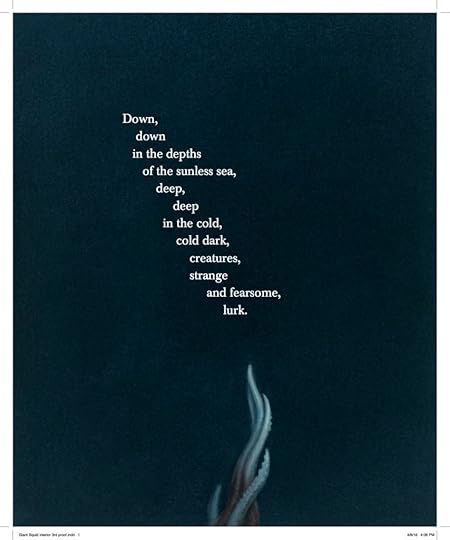

The additional information (including a drawing of a giant squid with different parts of its body labeled) at the back of the book is particularly interesting and has encouraged me to research the topic further.
Giant Squid successfully educates its readers on the facts and yet unsolved mysteries about this elusive giant, while its dark and mysterious illustrations (mostly close-ups of different parts of a giant squid "in the depths of the sunless sea") create an illusion of diving deep under the ocean and observing this sea creature in its natural habitat:
The additional information (including a drawing of a giant squid with different parts of its body labeled) at the back of the book is particularly interesting and has encouraged me to research the topic further.

January 1, 2017
Love it when an animal info book has a unique layout and voice. Cool features

October 2, 2016
I love the close up look and fascinating details about one of the ocean's most mysterious creatures.

December 31, 2016
Outstanding nonfiction picture book about an elusive creature of the deep! Loved the endnote material as well.

August 4, 2021
This book is a fascinating, gorgeous look at giant squid. We got hooked on giant squid thanks to Wild Kratts and I didn't realize Candace Fleming had done this beautiful book about them. Wonderful information at the back of the book as well. I loved learning that we have more close-up photos of the surface of Mars than we have of giant squid, and we know more about the behavior of dinosaurs than squid. The first time scientists saw a living one was 2006! Can you imagine a creature that is so massive and yet we know so little about it? Incredible.

November 6, 2016
Brilliant nonfiction.
February 19, 2021
That book is a possible answer to this question: What if Lovecraft wrote a biology lesson for children?

September 4, 2020
Ay qué belleza <3

February 2, 2017
I <3 giant squids.
April 14, 2018
I love the book Giant Squid! It's so interesting. The author uses this book to introduce the giant squid to young children. According to the book, the giant squid is one of the most mysterious creatures in the world, they are huge, and they live in the unexplored ocean depth, so no one has ever seen a real giant squid before. There are many beautiful illustrations in the book, it's beautiful and interesting.
People cannot get many pictures of the life of a giant squid, so they create illustrations and reconstruct what the giant squid's life look like in the ocean depth, which is talented because it provides young children with an intuitive feeling about this mysterious creature. For example, the author uses words to talk about how huge the giant squid is, and the illustrator provides students with illustrations of it. The author combines words and illustrations together to introduce the mysterious creature. I think it's so interesting, and the combination can grab students' attention and provide them with a better understanding of this mysterious creature.
The heading is pivotal parts of the author's organization of the text, it provides readers with important information and helps them have a better immersing experience of the book.The author uses headings to lead to the introduction of the giant squid. For example, when the author talks about eyes of the giant squid, he uses EYES as the heading and them introduce it to the reader.
There is no real photograph with captions in this book, but there are many amazing illustrations. The illustrations can lead the readers to the real situations that happen in the ocean depth. For example, the sense of hunting is so real, and it shows the huge of the giant squid perfect. The students can immerse themselves in to experience the book easily. I think this will attract students to explore more. Thanks to the words that the author uses to explain the story, we can understand it without any captions.
At the end of this book, the author uses a diagram of the giant squid to represent the information about this mysterious creature that shared in the text, and it helps make the information a lot clearer to the readers. Overall, this book is suitable for young children. It provides readers with clear information. I will use this book in my class.

January 5, 2017
LOVE THIS BOOK. Read this aloud to your students. Place in the classroom library for them to snap up at first chance. Use as a mentor for writing. Stunning illustrations and text. Fleming's language has a beautiful, almost dance-like flow. She captivates and teases the reader from the very beginning ("With writing arms and ghostly, lidless eyes, they glide; some as large as buses...). Across the book, Fleming develops a sense of mystery about the giant squid ("So big but rarely seen. Instead they are merely glimpsed")--there are some things we know and a lot we do not. And Rohmann's illustrations of the squid or parts of the squid in the deep, dark, murky depths of the sea support this idea.
The layout and design of the book is fantastic including a two page spread towards the end that children will gasp aloud at when they view. If you read this aloud to students, slow down and look carefully at the illustrations.
Well written author's note that made me want to reread the book and then do more research. Could easily be read aloud to younger students.
In the classroom, there's so much you could do with this book including asking a lot of questions that students can discuss in small groups like -
*How does the author develop a sense of mystery?
*How does the illustrator support the ideas in the text?
*What do we know and what do we not know about the Giant Squid?
This would also be a good mentor text for writing. Notice Fleming's word choice - curling, twisting, waiting, seize, surround, latch and her use of figurative language - eyes "as big as soccer balls" and "some as large as buses." And I was particularly intrigued by her ability to develop depth in just a few words on a single page. So much to discuss with writers in your classroom!
BTW - Candace Fleming is a "go to" author for me. I never miss reading one of her new books.
The layout and design of the book is fantastic including a two page spread towards the end that children will gasp aloud at when they view. If you read this aloud to students, slow down and look carefully at the illustrations.
Well written author's note that made me want to reread the book and then do more research. Could easily be read aloud to younger students.
In the classroom, there's so much you could do with this book including asking a lot of questions that students can discuss in small groups like -
*How does the author develop a sense of mystery?
*How does the illustrator support the ideas in the text?
*What do we know and what do we not know about the Giant Squid?
This would also be a good mentor text for writing. Notice Fleming's word choice - curling, twisting, waiting, seize, surround, latch and her use of figurative language - eyes "as big as soccer balls" and "some as large as buses." And I was particularly intrigued by her ability to develop depth in just a few words on a single page. So much to discuss with writers in your classroom!
BTW - Candace Fleming is a "go to" author for me. I never miss reading one of her new books.

January 24, 2018
Giant Squid, by Candace Fleming, is an intriguing informational picture book about the life of a giant squid. Before the book begins, the author immediately draws your attention by describing a mysterious creature that live in the deep, dark ocean. She writes about characteristics of the giant squid, making the reader anxious and excited for the pages to come. The author uses descriptive words that are engaging, making it seem as though you are watching a giant squid swim in an aquarium. The text is also very descriptive in how the giant squid catches and eats it prey, allowing for mental imagery to match the detailed illustrations. I also liked how the illustrations emphasis the part of the giant squid the text is describing. For example, as the author describes the giant squid's ginormous eyes, the illustration focuses on the eyes, drawing the reader's attention.
I found the illustrations to be very enticing because it puts the reader into the giant squid's environment. The dark colors make it seem as though you are swimming in the depths of the ocean with the squid. I was particularly fond of the illustration where the squid inks, covering the page in a dark cloud. The double page spread opens, creating a large canvas of the giant squid, hiding from a predator in its ink. I thought that this illustration allows readers to fully immerse in the giant squid's environment.
I found the illustrations to be very enticing because it puts the reader into the giant squid's environment. The dark colors make it seem as though you are swimming in the depths of the ocean with the squid. I was particularly fond of the illustration where the squid inks, covering the page in a dark cloud. The double page spread opens, creating a large canvas of the giant squid, hiding from a predator in its ink. I thought that this illustration allows readers to fully immerse in the giant squid's environment.
November 13, 2017
I absolutely love this book as I am drawn to any book that discusses marine life. This book is a must have in every home and classroom. It’s unique twist on nonfiction books uses amazing and mysterious illustrations and poetry format to give readers what we know about giant squid. The pictures matched the mysterious tone with the use of dark colors and just having parts of the squid being shown at one time. I loved that this book didn’t hide the fact that little is actually known about these huge creatures swimming in our dark mystery-filled ocean. It encourages readers to find out more and provides external sources for the readers to explore themselves, which also supports the credibility of the author. The amazing descriptions really stood out to me. I especially liked this line, “They surround their thrashing meal. They latch on with powerful sucker-studded clubs” on page 11. It perfectly describes the amazingness, as well as creepiness, of these creatures. The fact this nonfiction book is written in poetry form makes it a perfect bridge to connect young readers from fiction to nonfiction books. Overall, this book amazed me and I highly recommend to anyone who loves poetry, but also wants to learn about ocean life.
September 15, 2017
Summary: Giant Squids, by Candance Fleming and Eric Rohmann, takes readers to the eerie, mysterious depths of the ocean to learn about the giant squid. The author describes the elusive squid through descriptive and almost poetic text. The illustrator’s attention to detail and color, created illustrations that are simply captivating.
Evaluation: This book was mesmerizing. The illustrations are slightly mysterious and instantly pull the reader in. Each page has a different part of the squid. It is at the end of the story that readers are able to open up the flaps and see a giant squid. Students will cling onto this picturesque text in an effort to learn more about the squid.
Teaching Idea: I would have the students go on an investigation. In order to begin the investigation, I would have them complete a KWL (What I know, what I wonder, what I learned). After we finish reading the text, the students would have the opportunity to further their research through books and web searches.
Evaluation: This book was mesmerizing. The illustrations are slightly mysterious and instantly pull the reader in. Each page has a different part of the squid. It is at the end of the story that readers are able to open up the flaps and see a giant squid. Students will cling onto this picturesque text in an effort to learn more about the squid.
Teaching Idea: I would have the students go on an investigation. In order to begin the investigation, I would have them complete a KWL (What I know, what I wonder, what I learned). After we finish reading the text, the students would have the opportunity to further their research through books and web searches.
October 30, 2016
I am now terrified of giant squid. And also fascinated by them.
Thank you, Mary Van Akin for sending me the ARC; now I must get a copy (or two) for my students.
I support independent bookstores. You can use this link to find one near you: http://www.indiebound.
Thank you, Mary Van Akin for sending me the ARC; now I must get a copy (or two) for my students.
I support independent bookstores. You can use this link to find one near you: http://www.indiebound.
This entire review has been hidden because of spoilers.
March 30, 2017
Gorgeous illustrations and fabulous text! I love the mysterious opening and the way Fleming provides information while keeping the intrigue high. Fascinating back matter.
I've wanted to read this book for months but it has been so popular, I've just now gotten it, briefly, away from the kids ;-)
I've wanted to read this book for months but it has been so popular, I've just now gotten it, briefly, away from the kids ;-)

picturebooks
January 27, 2017Great illustrations and diagram at the end
2017 Sibert Honor Book
2017 Sibert Honor Book

June 20, 2019
Book 2: Giant Squid by Candace Fleming and President Squid by Aaron Reynolds
Fleming, C., & Rohmann, E. (2016). Giant squid. New York: Roaring Brook Press.
Reynolds, A., & Varon, S. (2016). President Squid. San Francisco: Chronicle Books.
I decided to pair these two books together because I think they would be a fun way to introduce an ocean unit for younger students. I would utilize these books for a crossover in science, and I would incorporate the KWL strategy. I think it would be fun to read the fiction book to the students and have a conversation about what kinds of animals live in the ocean. I would then show them the KWL chart and ask the students what they already know about squids and what they want to know about squids. I would then read the nonfiction book to the students before writing down things that they have learned from the book. I think this would be a fun way to introduce the ocean theme for science. The fiction book is a cute story about a squid who wants to become president, and I think it would give some cute ideas about the ocean. It would also be an easy way for them to connect the pretend story of the squid to the real information about them in the nonfiction book. It also would give me an idea of what the students already know about the ocean and what they still need to learn.

November 23, 2021
Giant Squid by Candace Fleming, illustrated by Eric Rohmann, is a 2017 Robert F. Sibert Informational Book Medal award winner. The writing and gorgeous oil painted illustrations pull the reader down into the depths of the ocean, slowly revealing the mysterious giant squid. I am not a science person. I gravitate toward history and biography, but this very factual and scientific book captured my attention. The book pairs fascinating details about the giant squid along with the even more intriguing mystery of the creature. I was amazed to learn that we have more close up photos of the surface of Mars than we do of the giant squid. The book not only tells about the giant squid, but tells how scientists use clues to gain understanding. You get an idea of how scientists compile evidence over a long time, combining a scrap of evidence here and a scrap of evidence there until a picture emerges. This book would be great for intermediate level students in science units about the ocean or more general units on scientific inquiry.

June 19, 2018
“Giant Squid,” written by Candace Fleming and illustrated by Eric Rohmann. Ocean Science would be the content-area crossover for the non-fiction book. The teacher would use ocean science to educate the students about what kind of sea life lives in the deepest, darkest parts of the ocean; the teacher could get the students critical thinking skills going by asking questions about Giant Squids. Questions like: do you think we have ever seen one in the wild and how old do you think Giant Squids live to? The fiction twin text would be “The Octonauts and the Giant Squid,” written and illustrated by Simon and Schuster UK. This fiction book enhances the non-fiction book by making the Giant Squid a friendlier monster from the deep, dark ocean. Within the fiction book, the students can now fully see an illustration of a Giant Squid on one page and they can now see just how huge a Giant Squid is in a size comparison to the other humanoid animals within the story. Each book gives the students a look into what’s happening under the ocean, with one book being more realistic than the other. The teacher could use these books in a science lesson with a K-W-L method activity. The students would write down everything they know about Giant Squids, what they would like to know, and what they have learned. This way the teacher knows that the students learned everything that they could about Giant Squids.
Simon & Schuster UK. The Octonauts and the Giant Squid. London, Simon & Schuster UK, 2011.
Simon & Schuster UK. The Octonauts and the Giant Squid. London, Simon & Schuster UK, 2011.

June 22, 2018
The book I used to introduce the Giant Squid is called, “Sid the Squid and the search for the perfect job” by David G Derrick. Since both of the books are dealing with a squid I would categorize both books in the science category. The Giant Squid is a non-fiction book that provides many detail oriented facts about squids in the ocean and how they survive, eat, about their bodies and all the other things they do. All of the information is evidence based from scientists. To compare the two books, you can use a detailed web diagram about squids. Sid the Squid and the search for the perfect job is a great book to introduce the Giant Squid because it is more playful book with real life characteristics of a squid, but with less in-depth details. I would first star by making a web diagram and asking students to think of everything they could that deals with squids. Then I would read them the fictional book and have them add anything they feel is necessary. Next, we would read the non-fiction book and finish out our web diagram.
Derrick, D. (2010). Sid the squid and the search for the perfect job. San Francisco, CA: Immedium.
Fleming, C. (2016). Giant Squid. New York, NY: Roaring Book Press.
Derrick, D. (2010). Sid the squid and the search for the perfect job. San Francisco, CA: Immedium.
Fleming, C. (2016). Giant Squid. New York, NY: Roaring Book Press.

Read
June 22, 2018Giant Squid by Candace Fleming and Eric Rohmann
Fiction Twin Text: Derrick, D. (2010). Sid the squid: and the search for the perfect job. San Francisco, CA: Immedium.
The possible content-area crossover is most likely science. This fiction twin text will greatly enhance students’ learning by first introducing them to the great squid. They’ll read a humorous story and glean just a little bit of background information on giant squids, most notable their physical appearance. However, I will extend that learning with a web method. After reading the fictional text, I will ask the students to supply me with important words and details about Sid the Squid. If they are able, I will have them pick out some important words or categories about giant squids. However, depending on their age and background knowledge, I will most likely read the nonfiction text before creating related areas to that connect to the central topic. By the end of both stories, the students should have a strong understanding of squid basics such as movement, defenses, habitat, physical appearance, food etc.
Reference:
Camp, D. (2000). It takes two: Teaching with twin texts of fact and fiction. The Reading Teacher, 53(5), pp. 400-408.
Fiction Twin Text: Derrick, D. (2010). Sid the squid: and the search for the perfect job. San Francisco, CA: Immedium.
The possible content-area crossover is most likely science. This fiction twin text will greatly enhance students’ learning by first introducing them to the great squid. They’ll read a humorous story and glean just a little bit of background information on giant squids, most notable their physical appearance. However, I will extend that learning with a web method. After reading the fictional text, I will ask the students to supply me with important words and details about Sid the Squid. If they are able, I will have them pick out some important words or categories about giant squids. However, depending on their age and background knowledge, I will most likely read the nonfiction text before creating related areas to that connect to the central topic. By the end of both stories, the students should have a strong understanding of squid basics such as movement, defenses, habitat, physical appearance, food etc.
Reference:
Camp, D. (2000). It takes two: Teaching with twin texts of fact and fiction. The Reading Teacher, 53(5), pp. 400-408.
September 5, 2017
Summary: The book was a great vivid description of the life of squids. It begins by showing an illustration of the squid diving deep into the ocean and then showing what it eats. It then ends by showing how large it is by an opening flap part of the book that takes up a few pages.
Evaluation: This was a great nonfiction book that I really enjoyed reading. It's illustrations were really engaging and looked almost lifelike. The images matched perfectly with the words in the text and made them come to life.
Teaching Idea: This book would be a great way of teaching about ecosystems in the ocean. Students could research more on squids and how they contribute to the life in the ocean.
Evaluation: This was a great nonfiction book that I really enjoyed reading. It's illustrations were really engaging and looked almost lifelike. The images matched perfectly with the words in the text and made them come to life.
Teaching Idea: This book would be a great way of teaching about ecosystems in the ocean. Students could research more on squids and how they contribute to the life in the ocean.
September 23, 2021
I read this book to my two tutoring kids for my first read through.
Boy 5 y/o : loved the fold out & loves pirates so he enjoyed it. the poetry style was more approachable, but i think that some of the lofty words did not help us. it also could easily be my read of it tho.
Girl 8 y/o : did not like it bc language was too lofty for her, not bright enough for her.
I would read this to a child who loves the ocean or in an ocean themed story time for kids who are a bit older. This is a “picture book” that should be read by an adult or by a child who is 9+ bc it is non fiction. I enjoyed the pictures and thought the use of multipage illustration was really effective.
Boy 5 y/o : loved the fold out & loves pirates so he enjoyed it. the poetry style was more approachable, but i think that some of the lofty words did not help us. it also could easily be my read of it tho.
Girl 8 y/o : did not like it bc language was too lofty for her, not bright enough for her.
I would read this to a child who loves the ocean or in an ocean themed story time for kids who are a bit older. This is a “picture book” that should be read by an adult or by a child who is 9+ bc it is non fiction. I enjoyed the pictures and thought the use of multipage illustration was really effective.
This entire review has been hidden because of spoilers.
Displaying 1 - 30 of 464 reviews