Robert Penn Warren was an American poet, novelist, and literary critic and was one of the founders of New Criticism. He was also a charter member of the Fellowship of Southern Writers. He founded the literary journal The Southern Review with Cleanth Brooks in 1935. He received the 1947 Pulitzer Prize for the Novel for All the King's Men (1946) and the Pulitzer Prize for Poetry in 1958 and 1979. He is the only person to have won Pulitzer Prizes for both fiction and poetry.
Season late, day late, sun just down, and the sky Cold gunmetal but with a wash of live rose, and she, From water the color of sky except where Her motion has fractured it to shivering splinters of silver, Rises. Stands on the raw grass. Against The new-curdling night of spruces, nakedness Glimmers and, at bosom and flank, drips With fluent silver. The man,
Some ten strokes out, but now hanging Motionless in the gunmetal water, feet Cold with the coldness of depth, all History dissolving from him, is Nothing but an eye. Is an eye only. Sees
The body that is marked by his use, and Time's, Rise, and in the abrupt and unsustaining element of air, Sway, lean, grapple the pond-bank. Sees How, with that posture of female awkwardness that is, The pure curve of their weight and buttocks Moon up and, in that swelling unity, Are silver, and glimmer. Then
The body is erect, she is herself, whatever Self she may be, and with an end of the towel grasped in each hand, Slowly draws it back and forth across back and buttocks, but With face lifted toward the high sky, where The over-wash of rose color now fails, Fails, though no star Yet throbs there. The towel, forgotten, Does not move mow. The gaze Remains fixed on the sky. The body,
Profiled against the darkness of spruces, seems To draw to itself, and condense in its whiteness, what light In the sky yet lingers or, from The metalic and abstract severity of water, lifts. The body, With towel now trailing loose from one hand, is A white stalk from which the face flowers gravely toward the high sky.
This moment is non-sequential and absolute, and admits Of no definition, for it Subsumes all other, and sequential, moments, by which Definition might be possible. The woman
Face yet raised, wraps, With a motion as though standing in sleep, The towel about her body, under her breasts, and, Holding it there, hieratic as lost in Egypt and erect, Moves up the path that, stair-steep, winds Into the clamber and angle of growth. Beyond The lattice of dusk-dripping leaves, whiteness Dimly glimmers, goes. Glimmers and is gone, and the man,
Suspended in his darkling medium, stares Upward where, though not visible, he knows She moves, and in his heart he cries out that, if only He had such strength, he would put his hand forth And maintain it over her to guard, in all Her out-goings and in-comings, from whatever Inclemency of sky or slur of the world's weather Might ever be. In his heart He cries out. Above.
Height of the spruce-night and heave of the far mountain, he sees The first star pulse into being. It gleams there.
One item in this book is Warren’s essay “On Segregation” — which is a series of interviews he conducted with southerners in 1956 in the wake of Brown vs. Board of Education. This single piece did more for my understanding of the divisive state of 2018 politics than ANYTHING else I’ve read since the 2016 election. His writing is so honest, direct, compassionate and yet thought-provoking — I wish we had more current journalists and writers with his tact and judgment.
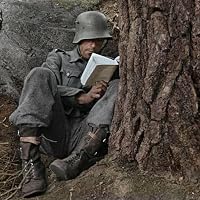
One of my favorite books is All the King's Men. However I could not figure out Wilderness. It is the story of a slew footed Jew from Bavaria whose father fought in the 1848 revolutions in Germany and who wants to follow in the footsteps by coming to the US to fight for freedom. When he gets here, things are complicated. The Union Army won't take him as a soldier because of his foot, he arrives in time for the Draft riots in NY and sees black people being hunted and murdered. With a stake from a relative he becomes an assistant sutler selling to the Union Army. There he encounters more racism, cruelty, and various assaults on his idealism. In the end he kills a rebel scavenger and feels like he has fought for freedom. That's the story line. What else happened, I am not sure. There are many instances where the reader is told Adam, the protagonist, sees something or does something that seems important but I never got a clue what those thing were. The writing paints a picture of Civil War times from Gettysburg to the Wilderness as a hellhole populated by very unsavory characters. In the end Adam, whose shoes get stolen, including one specially adapted for his bad foot, takes a new pair of shoes off the unknown rebel he kills. The rebel had gotten those boots off a dead Union soldier. Adam resolves to be worthy of the nameless soldiers and what they as men and in their error have endured.