

What do you think?
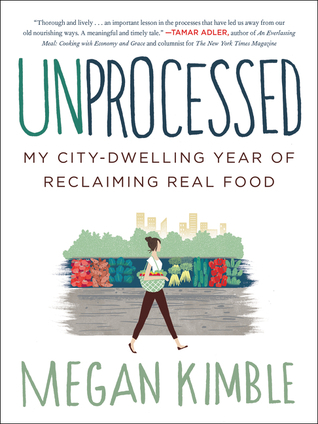
Unprocessed: My City-Dwelling Year of Reclaiming Real Food – A Chronicle with Research-Backed Insights and Practical Tips
In the tradition of Michael Pollan's bestselling In Defense of Food comes this remarkable chronicle, from a founding editor of Edible Baja Arizona, of a young woman's year-long journey of eating only whole, unprocessed foods--intertwined with a journalistic exploration of what "unprocessed" really means, why it matters, and how to afford it.
In January of 2012, Megan Kimble was a twenty-six-year-old living in a small apartment without even a garden plot to her name. But she cared about where food came from, how it was made, and what it did to her body: so she decided to go an entire year without eating processed foods. Unprocessed is the narrative of Megan's extraordinary year, in which she milled wheat, extracted salt from the sea, milked a goat, slaughtered a sheep, and more--all while earning an income that fell well below the federal poverty line.
What makes a food processed? As Megan would soon realize, the answer to that question went far beyond cutting out snacks and sodas, and became a fascinating journey through America's food system, past and present. She learned how wheat became white; how fresh produce was globalized and animals industrialized. But she also discovered that in daily life, as she attempted to balance her project with a normal social life--which included dating--the question of what made a food processed was inextricably tied to gender and economy, politics and money, work and play.
Backed by extensive research and wide-ranging interviews--and including tips on how to ditch processed food and transition to a real-food lifestyle--Unprocessed offers provocative insights not only on the process of food, but also the processes that shape our habits, communities, and day-to-day lives.
In January of 2012, Megan Kimble was a twenty-six-year-old living in a small apartment without even a garden plot to her name. But she cared about where food came from, how it was made, and what it did to her body: so she decided to go an entire year without eating processed foods. Unprocessed is the narrative of Megan's extraordinary year, in which she milled wheat, extracted salt from the sea, milked a goat, slaughtered a sheep, and more--all while earning an income that fell well below the federal poverty line.
What makes a food processed? As Megan would soon realize, the answer to that question went far beyond cutting out snacks and sodas, and became a fascinating journey through America's food system, past and present. She learned how wheat became white; how fresh produce was globalized and animals industrialized. But she also discovered that in daily life, as she attempted to balance her project with a normal social life--which included dating--the question of what made a food processed was inextricably tied to gender and economy, politics and money, work and play.
Backed by extensive research and wide-ranging interviews--and including tips on how to ditch processed food and transition to a real-food lifestyle--Unprocessed offers provocative insights not only on the process of food, but also the processes that shape our habits, communities, and day-to-day lives.
352 pages, Paperback
First published June 23, 2015
About the author
Megan Kimble
3 books57 followersMegan Kimble is an investigative journalist and the author of Unprocessed. A former executive editor at the Texas Observer, Kimble has written about housing, transportation, and urban development for The New York Times, Texas Monthly, The Guardian, The Nation, and Bloomberg CityLab. She lives in Austin, Texas.
Ratings & Reviews
Friends & Following
Create a free account to discover what your friends think of this book!
Community Reviews
Displaying 1 - 30 of 162 reviews

March 16, 2016
I literally could not put this book down and finished it in under 24 hours. The whole premise is that Megan decides to spend a year not eating processed foods, or, mostly not eating processed foods, and/or eating mostly not processed foods.* Her rules are a little loosey-goosey at first, although as she learns more about food processing--from vegetables to milk to meat--she firms them up quite nicely. I love that she lives in the arid Southwest--Tucson, just south of me--because I felt like I could relate and even try some of her tips. I also love that she does not make a gazillion dollars, she makes $18,000 per year as a single woman living on her own. Yes, she eats a lot of fairly plain food, but her point is that even with a small income we can make better choices about what we eat and where it comes from. I think it fitting that somewhere in-between starting and finishing this book I actually planted seeds in my new vegetable garden, and I also have looked up some CSA and Farmer's Markets. Quite convenient that many of the vendors she interviewed and tours/facilities she tours are local to me, so I cherry-picked off her research much more than I normally would be able to on a book about better eating choices.
As for the memoir part, I've read reviews complaining that Megan is just some privileged white girl who hasn't had enough experience with hunger or lack of choices to write a worthwhile memoir about it. Well, frankly, I am also a privileged white girl who has very very rarely gone to bed hungry, but that doesn't mean I don't want to learn to make better, more informed choices about what I put into my body, and to do it without spending a gazillion dollars.
As for the memoir part, I've read reviews complaining that Megan is just some privileged white girl who hasn't had enough experience with hunger or lack of choices to write a worthwhile memoir about it. Well, frankly, I am also a privileged white girl who has very very rarely gone to bed hungry, but that doesn't mean I don't want to learn to make better, more informed choices about what I put into my body, and to do it without spending a gazillion dollars.

Did Not Finish
July 19, 2015Earnest 20-something author seeks to transform self, world. Jaded 30-something reader encounters phrase "prideful peas," lurches on for a few more pages, can't.

May 3, 2016
Somewhat interesting read if you can get past her attitude. She was a white, privileged, grad student of 26 when she wrote this, and it shows. The book professes to be about her learning experience, and there are spots where I feel she was being honest and fair in her assessments of how the food world works, but there were an awful lot of "how can people think this way?" moments where her extreme liberal bias is glaringly obvious. Her date with a "climate denier" is the most obvious example. (She can't wait to get home and call her sister to talk about this crazy guy!)
I applaud her willingness to take part in the slaughtering of a sheep despite her mostly vegetarian upbringing, and her other learning field trips along the way.
I enjoyed reading the epilogue where she talks about the social connections we have because of food. But I did find myself skimming rather than reading most of the book.
So, what did I take away from it? A reinforced belief that education is the best way to end poverty and hunger. Education not just for those enduring poverty and hunger, but for those wanting to help. It goes back to the old saying of "give a man a fish and he eats for a day, teach him how to fish and he eats for a life time." And the people making the policies need to be educated, too. Our farm crisis goes straight back to the subsidy policies of FDR. Politicians aren't farmers and they don't know how farming works or what is best for the land being farmed.
Anyway, the book is an easy, if not quick, read (it took me three months of reading a chapter here and there between other, more interesting books). Just don't expect a how-to book. It's a memoir.
I applaud her willingness to take part in the slaughtering of a sheep despite her mostly vegetarian upbringing, and her other learning field trips along the way.
I enjoyed reading the epilogue where she talks about the social connections we have because of food. But I did find myself skimming rather than reading most of the book.
So, what did I take away from it? A reinforced belief that education is the best way to end poverty and hunger. Education not just for those enduring poverty and hunger, but for those wanting to help. It goes back to the old saying of "give a man a fish and he eats for a day, teach him how to fish and he eats for a life time." And the people making the policies need to be educated, too. Our farm crisis goes straight back to the subsidy policies of FDR. Politicians aren't farmers and they don't know how farming works or what is best for the land being farmed.
Anyway, the book is an easy, if not quick, read (it took me three months of reading a chapter here and there between other, more interesting books). Just don't expect a how-to book. It's a memoir.
January 12, 2016
I currently have my first loaf of homemade bread in the oven, made with locally grown and milled flour. That is probably the biggest indicator of how much I took from this book.

September 17, 2015
I was looking forward to reading this book and gleaming tons of great information about unprocessed foods. For a while now, I have been wanting to move away from processed foods, even though they are quick for meals. I have slowly been making the move. However not to really take anything away from the author but I found this book to be really wordy. I got to chapter 4 and put the book down. I realized when I got ready to pick it up again that I could not process what I had read in the first 4 chapters. This is because the author seemed to put a lot of focus on other things besides the food process and it was not that interesting to me. So I was really just skimming the first 4 chapters. The only parts that were really of interest to me were the "Unprocess Yourself" sections at the back of the book. These sections really told you all you needed to know about Unprocessed foods broken out in sections like Wheat and Sugar.. However not sure how much I will try the recipes or suggestions that the author has. They seem really time consuming. At least I have an idea of what unprocessed food is and how to shop for it.

April 27, 2019
This book took me almost three full months to read (something about reading on my Kindle slows me down!) but it prompted a lot of thought and reflection. The book chronicles Kimble's yearlong experiment in eating wholly unprocessed foods. For each chapter, Kimble explains the impact of eating unprocessed for one food group (for example, meat, dairy, etc.). I found reading Kimble's personal take to be pretty entertaining and enjoyable -- for example, when Kimble found giving up chocolate unthinkable, she decided to make it herself. I learned a lot of interesting facts to relay to friends (like the fact that it takes 40 gallons of water to make one gallon of almond milk!) and I've folded in some of the practices/ideas that Kimble delivers to readers at the end of each chapter for how to bring more unprocessed food into the home.
Read
December 6, 2018This book will make your life better.
I should mention that I am the last person to be caught dead carrying around a book with a title like Unprocessed: My City-Dwelling Year of Reclaiming Real Food. I have some deep snobberies and this is one of them--whenever people talk about science-supported supplements and what we should or should not be eating because of this or that cancer-causing additive, I get REALLY SUPER IRRATIONALLY annoyed. Because purity in food has never existed, and we're all implicated in the messed-up system, and whatever supplements you do or do not take, you're still gonna die.
But after reading Megan Kimble's articles in the now-defunct magazine Edible Baja Arizona, I became a devotee of the way she discusses the things I care about--not purity, but genuine health, community, consciousness. Kimble never fear-mongers, even as she's telling you that your strawberries are almost certainly poisoned. She acknowledges that we live in a world, and we can't just magically extricate ourselves from the systems that dominate it. But we can make more conscious decisions. We can gradually build new systems and support the small ones already in place. Consume fewer carcinogens and support more farmers. Don't let the perfect be the enemy of the good. Eat. Drink. Be merry.
Because as much as it's about food, this is a book about how to see things that are wrong and take steps to change them. It's about forming habits that are better for you and for the people around you and for the people you will probably never meet. She repeats my favorite punchline, just for emphasis: "Some challenges feel so insurmountable that it seems as though nothing can be done. But we live in a world full of insurmountable obstacles. And we do things. Without small gestures, without localness and precision of place, it is hard to ask and harder to answer: How do we begin?"
I should mention that I am the last person to be caught dead carrying around a book with a title like Unprocessed: My City-Dwelling Year of Reclaiming Real Food. I have some deep snobberies and this is one of them--whenever people talk about science-supported supplements and what we should or should not be eating because of this or that cancer-causing additive, I get REALLY SUPER IRRATIONALLY annoyed. Because purity in food has never existed, and we're all implicated in the messed-up system, and whatever supplements you do or do not take, you're still gonna die.
But after reading Megan Kimble's articles in the now-defunct magazine Edible Baja Arizona, I became a devotee of the way she discusses the things I care about--not purity, but genuine health, community, consciousness. Kimble never fear-mongers, even as she's telling you that your strawberries are almost certainly poisoned. She acknowledges that we live in a world, and we can't just magically extricate ourselves from the systems that dominate it. But we can make more conscious decisions. We can gradually build new systems and support the small ones already in place. Consume fewer carcinogens and support more farmers. Don't let the perfect be the enemy of the good. Eat. Drink. Be merry.
Because as much as it's about food, this is a book about how to see things that are wrong and take steps to change them. It's about forming habits that are better for you and for the people around you and for the people you will probably never meet. She repeats my favorite punchline, just for emphasis: "Some challenges feel so insurmountable that it seems as though nothing can be done. But we live in a world full of insurmountable obstacles. And we do things. Without small gestures, without localness and precision of place, it is hard to ask and harder to answer: How do we begin?"

April 20, 2017
Premise sounded interesting. Execution was disappointing. I recommend reading one of Michael Pollan's books instead.

April 19, 2017
What I learned: whole wheat flour is Humpty Dumpty flour! The mills usually break part the different parts and then, for the 'whole' order, they add this much of this back in and that much of that back in to make "whole wheat". It's kinda like hamburger!!

December 4, 2017
This was better than I thought it might be and worth the wait. I love requesting new materials at my library and then seeing a waitlist growing. I hope the next readers will get as much out of this one as I did.
Who is this book good for? Definitely fans of the "I did this thing for a year" genre. Yes, I'm a fan. 😊 But also, I think this would be a good introduction for someone new to unprocessing their food. While a lot of the info Megan shares wasn't new to me and likely wouldn't be a surprise to those already on the path, she does give a lot of good info on how our food system is run and makes a good case for learning more about where the foods we are consuming are coming from and how.
The book follows Megan's attempts to avoid processed food, or rather highly processed foods as she does include items she could make herself (though doesn't always due to time/will). There are foods she cuts out or limits later in the year as she discovers just how processed they actually are and there are a few foods she admits are more processed than she'd like but she still eats. She has caught some flack for that, but really, this isn't about being perfect but rather learning and making sustainable changes and I think her message is pretty clear.
So yes, I'd definitely recommend it though be prepared to maybe bump up your food budget and change where/how you're spending your food budget because the facts are pretty convincing. 😉
Just a few quotes from the book:
"Our dollars have the power to change the way things run, and yet we give them away with such ease. Money circulates, money travels, and money rushing through Wall Street does not simply appear it off the ether. I buy things and my dollars trickle toward the center. We treat money as an either/or--either we have money or we do not have money. But we often don't stop to consider what happens in the space between, how money flows through a community." (p9) "So what if I spend my dollars in a different way? Distribute my small portion not to the center, to the bargain shops and industrial producers, but to the periphery--to the locally accountable corners of my country rather than the abstract black hole of its center?... It is precisely because I have so few dollars that I should treat them so preciously, should make sure that each and every one, vibrating it there on the world, is behaving itself. I love this idea because it is quiet, immediate, and personal." (p10)
"... on average, ninety-one cents of every dollar American consumers spend on food goes to middlemen--to suppliers, marketers, producers." (p116)
Even more reason to make extra effort to buy straight from local farmers when possible and from my local co-op the rest of the year! I want more than 9 cents of my dollars spent to go to the people growing my food.
"According to a study by Local First, if you spend $100 at a local business, $73 of it will stay in your community, meeting payrolls, covering rent, creating accountability; spend that same money at a national corporation and only $43 sticks around." (p149)
Who is this book good for? Definitely fans of the "I did this thing for a year" genre. Yes, I'm a fan. 😊 But also, I think this would be a good introduction for someone new to unprocessing their food. While a lot of the info Megan shares wasn't new to me and likely wouldn't be a surprise to those already on the path, she does give a lot of good info on how our food system is run and makes a good case for learning more about where the foods we are consuming are coming from and how.
The book follows Megan's attempts to avoid processed food, or rather highly processed foods as she does include items she could make herself (though doesn't always due to time/will). There are foods she cuts out or limits later in the year as she discovers just how processed they actually are and there are a few foods she admits are more processed than she'd like but she still eats. She has caught some flack for that, but really, this isn't about being perfect but rather learning and making sustainable changes and I think her message is pretty clear.
So yes, I'd definitely recommend it though be prepared to maybe bump up your food budget and change where/how you're spending your food budget because the facts are pretty convincing. 😉
Just a few quotes from the book:
"Our dollars have the power to change the way things run, and yet we give them away with such ease. Money circulates, money travels, and money rushing through Wall Street does not simply appear it off the ether. I buy things and my dollars trickle toward the center. We treat money as an either/or--either we have money or we do not have money. But we often don't stop to consider what happens in the space between, how money flows through a community." (p9) "So what if I spend my dollars in a different way? Distribute my small portion not to the center, to the bargain shops and industrial producers, but to the periphery--to the locally accountable corners of my country rather than the abstract black hole of its center?... It is precisely because I have so few dollars that I should treat them so preciously, should make sure that each and every one, vibrating it there on the world, is behaving itself. I love this idea because it is quiet, immediate, and personal." (p10)
"... on average, ninety-one cents of every dollar American consumers spend on food goes to middlemen--to suppliers, marketers, producers." (p116)
Even more reason to make extra effort to buy straight from local farmers when possible and from my local co-op the rest of the year! I want more than 9 cents of my dollars spent to go to the people growing my food.
"According to a study by Local First, if you spend $100 at a local business, $73 of it will stay in your community, meeting payrolls, covering rent, creating accountability; spend that same money at a national corporation and only $43 sticks around." (p149)
June 2, 2024
4.5 ⭐️ I liked this a lot more than I was expecting, though I am pretty much exactly the target demographic. Much more focused on the community engagement and environmental aspects of shifting from processed to local, sustainable food systems.

June 13, 2016
This was a tedious and unfocused book whose author was too in love with the subject matter to make it interesting and readable. I abandoned the book after only about 60 pages.
June 29, 2024
This book completely changed the way I think about food. A lot of its topics, like USDA subsidies, dairy farm practices, GMOs, supply chains, and how corn sneaks its way into many things we eat, wasn’t necessarily new information, but the book puts together a lot of disparate facts about food systems for a very cohesive look at what we eat, how we eat it, and why we choose to eat it.
The most interesting overall concept was Kimble’s discussion around looking at what ingredients are in the things you buy. Intuitively, it makes sense- unprocessed things are things where you can list the total sum of ingredients and understand what they are and where they came from. It’s also interesting to think about- how many things do we eat that we could make with a handful of ingredients, but that comes with a laundry list of ingredients at the store? Bread is an interesting example, but I found it to apply to lots of things when I read ingredient labels while grocery shopping.
The discussion of organic produce was interesting to me too- incorporating not just human health, but also environmental health and practices, made that discussion much more interesting. I also really like Kimble’s discussion of how shopping locally benefits independent farmers, and ways that you can spend similar dollars in your local community instead of at big box stores.
There were a few grammatical errors, and the personal style of the book was more successful in some places than others, but overall I would highly recommend this for anyone who wants to think about where their food comes from and ways that they can shift their own eating patterns towards more local and sustainable food.
The most interesting overall concept was Kimble’s discussion around looking at what ingredients are in the things you buy. Intuitively, it makes sense- unprocessed things are things where you can list the total sum of ingredients and understand what they are and where they came from. It’s also interesting to think about- how many things do we eat that we could make with a handful of ingredients, but that comes with a laundry list of ingredients at the store? Bread is an interesting example, but I found it to apply to lots of things when I read ingredient labels while grocery shopping.
The discussion of organic produce was interesting to me too- incorporating not just human health, but also environmental health and practices, made that discussion much more interesting. I also really like Kimble’s discussion of how shopping locally benefits independent farmers, and ways that you can spend similar dollars in your local community instead of at big box stores.
There were a few grammatical errors, and the personal style of the book was more successful in some places than others, but overall I would highly recommend this for anyone who wants to think about where their food comes from and ways that they can shift their own eating patterns towards more local and sustainable food.

February 27, 2018
I have mixed feelings about Unprocessed by Megan Kimble. This book had been on my to-read list for a long time and I was so excited to finally receive a copy.
Part memoir, part business psychology, part sociology, part food history, part food revolution, this book is like having pieces of a bunch of college classes taught to you by a really fun, really young professor.
I love the premise of her experiment and I loved reading about her experience, however, I walked away feeling like she really wanted to publish a book about her adventure in food, but at the end of the year she realized there just wasn't enough to say and so she filled in all the little stories with random facts that while pertinent, left me feeling like she was regurgitating her research material without much feeling or attachment.
Was the book entertaining? Yes
Was it informative? Yes
Was it well researched? Yes
Would I recommend it? Maybe. If you are new to clean eating and it has become more than a trial, but not yet an obsession, then yes I would definitely recommend. But if you are a veteran of food literature and a devoted cooker and eater, I would say you might want to pass. There isn't anything terribly new in here information wise, and while her stories are very cute, I wouldn't say they are must-read material.
Part memoir, part business psychology, part sociology, part food history, part food revolution, this book is like having pieces of a bunch of college classes taught to you by a really fun, really young professor.
I love the premise of her experiment and I loved reading about her experience, however, I walked away feeling like she really wanted to publish a book about her adventure in food, but at the end of the year she realized there just wasn't enough to say and so she filled in all the little stories with random facts that while pertinent, left me feeling like she was regurgitating her research material without much feeling or attachment.
Was the book entertaining? Yes
Was it informative? Yes
Was it well researched? Yes
Would I recommend it? Maybe. If you are new to clean eating and it has become more than a trial, but not yet an obsession, then yes I would definitely recommend. But if you are a veteran of food literature and a devoted cooker and eater, I would say you might want to pass. There isn't anything terribly new in here information wise, and while her stories are very cute, I wouldn't say they are must-read material.
April 29, 2021
this book reads like a news report mixed with a coming of age story - a funny mix but it worked! I loved the writing, something about the tone just made me feel like if the author and I ever met in person we’d be good friends. I learned a TON and felt like i was on this journey with the author. I certainly feel like i will take the information i learned about our food system with me moving forward.

June 14, 2022
I’ve listened to this on audiobook.
It is non-fiction.
A young writer decides to spend one year eating only unprocessed food.
I was skeptical in the beginning, but it is very interesting.
It is relatable on the way that it is difficult to figure out what we should eat, trying to combine cheap and convenient with healthy, ethical and environmentally friendly.
It is very well written and it is packed full with information about the American food systems.
It is non-fiction.
A young writer decides to spend one year eating only unprocessed food.
I was skeptical in the beginning, but it is very interesting.
It is relatable on the way that it is difficult to figure out what we should eat, trying to combine cheap and convenient with healthy, ethical and environmentally friendly.
It is very well written and it is packed full with information about the American food systems.
March 4, 2022
5 stars more cause i enjoyed it than it being groundbreaking literature. Easy read, informative, thought provoking, and down to earth.

July 25, 2017
My favorite kind of book. Love the 'my year of doing xyz' genre. Kimble explores what it means to eat unprocessed while unpacking the policy and politics behind our food.

August 8, 2017
I wanted to really like this book, and while I did enjoy reading it, it just missed so much.
First impressions was that it could have benefited from better editing, not in a grammatical sense but in where to put different elements of the story. Like many similar type books it goes back and forth between current event storytelling and informative statistics and history. The problem I had was that these transitions were not always smooth - we're talking about cooking right now, now we're talking about the history of this, now a flashback from that year in Nicaragua, now back to the present. The transitions jarred me and it always took several paragraphs to reorient myself, something that has not been a problem when reading these types of books in the past.
The order in which the chapters are in is also something that seems strange. I understand it was how it actually unfolded chronologically, but I think creative license could have been used to put it in a more coherent order. At least, I found it odd to consider the process of "stuff" or refrigeration before looking into the process of dairy or meat.
Overall, this book also wasn't what I thought it would be. It focused, as the book went on, less about the unprocessed and more on food systems and history. These things would be fine to include, but I just found it very strange that so much attention was spent on dairies and the ethics of buying milk from large scale operations, and how that is "processed," yet never once did the author talk about how cheese is made outside of the fact that pre-shredded cheese has additives to prevent caking. Cheese is made much differently industrially now than historically, and most would probably not pass the unprocessed test if it had been looked into with any depth, but perhaps this oversight was an excuse to be able to keep eating the cheese. That certainly seemed to be what happened when wine was looked into - I assumed it was unprocessed for six months, then I found out maybe not, but I'm a broke grad student that can't afford the local stuff that isn't, so screw it, I'll still drink it anyway. The author goes in turn from being overzealous in some things (eschewing store wheat for grinding local heritage wheat berries in her kitchen) to nonchalance on the others (drinking cheap processed wine instead of drinking the unprocessed wine less often).
I think these cop outs, which happened with several foods, were a reflection of the author's privileged life, and how she's willing to sacrifice only so much in the name of this project. She starts to possibly get it at the end, though her stubborn purchase of coffee during the SNAP challenge right after she sees someone not be able to buy a loaf of bread shows maybe she doesn't quite get it enough.
The information in the book was good though, especially if you are new to the subject matter. (This may be part of what I didn't like, since a lot of it is information I have read before and I wasn't expecting the rehashing on CAFOs when reading a memoir on eating unprocessed.) I did appreciate the little tips on how to unprocess yourself at the end of each chapter, many of which would be useful for those trying to make these changes. I also appreciated the author's honesty with how her year went, even if it included divulging really stupid moments on her part. While I was shocked that she thought 110 degree water would be water barely cooled from a 212 degree boiling, I have to give her kudos for including that and other failures, allowing the embarrassing moments in to show the struggles of the year.
It wasn't a bad book, and I probably would have given it a 3 if I hadn't read other books that had done this type of format so much better before. I really wish a harder editor would have helped shaped it more, because the writing itself is good and the content has potential, it just missed a bit on the delivery for me.
First impressions was that it could have benefited from better editing, not in a grammatical sense but in where to put different elements of the story. Like many similar type books it goes back and forth between current event storytelling and informative statistics and history. The problem I had was that these transitions were not always smooth - we're talking about cooking right now, now we're talking about the history of this, now a flashback from that year in Nicaragua, now back to the present. The transitions jarred me and it always took several paragraphs to reorient myself, something that has not been a problem when reading these types of books in the past.
The order in which the chapters are in is also something that seems strange. I understand it was how it actually unfolded chronologically, but I think creative license could have been used to put it in a more coherent order. At least, I found it odd to consider the process of "stuff" or refrigeration before looking into the process of dairy or meat.
Overall, this book also wasn't what I thought it would be. It focused, as the book went on, less about the unprocessed and more on food systems and history. These things would be fine to include, but I just found it very strange that so much attention was spent on dairies and the ethics of buying milk from large scale operations, and how that is "processed," yet never once did the author talk about how cheese is made outside of the fact that pre-shredded cheese has additives to prevent caking. Cheese is made much differently industrially now than historically, and most would probably not pass the unprocessed test if it had been looked into with any depth, but perhaps this oversight was an excuse to be able to keep eating the cheese. That certainly seemed to be what happened when wine was looked into - I assumed it was unprocessed for six months, then I found out maybe not, but I'm a broke grad student that can't afford the local stuff that isn't, so screw it, I'll still drink it anyway. The author goes in turn from being overzealous in some things (eschewing store wheat for grinding local heritage wheat berries in her kitchen) to nonchalance on the others (drinking cheap processed wine instead of drinking the unprocessed wine less often).
I think these cop outs, which happened with several foods, were a reflection of the author's privileged life, and how she's willing to sacrifice only so much in the name of this project. She starts to possibly get it at the end, though her stubborn purchase of coffee during the SNAP challenge right after she sees someone not be able to buy a loaf of bread shows maybe she doesn't quite get it enough.
The information in the book was good though, especially if you are new to the subject matter. (This may be part of what I didn't like, since a lot of it is information I have read before and I wasn't expecting the rehashing on CAFOs when reading a memoir on eating unprocessed.) I did appreciate the little tips on how to unprocess yourself at the end of each chapter, many of which would be useful for those trying to make these changes. I also appreciated the author's honesty with how her year went, even if it included divulging really stupid moments on her part. While I was shocked that she thought 110 degree water would be water barely cooled from a 212 degree boiling, I have to give her kudos for including that and other failures, allowing the embarrassing moments in to show the struggles of the year.
It wasn't a bad book, and I probably would have given it a 3 if I hadn't read other books that had done this type of format so much better before. I really wish a harder editor would have helped shaped it more, because the writing itself is good and the content has potential, it just missed a bit on the delivery for me.
June 9, 2019
SO GOOD. SO. GOOD.
This is one of the purest books of our modern age, advocating a lifestyle based not only on physical health and individual economic strength, but also on growing and healing community and culture on micro, and subsequently macro, levels. Megan is so articulate and so moving in her recollection of her experience and really demonstrates how you don't have to be super-rich or super-bored to eat on your own terms. I've learned so much and have made so many changes!!
This is one of the purest books of our modern age, advocating a lifestyle based not only on physical health and individual economic strength, but also on growing and healing community and culture on micro, and subsequently macro, levels. Megan is so articulate and so moving in her recollection of her experience and really demonstrates how you don't have to be super-rich or super-bored to eat on your own terms. I've learned so much and have made so many changes!!

July 23, 2015
As I've confessed before, I'm a sucker for those memoirs in which an author decides to do (or not do) something for an entire year and write about their experiences. Since I don't study the lives of other people by peeping into their windows (as that is illegal, not to mention creepy), these books satisfy my small, voyeuristic tendencies.
With all of my reading, I have found the two drawbacks to these type of books are that they can be a-) poorly written and/or b-) swimming in self-righteousness. Fortunately, Megan Kimble avoids these two pitfalls and I found myself enjoying this book greatly.
Ms. Kimble employs a nice, uncomplicated but intelligent prose when discussing her year without processed food. Throughout the book, she explores exactly what unprocessed means in regards to specific foods. I appreciated her recognition of the many gray areas that surround how and what we eat, and I was also grateful that she validated several options, not just the routes she chose to take. Rigid, know-it-all narrators become a pain to read fast.
I also enjoyed all the research that went into this book. Ms. Kimble has the ability to take facts and statistics and turn them into an intriguing story that not only enlightened, but entertained me as well. At times, I wish she included a few more personal stories, experiences, or recipes to even out the great quantity of information she provided, but the book is by no means severely unbalanced.
All in all, Unprocessed is a very good read- especially if you're into growing and eating food.
With all of my reading, I have found the two drawbacks to these type of books are that they can be a-) poorly written and/or b-) swimming in self-righteousness. Fortunately, Megan Kimble avoids these two pitfalls and I found myself enjoying this book greatly.
Ms. Kimble employs a nice, uncomplicated but intelligent prose when discussing her year without processed food. Throughout the book, she explores exactly what unprocessed means in regards to specific foods. I appreciated her recognition of the many gray areas that surround how and what we eat, and I was also grateful that she validated several options, not just the routes she chose to take. Rigid, know-it-all narrators become a pain to read fast.
I also enjoyed all the research that went into this book. Ms. Kimble has the ability to take facts and statistics and turn them into an intriguing story that not only enlightened, but entertained me as well. At times, I wish she included a few more personal stories, experiences, or recipes to even out the great quantity of information she provided, but the book is by no means severely unbalanced.
All in all, Unprocessed is a very good read- especially if you're into growing and eating food.
August 1, 2015
Unprocessed was different from what I expected. I thought I would be reading a book that was more like Barbara Kingsolver's Animal, Vegetable, Miracle and learn about what it takes on a daily basis to move from eating processed to unprocessed food. How exactly did she do that? What did it take? What are the steps? Yet, in the end I learned a tremendous amount about our food supply, what actually makes a food unprocessed and came to respect her research and detail-driven narrative. I also enjoyed her easy-going tone, and practical and heartfelt advice and her ability to make the political connections to how our food supply has become so unhealthy. My only objection with the book is that I do not think it should be used as a model of how a poor person can survive on SNAP or without means. Ms Kimble is not poor, she is temporarily broke with all of her connections, networks, privilege and access to possibilities in the future. Instead of using this as a can-do" model for poor people whose day to days lives are unimaginably hard (food deserts, lack of transportation, medical care etc), we could use our political will to ensure that nobody should be asked to live on $4 a day per person and that everybody deserves access to healthy, yummy, unprocessed food just like Ms. Kimble.
Thank you to Edelweiss for allowing me to review this book for an honest opinion.
Thank you to Edelweiss for allowing me to review this book for an honest opinion.

July 9, 2015
Author Megan Kimble does a remarkable job of not lecturing the reader about what to eat. The "foodie" movement can make one cringe. Instead, she presents facts which then allow one to examine issues regarding processed or unprocessed foods.
Admittedly I read this book and have been reading books due to a recent diagnosis of a slew of food allergies. My sister-in-law was instrumental in suggesting I might actually be intolerant of the foods rather than allergic. My physician said, "Well, your immune system." I do have multiple sclerosis so I wondered. The allergist said, "Don't go crazy reading food labels." However, I am reading food labels and I am one of the growing number of Americans expressing concern about additives and the quality of our food supply.
I do not think it is my personal immune system either. I think my recent diagnosis is a growing collective diagnosis because our food supply is, quite frankly, poisoned.
Entwined in her presentation of facts is her story. Fact based books are only interesting to me if the book is presented as a story. This book is Megan's story, but really it is an America's story. As Kimble aptly notes, "The dysfunction of our food system is not simply that is has removed us from our food; it has removed us from each other."
Admittedly I read this book and have been reading books due to a recent diagnosis of a slew of food allergies. My sister-in-law was instrumental in suggesting I might actually be intolerant of the foods rather than allergic. My physician said, "Well, your immune system." I do have multiple sclerosis so I wondered. The allergist said, "Don't go crazy reading food labels." However, I am reading food labels and I am one of the growing number of Americans expressing concern about additives and the quality of our food supply.
I do not think it is my personal immune system either. I think my recent diagnosis is a growing collective diagnosis because our food supply is, quite frankly, poisoned.
Entwined in her presentation of facts is her story. Fact based books are only interesting to me if the book is presented as a story. This book is Megan's story, but really it is an America's story. As Kimble aptly notes, "The dysfunction of our food system is not simply that is has removed us from our food; it has removed us from each other."
December 30, 2015
While a good starting point for anyone interested in the food systems in North America it was a little bit dull if this is not the first book you've read on the topic. One thing that bothered me a bit is the approach she took - how little knowledge the author started out with. I'd hardly call the whole year unprocessed when she waits to learn about the basics of milk, wheat, meat and sugar production until 1, 3 or 6 months into the year. Just assuming things are unprocessed because it's convenient is a little naive. And finally I have to admit that I was very disappointed that her 'celebration' of the year completed was a hotdog and DIET coke, and a binge of storebought cookies and party mix. It felt like she promoted the feasibility and health of this method of eating and then proved that it's too restrictive for all but the most hardcore. All in all, an ok book, but I'd recommend Michael Pollan's Omnivore's Dilemma or In Defence of Food for a more focused and coherent experience.

October 12, 2015
Megan Kimble’s memoir tells about the year she decided to eat only unprocessed food. “Unprocessed” seemed to be convenient at times, such as when she learned that inexpensive wines can have up to 70 additives in them, but kept drinking them. Her overall conclusion is to think about things and do the best you can. Seemed like a lot of reading to get to that point, but there were interesting stops along the way as she learned to make chocolate candy, almond milk, and mead; and took a sheep-slaughtering class. The reader learns a lot about family, friends, and love interests, but although she was in grad school at the time, the book barely mentions that.
I am profoundly grateful that I am not one of the people who had to go to a restaurant with her during that year.
I am profoundly grateful that I am not one of the people who had to go to a restaurant with her during that year.

July 25, 2015
I did not like this book. Her reasons and thoughts behind eating unprocessed and what is considered unprocessed are illogical. I stopped reading it after realizing I had told 3 people how much I hated it.

September 15, 2015
Occasionally preachy, but mostly a comprehensive look at what is entailed in the processing of food and the consequences thereof.
February 21, 2025
I may have become rather obnoxious to be around while I read this. I could talk your ear off for an hour about all that I was learning and all that I wanted to change. Guys. This book is the reason we now have chickens*.
Kimble spent a year living as unprocessed of a life as she could on a rather tight budget while simultaneously doing a lot research on the processing of foods. The added bonus is that she lived in Tucson while writing this so most of her research is about options that I am able to partake in.
While her year was extreme, the information she shares gives options. Instead of feeling guilty about anything, I felt encouraged to decide in which ways I could unprocess my life even a little bit.
Here were some of the adjustments we're trying to make in our house:
Wheat - We're trying not to buy breads with glyceride, calcium propionate or calcium sulfate. Thomas English muffins? They have two of the three.
Dairy - We used to by Kroger's 2% but now we're buying Shamrock Farms Organic Vitamin D.
Meat - Anyone want to go in with us on a quarter of a cow in August?
Dressings/BBQ sauce - Avoiding maltodextrin, hydrolyzed soy protein, monosodium glutamate. (Famous Dave's has more than one!)
Produce - We signed up for a weekly food box with Blue Sky Farms. They send a list of the items in the box and you can swap out the things you don't want. Radishes. I will never want radishes. But their carrots? They are like candy.
*Back to the chickens. One morning, Sean and I were sitting on our back patio and I was telling him what I was learning and some changes I wanted to make. I said something along the lines of "These are small changes. I mean, it's not like I'm going to want chickens (makes a sweeping gesture towards the backyard) when I'm done with it!" Sean's eyes lingered towards where I had swept just a touch too long. "You know. We have so much scrap wood on the side of the house. I could build a coop in a day." (Correction. It took him three weeks.) And that's how we are now the proud and smitten owners of 9 lovely girls.
Kimble spent a year living as unprocessed of a life as she could on a rather tight budget while simultaneously doing a lot research on the processing of foods. The added bonus is that she lived in Tucson while writing this so most of her research is about options that I am able to partake in.
While her year was extreme, the information she shares gives options. Instead of feeling guilty about anything, I felt encouraged to decide in which ways I could unprocess my life even a little bit.
Here were some of the adjustments we're trying to make in our house:
Wheat - We're trying not to buy breads with glyceride, calcium propionate or calcium sulfate. Thomas English muffins? They have two of the three.
Dairy - We used to by Kroger's 2% but now we're buying Shamrock Farms Organic Vitamin D.
Meat - Anyone want to go in with us on a quarter of a cow in August?
Dressings/BBQ sauce - Avoiding maltodextrin, hydrolyzed soy protein, monosodium glutamate. (Famous Dave's has more than one!)
Produce - We signed up for a weekly food box with Blue Sky Farms. They send a list of the items in the box and you can swap out the things you don't want. Radishes. I will never want radishes. But their carrots? They are like candy.
*Back to the chickens. One morning, Sean and I were sitting on our back patio and I was telling him what I was learning and some changes I wanted to make. I said something along the lines of "These are small changes. I mean, it's not like I'm going to want chickens (makes a sweeping gesture towards the backyard) when I'm done with it!" Sean's eyes lingered towards where I had swept just a touch too long. "You know. We have so much scrap wood on the side of the house. I could build a coop in a day." (Correction. It took him three weeks.) And that's how we are now the proud and smitten owners of 9 lovely girls.
May 11, 2019
Meh. I liked it as much as I like any of these faux journalism books (sometimes called narrative journalism or literary journalism) until it crashed and burned.
It jumped the shark for me when she decided that because wine was processed (sugar & up to 70 other additives) but she really liked wine, she would drink it anyway because she needed it.
Please. I mean, the WHOLE BOOK is supposed to be about being unprocessed, and she goes to these ENORMOUS lengths to avoid processed food until she finds out that her nightly buzz is off limits. And whoosh! there goes the journalistic integrity.
After that, I just couldn't get past the hypocrisy. I mean, you're going to forego salad dressing because it has sugar, but wine has sugar, but that doesn't count because you really, really like it?
I couldn't get past it because it was just all so clearly fake.
I thought the writing was fine, although overly flowery in parts:
"but even now, on a fall afternoon, the decor seems to cringe at the sound of the wind grinding against the old structure" and "A rounded rectangular General Electric freezer-fridge combination, with a steel handle attached to a heavy door that exhales like a secret when I pull it open."
I rest my case. A fridge that exhales like a secret? Decor that seems to cringe? #figurativelanguagegonewild
It jumped the shark for me when she decided that because wine was processed (sugar & up to 70 other additives) but she really liked wine, she would drink it anyway because she needed it.
Please. I mean, the WHOLE BOOK is supposed to be about being unprocessed, and she goes to these ENORMOUS lengths to avoid processed food until she finds out that her nightly buzz is off limits. And whoosh! there goes the journalistic integrity.
After that, I just couldn't get past the hypocrisy. I mean, you're going to forego salad dressing because it has sugar, but wine has sugar, but that doesn't count because you really, really like it?
I couldn't get past it because it was just all so clearly fake.
I thought the writing was fine, although overly flowery in parts:
"but even now, on a fall afternoon, the decor seems to cringe at the sound of the wind grinding against the old structure" and "A rounded rectangular General Electric freezer-fridge combination, with a steel handle attached to a heavy door that exhales like a secret when I pull it open."
I rest my case. A fridge that exhales like a secret? Decor that seems to cringe? #figurativelanguagegonewild
September 1, 2019
The best use of this book is to keep it on the counter in your kitchen so it constantly reminds you to try to eat less processed food. But that doesn't mean it's otherwise worthless. I'd probably give it 2-3 chapters before the final chapter, but that one really brings a lot of ideas together. The writing is a bit inefficient but the events are interesting enough, and what's best about the personal story displayed here is how hard it can be to rebel against the heavily subsidized and corporatized food delivery system we live in. Kimble is a bit inconsistent at assigning blame - yes, corporation push high-profit stable foods that are heavily processed, but the same level of anger isn't leveled at the Farm Bill that subsidizes corn to the tune of billions and vegetables not at all - but she reports all the steps involved that push us toward processed foods. The last chapter also correctly points out how cheap food up front has led to higher health care costs later, and how the disconnect in responsibility has brought us to where we are. I would have liked more discussion of the fact that Kimble lives in Arizona, and whether it's possible to have 6 or 7 million citizens in the desert without processed foods.
Ultimately a quick read with a (heh) digestible message that will probably improve your life if you take any part of it to heart.
Ultimately a quick read with a (heh) digestible message that will probably improve your life if you take any part of it to heart.
Displaying 1 - 30 of 162 reviews