

What do you think?

The Education of Augie Merasty: A Residential School Memoir
This memoir offers a courageous and intimate chronicle of life in a residential school.
Now a retired fisherman and trapper, the author was one of an estimated 150,000 First Nations, Inuit, and Metis children who were taken from their families and sent to government- funded, church-run schools, where they were subjected to a policy of “aggressive assimilation.”
As Augie Merasty recounts, these schools did more than attempt to mold children in the ways of white society. They were taught to be ashamed of their native heritage and, as he experienced, often suffered physical and sexual abuse.
But, even as he looks back on this painful part of his childhood, Merasty’s sense of humour and warm voice shine through.
Now a retired fisherman and trapper, the author was one of an estimated 150,000 First Nations, Inuit, and Metis children who were taken from their families and sent to government- funded, church-run schools, where they were subjected to a policy of “aggressive assimilation.”
As Augie Merasty recounts, these schools did more than attempt to mold children in the ways of white society. They were taught to be ashamed of their native heritage and, as he experienced, often suffered physical and sexual abuse.
But, even as he looks back on this painful part of his childhood, Merasty’s sense of humour and warm voice shine through.
105 pages, Hardcover
First published January 1, 2017
About the author
Joseph Auguste Merasty
3 books6 followersA retired Cree trapper, Joseph Auguste Merasty attended St. Therese Residential School in Sturgeon Landing, Saskatchewan, from 1935 to 1944. He lived in Prince Albert, Saskatchewan.
Ratings & Reviews
Friends & Following
Create a free account to discover what your friends think of this book!
Community Reviews
Displaying 1 - 30 of 259 reviews

Read
December 7, 2015I won't rate this book.
I don't know what criteria to use. Do I judge it for its literary merits, as I do any other book I read? Yes, I suppose that is really the only option that I have. It is, after all, a book, like any other book that I have read, and so, like any other book I have read, it must be judged as a book.
But this isn't a book so much as it is the sprouting life of a man who's childhood was affected by the systematic brutality of a failed education experiment exacted upon him because his family, his race, his traditions, and his history were found to be offensive to the country which had stolen the land upon which he was raised.
So I won't rate this book.
I will recommend it though. It is sad and beautiful in the same moment, filled with a darkness and a joy balanced just enough to be effective on both sides of the spectrum without denying the existence of the opposite. And it is a pleasure to read, for the most part. Like a quiet story after another story. My only concern is that it, like most books which are so small, goes by too quickly. It could be read in an afternoon.
That isn't to say that it should be read in an afternoon.
It, and many others like it, many other books which struggle to make sense of the Canadian racist past to help us make sense of the racist present, should be taken up by Canadians, read through and memorized as though it were scripture commemorating dehumanization, and then, once it is read and memorized, it must be scribed out, word for word, as though you were a monk in the Middle Ages, dedicated to the reprinting and recreation of the Bible for new audiences. But you shouldn't do this for new audiences. You should do this for yourself. Because in a perfect world, where we all have time, we struggle with the realities of the past on a daily basis, and we open our minds and our hearts to the battles faced by those with less power than ourselves, and we find ways of reconciliation by understanding the tremulous impact of residential schools on the lives of hundreds of thousands of children. Hundreds of thousands of men and women sprouting in a school environment built on violence, abuse, and manipulation.
A powerful book - one of many which recounts the experience of those who went through the residential school system, and one of many which should be required reading. There is no fiction here. There is only the horrifying truth of colonialism embarking upon its ultimate goal of destruction through assimilation. Read it.
I don't know what criteria to use. Do I judge it for its literary merits, as I do any other book I read? Yes, I suppose that is really the only option that I have. It is, after all, a book, like any other book that I have read, and so, like any other book I have read, it must be judged as a book.
But this isn't a book so much as it is the sprouting life of a man who's childhood was affected by the systematic brutality of a failed education experiment exacted upon him because his family, his race, his traditions, and his history were found to be offensive to the country which had stolen the land upon which he was raised.
So I won't rate this book.
I will recommend it though. It is sad and beautiful in the same moment, filled with a darkness and a joy balanced just enough to be effective on both sides of the spectrum without denying the existence of the opposite. And it is a pleasure to read, for the most part. Like a quiet story after another story. My only concern is that it, like most books which are so small, goes by too quickly. It could be read in an afternoon.
That isn't to say that it should be read in an afternoon.
It, and many others like it, many other books which struggle to make sense of the Canadian racist past to help us make sense of the racist present, should be taken up by Canadians, read through and memorized as though it were scripture commemorating dehumanization, and then, once it is read and memorized, it must be scribed out, word for word, as though you were a monk in the Middle Ages, dedicated to the reprinting and recreation of the Bible for new audiences. But you shouldn't do this for new audiences. You should do this for yourself. Because in a perfect world, where we all have time, we struggle with the realities of the past on a daily basis, and we open our minds and our hearts to the battles faced by those with less power than ourselves, and we find ways of reconciliation by understanding the tremulous impact of residential schools on the lives of hundreds of thousands of children. Hundreds of thousands of men and women sprouting in a school environment built on violence, abuse, and manipulation.
A powerful book - one of many which recounts the experience of those who went through the residential school system, and one of many which should be required reading. There is no fiction here. There is only the horrifying truth of colonialism embarking upon its ultimate goal of destruction through assimilation. Read it.
October 4, 2018
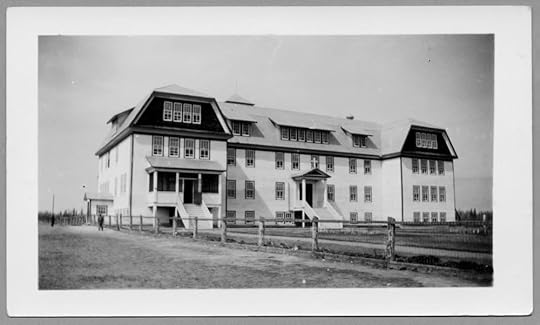
Sainte Thérèse Residential School in Sturgeon Landing, Saskatchewan, where Augie Merasty was “educated.”
“When I was at that school, it seemed always to be winter time. The days of that time always seem to have been colder.”
In 2001, Augie Merasty, a retired Cree trapper in his early 70s, wrote a letter to the dean of the University of Saskatchewan. He wanted help with a memoir he was working on. More specifically, he wanted an outdoorsy person who enjoyed fishing, someone who had a tape recorder and a good command of the English language, to come to his cabin in the bush and record the stories of what he and his schoolmates had experienced at Ste. Thérèse Residential School. Augie’s request was passed on to David Carpenter, a former English professor, who had left teaching to become a full-time writer. As it turned out, Augie didn’t have a cabin at all. He sometimes lived with his daughter in Prince Albert, Saskatchewan, but, consumed by alcoholism, he spent most of his later years homeless and on the streets. When Carpenter first spoke with him, he told Augie he could only be helpful if the memories were written down. Over the next several years, Augie sent his notes and stories in batches. All were written in his distinctive, flowing cursive. In the end, Carpenter had a total of about about 75 pages.
Born in 1930, Merasty, like thousands of young aboriginal kids, had been forced into a residential school run by the Catholic Church. (The Anglican, Presbyterian, and United churches also ran Indian schools in Canada). As The Report on the Royal Commission on Aboriginal Peoples notes, the first of what would become a network of schools was opened in 1849 in Ontario: “Church and government leaders had come to the conclusion that the problem (as they saw it) of Aboriginal independence and 'savagery' could be solved by taking children from their families at an early age and instilling the ways of the dominant society during eight or nine years of residential schooling far from home.” These institutions stayed open for over 150 years. Augie Merasty spent almost a decade at one located on the Saskatchewan-Manitoba border. From age five to age fourteen, he lived at Ste. Thérèse Residential School in Sturgeon Landing, about 300 miles (500 km) east of Prince Albert. At the time he first contacted the University of Saskatchewan, Augie had recently written testimony for the Working Group on Truth and Reconciliation Commission, an organization founded in the 1990s “with a mandate of documenting the history and impacts of the residential school system.”
In an interview with the Canadian Broadcasting Corporation in 2017, Augie’s co-author, David Carpenter, acknowledged the challenge in taking the “tatters of stories that sometimes had no ending to them” and putting them “all together in a sequence” while “try[ing] as hard as possible to preserve Augie's voice.” Augie’s education and capacity to write were limited, Carpenter said, but he had “a great storyteller's voice. And I didn't want to correct his English” and make him sound like someone other than himself. “I would only change the words on the page if he contradicted himself or if his limited ability with English obscured the meaning of what he was trying to get at." Carpenter fact-checked details with people who knew Augie and was reassured “that the core of the story, what happened to him at the school, was absolutely true." Names of people and places were changed to protect the identities of individuals and their families.
Carpenter has done a remarkable job organizing Merasty’s material. The memoir begins, quite surprisingly, with Augie’s recollections of those religious fathers, brothers, and nuns who showed kindness to the children. There was his grade-one teacher, Sister St. Alphonse, “one of the kindest and most loving persons in that institution,” who played games with the boys. She cried when administering the mildest corporal punishment: taps of a ruler to the hands of disobedient boys. Sister St. Famille, the school’s baker, who knew only a few words of English, gave the kids something they never received at mealtimes: small, round loaves of bannock bread. “Big Brother Beauville,” who drove the team of horses and worked in the barn, was another “good guy,” never saying a mean word to any of the boys. In fact, they prayed for him after he was injured by a horse and required two months’ hospitalization in The Pas, some 40 miles away.
Before the darkest memories of abuse are presented by the memoirist, he tells of other staff at Ste. Thérèse—not the good, the kind, and the jolly, but those whose failings Augie could nevertheless regard with some degree of warmth, humour, and even compassion. About these people, he observes: “They were all human beings, and they all had human feelings and weaknesses.” Take Brother Languir, for example: He’d come from Montreal and was teased by the older boys for his unfortunate, long chin. Languir had previously read some history about what Indians had done to whites, and he lived in fear of the boys at the school, regarding them as brutal savages. Not surprisingly, the kids played jokes on him, surrounding and poking him until he would suddenly burst from the circle, crying out and “running like the devil was after him.” Both Brother Languir and William “Scotty” Cameron, a Scottish bachelor employed by the school, also experienced the misfortune of unrequited love. They pined for beautiful Métis girls who were entirely beyond their reach.
According to Canada’s Truth and Reconciliation Commission website, “The policy behind the government-funded, church-run schools attempted to ‘kill the Indian in the child’.” Merasty’s memoir makes clear that notions of racial superiority certainly fuelled those who worked at Ste. Thérèse. About his vile chief tormenter, Merasty observes: “Brother Lepeigne was a man dedicated to preserving the image of the Superiority of the Semi-Super Race of Whiteman over Indian, like the German Super Race tried to establish during the time of Hitler’s regime. As I look back, what was happening at the school was basically the same thing except on a smaller scale with the same principles.”
The hypocrisy and toxicity of religion are regularly commented on by Merasty. He writes that when Bishop Lajeunesse visited the school, the children were dressed in their best clothing, made to perform concerts, and served food that was actually, and uncharacteristically, edible: beef stew, for example. However, during such visits the kids were also made to listen to the bishop hold forth about “how lucky we were to be looked after in such a school . . . and [how] we should be thankful to God and the administration for such blessings.”
Merasty’s recollections are occasionally punctuated with a kind of astonishment that the bishop was never told about the terrible abuses so many of the children endured—in particular, Brother Lepeigne’s method of securing the silence of seven boys he had molested. For years, Lepeigne engaged in daily, ritual beatings of the boys, using a corrugated hose to whip them as they lay on their dormitory beds. Augie, one of the seven, estimated he’d received 500 to 600 of these beatings in his time at the school. Sister St. Mercy, “the meanest of all the nuns”—“I can’t say enough to vilify her name,” he writes— forced Augie and a friend to walk miles in sub-zero weather to retrieve lost mitts. When the boys returned without the mittens, she strapped them 20 times on each hand. Sister St. Mercy also used her strap on Augie’s face one night, damaging his left eye. All he’d been doing was talking and laughing in his sleep. She regularly made him and other boys kneel for hours on cold cement floors after the other children had gone to bed, and she even burned his hand during a lecture on disobedience so he’d know what the fires of hell felt like. Sister St. Mercy and her disciple, Sister St. Joy, “really enjoyed causing pain and other kinds of suffering as punishment for the smallest infractions.”
Augie’s observation, “I always wondered why our keepers and teachers talked about Jesus, Mary, and Joseph and all the love they had for mankind [ . . . ] they never practiced what they preached, not one iota,” is the understatement of the century. It was his view that anyone who belonged to the order of the Oblates of Mary Immaculate was “considered to be infallible . . . respected with unshakeable reverence, especially by my parents.” Even worse than the hypocrisy and the blind, undeserved respect, however, was the culture of silence. “If any of our teachers ever claimed that there was no evidence of sodomy in the school, they were lying. There is no doubt that these things were forced upon many of us at St. Therese in those days.”
Merasty left Ste. Thérèse when he was 14. He felt as though he’d been sprung from prison. He writes that the hard lessons he learned there ensured that no one would ever again abuse him. However, what he’d experienced—endured—left him tremendously vulnerable to substance abuse. David Carpenter, who was instrumental in getting Augie’s powerful memoir published, acknowledges that “Augie was a nightmare of a father and a husband. He was a drunk, he was a sinner. And yet to me he feels like a real hero. A hero and a martyr. . . I think what was martyred there (at the residential school) was his innocence. . . yet because he got his story out and thousands of people are reading his story now, it’s almost as though there’s a bit of redemption at the end of his life.”
The Education of Augie Merasty is a tiny book, only 76 pages long and a mere 4 ½ inches by 7 inches in size. It is an important historical document about “the abuse and terror in the lives of Indian children.” The testimony it delivers—in natural, unembellished language—is incredibly powerful.
Augie Merasty died in Prince Albert, Saskatchewan in February, 2017. He was 87.

April 7, 2015
A very odd book to rate. Very small, no traditional narrative structure or style. It's an edited collection of letters and interviews smoothed out and turned into a single account of the Residential Schools.
If anything, this is a book that will be studied. It's a primary source document rather than a commentary or history. It will be an exercise in oral history. It's a unique and valuable project that deserves to essential Canadian reading.
In that sense, the book really is Augie's immortality.
If anything, this is a book that will be studied. It's a primary source document rather than a commentary or history. It will be an exercise in oral history. It's a unique and valuable project that deserves to essential Canadian reading.
In that sense, the book really is Augie's immortality.

January 31, 2017
Now in his late 80s, Auguste Merasty was 5 when he entered a residential school for indigenous kids in northern Saskatchewan. During his years there, he endured and witnessed horrific abuse and racism, all sanctioned by the church and the government. The point of the schools was to teach the Indian out of the kids, assimilate them. Canada's shame. My former English prof, David Carpenter, helped him write these important memoirs. Heartbreaking.

August 26, 2018
I’ve said it before and I’ll say it again. I cannot put a rating on someone’s life. It’s their life, how can you give it a rating?
This book is one of the only books where the Introduction and Conclusion are the important parts of the novel. That’s due to the fact that we, through these parts, see the impacts that residential schooling had on the Aboriginal community. Everyone suffers in their own way, but none come unharmed.
Review Continued Here
This book is one of the only books where the Introduction and Conclusion are the important parts of the novel. That’s due to the fact that we, through these parts, see the impacts that residential schooling had on the Aboriginal community. Everyone suffers in their own way, but none come unharmed.
Review Continued Here

October 5, 2016
Wow. This book is so important, and I think it should be required reading in schools.
It breaks my heart that I never learned about residential schools until I was in my mid-twenties.
It breaks my heart that I never learned about residential schools until I was in my mid-twenties.

May 8, 2015
I want to be very clear: this book has two sections. The plainly told, and the more horrifying for it, memoir of Augie Merasty's time in a residential school in the 1930s. And a lengthy introduction and brief coda by the editor, David Carpenter. Merasty's section, edited by Carpenter is heart wrenching, though everything is recounted in a straight forward voice. This I give 5 stars.
Carpenter's introduction is terrible. I think he's trying to give some indication of how Merasty's childhood experiences affected the rest of his life, but it's mostly relayed in terms of how inconvenient and difficult Merasty was to work with. It's just silly. And Carpenter clearly did not interview any of his family. In an interview on the CBC Carpenter mentioned he did not know the ending of a particular story involving Merasty running into one of his abusers in The Pas; in the same program the interviewer asked Merasty's daughter about it and she knew the answer, no problem. For what could be an important record, the editing just feels lazy. But he's an editor, you say, not a story teller? Ok then, why is more than a third of the book about him? Sheesh. This section gets 1 star.
My advice: skip the intro, and just read the heart of this book.
Carpenter's introduction is terrible. I think he's trying to give some indication of how Merasty's childhood experiences affected the rest of his life, but it's mostly relayed in terms of how inconvenient and difficult Merasty was to work with. It's just silly. And Carpenter clearly did not interview any of his family. In an interview on the CBC Carpenter mentioned he did not know the ending of a particular story involving Merasty running into one of his abusers in The Pas; in the same program the interviewer asked Merasty's daughter about it and she knew the answer, no problem. For what could be an important record, the editing just feels lazy. But he's an editor, you say, not a story teller? Ok then, why is more than a third of the book about him? Sheesh. This section gets 1 star.
My advice: skip the intro, and just read the heart of this book.

May 29, 2015
RATING: 3 STARS
(I received an ARC from the NETGALLEY in exchange for an honest review.)
(Not On Blog)
I picked this book up at the library as I have always been interested in knowing more about Aboriginal culture. Growing up in Canada, we did hear about Residential schools and the horrors behind it. It was not long in the history that this happened, and like other race and cultural atrocities it seems unimaginable that this is reality. This is a really short book, and that was one of the reasons I did not give this book a higher rating. I felt like you got a snippet of a story and are longing to know more context. It feels like a found diary.
What worked for me was that it was told by a survivor and that it is such an important story to share. You can't put a rating on an experience, but despite this being a short book, the impact is vast. It is not an easy read...and that is a great thing as it does make you uncomfortable in a good way. You should be upset over what Augie and his peers went through.
(I received an ARC from the NETGALLEY in exchange for an honest review.)
(Not On Blog)
I picked this book up at the library as I have always been interested in knowing more about Aboriginal culture. Growing up in Canada, we did hear about Residential schools and the horrors behind it. It was not long in the history that this happened, and like other race and cultural atrocities it seems unimaginable that this is reality. This is a really short book, and that was one of the reasons I did not give this book a higher rating. I felt like you got a snippet of a story and are longing to know more context. It feels like a found diary.
What worked for me was that it was told by a survivor and that it is such an important story to share. You can't put a rating on an experience, but despite this being a short book, the impact is vast. It is not an easy read...and that is a great thing as it does make you uncomfortable in a good way. You should be upset over what Augie and his peers went through.

September 18, 2022
Thank you NetGalley and University of Regina Press for accepting my request to read and review The Education of Augie Merasty.
Author: Joseph Auguste Merasty with David Carpenter
Published: 08/27/22
Genre: Biographies & Memoirs
Another residential school where abuse is the major. Merasty was an indIgenous student and the school is located in Canada. Indigenous people are abused in Canada and the U.S. The horrors that Augie and other students experienced is mentioned, but not graphically described.
David Carpenter is the one person who answered Augie's request for help with turning his writings into a book. I found the relationship between Carpenter and Merasty a nice relief from the cruelties.
The synopsis is clear, and I'm not going to repeat it.
I recommend this with adult guidance and education. The abusers were priests and nuns. I would gift this.
Author: Joseph Auguste Merasty with David Carpenter
Published: 08/27/22
Genre: Biographies & Memoirs
Another residential school where abuse is the major. Merasty was an indIgenous student and the school is located in Canada. Indigenous people are abused in Canada and the U.S. The horrors that Augie and other students experienced is mentioned, but not graphically described.
David Carpenter is the one person who answered Augie's request for help with turning his writings into a book. I found the relationship between Carpenter and Merasty a nice relief from the cruelties.
The synopsis is clear, and I'm not going to repeat it.
I recommend this with adult guidance and education. The abusers were priests and nuns. I would gift this.
March 11, 2017
An important memoir. I'm grateful to Merasty for his courage to tell his story.

Read
October 2, 2022September 30 is the commemoration of Truth and Reconciliation Day. This book is a brief but enduring account of Indigenous experience within the Residential school system. In plainspoken, non-hyperbolic language, the author Auguste Merasty recounts his youth in the school. They were collected by canoes and taken away from their communities. It is a fair narrative and the author highlights the priests and nuns who treated the children with complete kindness. However, at the same time the institution of schools operated without oversight and this enabled a situation where abuse festered. What stands out is the cruel, unconventional punishment. Children were whipped, made to trek through -60F with windchill and without gloves, fed raw eggs, and served rotten food while a parade of delicious culinary confections arrived to the Father's and Brothers' tables. One man of the cloth took the endowment for children's musical instruments and sold them to fund Hitler. There was also a lot of molestation. Fathers, Sisters, and Brothers all were identified in hurting and molesting their wards. This book is a good record of the sufferings or experiences of children in residential schools.
September 3, 2017
The book itself, written by Augie Merasty, is heartbreaking, and important, and I'm glad to have read it. The introduction, written by David Carpenter, is another thing. It so put me off I actually had to put the book down for a few days before I could continue.
Reading about Carpenter's repeated attempts to contact Mr. Merasty and get him to send more of the manuscript I couldn't stop thinking that it would have ultimately been easier and quicker for Carpenter to go visit Mr. Merasty, listen to him tell his story and have it transcribed, as Mr. Merasty wanted. It was sort of infuriating that he just...refused.
Carpenter then closes out the introduction with a few completely tone deaf paragraphs about how he hopes First Nation and Metis writers will some day feel comfortable attending a writer's retreat at an abbey in Muenster, SK. Not the time, not the place.
My suggestion is to read the book first, then the introduction, then the afterword.
Reading about Carpenter's repeated attempts to contact Mr. Merasty and get him to send more of the manuscript I couldn't stop thinking that it would have ultimately been easier and quicker for Carpenter to go visit Mr. Merasty, listen to him tell his story and have it transcribed, as Mr. Merasty wanted. It was sort of infuriating that he just...refused.
Carpenter then closes out the introduction with a few completely tone deaf paragraphs about how he hopes First Nation and Metis writers will some day feel comfortable attending a writer's retreat at an abbey in Muenster, SK. Not the time, not the place.
My suggestion is to read the book first, then the introduction, then the afterword.
June 21, 2017
I give this book five stars not because I enjoyed it, or because of the writing. I give it five stars as a salute to Augie Merasty for the courage it took to share the story of the immense abuse he suffered during his years at residential school in Canada.
I knew nothing about the horrors of residential schools or the Sixties Scoop until a few months ago. This book, heartbreaking as it is, is important because it brings into the open vile crimes committed against young innocent children like Augie that were otherwise hidden in darkness. It was Augie's wish that by leading the way in sharing his story, other survivors would come forward with their own stories. I think this is important because for so long these people have been ignored, overlooked or accused of lying. Their stories should be heard and validated and every effort made to provide help and resources for healing.
I knew nothing about the horrors of residential schools or the Sixties Scoop until a few months ago. This book, heartbreaking as it is, is important because it brings into the open vile crimes committed against young innocent children like Augie that were otherwise hidden in darkness. It was Augie's wish that by leading the way in sharing his story, other survivors would come forward with their own stories. I think this is important because for so long these people have been ignored, overlooked or accused of lying. Their stories should be heard and validated and every effort made to provide help and resources for healing.

Read
June 13, 2017This was exactly what I was looking for—a powerful and important residential school memoir. I suspect I'll reread it in the future.
I was glad that Merasty got to see his book published before he died, and I just wish the editor had been as determined to track him down and hear his story over the decade that they corresponded as he was to track him down and get the final contract signed.
Merasty's obituary is also worth the read.
I was glad that Merasty got to see his book published before he died, and I just wish the editor had been as determined to track him down and hear his story over the decade that they corresponded as he was to track him down and get the final contract signed.
Merasty's obituary is also worth the read.

March 6, 2025
I bought this book to help with a paper I’m writing on violence against children in residential schools. This was a harrowing read, and it served its purpose well. Reading about Augie and his companions' experiences at St. Therese Residential School was heartbreaking. Augie’s resilience, humour, and determination in telling his story are a testament to how difficult it is to break a strong spirit.
We know this was not an easy story for David Carpenter to capture or for Augie Merasty to tell. Augie lived simply, without technology. He was elusive, wayward. He had suffered extensive trauma and battled substance abuse. Despite these challenges, Carpenter did an incredible job with what he had, and Augie was phenomenal in his outspoken retelling of his devastating past.
This is not a book that should be rated at all. It’s not up to us to judge someone’s experiences or Carpenter’s efforts in piecing together what he could. But I’m giving it five stars, not just to counter those who felt the need to give it less, but because it deserves all five and more.
We know this was not an easy story for David Carpenter to capture or for Augie Merasty to tell. Augie lived simply, without technology. He was elusive, wayward. He had suffered extensive trauma and battled substance abuse. Despite these challenges, Carpenter did an incredible job with what he had, and Augie was phenomenal in his outspoken retelling of his devastating past.
This is not a book that should be rated at all. It’s not up to us to judge someone’s experiences or Carpenter’s efforts in piecing together what he could. But I’m giving it five stars, not just to counter those who felt the need to give it less, but because it deserves all five and more.

January 4, 2023
This was a brief, but far from an easy read. A reader really feels for Augie and his life experience, no matter how brief and (at first) disconnected his retellings are. He provides excruciating detail in many of his stories which serve as a poignant reminder as to what academics and government officials mean when they refer to the "sexual abuse" that occurred in residential schools. I am left wondering about David Carpenter's relationship with Augie. His unwillingness to visit Augie and record his life story felt a bit odd to me, especially when considering the importance of oral history and storytelling for Indigenous peoples, healing, survivorship, and reconciliation as a whole. Nonetheless, it is hard to say based on the little information available and I applaud Carpenter to keeping the work as true to Augie's work as he claims he has done.

September 7, 2017
ABOUT: As a Cree native, Augie Merasty was sent to a residential school run by French priests and nuns. This book is about his most lasting experiences there, and it's probably just a small part of a rarely-talked-about but dark part of Canadian history. Its implications still stretch out to today.
This book, like every book, isn't perfect. You will feel like the story is a little bit incomplete after reading all 90 pages, and the introduction fully explains that it is technically an unfinished book (circumstances explained). But I'm still giving this 5 stars because what we have of this story is powerful. It's important. I'm glad I found this book on my library display and took a leap by reading it. I hope it's only part of the beginning steps towards change.
This book, like every book, isn't perfect. You will feel like the story is a little bit incomplete after reading all 90 pages, and the introduction fully explains that it is technically an unfinished book (circumstances explained). But I'm still giving this 5 stars because what we have of this story is powerful. It's important. I'm glad I found this book on my library display and took a leap by reading it. I hope it's only part of the beginning steps towards change.
March 28, 2023
Who knew this short, little, tiny book could be so, SO powerful? Such an amazing insight into a survivor’s story of the Residential School system. Augie’s voice is so brilliantly clear throughout the memoir. He may not be an acclaimed author, but his honesty is so unwavering and beyond a doubt. Every Canadian should read this book.

February 29, 2016
The Education of Augie Merasty is a memoir written by a homeless, octogenarian Cree native while living in Prince Albert, Saskatchewan with the assistance of co-author David Carpenter. Merasty provided his co-author with approximately one hundred pages of handwritten notes that Merasty submitted to Carpenter in spurts. Sometimes Carpenter was able to speak with Merasty by telephone but there were long periods when Merasty was in the bush and Carpenter had no idea if he was still alive.
Merasty attended St. Therese Residential School in the community of Sturgeon Landing, Manitoba, from 1935 to 1944. This is the period was the focus of his memoir.
When I was reading Merasty’s memoir if felt like Augie was “telling” me a story. It seemed very much like a narrative, as is quite common in native people’s oral story telling tradition. Overall, Augie was very positive and generous in giving kudos where they were due. Despite the hardships he had endured, Augie spoke out primarily only a few, very nasty people who were supposedly to have been caregivers. Merasty sounded and seemed very hopeful. Based on his co-writer’s comments, it seems that Merasty wanted to take part in the collecting of information from First Nations people, Inuit and Métis about their residential school experiences. He wanted what he shared to be believed. To do this he focused on the most critical issues and the worst offenders while giving credit to the good things that also took place during that time.
He’d been inspired to write after the Working Group on Truth and Reconciliation and of the Exploratory Dialogues took place in the late 1990s.
Over a period of eight years, by letter and telephone and rarely in person, Carpenter, Merasty’s co-author felt that Merasty felt compelled to tell his story and that he thought if he didn’t he would have wasted his life. Merasty thought that his memoir would be his immortality.
Some have raised concerns about Merasty’s credence as a narrator, primarily because of his history of alcoholism and have used the term unreliable narrator when wondering about the value of his book. I happen to dislike the term unreliable narrator because when anyone is talking or writing about their own personal experiences, since each of us has personal filters (that’s what makes each of us unique) each of us will see and experience life in our own way. Others, who have different filters and experiences, may have a different remembering and therefore consider us an unreliable narrator. However, who is better to write a memoir about a life than the person who actually lived the life?
And when you think about it, how could anyone be unreliable about their own narrative unless they were deliberately lying? And what is the likelihood of anyone wanting to cause their own suffering by making up, writing and speaking about such painful circumstances as Merasty does, if it wasn’t true or if they didn’t believe it to be true? It could be possible but I tend to think it unlikely. When you are very young and people cause you significant pain, a self-defense mechanism is to zone out and disassociate. It is a coping mechanism and should be respected. What any child experiences should be listened to and valued.
On the back flap of the book there’s a reproduction of a wonderful 2013 acrylic painting of Merasty called I am a Writer, part of the Homeless Series by Kathie Bird.
On the front cover are these comments “Even as he looks back on this painful part of his childhood, Merasty’s sense of humour and warm voice shine through.”
I’m really glad that I read this book. Merasty shared important information and I felt he did so in as honest and upbeat a way as was possible given the circumstances. Carpenter also deserves a big thank you for seeing that Merasty’s story was written in a book format, using Merasty’s own words and then having it published and made widely accessible to the public.
Orignal Rating in 2016
2 stars for the book primarily due to its brevity and simplicity. 5 stars for the heart and tone of the story tellers.
Rating Change in 2024
When doing a book comparison with another person’s books on Goodreads – I saw that I rated this book 2 stars and couldn’t believe it. More than eight years later, I still remember how positive I was about book and how much it impacted me. I am also reflecting on all the children's books and shorter books that I have not penalized with less stars. I think that reducing the stars so significantly was an error on my part. I still agree with 5 stars for the heart and tone of the story tellers and am changing my rating to a well-deserved 5 stars.
Here’s an article in the Globe and Mail that provides more information about the men and lives behind this book.
http://www.theglobeandmail.com/arts/b...
Merasty attended St. Therese Residential School in the community of Sturgeon Landing, Manitoba, from 1935 to 1944. This is the period was the focus of his memoir.
When I was reading Merasty’s memoir if felt like Augie was “telling” me a story. It seemed very much like a narrative, as is quite common in native people’s oral story telling tradition. Overall, Augie was very positive and generous in giving kudos where they were due. Despite the hardships he had endured, Augie spoke out primarily only a few, very nasty people who were supposedly to have been caregivers. Merasty sounded and seemed very hopeful. Based on his co-writer’s comments, it seems that Merasty wanted to take part in the collecting of information from First Nations people, Inuit and Métis about their residential school experiences. He wanted what he shared to be believed. To do this he focused on the most critical issues and the worst offenders while giving credit to the good things that also took place during that time.
He’d been inspired to write after the Working Group on Truth and Reconciliation and of the Exploratory Dialogues took place in the late 1990s.
Over a period of eight years, by letter and telephone and rarely in person, Carpenter, Merasty’s co-author felt that Merasty felt compelled to tell his story and that he thought if he didn’t he would have wasted his life. Merasty thought that his memoir would be his immortality.
Some have raised concerns about Merasty’s credence as a narrator, primarily because of his history of alcoholism and have used the term unreliable narrator when wondering about the value of his book. I happen to dislike the term unreliable narrator because when anyone is talking or writing about their own personal experiences, since each of us has personal filters (that’s what makes each of us unique) each of us will see and experience life in our own way. Others, who have different filters and experiences, may have a different remembering and therefore consider us an unreliable narrator. However, who is better to write a memoir about a life than the person who actually lived the life?
And when you think about it, how could anyone be unreliable about their own narrative unless they were deliberately lying? And what is the likelihood of anyone wanting to cause their own suffering by making up, writing and speaking about such painful circumstances as Merasty does, if it wasn’t true or if they didn’t believe it to be true? It could be possible but I tend to think it unlikely. When you are very young and people cause you significant pain, a self-defense mechanism is to zone out and disassociate. It is a coping mechanism and should be respected. What any child experiences should be listened to and valued.
On the back flap of the book there’s a reproduction of a wonderful 2013 acrylic painting of Merasty called I am a Writer, part of the Homeless Series by Kathie Bird.
On the front cover are these comments “Even as he looks back on this painful part of his childhood, Merasty’s sense of humour and warm voice shine through.”
I’m really glad that I read this book. Merasty shared important information and I felt he did so in as honest and upbeat a way as was possible given the circumstances. Carpenter also deserves a big thank you for seeing that Merasty’s story was written in a book format, using Merasty’s own words and then having it published and made widely accessible to the public.
Orignal Rating in 2016
2 stars for the book primarily due to its brevity and simplicity. 5 stars for the heart and tone of the story tellers.
Rating Change in 2024
When doing a book comparison with another person’s books on Goodreads – I saw that I rated this book 2 stars and couldn’t believe it. More than eight years later, I still remember how positive I was about book and how much it impacted me. I am also reflecting on all the children's books and shorter books that I have not penalized with less stars. I think that reducing the stars so significantly was an error on my part. I still agree with 5 stars for the heart and tone of the story tellers and am changing my rating to a well-deserved 5 stars.
Here’s an article in the Globe and Mail that provides more information about the men and lives behind this book.
http://www.theglobeandmail.com/arts/b...

February 17, 2016
While these are important stories that must be heard, as a memoir I wasn’t able to take it all at face value. I began doubting its authenticity when reading an article in The Globe and Mail that quoted his daughter as saying: “it was hard to tell with my dad whether he’s telling the truth or not.”
My faith was not restored when I read in the introduction from his co-author of countless episodes of promised manuscripts that never came to fruit, such as:
There had been some break-ins at his cabin, and one of the culprits was a bear that laid waste to the cabin’s interior, ate his food and part of his manuscript.
“A bear ate your manuscript?”
“Oh, yeah, Davey. A big black bear.”
While this made me laugh out loud, my skepticism grew. In addition, Augie Merasty tells his story, and other third person accounts, more than half a century later, as a very old man, and after many years of hard drinking. How much accuracy can we expect? The quality of the writing, or lack thereof, is not the book’s strong point either. But still.....these stories must be heard.
My faith was not restored when I read in the introduction from his co-author of countless episodes of promised manuscripts that never came to fruit, such as:
There had been some break-ins at his cabin, and one of the culprits was a bear that laid waste to the cabin’s interior, ate his food and part of his manuscript.
“A bear ate your manuscript?”
“Oh, yeah, Davey. A big black bear.”
While this made me laugh out loud, my skepticism grew. In addition, Augie Merasty tells his story, and other third person accounts, more than half a century later, as a very old man, and after many years of hard drinking. How much accuracy can we expect? The quality of the writing, or lack thereof, is not the book’s strong point either. But still.....these stories must be heard.

November 17, 2015
Short but hits the heart hard. Great work between Augie's writing with David Carpenter's intro and afterword and getting this amazing story out there. Personally I feel more connected to what was really going on at the residential schools now. The abruptness and honesty of Augie's collections is powerful and moving as he shows very little hate (mostly disgust) towards those who were really cruel and sick to him and others. Only a small handful does Augie explain are the cruelest of humans and explains their actions similar to Hitler. The acts these leaders, mentors, caregivers were committing are unforgettable and unforgivable.
I appreciate this story being shared to enlighten more folk on the mistreatment of FNIM people. Maarsii.
I appreciate this story being shared to enlighten more folk on the mistreatment of FNIM people. Maarsii.

October 29, 2015
A very short snippet of the horrors that many Aboriginal children suffered during their time in Residential School. What this book highlights for us is the varying degrees of abuse that existed, and that while so many abusers worked in the system, there were many guilty of another crime - other priests and nuns knowing about and allowing the abuse to continue.
The book doesn't engage in the fetishizing of RS survivors. You won't hear all the gory details of abuse. But you should be horrified by just the hinting of them, which is exactly what Augie does. A beautifully written tragic memoir.
The book doesn't engage in the fetishizing of RS survivors. You won't hear all the gory details of abuse. But you should be horrified by just the hinting of them, which is exactly what Augie does. A beautifully written tragic memoir.

May 19, 2015
I think his was/is an important read, sadly it was poorly written.

July 19, 2021
This book has moments that are very hard to read. This is why it needs to be read.

December 11, 2020
Disclaimer: I read this book because of my history class titled "Native Peoples of Canada since 1867". It was required reading for my research essay based on residential schools.
I don't know how to rate this, so I am just giving it 5 stars. How do I say that this memoir, a book about someone's life in residential schools, is not worth 5 stars? I can't.
This memoir has opened my eyes because the Canadian government covers up so much stuff when it comes to what happened in residential schools. In order for us to get information, we have to read memoirs or read essays or textbooks AFTER primary school. This memoir shows me how much the Canadian government wants to keep this part of our history covered for eternity.
The memoir itself brings readers to see what happened in residential schools through the eyes of Augie. We see first hand how some Sisters, Brothers and Fathers were not bad people, they just thought that Indigenous peoples were "savages" needing "saving". Not only were some good people, we see the bad ones. We see first hand the abuse that happens, physical, psychological, and sexual.
This memoir in general really just showed me how much I sometimes despise the Canadian government when it comes to the reconciliation aspect towards Indigenous peoples. It shows that no money can help what happened to them. It shows that the government needst to do more to show citizens just how cruel our seemingly "nice" government can do.
I don't know how to rate this, so I am just giving it 5 stars. How do I say that this memoir, a book about someone's life in residential schools, is not worth 5 stars? I can't.
This memoir has opened my eyes because the Canadian government covers up so much stuff when it comes to what happened in residential schools. In order for us to get information, we have to read memoirs or read essays or textbooks AFTER primary school. This memoir shows me how much the Canadian government wants to keep this part of our history covered for eternity.
The memoir itself brings readers to see what happened in residential schools through the eyes of Augie. We see first hand how some Sisters, Brothers and Fathers were not bad people, they just thought that Indigenous peoples were "savages" needing "saving". Not only were some good people, we see the bad ones. We see first hand the abuse that happens, physical, psychological, and sexual.
This memoir in general really just showed me how much I sometimes despise the Canadian government when it comes to the reconciliation aspect towards Indigenous peoples. It shows that no money can help what happened to them. It shows that the government needst to do more to show citizens just how cruel our seemingly "nice" government can do.
This entire review has been hidden because of spoilers.
Read
June 22, 2021I find it difficult to rate this book, so I won't. The content is important, it's something everyone should be aware of.. But this is not thorough, well-structured book. It felt like I was sitting with Augie and he was telling me of his experience, which in some ways is better than the format of your typical novel. It was scattered, there were brief tangents, and of course it is difficult for him to remember that far back for all of the details so there are times when he simply admits he cannot recall something.
While I would've liked more structure, it was difficult for Carpenter to get enough info to really flesh things out. I think what Augie provided was sufficient but I still would have liked more.
In Carpenter's sections, we really get a feel for Augie and I can't help but feel charmed by him. He has put up with a lot and handled it as one would expect, if not better. I'm glad he had the opportunity to share his story and that I was able to read it.
While I would've liked more structure, it was difficult for Carpenter to get enough info to really flesh things out. I think what Augie provided was sufficient but I still would have liked more.
In Carpenter's sections, we really get a feel for Augie and I can't help but feel charmed by him. He has put up with a lot and handled it as one would expect, if not better. I'm glad he had the opportunity to share his story and that I was able to read it.

June 19, 2017
This was a tricky one to rate...what this man lived through was absolutely horrendous and in that respect I give him 10 stars for having the strength to share his stories. I am basing this rating on what I got out of it as someone interested in learning about our country's past, the good and the bad. Augie wrote letters about his experience in Canada's Residential School and sent them to David, who compiled them, with some light editing, into this book. David also wrote an Introduction and an Afterword to tie everything together. It was well written by both Augie and David and I commend them for being able to write this story together despite being very far away from each other with little to no communication at times.

September 2, 2026
1 star - 1 star for still being under copyright = 0 stars.
This is real Northern Saskatchewan history. Pointless, incoherent torture and abuse of children at a residential school. Scraps of suffering left out of the TRC, with a glimmer of humanity at the beginning to make it almost palatable.
Obviously canada and the catholic church failed these children. But unless you're doing some kind of research into residential schools, live around the people who descend from them or are just pig ignorant about what happened? Not sure what this book is going to do for you. For the former? It's probably better to just talk to them and hear their stories rather than judge based on this book. The latter? They are not likely to find even this book that helpful.
One thing for sure: children should not be forced to read this. Let them find it in a library, or a little library.
I disagree with Laura that this is somehow taking advantage of residential school experience in an unbecoming way -- and tend to side with the fact that his is simply a primary source-like story of an individual who suffered greatly at the heart of an genocidal institution. ie I don't think the author did anything wrong in writing this. There's a place in the world for such memories, awful they may be.
This is real Northern Saskatchewan history. Pointless, incoherent torture and abuse of children at a residential school. Scraps of suffering left out of the TRC, with a glimmer of humanity at the beginning to make it almost palatable.
Obviously canada and the catholic church failed these children. But unless you're doing some kind of research into residential schools, live around the people who descend from them or are just pig ignorant about what happened? Not sure what this book is going to do for you. For the former? It's probably better to just talk to them and hear their stories rather than judge based on this book. The latter? They are not likely to find even this book that helpful.
One thing for sure: children should not be forced to read this. Let them find it in a library, or a little library.
I disagree with Laura that this is somehow taking advantage of residential school experience in an unbecoming way -- and tend to side with the fact that his is simply a primary source-like story of an individual who suffered greatly at the heart of an genocidal institution. ie I don't think the author did anything wrong in writing this. There's a place in the world for such memories, awful they may be.

Read
August 15, 2021This was a difficult book to read. The writing was deceptively straightforward and clear, almost burying the horrors in it’s simplicity. I had to re-read several passages to understand the terror and brutality that was laid out in such a matter-of-fact way. Huge trigger warnings for sexual assault, rape, abuse, neglect, violence and religious fanaticism. I have a hard time recommending this book, yet I feel it is important to read. I keep thinking: these people (children, babies) had to endure this hell, how can I say it is too hard for me to witness it? This is an important, but not an enjoyable book. In less than 100 pages, it is hugely impactful.
This entire review has been hidden because of spoilers.

March 23, 2022
This was a tough book to listen to. While living in Alaska, I'd heard similar stories in regard to the boarding schools Native Alaskan children were taken to so this wasn't all a complete surprise, but how horrible that people in authority would abuse that trust.
Thanks to Bespeak Audio Editions and NetGalley for the ALC in exchange for my honest review.
Thanks to Bespeak Audio Editions and NetGalley for the ALC in exchange for my honest review.
Displaying 1 - 30 of 259 reviews