

What do you think?
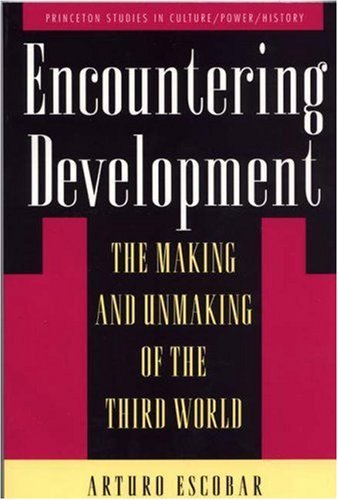
Encountering Development: The Making and Unmaking of the Third World
How did the industrialized nations of North America and Europe come to be seen as the appropriate models for post-World War II societies in Asia, Africa, and Latin America? How did the postwar discourse on development actually create the so-called Third World? And what will happen when development ideology collapses? To answer these questions, Arturo Escobar shows how development policies became mechanisms of control that were just as pervasive and effective as their colonial counterparts. The development apparatus generated categories powerful enough to shape the thinking even of its occasional critics while poverty and hunger became widespread. Development was not even partially deconstructed until the 1980s, when new tools for analyzing the representation of social reality were applied to specific Third World cases. Here Escobar deploys these new techniques in a provocative analysis of development discourse and practice in general, concluding with a discussion of alternative visions for a postdevelopment era.
Escobar emphasizes the role of economists in development discourse--his case study of Colombia demonstrates that the economization of food resulted in ambitious plans, and more hunger. To depict the production of knowledge and power in other development fields, the author shows how peasants, women, and nature became objects of knowledge and targets of power under the gaze of experts.
Escobar emphasizes the role of economists in development discourse--his case study of Colombia demonstrates that the economization of food resulted in ambitious plans, and more hunger. To depict the production of knowledge and power in other development fields, the author shows how peasants, women, and nature became objects of knowledge and targets of power under the gaze of experts.
320 pages, Paperback
First published January 1, 1994
About the author
Arturo Escobar
58 books90 followersArturo Escobar is the Kenan Distinguished Professor of Anthropology at the University of North Carolina, Chapel Hill. His most recent book is Territories of Difference.
Ratings & Reviews
Friends & Following
Create a free account to discover what your friends think of this book!
Community Reviews
Displaying 1 - 30 of 35 reviews

September 13, 2012
Dear Development World,
Here are all the things I hate: here are none of the solutions.
Love, Arturo. xoxo
Here are all the things I hate: here are none of the solutions.
Love, Arturo. xoxo

March 27, 2009
Arturo Escobar’s book Encountering Development is one of the foundational works of post-development studies. His research calls into question development as an institution, as an ordering system, and as a tool of capitalism and western hegemony.
Instead of an objective science, Escobar--building on the traditions of Edward Said, Michel Foucault, and James Ferguson--argues that instead we should think of development as a powerful discourse of power and control. Within this discursive system, Escobar argues “development” dictates what can be thought and not thought. Escobar’s aim, then, is to hold up development itself as an object of study. Citing Donna Haraway, Escobar writes, “To treat science as narrative is not to be dismissive. On the contrary, it is to treat it in the most serious way, without succumbing to its mystification as “the truth”” (p. 19-20).
In this way, Escobar is also carrying on the tradition of questioning the strategic alliances of knowledge and power. In the Saidian tradition (also Foucault), the Third World is a site of intervention for power of knowledge, a field in which to work, and a place where the other is reproduced in order to reaffirm hegemonic identity (in this case, Western dominance and the ethos of the market).
As Escobar says, almost by fiat, two-thirds of the world’s people were transformed into poor; the concept of the poor was created so that it could be solved with the solutions already on hand (p. 13). Though the project might change, the essential nature of the solution remains the same. The expertise remains the same, and the solutions remain divorced from the local nature of the problem.
As Batterbury and Fernando (2004) write on frequent criticisms of Escobar, the discourse of development is far from the essentialist bureaucratese that Escobar depicts it as. In addition, analysis that emphasizes politics and power miss much of the problems of livelihood and production that are real and not simply constructed features of the developing world (p. 116-117).
This book will remain a controversial classic for everyone interested in development, both those critical of development and those hoping to become practitioners.
If you are interested in my full critique of the book, you can read more here: http://www.japss.org/upload/16._Claus...
Instead of an objective science, Escobar--building on the traditions of Edward Said, Michel Foucault, and James Ferguson--argues that instead we should think of development as a powerful discourse of power and control. Within this discursive system, Escobar argues “development” dictates what can be thought and not thought. Escobar’s aim, then, is to hold up development itself as an object of study. Citing Donna Haraway, Escobar writes, “To treat science as narrative is not to be dismissive. On the contrary, it is to treat it in the most serious way, without succumbing to its mystification as “the truth”” (p. 19-20).
In this way, Escobar is also carrying on the tradition of questioning the strategic alliances of knowledge and power. In the Saidian tradition (also Foucault), the Third World is a site of intervention for power of knowledge, a field in which to work, and a place where the other is reproduced in order to reaffirm hegemonic identity (in this case, Western dominance and the ethos of the market).
As Escobar says, almost by fiat, two-thirds of the world’s people were transformed into poor; the concept of the poor was created so that it could be solved with the solutions already on hand (p. 13). Though the project might change, the essential nature of the solution remains the same. The expertise remains the same, and the solutions remain divorced from the local nature of the problem.
As Batterbury and Fernando (2004) write on frequent criticisms of Escobar, the discourse of development is far from the essentialist bureaucratese that Escobar depicts it as. In addition, analysis that emphasizes politics and power miss much of the problems of livelihood and production that are real and not simply constructed features of the developing world (p. 116-117).
This book will remain a controversial classic for everyone interested in development, both those critical of development and those hoping to become practitioners.
If you are interested in my full critique of the book, you can read more here: http://www.japss.org/upload/16._Claus...

January 23, 2012
I really enjoyed his arguments, but I found his writing incredibly difficult. Style aside, he shows just how pervasive the power relationships in development work really are. It calls the whole project into question. Sadly, upon explaining the problem, he doesn't have much in the way of a solution. That may make sense, though: the West is caught in its own development fiction, so a real solution will need to come from elsewhere, possibly BRICS?

November 8, 2012
The best book out there for development thinkers. While Escobar's postmodernist take on development remains shaky, he clearly contextualizes the power differentials that continue to pervade today's development discourse. Yes he does not provide much of an alternative, but his critiques of development policies are probably the most accurate I've read thus far.

October 5, 2022
i finally got around to reading some escobar!!! absolutely not disappointed, will read more,

July 9, 2012
This book has so many faults that perhaps it's probably worth focusing on the positives for a moment. Escobar highlights some serious problems with the World Bank, and the problems development has created for itself in the past. It also provides an interesting background history of development from its formation as a discipline in the 20th century that will be of use to newcomers to the subject (as I am).
One of the worst aspects of this book is what it fails to focus on. For instance, Escobar begins with a criticism of the terms 'First World' and 'Third World', a condescending hierarchy that could be linked intellectually to the spectre of 'civilisation'. Yet instead of destroying this concept theoretically once and for all, the author drops the issue only to employ those terms himself throughout the book! And while he proves adept at condemning the actions of some development policies, these are never put in context. Are these policies cherry-picked? Are they really representative of development? Is it true (though never mentioned in the book) that some recipients of development aid in the past are now net exporters of aid themselves? Finally, Escobar's dream of 'postdevelopment' rests heavily on a postmodernist interpretation of the world (his chapter 5 and conclusion especially), yet not once are we treated to a reflection on how valid postmodernism is! For a person with many severe criticisms of postmodernism, I felt that this book contributed to the overwhelming tendency of postmodernist works to avoid reflection on their own contentious positions.
Another problem is that after reading 210 pages (plus the 2012 preface) of Escobar's book, I am still no nearer to understanding what 'postdevelopment' would, in fact, entail. The conclusion is a nightmare of ambiguity and non-committal statements. A few examples would have been welcome, but really the whole book should have set up the conclusion already -perhaps there was no saving this book with a good last chapter.
On a final note, the worst aspect of this book by far was its impenetrable nature. The chapters were poorly demarcated into specific themes, and seemed to run into one single, over-long narrative. The writing style (in true postmodernist style) was consistently vague and unclear. There were a number of 'endless' sentences there, as well, which were so hopelessly contrived that I had to post several up on Facebook -did this book really undergo several drafts and an editor? I find it hard to believe so.
In a word, this book was 'disappointing'.
One of the worst aspects of this book is what it fails to focus on. For instance, Escobar begins with a criticism of the terms 'First World' and 'Third World', a condescending hierarchy that could be linked intellectually to the spectre of 'civilisation'. Yet instead of destroying this concept theoretically once and for all, the author drops the issue only to employ those terms himself throughout the book! And while he proves adept at condemning the actions of some development policies, these are never put in context. Are these policies cherry-picked? Are they really representative of development? Is it true (though never mentioned in the book) that some recipients of development aid in the past are now net exporters of aid themselves? Finally, Escobar's dream of 'postdevelopment' rests heavily on a postmodernist interpretation of the world (his chapter 5 and conclusion especially), yet not once are we treated to a reflection on how valid postmodernism is! For a person with many severe criticisms of postmodernism, I felt that this book contributed to the overwhelming tendency of postmodernist works to avoid reflection on their own contentious positions.
Another problem is that after reading 210 pages (plus the 2012 preface) of Escobar's book, I am still no nearer to understanding what 'postdevelopment' would, in fact, entail. The conclusion is a nightmare of ambiguity and non-committal statements. A few examples would have been welcome, but really the whole book should have set up the conclusion already -perhaps there was no saving this book with a good last chapter.
On a final note, the worst aspect of this book by far was its impenetrable nature. The chapters were poorly demarcated into specific themes, and seemed to run into one single, over-long narrative. The writing style (in true postmodernist style) was consistently vague and unclear. There were a number of 'endless' sentences there, as well, which were so hopelessly contrived that I had to post several up on Facebook -did this book really undergo several drafts and an editor? I find it hard to believe so.
In a word, this book was 'disappointing'.

September 30, 2019
Yes, the division between north and south, poor and rich and 1st and 3rd worlds is an invented concept by humanity and a most recent one. It is the legacy of colonialism and not a biological trait as some might believe. Which is why some Trump supporters should read this book.
Escobar is by far one of my favorite scholars because he has a charming way of writing that is gracefull and hard, which I find it was very consistent in proving his point.
He uses historical facts and events (Such as World War II) and he explains how the discourse of poverty and development was created: from only one point of view, based on economic and political interests and full of tricks to build a new reality. The argument of institutionalization and professionalization as an efficient method to make it true is very well exposed and clarifying. We can see it in our universities, here and in our home countries, no matter which one of the Worlds they belong to.
The case studies showed, in the end, are very good examples of the theoretical argument he constructed from the beginning. Coherent, they show how the discourse of development makes people from underdeveloped countries believe in their inferiority and the necessity of being more similar to the developed countries – therefore, more different from who they originally are, which is not good enough. It is actually a very cruel fallacy that has several other impacts.
In this sense, considering that the countries from the Third world have usually high level of inequality, being composed by rich and educated people (according to the classical point of view) in contrast to a majority of poor and uneducated people, does the discourse of development raises the prejudice and intolerance inside the countries?
Having seen the problems that the discourse of development caused to the so-called Third World people, does it make sense to say that people from the First World are also victims of it?
Escobar is by far one of my favorite scholars because he has a charming way of writing that is gracefull and hard, which I find it was very consistent in proving his point.
He uses historical facts and events (Such as World War II) and he explains how the discourse of poverty and development was created: from only one point of view, based on economic and political interests and full of tricks to build a new reality. The argument of institutionalization and professionalization as an efficient method to make it true is very well exposed and clarifying. We can see it in our universities, here and in our home countries, no matter which one of the Worlds they belong to.
The case studies showed, in the end, are very good examples of the theoretical argument he constructed from the beginning. Coherent, they show how the discourse of development makes people from underdeveloped countries believe in their inferiority and the necessity of being more similar to the developed countries – therefore, more different from who they originally are, which is not good enough. It is actually a very cruel fallacy that has several other impacts.
In this sense, considering that the countries from the Third world have usually high level of inequality, being composed by rich and educated people (according to the classical point of view) in contrast to a majority of poor and uneducated people, does the discourse of development raises the prejudice and intolerance inside the countries?
Having seen the problems that the discourse of development caused to the so-called Third World people, does it make sense to say that people from the First World are also victims of it?

January 14, 2013
Best summary to this book is
"Dear Development World,
Here are all the things I hate: here are none of the solutions.
Love, Arturo. xoxo"
If these type of guys spent their lives putting a couple bricks together in rural Africa to build schools and hospitals, maybe the world would be a difference place. But instead they spend their lives ranting against everything and over-criticising things that they wouldn't do differently whilst providing the world with no solution. In my belief, if there is criticism, there should also be a solution. Solutions and criticisms should go hand in hand. Anyone can make a point in semi-intellectual sentences with big words, basicly saying "First world countries are ethnocentric and patronising towards third world." That much is rather obvious!
Yes, he makes relevant points. I agree that we must develop a new way of viewing the "Third World", as the present constructed view is inaccurate.
But all this crap?
Seriously?
"Dear Development World,
Here are all the things I hate: here are none of the solutions.
Love, Arturo. xoxo"
If these type of guys spent their lives putting a couple bricks together in rural Africa to build schools and hospitals, maybe the world would be a difference place. But instead they spend their lives ranting against everything and over-criticising things that they wouldn't do differently whilst providing the world with no solution. In my belief, if there is criticism, there should also be a solution. Solutions and criticisms should go hand in hand. Anyone can make a point in semi-intellectual sentences with big words, basicly saying "First world countries are ethnocentric and patronising towards third world." That much is rather obvious!
Yes, he makes relevant points. I agree that we must develop a new way of viewing the "Third World", as the present constructed view is inaccurate.
But all this crap?
Seriously?
November 14, 2019
Extremely thought-provoking. Limited somewhat in that Escobar really only focuses on the World Bank and national-level projects and plans, which leaves out a lot of how development is practiced. It’s also frustrating that he can’t seem to speak about the experts whom he’s critiquing without sneering at them. His analysis is, as many others have pointed out, mainly focused on development texts; he dismisses the actors who produce those texts as bad-faith actors mainly interested in reproducing their own power. Surely some are that bad, and of course good intentions only get you so far even if you have them. The road to hell and so on. But to me, it seems that painting the people who produce the objects of his critique with such a broad and disdainful brush weakens his argument. The book is best when he’s dispassionately and incisively breaking down the process of producing a development idea and showing how it produces misrecognition and reinforces unequal distribution of power. It’s weakest when he’s forced to reckon with World Bank economists.
That said, the book is a pretty powerful critique of the production of power through language in development, which applies to anyone involved in the field: lack of reflexivity is dangerous. That might seem obvious but as a development practitioner who tries to be reflective and self-critical, the book gave me a lot to chew on.
That said, the book is a pretty powerful critique of the production of power through language in development, which applies to anyone involved in the field: lack of reflexivity is dangerous. That might seem obvious but as a development practitioner who tries to be reflective and self-critical, the book gave me a lot to chew on.
March 7, 2016
Arturo Escobar starts this book with an intensely interesting premise: that the discourse surrounding global development in the latter half of the twentieth century reflects the international hegemonic power more than an actual desire or ability to improve the situation of impoverished peoples. However, I felt like Escobar's writing doesn't go much farther than restating that basic premise in as many different ways as possible.
As much as a see the importance of discursive analysis, I think there needs to be a point when we go beyond discourse to talk about practicality. Escobar rarely delves into the details of specific case studies where communities were destabilized by development efforts, and fails to describe a specific kind of action or even a specific way of thinking and talking about these issues that would combat the problems he brings up.
While I still respect a lot Escobar's thinking, and think this book serves as a pretty good launch pad for getting into post-development studies, I personally found the book more frustrating than enlightening.
As much as a see the importance of discursive analysis, I think there needs to be a point when we go beyond discourse to talk about practicality. Escobar rarely delves into the details of specific case studies where communities were destabilized by development efforts, and fails to describe a specific kind of action or even a specific way of thinking and talking about these issues that would combat the problems he brings up.
While I still respect a lot Escobar's thinking, and think this book serves as a pretty good launch pad for getting into post-development studies, I personally found the book more frustrating than enlightening.

March 26, 2012
I started to read this one as for a seminar I had to read 2 or 3 chapters. But then I realized Escobar does something few scholars have done. Given his experience in the third world, it only made sense to me to check what he had to say about the making of US patio.
Growing and living 24 years of my life in Bolivia, Escobar presentation makes sense and helped me connect some points that I always had in my observations as a simple biologist.
For first world citizens, this book might sound like fiction or exaggerated. I was satisfied to find there is one in English that addresses this issue.
Growing and living 24 years of my life in Bolivia, Escobar presentation makes sense and helped me connect some points that I always had in my observations as a simple biologist.
For first world citizens, this book might sound like fiction or exaggerated. I was satisfied to find there is one in English that addresses this issue.

December 23, 2017
Essential poststructuralist criticism of development theory. Contrary to other reviewers, Escobar does actually present a positive, postdevelopment approach.

February 8, 2017
Encountering Development (ED) is essential reading for anyone interested in (or working in) development. It was a particularly refreshing read after wading my way through the development economists publications (Easterly, Collier, et al.).
Escobar's critiques of the development apparatus are compelling and promote fresh, new discourses still relevant today, perhaps now more than ever (let us not forget ED was first published in 1995).
Some will find the language of ED superfluous and at times vague. This leads to the primary criticism of ED which is that Escobar cites a whole plethora of problems to be addressed but in response offers only vague alternatives or solutions to development, at best.
Whilst an exact blueprint for an alternative is not provided (Escobar even acknowledges the task of implementing alternatives or concrete solutions is the much more difficult task) he does suggest multiple starting points and highlights spaces with reason for optimism e.g. Chapter 3 "Discourses of Transition: Emerging Trends" of the 2012 preface.
Escobar's critiques of the development apparatus are compelling and promote fresh, new discourses still relevant today, perhaps now more than ever (let us not forget ED was first published in 1995).
Some will find the language of ED superfluous and at times vague. This leads to the primary criticism of ED which is that Escobar cites a whole plethora of problems to be addressed but in response offers only vague alternatives or solutions to development, at best.
Whilst an exact blueprint for an alternative is not provided (Escobar even acknowledges the task of implementing alternatives or concrete solutions is the much more difficult task) he does suggest multiple starting points and highlights spaces with reason for optimism e.g. Chapter 3 "Discourses of Transition: Emerging Trends" of the 2012 preface.

April 11, 2014
Best book ever. Postmodernist critiques of subject based reasoning through a rich anthropological tapestry across Africa and Latin America. Rich with theoretical debates between Foucault- the author's favorite theorist who he spares no critique- Habermas, Laclau and Homi Bhabha. Must read for anyone who works in development and is duped by the development industry. Extremely rich in substantive argumentation (or what positivists call "case studies"). He levels a bottom up powerful critique of positivst methodology and epistemilogy that reaches the high altar priest of capitalism: the world bank and IMF through several rich first hand examples and 'institutional ethnography[ies]'.

July 18, 2010
An ethnocentric (Western) view to international development (e.g. environment, gender, poverty) can be an extremely dangerous idea. Critiques of modern day western civ abound yet we think these models are ideal for all cultures. When development fails under these auspices we scratch our head and wonder ... I wonder if the extremist environmental thinkers and conservative international development (econ theory) thinkers met in the middle the development community would just leave things as they are.

to-keep-reference
December 28, 2015El discurso del desarrollo fue una ilusión, pero una ilusión real y efectiva que estableció sus propias instituciones y estructuras a lo largo del mundo “en desarrollo”. Acerca de la institucionalización del desarrollo, ver Arturo Escobar, Encountering Development: The Making and Unmaking of the Tirad World (Princeton: Princeton University Press, 1991), pp. 73-101.
...una crítica de la ideología desarrollista de las teorías de la dependencia, ver pp. 80-81
Imperio Pág.214
...una crítica de la ideología desarrollista de las teorías de la dependencia, ver pp. 80-81
Imperio Pág.214

February 11, 2013
I love how Arturo Escobar in his "Encountering Development" book chastised the World Bank and its approach to alleviating poverty through first class travel and accommodation for their staffs, 70% of which are economists and the rest are engineers (pg. 165).

May 6, 2017
Basically besides listing everything that he hates in very confusing and complicated language, halfway through his research he realizes that he can't offer anything for a solution and decides to write chapter 6 with 4 pages conclusion after 200 pages hate speech.

February 27, 2018
There are some interesting arguments in this book. It seems to me in many parts more a critique of neoliberalism than of development per se. Some alternatives are sketched out in the end of the book, but in a slketchy way.

July 2, 2007
This development anthropologist made me read it.

March 12, 2008
To be posted...

Read
October 24, 2012A Foucaultian archeology of development practice.......
Read
April 17, 2015i want to read this book in online
September 16, 2015
Desperately in need of an update.

December 30, 2015
The ideas he presents are thought-provoking, and his research is deep. However, the language gets weighed down by an excess of academic jargon.

June 13, 2017
Recommended read for all those interested in development and in building a world that has space for all. It will make you think out of the box and question many things we take for granted.
November 5, 2022
A wonderful, eye-opening read that interrogates and criticises development concisely and convincingly in describing how poverty was created and problematised - poverty on a global scale was a discovery of the post-WWII period; the spread of global poverty only appeared when the spread of the market econnomy broke down community ties and deprived million of people from access to land, water, and other resources
The role of philanthropy in this transition, in which the poor transformed into the assisted, and the poor increasingly appeared as a social problem requiring new ways of intervention in society
The book begins by arguing that the development discourse is a rule-governed system held together by a set of statements that the discursive practice continues to reproduce, practices such as industrialisation, agriculture, peasants, or women and the environment
The discourse of development is not merely an "ideology" that has little to do with the "real world"; nor is it an apparatus produced by those in power in order to hide another, more basic truth, namely, the crude reality of the dollar sign. The development discourse has crystallised in practices that contribute to regulating the everyday goings and comings of people in the Third World
Another example is how the discourse of communism influenced a particular representation of development, which emphasised the role of the private initiative and private property in reaction
Similarly the fact that economic development relied so much on the need for foreign exchange and influenced the promotion of cash crops for export, to the detriment of food crops for domestic consumption
The book's case study of the so-called Integrated Rural Development strategy, produced by the World Bank in the early 1970s and implemented in Columbia from the mid-1970s to the early 1990s was also excellent in showing that as long as institutions and professionals are successfully reproducing themselves materially, culturally, and ideologically, certain relations of domination will prevail, and to the extent that this is the case, development will continue to be greatly conceptualised by those in power. By focusing on the practices that structure the daily work of institutions, it illustrated how power works, namely, how it is effected by institutional and documentary processes
Also partiarchy and ethnocentrism influenced the form development took as indigenous populations had to be modernised, which meant the adoption of the "right" values, namely those held by the white minority or a mestizo majority and in general, those embodied in the ideal of the cultivated European programs for industrialisation and agricultural development, however, not only have made women invisible in their role as producers, but also have tended to perpetuate their subordination
Forms of power in terms of class, gender, race, and nationality thus found their way into development theory and practice
The book makes great use of related and suitable literature such as leaning on the work of James Ferguson in showing that the construction in development literature of Third World societies as less developed countries is an essential feature of the development apparatus
Another example is referencing Mitchell, 1991: Objects of analysis do not occur as natural phenomena, but are partly constructed by the discourse that describes them
The practise of development that relies on official contacts in capital cities and could be described as "rural and urban development tourism", which isn't directly referring the mission members' first class travel and accommodation, but rather their style of work, which is learning about a country's problems through the lens of neoclassical economics, which is the only one compatible with the industry's predetermined model, and it never discusses in any significant way the underlying causes of the problems it deals with
The book also has illuminating discussions of the invisibility of women in modern discourses, referring to several studies that show that development has not only rendered invisible women's contribution to the economy, it has had a detrimental effect on women's economic position and status, as women's living conditions have not only worsened, but their work load has increased as a result of interventions - the reason for this exlusion is related to the male bias of both development and the model chose, that of US agriculture
As well as that both colonialism and development have utilised patriarchal practices in their construction of disciplined, peasant farmers in the Third World
Highly recommended and a must-read for anyone interested or adjacent to the field of development
The role of philanthropy in this transition, in which the poor transformed into the assisted, and the poor increasingly appeared as a social problem requiring new ways of intervention in society
The book begins by arguing that the development discourse is a rule-governed system held together by a set of statements that the discursive practice continues to reproduce, practices such as industrialisation, agriculture, peasants, or women and the environment
The discourse of development is not merely an "ideology" that has little to do with the "real world"; nor is it an apparatus produced by those in power in order to hide another, more basic truth, namely, the crude reality of the dollar sign. The development discourse has crystallised in practices that contribute to regulating the everyday goings and comings of people in the Third World
Another example is how the discourse of communism influenced a particular representation of development, which emphasised the role of the private initiative and private property in reaction
Similarly the fact that economic development relied so much on the need for foreign exchange and influenced the promotion of cash crops for export, to the detriment of food crops for domestic consumption
The book's case study of the so-called Integrated Rural Development strategy, produced by the World Bank in the early 1970s and implemented in Columbia from the mid-1970s to the early 1990s was also excellent in showing that as long as institutions and professionals are successfully reproducing themselves materially, culturally, and ideologically, certain relations of domination will prevail, and to the extent that this is the case, development will continue to be greatly conceptualised by those in power. By focusing on the practices that structure the daily work of institutions, it illustrated how power works, namely, how it is effected by institutional and documentary processes
Also partiarchy and ethnocentrism influenced the form development took as indigenous populations had to be modernised, which meant the adoption of the "right" values, namely those held by the white minority or a mestizo majority and in general, those embodied in the ideal of the cultivated European programs for industrialisation and agricultural development, however, not only have made women invisible in their role as producers, but also have tended to perpetuate their subordination
Forms of power in terms of class, gender, race, and nationality thus found their way into development theory and practice
The book makes great use of related and suitable literature such as leaning on the work of James Ferguson in showing that the construction in development literature of Third World societies as less developed countries is an essential feature of the development apparatus
Another example is referencing Mitchell, 1991: Objects of analysis do not occur as natural phenomena, but are partly constructed by the discourse that describes them
The practise of development that relies on official contacts in capital cities and could be described as "rural and urban development tourism", which isn't directly referring the mission members' first class travel and accommodation, but rather their style of work, which is learning about a country's problems through the lens of neoclassical economics, which is the only one compatible with the industry's predetermined model, and it never discusses in any significant way the underlying causes of the problems it deals with
The book also has illuminating discussions of the invisibility of women in modern discourses, referring to several studies that show that development has not only rendered invisible women's contribution to the economy, it has had a detrimental effect on women's economic position and status, as women's living conditions have not only worsened, but their work load has increased as a result of interventions - the reason for this exlusion is related to the male bias of both development and the model chose, that of US agriculture
As well as that both colonialism and development have utilised patriarchal practices in their construction of disciplined, peasant farmers in the Third World
Highly recommended and a must-read for anyone interested or adjacent to the field of development

September 4, 2022
Have only read half the book, the writing style was dreadful and boring, the content swings from abstract poststructuralist rambling to mere listings of historical events and phenomena, a classic Foucauldian style complaint about power and discourse with little material analysis. Either abstract theorizing (without much depth really) or mechanical listing, no story-telling, and material analyses are only attached as appendices. The author ostensibly concerns himself with the experiences of the people of the Third world - while talking more about institutions and power practices than studying these on-the-ground experiences. I haven't finished the book, but I have good reason to believe the rest of it follows the same formula. Especially dreadful is the part about institutional ethnography and food and nutrition planning - why on earth do I need to know in detail the textual origins of the discourse of food planning and development economics, while what I need is how these work in particular, their encounters with indigenous discourses and practices, their material and cultural effects on the lives of ordinary people?
The only takeaways of this book for me sofar are: its main general thesis about development in the Third world, the methodology it takes up (the first chapter influences my understanding of Foucauldian theory a lot), and its discussion of economic discourse (though of course, purely abstract and theoretical still). It gives me a lens through which to look at historical and social phenomena, but only in broad strokes - giving me the methodology, the objects of concern and analysis. The details however are just.. not worth it.
The only takeaways of this book for me sofar are: its main general thesis about development in the Third world, the methodology it takes up (the first chapter influences my understanding of Foucauldian theory a lot), and its discussion of economic discourse (though of course, purely abstract and theoretical still). It gives me a lens through which to look at historical and social phenomena, but only in broad strokes - giving me the methodology, the objects of concern and analysis. The details however are just.. not worth it.

April 28, 2020
I am torn about this book. The 2012 edition contains an amazing preface. I also really liked the chapter on power and visibility (chapter 5) and the conclusion. However, I found the rest of the chapters not worthy of Escobar's reputation as a scholar. They often lacked focus, they were methodologically confused and theoretically weak. As far as the latter is concerned, the author found it difficult to explain the relationship between discourse and the material world, while he also seemed to struggle to produce an analysis that was not structure-biased. He talked a lot about the potential agency of women and peasants and about alternatives to development, but when it came to concrete ways to achieve emancipation from the enslaving effects of the development apparatus, predatory international capital and modernity he seemed to have no concrete response. In any case, this is a refreshing voice in (post-) development studies. I keep Escobar's effort to deconstruct well-entrenched categorisations and his damning critique of the totalitarianism of capitalist economic development.

March 2, 2021
I abandoned this book half way through, certainly not because it is not excellently written, but it demands concentration and I have a lot of other things to do. It provides an excellent survey of the various schools of economic thought, from the outside rather than the inside. If you were an English major you would call it post structuralist explanation rather than formalist. And it is from the perspective of non European or United States/Canadian or, I suppose, Russian or Chinese economies, except as the "first world" affects other countries. I understand there is a more recent edition. He does write extremely well, and considering that English is not his first language I find it miraculous, because some academics do not write at all well. He is an extremely well known anthropologist.
Displaying 1 - 30 of 35 reviews