Jump to ratings and reviews
Rate this book

Philo Vance #1

La strana morte del signor Benson

Rate this book
The Benson Murder Case is the first novel in the Philo Vance series of mystery novels by S. S. Van Dine, which became a best-seller.

234 pages, Paperback

First published August 4, 1926

207 people are currently reading
1985 people want to read

About the author

S.S. Van Dine

122 books94 followers

Ratings & Reviews

What do you think?
Rate this book

Friends & Following

Create a free account to discover what your friends think of this book!

Community Reviews

5 stars
264 (16%)
4 stars
512 (31%)
3 stars
584 (36%)
2 stars
189 (11%)
1 star
65 (4%)
Displaying 1 - 30 of 263 reviews
Profile Image for John.
Author 537 books183 followers
September 9, 2016
Many years ago, when I first read Julian Symons's wittily graceful if sometimes controversial history of crime fiction, Bloody Murder (1972/74), I was sufficiently impressed by his excoriation of S.S. Van Dine's Philo Vance novels that I resolved never to touch one with a bargepole if I could possibly help it. More recently, however, I came across the suggestion that the early version of Ellery Queen was just a clone of Philo Vance and, since I love the early Queens (and the middle ones, and most of the later ones . . .), my resolve melted. I wondered if perhaps Symons might have been over-severe. And so, a couple of days ago, I took the plunge with The Benson Murder Case, the first in the series.

Reader, Symons was spot-on.

Alvin Benson, half of the Wall Street trading company Benson & Benson, has been found murdered, shot through the head while sitting in his favorite armchair, wearing his slippers but not his false teeth or toupee. Sergeant Heath of the Homicide Division and DA Markham investigate, but really the investigation is spearheaded by Markham's foppish, moneyed friend Philo Vance. Vance eschews such trivia as circumstantial and even hard evidence, preferring instead to focus on his own barmy psychological theories in solving crimes. So we're treated to a whole gamut of bonkers notions, from physiognomy (the idea that criminals have distinctive cranial features) through gender distinctions in the committing of crimes.

That would be okay -- you expect any novel published in 1926 to have some antiquated aspects -- but all of this is couched in the most flowery, pretentious language imaginable. If something can be expressed in ten words using a Latin phrase or poetical quotation (or a French one, or a German one or . . .) rather than two words of plain English, it is. Although I'm all for arcane vocabulary -- I love to pick up the occasional new word -- here the use of obscure words in preference to everyday ones is taken to a degree far beyond the plainly ludicrous. Just to give you a flavor, here's part of an exchange between Markham and Vance:

“Just how do you propose to elicit your information?”

“With morbidezza, as the painters say. Much more refined and gentlemanly, y’ know.”

Markham considered a moment.

“I think I’ll keep out of it, and leave the Socratic elenctus entirely to you.”

“An extr’ordin’rily brilliant suggestion,” said Vance.


Markham, you'll recall, is a grizzled DA, a hardbitten fighter of crime, yet he's using terms like "Socratic elenctus"? Just what the hell is "elenctus," anyway, if not something you see on the labels of dusty bottles you eye nervously when you come across them at the back of your grandmother's medicine cupboard? A quick check of my Chambers Dictionary made me realize that what was meant was actually a word that I've come across but would never in a million years use: "elenchus" -- Socratic refutation. I don't know if Van Dine, industriously parading his erudition for us all to see, got confused by the word's adjectival form, "elenctic," or if perhaps this is a proofing error either in the original or for the more recent digital edition I read. (I spotted other oddities like "redintegrating" for "reintegrating"; I don't blame the proofreader, for this must have been a nightmare task.)

I preferred simply to translate morbidezza as "cheese" in my mind and leave it at that. Makes perfect sense in context.

And now look at that closing sentence of Vance's: “An extr’ordin’rily brilliant suggestion.” That gives you an example of the man's speech patterns. For Vance isn't a clone of Ellery Queen at all (or, more accurately, vice versa); he's more nearly a clone of the early Lord Peter Wimsey, as encountered by those fool enough to read Dorothy Sayers's Whose Body? (1922), as I did recently. At least Wimsey had some redeeming characteristics, even in that early incarnation (and he did improve as time went on); Vance seems to me to have none.

The profound affectation of his speech -- doncha know, m'dear, eh, what, old bean? -- might I suppose be taken as amusingly parodic if it weren't so insuff'rable, so downright emetic. The affectation carries through to all the other aspects of his character, not least his conviction of his own intellectual superiority to all around him and his deeply ingrained snobbery (a snobbery that extends to the narrative as a whole). Clearly he regards democracy as something ghastly that gives rights to all those frightful inferior people the world is full of. For no good reason other than to prolong the period during which he can strut like a supercilious popinjay, keeping his secret, he delays for days telling his friend -- his friend! -- Markham the solution to the case. He delights in toying sadistically with those who are genuinely not the brightest bulbs on the chandelier, making it plain he thinks they're asses, happily leading them to make public fools of themselves. Of one he remarks: “Not exactly one of Nietzche’s Ûbermenschen—eh, what?" Nice, hm?

(That diacritic on Ûbermenschen is, by the way, sic. Again, I'm not sure if it's a product of the pretentious Van Dine's ignorance or just a typo.)

Apart from that, Mr. Grant, how did you enjoy the play? Well, there's the occasional alleviating feature -- there's a nicely constructed false alibi at one point -- but there aren't very many of them and it's easy not to notice them as they float by on the ordure-laden stream. I kept trying to tell myself that Van Dine was an early practitioner, at least in the US, of this sort of mystery fiction; but he wasn't that early -- I mean, he was late enough to rip off the character of Wimsey, whom I've never regarded as being an especially early figure in detective fiction.

You'll forgive me, I trust, after I've castigated the novel for its maddening overuse of foreign tags, but I was moved to dig out one such as I tried to sum up the character of Philo Vance. The word's German: Backpfeifengesicht, and the literal meaning is “a face in need of a fist.” (You can find something of the science behind the concept here. In fact, if I ever filmed an S.S. Van Dine novel, Shkreli would be my first casting choice as Vance.)

After spending a couple of days in the company of Philo Vance, wading through the extraordinary pretensions and repulsive attitudes of Van Dine's prose, I feel I'm in desperate need of a strong purgative dose of, I dunno, Mickey Spillane, James Hadley Chase . . . Okay, maybe not something that extreme, but . . .

Damn' stupid waste of a bargepole, doncha know, eh, what?
Profile Image for Susan.
3,018 reviews570 followers
September 27, 2019
This is the first in the Philo Vance series, first published in 1926. I haven’t read any of this series before, which is set in New York, with Philo Vance as a character who shares some traits with Lord Peter Wimsey. In this mystery, he is taken to a crime scene by his friend, the District Attorney, Markham. A wealthy financier has been shot dead in his home, the handbag of an actress lying nearby.

Of course, Markham, and the police, are keen to investigate the clues, but Vance doesn’t see those as very important. With his friend, and personal lawyer, Van Dine, telling the tale, Vance says he can solve the case through psychological, not material, clues. He then proceeds to tell Markham why just about every suspect in the case could have, but didn’t, commit the crime.

I thought this was a fun mystery. Vance was irritating, superior, and apt to make pronouncements about what may/could/didn’t happen… However, I have to admit that, although Vance lacked Wimsey’s charm, I really enjoyed this and will definitely give the second in the series a try.
Profile Image for Dfordoom.
434 reviews125 followers
October 3, 2011
Of all the books that have some claim to being considered classics of the crime genre none have divided readers quite so dramatically as S. S. Van Dine’s Philo Vance novels. The features that exasperate and enrage critics of these books are the very things that delight their admirers. I’m very much in the camp of the admirers.

The Benson Murder Case kicked off the series in 1926. Philo Vance has often confided to his friend Markham, New York’s District Attorney, that he would love to have the chance to try his hand at crime-solving. He has developed some interesting theories on the subject and it would amuse him greatly to put them to the test. When wealthy broker and somewhat notorious playboy Alvin Benson is found shot to death in puzzling circumstances Markham is finally persuaded to give Vance his opportunity.

Vance wastes no time in making obvious his considerable disdain for the professional crime-solvers of the police and the DA’s office. To Vance they seem to be hopelessly addicted to the pernicious practice of looking for physical clues and circumstantial evidence. All of which is complete nonsense, as he informs them with more candour than tact. His own theory is that psychology is the key. Some people are psychologically capable of murder; some are not. And some crimes could only be committed by people with a very particular personality profile. If you have the instinct and the intelligence to analyse the personalities of the various suspects then finding the guilty party becomes child’s play.

All of which is of course complete moonshine, but that just adds to the fun of the Philo Vance mysteries (or if you are not a fan it just makes them all the more annoying). If you like plots that make sense and if you like your fictional detectives to employ realistic and plausible methods of criminal investigation then these books are not for you. It’s not that Van Dine’s plots aren’t clever and intricate - it’s just that their connection with reality is more than a little tenuous.

And then there’s Philo Vance himself. His aristocratic arrogance, his very affected English accent (acquired during a prolonged stay in England), his contempt for modern life, his political views (circumstantial evidence is, he explains, almost as great a folly as democracy), the fact that no matter what subject comes up during an investigation Vance will prove to an expert in that field - all these things will either delight or incense the reader.

While Van Dine is very much of the Golden Age school of crime writing with the emphasis on puzzle-solving at the same time Vance’s belief in the psychological approach to murder is an interesting anticipation of more modern trends in crime fiction.

Personally I just can’t get enough of Philo Vance.
Profile Image for Alan (on December semi-hiatus) Teder.
2,705 reviews250 followers
February 23, 2024
Microscopic Edition may require reading with a Magnifying Glass
Review of the Flame Tree Collectable Crime Classics hardcover edition (2020) of the 1926 original

Normally I wouldn't start a review of a print edition with a survey of its physical features, but this very recent publication of a 1926 Golden Age of Crime classic does require some commentary about those aspects.

This Flame Tree Collectable Crime Classic hardcover measures 3.66 x 5.91 inches, i.e. it is roughly 2/5ths the size of a contemporary 6x9 inch hardcover. The print font is reduced accordingly to about 7-8 pt. font size (I think regular book size font is 10-11 pt. and large print 13-14 pt.) making it still readable (I admit to exaggerating the need for a magnifying glass in my lede), but definitely awkward and perhaps an eye strain for some.

Another advertised feature of this series is "a glossary of Victorian and Literary terms" which is provided as an appendix. This 40-page "feature" was quite useless in the context of the American origin of The Benson Murder Case, as the British-centric glossary seems to have been produced for generic use in British crime classics only. The un-usefulness of the glossary was made even more evident when snobbish amateur sleuth Philo Vance makes use of various classic Latin, German and French expressions several dozen times, but for which no translation or explanation is provided (although most are understandable in context). This is one time when your "benefits of a classical education" might actually be of some benefit.

Other physical features such as "deluxe cover treatments, ribbon markers, luxury endpapers and gilded edges" were admittedly nice to look at. The ribbon marker was definitely useful as a bookmark. The gilded lettering on the "deluxe" cover and spine started to wear away though with regular usage during the course of 1 week of reading.

As for the book itself, this was my first reading of an S.S. Van Dine novel (the pseudonym of Willard Wright) and I searched it out because of my recent enjoyment of Marlowe Benn's Julia Kydd Jazz-Age amateur sleuth series, where Willard Wright makes regular cameo appearances. Van Dine's Philo Vance seems to be a Americanized version of Dorothy L. Sayer's Lord Peter Wimsey, having the same wealth and artistic interests, but none of the Brit's charismatic humour and human warmth. Vance does have an interesting manner of detection though which mostly ignores physical clues and instead focusses on the psychological aspects of the crime. He revels in displaying aspects of the physical clues though to the authorities but mostly only in order to demonstrate how they will lead their investigations astray and cause the arrest of innocent people.

I will probably still attempt to seek out other copies of S.S. Van Dine's works although they seem to have fallen out of favour. The Toronto Public Library system for instance has only 2 reference copies of The Benson Murder Case in their stacks, with none available for lending.

Trivia and Link
Willard Wright aka S.S. Van Dine is also the author of the Twenty Rules for Writing Detective Stories.
Profile Image for Alan (on December semi-hiatus) Teder.
2,705 reviews250 followers
April 25, 2024
Murder Most Foul, Don’t Cha Know?
Review of the Penzler Press American Mystery Classics hardcover (August 2, 2022) of the original Scribner’s hardcover (August 4, 1926).

“Markham, old dear, how do those robust lads ever succeed in running down a culprit?”
“You have witnessed only the barest preliminaries,” Markham explained. “There are certain things that must be done as a matter of routine— ex abundantia cautelæ*, as we lawyers say.”
“But, my word!—such technique!” sighed Vance. “Ah, well, quantum est in rebus inane**! as we laymen say.”
The Benson Murder Case introduced amateur sleuth Philo Vance to the world and led to a successful run of 12 novels which ended with author Willard Wright’s (1888-1939) passing. Wright wrote his detective novels using the S.S. Van Dine pseudonym. I had a bad introduction to the series with Flame Tree Publishing's Microscopic Edition when I was scammed by its being labelled a "collectible". I've since given the Vance series another look through various reprints from American Mystery Classics and Felony & Mayhem. This review is for a re-read under better circumstances. I also used the benefit of a cheap Kindle edition to make notes on several passages.


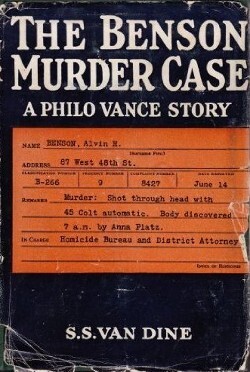
The front cover of the original Scribner’s first edition (1926). Image sourced from Wikipedia.

This first book sets the pattern for the series with District Attorney Markham inviting his friend Philo Vance together with his personal “Watson”, lawyer and confidant S.S. Van Dine, along on an investigation. Vance usually senses the culprit very early in the books, but doesn’t reveal his thinking to Markham or homicide sergeant Heath until he has assembled enough proof to convince them. Along the way, he usually banters them about how their investigations are going nowhere.

The early books are entertaining, but the pattern became predictable and tiresome towards the end of the series. Vance was frequently an irritating character due to his apparent expertise in every single area of knowledge required in each case. In his Introduction to the American Mystery Classics edition, author Ragnar Jónasson tells the story of Wright simply wanting to make the character interesting, but not necessarily likeable.

Footnotes
* Latin: an abundance of caution.
** Latin: most of these things are done in vain.

Trivia and Links
The unsolved murder of Joseph Bowne Elwell (1873-1920) was the inspiration for the plot of The Benson Murder Case. Various elements of the actual case were duplicated in the novel. The victim was found dead in a locked room with a gun at his side.


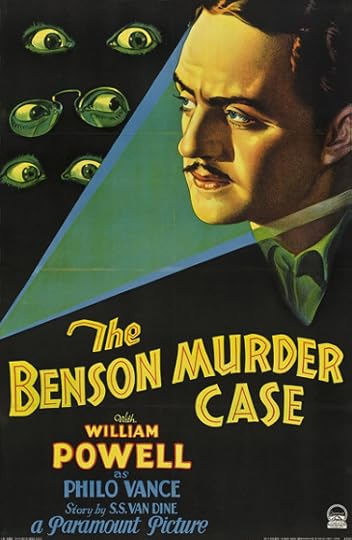
The poster for the 1930 movie adaptation. Image sourced by Paramount Pictures - Source, Public Domain, Link.

The Benson Murder Case was adapted for film as The Benson Murder Case (1930) directed by Frank Tuttle and starring William Powell as Philo Vance. You can watch the entire movie on YouTube here.

This edition of The Benson Murder Case is part of the Otto Penzler American Mystery Classics series (2018-ongoing). There is a related Goodreads Listopia here with 58 books listed as of mid April 2024. There are currently 71 titles listed at the Mysterious Press online bookshop. The official website for the series at Penzler Publishers seems to show only the most recent and upcoming titles.

The Benson Murder Case is in the Public Domain and can be read or sourced online at various sites such as Wikisource.

Willard Huntington Wright aka S.S. Van Dine is also the author of the Twenty Rules for Writing Detective Stories.
Profile Image for C.J..
Author 18 books11 followers
March 11, 2014
This exceptionally annoying book is a chilling visit to the Old Boys' Network in New York before the war. Philo Vance is a more smug & racist version of his British contemporary Lord Peter Wimsey, complacently judging people by their social class, gender, & ethnicity, as well as the shape of their skulls, while inflicting his taunting, tedious company & pronouncements upon hard-working city employees. The mystery per se is fairly interesting, although nothing unusual; Vance (=Van Dine) does take an unusual approach in looking at the case from several different points of view before revealing the solution to the murder, which of course he knew the minute he first set eyes on the corpse. Why this popinjay is tolerated by the D.A. or anyone else was beyond me. Particularly irksome were pages of esoteric art criticism & commentary (I love art, but not in the middle of a mystery!), & Vance's physically impossible peppering of his conversation with apostrophes -- not just droppin' the occasional G, don't ye know, but leavin' out ev'ry schwa and a s'prisin' range of oth'r function'l syl'bles.
Profile Image for Amy.
3,051 reviews619 followers
January 2, 2024
The real question is not 'who killed Alvin Benson?' but 'how has no one murdered Philo Vance yet?'

What an insufferable detective. I almost hate him enough to keep reading this series.
Profile Image for Judy.
443 reviews117 followers
September 28, 2019
I'd gathered before starting this one that S.S. Van Dine is an author people love or hate. So far, after reading this first book in the Philo Vance series, I'm in the 'love' camp. I enjoyed the witty writing and the detective - the effete, bored Vance, who apparently decides to solve crimes to show off his brilliance.

The story centres on the murder of a wealthy man-about-town, Alvin Benson. Police quickly think they have solved the case, but Vance doesn't agree with their theories - even though the officer in charge of the investigation, Markham, is an old friend.

Vance is at times reminiscent of Holmes and, in his affected style of speech, at times of Wimsey. He claims to be able to solve crimes via his psychological insight, regarding clues and alibis as distractions. The quantity of dialogue does slow down the story, and the number of Latin phrases dropped into conversation get a bit much, but it was a fun read all the same, and kept me guessing about the culprit's identity until near the end.
Profile Image for IShita.
44 reviews79 followers
August 6, 2016
WARNING: The review might contain certain spoilers.

What a brilliant series! I am so glad I finally decided to pick the series up, it's been shelved for me for quite a while now!

The story starts with the art Connoisseur Philo Vance sitting at breakfast with Van Dine, who run his own business, when they're called upon by the district attorney himself- Markham. He tells them about a favor a close friend asked of him and offers them to join him. The favor- a through investigation of his brother's murder. As they reach the crime scene, they're faced with a murdered Alvin Benson reclining in his chair in a position so natural you almost expect him to "to turn to us and ask why we were intruding upon his privacy". Alvin's brother, Major Anthony Benson, Markham's friend, like a good ol' big brother, offers every assistance he can and turns over a list of few names for them to start their investigation.

What makes a crime mystery truly worth reading is it's unpredictability. any book that keeps us guessing is one well written. And in this book, when you look at it and finally understand it, it's not so extraordinary- the motive, the means, opportunity. But what baffles us is- we never suspected him- the murderer. Not even until the very end when Vance finally demonstrates his case against him. But what's extraordinary are his methods of deductions. It gets further exciting when he finally explains his methods in the last chapter. With all the art and literary euphemism and references you'd think he's a philosopher of life but as it turns out, his methods do have substantiality to them.

PLOT

What more about the story and makes it that much more interesting is the fact that this is a real life case. Philo Vance, obviously not his original name, does exist. The case was indeed confusing and required considerations from more than one angle and had Vance not provided us with his great insights, we must've gotten confused with the circumstantial evidence against those suspected too. Despite of there being a twist, it's not so much because obviously Vance has known it since "five minutes later (he) entered the Benson living room".

CHARACTERS

To be honest, there's only one character I really ever want to talk about- Philo Vance . He's ingenuous! And to think that he really exist! He's, and likes to think of himself, some sort of literary philanthropist. He's quite amusing but starts to get on your nerves at times. Amusing because he's fascinating to watch and I picture him as some sort of guff, dressed in silk (which he really doesn't!), smoking a pipe (when he really smokes Cigar), a man who takes pride in his literary intelligence, artistic possessions and philosophical knowledge. His "don't y'know"s are annoying at first but as the book moves on, it kinda grows on you and you find yourself reading those with an accent. It's quite funny, the voice you use! At the same time, that vanity is precisely why he starts getting on our nerves- he thinks everyone else naive for following protocol. Not that he talks down on them but it's almost as if he pities them. That's plain irritating! But then- we can't really blame him, seeing as all minds brilliant in that respect have been some kind of "high functioning sociopaths"!

S.S. Van Dine is not just a writer, he's an attorney and has worked with Vance all through these series of cases. However, while sometimes it is refreshing to have someone who can make Vance sound less sarcastic and to level things up, we don't really see much of him. He's like a personal one-man entourage of Vance. I wish we'd seen more of him and, being as he's been following the entire case and everything, I wish he'd put some of his own remarks in it too. He plays the role of the narrator through the series and that's just that. I believe he could've come out stronger as an entity if only he'd played a little more part in it. One would think he'd understand Markham, being an attorney himself! And that scenario must've made these proceeding even more exciting- to watch him struggle as to understand what to believe- Both Vance and Markham are experts in what they do and he's very well acquainted with one while he can completely stand in the shoes of another! That unintelligent agony!

Markham was a strong character. If anyone, he had the nerves to both stand and stand up against Vance with resolution. He's smart, in the conventional sense of the word, and is also a good officer. He's not intelligent the way Vance is but is clever all the same. Although, there've been times when I found myself pitying him. But then there've also been times when I've shared his feelings of exasperation with Vance because of his know-it-all, oversmart, I've-outsmarted-you-but-I-won't-reveal-it-yet or I've-known-it-for-ages-now-you-legal-psychologically-unintelligent-fool attitude. Urgh! *eye roll* (Yes okay, you're right! Now stop with that I-told-you! attitude.)


The possibilities in this case were amazing. Everyone seemed like an obvious suspect while he wasn't so obvious at the same time. Vance demonstrates with brilliance his ways and his belief that anything and everything is possible when provided with sufficient circumstantial and material evidences accompanied by the willingness to believe in it. His methods of deductions are amazing and nothing but plain intelligent. And although brilliant, no one with a psychological knowledge would really be surprised with it. But that doesn't mean they won't be impressed!

Not to mention the writing! This was one of those beautifully technical while lyrically written books that render a different charm to crime mystery books, altogether. In my opinion, this is what makes Classic Mysteries the best combination of two of my absolute favorite genres- Classics and Mysteries. While you can be assured of having a beautiful writing experience with a classic, a story that keeps you guessing is a treat when it comes to crime mysteries. For me, the book accomplished both with superb elegance.

This is an amazing series, one of my favorites now, and I sure am gonna read it through to the end. Anyone who loves an intelligent mystery would love it.
Profile Image for Jill H..
1,637 reviews100 followers
June 16, 2013
This is the first of the Philo Vance mystery series, written in 1926 and it is definitely an acquired taste, as are all the Vance books. He is a rich dilettante who drops his "g"s, is too effete for words and reminds you of Lord Peter Wimsey. But there is something about him and the stories that Van Dine weaves that will hold the interest of the lover of the golden age mystery.

In this story, a unpopular stockbroker is murdered in his elegant apartment and Vance helps (and hinders)his friend District Attorney John F.X. Markham and Sergeant Heath of the NYPD. In the end, Vance admits that he knew who the murderer was almost at once and was interested to see how the police went about catching the culprit. There is not a lot of action here but there is a lot of dialogue, usually snooty bon mots by Vance. He is pretty insufferable but somehow you can't help but like him.

This was a very popular series during the 1920/30s but the sheen wore off as people who were in the middle of the great Depression did not want to read about rich amateur detectives who slept till noon and considered cataloging their antiques as work. My review gives the impression that I don't like this book.....on the contrary, I loved it.
Profile Image for Ren.
236 reviews30 followers
November 14, 2021
I was listening to a podcast about the Elwell murder case, and they mentioned that it was the same case that inspired this book. I had fond memories of reading some of my dad's mystery books about an American amateur sleuth, so I decided to get the ebook of the Benson Murder Case. After a few chapters, a few things became apparent:
1) S.S. Van Dine couldn't write at all;
2) Philo Vance is a pompous ass;
3) my dad read Ellery Queen, not Philo Vance.

This is a bad book. I can't overstate how bad it is. The prose contains some of the worst sentences I've been unfortunate to encounter in my life, and my work involves reading a lot of Facebook posts. Van Dine can't handle more than two characters in a scene. Several times, two characters are doing something, and then he cuts back to a third to relate what he was doing while the other two were doing something else. Not to mention the narrator, his own alter ego, who shadows Philo Vance for the entire book without ever saying a word or doing anything aside from looking at things. At one point he gives up entirely on trying to describe what the characters are even doing, and an entire dialogue is in script form.

The plot itself is mostly nonexistent. All the interesting details about the murder are copied from the Elwell murder case, which was a famous unsolved crime of that time. The solution itself is painfully obvious from the first time the murderer appears, thanks to the ineptitude of the writer. All that remains is follow along while Philo Vance jerks his supposed friend Markham around, and lets innocent people be arrested while he imparts nuggets of wisdom such as "women can't shoot people in cold blood, don't'cha know old chap, eh what?"

Some books don't age well. This book was crap in the 1920s. Don't read this drivel.
Profile Image for Ebenezer Arvigenius.
24 reviews7 followers
March 22, 2017
It is probably not fair to judge a classic by the standards of the books which will follow in its footsteps. Unfortunately, the fact that Van Dine could not rely on previous authors to avoid unnecessary errors does not make the read any more enjoyable.

From the pages and pages detailing Vance's art collection to the sneering superiority with which the main character lavishes such gems as "Evidence is irrelevant. Every halfway competent criminal expects the police to look for it and will therefore avoid leaving any" on the rubes, the book is both padded and annoying.

Adding insult to injury, the criminal case that Vance uses to show his brilliance is so easy that any Agatha Christie reader will have figured out before the half-time mark. The few red herrings used are tame and barely adequate to cover the fact that all relevant information is already revealed in the first 50 pages or so.

In the end you have a lackluster crime novel with unnecessary lengths and an annoying protagonist. If you want a window into the life of the upper class during the short period between the great depression and the great war this might be worth a read. Otherwise there are a lot of classic crime novels significantly better at what Van Dine was trying to do here.
October 8, 2014
I must admit I only picked up this book because of the Philo Vance movies with William Powell. I just love William Powell:) Unfortunately, I think this is one of the rare instances where the film is obviously better than the book it's adapted from.

This was actually a pretty boring read and I just couldn't find any of the characters likeable enough.
Profile Image for Chomsky.
196 reviews36 followers
May 7, 2019
“La strana morte del signor Benson” è un romanzo fondamentale nella storia del giallo. In Italia tenne a battesimo, nel 1929, la collana “I libri gialli” edita da Mondadori che dal colore delle copertine fece nascere il termine “giallo” per caratterizzare l'intera produzione del genere.

Il libro di Van Dine ha anche il merito di presentare ai lettori un nuovo investigatore, Philo Vance, che eredita dai grandi detective del passato come Auguste Dupin , il primo della storia, e Sherlock Holmes l'approccio deduttivo e scientifico all'indagine poliziesca.

Il romanzo venne scritto nel 1926 nel pieno del periodo chiamato dai critici “l'età dell'oro” in quanto comprende tutti i maggiori lavori della “detection” classica. Generalmente si pone come data di inizio di questo ciclo fortunato il 1920 anno in cui fu pubblicato “Poirot a Styles Court” (The Mysterious Affair at Styles) il romanzo d'esordio di Agatha Christie e come data indicativa di termine il 1929 anno in cui fu pubblicato “La poltrona n°30” di Ellery Queen.
Proprio Ellery Queen fu creato con caratteristiche molto simili a Philo Vance, un dandy che partecipa alle indagini per puro interesse intellettuale come del resto Van Dine esplicita chiaramente in un suo scritto. “Il romanzo poliziesco è un giuoco intellettuale, anzi uno sport addirittura.”

Il metodo d'indagine di Vance è però diverso da quello di Sherlock Holmes perché privilegia l'aspetto psicologico rispetto agli indizi materiali “perché tutte le indicazioni psicologiche del delitto portano a conclusioni che dimostrano la tesi anche se gli indizi reali segnano tutt'altra direzione.”

Philo Vance è l'investigatore più raffinato, colto e aristocratico di tutta la letteratura poliziesca americana, è infatti “intriso d'arte, di letteratura e di pittura”, è uno studia attivamente psicologia e colleziona opere d'arte orientali e disegni di grandi artisti come Michelangelo e Picasso.
L'autore era critico d'arte e condivide con il suo personaggio l'atteggiamento deduttivo tipico dell'esperto di pittura che “guardando una tela sa perfettamente se si tratta di un Rembrandt oppure di un Franz Hals”. Del resto non perde tempo a cercare con il monocolo la firma dell'autore del quadro perché sa benissimo che la firma potrebbe essere falsa mentre gli aspetti psicologici, le pennellate sul dipinto sono uniche e personalissime come le impronte digitali. Vance cerca di comprendere il carattere del colpevole come dell'autore di un'opera d'arte, di farlo risalire ad una determinata scuola. I particolari materiali, come le tracce concrete, lo interessano solo come conferma postuma del suo intuito. La sua “vista mentale”, come diceva il filosofo Nicola Cusano, intuisce ciò che è prima di ogni cognizione proprio come un sagace intenditore inferisce l'autenticità di un quadro dai particolari più insignificanti come la forma di un orecchio o lo spessore di un aureola.

Definito da Raymond Chandler “'investigatore più balordo della storia del giallo” (“asinine” è il termine inglese usato) Philo Vance si dimostra invece scaltro e capace di una ferrea visione logica deduttiva incredibilmente precisa che gli consente di capire in pochi minuti, da tanti indizi psicologici, il colpevole dell'assassinio del signor Benson, Per poter convincere il suo amico Markham, il procuratore distrettuale che si occupa del caso, però Vance deve prima elaborare tante teorie che poi provvede a demolire per dimostrare che gli indizi sono ingannevoli e che solo attraverso i fallimenti si raggiunge l'unica soluzione soddisfacente, metodo che in questo anticipa la teoria della falsificazione di Karl Popper.
“Mi avresti fatto processare per calunnia, dice Vance al procuratore distrettuale, e ancor oggi, solo ingannandoti continuamente sul vero colpevole, ho potuto a malapena persuaderti ddella verità.”
Una mente dedita al sospetto, come quella del lettore abituale dei gialli, avrebbe potuto cogliere gli indizi sapientemente sparsi durante il romanzo ma il vero godimento del libro consiste nel rileggerlo per disporli nella dovuta importanza e allora il colpevole si delinea proprio come si è mostrato immediatamente a Philo Vance, con tutti le sue tracce psicologiche inimitabili.

Come un bambino che scompone la macchinina per capire come funziona, Willard Huntington Wright, a riposo forzato dopo un esaurimento nervoso o un abuso di droghe, come dissero i maligni, in convalescenza lesse tantissimi gialli e si divertì a smontarli per capire i meccanismi intimi e segreti del genere per poter poi creare un romanzo moderno e intrigante, lubrificando e migliorando gli ingranaggi narrativi.
Questo risponde anche alla domanda che molti si saranno posti, chiedendosi per quale motivo si debba leggere un giallo che ha quasi cent'anni.

Con “La strana morte del signor Benson” si torna al punto in cui il giallo moderno è iniziato, contemporaneo all'età del jazz esaltata da Francis Scott Fitzgerald nei ruggenti anni venti.


Profile Image for Jenny.
1,219 reviews102 followers
July 17, 2021
*****3.5*****

This is now my fourth Philo Vance novel. I fell in love with Vance as an amateur sleuth because he's such a character. He's intelligent, snobbish, droll, witty, and funny. He has respect for his friends, and he genuinely cares about finding the guilty party only because it means not wasting resources on innocent people or convicting innocent people. I also realized when watching a Philo Vance movie, starring one of my favorites, William Powell, that Vance was an inspiration for one of my own characters. It wasn't a direct inspiration--I realized it when watching Powell as Vance because Powell played him straight. Everything that makes Vance Vance was left out of Powell's version, which was disappointing because otherwise, Vance is just an amateur sleuth but also because Powell could play Vance.

Anyway, back to this book. It's the first Vance novel, so we get a lot more backstory than usual. Van Dine, the first-person narrator, tells us about his history with Vance and who Vance is with asides and footnotes throughout. I really enjoyed the story, though it did lag in places, but as usual, it was more about Vance and his interactions with the other characters. I always love social commentary, and Vance offers plenty of that, such as remarking on America's philosophy that big is beautiful, which affects everything from skyscrapers to art. He also remarks on America's lack of gastronomy, claiming that it's a sign of our decadence. Interesting perspective. He comments on the legal system most, of course, and he also remarks on modern democracy, claiming that it's basically accumulating as much ignorance as possible at the polls in hopes of achieving intelligence as a whole. He even calls out the DA, his good friend Markham, for caring more about the death of one man than the death of millions in World War I. Yet, Vance also comments on art and philosophy and on melons. Yes, melons. Did you know there were only two species of melons? Watermelons and muskmelons (didn't even know that was a thing), and apparently, in Philly in the 1920s, cantaloupe was used as a generic term to refer to all melons. Vance's knowledge is so random.

About this edition of the book. So, I was upset because I own the three other Vance books I've read, and they're all the same format--hardcover, black with the title and author in red, green, or orange, and from the 1930's, I believe. I thought I was ordering the same binding on Amazon, but I got this version instead. I like having all the books in a series in the same format, and this book is drastically different. But I got over it quickly because this 2020 edition of the first Vance novel is beautiful. The gilt edges, the art deco cover...I love it. Plus, the editors included a biography on S.S. Van Dine, pen name of Willard Huntington Wright.

Now, I knew that S.S. Van Dine was a penname and that Van Dine had written the first Philo Vance while he was sick. But I had the whole rest of the story wrong (thanks a lot, Wikipedia). Wright was a literary critic, and he lived in Paris for a time with his artist brother. He was very avant-garde and believed that conservative people needed to be confronted with the literary, controversial work being put out by his contemporaries. He was doing well for a time but ended up getting fired, and he was sick because he was ill and a cocaine addict. So, while he was recovering, he read mysteries to entertain himself and keep his mind off his troubles, and even though he maligned mysteries as popular fiction, he thought he figured out the key of how to write bestselling ones.

And he did. He wrote the Vance novels but used a pseudonym because he didn't want anyone to know that he, Willard Huntington Wright, was writing popular fiction. He made good money, got involved with the film versions too, but then fell out of popularity and died at 50 years old. According to the bio, Wright based Vance off himself a bit, and I can see how. Like Vance, Wright was snobbish, but he also knew so much about so much. I mean, how else is Van Dine including these details unless Wright himself knew them? So, there are a lot of quotes from philosophers and a lot of information about art and literature and random phrases in other languages, mostly French and Latin. I think this is what makes the books and Vance himself the most interesting for me.

Okay, I blabbered on for far too long. Overall, I liked this first book in the Philo Vance series, mostly because of Vance's asides and monologues (especially when he's talking about random subjects to Markham's disconcertion), and I strongly recommend the book/s to mystery lovers, people who like gaining random knowledge (like about melons) through books, and to people interested in snapshots of 1920's life (references to the war, the fashions, the cars, the language and culture, Prohibition, etc).
Profile Image for Antonio Fanelli.
1,030 reviews204 followers
June 30, 2021
Avevo ben vivo l'ottimo ricordo di Albertazzi in bianco e nero, quindi mi sono tuffato nel romanzo; non scorre purtroppo: Vance è antipaticissimo, chi gli sta intorno ha una pazienza innaturale, e la storia non offre alcun appiglio, peccato.
2 reviews
August 2, 2014
I enjoyed this book. I have to admit I binge read it and loved the New York settings and the accurate characterizations of New York types. Some people are highly critical of this style- I enjoy all kinds of books. Remember this book is almost 100 years old and for a detective mystery it moves along with style and ease- bouncing from one dump of red herrings to another. I intend to read the others over time as this is an acquired taste. I like to read books that are only available as eBooks , science thrillers and ones that might be a little unpolished as I enjoy digging in the author dirt. Lord knows there are enough trolls out there steeped in anger and negativity so I perfer to be encouraging if the writer has put in a worthy effort. Even though this one has been dead for some time I gave it 5 stars and admire that the work is still worth the read! Consider it if you'd like something different that doesn't read like a movie script... :-)
15 reviews2 followers
November 8, 2021
I read a lot of Golden Age mysteries, and I've learned that, along with the gems, there's a lot of dross. There's misogyny, racism, xenophobia, and anti-Semitism. They're a product of their time, and I accept that. I class Philo Vance as a lot of dross.

Vance is supposed to be a psychologist, and he's supposed to use psychology to solve crimes. In reality, he's an annoying know-it-all who reveals the solution little by little, presumably because he likes to appear smarter than everyone else around. I was expecting an American Sir Peter Wimsey; what I got was an unmitigated ass.

Frankly, if Vance had revealed what he knew right away, this book would have been a short story, and that would have been a good thing.
Profile Image for Jokoloyo.
455 reviews304 followers
July 23, 2016
A fine standard classic mystery. My first read of the author. For mystery game, the author played by the rule fairly.

For personal taste, I am tired with the many philosophical quotes in the main protagonist's voice in talking. Maybe for fulfilled number of words quota of the novel?
Profile Image for lise.charmel.
524 reviews194 followers
May 19, 2025
Primo romanzo della serie dell'iconico investigatore Philo Vance, ricco e colto appassionato d'arte newyorkese, che risolverà il crimine grazie al suo acume psicologico.
La trama in breve è questa: viene assassinato un agente di borsa sgradevole e senza scrupoli. Lungo il romanzo vengono sospettati a turno un po' tutti quelli che lo conoscevano, fino a che Vance non farà emergere la verità.
Alcuni dettagli sono proprio di facile comprensione (e infatti non si capisce come la polizia non ci arrivi), altri forse un po' datati (come la convinzione che il colpevole non possa essere una donna), ma complessivamente è un racconto gradevole, forse un po' troppo inframezzato da osservazioni su arte, architettura e musica che nulla aggiungono alla trama e che per il lettore del secolo successivo sono poco significative.
Comunque nel complesso una lettura gradevole e prevedo in futuro di proseguire la serie.
Profile Image for John Lee.
870 reviews14 followers
February 14, 2021
From the precis that I had read the master sleuth in this book, and series, sounded as if he could have been entertaining. He was an arrogant dandy with a liking for fine food and wine and was a connoisseur of the Arts.
The book was written around the beginning of the 20th century and in the early days of Detective fiction. Like some of the earlyday Japanese Murder fiction, this story is a little claustrophobic around the crime itself and close witnesses. It seems very clinical in its approach.

I skipped parts of the early paragraphs of introduction of the Detective himself, Philo Vance. He struck me a little like the Sherlock Holmes character, a consulting detective. However, I fear that had this appeared in a serialized version in The Strand, it wouldn't have survived. At least the Holme's stories engendered some excitement which was missing here.

I suppose that it was a fair who-done-it but for me, it dragged and lacked much of the background story and colour that makes modern day murder mysteries more enjoyable. I suspect that the author knows more about these early days of policing in America than I but I found the situation with District Attorney most strange. From the invitation for Vance ( a private citizen although a member of the same club) to join him in what was always going to be a high level case, to his refraining from punching him or at the very least threatening him with 'withholding information or wasting police time'. It must be an American thing !

My other criticisms was of the writing style and the overuse of foreign ( french and latin) words/phrases - sometimes several on a page. My online translator had never been as busy until I realized that they added nothing and ignored them.

The author was well known in his day and tried his hand with this character while recovering from an illness. He was not sure how successful it would be and so wrote under this 'nom de plume' (see ! he's even got me doing it now). This series runs to a dozen or so books. I really wanted to like it.
Before deciding, I even checked the definition of each star on the rating system to make sure I was being fair. I settled on 2* - 'It was OK'. All that said, I don't rule out a return to the series at some future time.
Profile Image for Alexander Inglis.
75 reviews9 followers
June 11, 2011
SS Van Dine, the pseudonym of Willard Huntington Wright, created the popular fiction detective Philo Vance. His first appearance was in The Benson Murder Case, which was published by Scribner's in 1926. Another 11 novels appeared, about one per year, until his early death in 1939 at the age of 51.

There are some, like the current Philo Vance wiki author, who believe "Vance's character as portrayed in the novels might seem to many modern readers to be supercilious, obnoxiously affected, and highly irritating" and, actually, that's true. Throughout this tale, I heard the unmistakable inflected accent of Lord Peter Wimsey, without his corresponding business-like masculinity. As Ogden Nash quipped: "Philo Vance / Needs a kick in the pance".

But that's really unfair. Yes, the book is a little padded, and the explanations at times wearyingly long-winded, but there's also terrific charm. And, without question, the work is an expression of its time: the period shortly after WWI when New York was re-emerging from the chill of war and for the first time feeling its strength as a true International capital -- and before the devastation that would hit four years later as the markets crashed. It was a time of much greater class delineation, and certainly an era where being called an immigrant was not yet pejorative. Much of this tale inhabits the privileged class of which Vance was securely, and proudly, a member.

So, there's my own long-winded way of putting it: a charming bon-bon of classic early American detective fiction that's well worth devouring.
Profile Image for Libros Prestados.
472 reviews1,045 followers
January 29, 2017
Es un cuatro raspado, porque entiendo que parte de la gracia de la novela era demostrar que el método psicológico de Philo Vance funciona, pero a veces lo ciegos, cabezotas y densos que eran los policías me sacaba un poco de quicio. También el hecho de que Philo se guardara información para sí, aunque al final explica por qué lo hizo y se lo perdono.

Hacia las tres cuartas partes de la novela, cuando el fiscal del distrito y amigo de Philo ya se fía de él, todo discurre con mucha más naturalidad y se da paso a una resolución tal vez algo previsible, pero ingeniosa, y que en mi caso no decepciona.

Sin duda es un misterio clásico, que en vez de basarse en la deducción fría y las pistas comos otros detectives, se basa en la figura de Philo Vance, un "diletante"culto, irónico y flemático que estudia los crímenes como si de obras de arte se tratara, reconociendo al auto no por las pistas, sino por la impronta personal del autor.

Aunque el hecho de que los policías y el fiscal se agarraran a su forma de investigar aún cuando Philo había acertado varias veces me molestó un poco, lo cierto es que la novela me ha divertido mucho y creo que los amantes del género lo encontraran una lectura interesante y entretenida. Y a Philo Vance un detective carismático y distinto a muchos.
Profile Image for Donna.
1,030 reviews31 followers
November 19, 2021
Challenges: Buddy Read November 2021/Janelle (Too Fond of Books); Fall Into Reading 2021 - Classic (12/15, 1926 Golden Age of Mystery). The author is the omnipresent narrator and reporter of the proceedings in the case. The first in the Philo Vance series by Willard Huntington Wright (S. S. Van Dine), Vance is brought into the case out of curiosity at a friend's bidding. Vance uses a psychological approach to educe the murderer and demonstrates that evidence supporting motive, means, and opportunity can not only cloud an investigation, but can also send any number of innocent persons to prison or death. Room décor, personality and physical traits of characters, step-by-step movements of the suspects are given in great detail. The story is well-organized with each chapter covering a salient point of the mystery within a timeline of day and time of the week in which the murder is solved. Illustrations of various domiciles and rooms are included. A plot driven mystery that places the reader in the well-to-do class of the late 1920s and early 1930s with all of its sentiments and prejudices. A unique experience from today's perspective.
67 reviews43 followers
March 28, 2022
"The first mystery book by Willard Huntington Wright (1888-1939), or S.S. Van Dine, "The Benson Murder Case", based on an actual New York murder, was published in 1926. Philo Vance, his detective, based to quite an extent on Lord Peter Wimsey, was an amusing and brilliant dilettante as well as a smart deductive detective...the mysteries Van Dine wrote changed the face of mystery writing in the 1920s, from the formalized story to an intimate picture of New York life, close to romans à clef"
(H.R.F. Keating)
"Philo Vance's first case allows him to explode not one but five successive police theories, until at last he reveals the murderer of Alvin Benson, the stockbroker everyone loved to hate."
(Art Bourgeau)
There's a lot of fun in this book and there's Philo Vance.
Well, either you like Philo Vance, and the way he is, or you hate him.
I'm sorry folks but I like him.
This is a very good mystery book. Don't miss it.
Profile Image for Jane (Avid reader).
362 reviews4 followers
January 28, 2022
In every way a thoroughly irritating book. I persevered to the end only because it is my 1926 pick out of 101 years of books I plan to read this year.

I listened on audio and the narrator drawled and sniffed his way through the book. This was compounded by ludicrous claims by Philo Vance (friend of the district attorney), that to determine the murderer all you need is a good understanding of psychology and phrenology and that physical evidence has nothing to do with it. Many readers find this approach endearing and are great fans of Philo Vance - I am not among them. Perhaps I may have been slightly less disenchanted if I had met him on the printed page rather than via a really terrible narration.
Profile Image for aynsrtn.
487 reviews12 followers
December 19, 2024
Sebuah novel detektif klasik yang tak hanya menyajikan investigasi dan penyelidikan kasus misteri pembunuhan, tetapi menilik juga dari aspek psikologi, kriminologi, hukum, filsafat, fisika, seni rupa, mitologi yunani, metafisik, dan estetik dari seorang Philo Vance, full-time nobleman, part-time detective, yang jenius, sarkas, dan nyentrik (baca: ngeselin pula, haha).

5⭐️ !!!

Buku ini beneran paket komplit sebuah kisah detektif. Tidak ada plot hole dan yang bikin aku suka banget buku ini adalah pembaca digiring untuk mengungkapkan satu per satu terduga baik secara alibi, motif, dan modus operandi.

Aku banyak mendapat pelajaran dari Bapak Vance mengenai investigasi, deduksi, dan penalaran dalam pemecahan kasus misteri:

1. Pengakuan
pengakuan saja tidak bisa dijadikan bukti dalam penegakan kasus karena ada faktor psikologis yang menyertainya.

2. Motif
mencurigai [terduga] tersangka karena memiliki motif itu terlalu universal. justru janggal kalau motifnya [mudah] ketahuan. sebab, seharusnya motif ditutupi sedemikian rupa, jika orang itu tersangkanya.

3. TKP (Tempat Kejadian Perkara)
penjahat bakal kembali ke TKP itu tidak masuk di nalar psikologis. karena jika dia tersangka, dia justru menjauh sejauh mungkin dari TKP, bukannya malah kembali ke TKP.

4. Mencurigai orang
tidak bisa langsung serta merta mencurigai terduga yang terlihat gugup dan takut, sebagai tersangka. karena justru kalau tidak salah, malah akan terlihat takut dituduh. sementara yang salah, dia berusaha menutupinya dan pura-pura tenang.

Keempat hal di atas membuka perspektif baru untukku. Thanks, Mr. S.S. Van Dine for the greatest detective novel and created Mr. Philo Vance 💐

Terakhir—sekaligus yang paling utama, adalah interaksi dan dinamika hubungan Vance dan Markham—jaksa wilayah. Debat dan obrolan (kadang seringnya debat kusir) mereka berdua sampai dikasih disclaimer sama penulisnya, haha.

Ingatlah: kedua orang ini teman dekat; dan, dengan segala perbedaan dalam sifat keduanya, mereka saling memahami dan menghormati satu sama lain. Keterusterangan mereka—yang terkadang keras bahkan kasar—merupakan wujud rasa hormat tersebut.-p. 110

They are a wholesome. Counter attack, bite and also hug each other, the bickering, and the sarcasm. Paling suka kalau mereka udah saling ribut kek Vance udah mode fafifu wasweswos ala filsuf, Markham udah mode idgaf, "nggak usah banyak cingcong, jadi apa kesimpulannya?", hahaha. Their energy🤙

Well, no word again, just awesome!!
Displaying 1 - 30 of 263 reviews

Can't find what you're looking for?

Get help and learn more about the design.