

What do you think?

Detour
1938. Alexander Roth is hitchhiking from New York to Los Angeles, hoping to reconnect with his self-absorbed, cutesy-poo girlfriend. A car stops to pick him up and he is soon plunged into a nightmare from which there may be no escape.
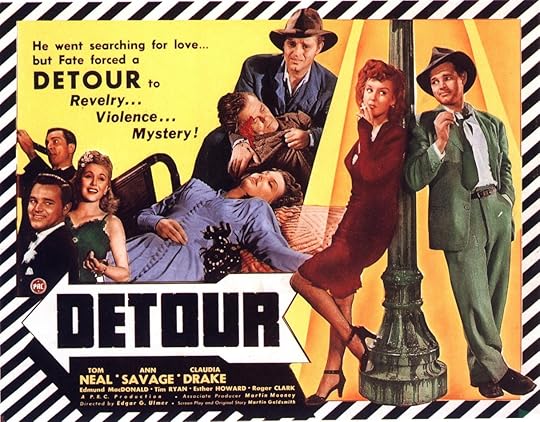
This fatalistic novel is a forgotten noir masterpiece that has languished for decades in the swamps of neglected crime fiction. In 1945, film director Edgar G Ulmer cranked out the movie version in a couple of weeks on a microscopic budget, and it is now widely recognized as one of the greatest gems in film noir history. The novel is its equal in every way, exploring the very darkest corners of the human condition.
Legendary crime fiction author Lawrence Block provides a foreword unique to this edition.
This fatalistic novel is a forgotten noir masterpiece that has languished for decades in the swamps of neglected crime fiction. In 1945, film director Edgar G Ulmer cranked out the movie version in a couple of weeks on a microscopic budget, and it is now widely recognized as one of the greatest gems in film noir history. The novel is its equal in every way, exploring the very darkest corners of the human condition.
Legendary crime fiction author Lawrence Block provides a foreword unique to this edition.
146 pages, Kindle Edition
First published January 1, 1939
Ratings & Reviews
Friends & Following
Create a free account to discover what your friends think of this book!
Community Reviews
Displaying 1 - 30 of 32 reviews

September 28, 2020
Towards the end of the Great Depression in the late 1930s, fiddle player Alexander Roth leaves New York City, hitchhiking to Los Angeles. Sue, a night club singer with whom he was living in New York has decided to follow her dreams and go out to Hollywood in the hope of becoming a star. Still in love with Sue, after a few weeks of living without her, Roth decides to follow her to the Coast. He hopes to reconnect with Sue and to find a job himself. He's been told that it's easy for musicians to find work in Hollywood.
In the meantime, he's almost flat broke and is having trouble getting rides. Finally somewhere out in New Mexico, he's offered a ride by a well-dressed man driving a powerful and expensive roadster. Even better, the guy says that he's going all the way to L.A. Roth figures that he's now got it made and will soon be reunited with Sue. Just out of Phoenix, though, the driver says he's not feeling well. They switch places and while Roth is driving, the guys dies. Roth has no intention of taking illegal advantage of the situation, but in attempting to help the man out of the car, the guy slips out of Roth's grip and his head cracks off the pavement in such a way that it now looks like Roth may have hit him over the head and killed him.
In short, this is a classic noir setup in which an innocent man suddenly finds himself in an impossible situation. Roth fears that if he tries to tell his story to the cops, they won't believe him and will arrest him. So he attempts to make the best of a bad situation by hiding the guy's body, appropriating his car, his money and his identity and heading off to California.
Things will naturally go from bad to worse.
The story is told mostly from Roth's point of view with some alternating chapters describing Sue's life in California. She still loves Roth and is having trouble being discovered. We learn about her problems attempting to make a success of her life, and Goldsmith describes very well the nasty underside of the Hollywood dream which consumes most of the innocents like Sue who come to the Coast seeking fame and fortune.
The Sue chapters are interesting, but they tend to break the tension of the chapters describing the trials and tribulations that Roth is enduring, and the book is a bit weaker for that. In addition, the book turns on a coincidence that is simply impossible to believe. But if you can let that slide, it's still a very entertaining read and fans of noir fiction are sure to enjoy it. It's nice to see the book back in print.
In the meantime, he's almost flat broke and is having trouble getting rides. Finally somewhere out in New Mexico, he's offered a ride by a well-dressed man driving a powerful and expensive roadster. Even better, the guy says that he's going all the way to L.A. Roth figures that he's now got it made and will soon be reunited with Sue. Just out of Phoenix, though, the driver says he's not feeling well. They switch places and while Roth is driving, the guys dies. Roth has no intention of taking illegal advantage of the situation, but in attempting to help the man out of the car, the guy slips out of Roth's grip and his head cracks off the pavement in such a way that it now looks like Roth may have hit him over the head and killed him.
In short, this is a classic noir setup in which an innocent man suddenly finds himself in an impossible situation. Roth fears that if he tries to tell his story to the cops, they won't believe him and will arrest him. So he attempts to make the best of a bad situation by hiding the guy's body, appropriating his car, his money and his identity and heading off to California.
Things will naturally go from bad to worse.
The story is told mostly from Roth's point of view with some alternating chapters describing Sue's life in California. She still loves Roth and is having trouble being discovered. We learn about her problems attempting to make a success of her life, and Goldsmith describes very well the nasty underside of the Hollywood dream which consumes most of the innocents like Sue who come to the Coast seeking fame and fortune.
The Sue chapters are interesting, but they tend to break the tension of the chapters describing the trials and tribulations that Roth is enduring, and the book is a bit weaker for that. In addition, the book turns on a coincidence that is simply impossible to believe. But if you can let that slide, it's still a very entertaining read and fans of noir fiction are sure to enjoy it. It's nice to see the book back in print.

May 21, 2023
a total gem. but strangely forgotten.
darkly hilarious and even better than the classic b&w film adaptation for me.
darkly hilarious and even better than the classic b&w film adaptation for me.

June 4, 2016
Flat-broke fiddle player Alexander Roth is hitching his way to L.A. in search of his runaway fiancée, Sue. He's picked up by Haskell, a swell in a nice car, who's also toting a wad o' cash. Good set up for bad things to happen. And they do.
There's no doubt that Goldsmith possessed some keen writing skills, and the second half of the book is packed with tricky fun. However, I was put off by his decision to alternate chapters between Alex and Sue. The AWOL paramour and would-be-starlet's swoonings over which man she really loves, sigh, are hand-wringingly overdramatic, and take away from intensity of Alex's tale. There's also an unintentionally hilarious Reefer Madness moment that had me rolling my eyes. Then there's the problem that the climax depends on a coincidence so implausible, it could only happen in, well, Hollywood.
Despite the missteps, the story builds to a satisfying, for me anyway, conclusion. While I don't think this book deserves the title of "noir classic," it was still a fun and fairly compelling read. And, now . . . onto the movie!
There's no doubt that Goldsmith possessed some keen writing skills, and the second half of the book is packed with tricky fun. However, I was put off by his decision to alternate chapters between Alex and Sue. The AWOL paramour and would-be-starlet's swoonings over which man she really loves, sigh, are hand-wringingly overdramatic, and take away from intensity of Alex's tale. There's also an unintentionally hilarious Reefer Madness moment that had me rolling my eyes. Then there's the problem that the climax depends on a coincidence so implausible, it could only happen in, well, Hollywood.
Despite the missteps, the story builds to a satisfying, for me anyway, conclusion. While I don't think this book deserves the title of "noir classic," it was still a fun and fairly compelling read. And, now . . . onto the movie!

June 6, 2016
Now don't try to tell me that man is master of his own destiny. What happened to Haskell proves that you never can tell what's in the cards for you, and the road you aim to take nine times out of ten turns out to be a blind alley; either that, or it leads someplace quite different. If you think I'm all wet in this theory, you'll have to show me where.
Alexander Roth is on the road from New York to Los Angeles. He's having a hard time getting there without money or food, harrased by the cops and worried about how his former gal Sue will receive him after she had a taste of Hollywood glamour. His luck seems to be changing for the better when he is picked up from the side of a road by a wealthy man who goes all the way to the West Coast. Fate, or God or Alex's bad luck conspire to derail his plans. The journey will take a detour into darkness, danger, despair and, at the end of the road, most probably death.
Alex Roth is baffled at how easy a man's life can go to ruin. A talented concert violinist from New York and, from the style of his narration, a well read young man, Alex finds himself playing in cheap jazz bars, getting into fights over his hot girlfriend Sue, ultimately fired, on the bum and in jail like so many of his compatriots in the aftermath of the Great Depression. He is becoming a bitter man, a cynical observer of human folly, but deep down he probably still has hopes of turning his luck around, once he gets reunited with Sue in the place where dreams come true.
They say that money is nothing, that a buck is only a piece of paper crawling with germs, and that you can't buy happiness with cash. I say sour grapes. Name me one thing money can't buy. Respect? That's usually the first item people mention. Well, will you tell me who respects a guy without money? A guy that's starving, say, or on the bum? Go on the bum some time and find out how much respect you get. I know. Love? That's usually the next come-back. Brother, don't ever let anyone pull that one on you. You can win a woman a lot easier with a mink coat than with poetry and walks in the park.
Detour is for me an excellent example of the 'hidden gem' from that dramatic period of American modern history that is expressed so well through the structures of 'noir' novels. I found it to be closer in themes and style to James M Cain doomed anti-heroes than to the hard-boiled knight-detective of Chandler or Hammett. The text is not only concise and hard edged, something that I enjoy in most of the novels from the period, but also intelligent and authentic in the moderate use of Depression era slang.
Alex is in general, and mostly in the beginning, a likable character who tries to make the best of the bad set of cards that were dealt to him. The way the reader is led to doubt Mr. Roth's motives and sincerity is another good selling point of the novel. We can take Alex's confession at face value and believe him to be a victim of a corrupt system and of the general deviousness of the 'females of the species', or we can hold back our judgement and notice how self-serving some of these confessions are. Alex is afraid of the police and bitter about the dames, but he is not above making a profit from a bad situation and from casting a roving eye at every woman he meets on the trip.
Cops, as a rule, are overbearing and brutal, swollen up with their own authority which they abuse. Instead of being public servants, they bully the public and treat ordinary citizens like criminals. In spite of the law to the contrary, in a station-house a man is guilty unless he can prove an alibi.
Cops are bad in Alex's book (and this particular rant demonstrates that law enforcement hasn't progressed much since 1939), but the women are even worse. In the novel they are fickle, greedy, treasonous, vindictive etc. This is in keeping with the general atitudes of men at the time the novel was written, although it may not sit so comfortably in the minds of modern readers. A good part of the book is written from the perspective of Sue, a chorus dancer of limited talent yet great ambition, a gold-digger who is ready to do just about anything to get what she considers is her due. It was jun for the most part to compare notes on their relationship between Alex and Sue, and for me it was still more fascinating to look at Hollywood not as a dream-factory, but as a graveyard of abandoned hopes where only the most ruthless succeed.
Says Alex : Sue was - and for that matter must still be - a gal who can bother anybody under the age of seventy. Pretty as a dream, blonde and green eyed, it is her habit to open those big eyes wide, pout that red Cupid mouth, and crawl right under a guy's skin. That is exactly the way she crawled in under mine.
Says Sue : Men are funny, sometimes. A girl can semaphore every signal in the book before the fellow wakes up and finds the war is over.
Some readers may look at the chapters narrated by Sue as unimportant to the main story of the detour in Alex's life, only included here as a filler to get to the required number of pages. There's also an argument to be made that it's pretty clear that Sue (and Vera, for what it's worth) are characters written by a man, and a cynical one to boot. Goldsmith is not very complimentary about the basic nature of a woman's personality, even as he acknowledges the difficulties faced by a woman on its own in a world dominated by men - Sue is waiting tables why she waits for that fabled call from Selznyck, Vera has an even worse job record as another American on the bum in the 1930's. Yet, what sticks to the mind at the end of the lecture are the furious rants of Alex Roth and his putting the blame on the women for his plight:
If there is any worse spot than for a man to find himself a slave to a woman's whims I'd like to know about it. What makes it so tough is you never can be sure what a woman will do. At one moment she's calm and everything is velvet; then, in a flash, it all explodes sky-high and she's got it in for you. And when she's got it in for you, brother, look out. There are never any halfway measures. A woman loves or she hates. Pity and all the feelings in between she never even heard of.
and in another place:
She laughed, like the Romans must have laughed when they saw some poor Carthaginian slob being mangled by a dozen lions. "Oh, don't thank me yet, brother. I'm not done with you by a long shot. Let's see that wallet."
I am glad I 'discovered' Detour with a little help from my friends in the "Pulp Fiction" group. I recommend it as a fine example of the genre and I can't wait to check out the movie version scripted also by Martin Goldsmith. I'll say farewell now, with a last quote from Alex Roth that seems to encapsulate one of the basic tenets of 'noir': the fact that Life never follows the convenient conventions of a Hollywood script and that happy endings are a way to make the mugs part from their dough:
I was just coming to the conclusion that men are mere debris in the gale Fate whips up, and that when they make future plans they are fools. My own case is a corking example. Was it Shakespeare, Robert Burns or Ralph Walso Emerson who wrote, "The best laid plans of mice and men often go blooey"? Well, whoever it was said a mouthful.

May 2, 2021
Quite odd 1939 'noir' in which fate grabs violinist Alex Roth as he hitchhikes to LA to reunite with his girlfriend, Sue. The book covers his story, which certainly holds your attention, and her story, which seems to have little relevance to the final product and is not really that interesting. This puzzled me so much that I went a found the 1945 movie in which, while she remains as a character in his narrative, her story is completely left out. I feel that was probably a good decision. Not a particularly great story or great writing, but worth a read if only for its being solid noir and a little different.

June 16, 2020
A violinist named Alexander Roth is hitching rides across the country on his way to Los Angeles to be with his actress girlfriend and gets waylaid along the way by unfortunate circumstances. This essential, classic noir stands out because of its strong writing. Many of the pulp novels back then, because of their quick turn out, felt hastily written, but this one really feels like a little more time was taken to craft the work. Another thing that stands out and that I expect felt different back then was the parallel storytelling, jumping back and forth between Roth's predicament and the story of his girl Sue and her life in Hollywood as a struggling actress. I loved the way the twists in each story revealed themselves and what they meant for the other plotlines. I wish there was a little more substance to Sue's story beyond her pining for love though. But with a cool plot, good writing, a ruthless fatale, and doom-filled atmosphere, this one should definitely be included on any noir bookshelf!

August 11, 2017
Detour is a hell of a novel. And it’s an unheralded classic of noir fiction. Alexander Roth, a jazz musician, and Sue Harvey, a jazz singer. Alex and Sue lived together in New York before Sue left for California to pursue her dreams of Hollywood. Sue's share of the narrative tells of her life in California without Alex. Alex's narrative tells what happens when he tries to hitchhike to California to rejoin Sue.

June 2, 2015
Toward the end of this book we find the main character musing about how great things would be if "our lives could be arranged like a movie plot," and how MGM does a "much better job of running humanity than God." As he says, "Things are plotted in straight lines," and
"There are never any unexpected happenings which change everything about the hero but his underwear."
In this book, though, Alex Roth finds his life turned upside down precisely due to a number of "unexpected happenings" that detour him away from his dream of a decent life with the woman he loves. Detour is a compelling, dark novel and the film based on this book is also really good, considering that it was made on a shoestring budget and took only a few days to make.
Briefly, Alex Roth is thumbing his way across the US from New York to Los Angeles to reunite with his singer girlfriend Sue Harvey. Roth had worked hard his entire life training to be a classical violinist, but ends up instead in a club in New York city playing with a band. That gig ended one night when a customer decided to make a pass at Sue and decided to "pat her fanny," causing Alex to see red. It also caused him to lose his job. A month later, just days before Sue and Alex had planned to be married, Sue decides to hotfoot it to Hollywood to take her chances. Alex, down to his last fourteen dollars, is sort of stuck there, but eventually he too decides to head west to see Sue and to try his own luck in the movies, a la "Heifetz or Kreisler." So off he goes, and makes it as far as Texas before the money runs out and he finds himself in jail for a month. Back on the road once more, Alex is somewhere on Highway 70 in New Mexico when a car stops to pick him up, and it's then that, as he informs us, we have "reached the part where all the mess begins."
And oh, what a mess it is!
for more re plot you can click here to get to my reading journal.
Here we have deadly women, life's plans taking a huge detour for pretty much all of the main characters in this novel, and an overwhelming fatalistic atmosphere all combining to make for an incredible book, which in my opinion definitely falls squarely into the noir camp. It's one of those books that reminds me of watching a train wreck, where you just know beyond a shadow of a doubt that something terrible's going to happen, but you just can't take your eyes away from what's coming. Considering the short length of this story, it grabbed hold of me and wouldn't let go.
Coincidence, fate, whatever you call it, is a huge part of the story here. I think Alex's film counterpart says it best when he notes that
"That's life. Whichever way you turn, Fate sticks out a foot to trip you."
recommended for pulp, noir, and darker crime fans. Booyah! Fine novel.
"There are never any unexpected happenings which change everything about the hero but his underwear."
In this book, though, Alex Roth finds his life turned upside down precisely due to a number of "unexpected happenings" that detour him away from his dream of a decent life with the woman he loves. Detour is a compelling, dark novel and the film based on this book is also really good, considering that it was made on a shoestring budget and took only a few days to make.
Briefly, Alex Roth is thumbing his way across the US from New York to Los Angeles to reunite with his singer girlfriend Sue Harvey. Roth had worked hard his entire life training to be a classical violinist, but ends up instead in a club in New York city playing with a band. That gig ended one night when a customer decided to make a pass at Sue and decided to "pat her fanny," causing Alex to see red. It also caused him to lose his job. A month later, just days before Sue and Alex had planned to be married, Sue decides to hotfoot it to Hollywood to take her chances. Alex, down to his last fourteen dollars, is sort of stuck there, but eventually he too decides to head west to see Sue and to try his own luck in the movies, a la "Heifetz or Kreisler." So off he goes, and makes it as far as Texas before the money runs out and he finds himself in jail for a month. Back on the road once more, Alex is somewhere on Highway 70 in New Mexico when a car stops to pick him up, and it's then that, as he informs us, we have "reached the part where all the mess begins."
And oh, what a mess it is!
for more re plot you can click here to get to my reading journal.
Here we have deadly women, life's plans taking a huge detour for pretty much all of the main characters in this novel, and an overwhelming fatalistic atmosphere all combining to make for an incredible book, which in my opinion definitely falls squarely into the noir camp. It's one of those books that reminds me of watching a train wreck, where you just know beyond a shadow of a doubt that something terrible's going to happen, but you just can't take your eyes away from what's coming. Considering the short length of this story, it grabbed hold of me and wouldn't let go.
Coincidence, fate, whatever you call it, is a huge part of the story here. I think Alex's film counterpart says it best when he notes that
"That's life. Whichever way you turn, Fate sticks out a foot to trip you."
recommended for pulp, noir, and darker crime fans. Booyah! Fine novel.

October 25, 2015
Published in 1939 this is the source novel for the classic noir film Detour, for which Goldsmith also wrote the screenplay. I will follow-up with a longer review after I do some more work on it because this is an important noir classic - a seminal book in noir sensibility actually - that was completely skipped over and not even mentioned in the three major book length studies of the genre: Haut's Pulp Culture: Hardboiled Fiction and the Cold War, O'Brien's Hardboiled America: Lurid Paperbacks And The Masters Of Noir, and Horsley's The Noir Thriller. While those books focus is on "hardboiled" fiction, the omission of Detour is striking given that other non-hardboiled books and writers are discussed at length. Goddis being a prime example. And Goldsmith wrote some great hardboiled dialogue! So this one never should have been skipped. Even the Film Noir: The Encyclopedia, although it devotes nearly a full page to the movie, does not mention the novel, even in the appendix where it lists source novels for the films! I think this is a great example where the fame of the film has completely submerged the novel. Goldsmith's screenplay is brilliant and he clearly never received enough credit for the film. Much of what directer Edgar G. Ulmer is given credit for is all right there in the shooting script, which was not a collaboration as so many screenplays are once the director is involved. Goldsmith sold the rights with the stipulation that he write the adaption from his novel. It was the lowest of budgets film and his screenplay is notable for the amount of camera direction it includes. The intent was for cast and crew to show up and just shoot.
The part of the novel that is most faithfully reproduced in the screenplay adaptation and in the movie is five stars. But the novel also contains two long chapters from Sue's point of view. The voice in those is not done as well and that drags the novel down a bit. The screenplay and movie both seem better for cutting these sections out. Not sure what I would have thought of these Sue narrated sections if I had read the novel before I'd read the screenplay or seen the movie (more than 20 times now!). Seems better noir without them that's for sure.
More later . . .
The part of the novel that is most faithfully reproduced in the screenplay adaptation and in the movie is five stars. But the novel also contains two long chapters from Sue's point of view. The voice in those is not done as well and that drags the novel down a bit. The screenplay and movie both seem better for cutting these sections out. Not sure what I would have thought of these Sue narrated sections if I had read the novel before I'd read the screenplay or seen the movie (more than 20 times now!). Seems better noir without them that's for sure.
More later . . .

April 8, 2008
Disclaimer: I have seen the movie version of Detour three times before now having read the book, so my reaction to the book is unavoidably colored by my familiarity with the movie (which I love).
Detour the novel alternates between two narrators: Alexander Roth, a jazz musician, and Sue Harvey, a jazz singer. Alex and Sue lived together in New York before Sue left for California to pursue her dreams of Hollywood. Sue's share of the narrative tells of her life in California without Alex. Alex's narrative tells what happens when he tries to hitchhike to California to rejoin Sue. Detour the movie (scripted by Martin M. Goldsmith, who also wrote the novel) tells only Alex's story. In the movie, Sue is already in California, and we never learn anything of what has become of her. In this way, the novel is richer than the movie. Not only do we learn of Sue's fate, but her story and Alex's story enrich each other--his story is made more complex and more powerful by our knowledge of her story, and vice versa.
Unfortunately, there has not been a decent reprint of Detour since the hardback first edition of 1939. Recent paperbacks by O'Bryan House and Blackmask.com, in addition to their dubious legality, are textual disasters. Both seem to have been produced by ten-year-olds who were given OCR software for Christmas. Readers beware!
Detour the novel alternates between two narrators: Alexander Roth, a jazz musician, and Sue Harvey, a jazz singer. Alex and Sue lived together in New York before Sue left for California to pursue her dreams of Hollywood. Sue's share of the narrative tells of her life in California without Alex. Alex's narrative tells what happens when he tries to hitchhike to California to rejoin Sue. Detour the movie (scripted by Martin M. Goldsmith, who also wrote the novel) tells only Alex's story. In the movie, Sue is already in California, and we never learn anything of what has become of her. In this way, the novel is richer than the movie. Not only do we learn of Sue's fate, but her story and Alex's story enrich each other--his story is made more complex and more powerful by our knowledge of her story, and vice versa.
Unfortunately, there has not been a decent reprint of Detour since the hardback first edition of 1939. Recent paperbacks by O'Bryan House and Blackmask.com, in addition to their dubious legality, are textual disasters. Both seem to have been produced by ten-year-olds who were given OCR software for Christmas. Readers beware!
October 10, 2014
If you’re familiar with the 1945 film noir classic, Detour, check out the novel on which it was based. Written by Martin M Goldsmith in 1939, the novel is every bit as good as the film. There are several editions of this book on Amazon right now, but the others are poorly edited and formatted. This is the newest one (2014), and it's pretty clean.
Also, this one is unique in that it comes with a foreword written by crime fiction legend Lawrence Block.
Detour is as noir as it gets. Alexander Roth, a small-time musician from New York, is hitchhiking across the country to hook up with his girlfriend in Los Angeles. She's already made the trip and is in LA seeking fame and fortune in the movies, but she's having a tough time breaking in.
Alex, meanwhile, is having his own problems. A car stops to pick him up, and … well, no spoilers here. But let's just say, "that's noir, baby".
Also, this one is unique in that it comes with a foreword written by crime fiction legend Lawrence Block.
Detour is as noir as it gets. Alexander Roth, a small-time musician from New York, is hitchhiking across the country to hook up with his girlfriend in Los Angeles. She's already made the trip and is in LA seeking fame and fortune in the movies, but she's having a tough time breaking in.
Alex, meanwhile, is having his own problems. A car stops to pick him up, and … well, no spoilers here. But let's just say, "that's noir, baby".

June 26, 2008
Overlooked, underrated and otherwise forgotten gem of a noir classic. This would have to be in the top 50 of hardboiled crime novels. Besides being a great story, it has a lot of the plot elements of a hardboiled classic, including the ironic and likely improbable plot twist upon which, in this case, the story hinges.

October 29, 2016
Detour starts well, with down-on-his-luck sometime musician Alex thumbing a ride to Los Angeles to look for his girl. His journey takes a twist when he his picked up by a mysterious chap in a flash car. Unfortunately, the POV alternates between Alex and his girl, and she is pathetic and irritating to the extreme. This leads to an interesting tale going downhill fast and becoming rather silly. Detour could have been Chandler-Lite, but ends up more soft-boiled and runny.

November 14, 2020
What a wonderful book this is! The writing is so tight; every word is exactly the word that belongs where it is. Of course there are dead bodies (though no intentional murder), slimy used-car salesmen, women one just should not pick up on the road and more. Nicely noir.
Poor, poor Alex Roth--the definition of "if it weren't for bad luck, he'd have no luck at all". All the guy wants to do it hitch hike to LA to join his lady love. And he gets a ride in a very fine automobile. The guy who picks him up even buys him a steak dinner, easily picking up on how long it's been since Alex has eaten. Sadly, everything conceivable that could go wrong for Alex, does go wrong, even the things that look sort of good at first blush. But no.
The characters are spot on. You can't not like Alex and feel for him. The others you might not like so much, but all of them are real. And there is a bit of wisdom to be had--if you must hitch hike, please be very careful out there.
Poor, poor Alex Roth--the definition of "if it weren't for bad luck, he'd have no luck at all". All the guy wants to do it hitch hike to LA to join his lady love. And he gets a ride in a very fine automobile. The guy who picks him up even buys him a steak dinner, easily picking up on how long it's been since Alex has eaten. Sadly, everything conceivable that could go wrong for Alex, does go wrong, even the things that look sort of good at first blush. But no.
The characters are spot on. You can't not like Alex and feel for him. The others you might not like so much, but all of them are real. And there is a bit of wisdom to be had--if you must hitch hike, please be very careful out there.

August 24, 2021
Bleak. Not as bleak as some other noir books but still pretty bleak.

November 28, 2021
dripping with pulp

June 21, 2016
Sometimes life takes a detour.
Alex Roth, a disillusioned fiddle player, hitches a ride from the East to sunny Los Angeles with the hopes of seeing his girl, Sue, and maybe even getting a gig as a player in a band. However, things don’t always pan out how you expect, and things go really awry very quickly when Haskell, the man who offered him the ride, suddenly dies on route to Hollywood. In a panic with evidence pointing to him, Alex is in quite a pickle. Panic stricken, confused, Roth’s journey to Hollywood might be a little more suspenseful than he had hoped or expected….
In Detour, the narrative shifts back and forth from Alex’ and Sue’s vantage point, so we see the action from here and can get inside their heads and their thoughts as the plot unfolds. As Alex is up to his head in troubles of various types, he questions the laws of Fate quite often; we shift to Sue, who has her own disillusionment to work out, hers being in the Hollywood form. There is a well-done critique and criticism of the “Hollywood scene”—the games, the shams, the ultimate phoniness. Oftentimes Alex and Sue take a break in their narration to give us their own take and philosophy on life and its hopes and disappointments, and this helps us understand their character a little more. Still, I found some of their “inner musings” to be a little naïve and silly, especially from Sue when she trying to work out her feelings about love.
There were some aspects of Detour that didn’t quite add up. For starters, there were some pretty wild coincidences thrown in the plot that were a little hard to swallow. These moments propelled the plot forward, yes, but also were a tad unbelievable. Secondly, there were some points at which high tension was lessened because the action in a scene happened too suddenly or just “out of the blue” with zero build up.
That being said, there are some nice twists that really can throw you off and keep you on the edge. When Alex picks up a young woman hitching, Vera , things take off at rapid pace….
There are some classic jabs that Alex and Vera throw at each other:
Vera: “I know. But life is a ball game. You have to take a swing at whatever comes along before you wake up and find you’re struck out.”
Alex: “I bet you read that somewhere.”
Or…
“She didn’t appear to be bluffing and I was frightened. Those eyes of hers were cold. She wasn’t playing poker.”
The action moves fast and overall, despite some bumps in the road, Detour builds to an unpredictable conclusion.
There is also a film that became a noir classic from 1945, a nice companion piece to Goldsmi
Alex Roth, a disillusioned fiddle player, hitches a ride from the East to sunny Los Angeles with the hopes of seeing his girl, Sue, and maybe even getting a gig as a player in a band. However, things don’t always pan out how you expect, and things go really awry very quickly when Haskell, the man who offered him the ride, suddenly dies on route to Hollywood. In a panic with evidence pointing to him, Alex is in quite a pickle. Panic stricken, confused, Roth’s journey to Hollywood might be a little more suspenseful than he had hoped or expected….
In Detour, the narrative shifts back and forth from Alex’ and Sue’s vantage point, so we see the action from here and can get inside their heads and their thoughts as the plot unfolds. As Alex is up to his head in troubles of various types, he questions the laws of Fate quite often; we shift to Sue, who has her own disillusionment to work out, hers being in the Hollywood form. There is a well-done critique and criticism of the “Hollywood scene”—the games, the shams, the ultimate phoniness. Oftentimes Alex and Sue take a break in their narration to give us their own take and philosophy on life and its hopes and disappointments, and this helps us understand their character a little more. Still, I found some of their “inner musings” to be a little naïve and silly, especially from Sue when she trying to work out her feelings about love.
There were some aspects of Detour that didn’t quite add up. For starters, there were some pretty wild coincidences thrown in the plot that were a little hard to swallow. These moments propelled the plot forward, yes, but also were a tad unbelievable. Secondly, there were some points at which high tension was lessened because the action in a scene happened too suddenly or just “out of the blue” with zero build up.
That being said, there are some nice twists that really can throw you off and keep you on the edge. When Alex picks up a young woman hitching, Vera , things take off at rapid pace….
There are some classic jabs that Alex and Vera throw at each other:
Vera: “I know. But life is a ball game. You have to take a swing at whatever comes along before you wake up and find you’re struck out.”
Alex: “I bet you read that somewhere.”
Or…
“She didn’t appear to be bluffing and I was frightened. Those eyes of hers were cold. She wasn’t playing poker.”
The action moves fast and overall, despite some bumps in the road, Detour builds to an unpredictable conclusion.
There is also a film that became a noir classic from 1945, a nice companion piece to Goldsmi

June 27, 2016
Martin M. Goldsmith’s “Detour” was written in 1939 before Vegas was a thing. Alexander Roth finds himself somewhere in New Mexico as he is hitch-hiking to Los Angeles. Except for Phoenix and Tucson, there is nothing but desert between Roth and his goal, to meet up back with his girl, Sue Harvey. Both Harvey and Roth narrate this novel in alternating chapters. Roth begins the story by getting picked up by a Mr. Haskell. Roth tells the reader his story, what he can pick up of Haskell’s story and by the end of Chapter One, life changes drastically for both Roth and Haskell.
One of the things we learn about Roth is that he’s a liar and not a bright one at that. When Haskell asks Roth where he’s from, Haskell responds with Detroit rather with New York City. “I don't know why I said that; there really was no call to lie. Maybe I was so accustomed to lying it had become a habit, I don't know. But that's me all over. For the life of me, I can't figure myself out.”
Chapter Two ushers in Harvey’s voice which I didn’t find all that believable, not in the same sense I didn’t believe Roth, rather it is Goldmsith’s plundering about that makes Harvey seem unreal. Los Angeles really isn’t working out to well for Harvey.
“It seemed scarcely believable, but only a few months before I too had thought Hollywood a glamorous place. I had arrived so thoroughly read-up on the misinformation of the fan magazines that it took me a full week before I realized that the "Mecca" was no more than a jerkwater suburb which publicity had sliced from Los Angeles—a suburb peopled chiefly by out and out hicks (the kind of dumbbells who think they are being wild and sophisticated if they stay up all night) or by Minnesota farmers and Brooklyn smart alecks who think they know it all. I soon saw that there were only two classes of society: the suckers, like myself, who had come to take the town; and the slickers who had come to take the suckers. Both groups were plotters and schemers and both on the verge of starvation."
There are some plot points as well as some character behavior that I had problems with, but “Detour” ended as a pulp novel should. As Roth narrates, “Whether people's hopes are the result of pictures or pictures are based on hopes, I can't say. However, in real life, things rarely happen so conveniently.”
One of the things we learn about Roth is that he’s a liar and not a bright one at that. When Haskell asks Roth where he’s from, Haskell responds with Detroit rather with New York City. “I don't know why I said that; there really was no call to lie. Maybe I was so accustomed to lying it had become a habit, I don't know. But that's me all over. For the life of me, I can't figure myself out.”
Chapter Two ushers in Harvey’s voice which I didn’t find all that believable, not in the same sense I didn’t believe Roth, rather it is Goldmsith’s plundering about that makes Harvey seem unreal. Los Angeles really isn’t working out to well for Harvey.
“It seemed scarcely believable, but only a few months before I too had thought Hollywood a glamorous place. I had arrived so thoroughly read-up on the misinformation of the fan magazines that it took me a full week before I realized that the "Mecca" was no more than a jerkwater suburb which publicity had sliced from Los Angeles—a suburb peopled chiefly by out and out hicks (the kind of dumbbells who think they are being wild and sophisticated if they stay up all night) or by Minnesota farmers and Brooklyn smart alecks who think they know it all. I soon saw that there were only two classes of society: the suckers, like myself, who had come to take the town; and the slickers who had come to take the suckers. Both groups were plotters and schemers and both on the verge of starvation."
There are some plot points as well as some character behavior that I had problems with, but “Detour” ended as a pulp novel should. As Roth narrates, “Whether people's hopes are the result of pictures or pictures are based on hopes, I can't say. However, in real life, things rarely happen so conveniently.”

August 3, 2015
Detour has been one of my favourite films, and my favourite film noir, since I first had the chance to see it on the old late-night movie show out of Buffalo in the late 80s/early 90s. Can't recall the show's title, but they all acted like hep cats. A cool show that introduced me to a lot of out there stuff.
Having just recently learned that the film was based on a book, and by the same guy who wrote the movie, I knew I had to get this.
A very enjoyable read, with some minor differences. In the book the protagonist is called Alex Roth, instead of Al Roberts, and he is a violinist/fiddle player, instead of the piano player from the film. The other main characters have the same names and pretty much follow there actions from the film.
A couple of key, if not unwelcome, changes. First, Sue Harvey, his girlfriend, has a bigger part in the book. Instead of just appearing in flashbacks and on a telephone call, we get to see some of her experiences in L.A. And they are quite the experiences. The novel definitely has a strong sexual undercurrent, even more so than the film, which was already dripping with it.
Second, we get a little more information, like finding out the police have found Haskell's body, and the final fate of Sue Harvey.
Highly recommended.
Having just recently learned that the film was based on a book, and by the same guy who wrote the movie, I knew I had to get this.
A very enjoyable read, with some minor differences. In the book the protagonist is called Alex Roth, instead of Al Roberts, and he is a violinist/fiddle player, instead of the piano player from the film. The other main characters have the same names and pretty much follow there actions from the film.
A couple of key, if not unwelcome, changes. First, Sue Harvey, his girlfriend, has a bigger part in the book. Instead of just appearing in flashbacks and on a telephone call, we get to see some of her experiences in L.A. And they are quite the experiences. The novel definitely has a strong sexual undercurrent, even more so than the film, which was already dripping with it.
Second, we get a little more information, like finding out the police have found Haskell's body, and the final fate of Sue Harvey.
Highly recommended.

Read
February 6, 2013This book is awesome! Though I was lucky enough to read the 1939 edition and not the version pictured here... Not sure if I would've enjoyed it as much having to deal with that cover.
If you love the movie Detour, then definitely you must read the book. It's like the movie only with more details plus even grittier and darker and more raw because there wasn't a Hays Code for books. Also the girlfriend, who's kind of random and half-assed in the movie, narrates her side of the story in the book and it's pretty great. Vera's character is slightly less memorable than in the film version, maybe because she splits page time with Sue, but the book's still awesome if you're at all into this kind of thing... this kind of thing being the road trip to hell, desperate Depression-era style. Spoiler alert -- the last lines:
Dramatics, buddy? No, sir. No dramatics. God or Fate or some mysterious force can put the finger on you or on me for no good reason at all.
Damn straight!
And in other news:
http://www.youtube.com/watch?v=PLG-S0...
Great book!
If you love the movie Detour, then definitely you must read the book. It's like the movie only with more details plus even grittier and darker and more raw because there wasn't a Hays Code for books. Also the girlfriend, who's kind of random and half-assed in the movie, narrates her side of the story in the book and it's pretty great. Vera's character is slightly less memorable than in the film version, maybe because she splits page time with Sue, but the book's still awesome if you're at all into this kind of thing... this kind of thing being the road trip to hell, desperate Depression-era style. Spoiler alert -- the last lines:
Dramatics, buddy? No, sir. No dramatics. God or Fate or some mysterious force can put the finger on you or on me for no good reason at all.
Damn straight!
And in other news:
http://www.youtube.com/watch?v=PLG-S0...
Great book!

August 27, 2010
A largely forgotten book that was the basis for one of the seminal "B" film noirs, this novella length story is pretty darn good. The structure is a little odd. Goldsmith tells the tale from two points of view, that of Alex Roth the "protagonist" and that of Sue Harvey his girlfriend. Goldsmith's writing is more comfortable when he uses Roth's voice, but there is a compelling world-weariness to Harvey, who simply wants to make it in Hollywood.
Of course it wouldn't be noir without someone acting stupid and Roth certainly does his fair share of that. Vera, the femme fatale, is more than a match for the intellectually challenged Roth. Those familiar with the film (which will be legion compared to those who have read this book) will note some significant changes to please the Hayes Board. They were necessary, but ultimately detracted from the story that Goldsmith told here. And it's a story that is well worth reading.
Of course it wouldn't be noir without someone acting stupid and Roth certainly does his fair share of that. Vera, the femme fatale, is more than a match for the intellectually challenged Roth. Those familiar with the film (which will be legion compared to those who have read this book) will note some significant changes to please the Hayes Board. They were necessary, but ultimately detracted from the story that Goldsmith told here. And it's a story that is well worth reading.

March 13, 2012
This was one of the better classic pulps I've read in a while. Reading a book in one sitting is usually a good sign.

February 10, 2021
I tracked down a copy of the 2013 Black Curtain edition of this novel, which is frills-free even of original publication information and mostly typo free, except for one persistent repeated one. The font is big to give it a novel-length page count (145) but it’s really more of a novella.
I’m always interested in the ways novels get adapted to film. What’s interesting about the novel is how much more noir it feels than the film and how awful all the characters are—and none of them are on to themselves except maybe Vera. She doesn’t get a chance to speak for herself. Chapters alternate between Al and Sue. Al is originally Alexander Roth, changed to the generic Al Roberts in the film. Roth surely chosen for the point of someone waxing wroth, as Groucho might say.
Everybody in this novel is very angry, too. Alex is a lot more of a jerk than the hapless innocent the film makes him. Picked up hitching, he’s asked where he’s from but says Detroit instead of New York. ‘I don’t know why I said that; there was really no call to lie. Maybe I was so accustomed to lying it had become a habit, I don’ know. But that’s me all over. For the life of me, I can’t figure myself out.’ He is indeed in pursuit of his Sue, whom he idealises ridiculously, in the same way he disparages women in general. ‘If there is any worse spot than for a man to find himself a slave to a woman’s whims I’d like to know about it.’ Of course this is when he’s dealing with Vera, but as he concludes, ‘All women are dangerous.’
‘What makes it so tough is you never can be sure what a woman will do. At one moment she’s calm and everything is velvet; then in a flash, it all explodes sky-high and she’s got it in for you. And when she’s got it in for you, brother, look out. There are never any halfway measures. A woman loves or she hates. Pity and all the feelings in between she’s never heard of.’ Alex pities himself more than anybody else, even when he’s murdering someone.
While there’s still some uncertainty about Haskell’s death, there’s no lame attempt to make Vera’s death accidental as with the ridiculous scene in the film. His loathing just wells up. ‘She was the type of woman I have always despised: the kind who knows all the answers and makes no bones about being hard-boiled. Even though I know just how women are underneath, I still prefer them to have that phony sweetness in their manner.’ Alex prefers lies.
The big difference in the novel is Sue. The second chapter catches up with her in California—right after a date rape. She’s full of tears and recriminations, mostly aimed at herself. ‘When a man gets finished, he’s through; his appetite’s been satisfied, except now he wants a plate of ham and eggs. We girls are quite another story. We have emotions and what not. We feel things. Any woman will know what I’m talking about. So I felt terrible.’
Singer Sue goes to Hollywood to break into the films but ends up waiting tables. In the film she gets a moment of that on the phone with Al. In the novel we see a lot more of her life. She really has an ambition to get into the pictures, but is hesitating to give in to the casting couch. Her weary dissection of Hollywood’s shabby reality still can’t dim her dream. Sue hopes the B-actor Raoul will give her leg up instead of getting a leg over.
Angry with herself, she finally gets even more angry at Raoul’s obliviousness. He thinks he gave her a swell time and asks for another date. At first she tries to find the easiest way to slip out of any commitment, but his cocksure attitude – flourishing his fountain pen to write in his address book – tips her anger over the edge and she tells him he’s been a terrible lover. ‘There was a jubilance in me for the first time in ages. I watched him flinch and I knew I had struck home, into the most vulnerable spot in the man’s armour.’ She is pleased he’s so deflated and talks of it as a way to ‘avenge poor Alex’ too.
It would give more sympathy to her character if Goldsmith didn’t make plain that she is everything that Alex thinks of women: duplicitous, vengeful, cruel and above all, an actor. When Haskell’s death is reported as Alex’s, Sue performs grief styles she has seen in films, trying to convince herself she feels something other than relief. All it really does is boost her confidence that she can make it in Hollywood after all.
And Alex? ‘I wasn’t sorry she was dead; just sorry it was me who killed her.’ Nothing is as he claims, except maybe this. The original film had to soften the ending a bit. The remake is closer to the book. The twists and turns match Alex’s own thoughts: ‘God or fate or some mysterious force can put the finger on you or on me for no good reason at all.’ Not getting caught; it’s the same as not being guilty for him as long as he can keep wondering about that fateful day Haskell picked him up on the road. ‘Well, sometimes I want to curse and sometimes I want to cry.’
[Originally posted https://punknoirmagazine.com/2020/04/...]
I’m always interested in the ways novels get adapted to film. What’s interesting about the novel is how much more noir it feels than the film and how awful all the characters are—and none of them are on to themselves except maybe Vera. She doesn’t get a chance to speak for herself. Chapters alternate between Al and Sue. Al is originally Alexander Roth, changed to the generic Al Roberts in the film. Roth surely chosen for the point of someone waxing wroth, as Groucho might say.
Everybody in this novel is very angry, too. Alex is a lot more of a jerk than the hapless innocent the film makes him. Picked up hitching, he’s asked where he’s from but says Detroit instead of New York. ‘I don’t know why I said that; there was really no call to lie. Maybe I was so accustomed to lying it had become a habit, I don’ know. But that’s me all over. For the life of me, I can’t figure myself out.’ He is indeed in pursuit of his Sue, whom he idealises ridiculously, in the same way he disparages women in general. ‘If there is any worse spot than for a man to find himself a slave to a woman’s whims I’d like to know about it.’ Of course this is when he’s dealing with Vera, but as he concludes, ‘All women are dangerous.’
‘What makes it so tough is you never can be sure what a woman will do. At one moment she’s calm and everything is velvet; then in a flash, it all explodes sky-high and she’s got it in for you. And when she’s got it in for you, brother, look out. There are never any halfway measures. A woman loves or she hates. Pity and all the feelings in between she’s never heard of.’ Alex pities himself more than anybody else, even when he’s murdering someone.
While there’s still some uncertainty about Haskell’s death, there’s no lame attempt to make Vera’s death accidental as with the ridiculous scene in the film. His loathing just wells up. ‘She was the type of woman I have always despised: the kind who knows all the answers and makes no bones about being hard-boiled. Even though I know just how women are underneath, I still prefer them to have that phony sweetness in their manner.’ Alex prefers lies.
The big difference in the novel is Sue. The second chapter catches up with her in California—right after a date rape. She’s full of tears and recriminations, mostly aimed at herself. ‘When a man gets finished, he’s through; his appetite’s been satisfied, except now he wants a plate of ham and eggs. We girls are quite another story. We have emotions and what not. We feel things. Any woman will know what I’m talking about. So I felt terrible.’
Singer Sue goes to Hollywood to break into the films but ends up waiting tables. In the film she gets a moment of that on the phone with Al. In the novel we see a lot more of her life. She really has an ambition to get into the pictures, but is hesitating to give in to the casting couch. Her weary dissection of Hollywood’s shabby reality still can’t dim her dream. Sue hopes the B-actor Raoul will give her leg up instead of getting a leg over.
Angry with herself, she finally gets even more angry at Raoul’s obliviousness. He thinks he gave her a swell time and asks for another date. At first she tries to find the easiest way to slip out of any commitment, but his cocksure attitude – flourishing his fountain pen to write in his address book – tips her anger over the edge and she tells him he’s been a terrible lover. ‘There was a jubilance in me for the first time in ages. I watched him flinch and I knew I had struck home, into the most vulnerable spot in the man’s armour.’ She is pleased he’s so deflated and talks of it as a way to ‘avenge poor Alex’ too.
It would give more sympathy to her character if Goldsmith didn’t make plain that she is everything that Alex thinks of women: duplicitous, vengeful, cruel and above all, an actor. When Haskell’s death is reported as Alex’s, Sue performs grief styles she has seen in films, trying to convince herself she feels something other than relief. All it really does is boost her confidence that she can make it in Hollywood after all.
And Alex? ‘I wasn’t sorry she was dead; just sorry it was me who killed her.’ Nothing is as he claims, except maybe this. The original film had to soften the ending a bit. The remake is closer to the book. The twists and turns match Alex’s own thoughts: ‘God or fate or some mysterious force can put the finger on you or on me for no good reason at all.’ Not getting caught; it’s the same as not being guilty for him as long as he can keep wondering about that fateful day Haskell picked him up on the road. ‘Well, sometimes I want to curse and sometimes I want to cry.’
[Originally posted https://punknoirmagazine.com/2020/04/...]

January 7, 2025
I'd been almost inclined to give 4 stars, because I'd wondered if some of my pleasure in the book is from having seen the movie: I'm picturing Ann Sheridan firing off all Vera's dialogue, and she does a great job with it. But then I discovered that the same author turned his own book into the screenplay, so I'm not going to quibble. Both the book and the tight little film contain the same energy and excitement.
Where they differ is that the book is largely two stories, and the film Detour ignored Sue's story (which was a good decision: books can handle parallel plots, Middlemarch managed it very nicely) but the short breakneck pace of the film version would have been derailed by including Sue's bits.
But in the novel, she's half the story. And wow. What a character she turned out to be. She's up there in my top 10 most awful-people list (excluding evil serial killers, obviously they're no good) in fiction. She's the sort of person that people used to refer to as "what a piece of work," I'm not sure what the current slang would be. Perhaps simple: she nasty.
A very compelling read throughout.
(Note: I'm a writer, so I suffer when I offer fewer than five stars. But these aren't ratings of quality, they're a subjective account of how much I liked the book: 5* = an unalloyed pleasure from start to finish, 4* = really enjoyed it, 3* = readable but not thrilling, 2* = disappointing, and 1* = hated it.)
Where they differ is that the book is largely two stories, and the film Detour ignored Sue's story (which was a good decision: books can handle parallel plots, Middlemarch managed it very nicely) but the short breakneck pace of the film version would have been derailed by including Sue's bits.
But in the novel, she's half the story. And wow. What a character she turned out to be. She's up there in my top 10 most awful-people list (excluding evil serial killers, obviously they're no good) in fiction. She's the sort of person that people used to refer to as "what a piece of work," I'm not sure what the current slang would be. Perhaps simple: she nasty.
A very compelling read throughout.
(Note: I'm a writer, so I suffer when I offer fewer than five stars. But these aren't ratings of quality, they're a subjective account of how much I liked the book: 5* = an unalloyed pleasure from start to finish, 4* = really enjoyed it, 3* = readable but not thrilling, 2* = disappointing, and 1* = hated it.)

June 8, 2019
Except for the ending, this book is pretty much exactly like the movie that was made from it. It's a Calvinism on steroids story. Alex Roth is a violinist (piano player in the movie) working in New York His girlfriend leaves to head for Hollywood to become a star, and Alex later hitchhikes out to join her. The Detour happens when a driver who picks him up dies, and Roth assumes his identity, hiding the body in a ditch and taking the money and identity. Things go downhill for him from there (though he doesn't start on a very high note). The book devotes several chapters to his Hollywood girlfriend, and things don't go well for her, either. Like the movie, it's a brief story of a descent into hell. Well worth the couple hours it will take to read it (and only about 80 minutes to watch the movie). Recommended.

July 3, 2021
Fantastic from beginning to end.

November 27, 2025
Strange crime novel, two different people a married couple separated, different stories as they become involved in as the guy as chance sends him down the wrong way.Easy read, don't want to put down.
December 22, 2025
It's 2/3 of a good book.

January 10, 2009
My husband was so excited for me to read this book that I'm hesitant to write my review. The book was great, but didn't strike me as amazing. And perhaps my two viewings of the movie has affected my reading. The book, as is usually the case, is richer than the movie and shares a developed storyline about Sue that isn't present in the movie. And the book is sadder, more despairing for it.

November 4, 2014
Very good.
Displaying 1 - 30 of 32 reviews