Jump to ratings and reviews
Rate this book

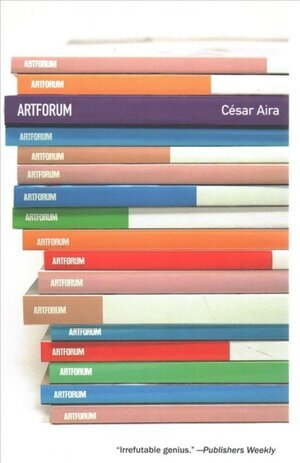
Artforum

Rate this book
"Me hice una pregunta extraña, sólo justificable por lo extraño de la situación: ¿me amaba la 'Artforum' a mí? Si su sacrificio había tenido por objeto salvar a las otras revistas, y yo era el dueño y lector de esas revistas, entonces ella había valorado más mi felicidad que su vida, y objetivamente eso se parecía al amor. (¡Pero cuánto se había equivocado! Porque yo la quería más a ella que a todas las demás revistas juntas).

¿Un objeto podía amar a un hombre? Toda la historia del animismo se encerraba en esa pregunta. Pero los antropólogos que habían intentado responderla nunca habían tenido ocasión, como la tenía yo, de formularla frente a un objeto que les hubiera dado la suprema prueba de amor".

86 pages, Paperback

First published October 1, 2014

12 people are currently reading
649 people want to read

About the author

César Aira

260 books1,149 followers
César Aira was born in Coronel Pringles, Argentina in 1949, and has lived in Buenos Aires since 1967. He taught at the University of Buenos Aires (about Copi and Rimbaud) and at the University of Rosario (Constructivism and Mallarmé), and has translated and edited books from France, England, Italy, Brazil, Spain, Mexico, and Venezuela. Perhaps one of the most prolific writers in Argentina, and certainly one of the most talked about in Latin America, Aira has published more than eighty books to date in Argentina, Mexico, Colombia, Venezuela, Chile, and Spain, which have been translated for France, Great Britain, Italy, Brazil, Portugal, Greece, Austria, Romania, Russia, and now the United States. One novel, La prueba, has been made into a feature film, and How I Became a Nun was chosen as one of Argentina’s ten best books. Besides essays and novels Aira writes regularly for the Spanish newspaper El País. In 1996 he received a Guggenheim scholarship, in 2002 he was short listed for the Rómulo Gallegos prize, and has been shortlisted for the Man Booker International Prize.

Ratings & Reviews

What do you think?
Rate this book

Friends & Following

Create a free account to discover what your friends think of this book!

Community Reviews

5 stars
189 (33%)
4 stars
238 (42%)
3 stars
115 (20%)
2 stars
17 (3%)
1 star
3 (<1%)
Displaying 1 - 30 of 102 reviews
Profile Image for Gaurav Sagar.
203 reviews1,718 followers
December 24, 2025
Having read a few books by Cesar Aira- The Divorce and The Literary Conference- I have already developed a special inclination towards the author but I was looking for something which could fill the void of dissatisfaction one may feel after experiencing an outlandish encounter with chance, a slim and crisp beauty sneaks a glance from the bookshelf towards me, it sheds off the fog of timidity and launches itself as Artforum. I gather myself and muster courage to be ready for another serendipitous likelihood of improbable possibilities.


As I open the (perceived) pandora box I watch with contemplative surprise that a copy of ravishing and bewitching magazine sacrifices itself to save other not so uncommon magazines. The act inspires me to realize that perhaps mundane and routine acts of everyday life do not act out of serendipity, and it persuades me to ponder upon the possibility that a magazine may think and thereby take decisions. The martyr is Artforum, the favourite magazine of the narrator, the discernment takes us to the deep cervices of memories associated with our childhood wherein we use to infuse soul and life in inanimate objects and thereby experiencing the sheer bliss of animism. Over the period of time as we get metamorphosized owing to the effect of maturation, we gradually shy away from the divine game of animism and steadily these expeditions take refuge under stealth and seclusion, and shame enwraps our consciousness since we are no more supposed to indulge in once great game of solitude. However, Cesar Aira catapults us to those cherished reveries and in fact, sheds away our guilt and shame of maturity and makes us believe these games of our sacred space of solitude may be played in so called matured age too.


source


We, the reader of amusing literature, find the companion of our souls in the author and feel a moral responsibility to payback our debt by being on his exuberant literary expeditions. The narrator of Aira takes us on the speculative sojourn of exploring his beloved art magazine, Artforum through bookstores to show auto fictional prowess of the author. What follows a series of contemplative and entertaining reflections of the author on life, day-to-day activities, essentially about the process itself through which we assimilate life. It is a curios fantasy or rather more of hallucination than simply a fantasy infused with overwhelming reality. Artforum puts all the traditionally accepted genres to shame in fact, it reduces the forms of literature themselves to nothingness since it is a perfect amalgamation of essays, fiction, and non-fiction. It offers rich insight into process of creation of art itself and the desire to possess.


The narrator feels the emptiness and void as he keeps on longing for fulfilment of his obsessive passion but the elusive magazine, Artforum fails to fill the void entirely, since there is always delayed satisfaction due to the anticipation of the impending issues of the magazine. Within emptiness’s attraction to fullness dwelled an inevitable delay, because there was always a new plenitude, absent and remote. The object of desire of the narrator keeps his fire of obsession burning throughout the narrative, only eventually to realize that the narrator does not have much to do with the being and essence of Artforum, and it also questions our so-called passions as to whether they are really authentic or are based upon hollow references wherein our maddening obsessions are shielded in a layer of fervors.


The prose of Artforum forces you to take pauses and contemplate over each and every word as if the prose has been refined with the precision of a surgeon to avoid any superfluidity. Though it seems to be dealing with routine and mundane escapades which are being taken to extraordinary proportions by pushing the very limits of the language and the desires too to the level at which human emotions seems to be knocking the door of obsession and madness.


There is a series of ill-proportioned sections distributed along a timeline of thirty years, these pondering and ruminating sections are interspersed by an interlude of clothespins which keep on breaking irrespective of the materials they are made up of, the reason is a disintegration at subatomic level which the author choses to call as “material fatigue”. The clothespins take it on themselves scarifying themselves to pull along the narrative together perhaps for conveying that there is nothing eternal in life, not even art forms and these art forms are annihilated only to bring up new forms.


It is inevitable that the reader would be reminded of Borges since like him, Cesar Aira spurts out creative burst of imagination wherein the reality is taken to outlandish levels by stretching the very limits of literature. However, I would say Artforum is more closely related to If on a winter’s night a traveller by Italo Calvino since like Calvino the author here develops the narrative on the process of longing for an object, exploring the joys and melancholy of anticipation without realizing the object itself.


source
Profile Image for Fionnuala.
887 reviews
Read
August 20, 2024
Artforum was in my pocket the other day while I was sitting on a rock in a very stony cove waiting for the tide to come in. That little cove is new to me and I was very curious to see how it would look at full tide. I checked the time of the high tide on my phone and figured I could wait the two hours it would take to arrive.

Because the shoreline of the cove is full of stones, the waves were breaking far out beyond them, and I figured the water would have to rise quite a bit before the waves would begin to break near where I was sitting. I love watching waves rise, surge and break, the intricate lace of their edges disappearing back into the sea from where they were formed, so I was more than happy to wait.

While the water was rising slowly, swirling around more and more of the seaweed-covered stones, I took Artforum out of my pocket and read some of the narrator's thoughts about waiting for his 'Artforum' magazine to arrive from New York to his home in Buenos Aires each month.

Every now and then, I looked up from the book to see how close the breakers were getting and to check that my rock was still clear of the rising water. As the narrator spoke about waiting for his magazine being 'an empty waste of time', I thought about the things that needed doing in the holiday-weekend rental at the top of the steps behind me—mainly, the food to be prepared for the evening meal.

But waiting for the breakers to reach my rock had become the most important thing in the world at that moment, and I knew I would not abandon my post for anything. When the waves finally reached me, my heart soared with the energy of the sea exploding around me. And then I had the crazy desire to drop Artforum into the surging sea and watch it being tossed hither and tither. I was certain César Aira would have cheered me on—his book is partly about transformation of everyday objects—and he would have been as curious as I was about the changes the book would undergo in contact with the energy of the sea.

But alas I didn't drop it, and now it's too late. The book and I have returned home, both unmarked by the force of the sea—but not completely unchanged. I will never forget those two hours spent waiting and waiting for the tide to fill up the stony cove, and the book, in its place on the shelf, has become the repository of that experience.
Profile Image for Glenn Russell.
1,513 reviews13.3k followers
Read
March 30, 2022


Hey, César! Absorbed in reading the latest issue of Artforum?

Artforum - international magazine of contemporary art headquartered in New York City.

Artforum – quirky 80-page novel featuring a narrator sharing much in common with author César Aira: he’s a writer who lives in Buenos Aires, in an apartment on the second floor; every morning he bikes to a café, orders espresso and writes in his notebook for an hour (but never more than an hour); he spent his boyhood in the provincial town in Pringles; he can occasionally become a tad obsessive over an object or idea.

Artforum is playful, philosophical and very funny. I read and reread sections for the sheer delight of it. I chuckled, I chortled and occasionally laughed out loud. If you haven’t read any of the Argentine author’s short novels (nearly all under 100 pages), I encourage you to pick up Artforum. If you are like many readers of literary fiction, you’ll become an instant fan and yearn for more. Fortunately, 16 other books by César Aira are available in English from New Directions.

Artforum begins with a stroke of the miraculous: upon waking one rainy morning, César (yes, I’ll call the unnamed narrator César) races around his apartment closing windows since he knows what damage rain can inflict. Sure enough, it appears rain soaked his stack of precious magazines on the glass table by the window. But wait – what’s this? To César’s dismay, there’s a sphere the size of a soccer ball sitting on top of his magazines. César can see the soaking wet ball is none other than a copy of Artforum, the one with a work of artist Robert Mangold on the cover, the very magazine he cherishes above all others.

Upon closer inspection, as impossible as it might seem, this Artforum magazine now turned soaking wet ball performed a sacrificial act: it absorbed every drop of rain so the other magazines beneath could remain perfectly dry. “Useless and unreadable, I loved it more than ever. I asked myself a strange question, justified only by the strangeness of the situation: did it love me?”

César knows very well his posing this question of an object being capable of loving him encapsulates the entire history of animism - in other words, perhaps the beliefs of indigenous peoples are right and our modern world is wrong, objects like his Artforum soccer ball are, in fact, capable of thought and emotion, they can direct their love and compassion to someone like himself.

Such a question, César! - a question leading to further inquiries that, in turn, propel you to initiate a monumental change in your life, an absolute first: to set up, via computer and credit card, a subscription whereby you'll receive the monthly edition of not just any magazine but your very own copy, mailed to you directly, of your beloved Artforum. Both astounding and positively life-altering.

Thus we're off, joining César on his adventures revolving around his relationship with Artforum, adventures wherein César ponders a gaggle of philosophic questions, among their number, the following trio:

Economic Realities - When a lad back in Pringles, his dad always impressed on young César how everything in life is connected to everything else. César reflects on this truism when sitting in his armchair, copy of Artforum in hand, and his eye catches sight of the price of the magazine in the upper left corner: ten dollars. What would ten dollars mean to a beggar? "The amount of money that for the beggar meant appeasing his hunger, for me gratified an idle whim, the snobbism of an armchair connoisseur."

This line of reckoning leads César to consider larger economic issues: those people who must do without so he can easily afford his much loved Artforum; the value of an Argentine peso compared to an American dollar; the trust necessary for the entire system to run smoothly (for example, he must trust all the many people in the post office who set hands on his copy of Artforum will not steal it).

In his essay on César Aira, critic Kamil Ahsan asks us to consider the author's short novels as more than simply bizarre, creative bursts of a fertile imagination within the spirit of avant-garde. Rather, on closer inspection, César Aira continues the tradition of so much Latin American literature in its scalding indictment of a global system further empowering the rich at the expense of the poor. After reading Artforum, I can see Kamil Ahsan's point.

Waiting for Godot, César style – Now that he’s one of the magazine’s bona fide subscribers, he, César, is entitled to a post office delivered copy scheduled to arrive within the first two weeks of every month. César acknowledges any reasonable person would simply wait patiently but, and this is a supersized but, patience and reasonableness are not counted among César’s virtues. “I waited with fury, day after day, and within each day, hour after hour.”

However, it only takes César a few months to detect a predictable pattern: on the morning a young couple come to clean his apartment building - wash the sidewalk and stairwell, wax the foyer and landings - turns out to be the very day his mail carrier delivers Artforum. Pondering this striking connection, César surmises “the building had to be pristine in order for the Artforum to deign to disembark therein.”

César’s wife accuses him of mocking the supernatural but César maintains his thinking is not that farfetched since, taken several steps further, “a solid and coherent system of superstitions is a religion, and an entire civilization can be built from there.” Perhaps not so coincidently, the reasoning of narrator César dovetails with the following statement made by author César during an interview: “I remember a phrase by Borges: there are no absurd ideas that have not been written at some point by a philosopher. And I add: if the idea was too absurd even for a philosopher, it must have come from a theologian.”

The Clothespins - Given an everyday occurrence, the thoughts you will think. While performing a round of household chores, a stroke of bad luck - a broken clothespin. César takes this setback as occasion to launch into a meditation on the very nature of form in our lives. César remembers the enormous clothespin of Claes Oldenberg and muses that surely human ingenuity can find ways to solve our issues with form. "And in the worst-case scenario, we would be left in a world without forms - maybe it was better that way. Maybe we have lived as prisoners of something that in reality we don't need."

Again, the above are only three of the many topics considered by César as he rambles and shambles through Buenos Aires, issue of Artforum at the ready. Pick up your copy of Artforum, the novel, and join him.


Public Art in Philadelphia - Clothespin by Claes Oldenburg
Profile Image for Lisa.
627 reviews229 followers
May 11, 2025
Cesar Aira's brief tale of his narrator's love affair with the art magazine Artforum is shared through a breezy prose of short sections that almost read like essays. The first person narration gives me an intimate feel as I am pulled into this relationship and into the narrator's adjacent philosophies.

I have never been a collector so I can only partially relate to this obsession. I can relate to the feeling of anticipation, the thrill of knowing that something or someone is on the way. Being on tenterhooks and heart rising with each car/truck coming down the street and falling when the object of my desire does not materialize.

I appreciate the philosophical bent that runs through the work such as the value of 10 pesos to a beggar vs. the value of 10 pesos (the cost of a copy of the magazine) to someone who has plenty and the consideration of forms from clothespins to Adam's first viewing of forms in the Garden of Eden.

This is not a story with a straight line from beginning to middle to end. For me it is a treat to meander along with Aira on his journey.

Publication 2014. Translation 2020.
Profile Image for Vesna.
239 reviews169 followers
March 8, 2023
What a unique and fascinating writer. He picks up what on its surface looks like a trivial and mundane issue such as the delayed delivery of the beloved magazine to expand it into a magical tale about a 30-year love affair between a human and his favorite foreign magazine. It's witty throughout with comically absurd moments but through the seemingly lighthearted prose Aira masterfully weaves his own philosophical thoughts about our obsessions, longing, waiting, melancholy, time... This is my first Aira and will definitely not be the last.
Profile Image for Lee Klein .
910 reviews1,058 followers
May 27, 2020
Eighty pages is probably the perfect length for a series of short experiential Artforum-related essays dating from 1983 to 2013, although some sections are undated, outside time, as though the clothespins of the born-on dates Aira usually very intentionally (I read an interview with him where he talked about their importance) adds at the end of his publications are malfunctioning, the way all clothespins are breaking down in his world, suggesting the end of the reign of Claes Oldenburg pop-art in favor of what? Superstition, magic, the issue of Artforum wreaked by water transforms into a magical blue orb like one of Almalfitano's magical geometrical compendiums hung out to dry so rationality can give way to the "Eastern" intelligence of the elements? Instead of magical realism, the force against which Aira by geographical and generational blessing/curse must push, it's more like magical rationalism, thinking his way through quasi-mystical or at least mysterious or not entirely effable art processes. Whatever this broken clothespin of a novel/essay collection is about, in the end its focus on Artforum is inseparable from Aira, which I think may have been his point in the end? Inseparability of objects and artists? Also about waiting, in parts, but not enough to add this to that particular canon. Worth reading again although I probably won't wind up reading it again. Generally I like Aira and his "flee forward" technique, how he trusts intuition, how he incorporates theoretical language, how he takes sudden wondrous turns, how he just as often makes the eyes glaze a bit but then you read back up the page and realize he lost you on another wondrous turn -- I also like his speed, ease, interest, audacity, idiosyncratic "artless" artfulness? Read mostly outside sitting on a beach chair in the backyard on a beautiful warm blue-sky afternoon, the day after Memorial day, during ye olde Pandemic 2020, keeping an eye intermittently on three hens intermittently spooked by the warning calls of area blue jays and crows (maybe there was an eagle about). Will definitely continue reading Aira but I think I fell off the completist wagon a few years ago and at this point am pretty much dusted.
Profile Image for Nick Grammos.
277 reviews160 followers
March 30, 2022
Art Renews from the Periphery

Artforum simply refers to the long standing journal of modern art, published in New York. Our narrator loves to read it and loves to find it. That is the premise. He pursues it like an idea. It may come from a newsstand, magazine rack or a used bookshop. It is necessary, less object. Our narrator reminds us that he is not a collector but something else. Artforum is not a fetish. A relationship forms between the narrator and the magazine.

Objects called books (and more so magazines) fulfilled their condition as objects twice over by being specialised carriers of information; they were superobjects because in their infinite variety and novelty they could supplant all other objects in imagination and desire.

Reading Cesar Aira is a lesson in the possibilities of the imagination. Where it can go and where it’s been. Kind of infinite. The forms he finds to explore were unknown before he chose them. Art magazines inform the consciousness, out of which new ideas become new books accompanied by forms. Even forms are up for examination.

There is an interlude on clothes pegs that becomes a discussion on forms. The pegs keep breaking. No matter what form they come in, plastic, wood, metal, how old - some are decades old, all suddenly destroyed. As are those who own Artforum, as we discover, a deceased gallery owner’s estate offers our narrator a chance to procure some more. The peso once the equivalent of the dollar, later devalues. So the 10 pesos given to a beggar, despite the rigid rule of the narrator not to give to beggars, is not the same as the 10 dollars he later sees on the ticket on the cover. The pegs he conjectures go through a kind of “form fatigue”, an invention perhaps arising out of readings from Artforum. Pegs suffer to prove that not even art forms are eternal, always subject to change, destruction and re-emergence as new forms. Or could we run out of forms?

Maybe we have lived as prisoners of something that in reality we don’t need

That Artforum is published in New York is significant. Our narrator lives in the southern hemisphere in Buenos Aires. He imagines northern light, which is winter light, coming through his apartment, something only us southern “hemispherites” appreciate on a cold winters day. And then there’s the distance between the world of ideas in New York and the narrator’s home. When our narrator serendipitously gets a credit card, he subscribes. But subscribing to receive something from New York to the southern hemisphere is full of pitfalls. You have to change your relationship with time. If your publication comes out on the first of every month, most subscribers will get it soon after depending on their relationship to the epicentre. Our narrator knows differently. He expects delays. It’s a hemisphere thing. Sometimes the anticipation is delicious. On other occasions delay is painful. To explain it requires a reformulation of time to appreciate. The southern hemispherite lives in a parallel dimension of time to the northerner. Such is my experience, too, of subscribing over the years to the New Yorker, TLS, Literary Review, LA Review of Books. I have to invent ways to accept the time that passes between issue and arrival. Always vague, inexplicable, full of possibilities. Like art and literature. So our narrator, to understand and accept all this, invents a calendar for each issue. The day of the month corresponds to how long it’s been since the issue was due. If longer than 31 days of a likely calendar, then a month can have 54 days. Or 38, or 109 days. This little theme of the distance between the centre and its periphery gave this little book an extra delight for me.

To love something means to lose something. Even subscriptions and magazines disappear, never arrive, are destroyed by the elements. The pursuit of the magazine has its dangers. The story opens with the horror of loss. Destruction from the element of rain. Art magazines too are subject to destruction. Forms renew, magazines can duplicate and emerge again, found in new places. Stories can too. From new places.

Addit 22 December 2021. Just to show how art imitates, I will run through my subscription to the Literary Review. I signed up to receive the first issue - September Issue - it arrived mid October. I waited for October for a while, which came this morning on my way to a 3-hour wait for a Covid test. On the way back, the November issue came in the mail. Not sure how it happened. So two came in a day, tw0+ and one+ months late. So you see, this is an important book that explains the world's workings so well. And yes, the wait is delicious, since I now have two issues to read through during the summer holidays. Unless December's comes early and I feel overwhelmed. Which was not explained by Cesar Aira. And possibly needs a new chapter.
Profile Image for Stephanie B.
175 reviews31 followers
January 5, 2023
This book is so exquisitely delicious I want to eat it, just chew up every juicy sentence and savor the experience on my tongue. I want to consume it in many more ways than one – is what I think I’m saying here.

The writing tickled my brain in the best way, and now, like the author's passionate obsession towards the elusive magazine Artforum, I have a passionate obsession for this lovely little book and author (I hear he has more….?!)

“Artforum hasn’t arrived. A state of deep melancholy has taken hold of me. I see the world through a gray veil, not even the best of jokes can exact a smile from me. I could die right now and I wouldn’t notice the difference. Or maybe I would.”

This book will make you examine your curious or absurd little obsessions with gratitude and realization that they are actually part of you - and how simply pleasure can be found.

When he (symbolically?) dies of a shot through the heart at the end of the chapter from 2002 I nearly lost it. This book is the most miniature hilarious and philosophical masterpiece I have happened upon in recent memory and I truly loved it so much.

I could not have been luckier with a better first read for 2023!

“I ran into the living room. In a way, I had already foreseen the worst, but I never could have foreseen everything. This was because of simultaneity. My mind got ahead of my eyes, my eyes got ahead of my mind, the two waited for each other so that they would coincide, making time go backwards. But time had already passed, and what I feared most had happened.”
Profile Image for G.
Author 35 books198 followers
May 22, 2017
Brillante. La pasión meditada de un coleccionista de revistas de arte pone en movimiento esa maravillosa máquina literaria de Aira que puede procesarlo todo, que es capaz de llegar al núcleo filosófico de las cosas en el primer intento. Es esa circulación del pensamiento abstracto en episodios concretos la que genera fascinación en Artforum. Desde ideas presocráticas hasta postmodernas, desde sujeciones prekantianas hasta subjetivismos felizmente evaporados, todo colapsa por la centralidad del lenguaje. En definitiva, el coleccionista no importa, la revista Artforum no importa, la filosofía tampoco importa. Lo único que importa en este libro es la narración airana, esa colección densa de mundos extraños hechos de palabras.
Profile Image for Ray Nessly.
385 reviews37 followers
July 13, 2022
Read June 2022 Edited July 2022 (additional quotes)

"Material made of spirit is the luxurious border where reality communicates with utopia."--César Aira

A few weeks ago, before I read this book, Tracy and I re-watched Wes Anderson’s film, Rushmore, for the nth time. In the soundtrack is an old Rolling Stones favorite of mine, “I Am Waiting,” from the 1966 album, Aftermath. I’d sort of forgotten the song until revisiting the film. But for several weeks, continuing while I read this book the other day (and continuing today), I can’t shake that song from my head. It’s an earworm, yes, but one I like. A persistent but very appropriate soundtrack-of-the-inner-kind, to accompany this book.

The first video is live (something you don't see everyday, Brian Jones on dulcimer!), the second is the lyrics
https://www.youtube.com/watch?v=1ytRG...

https://www.youtube.com/watch?v=YMNEo...

“I am waiting, I am waiting
Oh yeah, oh yeah
I am waiting, I am waiting
Oh yeah, oh yeah
Waiting for someone to come out of somewhere
Waiting for someone to come out of somewhere.” —Jagger, Richards

(And --bear with me-- the song’s final chorus, undiscovered until today, just might just be):

I am waiting, for Artforum
Oh yeah, oh yeah
I am waiting, for my magazine
Oh yeah, oh yeah
Waiting for it to show up here someday

The narrator of Artforum, you see, is obsessed with the magazine of the same name. (He also really, really digs pens. But who doesn’t?) Much of his time and energy in these pages is spent waiting. Waiting, anxiously, two days for a bookstore to open so he can score 24 back issues of Artforum before another collector beats him to it. Waiting, day after day, for the postman to deliver his subscription, but the issues almost always fail to arrive. And then they stop altogether. So he considers building, like sculptures, his own replicas of the magazine.. He plans it all out but doesn’t follow through, for which “I’ll never forgive myself.”

If you love a straightforward plot, this is not your book. The whole of the conflict is that his demand for Artforum exceeds the supply, and the price he pays is anxiety, an unrequited desire for Artforum. (Straight out of ECON 101, no?). For me, where these pieces get most interesting is when the narrator muses about what his obsession has to say about materialism and about objects themselves. At times the book reads like fictional non-fiction, fictional essays where the asides get quirkily philosophical and absurdist, and now and then, funny. Here and there also is some amazing prose.

In the opening piece, The Sacrifice, the narrator's favorite issue of Artforum is atop a stack of magazines by an open window, and becomes soaked with rain. It somehow forms a perfectly spherical, soaked ball, the issues underneath it completely undamaged. He wonders, did it sacrifice itself to save the other magazines, and does this mean that it, a mere though beloved object, loves him?:
“It had placed more value on my happiness than on its own life, and objectively that seemed like love…. Can an object love a man? … The entire history of animism was contained in that question.”

Also in this chapter: “Objects were carriers of information. All of them, from cathedrals to little balls of mercury, were inscribed with their histories, their properties, their user manuals…. (Books) and more so, magazines, fulfilled their condition as objects twice over by being specialized carriers of information; they were superobjects, because in their infinite variety and novelty they could supplant all other objects in imagination and desire.”

From the segment about the 24 issues: “One can say that they are only material objects (but) even love needs something to touch. And in my proceeds of that joyful day, the material was so entwined with the spiritual that it transcended itself, without ceasing to be material … Material made of spirit is the luxurious border where reality communicates with utopia.”

Two more favorite chapters are the final, untitled one about Adam (a quote is below) and The Clothespins, about the sudden failure of seemingly undamaged clothespins. (This is quite a bit more involving than it perhaps sounds). After a funny exchange between the narrator and his wife (the bulk of the dialogue in this book), he says he can understand “material fatigue,” but the dead clothespins were solid, “without any sign of disintegration. So there was no choice but to surrender to the evidence: there existed such a thing as form fatigue, still not diagnosed by science, and I had witnessed its first manifestation.”

Quotes for this book were severely lacking, so I added two to the quote library. One opens this review. The other quote comprises about half of the final chapter. It's amazing, and I'd hate for anyone to miss it, so I've pasted it here as well:

“Adam's marvelous eyes, which learned to see, saw how the atoms--new, brand new--began to trace their orbits, still hesitantly, not knowing how to function. Colors shone one by one, in the gentle fluoride tones that they would never recover when they matured. Space stretched out, dimensions scampered along hallways of burnished ozone, like small children looking for toys. Time had not stopped tightening the spring that it would later release a little at a time. Adam could almost touch the edge of the universe, which was expanding like the corolla of a flower preparing to be the All. Forms were born, wrapped in the shimmering dampness, they grew sharper as they felt their way along, successively adopting the line, the plane, volume, aligning themselves in the perspective of an infinite trompe l'oeil. Gravity intervened and each thing making its debut found its place--mountains and suns, galaxies and roses. Adam heard the first birdsong.”
Profile Image for Jolanta (knygupė).
1,278 reviews233 followers
November 1, 2021
Mane Aira visada įvaro į kampą.

'It might seem like nothing. After all, nothing horrible happened to me; but I don't need to compare my problem with those of so many people who have really serious ones. There is, however, always a lack of proportion when it comes to the human soul. Moreover, melancholy as an effect is neither great nor small, important nor insignificant, serious nor frivolous; it's more like nothingness. It's not so much that it doesn't have any attributes as that it dilutes all of them in an impenetrable fog.'

Visas šis trumputis (82 p.) fragmentiškas pasakojimas sukasi apie žmogų apsėstą aistros meno žurnalui "Artforum".

Kas labai svarbu mums, kitiems tai - niekas.
Profile Image for jeremy.
1,204 reviews311 followers
November 1, 2019
aira muses. aira ruminates. aira really likes his artforums.

this is the argentine's seventeenth book translated into english (with at least four score more to go) and if you don't know him by now, you'll never, never, never know him.
it was more than that: the word is "luxury." material made of spirit is the luxurious border where reality communicates with utopia.
*translated from the spanish by katherine silver (castellanos moya, adán, giralt torrente, poniatowska, sada, bernal, et al.)

quasiautobiografictantasy
Profile Image for Viji.
24 reviews49 followers
September 15, 2022
I am liking César Aira, i could listen to him rambling on - on the Artforum obsession, on the material details of worn cloth-spins, on the 'whys' of his idiosyncrasies, on pens, and on and on. Picked up the book from the library while i was in the middle of another little assignment, could not resist bringing it home as a small treat for finishing up my overdue assignment that i had been procrastinating. Now, set to hunt more of his books.
Profile Image for Bert Hirsch.
181 reviews16 followers
February 5, 2022
A brief book from Aira in which he rips on his obsession with the magazine, ArtForum.
Cherishing the few copies, he had procured through years of happenstance at second-hand bookstores or magazine kiosks he laments when a copy is spoiled after it was left by an open window during a tropical rainstorm.

Succumbing to his desires he, for the first time in his life, takes out a subscription. This only heightens his fixation as he awaits each month its arrival to his home in Buenos Aires from New York City where it is published. His obsession effects his family as he becomes irritable and distracted as he counts the days between their arrival.
He develops a system of superstitions, coincidences as he awaits that unpredictable day when it might arrive as if out of the blue.

"ArtForum hasn't arrived. A state of melancholy has taken hold of me", he laments and comes to realize that some unconscious wish or process must be the cause of his fixations.

In the end the subscription terminates, they no longer arrive yet he becomes aware that he had incorporated ArtForum's essence. his love for contemporary art was a part of his being and he no longer needed the monthly reinforcement.

Another peculiar unique piece form Cesar Aira. He allows all of us to ruminate on our own obsessions and attachments.
Profile Image for Brooke (B for Books).
821 reviews27 followers
October 31, 2025
Very humorous 80-some pages, made me chuckle multiple times! A series of interconnected short stories which kinds of reads like one consecutive surrealist romp. "..everything was tied together in a great web of interconnectedness." To give some background, a Chilean politician is quoted as saying

"Some say that I am a genius, others that I am a mad-man. I'm neither one nor the other. The problem is, I read foreign magazines." (assuming he is referring to the infamous Artforum)

This was like a mad descent through obsession over the magazine "Artforum." The obsession was so real and tactile. "They reproduced the dialectic of art, with as many or more attributes as art itself. Before, I spoke about the 'material trace.' It was more than that: the word is 'luxury.' Material made of spirit is the luxurious border where reality communicates with utopia." I mean, they worship this magazine :D Numerous moments of laughing to myself:

"Artforum hasn't arrived. A state of deep melancholy has taken hold of me."Now, this is enough to make me chuckle, but he goes on: "I see the world through a grey veil, not even the best of jokes can exact a smile from me. I could die right now and I wouldn't notice the difference."

I love how Aira goes off on side-meditations, sometimes poignant, often unnecessary, always weird, quizzical, maybe profound? "Maybe we have lived as prisoners of something that in reality we don't need."

I've read a lot of Aira, somehow this one escaped me and I'm so glad I found it as it is definitely one of his more humorous novellas :)
Profile Image for Read By RodKelly.
280 reviews809 followers
January 21, 2025
I absolutely loved this book. I was utterly captivated and charmed by its quirky, unnamed narrator, a writer obsessed with Artforum magazine. Eleven interconnected stories describe his endless pursuit of the elusive magazine (elusive only because he lives in Buenos Aires) and his reflections on its significance as both an object and an artistic symbol.

These stories, written over three decades (between 1983 and 2013), are occasionally stamped with dates like diary entries. I loved the way Aira allows the narrator’s thoughts to unspool organically; questioning, digressing, and circling back with a rhythm that feels less like storytelling and more like a conversation with a dear and slightly eccentric friend.

The narrator’s fixation on Artforum resonated with me as an artist and fellow nerd. I felt an immediate kinship with his passion for magazines, which he sees as both tangible objects and portals to a world of imagination. There’s something deeply recognizable in the thrill he describes upon acquiring a new issue and the quiet despair of waiting for the next.

One particularly funny yet poignant moment comes when the narrator mourns a water-damaged issue atop a stack of magazines, imagining it as a heroic soldier sacrificing itself to protect its companions. This leads him to wonder whether objects can reciprocate human emotions and, more audaciously, whether his martyred issue of Artforum might actually love him. I couldn’t help but laugh at the absurdity of the question, while also pausing to seriously consider its implications.

I appreciate Artforum’s celebration of eccentricity and its unabashed embrace of nerdy obsession. The narrator’s passion underscores how art can fill voids in our lives, touching something ineffable within us. Aira beautifully captures the immense joy I personally find in simply collecting and owning books:

One can say that they are only material objects, that other things bring true happiness. But would that be true? There always has to be something material, even love needs something to touch. And in my proceeds of that joyful day, the material was so entwined with the spiritual that it transcended itself, without ceasing to be material.
Profile Image for Adrian Alvarez.
574 reviews52 followers
November 2, 2022
It is impossible to read a César Aira novella without a huge smile on my face. He's playful, often delightfuly cerebral, and always so creative. This work is no exception. A series of interconnected stories centering on a character who adores Artforum magazine but who has some difficulty acquiring it from Buenos Aires. The stories range from the tragic to the contemplative and just by using this relatively straightforward scarce, foreign art magazine conceit Aira is able to build themes about art creation, art consumption, the reception of art through the lens of class and national identity. And he does all of this without breaking character.
Profile Image for Corey.
14 reviews2 followers
May 20, 2021
Such a lovely and thought provoking book and all in under 100 pages. A man in Buenos Aires is obsessed with foreign magazines and pens. He waits longingly for his Artforum to come in the mail, contemplating the fetishism of the object and fetishism of form. The book is not really about art or artforum, but rather, the protagonists obsession and reflection upon the joy materials can give us and the sadness we feel when they break or never show up.
Profile Image for Aloke.
209 reviews57 followers
March 22, 2025
Classic Aira auto-meta-fictional fun! But very short. From the few books I've read of his I'm sure Aira fans could construct something like Murakami bingo, some candidates: wife Veronica, Pringles, cafe visits.
Profile Image for Neolito.
28 reviews
September 15, 2025
muy original porque parece que no va de nada pero en realidad va de muchísimas cosas que no son nada pero que nos afectan mucho (como cuando te preocupas mucho por algo y terminas siendo optimista al respecto). pocos libros mejor escritos que estos, tiene la misma sintaxis que mi cerebro. y además creo que es una poética sobre el caos.
Profile Image for Hayley.
115 reviews14 followers
Read
June 12, 2025
cesar doesn’t give a shit what’s in artforum he just wants his square magazine and i rate that (very charming)
Profile Image for Kaya.
305 reviews70 followers
November 5, 2022
Brilliant and whimsical, Artfourm is a perfect collection of connected short stories. Full of philosophical musings on material, being, and waiting without feeling too heavy.


Some of my favorite thoughts:

“One can say that they are only material objects, that other things bring true happiness. But would that be true? There always has to be something material, even love needs something to touch.”

“It was more than that: the word is “luxury.” Material made of spirit is the luxurious border where reality communicates with utopia.”

“Did he not know me at all? He was my confidant, the only person I hid nothing from! Or at least that’s what I thought. Because one thing is the sincere intention to tell someone everything, and another the efficacy with which one makes oneself understood.”
5 reviews
Read
September 10, 2025
Beautiful observations of consumerism and possession. finished in under 3 hours
Profile Image for Claire Iverson.
87 reviews4 followers
April 6, 2023
4.5 — this shocked me?? Such a weird little book with gorgeous prose that surrounded a single magazine and yet felt so cumulatively and universally profound.
Profile Image for Ben.
29 reviews6 followers
June 17, 2022
As a rule, I don’t buy books at the airport. Maybe it was the pamphlet-sized size, the intriguing title and fitting description on the back, or perhaps the small yellow 30% off sticker on the cover. No other book in the store had a 30% off sticker on the cover. But I bought it. Made sure I got it 30% off. I devoured it on the flight. My unconscious attraction to it was further justified post-hoc by the appearance of my birthdate (December 6) in two separate stories. I am both satisfied and never will be. This is what the book is about.
Profile Image for michal k-c.
896 reviews121 followers
July 1, 2022
a nice lesson in Lacanian object transference, or a series of vignettes about a person so neurotically obsessed with collecting the magazine artforum that it occasionally ruins (or even ends) their life. my first of César Aira’s many novellas and stories, looking forward to checking out some more sub-hundred page books
Profile Image for Damián Lima.
587 reviews43 followers
October 12, 2023
En Artforum encontramos al Aira minimalista, íntimo, autobiográfico, pero también al creador de objetos insólitos, al filósofo de planteos increíbles, al creador de fórmulas sobre la escritura, y en este caso en particular, al crítico de la realidad sociopolítica de la época. A través de una colección de relatos breves que tienen como único eje vertebrador la presencia de la revista de arte moderno Artforum (exceptuando, curiosamente, el relato central sobre los broches, donde la Artforum no aparece), Aira construye una suerte de novelita sobre sus ansiedades, amores, odios, preferencias y oportunidades en torno a la revista en cuestión, de la que se define como un verdadero fanático y coleccionista. En uno de los cuentos una de sus Artforum absorbe todo el agua de una lluvia y se transforma en una suerte de revista aleph, llevando al narrador a plantearse el amor de los objetos por sus dueños; en otro, una limosna entregada a un mendigo equivalente al precio de una Artforum lo lleva un crítica (profética) sobre la convertibilidad de los 90; en otro, la espera insoportable de la llegada de la revista lo mueve a crear su propia Artforum. La vida cotidiana, el arte y las revistas se entrelazan en estos relatos ingeniosos e imaginativos. Un lujo, como siempre lo es Aira.
Profile Image for Cat.
180 reviews6 followers
April 5, 2022
Este libro es fascinante. Me encanta el tema de los objetos y este es un libro que está lleno de análisis profundos matizados en comentarios sueltos y metáforas increíbles. Debo decir que lo único que me decepcionó fue que no se continuara la historia del espléndido comienzo del libro, de los mejores que he leído. ¿Es esto una novela o un conjunto de relatos que se entrelazan alrededor del amor que profesa el narrador a ArtForum? El capítulo sobre los broches nos remite a la lluvia del primer capítulo, pero en ese no aparece la Artforum. Y esa magistral insinuación de “espero la Artforum pero en realidad espero algo diferente disfrazado de ella” que es uno de los temas más recurrentes en el psicoanálisis, enfatiza en la profundidad de un libro que es mucho más de lo que parece.
Profile Image for Idasdudu.
21 reviews1 follower
November 26, 2025
Havde ikke lyst til at læse den færdig fordi så skal jeg aflevere den på Svendborg Bibliotek og så bliver jeg vemodig ved tanken om at det ikke skal være mit lokale bibliotek længere. Bogen er et fjernlån fra Tennessee i USA udlånt til det kongelige bibliotek i Aarhus og så udlånt til Svendborg Bibliotek, udlånt til mig. Julie spurgte min bibliotekar om han kunne skaffe den i august, det var et stort og underligt arbejde at få fat i den og det gjorde mig til en anderkendt bruger af biblioteket. De andre bibliotekarer begyndte at hilse og spørge ind til den sagnomspundne bog. Hvad er det for en bog? Er den god? Jeg fortalte dem at den var til min ven i Georgien og at jeg ville vende tilbage med hendes dem. Så jeg tog den med til tbilisi hvor Julie læste den og fortalte om den og læste også lidt højt. Så begyndte jeg selv at læse. Mest er jeg interesseret i alle fjernlånssedlerne i bogen, en slags kvitteringer. Og stemplet på den øverste kant: university of the south library. Sådan et stempel synes jeg også vi skal have på vores bibliotek. Det er flot. Og besidderisk. Julie havde en så smuk pointe om at Artforum handler om at vente på artforum og at det skal sendes så langt med posten og den tilstand forfatteren er i imens han venter. Vi ventede ligeledes flere måneder på artforum og den har været igennem flere biblioteker og bibliotekares og postbudet hænder før den kom. For så at blive taget med i håndbagage til Julie i Tbilisi, hvor hun bar den i sin lomme til og fra arbejde og læste i pauserne og i metroen. Det forestiller jeg mig ihvertfald.
Det har været en virkelig god oplevelse. Det hele. Mange tak Cæcar Aira og Svendborg Bibliotek.
Displaying 1 - 30 of 102 reviews

Can't find what you're looking for?

Get help and learn more about the design.