Jump to ratings and reviews
Rate this book

Warhammer Age of Sigmar

Ushoran Mortarch of Delusion

Rate this book
A Warhammer Age of Sigmar Novel

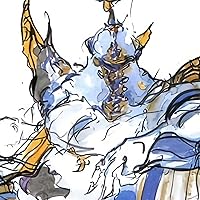
Ushoran, the Carrion King. Paragon of majesty, ravening abomination. His curse – to perceive the grimdark Mortal Realms as a chivalric kingdom, and himself, not as a twisted monstrosity, but as an exemplar of kings. Before him scuttle the horrors of his brood – the ghoul courts – spreading their deluded taint.

READ IT BECAUSE
Is madness the only way to defeat madness? Discover the utter terror of facing the Mortarch of Delusion and his twisted cannibalistic minions in a twisting, turning tale of obsession.

THE STORY
For generations, the people of the Howling Vale have fought against this madness, largely in vain. Now, Kosomir Vornarov, the city’s Master Patriarch, risks everything – his reputation, friends, even his people’s survival – to destroy the flesh-eater menace entirely and forge a brighter future in his name.

Two ambitious lords, two haunted souls. Whose madness will prove the stronger?

266 pages, Kindle Edition

First published May 24, 2025

12 people are currently reading
49 people want to read

About the author

Dale Lucas

21 books107 followers

Ratings & Reviews

What do you think?
Rate this book

Friends & Following

Create a free account to discover what your friends think of this book!

Community Reviews

5 stars
17 (24%)
4 stars
23 (33%)
3 stars
24 (34%)
2 stars
5 (7%)
1 star
0 (0%)
Displaying 1 - 15 of 15 reviews
Profile Image for Charlie.
96 reviews43 followers
June 19, 2025
The Flesh-Eater Courts are one of the coolest ideas for a fantasy faction that I've come across in a while. The premise is this: In the grimdark Warhammer universe, some communities on the margins of empire are left to fend for themselves while the mainline Big Fantasy Battles occur around them, with the result being that constant war, magical blight, and universal marauding often forces these struggling populations to commit widespread cannibalism as a means of survival. In doing so, their bodies, or perhaps their souls, are removed from the ownership of the Imperial, quasi-fascistic suzereinity of humanity's patron deity, and given over to the god of death.

As if their new monstrous features weren't enough, it turns out that the God of Death (as they always are) is a sadistic bastard, and so he plays a trick on these cannibal ghouls that have come into his possession: he blinds them with a strange delusion of chivalry. While they scrabble around blasted, crumbled ruins under sunless skies, their bloodshot eyes spy grand cathedrals, towering castles, and rich tapestries fluttering in a golden dawn. While they scuttle across battlefields as a shrieking horde of blister-skinned, bone-impaled, fang-toothed abominations, they behold a majestic parade of knights in shining armour assisted by legions of happy, smiling, adoring peasant militias. And while they sink their teeth into human flesh, tear out the livers from screaming children, and roll around howling in bloody orgies of innocent viscera, they perceive themselves as elegant lords and ladies daintily supping wine from goblets, carving up venison with knife and fork, while maintaining the most sophisticated etiquette in conversation with their peers.

What a perfect metaphor for Ideology! What a chilling image of moralism's hideous shadow! The brilliance of this premise displays Warhammer's satirical origins at its best, and seems like a great premise for grim novel about political delusion, social hysteria, and the sadism of good intentions.

This book... sorta does that, though it makes the classic 'Herohammer' error of reducing a fascinating concept of some weird, bizarre society from the lore into an individualistic narrative where those sociological features are reexpressed as personal foibles of a handful of elite, named characters.

The story therefore concerns the conflict between two rival leaders: Kosomir, a throwaway character whose fate you can guess from his absence in the title, and the titular Ushoran (available from all good wargaming stores TM). Kosomir is a foolish, insecure, and hyper-ambitious human noble whose dream of wiping out the Flesh-Eaters near his family's settler city instigates a war that his increasingly Stalinistic delusions and paranoid purges of suspected dissidents are incapable of quelling. Ushoran, meanwhile, is the first Flesh-Eater, an ancient monarch who the God of Death cursed with the contagious madness that is the Flesh-Eater worldview. Where Kosomir is bitter, cruel, and paranoid in his selfish treatment of the population he dominates, Ushoran is nothing but kind, self-sacrificing, and wholly committed to an eye-rollingly hypersincere ideology of Noblesse oblige. Where the humans see screeching hordes of gibbering ghouls, he sees poor, brave, and heart-rendingly loyal subjects victimised by an oppressive colonial invader, which nicely updates the classic Warhammer: Fantasy gag that vampires make for more genial rulers than human nobles, since the vampires don't need to tax the peasants for their crops.

There's some eerie moments and good ideas in here, but they are overwhelmingly watered down by the tepid blandness of the pulp-fantasy format. Ushoran's madness being the source of Flesh Eater ideology means that his sections of the book can only create drama through his mournful self-recriminations about failing his subjects, since the wideeyed naivity of his cannibal followers can't ever run against his will. Kosomir's story, on the other hand, tries to mine the theme of Stalinist paranoia for all its worth, but the side characters are not fleshed out enough to make their political struggles against him register as anything more than the plot's gear-mechanisms click-click-clicking away on the grinding track towards Kosomir's personal depravity. This railroad rigidity doesn't carry the weight of tragedy because those plot beats become so mechanically obvious that it never accumulates any sense of the fatalistic richness necessary to give the predestination structure of tragedy its appropriate weight.

This means that the book's best moments tend to be its occasional, eerie deviations from the main narrrative. Though the cotton-candy blandness of its expository prose and its flat, two-dimensional characters carry the plot forward at a grippingly brisk pace, this is done at the expense of the baroque grandure that the best ideas of this story really call for.

That's not to say there aren't great moments. There is a well-considered, accumulated half-refrain where episodes of overheard cannibalistic feasting are described via soft, sinister sibilance that grows into a gnarlier array of hard consonants and bubbling, juicy plosives as the narrative eye adjusts to the darkness and sees more clearly what lies within a cage, as in:

"Only a soft, sighing groan remained - the sounds of a wounded animal slowly dying, accompanied by other sounds that were soft, even subtle, but utterly repellant.
Blood-slicked fingers slithering on flesh and fabric.
Tongues lapping.
Sharp, bestial teeth, biting and tearing, gnawing and chewing." (176)


This precise soundscape is later echoed via soft, delicate assonance in a different context, as "a small, wet sound. Lips smacking. Tongues lapping. Teath tearing and grinding," (231) which demonstrates a certain flare that lights up the otherwise unremarkable prose.

Likewise, the concluding chapter, which rewrites really is cracking stuff, but the book needed more of that energy throughout. The only other scene that really shows off Dale Lucas having as much fun with his material is the depiction of the Stormcast warriors as "giants [uttering] strange sounds, a slow dirge chanted in rasping tones that made the still, pre-dawn forest feel like the site of a secret funeral" - a sound that unnerves all the humans listening to these abhuman soldier-saint/Valhalla-hardened/literal stormtroopers because it highlights the unpleasant realities that their society's own ideology cannot fully insulate them from. All zombie stories tend to be about how humans are the real monsters, and moments like this reinvigorate that trope by giving the characters a brief glimpse into the terrible, uncanny architecture that maintains their society's political structure and defensive stability. Their god does not care. His angels grow more dull-hearted with every reincarnation. Nothing human survives the trials that their colonial project demands of them.

Any story about corruption, invasion, and abhuman cannibal monsters is always going to have that spectre of colonial and xenophobic imagery hanging about it. You can't tell a story about governments and plague, after all, without getting into the disturbing territory of biopolitics, especially not when your humans are third generation pioneers settling a landscape full of crawling, pre-industrial flesh-eaters. Zombie mythology grew out of plantation anxieties over the Haitian Revolution, then bourgoise paranoia about proletarian civil disorder, then neoliberal anxieties about racialised biosecurity and anti-liberal terrorism. That stuff casts a long shadow which Warhammer has constantly flirted with, subverted, rejected, endorsed, and toyed with in every new edition. Nevertheless, Lucas' commitment to the ironic glories of Ushoran's court means that he largely avoids confronting the seedier underbelly of the undead natives theme. People really are happier in Ushoran's court, to the point that the book bearing his name as the title actually ends up featuring very little of him in it, since there is so little conflict to be had in his POV chapters that their society ends up being rendered in matte colours. Are there really no divisions within the insanity of Flesh-Eater society? Do these hyperchivalric moralists never eat their own?

Though the narrative of settler-colonial delusion ends on an exhaltantly grotesque image of Fanonian retribution, I couldn't escape the feeling that this book should have pushed its chivalric theme much further. King Arthur's court could not survive in Avalon forever, but it is hard to imagine what kind of Mordred could overpower the psychotic mental shackles that Ushoran's ideology imprints onto his followers. The impenetrable steadfastness of his worldview blocks off the best themes of chivalric drama - the inevitable corruption that causes those delusions to fall apart. From the way Dale Lucas has written their madness as a secure, happy, artistically, socially and existentially fulfulling way of life, it is not clear why becoming a Flesh-Eater in this universally nasty setting is actually to be dreaded at all.

Perhaps that's the point, but it weakens the horror of his theme, for it robs the poison of its final sting.
5 reviews
September 29, 2025
It’s nice to get to know ushoran and his court a little more but storywise it was quite underwhelming.
Profile Image for Jerik Thibodeaux.
2 reviews
August 4, 2025
Wish there would have been more flesh eater point of view, especially from Ushoran. Still a very good story even from the human side.
Profile Image for Tim Miranda.
10 reviews
June 27, 2025
This novel is highly disappointing. Marketed as a deep dive into the delusional grandeur of Ushoran, it barely scratches the surface of its titular character. What we’re left with is a meandering narrative that feels more like an overlong short story than a fully realized novel.

Rather than exploring Ushoran’s twisted psyche, readers are instead subjected to nearly 180 pages of Kosomir’s perspective, a lesser character who hijacks the narrative with his unexplained paranoia and terrible decision making. In contrast, Ushoran himself gets about 20 pages, hardly enough to justify naming the book after him. They might as well have called this novel “Kosomir: Mortarch of Stupidity”.

The pacing is also relatively stale and slow, with forced action sequences that feel shoehorned in rather than growing organically from the plot. Scene-building is minimal at best, and character development is practically nonexistent.

Ultimately, this book fails to deliver on its central premise and left me feeling like I wasted my time reading it. If you’re looking to understand Ushoran or delve into his delusions and legacy, this is not the book for you.

A disappointing misfire. 1.5 stars.
Profile Image for Melkor  von Moltke.
86 reviews10 followers
August 24, 2025
First off, this is not a Flesh Eater Courts book, let's just rip that bandage off at the start. There is an intro chapter from the Court's perspective, a few chapters throughout from Ushoran, and the rest is a centered on a human governor. In spite of that disappointment, this an overall good book.

The central character of the book is a colonial Governor in the land of the dead. He begins by massacring a host of monsters to the accolades of everyone around him, and it's even decided that, come spring, his lands will be fully incorporated into the god king Sigmar's realms. Titles, prosperity, and wealth are just a winter away for our brave human hero. Yet, even as he celebrates his achievements...things begin to unravel. Conspiracy, famine, plague, and violence assail his realm...often caused by the Governor himself. As things spiral downward and the Governor's delusions of grandeur mix with paranoia there are whispers of the return of the mythic Winter King, leader of a monstrous host.

Again, the biggest knock against this book is its lack of the Flesh Eater Court perspective. It's such a fun concept of ghouls who think they are nobles. Between the introduction and Ushoran's segments we get bits and pieces of how the Courts work but they are few and far between, and not really delved into deeply. We don't even really get to see a character change into a Flesh Eater, which would have been nice.

That said, I did enjoy what was in the book. The Governor quickly shows that he is a self righteous and insecure monster, and I found myself very quickly rooting for his fall. The only big critique that I have for his storyline is that there wasn't enough room for all of his terrible actions to breathe. The pace is simply rushed at times. In one section of the book a loyal friend and mentor confronts him on his actions and the fact that they will have dire consequences. Yet, we don't get to see those consequences because that same night we see him deal with a refugee crisis, the slaughter of prisoners, and the sealing off of the castle. It just would have been nice to see him marinate in the consequences of one terrible decision before he moves on to another. That said, I did enjoy the whole ride down with the Governor.

Ushoran is nicely written both as a boogeyman for the people of the towns and as a caring and generous monarch of a monstrous host. He's a nice contrast to the Governor, "who's the real monster" and all that. I enjoyed his chapters, I just wish he was in the book that bears his name.

As minor thing, I appreciated the use of Stormcast in this book. They played a role, but were always secondary characters. They never took over the narrative and ended up being a nice little cameo. I also liked regular people being unsettled by the Stormcast and even mocking their sincerity, given their immortality.

Overall, in spite of rushed pacing and a lack of Flesh Eater perspectives, I enjoyed this work quite a bit. It's a nice mix of fantasy and horror, which I plowed through very quickly.
4 reviews
November 8, 2025
This is one of those situations where I wish I could rate a 3.5. It's a fairly decent Cities of Sigmar book. Unfortunately, my Ushoran book is much more of a CoS book, which is the issue. The Mortal Realms should mostly be explored through the eyes of humans as that's what we as readers can easily sympathize with. The thing is that the Flesh-eater Courts see themselves as a medieval society with knights, lords, and serfs despite actually being delusional being caught between life and death. We can easily understand their delusional perspective. Then the joy in the writing is how you let us see through the delusions and understand what is reality.

Instead this book is told from the perspective of a CoS noble as he shows us just how terrible he is as a leader despite being a bit clever. His perspective is foiled with Ushoran's, where he's shown being a kind and generous leader for his ghouls. It's very clear that the intention is to push the "humans are the monsters" theme, which is a direct quote from Ushoran. The book unfortunately pursues this theme above all else. Which is a shame, because the quality of the writing is quite good. Dale Lucas did well to color the world and make his characters interesting. The book was very much on a track the entire time with little deviation in established narrative frameworks for "tragedy in motion" stories, and the characters were embodiments of archetypes with only a bit of challenging to them (when you're writing FEC, I'd highly recommend challenging tropes and archetypes). Experimenting with the FEC's perspective would've elevated the story. Dale, I haven't read your other works, but I think you can weave an excellent tale with a little more deviation from a standard storyline. Games Workshop and editors, please let/encourage him to experiment more.

Also, GW, you might need to redefine FEC's theme, as the ghouls didn't come off as delusional. Their society just seems like an actual medieval society as opposed to an order of flesh hungry ghouls delusionally thinking their actions are noble as opposed to be the acts of savage monsters. They genuinely acted nobly. The only evidence to the contrary of them being noble is the intro chapter. It seems like to me that at least as long as Ushoran is around, they are a noble society. We'll need more evidence than a single cutaway scene. Moments of clarity sell delusions.
Profile Image for Dijana Kasumovic.
221 reviews
June 18, 2025
This is my first foray into the Warhammer world, and most of the background and lore that I am aware of is only what my husband has told me. Ushoran is honestly of the most interesting in terms of backstory, this being my primary motivation for picking up this novel over the countless others we own.

The premise, though interesting, is a bit shallow for me. As the novel progresses, I see how Kosomir is meant to act as a foil for Ushoran, where the human has more hubris and is more paranoid than the actual "monster." However, I honestly would have loved a story told more from Ushoran's perspective, or told entirely from one side in the first half, then switching POVs in the second half.

The book itself is also far too short to instill any kind of fear of Ushoran, and Kosomir's growing paranoia seems far too sudden rather than being built up over time. Perhaps I expected too much from a book like this, but I had honestly hoped for more backstory and lore prior to getting into the main plot. The title is also misleading, since most of the chapters are from Kosomir's perspective.

All in all, for someone new the Warhammer looking for an in depth story about Ushoran, this is not it. We have one of the early release special editions, so our hardcopy is gorgeous, but not really worth the read as a Warhammer newbie.
This entire review has been hidden because of spoilers.
460 reviews4 followers
October 6, 2025
Dale Lucas delivers a mesmerizing descent into madness with Ushoran: Mortarch of Delusion, a novel that blurs the line between horror and tragedy in the most haunting way imaginable.

At its core lies the Carrion King Ushoran an immortal figure both regal and grotesque, whose delusion transforms the grim wastelands of the Mortal Realms into a glittering kingdom of noble courts. To his followers, he is a savior; to his victims, a nightmare. Lucas’s portrayal of Ushoran’s fractured psyche is nothing short of brilliant an exploration of self deception elevated to the level of myth.

The novel’s parallel thread, centered on Kosomir Vornarov and his doomed struggle against Ushoran’s flesh-eater courts, grounds the story in human desperation. As the two men’s obsessions spiral toward collision, the question becomes not who will win but whose madness will devour the world first.

Lucas writes with operatic intensity, combining the grotesque grandeur of Warhammer lore with psychological precision. Every page feels like a confrontation between glory and decay, faith and delusion. Ushoran: Mortarch of Delusion is not only one of the finest character studies in the Age of Sigmar canon it’s a gothic masterpiece in its own right.
Profile Image for J.D Wheeldon.
Author 4 books4 followers
May 12, 2025
(I read the collectors edition, which released prior to the regular edition). Quite a short story, which is all the more surprising that the titular character is barely I'm it and doesn't really do anything of significance.

The story could have been told without the appearance of Ushoran at all, and then it probably wouldn't have been a disappointment. There's also a lot of repetition in the way things are described or what is happening or how people are feeling, which seems to only accomplish drawing the book out and making it longer than it needs to.

The prose is okay, and it's an interesting premise, but the portrayal of Ushoran and how much he appears and contributes to the book isn't what I was expecting or hoping for in a novel supposedly about him
Profile Image for Sunil S.
86 reviews
August 11, 2025
4.5!

The only reason it doesn't reach a solid five stars for me is due to how little screen time Ushoran, himself, actually receives.

I really enjoyed his characterisation as a genuinely kind-hearted -- albeit extremely deluded -- ruler who sincerely loves his followers and servants as if they were his own children. Yes, he is insane. Yes, he is living within an illusion, but this makes him a very interesting and unique villain to me.

This is one of those novels where both of the POVs are villainous in their own rights. Kosomir is paranoid and ruthless, while Ushoran is coddling and 'righteous'. I liked Kosomir as a character, certainly, but Ushoran definitely had my heart.
This entire review has been hidden because of spoilers.
Profile Image for Alex.
13 reviews
June 5, 2025
I throughly enjoyed this novel, having hoped for one focused on Ushoran since his model was released and the wider relaunch of the Flesh-Eater Courts faction.

It follows two rulers on opposite sides, and explores the weight of leadership, hard choices and what makes a good ruler. For Ushoran, wrapped in his chivalric delusion, he remains a noble and generous king to his followers, regardless that they are cannibalistic, bloodthirsty ghouls. His mortal adversary, Master Patriarch Voranov faces endless difficult choices to try and protect his people from the ghouls’ predations and descends into paranoia, cruelty and shocking ruthlessness. Dale Lucas has done an excellent at making Voranov’s choices somewhat understandable, along the lines of ‘for the greater good’ but he serves as a superb foil to Ushoran’s boundless generosity and kindness towards his ‘people’.

I did find that the finale of the story a bit sudden, despite the good work done to build the tension right up to the final confrontation. It’s a minor thing and did not lessen my enjoyment at all.

Once again, Richard Reed has done a masterful job with the narration. So far anything written for Ushoran had be in the form of almost Shakespearean English, all thee, thou and thy, which I’ve enjoyed as it befits his delusions. I had no real notion of his voice but Richard Reed created something almost Nosferatu-esque which I feel perfect for such a monstrous character.

Overall I loved this story and really hope it encourages Black Library to commission more stories about my favourite Mortarch!
Profile Image for Christian.
716 reviews
October 3, 2025
Oh wow! What a fun short read. The sumptuousness and horror of the last 30 pages was so masterful. This novel could be part of the Black Library horror imprint. Such great atmosphere. Now I want to build and play a flesh eaters army!
Profile Image for Dominic Thibeault.
1 review
November 11, 2025
Le livre est donné un regard intéressant sur plusieurs aspects de la vie dans les Cités de Sigmar ainsi que sur les épidémies de ghoules.

Par contre pour un livre qui porte le nom d'Ushoran, il n'apparaît que très peu. j'aurais aimé plus de segments du point de vue des ghoules.
Displaying 1 - 15 of 15 reviews

Can't find what you're looking for?

Get help and learn more about the design.