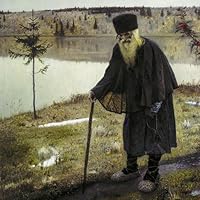
During the three decades between Nikon's elevation to the patriarchate (July 1652) and the execution by fire of the prisoners of Pustozersk, including Avvakum (April 1682), the Archpriest's influence and fame grew steadily among those committed to the old rituals. He was thirty-one in 1652, simply one among several outstanding clerics from the younger generation who had impressed Neronov and Vonifat'ev by their piety, force of personality, and devotion to spiritual renewal. Thirty years later he was considered a saint by many; he had become the authoritative doctrinal arbiter among the dissenters and an inspiring example of unflinching defiance no matter the risk or cost.
In reading Avvakum's Life we are struck by the astonishing record of his tumultuous existence prior to his final imprisonment. Yet many of his contemporaries could have matching him tale for dramatic tale, had they his narrative gifts. Avvakum's sufferings had little to do with his special destiny. When he returned from his Siberian exile in 1664, the older leaders of the Lovers of God were scattered, discouraged, or dead. Conservatives were understandably attracted by this charismatic and already well-known spokesman for their convictions, especially as his visibility increased in proportion to his growing antipathy for the reformers and their conciliatory blandishments. When Avvakum did not bend under his second exile nor break under the excommunication and anathema heaped upon his by the Ecumenical Council of 1666-67, he was thrust into a position of lasting preeminence. His entire life seems to have been a preparation for this culminating confrontation with the devil's deputies and for his subsequent imprisonment in the arctic village of Pustozersk; it was there in bestial incarceration that he produced the writings which consolidated his place among the schismatics, in the annals of Russian history, and in the cultural consciousness of every literate Russian.
This volume includes a preface, introduction, remarks, annotation, notes, and references by Kenneth N. Brostrom. The study of Life by V. V. Vinogradov is also included. Avvakum'sThe Life of the Archpriest Avvakum is translated by Kenneth N. Brostrom.
Early in the book Avvakum (1620? - 1682) is on a boat travelling on the Volga when he begins to lambast a Boyar's son who has shaved his beard off - shocking behaviour for seventeenth century Russia. The Boyar's son promptly has the lowly Archpriest Avvakum thrown overboard.
And that's how Avvakum tells the story of his life. Truth to power, heedless of the consequences, preaching an intense and serious approach to religion (something he shared with the Patriarch Nikon who could be regarded ironically, at least indirectly, as his nemesis) and determined to stand up for tradition not only against social change but particularly against the religious reforms brought in by the aforementioned Patriarch Nikon. As such Avvakum became one of the leading figures among the so called Old Believers, a group regarded as heretics by the Orthodox Church over their disagreements on what was correct religious practise.
Avvakum is careful in his autobiography to stress that he has an upbeat and positive relationship with Tsar Aleksei - as you would if you were the subject of an autocratic ruler finding yourself in the increasingly dangerous position of vehemently not being in active support of his religious policies. So unsurprisingly this doesn't save him from what is effectively a period of exile in Siberia (where he tells us the fish were so fat they would fry themselves in the pan) and later from imprisonment north of the Arctic circle with other leading Old Believers (or Raskolniki / splitters as they were called - & yes the similarity of the term to the name Raskolnikov in Crime and Punishment is not accidental) and eventually martyrdom.
The discovery of Avvakum's work as discussed in Bortnes Visions of Glory had an impact on later Russian Literature as Avvakum had invented a style that combined both formal, liturgical Old Church Slavonic and a colloquial form of Russian, but also managed to combine deeply traditional elements drawn from the tradition of Hagiography with a very direct and immediate style of storytelling. It also has historical interest as early Russian prison literature, as a historical document from the side of the defeated - the Old Believers were to be continually persecuted under the Tsars until things relaxed under the Soviets, but it is particularly interesting because the autobiography comes down to us complete with a series of earlier drafts.
What this tells us is exactly how radically Avvakum revised his texts, shaving away words and hacking apart sentences to create a skaz style in which the writing is extremely direct, intimate and aiming for an emotional connection with the reader. It's a little as though you are sitting by a fire next to the author, chatting together, and you can see the tears in his eyes. For example in his earliest draft he begins by describing when he was born and who his parents were and then explains when his wife was born and who her parents were. By his final version he has abandoned all this in favour of 'My wife and I were orphans with no one in the world to fend for us'. Every precise and historical detail has been shaved away in favour of creating a text that is vague but makes a direct emotional appeal to the reader.
You realise how carefully he has designed his life story to appeal to the reader and clearly to strengthen them in Old Belief through his self-portrait as a martyr. The end of the story therefore contains the martyr like sufferings of his companions and the miraculous ability of one of them to speak after his tongue had been removed. For Avvakum this is a miracle, personally it reminds me that you just can't get hold of the staff, even back in the day.
A word of warning, if you seek this book out try to avoid the older translation published by Leonard Woolf's Hogarth Press which was bowdlerised. Apparently those Bloomsbury set types couldn't stand all the foul language.
A note on the Manuscript tradition Since Avvakum was officially regarded as a heretic, part of an officially persecuted group, his Life was not published in his lifetime. It was rediscovered in the nineteenth century in three manuscripts (MS), known as A, B and C in order that it was believed they were written in, and a version was prepared for publication and released in the same year as another classic of Russian prison literature - Dostoevsky's The House of the Dead.
In 1949 another MS of the life was found, known as the Prianishnikov MS and this was radically different in style to the other MSS but closer to letters and petitions written by Avvakum that had also survived. This led to a reconsideration of the order of the MS tradition which it is now argued runs: Prianishnikov-B-A-C.
What this shows is how much Avvakum did not want to simply tell the story of his life, but deliberately and with care reworked it into the passion story of a martyr. Perhaps this should serve to remind us how far all autobiographies are not just the story of a life but the deliberate and careful creations of their authors.
”…nor should we be negligent in godly concerns; and we simply must not barter them for the seductions of this vain age.”
This was a fascinating read, an autobiography from an Old Believer (just as they became “Old Believers”) in the 1600s. You know, that infamously vain age. Oh Petrovich, what would you say of us now?
On this book… first of all, it makes you feel pretty good about whatever you’ve got going on in your life because the 1600s were not fun. exile and years of wandering in deep poverty is pretty much the “light” sentence to not conforming to the church reforms if the time (in Orthodox Russia).Tongues get torn out, hands chopped off, people are burned or ”roasted” in ovens, hanged, or buried alive…
Then you are reminded that this was about things like how to hold your fingers while crossing yourself and you’re taken aback, even though people doing horrible things to people for seemingly petty things is all of history. This particular schism, or Raskol, is one I’ve mostly heard of from the side of the reformers, so I loved being able to partake in the arguments of the opposition. Not that there were much arguments per se, more strong faith in the truth.
Avvakum believed enough to die for what he thought was true, and though he curses his persecutors, he also finds forgiveness in his heart and does not blame them for the division (but Satan).
It is a harsh world filled with violence and hardships, but also miracles. Pulling through it does seem like a blessing of God to be honest.
The language is vivid and if slightly prone to deviate into side stories, Avvakum always finds a way back to the red thread of his narrative. I can see how this as hugely inspirational to great Russian authors of later times, even in translation the language is lively and rapt and the images are vivid, asking me feel like I am watching this narrative unfold like a movie.
And who knew there was a ‘happy wife, happy life’ for the 17th Century?
“We already knew that when the womenfolk are pleasant, then everything will be pleasant in Christ.” (P.48)
I put a lot of notes in this book that I’ll return to from time to time, the Archpriest, by his own admission, is not perfect, yet there is something to learn from his humility yet also his steadfastness and strong belief. It is inspiring to see someone not bow down to something they find obviously wrong, even if the actual conflict is a bit difficult to relate to in the present.
Quote regarding his enemy:
“Ten years he tormented me, or I him - I don’t know. God will sort it out on Judgement Day.”
Quote regarding his wife:
“Will these sufferings go on s very long time, Archpriest?” And I said, “Markovna, right up to our very death.” And so she sighed and answered, “Good enough, Petrovich, then let’s be getting on.”
Something about that makes me thing of Waiting for Godot. The resignation and acceptance that, oh well, no one said it was going to be easy. And ain’t that just life. Let’s be getting on.
Quello che colpisce di più in questa testimonianza dell'arciprete Avvakum è la sua forte passione nella fede che professa, fino a rinunciare a tutto, anche a separarsi dalla famiglia, pur di non piegarsi ai suoi nemici. E poi è una testimonianza importante per la storia della fede russa, che ci riporta nel Seicento in cui avvenne lo scisma. Avvakum non si piega mai, nonostante venga frustato, imprigionato, torturato, preso a calci e pugni, perseguitato e ricercato in tutta la Russia.
Questo testo storico è stato definito uno dei capolavori della letteratura russa: nel XVII secolo, in Russia, ha luogo un grande scisma all'interno della Chiesa ortodossa, in cui si contrappongono i Vecchi Credenti (i raskolniky, di cui fa parte Avvakum) e il Patriarca Nikon con i suoi seguaci. Nikon apportò diverse modifiche nella liturgia ortodossa, basandosi soprattutto su quella della Chiesa greca, corrompendo così il vero spirito della religione russa, profondamente radicata nel popolo e in cui ministri del culto erano uomini esattamente uguali al resto dei credenti. Avvakum e altri si oppongono a quella che per loro è una vera e propria eresia e per questo vengono perseguitati e puniti. Con il Concilio del 1666-67, le cose precipitano inesorabilmente. Avvakum passa la maggior parte della sua vita o in esilio o imprigionato ma, a differenza di altri suoi compagni, non cede mai: fino alla fine combatterà contro l'apostata Nikon e patirà qualsiasi tortura pur di continuare a professare la vera fede, che non è di certo quella corrotta dei Greci e dei Latini. La forza di quest'uomo è straordinaria e non solo la sua, ma anche quella della moglie e dei figli, costretti a seguirlo durante l'esilio e anche loro imprigionati. In questa autobiografia Avvakum parla nel linguaggio schietto del popolo, senza lasciarsi andare a pensieri troppo complicati tipici dei Cristiani latini. Quella dell'arciprete è una fede sentita, fisica e lo si capisce in particolar modo durante le descrizioni degli scontri contro i demoni che si impossessano delle persone e che tentano di corromperlo. Anche se vacilla, Avvakum torna sempre a Dio amandolo con più forza.
Two reviewers battle within me: the scholarly one and the cheery, enthusiastic one. Which to choose?
Thanks are in order for NetGalley and Columbia University Press for providing me with an ARC of this book in exchange for an honest review; I'm afraid you get two.
Review One: Of Scholarly Interest
"The Life Written by Himself" is the autobiography of the Russian priest Avvakum (1620(?)-1682). A series of hasty reforms in the Russian Orthodox Church lead to a small schism and religious persecution. Avvakum is on the losing side of the Old Believers, who want to keep the old ways intact.
His autobiography has many interesting qualities to it. The first is the style: Avvakum writes in the spoken Russian at the time, with a great sense of how to make it compelling to listeners from all walks of life. Whenever he quotes the Bible or saints, however, he switches to the archaic style of ecclesiastic scholarship, so it's always clear when he's deferring to authority. It's an interesting combination - and it actually works. Kenneth Brostrom does a wonderful job here. The English version of this text is superbly readable and compelling. It simply flows and it feels familiar and friendly.
Avvakum also combines real events with hagiographic tropes (a hagiography is a biography of a saint), so we have his life and that of other Old Believers, combined seamlessly with miracles and martyrdom. The ill are healed through the power of prayer, captives have their chains fall off, Old Believers speak clearly despite their tongues being cut out - and more.
Aside from the details of schismatic life, Avvakum adds descriptions of Russian landscape, as his exiles take him on journeys north, so he gets to marvel at flora and fauna.
While the autobiography in itself is quite wonderful to read, this edition of "The Life Written by Himself" is more than accessible to anyone, regardless of their familiarity with any of the topics involved. Avvakum's "Life" is about 90 pages long, but the book is 216, containing everything one needs to understand it thoroughly, from an introduction explaining Russia's context and what the religious schism was all about, to numerous endnotes detailing everything from the lives of those mentioned in the books, to Avvakum's inaccuracies, to facts about the Russian fauna mentioned in Avvakum's writings.
I'm not sure what I was expecting when I picked up this book, but I got all that and more.
Review Two: I'm laughing. They were tortured and killed, and I'm laughing.
Oh god, there are so many dumbasses in this book, I can't even...
Look. I understand. If you really, truly, deeply, absolutely believe in the existence of God and in there being a Right Way to worship Him, then the slightest change to that is a huge concern and might indeed be worth dying for. I can respect a martyr for the faith.
But Avvakum, man. He could be a martyr for the stupid.
Aside from any religious concerns, insulting your captors and implying they're the scum of the earth out of the blue is not conducive to a long and peaceful life. Getting whipped badly for it isn't you suffering for the faith. I'm not usually one to vicitim-shame, but have you considered, like, maybe not baiting the people who have power over you?
There's also an inherent hilarity in him beating his wife and maid, then realizing he did badly, and having his entire household whip him for penance while everyone cried their eyes out, whipping and crying, crying and whipping.
And also, once, when a guy in a position of authority let someone get away with incest, Avvakum decided that was entirely unfair and wanted that guy dismissed... so he accused the guy in a position of authority of incest. That's not how it works, Avvakum! Not even in the 17th century!
I feel somewhat like a horrible person, because life in the 17th century was hard and violent. People were tortured and killed, they were burned alive, or they burned themselves alive in the name of faith, there was famine, and brutality at all levels. On a human level, it's chilling and horrifying to think all these things happened to real people. I don't think the actual reality of living back then was in any way funny.
But Avvakum's description of events isn't very realistic to begin with. And if you're very impassive and welcoming about being tortured and/or killed, then I'm not about to take it very seriously, either, am I? I mean, you just had a little girl deliver a full prophetic speech and telling you about what edicts the Tsar will be giving, I'm not about to find it any less funny that you got whipped.
Also, for a saintly man, Avvakum sure was an asshole. Never mind wanting his own kids to die for the right faith, but all the beatings he himself delivers, praying for people he knew and cared about to die in battle so that someone else's prophecy of them being victorious won't come true and more show him as a relatively vengeful and petty bastard.
I'm sure this is all very serious (the introduction tells us that Leo Tolstoy couldn't read "The Life" without weeping), but I think I'm a bit of an asshole, too, because I was much too amused.
(Also, important life lesson: if it's a year ending in "666", like 1666, maybe hold off on making major changes to your Christian religion, because that number of the beast thing might be an issue.)
on parle de la vie d'un archiprêtre dans les temps politiques / religieux troublés de la Russie du 17ème, où l'on est envoyé en déportation, persécuté sa vie durant car, entre autre, l'on signe Dieu avec 5 doigts, et non trois (je caricature mais c'est plus ou moins ça)
hors l'intérêt historique c'est un calvaire, c'est une édition pour universitaire, pas pour lecteur
One group of people forced another group of people to literally live in a hole in the ground because the two groups could not agree whether to make the sign of the Cross with two or three fingers. The people in a hole in the ground were the lucky ones – compared to the ones who had the offending fingers cut off.
One group believed that saying “Alleluia, alleluia, glory be to thee, O God!” was looked on with favor by divine authorities, but saying “Alleluia, alleluia, alleluia, glory be to thee, O God!” would get you damned to hell for eternity. In this case, cutting out the tongue was considered appropriate.
The argument over whether religious services should properly be seven hours long, or merely three hours long, led to torture, violence, and death.
Your enjoyment of this book will depend on whether you find all of this senseless violence fascinating or infuriating.
I am not a scholar of things Russian, but I know more about the topic than the average non-Russian, which was enough to be able to enjoy this book, if “enjoy” is the right word. It will probably be incomprehensible if you are not a bit of a Russian and/or religious history nerd.
Surprisingly, this book is an easy read. The translator says the original is written in a style easily comprehensible for native speakers of Russian, so that the average man could read and understand it. This idea seems unremarkable now, but in seventeenth century Russia, it was an unusual idea.
The translator, Kenneth Brostrom, attempted – successfully – to duplicate this style in his English translation. This translation was originally published in 1979, and the translator was working on a revised edition when he passed away (see obituary here). His work was completed by another scholar.
The original author, Avvakum Petrov, is sort of a Martin Luther-analog for Russian Old Believers, a group which broke off with the mainstream of the Russian Orthodox Church around the years 1650. To this day, they are to be found in pockets all over the world, miraculously surviving centuries in defiance of war, repression by forces both secular and religious, and the temptations of the modern world.
In many ways Petrov seems quite a bit like Martin Luther – both alternated between moments of heartfelt humanity and longer periods of monomaniacal intolerance. In other ways, he was the opposite of Luther – rather than change the church for the better, Petrov's mission was to make sure that nothing the church did ever changed.
Like Luther, he enjoyed proclaiming loudly that he was a miserable sinner, but he never, ever, forgot a slight given or an offense taken.
This all may seem a little grim, but Petrov really comes alive on the page – I enjoyed reading this.
This book is very heavily footnoted. The reader will need several bookmarks (either paper or electronic) and will have to shuttle back and forth frequently to keep track of which bloated religious hypocrite Petrov is currently railing against, and why.
As for the matters of doctrinal dispute mentioned at the top (e.g., two vs. three fingers): it's easy, from a vantage point of smug modern superiority, to sneer at these people as ignorant yokels and tell ourselves that we are past this type of hair-splitting idiocy now, but every time I hear somebody blather on about how their city, state, country, or skin color are superior to someone else's, it's clear that we haven't really come so far.
Poor old Avaakum. He really didn’t have a good time of it. Talk about suffering for your faith – he never seemed to stop suffering. Although he did manage to find time to marry and have children in between bouts of imprisonment, torture, beatings, starvation and so on. His autobiography makes for some fascinating reading. Not only is it an important historical document but a wonderful insight into an era when religious conflict was part of everyday life and disputes about worship could lead to the most horrendous of punishments. Signing the cross? Is it to be 2 fingers or 3? Worth dying for, obviously. Avaakum (1620/1682) was the one of the principal leaders of the Old Believers and in the 1660s and 1670s decided to chronicle his life – his career, religious persecution, torture and imprisonment, making this a unique account, written in everyday language that anyone could understand, in a language and vivid style that served as a model for later writers such as Tolstoy and Dostoevsky. He lived and died for his religious faith, never flinching from talking truth to power, regardless of the consequences. He was burned as a heretic, never willing to compromise in any way. This edition has been excellently translated, and includes an essential introduction and many useful footnotes and annotations. So yes, it’s a scholarly and academic work but nevertheless, and although obviously not aimed at the general reader, a book that will be of enormous interest to all Russophiles in particular as well as those interested in church and religious history.
After years of torture, beatings and starvation in Siberian exile, Avvakum's wife turns to him and asks, "Will these sufferings go on a long time, Archpriest?". He answers "Markovna, right up to our very death". So she sighs and replies, "Good enough, Petrovich, then let's be getting on." For this excellent bit of dialog alone, the book gets four stars. Of course Avvakum was right as far as his own future was concerned -- the rest of his life was just more of the same up to the point that he was finally killed by burning. At least there were a few healings, miracles and holy fools along the way,and that devil's spawn, the Patriarch Nikon, was never able to get Avvakum to stop crossing himself with two fingers. This is the greatest work of Russian medieval writing and is said to have influenced, among others, Gogol and Tolstoy. The combination of the mundane and the holy, expressed in an interesting mixture of vernacular and ecclesiastical writing styles is like nothing else that I have ever read. This book isn't for everyone, but I found it fascinating.
Utterly fascinating look at the beginning of Russian literature that somehow manages to be both entertaining and educational. The extensive footnotes, which you will need to fully appreciate the book unless you are well versed in Russian history and/or theology, can be a little too exhaustive and take away from the flow of the book itself, though the enrichment and understanding they add more than make up for it.
Протопопица бедная бредет-бредет, да и повалится, кольско гораздо! <...> Я пришел, – на меня, бедная, пеняет, говоря: "долго ли муки сея, протопоп, будет?" И я говорю:"Марковна, до самыя смерти!" Она же, вздохня, отвещала: "добро, Петрович, ино еще побредем".
Раскол православия — трагедия конца XVII века. Выходцы из кружка ревнителей благочестия изменили миропонимание русских христиан. Желая добиться истинного следования религии, ревнители уничтожали сделанное до них. Если человек желает перемен, он их делает не задумываясь, не осознавая, к чему это приведёт. Как ратовал Никон за ему потребное, так и Аввакум шёл по пути собственных представлений о действительности. Никто из них не исповедовал настоящего пристрастия к делу их жизни, поскольку они не понимали, зачем осуществляют требуемые им перемены.
This was absolutely crazy. I originally read this because it was mentioned in an article on Russian culture as being the greatest piece of Muscovite literature. I agree with the article that the voice Avvakum used in his writing was unique. It was crazy to me to think how far this man traveled from Moscow.... mind-boggling. It was refreshing to see his perspective on life. The way he wrote about events was free from a lot of the societal constructs seen today and uncaring about the perception of others. His faith was remarkable, even though I do not agree with his theology or the way he viewed the world.
Aunque nunca he estado en Rusia me interesa la literatura de este país y por ello compré este libro, de lectura cruda, trágica, y te hace llorar por los sufrimientos del autor cuando explica cómo fue castigado por oponerse a las reformas del cristianismo ortodoxo del siglo XVII, y cómo se morían de hambre sus hijos en Siberia. Finalmente el hombre sufrió martirio y fue quemado en la hoguera. Muy duro de leer, pero auténtico y útil para conocer a los denominados viejos creyentes, que fueron obligados a emigrar a Siberia y Alaska.
Avvakum's autobiography is a great testament of faith, but an even better portrait of a man who struggles with himself and is undeniably real. It is a rare occasion that one can read the self-written story of a martyred Russian Orthodox priest from the 1660s and come away with this thought, but this is accomplished within this book. At times, his arrogance and self-contradictory nature will harshen your view towards him, but as you take this in along with his compassion and endurance, his character truly comes into fruition, and even if you do not like him it is hard to deny the richness of his personality. An interesting aspect of this work is its rather modern nature, and though it is far from a novel of our time, it is a unique work from its era. This isn't a book I recommend to most people, as it isn't a topic that will interest most, but I have a bleeding heart for those martyred for their beliefs, especially when their faith is as untarnished like Avvakum. I shall end this with a few quotes from the book.
"And I said to them, 'We are fools for Christ's sake! Ye are honorable, but we are despised! Ye are strong, but we are weak!'"
"I am swathed in weakness of mind and hypocrisy, I am covered with lies, I am arrayed in hatred of my brother and love of myself, I am perishing in the condemnation of all men; seeming to be something, I am excrement and pus, an accursed man - just plain shit! I stink all over, in body and soul! It would be good for me to live with dogs and hogs in their pens; they stink just like my soul, with an evil-smelling stench. But hogs and hounds stink by their nature, while I stink from my sins like a dead dog cast out into a city street."
La nascita della letteratura russa, dicono. La potenza verbale, nominativa per così dire, è enorme in effetti. Ma ancor più incredibile è che questo libro sia nato: nella Russia ancora medioevale del Seicento non solo ecco un testo più o meno letterario, benché grezzo e animalesco, con un autore ben definito, ma questo autore parla addirittura di sé, e in un modo del tutto inaudito in una realtà in cui non esistevano che testi sacri, cronache, commentarii e agiografie. Il passo è colossale e brevissimo: questa È un'agiografia, un'autoagiografia. Ma quale dev'essere stato lo shock culturale del raskol, se ha potuto spingere un uomo a tramandare la propria testimonianza in un'epoca e in un mondo in cui il concetto di testimonianza non esisteva - non, almeno, in prima persona e da vivi! La letteratura inizia con questo testo solamente per questo, perché un uomo porta testimonianza di sé e della propria vita attraverso la scrittura, usando il proprio nome, usando la propria lingua, facendosi autore, personaggio e testimone: martire.
Superbe ouvrage, en tous points. Je voudrais d'abord souligner qu'il y a, derrière cette édition (attention, pas bilingue), un rigoureux travail philologique, exposé en toute transparence dans l'impeccable introduction (sur la vie d'Avvakum, les manuscrits, les éditions précédentes, les langues dans la Vie...) et dans les notes de bas de page très fournies. La traduction française est également très agréable à lire. Quant à la Vie elle-même, c'est un vrai bijou de l'"antique" littérature russe. Entre autobiographie, épopée, hagiographie, la Vie d'Avvakum nous emmène avec lui au fil de ses malheurs, exils, supplices. Le portrait d'un homme tenace dans sa foi, à la fois espiègle et miséricordieux (je te pardonne... une fois que je t'aurai insulté). Cette Vie est une vraie leçon de persévérance, d'humilité et d'amour du prochain, en plus d'offrir une très belle peinture du paysage politique, religieux, et même (rigoureusement bien) géographique de la Russie du XVIIe.
Гениальная текстовая рекурсия — помимо очевидного автобиографического новаторства Аввакум уже вводит проблематику автора как такового, буквально разрывая текст — эти сюжетно немотивированные вопросы некоему ‘старцу’, в которых он предоставляет рассказываемое на суд других; а также постоянные ссылки на уже рассказанное или, наоборот, делающие залегания вперед, — представление жены как уже закопанной заживо, хотя с точки зрения повествования этого еще не произошло, или удавленного Федора юродивого, — текст постоянно себе не соответствует, опережает или запаздывает, сам себя разрывает, вскрывая известный зазор между означающим и означаемым — и это все в 17 веке!!! за сотни лет до постмодерна.
И прежде всего — наиживейший язык, читается с упоением, просто медятина
La vie d’Avvakum décrit la lutte de cet archiprêtre contre les réformes du patriarche Nikon dans l’église orthodoxe russe du XVIIème siècle. Avvakum sera exilé successivement en Sibérie puis en Transbaïkalie et dans le nord vers la Mer Blanche. À plusieurs reprises il rencontrera le tsar Alexis et lui écrira des épîtres. Ce récit fait voyager le lecteur aux quatre coins de la Russie et est un intéressant témoignage des conditions de vie de l’époque.
The story of one of the "Old Believers" of the Russian Orthodox Church. Lots of suffering and misery. Interesting in the element of Russian history and the modernization of the Church.
Никогда бы не подумала прочитать, если бы не Полка. А оказалось очень читабельно (17 век!), живо и иногда даже смешно — протопоп и трикстер в одном лице.
I had the chance to read an early copy of an upcoming update to an old book. It’s called The Life Written by Himself by a Russian Archpriest named Avvakum Petrov. The book comes out at the end of May but you can preorder it now.
This book certainly isn’t for everyone. That’s to be expected from the fact that it shares the thoughts of a 17th-century priest who lived in poverty and persecution in Russia. Yet the older I get, the more I realize how much we stand to gain from reading really old books.
The updated intro itself is worth the book as it offers a fascinating historical setup to Avvakum’s life and times. Avvakum stood up against a version of Christianity that joined itself together with the government of Russia to gain power and influence. This is something the church in America would benefit to reflect on as well. Beyond this, there are two reasons you might find to appreciate this book.
The first reason—and the best takeaway from this book—is its perspective on the nature of suffering, especially for a Christ-follower. Despite the difference in culture and times, I was incredibly moved by his account. Avvakum is tortured in numerous ways throughout his lifetime and is eventually killed for his faith. Yet he lives with boldness in the face of suffering. -I came up, and the poor dear started in on me, saying, “Will these sufferings go on a long time, Archpriest?” And I said, “Markovna, right up to our very death.” And so she sighed and answered, “Good enough, Petrovič, then let’s be getting on.” -Neither famine of bread nor thirst for water destroys a man; but a great famine it is for a man to live, not praying to God. -In the Chamber of the Cross the bishops disputed with me, then led me into the great cathedral, and after the Transposition of the Host they sheared the Deacon Fyodor and me, and then damned us, but I damned them in return. Almighty lively it was during that Mass! -Satan besought God for our radiant Russia so he might turn her crimson with the blood of martyrs. Good thinking, devil, and it’s good enough for us—to suffer for the sake of Christ our Light!
Most moving of all for me was the way Avvakum boldly lived out his faith, precisely when he recognized what it would cost him. Passages like this one are stunning (and show how amazing his wife was too):
"Sitting there feeling heavy at heart, I pondered: “What shall I do? Preach the Word of God or hide out somewhere? For I am bound by my wife and children.” And seeing me downcast, the Archpriestess approached in a manner most seemly, and she said unto me, “Why are you heavy at heart, my lord?” And in detail did I acquaint her with everything: “Wife, what shall I do? The winter of heresy is here. Should I speak out or keep quiet? I am bound by all of you!” And she said to me, “Lord a’mercy! What are you saying, Petrovich? I’ve heard the words of the Apostle—you were reading them yourself: ‘Art thou bound unto a wife? seek not to be loosed. Art thou loosed from a wife? seek not a wife.’ I bless you together with our children. Now stand up and preach the Word of God like you used to and don’t grieve over us. As long as God deigns, we’ll live together, and when we’re separated, don’t forget us in your prayers. Christ is strong, and he won’t abandon us. Now go on, get to the church, Petrovich, unmask the whoredom of heresy!” Well sir, I bowed low to her for that, and shaking off the blindness of a heavy heart I began as before to preach and teach the Word of God about the towns and everywhere, and yet again did I unmask the Nikonian heresy with boldness."
The second reason you may enjoy this book is if you have an appreciation for Russian literature. Perhaps that is an even smaller category than the first reason I gave to read this book. Yet there is a lot here. In the past six months, I read both the Gulag Archipelago and Crime and Punishment (two iconic Russian books). Both impacted me deeply and continue to stir my thoughts.
Avvakum is considered Russia’s first modern writer. Therefore, reading him is a chance to “climb the tree” of ideas and trace many back to an early source (see: Climbing the Tree). The great novelist Fyodor Dostoevsky (who wrote Crime and Punishment) hilariously said, “I think that if one were to translate a piece such as the narrative of the Archpriest Avvakum, the result would be nonsense, or better, nothing whatever would come of it.” I think he was wrong on both accounts.
More favorably, another great Russian writer—Leo Tolstoy—“once said that he could not read the Life without weeping, and one supposes that he perhaps saw in Avvakum an ideal Russian with a Russian capacity to suffer and to remain steadfastly true to his understanding of the good.” I read the book more as Tolstoy did. If reading this book helps us with the capacity to suffer and remain steadfastly true to our understanding of the good, it would be well worth it.
Disclaimer: This book was sent to me by the publisher in exchange for an honest review.