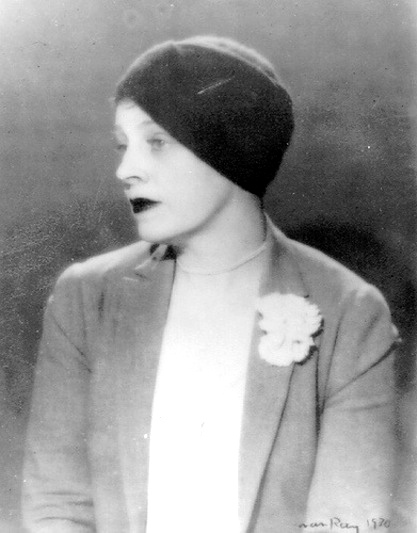
Richardson was born in Abingdon in 1873. Her family moved to Worthing, West Sussex in 1880 and then Putney, London in 1883. At seventeen, because of her father's financial difficulties she went to work as a governess and teacher, first in 1891 for six months at a finishing school in Germany. In 1895 Richardson gave up work as a governess to take care of her severely depressed mother, but her mother committed suicide the same year. Richardson's father had become bankrupt at the end of 1893.
Richardson subsequently moved in 1896 to Bloomsbury, London, where she worked as a receptionist/secretary/assistant in a Harley Street dental surgery. While in Bloomsbury in the late 1890s and early 1900s, Richardson associated with writers and radicals, including the Bloomsbury Group. H. G. Wells (1866–1946) was a friend and they had a brief affair which led to a pregnancy and then miscarriage, in 1907. While she had first published an article in 1902, Richardson's writing career, as a freelance journalist really began around 1906, with periodical articles on various topics, book reviews, short stories, and poems, as well as translation from German and French. During this period she became interested in the Quakers and published two books relating to them in 1914.
In 1915 Richardson published her first novel Pointed Roofs, the first complete stream of consciousness novel published in English. She married the artist Alan Odle (1888-1948) in 1917 – a distinctly bohemian figure, who was fifteen years younger than she. From 1917 until 1939 the couple spent their winters in Cornwall and their summers in London, and then stayed permanently in Cornwall until Odle’s death in 1948. She supported herself and her husband with freelance writing for periodicals for many years. In 1954, she had to move into a nursing home in the London suburb of Beckenham, Kent, where she died, forgotten, alone and ignored, in 1957.
Richardson was one of a select group of writers who changed the rules of prose fiction at the beginning of the twentieth century. With James Joyce in Ireland, Marcel Proust in France, William Faulkner in the United States and, in England, Virginia Woolf, Richardson invented a new form of writing. She can claim, with Proust and Joyce, to have been at the forefront of a revolution in literature. The first ‘chapter’ of her long work, Pilgrimage, was begun in 1912 - a year before the publication of the first volume of A La Recherche du Temps Perdu, two years before the first appearance of A Portrait of the Artist as a Young Man, and seven years before Woolf’s first experimental novel Jacob’s Room.
Richardson also published short stories in a variety of periodicals (a collection was published by Virago in 1989) and a handful of poems. She was the author of numerous articles in periodicals such as Adelphi and Vanity Fair. She began her literary career reviewing for the vegetarian journal, Crank. Between 1912 and 1921, she wrote a regular column, ‘Comments by a Layman’, for the Dental Record. She translated eight books into English from French and German. Between 1927 and 1933 she published 23 articles on film in the avant-garde little magazine, Close Up.
Richardson’s aesthetic was influenced by diverse currents of thought. She was part of the alternative, bohemian culture at the turn of the century that embraced vegetarianism, feminism and socialism. Olive Schreiner and Charlotte Perkins Gilman made an early impact on her work and one of her first reviews was of a book by the advocate for homosexual rights, utopian socialist, and Whitmanite poet, Edward Carpenter.
13 novel/chapters covering around 25 years of Miriam's life, the first published in 1915 and the last not until after Richardson's death in 1957. To designate it "autobiographical" is to entirely miss the point, not only because it is simply impossible for one to have such detailed recall of one's life, but also because it is to ignore what is being done with this text.
DR tells us in her introduction that she began writing a more traditional novel, but quickly discovered it would not allow her to explore or express those things she felt it essential to get down on the page. So she destroyed her work and began from first principles, creating a new form of prose, a new type of sentence as she did so. It has been called "feminine", but I think we have moved passed such essentialism and can seek to find another way to describe it (this is not to negate the work of Cixous and others, just that I don't think the idea of the Feminine Menstrual Flow etc is helpful – the politicisation of the female body is obviously important, and was rightly dealt with extensively in the 70s and 80s, but ironically neglects the fluidity of the very concept of gender itself – one can, of course, discuss society's representation of the concepts of Woman and Man as binaries, but this does not reflect some essential form of Being).
Her work is presented primarily as being in opposition to what is often termed "masculine" prose – by this is meant a text with a privileged authorial position, a prose which speaks in the definitive, which has a confidence in its ability to say what things are, that is solid, formed, firmly tied to its object, its purpose. Male logocentricity and the certainty of the Word.
Hence why Richardson objected to the term "stream of consciousness" – a stream is defined and delineated by its banks, by its purposeful descent to the sea.
Masculine prose, at the time of her writing at least, often described itself as "realist". Richardson failed to see any connection between the reality she experienced and the world displayed in these texts. The development of the novel in the 20th century surely proves her view correct.
She needed her prose to be fluid, to move easily between first, second or third person, to shift in perspective and between contradictory opinions. Such a style becomes even more complex when we discover that the later chapters will comment upon or re-write parts of earlier ones, just as our view of our lives changes as we grow. There is no privileged position from which to form the arc of a plot, no statement of fact. There is only the attempt.
Is this not something we usually associate with the Postmodern, rather than the Modernist? Though this tells us little but that such labels are meaningless and irrelevant.
She explicitly problematizes gender binaries, defines herSelf as a fluid state moving between the Male and the Female, and is strongly critical both of Woman and of Man. Her critique of Woman should be unsurprising when we remember the meaning of this term in those early days of the 20thc.
That Richardson's mother slit her own throat with a kitchen knife is an important point to remember. As is the bankruptcy and "failure" of her father.
What does it mean to have a Pilgrimage without a goal? Where the destination is the wandering itself, the travel over borders and through time, the transformation of life into text?
It is a text which exists on the margins (particularly when one considers bell hook's use of the term) in that it creates a space for Miriam's Being whilst being explicitly conscious of the pull of the Centre. It could never be Canonical. It holds a true and paradoxical Self, as Self which is both Within society and observing it from the position of Other. This is a painful place to be. This is a pleasurable place to be. It is most certainly impossible without a Room of One's Own.