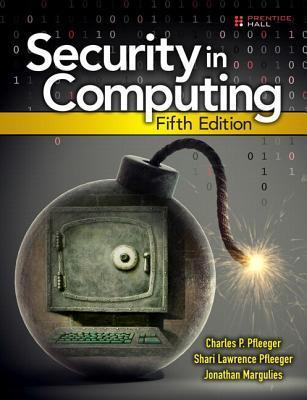
The New State of the Art in Information Now Covers Cloud Computing, the Internet of Things, and Cyberwarfare
Students and IT and security professionals have long relied on Security in Computing as the definitive guide to computer security attacks and countermeasures. Now, the authors have thoroughly updated this classic to reflect today’s newest technologies, attacks, standards, and trends.
Security in Computing, Fifth Edition, offers complete, timely coverage of all aspects of computer security, including users, software, devices, operating systems, networks, and data. Reflecting rapidly evolving attacks, countermeasures, and computing environments, this new edition introduces best practices for authenticating users, preventing malicious code execution, using encryption, protecting privacy, implementing firewalls, detecting intrusions, and more. More than two hundred end-of-chapter exercises help the student to solidify lessons learned in each chapter.
Combining breadth, depth, and exceptional clarity, this comprehensive guide builds carefully from simple to complex topics, so you always understand all you need to know before you move forward.
You’ll start by mastering the field’s basic terms, principles, and concepts. Next, you’ll apply these basics in diverse situations and environments, learning to ”think like an attacker” and identify exploitable weaknesses. Then you will switch to defense, selecting the best available solutions and countermeasures. Finally, you’ll go beyond technology to understand crucial management issues in protecting infrastructure and data.
New coverage includes
A full chapter on securing cloud environments and managing their unique risks Extensive new coverage of security issues associated with user—web interaction New risks and techniques for safeguarding the Internet of Things A new primer on threats to privacy and how to guard it An assessment of computers and cyberwarfare–recent attacks and emerging risks Security flaws and risks associated with electronic voting systems
This book covers security at Many different levels (tries to be comprehensive)... although this is a constantly changing topic of study, every time new tactics are used by some hacker/virus/trojan...etc.
Topic included are: the "Meaning of Computer Security", Attacks & methods of defense, cryptology, software(code) security, Viruses, root-hacks, Operating system security, Trusted-systems, File protections, Database security, SQL injection, Multi-Level approaches, Networks, firewalls, Vlans, Session hijacking, flaws in net protocols, Web site vulnerabilities, Alarms, monitoring, countermeasures, Administration, Risk Analysis, Physical building security, Data privacy, computer ethics, Email monitoring or interception, spoofing, phishing, computer crime, code of ethics, SOA Architecture, and more...
This is certainly not a "light read" or something you complete in a week; but for somebody who runs computers professionally, there is a lot of info here -so you know several problem issues to avoid when designing new computer systems.
I would also recommend knowing the ISO-27001 and ISO-27009 standards, and similar security standards from OWASP (Open.Web.Application.Security.Project), plus Oasis-open.org guides.
This book has some great high level information on computer security and is heavy loaded with the computer security's industry lingo. However, it does not cover details on hacking techniques and the content is quite verbose - not very succinct. Additionally, this is not the latest edition of that book.