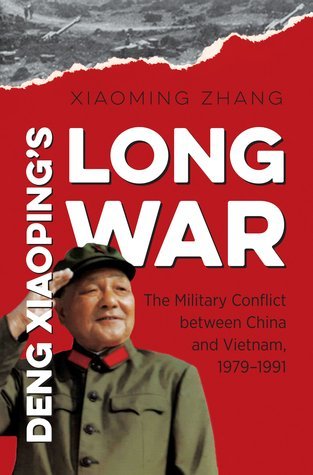
The surprise Chinese invasion of Vietnam in 1979 shocked the international community. The two communist nations had seemed firm political and cultural allies, but the twenty-nine-day border war imposed heavy casualties, ruined urban and agricultural infrastructure, leveled three Vietnamese cities, and catalyzed a decadelong conflict. In this groundbreaking book, Xiaoming Zhang traces the roots of the conflict to the historic relationship between the peoples of China and Vietnam, the ongoing Sino-Soviet dispute, and Chinese leader Deng Xiaoping's desire to modernize his country. Deng's perceptions of the Soviet Union, combined with his plans for economic and military reform, shaped China's strategic vision. Drawing on newly declassified Chinese documents and memoirs by senior military and civilian figures, Zhang takes readers into the heart of Beijing's decision-making process and illustrates the war's importance for understanding the modern Chinese military, as well as China's role in the Asian-Pacific world today.
Surprisingly balanced and interesting account of the extremely unfortunate military conflict between China and Vietnam, starting with China's brief invasion in February 1979. Zhang has done an impressive amount of research, and is able to synthesise this into a plausible narrative: approximately, that the conflict was a near-inevitable function of the Sino-Soviet Split, China's serious security concerns, Vietnam's alignment from the early 1970s onwards with the Soviet Union, the Vietnamese occupation of Cambodia, and more.
I’d give it a solid 2.75. It is very thorough of the border conflicts of China and Vietnam. A lot of people died considering it was a battle for a few unnavigable mountains. The Cold War is all about fear. In this case, it is the fear of the Soviet Union fighting China through Vietnam and Vietnam asserting themselves through Cambodia. It was a stretch to call it ‘the longest conflict in modern Chinese history’ it was off more than it was on. It is also a stretch to write a book with predictions and interviews on the Vietnamese side with no real records available.
A book on a war that is often long forgotten. A war I had no real knowledge about until I read Brother Enemy which was more focused on Vietnam's expansion into Cambodia but of course included the Sino Invasions. Examines the war itself along with its socio-economic and political causes and effects. Somewhat dry, but gets an extra star just for how rare its subject is.
This book is very useful and informative in certain senses. It certainly gives much clarity to the thinking of the Communist Party of China, and particularly Deng Xiaoping, in choosing to go forward with invasion of Vietnam followed by ten years of 'cold war'. (More on that later.) It gives a lot of technical detail in the specific formations, makeup of battalions, as well as military-analysis style descriptions of the various battles during China's invasion themselves. Much like clarity of the thinking of the CPC, this is presented one-sidedly. That's not to say that the book is 'pro-China', it's definitely written from a 'democracy' vs. communism perspective, a book for Western military analysts (though it's not too heavy-handed here and is relatively neutral with the facts it has on hand-- however, in the Conclusion, it's laid on thick). It's just that lacking access to Vietnamese records and accounts of the same event, the book is simply unable to present a truly all-encompassing reporting of the events. Vietnam's occupation of Cambodia/Kampuchea is extremely important to this sequence of events, but yet is only touched on in reference to China's thinking on the matter -- this seems to be a serious gap in reporting on the history of the event. This can be excused if we keep its purported purpose in mind... but it lacks as a helpful general overview of the conflict from all sides.
But also with that in mind, the book could be shorter than it is, because Deng Xiaoping as a character in its narrative is sidelined for most of it as it gets into reporting on the details of the actual conflict. The idea behind its narrative becomes muddled. And if you are not some sort of person who loves to read how certain military units took certain hills named by certain number, you will find a good portion of this book tedious and worth skimming only.
Anyway, on to some thinking about the conflict and correctness of line and thinking,
I've long considered Mao's turn towards the US in opposition to 'Soviet revisionism' (and Deng's continuation and doubling down on these policies) to be the biggest Theoretical mistake in the CPC line. This book only solidified that opinion for me.
'Maoists' love to point to China before Mao's death in 1975 as the ideal of communism. Everything after Mao, that's counterrevolution. The issues in domestic and foreign policy began with the death of Mao, the arresting of the Gang of Four, and as a final nail in the coffin, the ousting of Hua Guofeng. This is mistaken and also simply historically not factual. Mao turned to Nixon and the US, not Deng. The line of Soviet 'social imperialism', and that the USSR was the hegemony power of the day, and that the US was alternatively NOT that, started with Mao, and is frankly absurd. This line came from both Mao and Deng. It is simply not aligned with reality to suggest otherwise.
On the one hand, we can understand and appreciate the thinking behind China's turn to the US. They did in fact manage to avoid the neoliberal shock therapy that many other socialist countries had to endure-- to the point of collapse, in most cases. The CPC maintained a hold on economic and political power, and maintained national sovereignty, and it seems standing in 2026 that their gambit has paid off.
On the other, it is undeniably a turn away from the greater Socialist movement. Whatever the case may have been for Soviet revisionism, and I am frankly someone who thinks the post-Stalin turn was indeed that, surely this is a time where 'lesser-evilism' should have been considered.
Tensions had certainly simmered between the USSR and the PRC in the two decades between Krushchev's ascent to power and the eve of the invasion of Vietnam, to the point where the USSR had a million soldiers stationed along their shared borders with the PRC, and Mao and Deng (and probably many other leaders in the CPC) considered the Soviet Union as the primary threat to their nation's sovereignty.
There's something to be said about the feeling of a Soviet chauvinism, where China, as a burgeoning additional Communist power in the world (compared to most other Communist or Socialist countries that were comparatively tiny or even less developed), felt particularly threatened by a Soviet Union that had its 'fingers in many pies' so to speak. But this in itself is revealing.
This book mentions how Deng thought Cuba's intervention in Angola should have been dealt with in the same way that China handled Vietnam's intervention in Kampuchea. This is likely due to Cuba being in the Soviet sphere of influence, but the fact that Deng, and by extension Mao, were so theoretically misguided to see the US as being a less hegemonic power who should have been intervening against the USSR and its 'puppet states' shows how totally off the mark their thinking with regard to the USSR was. For as long as the Soviet Union existed, neoliberalism was held at bay. Once it collapsed, and many other socialist states with it, so started Fukuyama's 'end of history'. The Soviet Union's intervention and arming of revolutionary movements was one of its greatest positives throughout its whole existence. Considering what the USSR was doing as hegemonic is reductive towards nationalist thinking. In the CPC's thinking, the Soviet Union was fighting for hegemony in the socialist world, instead of seeing it as a general boon in the general equation of 'capitalism vs socialism'. And for a period of time, they considered their own intervention as true to that general equation, though eventually turned towards the theory of 'hegemony' as against the third world. While I haven't really investigated the Soviet side of this split, I wouldn't be surprised if they were thinking of China's moves in the 'third world' in the same ways.
The Sino-Soviet split is perhaps at the top of the list of tragedies within the still-burgeoning movement towards communism.
Whatever legitimate criticisms there may be of the Soviet Union's leadership and decisions that were made in the post-Stalin era, a theoretical line thinking the US was the lesser evil is absolutely an incorrect one. Perhaps China's theoretical analysts should have been reading more of the Black Panther's reports of COINTELPRO, as well as European, Latin American, Middle Eastern, and African reports of GLADIO and other CIA activities -- much of which was only revealed officially after the fall of various Socialist/Communist governments, but which was certainly reported in good time by leftist movements as they were happening.
You can dream of a proper continuation of the Third International as the solution to some of these problems. You can dream, but it would be a mistake to evaluate your own line as against one socialist country or another with that same understanding.
In 1991, China watched the US decimate Iraq in the Gulf War, and realized quietly that their line for the past decade and more had been wrong. And that they were ill-equipped to deal with the Greater Satan. While maintaining a public face of superiority over Vietnam in their regional Cold War conflict, ultimately getting the concessions from Vietnam they sought from the beginning, they more or less dropped it, to the point where the invasion of the SRV has become China's 'forgotten war' wherein veterans of it, except those who have ascended the ranks of the military, consider it as completely pointless -- and it would appear with how both sides of kept much of the conflict and its official documents behind closed doors, that an agreement was made to recognize that this was a mistake that both countries should move past without embarrassing the other.
It would seem in the past decade, particularly since Xi Jinping's rise to paramount leader of the CPC, that the thinking of the party has developed to a point where official party theorists and organs have learned lessons from the CPC's tragic ideological conflict with the USSR. See for example the party and affiliate analysis on the fall of the USSR and their 'historical nihilism', as its put in Chinese Marxist theory, essentially mimicking what Kim Jong Il of the DPRK was saying around the era of Communist collapse. In particular we see them putting forward their own synthesis of Soviet revisionism (peaceful coexistence in particular) with Juche understandings of the need for each Socialist country to pursue development and sovereignty in the way they see fit without 'chauvinist' intervention. That's good to see. Of course, those that build their theoretical understandings over one country's particular era's lines might expect some sort of formal apology, but, I'm of the opinion that public apologies of incorrectness of line give in to moralism which is simply not scientific and by the nature of such a thing subject to individualist opinions about a situation. You will never please everyone with such a statement. Much better to just change your theory and praxis and move on.
Communist parties dealing with maintenance and development of an underdeveloped nation is a tricky thing, deeply complex, and it's not reasonable to cast blanket statements over any particular move or choice made to maintain the country or maintain peace in the inherently unstable situation of a socialist government in an imperialist encirclement. Thus, for Communists in the 'West', the goal is to end the Western imperial conditions that lead to such difficult choices as the ones various Communist and Socialist governments have been forced to make under threat of Nuclear Gun, instead of casting black-and-white moral judgments over them in one era vs the other. This goes for China in its Mao and post-Mao eras, but goes for the USSR and its Lenin, Stalin, and post-both eras as well. So many 'communists' in the imperial core decide their line on any of these particular eras and their lines, instead of recognizing this greater fact.
An excellent read that explores the many dimensions of this important conflict between China and Vietnam. I credit Zhang Xiaoming with giving me three major ideas to chew upon: Deng's visionary thinking, how to evaluate the conflict, the role of political ideology.
First, Zhang makes a very compelling argument that Deng Xiaoping invaded Vietnam with the future in mind. He made a bold calculation that the Soviet Union would not be able to assist Vietnam and that the U.S. would be intrigued to see China stand-up to Vietnam's assertiveness in Southeast Asia. His calculation certainly paid-off and arguably was useful in creating goodwill between certain American leaders who probably were satisfied to see Vietnam be humbled. Americans often forget that the 1980s were a boom for U.S.-China relations. I think Zhang is correct to assert that Deng had hoped for closer economic and political ties with the West and that fighting Vietnam would portray China as a more attractive partner.
Second, Zhang is helping me rethink how I evaluate this conflict. Previously, I was convinced that from an operational perspective, China did not accomplish that much. And while Zhang showcases China's problems with logistics, combined armed, and fighting on unfamiliar terrain, he also shows that China did a lot right. There was certainly a lot of thought placed into how the campaign would be waged and the goals were clearly defined. Chinese soldiers fought bravely against some of Vietnam's elite, battle-tested units. Not only did they fight well, they accomplished their objectives by seizing the northern provincial capitals of Vietnam. The military accomplished all of its goals, even if it wasn't pretty. And while China's invasion didn't force Vietnam out of Cambodia, Beijing bled Hanoi dry by staging a ten-year conflict along the Sino-Vietnamese border. Vietnam's economic growth was stunted by having to support such a large defensive force for so long. And while Yunnan and Guangxi paid a high economic cost, China as a whole was economically soaring in the 1980s. China can rightly claim a strategic, geopolitical victory in the war against Vietnam.
Lastly, Zhang highlights the importance of ideology. Whether it was at the strategic level: Sino-Soviet completion for the leadership of the international communist movement, or at the tactical level: political commissars using ideology to inspire bravery amongst Chinese PLA battalions, ideology matters to China. The West is often quick to eye-roll and scoffs at Marxist-Leninism ideas and there usefulness. But what matters is how China views ideology. Many Chinese political and military leaders do view ideology as a supplement to military power. Creating and nurturing patriotism, just-war narratives, and perspectives of self-defense are important. We should not underestimate China's value of ideology. They believe this stuff works and attach great importance to it. And there is a strong argument that it does work to some extend. Significant persuasion was required to mobilize an army of uneducated, largely rural, and inexperienced soldiers AND that it was in their interest to invade a foreign country, confronting a Vietnamese military that had outlasted the French and the Americans. Ideology and its role in Chinese warfighting need not be simply dismissed.
Kết cuộc lại thì cá nhân Đặng Tiểu Bình và quyết định tiến quân vào Campuchia của Lê Duẩn là hai yếu tố quan trọng dẫn đến cuộc chiến tranh biên giới. Hai nhà độc tài đã khiến cho không biết bao nhiêu con người đã phải thiệt mạng cả ở hai bên.
We are competing in an era where bite-sized territorial conquest is an increasingly common strategy, and the Sino-Vietnamese War is an example of China taking just that approach. In 1979, China sent its People’s Liberation Army (PLA) south to “teach Vietnam a lesson” in response to simmering Sino-Vietnamese territorial disputes and concerns over the Soviet Union’s influence in southeast Asia (China had recently aligned with the United States against the Soviets). Within a month, the PLA’s “self-defense counterattack” had defeated Vietnamese ground forces, reduced the provincial capital city of Lang Son to rubble, declared the road to Hanoi open, and then withdrawn, having made China’s point. However, as Xiaoming Zhang notes in this unique and richly sourced history, China continued to fight a war of attrition against Vietnam until the early 1990s, regularly shelling targets in the Vietnamese border region and fighting major border battles as part of a policy of “bleeding” Vietnam to punish it for its ongoing occupation of Cambodia. Until 1983, China continued to seize small territorial strongholds along the border. Then, in 1984, it launched a major operation to seize the Laoshan Heights. From 1985 to 1989 the PLA systematically rotated a total of 180,000 combat troops through deployments to the Laoshan Heights so they could gain combat experience, inflicting 33,500 Vietnamese casualties, and suffering 4,300. The PLA continued to execute combat missions on the border until 1993. China does its best to censor accounts of this aggression, but we certainly should not forget them. Keep this in mind when analysts argue that China has not fought a war since 1979.
So North Vietnam manages to rearm after taking over South Vietnam and uses that gear tô take over Cambodia and Laos. The Communist world disintegrates and Vietnam sides with the Soviet Union. Communist China feels like it is surrounded by enemies and wants to punish “ungrateful” Vietnam and hates the fact that the Soviet Union used its rail lines that were overburdened during the Cultural Revolution. It then uses diplomacy to build support against Vietnam, which the rest of the world increasingly sees as an imperial power. However, China decides to invade Vietnam to clear at least one enemy from its borders, get Vietnam out of Cambodia, remind Vietnam who’s boss, and get military training. Unfortunately, the Military is not large enough and China flounders in Vietnamese jungles. Basically, it ends with China having a boot print on its face, with a low grade border conflict that lasts through the 1980s that puts economic strain on the Yunnan and Guangxi provinces that prevents their modernization until later. I sense that mistakes were made. Also, I find it strange that Mao thought that America would switch ơn a dime to befriend thêm after sợ much animosity. Well that and how Le Duan was actually a bad negotiator since he had trouble understanding why the USSR and China kept pursuing different goals instead of realizing that countries inevitably pursue their national interests.
If you are deeply interested in the politics of the Cold War, especially the largely unknown Soviet Union vs Chinese component I highly recommend this book. It shows how the Chinese attacked Vietnam as a result of Cold War fears and fought a 10 year off and on war against their much smaller neighbor. I have long studied the Cold War, but like most people, my reading has focused on the US vs Russian part of the conflict. Reading this book gives one new insight on the opening of China and détente with Russia as both rivals jockeyed for US support against their enemy.
Having highly recommended this book I will add that this book is not for someone looking for a light quick read. It examines Chinese politics in depth and is densely packed with facts. It is also sparse on information on the Vietnamese version of events, as the author puts it, due to the inability to examine Vietnamese archives.
Barely mentioned in both China and Vietnam, the Chinese invasion of Vietnam in 1979 (the Third Indochina War) epitomised the pervasive fear that defined the Cold War: in this war it was the fear of Soviet encirclement of China through Vietnam and Vietnamese hegemony in Southeast Asia, seen through the invasion by the former of Cambodia to oust Pol Pot.
Xiaoming Zhang has written the definitive history of the war and its origins from the Chinese perspective (Vietnamese archives and histories remain inaccessible). Zhang outlines the war’s origins in Chinese geopolitical concerns and lack of gratitude for aid during the war with America; he charts the progress of political and military mobilisation as well as the decade-long border conflict that followed the Chinese army’s withdrawal in March 1979.
This might be the most detailed account of the Chinese side of the war but it still is a dry and academic work, more maps and photos would have been beneficial.
The major fault of this book is that the author didn't have access to Vietnamese records. Considering they were one half of the conflict, that's a pretty significant issue. However, it really can't be held against the author since no one outside of the Vietnamese government, military, and select few others, do. The other option would have been to wait around for who knows how many years for Vietnam to open up their archives before writing about this subject—hardly an ideal solution, either. Given what he had to work with, I think the author did a fine job recounting and analyzing this often overlooked and underestimated conflict.
A by-the-numbers retelling of one of the most important conflicts of the Cold War. It suggests that the PRC will go to war if they fear strategic encirclement. But that is the extent of its lessons for contemporary times.
The other issues that colour in its margins, namely the decrepit state of the PLA at the start of that conflict and the centrality of Deng Xiaoping in the decision to wage a long war for uncertain gains are questions that only war will answer.
Operational and political history of the Chinese invasion of Vietnam in 1979 and subsequent violent border clashes to 1991. Zhang's argument, from memoirs, interviews, and available documents is that Deng Xiaoping played a central role in this war, and his motivations include implementing it a safeguard for planned economic modernization, to affect China's neighbors and strengthen China's diplomatic position, and rehabilitate the People's Liberation Army after the Cultural Revolution.