

What do you think?

Win a free print copy of this book!
17 days and 11:27:42
25 copies available
U.S. only
The War Within a War: The Black Struggle in Vietnam and at Home
Win a free print copy of this book!
17 days and 11:27:42
25 copies available
U.S. only
The Vietnam war era, in many ways, mirrored and was the beginning of the racial and political turbulence and divisiveness we are experiencing today. By tracing the lives of a group of Black men and women—soldiers, doctors, nurses, journalists—who experienced the battles in Vietnam as well as the socio-political war raging at home in America, Wil Haygood brilliantly contextualizes the racial strife that dominated so much of life in those years and still dominates it today. The most important book to deal with this subject since the bestselling Bloods.
DR. ELBERT A Black doctor who came to Vietnam after watching TV footage of the Watts racial riot in Los Angeles, but soon found himself in the midst of Black Soldier protests; FRED Air Force pilot who became the first Black military officer captured by the North Vietnamese, becoming a hero to twenty million Black Americans; JOE The first Black cinematic star of the war after his exploits in Vietnam inspired the academy award winning film The Anderson Platoon; DOROTHY A nurse stationed at Cu Chi, thirty miles from Saigon, where one particular death would haunt her forever...; WALLACE An Ivy League grad who became the most visible Black reporter in Vietnam, determined, more than anyone, to investigate the racial dynamics of the decade-long conflict; GEORGE The gauntlet he ran through enemy territory during the 1965 Battle of Ia Drang to get back to his men became the stuff of legend; HENRY A marine officer feared by the North Vietnamese, and who came to stand up against the racism in the Marine Corps; PHILIPPA A biracial concert pianist who went to Vietnam to rescue mixed-race orphans, many fathered by Black soldiers, and who died fleeing Vietnam with some of those orphans.
These are the central characters Haygood uses to examine the role of Blacks in Vietnam and at home during and immediately after the war. Through the prism of their lives as well as many other crucial figures of that era—Marvin Gaye and Berry Gordy, Dwight Johnson (a war hero, who is shattered and ultimately destroyed by his experiences), Maude deVictor (who took up the cause of Agent Orange on behalf of veterans), Lyndon Johnson, William J. Fulbright, Martin Luther King, and still many others, Haygood reveals the tragedies and triumphs, the honor and hypocrisies, the courage and the cowardice that shaped an era and whose repercussions resonate today.
DR. ELBERT A Black doctor who came to Vietnam after watching TV footage of the Watts racial riot in Los Angeles, but soon found himself in the midst of Black Soldier protests; FRED Air Force pilot who became the first Black military officer captured by the North Vietnamese, becoming a hero to twenty million Black Americans; JOE The first Black cinematic star of the war after his exploits in Vietnam inspired the academy award winning film The Anderson Platoon; DOROTHY A nurse stationed at Cu Chi, thirty miles from Saigon, where one particular death would haunt her forever...; WALLACE An Ivy League grad who became the most visible Black reporter in Vietnam, determined, more than anyone, to investigate the racial dynamics of the decade-long conflict; GEORGE The gauntlet he ran through enemy territory during the 1965 Battle of Ia Drang to get back to his men became the stuff of legend; HENRY A marine officer feared by the North Vietnamese, and who came to stand up against the racism in the Marine Corps; PHILIPPA A biracial concert pianist who went to Vietnam to rescue mixed-race orphans, many fathered by Black soldiers, and who died fleeing Vietnam with some of those orphans.
These are the central characters Haygood uses to examine the role of Blacks in Vietnam and at home during and immediately after the war. Through the prism of their lives as well as many other crucial figures of that era—Marvin Gaye and Berry Gordy, Dwight Johnson (a war hero, who is shattered and ultimately destroyed by his experiences), Maude deVictor (who took up the cause of Agent Orange on behalf of veterans), Lyndon Johnson, William J. Fulbright, Martin Luther King, and still many others, Haygood reveals the tragedies and triumphs, the honor and hypocrisies, the courage and the cowardice that shaped an era and whose repercussions resonate today.
384 pages, Hardcover
Published February 10, 2026
Ratings & Reviews
Friends & Following
Create a free account to discover what your friends think of this book!
Community Reviews
Displaying 1 - 30 of 65 reviews

February 10, 2026
Vietnam Didn’t End in 1975 – It Just Came Home: Wil Haygood’s “The War Within a War” and the Hidden Front America Still Won’t Name
By Demetris Papadimitropoulos | February 10th, 2026
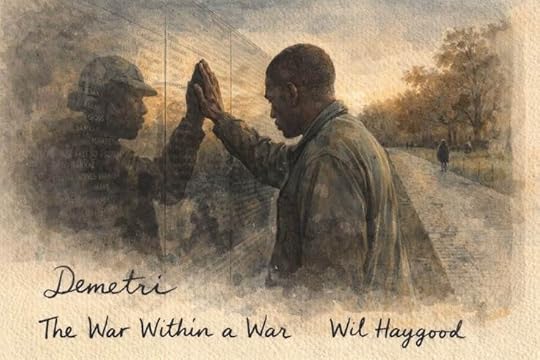
Watercolor Piece by Demetris Papadimitropoulos
Wil Haygood has always trusted the smallest unit of history: a face, a room, a sentence spoken without rehearsal. In “The War Within a War,” his attention lands where the official record tends to blur – on Black Americans who went to Vietnam wearing the uniform of the United States and returned to discover that the uniform did not fully protect them from the country’s oldest weather. Haygood is a writer who believes the nation’s moral biography is written in ordinary lives, in the people who rarely appear in heroic murals yet keep the country’s conscience from going numb. He does not thunder. He stays close. He lets the reader hear how a life sounds when it is telling the truth.
The Vietnam War has been narrated so often it can feel like an American myth with preinstalled pictures: helicopter blades, rice paddies, an officer’s radio chatter, a young man’s face hardening into cynicism. Haygood does not deny those images; he refuses to let them do the work. His Vietnam is less a theater of tactics than a stress test for citizenship. The question that keeps returning, sometimes directly and sometimes through the angle of a story, is cruelly simple: what does it mean to be asked to fight for democracy abroad while living inside a democracy that withholds its full promise at home?
Haygood’s structure is braided and musical. He moves between fronts that defined the era: combat and caretaking, barracks and back home, politics and culture, the private dread of a soldier and the public language of the state. He resists strict chronology in favor of moral clarity. He wants the reader to feel how a war abroad and a war at home interacted, echoed, and amplified each other. The result is a kind of national montage. A medic crouches over a wound and becomes a lens on policy. A nurse endures the nightly arithmetic of triage and becomes a lens on what war costs the caretakers. A journalist’s notebook becomes a lens on who is granted voice, and when.
One of the book’s most unsettling achievements is its depiction of bureaucracy as a second battlefield. Haygood returns repeatedly to the places where power is administered: stockades, chain-of-command offices, disciplinary rooms where the language of “order” can hide the reality of unequal scrutiny. His chapters on military confinement and revolt are not simply episodes of wartime unrest; they are portraits of a system in which punishment becomes a tool of racial governance. He shows how quickly “discipline” can become an alibi for suspicion, and how swiftly suspicion can harden into policy when it is wrapped in institutional language.
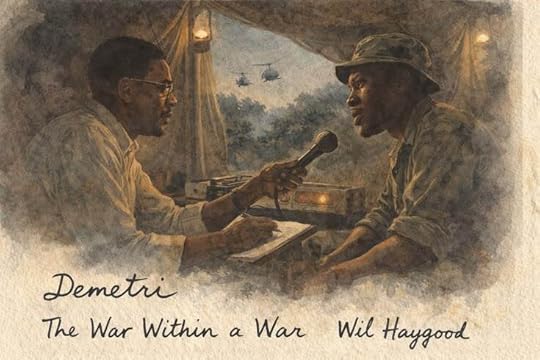
Watercolor Piece by Demetris Papadimitropoulos
Yet “The War Within a War” never reduces its subjects to symbols. Haygood’s gift is for the human detail that resists simplification. He has an eye for the small thing that carries a whole life: the taste of a cold drink in the heat, the ritual of a late-night conversation, the way humor can serve as armor and confession at once. He writes people as people – funny, frightened, stubborn, vain, exhausted, tender. Courage here is rarely cinematic. It looks like endurance, like competence, like a steady refusal to become numb.
The prose, like the moral stance, is controlled. Haygood avoids the pyrotechnics that war writing can invite. Even when the material is harrowing, the sentences keep their temperature. This restraint is not aesthetic modesty so much as ethical refusal. He will not turn suffering into spectacle. He is more interested in the war’s slow violences – the administrative humiliations, the casual slurs, the unequal discipline, the fatigue that accumulates in the body. The book is full of sound – radios, shouted orders, music – but it often feels quiet. It is the quiet of a hospital at 3 a.m., of a complaint delivered carefully because the wrong tone will be used as an excuse to ignore the truth.
That choice places Haygood at an angle to the most famous Vietnam storytelling. Where Michael Herr’s “Dispatches” turns the war into a fever dream of language, and where the movies “Apocalypse Now” and “Platoon” burn Vietnam into the retina as nightmare and spectacle, Haygood narrows the aperture. He is not trying to out-intensify the canon. He is trying to correct the frame. The effect is closer, at times, to the moral uncertainty of “The Things They Carried,” in which what matters is not only what happened, but what a person has to carry afterward, and what stories become survivable.
If there is a signature Haygood move, it is his devotion to rooms. He understands that history happens indoors as much as it happens in the open air: in a hospital tent where a nurse learns to triage her own fear, in an office where a complaint must be phrased in the language of the institution in order to be heard, in a cell where time itself becomes a kind of punishment. He lets these rooms do symbolic work without insisting that the reader notice. The book reads, in that sense, like a series of carefully lit interiors, each one revealing a different way the nation treats the people it asks to serve it.
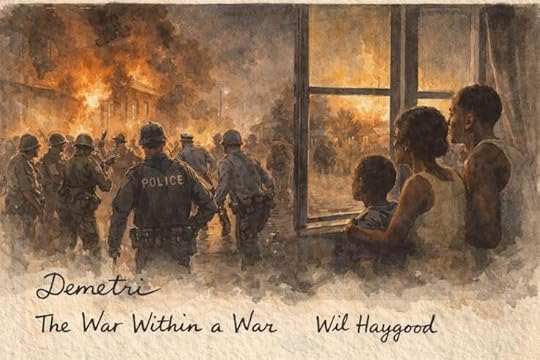
Watercolor Piece by Demetris Papadimitropoulos
Haygood is especially shrewd about culture, and he refuses to treat it as decoration. When the book turns toward Motown – toward the friction between the desire to entertain and the obligation to tell the truth – it is not taking a detour from Vietnam. It is showing how the war entered American life through sound. “What’s Going On” does not appear as a nostalgic needle drop; it arrives as an artifact of conscience, a reminder that sometimes feeling travels faster than policy. Haygood understands the moral work of music in a divided nation: it can deliver grief where speeches cannot, and it can smuggle criticism into the bloodstream of the culture before the culture has decided it is ready to hear it.
The political chapters deepen that legibility without slipping into caricature. Haygood writes about Lyndon B. Johnson with an almost tragic patience, attentive to the way a man can be both consequential in civil rights and undone by Vietnam. Johnson in twilight – brooding, resentful, haunted by his own appetite for approval – is not exonerated, but he is made human, which is harder. Haygood is less interested in scoring points than in capturing the texture of power: its vanity, its loneliness, its ability to rationalize what it cannot bear to admit. He allows the reader to feel how policy becomes personal, how the country’s decisions become a private burden carried by the people least responsible for making them.
The book’s most radical insistence may be that caretaking counts as war work. Haygood makes space for nurses and medics who held bodies together, and he refuses to treat their labor as supporting cast. Their heroism is rarely rewarded with narrative fireworks; it appears as repetition, competence, and the moral discipline of staying present. In a moment when the public conversation is more alert to the invisible costs carried by caregivers – in hospitals, in homes, across institutions that lean on emotional labor while pretending it is renewable – Haygood’s attention feels not only humane but corrective.
If the middle of the book is about fracture, the final movement is about afterlives. Here Haygood’s restraint becomes a form of authority. The nation prefers to imagine wars as events with end dates, as if a signature on a document can dissolve a memory in the body. Haygood insists on the opposite. Vietnam follows his subjects into jobs, marriages, addictions, silences, and sudden rages. It returns as sleeplessness, as vigilance, as a reflex that cannot be argued with. It returns, too, as a burden of explanation: the need to translate private damage into a public language that often has no patience for nuance.
The movement toward memorial and remembrance does not deliver easy closure. Haygood understands that monuments can acknowledge and still fail to repair. The Vietnam Veterans Memorial, with its names held in black stone, becomes both recognition and question: what does it mean to be finally visible in death, when visibility in life was conditional? Haygood lingers over tactile rituals – fingers tracing letters, rubbings made on paper – and he makes the reader feel how memory is performed, not simply possessed. Those scenes also press quietly on a contemporary nerve: the nation is still arguing over what deserves commemoration, and who gets to be central in the story the country tells itself.
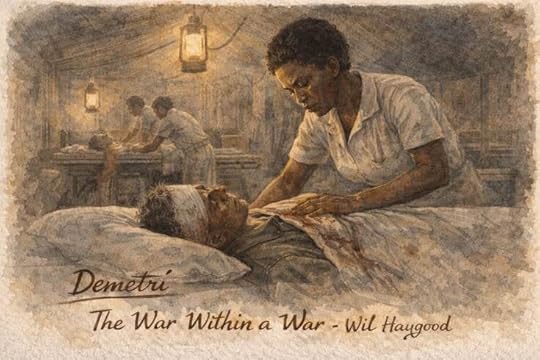
Watercolor Piece by Demetris Papadimitropoulos
Wallace Terry, whose work haunts the book, embodies that ethic. Haygood treats Terry not merely as a reporter but as a custodian of testimony, someone who understood that if Black soldiers were not recorded in their own voices, they would be edited out by the next retelling. This emphasis on witness gives “The War Within a War” its pulse. It also explains Haygood’s own approach. He is less a lecturer than a collector. He draws close, asks, waits, and lets the person speak. That method produces one of the book’s quiet pleasures: the reader comes to recognize voices, not just facts, and to understand history as a chorus rather than a lecture.
It is impossible to read the book without sensing its place in a lineage. Its closest ancestor is Terry’s “Bloods,” the oral-history foundation that proved Black Vietnam testimony could be both record and literature. Haygood shares Terry’s reverence for the unvarnished voice and his suspicion of the official narrative. At the same time, Haygood’s collage approach recalls books like Isabel Wilkerson’s “The Warmth of Other Suns” and George Packer’s “The Unwinding,” in which a handful of lives become a portrait of a nation’s inner weather. The achievement in Haygood’s version is tonal: he keeps the dignity of biography while allowing the larger argument to emerge without being hammered into place.
There is, too, a quiet theory of Americanness embedded in the book. Haygood keeps returning to the sensation of being asked twice: to serve, and then to prove that the service counts. The war zones are physical, but the other war is administrative and psychological. It unfolds in who is presumed credible, who is watched, who is disciplined first, whose grief is granted public language and whose grief is expected to stay private. In Haygood’s telling, Vietnam does not merely injure bodies; it exposes the hidden machinery of belonging – the rules, spoken and unspoken, by which the nation decides who is inside the circle and who is permitted only temporary entry.
Haygood is careful, however, not to let diagnosis harden into certainty. He respects contradiction. His subjects can be patriotic and furious, proud and ashamed, protective of the institution and unwilling to excuse it. That complexity is part of the book’s moral education. It asks the reader to abandon the lazy binaries of hero and victim, loyalty and betrayal, soldier and protester. In an era that rewards instantaneous moral sorting, the book’s insistence on layered feeling can register as a kind of quiet rebellion: it refuses the simplifications that make outrage easy and understanding impossible.
The book also offers an implicit lesson about how truth travels. Official language tends to arrive cleaned and optimistic. Lived experience arrives messy, particular, sometimes profane, sometimes funny. Haygood’s chapters about songs, speeches, and public performances remind the reader that culture is often where a society processes what government cannot admit. That feels newly relevant in a time when institutions struggle to maintain credibility, and when citizens increasingly rely on witnesses, artists, and first-person testimony to locate reality amid competing narratives.
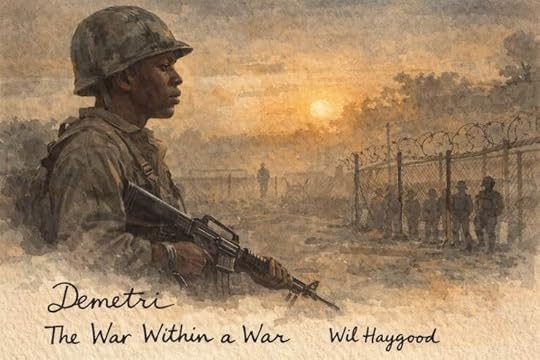
Watercolor Piece by Demetris Papadimitropoulos
And because Haygood writes with an archivist’s tenderness, the book often behaves like a counter-monument: not marble-smooth, not heroic, but intimate and insistently human. Names, voices, and small objects carry as much weight as any battle map. This is why the book resonates amid contemporary arguments about what deserves commemoration and who gets placed at the center of the national story. Haygood’s answer is practical: start with the people, and let the nation reassemble around them. It is a bracing kind of patriotism.
What makes “The War Within a War” feel urgent now is not a parade of contemporary references but the way it illuminates patterns we keep relearning: the brittleness of trust, the cost of bureaucratic indifference, the ease with which public language drifts from lived reality. The book’s veterans navigate a world where loyalty is demanded but belonging is conditional, where institutions ask for sacrifice and then struggle to deliver care, where dissent is punished as disloyalty rather than treated as civic participation. Haygood does not need to gesture at today’s headlines to make the connection. The connective tissue is structural, and it is still with us.
Still, the book is not flawless, and its imperfections are the kind that come from ambition. The mosaic form can at times feel more elegiac than driving; certain chapters function as thematic panels rather than as strands that tighten toward a single narrative climax. Readers who want a firmer policy accounting – the mechanics of decision-making, the internal debates, the architecture of strategic failure – may find Haygood less interested in causality than in consequence. And occasionally, the book’s movement toward well-known cultural and political figures can feel like a concession to familiarity, when the least familiar voices are the ones that most powerfully rewire the reader’s sense of the war.
Those criticisms are inseparable from the book’s strengths. Haygood has chosen the form that best matches his moral aim: to enlarge the national memory without turning it into a courtroom brief. His power lies in intimacy and witness, in the way he makes a reader feel that history is not an abstraction but a set of lives that were lived, bodies that were bruised, and hopes that had to adapt in order to survive.
If a single number must stand in for a reading experience that is larger than arithmetic, “The War Within a War” earns an 89 out of 100 – a compassionate, formally elegant, deeply humane history that expands the nation’s sense of itself, even if its devotion to atmosphere sometimes softens the sharpest edges of analysis. What lingers is not the thrill of revelation but the steadier ache of recognition: the sense that wars do not end, they migrate, and that the struggle over who gets remembered as fully American is itself a battlefield whose borders keep shifting.
By Demetris Papadimitropoulos | February 10th, 2026
Watercolor Piece by Demetris Papadimitropoulos
Wil Haygood has always trusted the smallest unit of history: a face, a room, a sentence spoken without rehearsal. In “The War Within a War,” his attention lands where the official record tends to blur – on Black Americans who went to Vietnam wearing the uniform of the United States and returned to discover that the uniform did not fully protect them from the country’s oldest weather. Haygood is a writer who believes the nation’s moral biography is written in ordinary lives, in the people who rarely appear in heroic murals yet keep the country’s conscience from going numb. He does not thunder. He stays close. He lets the reader hear how a life sounds when it is telling the truth.
The Vietnam War has been narrated so often it can feel like an American myth with preinstalled pictures: helicopter blades, rice paddies, an officer’s radio chatter, a young man’s face hardening into cynicism. Haygood does not deny those images; he refuses to let them do the work. His Vietnam is less a theater of tactics than a stress test for citizenship. The question that keeps returning, sometimes directly and sometimes through the angle of a story, is cruelly simple: what does it mean to be asked to fight for democracy abroad while living inside a democracy that withholds its full promise at home?
Haygood’s structure is braided and musical. He moves between fronts that defined the era: combat and caretaking, barracks and back home, politics and culture, the private dread of a soldier and the public language of the state. He resists strict chronology in favor of moral clarity. He wants the reader to feel how a war abroad and a war at home interacted, echoed, and amplified each other. The result is a kind of national montage. A medic crouches over a wound and becomes a lens on policy. A nurse endures the nightly arithmetic of triage and becomes a lens on what war costs the caretakers. A journalist’s notebook becomes a lens on who is granted voice, and when.
One of the book’s most unsettling achievements is its depiction of bureaucracy as a second battlefield. Haygood returns repeatedly to the places where power is administered: stockades, chain-of-command offices, disciplinary rooms where the language of “order” can hide the reality of unequal scrutiny. His chapters on military confinement and revolt are not simply episodes of wartime unrest; they are portraits of a system in which punishment becomes a tool of racial governance. He shows how quickly “discipline” can become an alibi for suspicion, and how swiftly suspicion can harden into policy when it is wrapped in institutional language.
Watercolor Piece by Demetris Papadimitropoulos
Yet “The War Within a War” never reduces its subjects to symbols. Haygood’s gift is for the human detail that resists simplification. He has an eye for the small thing that carries a whole life: the taste of a cold drink in the heat, the ritual of a late-night conversation, the way humor can serve as armor and confession at once. He writes people as people – funny, frightened, stubborn, vain, exhausted, tender. Courage here is rarely cinematic. It looks like endurance, like competence, like a steady refusal to become numb.
The prose, like the moral stance, is controlled. Haygood avoids the pyrotechnics that war writing can invite. Even when the material is harrowing, the sentences keep their temperature. This restraint is not aesthetic modesty so much as ethical refusal. He will not turn suffering into spectacle. He is more interested in the war’s slow violences – the administrative humiliations, the casual slurs, the unequal discipline, the fatigue that accumulates in the body. The book is full of sound – radios, shouted orders, music – but it often feels quiet. It is the quiet of a hospital at 3 a.m., of a complaint delivered carefully because the wrong tone will be used as an excuse to ignore the truth.
That choice places Haygood at an angle to the most famous Vietnam storytelling. Where Michael Herr’s “Dispatches” turns the war into a fever dream of language, and where the movies “Apocalypse Now” and “Platoon” burn Vietnam into the retina as nightmare and spectacle, Haygood narrows the aperture. He is not trying to out-intensify the canon. He is trying to correct the frame. The effect is closer, at times, to the moral uncertainty of “The Things They Carried,” in which what matters is not only what happened, but what a person has to carry afterward, and what stories become survivable.
If there is a signature Haygood move, it is his devotion to rooms. He understands that history happens indoors as much as it happens in the open air: in a hospital tent where a nurse learns to triage her own fear, in an office where a complaint must be phrased in the language of the institution in order to be heard, in a cell where time itself becomes a kind of punishment. He lets these rooms do symbolic work without insisting that the reader notice. The book reads, in that sense, like a series of carefully lit interiors, each one revealing a different way the nation treats the people it asks to serve it.
Watercolor Piece by Demetris Papadimitropoulos
Haygood is especially shrewd about culture, and he refuses to treat it as decoration. When the book turns toward Motown – toward the friction between the desire to entertain and the obligation to tell the truth – it is not taking a detour from Vietnam. It is showing how the war entered American life through sound. “What’s Going On” does not appear as a nostalgic needle drop; it arrives as an artifact of conscience, a reminder that sometimes feeling travels faster than policy. Haygood understands the moral work of music in a divided nation: it can deliver grief where speeches cannot, and it can smuggle criticism into the bloodstream of the culture before the culture has decided it is ready to hear it.
The political chapters deepen that legibility without slipping into caricature. Haygood writes about Lyndon B. Johnson with an almost tragic patience, attentive to the way a man can be both consequential in civil rights and undone by Vietnam. Johnson in twilight – brooding, resentful, haunted by his own appetite for approval – is not exonerated, but he is made human, which is harder. Haygood is less interested in scoring points than in capturing the texture of power: its vanity, its loneliness, its ability to rationalize what it cannot bear to admit. He allows the reader to feel how policy becomes personal, how the country’s decisions become a private burden carried by the people least responsible for making them.
The book’s most radical insistence may be that caretaking counts as war work. Haygood makes space for nurses and medics who held bodies together, and he refuses to treat their labor as supporting cast. Their heroism is rarely rewarded with narrative fireworks; it appears as repetition, competence, and the moral discipline of staying present. In a moment when the public conversation is more alert to the invisible costs carried by caregivers – in hospitals, in homes, across institutions that lean on emotional labor while pretending it is renewable – Haygood’s attention feels not only humane but corrective.
If the middle of the book is about fracture, the final movement is about afterlives. Here Haygood’s restraint becomes a form of authority. The nation prefers to imagine wars as events with end dates, as if a signature on a document can dissolve a memory in the body. Haygood insists on the opposite. Vietnam follows his subjects into jobs, marriages, addictions, silences, and sudden rages. It returns as sleeplessness, as vigilance, as a reflex that cannot be argued with. It returns, too, as a burden of explanation: the need to translate private damage into a public language that often has no patience for nuance.
The movement toward memorial and remembrance does not deliver easy closure. Haygood understands that monuments can acknowledge and still fail to repair. The Vietnam Veterans Memorial, with its names held in black stone, becomes both recognition and question: what does it mean to be finally visible in death, when visibility in life was conditional? Haygood lingers over tactile rituals – fingers tracing letters, rubbings made on paper – and he makes the reader feel how memory is performed, not simply possessed. Those scenes also press quietly on a contemporary nerve: the nation is still arguing over what deserves commemoration, and who gets to be central in the story the country tells itself.
Watercolor Piece by Demetris Papadimitropoulos
Wallace Terry, whose work haunts the book, embodies that ethic. Haygood treats Terry not merely as a reporter but as a custodian of testimony, someone who understood that if Black soldiers were not recorded in their own voices, they would be edited out by the next retelling. This emphasis on witness gives “The War Within a War” its pulse. It also explains Haygood’s own approach. He is less a lecturer than a collector. He draws close, asks, waits, and lets the person speak. That method produces one of the book’s quiet pleasures: the reader comes to recognize voices, not just facts, and to understand history as a chorus rather than a lecture.
It is impossible to read the book without sensing its place in a lineage. Its closest ancestor is Terry’s “Bloods,” the oral-history foundation that proved Black Vietnam testimony could be both record and literature. Haygood shares Terry’s reverence for the unvarnished voice and his suspicion of the official narrative. At the same time, Haygood’s collage approach recalls books like Isabel Wilkerson’s “The Warmth of Other Suns” and George Packer’s “The Unwinding,” in which a handful of lives become a portrait of a nation’s inner weather. The achievement in Haygood’s version is tonal: he keeps the dignity of biography while allowing the larger argument to emerge without being hammered into place.
There is, too, a quiet theory of Americanness embedded in the book. Haygood keeps returning to the sensation of being asked twice: to serve, and then to prove that the service counts. The war zones are physical, but the other war is administrative and psychological. It unfolds in who is presumed credible, who is watched, who is disciplined first, whose grief is granted public language and whose grief is expected to stay private. In Haygood’s telling, Vietnam does not merely injure bodies; it exposes the hidden machinery of belonging – the rules, spoken and unspoken, by which the nation decides who is inside the circle and who is permitted only temporary entry.
Haygood is careful, however, not to let diagnosis harden into certainty. He respects contradiction. His subjects can be patriotic and furious, proud and ashamed, protective of the institution and unwilling to excuse it. That complexity is part of the book’s moral education. It asks the reader to abandon the lazy binaries of hero and victim, loyalty and betrayal, soldier and protester. In an era that rewards instantaneous moral sorting, the book’s insistence on layered feeling can register as a kind of quiet rebellion: it refuses the simplifications that make outrage easy and understanding impossible.
The book also offers an implicit lesson about how truth travels. Official language tends to arrive cleaned and optimistic. Lived experience arrives messy, particular, sometimes profane, sometimes funny. Haygood’s chapters about songs, speeches, and public performances remind the reader that culture is often where a society processes what government cannot admit. That feels newly relevant in a time when institutions struggle to maintain credibility, and when citizens increasingly rely on witnesses, artists, and first-person testimony to locate reality amid competing narratives.
Watercolor Piece by Demetris Papadimitropoulos
And because Haygood writes with an archivist’s tenderness, the book often behaves like a counter-monument: not marble-smooth, not heroic, but intimate and insistently human. Names, voices, and small objects carry as much weight as any battle map. This is why the book resonates amid contemporary arguments about what deserves commemoration and who gets placed at the center of the national story. Haygood’s answer is practical: start with the people, and let the nation reassemble around them. It is a bracing kind of patriotism.
What makes “The War Within a War” feel urgent now is not a parade of contemporary references but the way it illuminates patterns we keep relearning: the brittleness of trust, the cost of bureaucratic indifference, the ease with which public language drifts from lived reality. The book’s veterans navigate a world where loyalty is demanded but belonging is conditional, where institutions ask for sacrifice and then struggle to deliver care, where dissent is punished as disloyalty rather than treated as civic participation. Haygood does not need to gesture at today’s headlines to make the connection. The connective tissue is structural, and it is still with us.
Still, the book is not flawless, and its imperfections are the kind that come from ambition. The mosaic form can at times feel more elegiac than driving; certain chapters function as thematic panels rather than as strands that tighten toward a single narrative climax. Readers who want a firmer policy accounting – the mechanics of decision-making, the internal debates, the architecture of strategic failure – may find Haygood less interested in causality than in consequence. And occasionally, the book’s movement toward well-known cultural and political figures can feel like a concession to familiarity, when the least familiar voices are the ones that most powerfully rewire the reader’s sense of the war.
Those criticisms are inseparable from the book’s strengths. Haygood has chosen the form that best matches his moral aim: to enlarge the national memory without turning it into a courtroom brief. His power lies in intimacy and witness, in the way he makes a reader feel that history is not an abstraction but a set of lives that were lived, bodies that were bruised, and hopes that had to adapt in order to survive.
If a single number must stand in for a reading experience that is larger than arithmetic, “The War Within a War” earns an 89 out of 100 – a compassionate, formally elegant, deeply humane history that expands the nation’s sense of itself, even if its devotion to atmosphere sometimes softens the sharpest edges of analysis. What lingers is not the thrill of revelation but the steadier ache of recognition: the sense that wars do not end, they migrate, and that the struggle over who gets remembered as fully American is itself a battlefield whose borders keep shifting.

May 25, 2026
It took me a long time to read this book because it is so heartbreaking.
Wil Haygood is an award-winning author and journalist. He wrote about Vietnam because the treatment of Blacks in this war mirrors the struggle of Blacks in this country.
•Haygood focuses on specific soldiers to illustrate the inequities faced by Black soldiers. Rather than review these individual stories, I want to list some of the facts from his research:
•“A racist society can’t but fight a racist war— this is the bitter truth.” James Baldwin
•“In the early years of the war, proportionately more Blacks were drafted than whites.”
•“We were three percent of the population at the time. And about thirteen percent of the troops being sent to the front lines were Black,” according to former Marine Steve Collins.
•Secretary of defense, Robert McNamara devised a plan to get more Blacks in the war. It was called Project 1,000, and later became Project 4,000. They allowed the courts to “drop charges against those accused of criminal actions provided they’d agree to sign on with Uncle Sam.” Nearly half of those targeted were Black. “Project 100,000 added 100,000 ill-equipped soldiers to those being sent to Vietnam.”
•Blacks accounted for 11% of the troops, and, in 1965, 23.5% of those killed in action were Black. They were referred to as “McNamera’s Morons.”
•When too many of the Black recruited failed the literacy test, the standards were lowered. “A total of 354,000 soldiers from challenged backgrounds, with mental and physical deficiencies— again 41% of them were Black.” Standard minimum standard IQ tests required 31 answers out of 100. When not enough Blacks passes, standards were lowered to 10 out of 100.
•“The inmate population of Long Binh [a prison in Saigon] was 30% beyond capacity and Blacks now constituted a whopping 90% of the inmates.”
•“In 1965, black Americans made up 12% of the population…and 30% of ground combat battalions…yet less than 2% of the officers were Black.”
•At camps, there were Confederate flags, and “soldiers who preached the gospel of the Ku Klux Klan “
“This chronicle will follow seven Black soldiers who served in Vietnam, along with a piano player and a reporter who played a part in the war.” These stories are well-worth reading.
Wil Haygood is an award-winning author and journalist. He wrote about Vietnam because the treatment of Blacks in this war mirrors the struggle of Blacks in this country.
•Haygood focuses on specific soldiers to illustrate the inequities faced by Black soldiers. Rather than review these individual stories, I want to list some of the facts from his research:
•“A racist society can’t but fight a racist war— this is the bitter truth.” James Baldwin
•“In the early years of the war, proportionately more Blacks were drafted than whites.”
•“We were three percent of the population at the time. And about thirteen percent of the troops being sent to the front lines were Black,” according to former Marine Steve Collins.
•Secretary of defense, Robert McNamara devised a plan to get more Blacks in the war. It was called Project 1,000, and later became Project 4,000. They allowed the courts to “drop charges against those accused of criminal actions provided they’d agree to sign on with Uncle Sam.” Nearly half of those targeted were Black. “Project 100,000 added 100,000 ill-equipped soldiers to those being sent to Vietnam.”
•Blacks accounted for 11% of the troops, and, in 1965, 23.5% of those killed in action were Black. They were referred to as “McNamera’s Morons.”
•When too many of the Black recruited failed the literacy test, the standards were lowered. “A total of 354,000 soldiers from challenged backgrounds, with mental and physical deficiencies— again 41% of them were Black.” Standard minimum standard IQ tests required 31 answers out of 100. When not enough Blacks passes, standards were lowered to 10 out of 100.
•“The inmate population of Long Binh [a prison in Saigon] was 30% beyond capacity and Blacks now constituted a whopping 90% of the inmates.”
•“In 1965, black Americans made up 12% of the population…and 30% of ground combat battalions…yet less than 2% of the officers were Black.”
•At camps, there were Confederate flags, and “soldiers who preached the gospel of the Ku Klux Klan “
“This chronicle will follow seven Black soldiers who served in Vietnam, along with a piano player and a reporter who played a part in the war.” These stories are well-worth reading.

May 14, 2026
Not since Wallace Terry's 1984 oral history, Bloods, has any book done such a solid job documenting, and putting in context, the experience of African Americans in the Vietnam War. Haygood's approach is essentially journalistic, weaving in short biographies with enough background material so that their (kind of) representative value stands out. Crucially, he never forgets that the heart of the stories is in their intense individuality. Having spent a good deal of time researching and writing about Vietnam (We Gotta Get Out of This Place: The Soundtrack of Vietnam co-authored with Vietnam vet Doug Bradley, I can be touchy about distortions and misrepresentations, so it's a tribute that my "wait a minute response" never kicked in. Lots of highlights, including the deft portraits of Saigon's Soul Alley and the notorious Long Binh Jail; and Motown's responses to the war. Haygood's chapter on the LBJ riot should be read in conjunction with Beth Bailey's Army on Fire. To list just a few of the memorable people who enliven The War Within a War, I'll list Joe Anderson, central figure of the Oscar-winning documentary The Anderson Platoon, nurse Dorothy Harris, POW Fred Cherry, and Lt. General Art Gregg.
The big picture history at times glosses over complications I would have liked to have seen him delve in to, but that's a minor quibble on an excellent book.
The big picture history at times glosses over complications I would have liked to have seen him delve in to, but that's a minor quibble on an excellent book.

April 11, 2026
this book is such a powerful account of the struggles faced by black americans as they fought in the vietnam war. to think that one could risk their life for their country and come back home to a searing cocktail of racism, inequality and unrest is unthinkable - but it was a real and lived experience of many. haygood does an amazing job of taking us through the motions of this time period and it's lingering effects beyond vietnam. incredibly informative novel and will def recommend to others

March 28, 2026
“So I was increasingly compelled to see the war as an enemy of the poor and to attack it as such… This business of burning human beings with napalm, of filling our nation’s homes with orphans and widows, of injecting poisonous drugs of hate into veins of people normally humane, of sending men home from dark and bloody battlefields physically handicapped and psychologically deranged, cannot be reconciled with wisdom, justice, and love.”
— Martin Luther King Jr.
“We often think of peace as the absence of war, that if powerful countries would reduce their weapon arsenals, we could have peace. But if we look deeply into the weapons, we see our own minds — our own prejudices, fears and ignorance. Even if we transport all the bombs to the moon, the roots of war and the roots of bombs are still there, in our hearts and minds, and sooner or later we will make new bombs. To work for peace is to uproot war from ourselves and from the hearts of men and women. To prepare for war, to give millions of men and women the opportunity to practice killing day and night in their hearts, is to plant millions of seeds of violence, anger, frustration, and fear that will be passed on for generations to come.”
— Thích Nhất Hạnh
Black men were drafted into the Vietnam War at disproportionately high rates compared with white men. Many had less access to college deferments. Some, who might have earlier been disqualified for medical or psychological reasons, were accepted into service through President Lyndon B. Johnson’s Project 100,000. Others were only given one choice: join the military or go to prison.
They were often assigned to the most dangerous, lowest-ranking positions, only to return to America still treated as inferiors. They risked their lives in the dense jungles for each other, even for white soldiers who despised them, finding brotherhood in the firefight. Yet back in their home country, many were traumatized by what they had done, by what they had seen, unable to find steady work, unable to find acceptance anywhere.
After being sent off to Vietnam, they were told to spread the message of democracy with a gun. Yet how could the United States promote democracy while denying them their own rights? How could they adjust to the nightmare of napalm burning through skin and bone, bombed villages, and children wandering alone in the streets, some even fathered by them?
The U.S. framed its involvement as stopping communism but also acted to deter independent development outside its influence, sought to limit rival control over resources (oil, minerals, agricultural products) and markets (consumer goods, investments, trade routes), and supported regimes that were compliant with U.S. interests.
Despite everything, Black soldiers found ways to assert their humanity and solidarity. They spoke out about the war’s hypocrisies, listened to soul on the airwaves, grew their Afros out, gave each other daps, and drifted through the elephant grass in search of guerrillas.
They were often punished more harshly than white soldiers. Some were sent to places like Long Binh Jail, where conditions were hot, overcrowded, and crawling with insects. Prisoners spent long hours filling sandbags, growing increasingly frustrated by their mistreatment, until a major riot erupted on August 29, 1968. As Sarah Kramer wrote in the article “The Forgotten History of an Uprising in Vietnam”:
The Vietnam War reflected deeper racial divisions at home. The 1960s were a decade of intense unrest in the United States. The civil rights movement gained national attention with events such as the Selma to Montgomery marches in 1965. The Voting Rights Act passed later that year, following the Civil Rights Act of 1964. This period was also marked by high-profile assassinations: President John F. Kennedy in 1963, Malcolm X in 1965, and Martin Luther King Jr. in 1968. News of their murders fueled the resentment of soldiers stationed in Southeast Asia.
After the burning of Watts, even more young men were carried home in body bags, draped in identical American flags. First, they were used up by the government. Then they were turned into patriotic symbols, if they were acknowledged at all.
After Johnson, new domestic politics shaped the conditions of Black communities. When Richard Nixon became president, he pursued a “Southern strategy” aimed at gaining political support from white voters in the South. Funding for the Model Cities Program, which had provided jobs and resources to Black communities, was significantly reduced under his administration. Federal funding for school lunch programs serving low-income children declined.
A 1974 report by the United States Commission on Civil Rights found poor enforcement of the Fair Housing Act of 1968. There were zoning policies that pushed Black homebuyers into only Black neighborhoods. This same study showed that Nixon’s federal programs often perpetuated segregation instead of reducing it.
A separate 1974 report by the Center for National Policy Review showed a sharp decline in school desegregation enforcement. This inaction was particularly concerning because school segregation continued to be widespread.
At the same time, the Vietnam War remained Nixon’s primary geopolitical concern. He feared that North Vietnam was being sustained by military aid from the Soviet Union and China. Nixon wanted to win the war, following the same Cold War logic of Kennedy and Johnson. He continued bombing, even after removing ground troops. Ultimately, he had to sign the Paris Peace Accords on January 27, 1973, which were the first steps in the war’s conclusion. On August 8, 1974, he resigned from the presidency due to the Watergate scandal.
Activists, such as those from Vietnam Veterans Against the War, protested for improved benefits and amnesty for draft resisters who had fled. They questioned whether the war had truly ended, as U.S. personnel still remained in Vietnam.
Economic conditions were harsh at home. Data from the Bureau of Labor Statistics showed 8.6% unemployment among Vietnam veterans overall, 9.5% for Black veterans, and as high as 15% for Black veterans in New York City.
Beyond unemployment, Black communities were heavily impacted by drugs, especially heroin and marijuana. Much of it came from Vietnam, where its availability contributed to addiction among U.S. troops. There was a lack of treatment programs to handle its spread from the rural towns to inner cities.
Many veterans began experiencing serious health problems years after their return. One reason was that the U.S. military sprayed Agent Orange, a defoliant contaminated with dioxin. Troops exposed to it developed sores, tumors, respiratory issues, weight loss, and birth defects or stillbirths in their children. While many of the veterans recognized the need for collective action across racial lines, distrust persisted among Black veterans toward white administrators in the U.S. Department of Veterans Affairs.
Officials like J. C. Peckarsky rejected scientific evidence linking dioxin to illness, suspected fraud among applicants, and became known for frequently denying Agent Orange claims. Other VA workers, such as Maude DeVictor, publicly criticized the Administration for lacking standards to evaluate chemical exposure claims and denying or indefinitely delaying cases.
It has slowly taken decades for Black veterans to receive accolades for their bravery during the war. Some have not been recognized at all. Many had to survive the war only to learn how to survive in their own country once again. Regrets over the suffering inflicted, over the brutal deaths of fellow soldiers, over the injustices endured, continued to haunt those who were lucky enough to come back.
War may provide a sense of purpose, it may enrich a select few, but it always exacts a heavy toll on societies. It dehumanizes both sides, who often believe they are fighting for the truth. People become conditioned to accept the unacceptable. They endure the indefensible. War collectively corrupts those who participate in it, normalizing violence, lies, hatred, and propaganda. It makes the world appear black and white, good and evil, suppressing the nuances of humanity.
It is not just up to soldiers, but to every ordinary citizen, to listen to their conscience, resist injustice, and refuse to simply follow orders. From those who spoke out after the My Lai Massacre to the release of the Pentagon Papers to mass protests in cities, there is proof that morality endures, even under immense social pressure. For a healthy society to function, there must be respect for those who question, those who challenge, and those who strive to defend what is right.
***
Haygood, Wil. The War Within a War: The Black Struggle in Vietnam and at Home. Kindle edition, Knopf Doubleday Publishing Group, 2026. pp. xii, 5, 10, 13, 27–28, 120, 125, 136, 143, 254, 272, 276.
Kramer, Sarah. “The Forgotten History of a Prison Uprising in Vietnam.” NPR, 29 Aug. 2018, www.npr.org/sections/codeswitch/2018/.... Accessed 28 Mar. 2026.
— Martin Luther King Jr.
“We often think of peace as the absence of war, that if powerful countries would reduce their weapon arsenals, we could have peace. But if we look deeply into the weapons, we see our own minds — our own prejudices, fears and ignorance. Even if we transport all the bombs to the moon, the roots of war and the roots of bombs are still there, in our hearts and minds, and sooner or later we will make new bombs. To work for peace is to uproot war from ourselves and from the hearts of men and women. To prepare for war, to give millions of men and women the opportunity to practice killing day and night in their hearts, is to plant millions of seeds of violence, anger, frustration, and fear that will be passed on for generations to come.”
— Thích Nhất Hạnh
Black men were drafted into the Vietnam War at disproportionately high rates compared with white men. Many had less access to college deferments. Some, who might have earlier been disqualified for medical or psychological reasons, were accepted into service through President Lyndon B. Johnson’s Project 100,000. Others were only given one choice: join the military or go to prison.
They were often assigned to the most dangerous, lowest-ranking positions, only to return to America still treated as inferiors. They risked their lives in the dense jungles for each other, even for white soldiers who despised them, finding brotherhood in the firefight. Yet back in their home country, many were traumatized by what they had done, by what they had seen, unable to find steady work, unable to find acceptance anywhere.
After being sent off to Vietnam, they were told to spread the message of democracy with a gun. Yet how could the United States promote democracy while denying them their own rights? How could they adjust to the nightmare of napalm burning through skin and bone, bombed villages, and children wandering alone in the streets, some even fathered by them?
The U.S. framed its involvement as stopping communism but also acted to deter independent development outside its influence, sought to limit rival control over resources (oil, minerals, agricultural products) and markets (consumer goods, investments, trade routes), and supported regimes that were compliant with U.S. interests.
Despite everything, Black soldiers found ways to assert their humanity and solidarity. They spoke out about the war’s hypocrisies, listened to soul on the airwaves, grew their Afros out, gave each other daps, and drifted through the elephant grass in search of guerrillas.
They were often punished more harshly than white soldiers. Some were sent to places like Long Binh Jail, where conditions were hot, overcrowded, and crawling with insects. Prisoners spent long hours filling sandbags, growing increasingly frustrated by their mistreatment, until a major riot erupted on August 29, 1968. As Sarah Kramer wrote in the article “The Forgotten History of an Uprising in Vietnam”:
The reasons soldiers were serving time at LBJ varied greatly. Some were there for serious crimes, like murder. Others were there for small infractions, such as refusing a direct order to get a haircut. By the summer of 1968, over half were being held on AWOL charges…
…Despite representing 11% of the troops in Vietnam, more than 50% of the men incarcerated at the stockade were black. Many black soldiers felt they were more severely punished than white soldiers for similar offenses…
…Frustrated about being in Vietnam, and angry about their treatment in the stockade, Childress and many other black soldiers in the prison had reached a breaking point. “We were hot, and crazy, we were fed up. So we decided, we’re going to tear this M***F*** down.”
The Vietnam War reflected deeper racial divisions at home. The 1960s were a decade of intense unrest in the United States. The civil rights movement gained national attention with events such as the Selma to Montgomery marches in 1965. The Voting Rights Act passed later that year, following the Civil Rights Act of 1964. This period was also marked by high-profile assassinations: President John F. Kennedy in 1963, Malcolm X in 1965, and Martin Luther King Jr. in 1968. News of their murders fueled the resentment of soldiers stationed in Southeast Asia.
After the burning of Watts, even more young men were carried home in body bags, draped in identical American flags. First, they were used up by the government. Then they were turned into patriotic symbols, if they were acknowledged at all.
After Johnson, new domestic politics shaped the conditions of Black communities. When Richard Nixon became president, he pursued a “Southern strategy” aimed at gaining political support from white voters in the South. Funding for the Model Cities Program, which had provided jobs and resources to Black communities, was significantly reduced under his administration. Federal funding for school lunch programs serving low-income children declined.
A 1974 report by the United States Commission on Civil Rights found poor enforcement of the Fair Housing Act of 1968. There were zoning policies that pushed Black homebuyers into only Black neighborhoods. This same study showed that Nixon’s federal programs often perpetuated segregation instead of reducing it.
A separate 1974 report by the Center for National Policy Review showed a sharp decline in school desegregation enforcement. This inaction was particularly concerning because school segregation continued to be widespread.
At the same time, the Vietnam War remained Nixon’s primary geopolitical concern. He feared that North Vietnam was being sustained by military aid from the Soviet Union and China. Nixon wanted to win the war, following the same Cold War logic of Kennedy and Johnson. He continued bombing, even after removing ground troops. Ultimately, he had to sign the Paris Peace Accords on January 27, 1973, which were the first steps in the war’s conclusion. On August 8, 1974, he resigned from the presidency due to the Watergate scandal.
Activists, such as those from Vietnam Veterans Against the War, protested for improved benefits and amnesty for draft resisters who had fled. They questioned whether the war had truly ended, as U.S. personnel still remained in Vietnam.
Economic conditions were harsh at home. Data from the Bureau of Labor Statistics showed 8.6% unemployment among Vietnam veterans overall, 9.5% for Black veterans, and as high as 15% for Black veterans in New York City.
Beyond unemployment, Black communities were heavily impacted by drugs, especially heroin and marijuana. Much of it came from Vietnam, where its availability contributed to addiction among U.S. troops. There was a lack of treatment programs to handle its spread from the rural towns to inner cities.
Many veterans began experiencing serious health problems years after their return. One reason was that the U.S. military sprayed Agent Orange, a defoliant contaminated with dioxin. Troops exposed to it developed sores, tumors, respiratory issues, weight loss, and birth defects or stillbirths in their children. While many of the veterans recognized the need for collective action across racial lines, distrust persisted among Black veterans toward white administrators in the U.S. Department of Veterans Affairs.
Officials like J. C. Peckarsky rejected scientific evidence linking dioxin to illness, suspected fraud among applicants, and became known for frequently denying Agent Orange claims. Other VA workers, such as Maude DeVictor, publicly criticized the Administration for lacking standards to evaluate chemical exposure claims and denying or indefinitely delaying cases.
It has slowly taken decades for Black veterans to receive accolades for their bravery during the war. Some have not been recognized at all. Many had to survive the war only to learn how to survive in their own country once again. Regrets over the suffering inflicted, over the brutal deaths of fellow soldiers, over the injustices endured, continued to haunt those who were lucky enough to come back.
War may provide a sense of purpose, it may enrich a select few, but it always exacts a heavy toll on societies. It dehumanizes both sides, who often believe they are fighting for the truth. People become conditioned to accept the unacceptable. They endure the indefensible. War collectively corrupts those who participate in it, normalizing violence, lies, hatred, and propaganda. It makes the world appear black and white, good and evil, suppressing the nuances of humanity.
It is not just up to soldiers, but to every ordinary citizen, to listen to their conscience, resist injustice, and refuse to simply follow orders. From those who spoke out after the My Lai Massacre to the release of the Pentagon Papers to mass protests in cities, there is proof that morality endures, even under immense social pressure. For a healthy society to function, there must be respect for those who question, those who challenge, and those who strive to defend what is right.
***
Haygood, Wil. The War Within a War: The Black Struggle in Vietnam and at Home. Kindle edition, Knopf Doubleday Publishing Group, 2026. pp. xii, 5, 10, 13, 27–28, 120, 125, 136, 143, 254, 272, 276.
Kramer, Sarah. “The Forgotten History of a Prison Uprising in Vietnam.” NPR, 29 Aug. 2018, www.npr.org/sections/codeswitch/2018/.... Accessed 28 Mar. 2026.

February 24, 2026
In today’s political climate, one that’s on the brink of war and somehow still at odds with communism, I think this is an important and eye opening book. I didn’t know a lot of these facts, like how dapping was popular amongst black soldiers in Vietnam, or even how segregated Vietnam still was at time on the front lines. There are a lot of under appreciated people throughout this book that not only helped pave the way for the black community, but also showed the disparities in how we treated outside countries at the time.

February 25, 2026
I have a particular interest in The Vietnam War, so was aware of some of the issues discussed in this book—mainly that Black soldiers made up a much higher percentage of the military than whites (but fewer officers). At the same time, the military was integrated, and the shared danger had a way of neutralizing racial divisions. But when Black soldiers returned home, they faced a distinctly segregated and prejudiced society. While President Johnson drove Civil Rights legislation and Great Society programs, the ballooning cost of the war impeded their implementation.
The War Within a War: The Black Struggle in Vietnam and at Home by Wil Haygood follows soldiers, journalists, entertainers cum activists, and medical professionals who experienced the war in Vietnam while fighting for respect and equality at home. It traces the impact of the Civil Rights struggle—and Martin Luther King, Jr.’s assassination—on Black soldiers.
I learned that dapping lead to numerous fights and charges of insubordination, that Black soldiers were much more likely to be imprisoned in military jails, and that Project 100,000 targeted Blacks for enlistment. Furthermore, I was enraged to be reminded that in 2023 Fort Lee was renamed Fort Gregg-Adams after Arthur Gregg and Charity Adams Earley, the first time a based was named after African-Americans. In 2025, Trump changed the name back to Fort Lee, officially to honor honor Buffalo Soldier Private Fitz Lee, but he was chosen because his last name was Lee.
If you are interested in Black History or Military History, add The War Within a War to your reading list. It is so well-researched but also puts a very personal face on historical events. I did think a more careful edit might have eliminated some redundancies and smoothed some abrupt transitions, yet these are small quibbles. This excellent account of events from sixty years ago highlight how much MAGA has set us back.
~Find Me Online~
...aka darzy...
Instagram
Twitter
Flickr
Facebook
Goodreads
The War Within a War: The Black Struggle in Vietnam and at Home by Wil Haygood follows soldiers, journalists, entertainers cum activists, and medical professionals who experienced the war in Vietnam while fighting for respect and equality at home. It traces the impact of the Civil Rights struggle—and Martin Luther King, Jr.’s assassination—on Black soldiers.
I learned that dapping lead to numerous fights and charges of insubordination, that Black soldiers were much more likely to be imprisoned in military jails, and that Project 100,000 targeted Blacks for enlistment. Furthermore, I was enraged to be reminded that in 2023 Fort Lee was renamed Fort Gregg-Adams after Arthur Gregg and Charity Adams Earley, the first time a based was named after African-Americans. In 2025, Trump changed the name back to Fort Lee, officially to honor honor Buffalo Soldier Private Fitz Lee, but he was chosen because his last name was Lee.
If you are interested in Black History or Military History, add The War Within a War to your reading list. It is so well-researched but also puts a very personal face on historical events. I did think a more careful edit might have eliminated some redundancies and smoothed some abrupt transitions, yet these are small quibbles. This excellent account of events from sixty years ago highlight how much MAGA has set us back.
~Find Me Online~
...aka darzy...
Flickr
Goodreads
Review of advance copy received from Netgalley
Harwood did an amazing job of writing The War Within a War. The story is powerful and I really appreciated the insights and perspectives of the different people whose stories he focused on to help illustrate the struggle Black Americans experienced during the battles of the Vietnam War while also battling inequality in the United States. I liked how he used other pivotal events to provide a timeline and deeper context of what was happening. I would definitely recommend that others read this.
Thank you, Netgalley, and the publisher for letting me read an ARC in exchange for an honest review.
Thank you, Netgalley, and the publisher for letting me read an ARC in exchange for an honest review.

March 18, 2026
This is an extraordinary book that will make you smarter, enrage you, make you ashamed of what was done to the African American soldiers during Vietnam, and ultimately make you swell with pride for what they endured and overcame.
There are so many moments in this book that will stay with you: blacks fighting for their right to vote in the US who go to Vietnam to fight a very different war, the only black graduate of a flight program endures the rest of his class refusing to walk along side of him during graduation, a decorated officer’s wife gives birth and the white nurses refuse to change the diapers; the abuse seemingly never ends.
It’s an ambitious book, and what I feared would be overreach instead becomes necessary in order to understand all the factors that led to the grim history.
As angry as the book will make you, the resilience will equally inspire you.
It’s going to be one of the very best books of the year.
There are so many moments in this book that will stay with you: blacks fighting for their right to vote in the US who go to Vietnam to fight a very different war, the only black graduate of a flight program endures the rest of his class refusing to walk along side of him during graduation, a decorated officer’s wife gives birth and the white nurses refuse to change the diapers; the abuse seemingly never ends.
It’s an ambitious book, and what I feared would be overreach instead becomes necessary in order to understand all the factors that led to the grim history.
As angry as the book will make you, the resilience will equally inspire you.
It’s going to be one of the very best books of the year.

December 29, 2025
I always love to read books about perspectives during the Vietnam War. Immediately the premise of this book intrigued me. Wil Haygood does a great job of presenting us with African American narratives in Vietnam while weaving it with the narratives happening in the US. Overall well written!
I received a free advanced copy of this book through NetGalley in exchange for an honest review.
I received a free advanced copy of this book through NetGalley in exchange for an honest review.

August 13, 2026
Personally intrigued by this book as the daughter of a black Vietnam veteran (who doesn’t like to talk about it) I am so glad I read it.
This text is another perfect example of how little we learn in school about the truth of the Vietnam war. Yeah we can claim it was historically significant as first “racially integrated” war but what about the KKK members that harassed and threatened their own squad. What about project 100,000 then 400,000 that preyed upon black men from low income and low IQ backgrounds that were used as sacrificial HUMAN BEINGS on the front lines of combat? What about the black men who came back to the United States after being integrated with white men and were spat at then refused seating at a burger joint sitting next to the white man who’s life they saved in Vietnam?
I could go on for days but I’ll stop at that.
This text is another perfect example of how little we learn in school about the truth of the Vietnam war. Yeah we can claim it was historically significant as first “racially integrated” war but what about the KKK members that harassed and threatened their own squad. What about project 100,000 then 400,000 that preyed upon black men from low income and low IQ backgrounds that were used as sacrificial HUMAN BEINGS on the front lines of combat? What about the black men who came back to the United States after being integrated with white men and were spat at then refused seating at a burger joint sitting next to the white man who’s life they saved in Vietnam?
I could go on for days but I’ll stop at that.

June 13, 2026
“The twin battles [racism and the North Vietnamese] that [Blacks] have been forced to fight” is on detailed display in Wil Haygood’s enlightening book. Some of the Black heroic figures stories’, including: Leroy Pitts, Dorothy Harris, Maude DeVictor, Wallace Terry, and Fred Cherry, will break your heart. I came away from this book thinking that these people have more heart, honor, and courage than one “man” with bone spurs.
Haywood also introduced me to “The Anderson Platoon,” an award-winning documentary, by Piere Schoendoerffer, a Frenchman who fought in the war. It’s available on Internet Archive. I won’t stop thinking about this book for a long time.
Haywood also introduced me to “The Anderson Platoon,” an award-winning documentary, by Piere Schoendoerffer, a Frenchman who fought in the war. It’s available on Internet Archive. I won’t stop thinking about this book for a long time.

May 10, 2026
The War Within a War is a much needed addition to the history of Vietnam as it presents the experience of Black Americans in the military. Presented through the personal stories of several individuals, the narrative is gripping and provides even more evidence that Vietnam was a catastrophe. For the young men who hoped to find an escape from the civil rights battles at home, Vietnam proved to be more of the same. How some of the soldiers fared makes for a very interesting, inspiring and often sad book.

February 18, 2026
4.5⭐️

July 27, 2026
A really strange one. The first 10 sections are frustratingly inept at making you understand or even feeling anything towards the war abroad. It might as well be describing paint chips. The only place these disjointed essays excel is in the non-combatant figures, domestic and abroad. Every critique is combined with a pasteurized brand of nationalism that does not sit well with the subject matter at hand. I don’t regret the read entirely as there are some good tidbits of lesser known Vietnam War info but the method of delivery was less than desirable.

March 21, 2026
There's a lot to be said. Not only does this point out disparity in every sense, before, during and after war for these men and women; Haygood shares their lives and voices too. It's outrageous. But it's so important.
idk, there's not a single reason to NOT read this book. so you probably just...should read it, ok?
idk, there's not a single reason to NOT read this book. so you probably just...should read it, ok?
May 30, 2026
4.5/5
With the Trump Administration doing everything they can to erase the accomplishments of Black Americans throughout our country's history, Wil Haygood has written a powerful antidote to this poisonous negationism. In these pages, you'll learn about the struggles of Black servicemembers during the Vietnam War. They were men and women who were fighting a war both at home and abroad. With the Civil Rights movement gaining momentum across the country, it seemed that equality was right around the corner. But of course, progress takes time and not everyone was ready for integration. You could see this in the American military where Black officers were rare and Black soldiers were dying at a much higher rate than whites. But despite this, these brave men and women persevered to make sure that everyone around them made it home alive. You'll learn about George Forrest, whose heroics at Ia Drang earned him a Silver Star. You'll learn about Fred Cherry, an Airforce Pilot who was captured in Vietnam and experienced several long and grueling years of torture only to come home to a fractured family.
But it's not just the soldiers who get their due, it's also journalists like Wallace Terry. The first Black reporter in Vietnam. Thanks to Terry's journalistic pedigree we learn about the experience of Black Soldiers, from the outright racism to the violence of combat to the camaraderie that keeps them from falling apart. Nurse Dorothy Harris went through hell and back to care for the men under her caring eye, working long shifts and experiencing the tumult that comes with war. Perhaps the most interesting story is about Philippa Schuyler, a piano prodigy who grew up an archconservative that refused to condemn the war, only to change her views once she came into contact with Black soldiers. Through them, she also learned about the plight of orphans fathered by servicemembers who were abandoned and left to beg in the streets. Schuyler did everything she could to get those children out of Vietnam and into America to find loving homes. Tragically, she would be killed in a helicopter crash in 1967. One more fascinating story is about Maude DeVictor, a nurse in a Chicago VA Hospital who helps unearthing the connection between Agent Orange and cancer in troops. She did so at the risk of losing her job, but thanks to her, Vietnam Vets were able to receive compensation. But its not all heroics. We also learn about the Long Binh Jail uprising. The many instances of returning troops being addicted to drugs, the racism experienced at home.
There is also a sociological lense to this story. We learn about the making of Marvin Gaye's What's Going On. The origin of Motown and how Black music was used to question the war itself. We learn about the dap, the afro, the balled fist salute and what they meant to the Black community at large and Black troops in particular. It certainly wasn't easy trying to survive in Vietnam and trying to fight for your rights at home. Through these stories, they can be held up as an example of perseverance and heroism. Stories that we desperately need now.
I do have some problems with Haygood's writing. He sometimes goes on a tangent about battles and trying to provide proper context. As someone who is already familiar with Vietnam and it's politics, these felt like a drag. Haygood also devotes an entire chapter to the twilight years of LBJ, analyzing how Vietnam ultimately muddled his War On Poverty legislation and tainted his Civil Rights laws. I don't see why Haygood wrote an entire chapter when a few paragraphs could've provided enough context. But these criticisms are minor. Wil Haygood has written a fantastic book bringing to light the accomplishments of Black Vietnam Veterans. Right now in our country, powerful forces are trying to narrow our history to a sanitized and whitewashed lense, and minority voices are pushed to the wayside. Thank goodness for this book. As a veteran myself, I salute these brave men and women. Patriotism comes in many colors. Let us never forget that.
With the Trump Administration doing everything they can to erase the accomplishments of Black Americans throughout our country's history, Wil Haygood has written a powerful antidote to this poisonous negationism. In these pages, you'll learn about the struggles of Black servicemembers during the Vietnam War. They were men and women who were fighting a war both at home and abroad. With the Civil Rights movement gaining momentum across the country, it seemed that equality was right around the corner. But of course, progress takes time and not everyone was ready for integration. You could see this in the American military where Black officers were rare and Black soldiers were dying at a much higher rate than whites. But despite this, these brave men and women persevered to make sure that everyone around them made it home alive. You'll learn about George Forrest, whose heroics at Ia Drang earned him a Silver Star. You'll learn about Fred Cherry, an Airforce Pilot who was captured in Vietnam and experienced several long and grueling years of torture only to come home to a fractured family.
But it's not just the soldiers who get their due, it's also journalists like Wallace Terry. The first Black reporter in Vietnam. Thanks to Terry's journalistic pedigree we learn about the experience of Black Soldiers, from the outright racism to the violence of combat to the camaraderie that keeps them from falling apart. Nurse Dorothy Harris went through hell and back to care for the men under her caring eye, working long shifts and experiencing the tumult that comes with war. Perhaps the most interesting story is about Philippa Schuyler, a piano prodigy who grew up an archconservative that refused to condemn the war, only to change her views once she came into contact with Black soldiers. Through them, she also learned about the plight of orphans fathered by servicemembers who were abandoned and left to beg in the streets. Schuyler did everything she could to get those children out of Vietnam and into America to find loving homes. Tragically, she would be killed in a helicopter crash in 1967. One more fascinating story is about Maude DeVictor, a nurse in a Chicago VA Hospital who helps unearthing the connection between Agent Orange and cancer in troops. She did so at the risk of losing her job, but thanks to her, Vietnam Vets were able to receive compensation. But its not all heroics. We also learn about the Long Binh Jail uprising. The many instances of returning troops being addicted to drugs, the racism experienced at home.
There is also a sociological lense to this story. We learn about the making of Marvin Gaye's What's Going On. The origin of Motown and how Black music was used to question the war itself. We learn about the dap, the afro, the balled fist salute and what they meant to the Black community at large and Black troops in particular. It certainly wasn't easy trying to survive in Vietnam and trying to fight for your rights at home. Through these stories, they can be held up as an example of perseverance and heroism. Stories that we desperately need now.
I do have some problems with Haygood's writing. He sometimes goes on a tangent about battles and trying to provide proper context. As someone who is already familiar with Vietnam and it's politics, these felt like a drag. Haygood also devotes an entire chapter to the twilight years of LBJ, analyzing how Vietnam ultimately muddled his War On Poverty legislation and tainted his Civil Rights laws. I don't see why Haygood wrote an entire chapter when a few paragraphs could've provided enough context. But these criticisms are minor. Wil Haygood has written a fantastic book bringing to light the accomplishments of Black Vietnam Veterans. Right now in our country, powerful forces are trying to narrow our history to a sanitized and whitewashed lense, and minority voices are pushed to the wayside. Thank goodness for this book. As a veteran myself, I salute these brave men and women. Patriotism comes in many colors. Let us never forget that.

April 1, 2026
I was anticipating that I was really going to enjoy this book. I came of age in the Vietnam era (my draft card is still in my wallet) and the author is an acclaimed journalist who also wrote the book that the movie "The Butler" was based on. Sadly, I was rather disappointed in this book. It did have its very strong parts, as all of the individuals that the book focused on were new to me, with the exception of George Forrest, whose story was told in a book and then a documentary about the Battle of the Ia Drang Valley. The book points out the discrimination that Black soldiers faced in the military, and among other things, it was appalling to read about the Confederate flags being flown on American military bases in Vietnam to celebrate the murder of Martin Luther King. I was very pleased to read about a woman- Maude DeVictor- who almost single-handedly brought attention to the way that Agent Orange was impacting Vietnam vets. But I was very frustrated as I worked my way through the book, as it attempts to tell a number of different stories: the experience of Black soldiers in the Vietnam War, the civil rights struggles going on at the same time back in the U.S., and the legacy of both of those experiences, and unfortunately it did not do any of those things particularly well. I struggled to figure out the organizational methodology of the book, as it jumps all around the place- chronologically, topically, the locus of the narrative. The author occasionally tried to tell the story of the Vietnam War, but it was done so superficially that a reader would emerge from this book with no real insights about how the war progressed. I also did not understand why the book focused on some things that seemed very peripheral to the them of the Black struggle in the war: Watergate and Lyndon Johnson's retirement life, among others. But as a history teacher, what bothered me the most about this book were the large number of egregious factual errors it contained:
*China joined the Korean War in 1950, not 1952
*Dan Bullock (a Black marine who died at age 15)- the Vietnam Memorial does not list his date of birth and death; the Memorial only contains names (has the author ever visited?)
*The draft increased in 1965, it did not begin that year
*King's visit to Howard University in March, 1965 “coincided with reports of more bombing in Vietnam." March, 1965 was the beginning of bombing (Operation Rolling Thunder), not an escalation of bombing.
*The Vietnamese who went into tunnels were not called "tunnel rats"; most of the enemy used the tunnels. The "tunnel rats" were the unbelievably courageous Americans who went into the tunnels (the father of a former student was a "tunnel rat" and he definitely was not Vietnamese).
*Truman did not replace MacArthur due to his hesitancy about integration! Truman relived MacArthur of his command because the general publicly criticized the president about Truman's unwillingness to expand the Korea War. Every high school student should know that.
*Medgar Evers was killed before Malcolm X, not after him (1963, 1965). (The author writes "first Malcolm, then Medgar, then Martin."). That's a howler of an error.
I appreciate this book, as it draws deserved attention to a number of incredible individuals whose sacrifices have been heretofore overlooked. But I would say that if one wished to really learn about the Black experience in Vietnam, you should start with a book that the author mentions a number of times: Wallace Terry's "Bloods."
*China joined the Korean War in 1950, not 1952
*Dan Bullock (a Black marine who died at age 15)- the Vietnam Memorial does not list his date of birth and death; the Memorial only contains names (has the author ever visited?)
*The draft increased in 1965, it did not begin that year
*King's visit to Howard University in March, 1965 “coincided with reports of more bombing in Vietnam." March, 1965 was the beginning of bombing (Operation Rolling Thunder), not an escalation of bombing.
*The Vietnamese who went into tunnels were not called "tunnel rats"; most of the enemy used the tunnels. The "tunnel rats" were the unbelievably courageous Americans who went into the tunnels (the father of a former student was a "tunnel rat" and he definitely was not Vietnamese).
*Truman did not replace MacArthur due to his hesitancy about integration! Truman relived MacArthur of his command because the general publicly criticized the president about Truman's unwillingness to expand the Korea War. Every high school student should know that.
*Medgar Evers was killed before Malcolm X, not after him (1963, 1965). (The author writes "first Malcolm, then Medgar, then Martin."). That's a howler of an error.
I appreciate this book, as it draws deserved attention to a number of incredible individuals whose sacrifices have been heretofore overlooked. But I would say that if one wished to really learn about the Black experience in Vietnam, you should start with a book that the author mentions a number of times: Wallace Terry's "Bloods."

March 8, 2026
The US involvement in the Vietnam War had been ongoing for three years and had started to consume much of Lyndon B. Johnson’s presidency. The promise brought about by his Great Society programs tackling poverty and civil rights issues had begun to fade as more funding was needed for the war in Southeast Asia, which also required more troops.
By 1967, a disproportionate number of soldiers fighting and dying in Vietnam were African American. These young men, whether volunteers or draftees, flew halfway across the world to fight under the flag of a country that still was divided over the rightful place of Black people.
George Forrest was born and raised in a racially divided Maryland. His ticket to the war came about after he signed up for ROTC in college. In 1965, he was present and active in the memorable Battle at Ia Drang, where American forces were vastly outnumbered by their North Vietnamese counterparts. Surrounded and under constant gunfire, Forrest braved an enemy barrage to reconnect with his unit. His actions were heroic, yet he remained modest and took the loss of his men particularly hard.
Joe Anderson was born and raised in the Civil Rights battleground of Topeka, Kansas, where the landmark Brown v. Board of Education case would arise. He worked hard to gain admittance to West Point. Anderson’s leadership skills were noticed, and he found success in each subsequent school to which he applied. His exemplary leadership served him well when he rescued a missing platoon during his first mission in the Central Highlands of Vietnam. His exploits were documented by a French filmmaker and turned into a movie, The Anderson Platoon.
Wallace Terry spent two years in Vietnam while working as a correspondent for Time magazine. He had a sympathetic ear and could tell how the tenor of war had changed from his engaging conversations with Black soldiers. Despite the integration of the armed forces, bigotry was still a persistent issue that led to volatility at various stations and bases throughout South Vietnam. The uprising at Long Bien Jail was merely a microcosm of the racial turmoil affecting Black and white soldiers.
THE WAR WITHIN A WAR is an extensive and revealing history recounting not only the experiences of Black men who served in Vietnam but also the Black men and women fighting for equality back home. Many who are highlighted in this historically significant and poignant book served their country with distinction yet returned to a nation divided by racial strife and a polarizing war.
Wil Haygood captures the essence of a transformative time when revolutionary change was in the air and the voices of protest were breaking through color barriers. He underscores that there were heroes on and off the battlefields: soldiers and activists, nurses and journalists, men and women of color who have earned the right to be recognized for their contributions. THE WAR WITHIN A WAR is an outstanding work deserving of a place on classroom bookshelves.
Reviewed by Philip Zozzaro
By 1967, a disproportionate number of soldiers fighting and dying in Vietnam were African American. These young men, whether volunteers or draftees, flew halfway across the world to fight under the flag of a country that still was divided over the rightful place of Black people.
George Forrest was born and raised in a racially divided Maryland. His ticket to the war came about after he signed up for ROTC in college. In 1965, he was present and active in the memorable Battle at Ia Drang, where American forces were vastly outnumbered by their North Vietnamese counterparts. Surrounded and under constant gunfire, Forrest braved an enemy barrage to reconnect with his unit. His actions were heroic, yet he remained modest and took the loss of his men particularly hard.
Joe Anderson was born and raised in the Civil Rights battleground of Topeka, Kansas, where the landmark Brown v. Board of Education case would arise. He worked hard to gain admittance to West Point. Anderson’s leadership skills were noticed, and he found success in each subsequent school to which he applied. His exemplary leadership served him well when he rescued a missing platoon during his first mission in the Central Highlands of Vietnam. His exploits were documented by a French filmmaker and turned into a movie, The Anderson Platoon.
Wallace Terry spent two years in Vietnam while working as a correspondent for Time magazine. He had a sympathetic ear and could tell how the tenor of war had changed from his engaging conversations with Black soldiers. Despite the integration of the armed forces, bigotry was still a persistent issue that led to volatility at various stations and bases throughout South Vietnam. The uprising at Long Bien Jail was merely a microcosm of the racial turmoil affecting Black and white soldiers.
THE WAR WITHIN A WAR is an extensive and revealing history recounting not only the experiences of Black men who served in Vietnam but also the Black men and women fighting for equality back home. Many who are highlighted in this historically significant and poignant book served their country with distinction yet returned to a nation divided by racial strife and a polarizing war.
Wil Haygood captures the essence of a transformative time when revolutionary change was in the air and the voices of protest were breaking through color barriers. He underscores that there were heroes on and off the battlefields: soldiers and activists, nurses and journalists, men and women of color who have earned the right to be recognized for their contributions. THE WAR WITHIN A WAR is an outstanding work deserving of a place on classroom bookshelves.
Reviewed by Philip Zozzaro

July 24, 2026
Haygood tells stories of Black Americans who from the mid-1960s to the mid-1970s served in or otherwise experienced Vietnam: soldiers, marines, pilots, doctors and nurses, officers and drafted men, reporters and activists, cultural commentators and more. “Vietnam was the first desegregated war,” Haygood says, “the first engagement on any large scale in the history of this nation where Blacks and whites had to depend on each other. The Civil Rights Act of 1964, in spirit, told us that, to respect your fellow man or woman. But so often, that didn’t happen.”
Figures from the Library of Congress are stark: “Approximately 300,000 African Americans served in the Vietnam war. In 1965, African Americans filled 31% of ground combat battalions in Vietnam, while the percentage of African Americans as a minority in the general population was 12%. They also saw more combat and suffered casualties at a higher rate. Dr. Martin Luther King Jr referred to the Vietnam war as a white man’s war, a Black man’s fight.”
Haygood includes the stories of Joseph B Anderson, a West Point graduate and the subject of ‘The Anderson Platoon’, a 1967 Oscar-winning documentary directed by the Frenchman Pierre Schoedoerffer. There is also George Forrest, who fought heroically at Ia Drang, a ferocious battle in 1965; Fred Cherry, an ace pilot shot down the same year, tortured, and finally released in 1973; and Wallace Terry, a Post and Time reporter who wrote ‘Bloods’, an oral history published in 1984.
There is the remarkable Philippa Schuyler, a mixed-race former child prodigy pianist who went to Vietnam to save orphaned children, but died on May 9, 1967 when her helicopter went down near Da Nang. Also among those profiled are Capt. Leroy Pitts, the first Black officer awarded the Medal of Honor after he ‘heaved himself’ onto a grenade to protect his men; and Maude DeVictor, “a government worker-bee” who investigated veterans’ illnesses caused by Agent Orange.
Haygood conceives Vietnam as a foreign theater of the rights struggle, in which concerns about inequality were magnified by the fact that Black soldiers were being asked to die for a country that discriminated against them in housing, employment, and education.
Excellently researched account that reminded me of that tumultuous time 60 years ago.
Figures from the Library of Congress are stark: “Approximately 300,000 African Americans served in the Vietnam war. In 1965, African Americans filled 31% of ground combat battalions in Vietnam, while the percentage of African Americans as a minority in the general population was 12%. They also saw more combat and suffered casualties at a higher rate. Dr. Martin Luther King Jr referred to the Vietnam war as a white man’s war, a Black man’s fight.”
Haygood includes the stories of Joseph B Anderson, a West Point graduate and the subject of ‘The Anderson Platoon’, a 1967 Oscar-winning documentary directed by the Frenchman Pierre Schoedoerffer. There is also George Forrest, who fought heroically at Ia Drang, a ferocious battle in 1965; Fred Cherry, an ace pilot shot down the same year, tortured, and finally released in 1973; and Wallace Terry, a Post and Time reporter who wrote ‘Bloods’, an oral history published in 1984.
There is the remarkable Philippa Schuyler, a mixed-race former child prodigy pianist who went to Vietnam to save orphaned children, but died on May 9, 1967 when her helicopter went down near Da Nang. Also among those profiled are Capt. Leroy Pitts, the first Black officer awarded the Medal of Honor after he ‘heaved himself’ onto a grenade to protect his men; and Maude DeVictor, “a government worker-bee” who investigated veterans’ illnesses caused by Agent Orange.
Haygood conceives Vietnam as a foreign theater of the rights struggle, in which concerns about inequality were magnified by the fact that Black soldiers were being asked to die for a country that discriminated against them in housing, employment, and education.
Excellently researched account that reminded me of that tumultuous time 60 years ago.
April 1, 2026
I grew up in the 60s in the middle of the Vietnam War and Civil Rights Movement. In Kentucky where I was raised, we had a lot of people who were very pro-war and racist, but even as tween I could see that most of those people were idiots. By the time I was a teenager and we had Nixon, I was firmly in the antiwar camp, and though my crowd was pro Civil Rights and mourned the death of MLK, most of the Civil Rights programs were already being pushed into the background by that time, and we were too busy being against the war to worry about it. In retrospect those were misplaced priorities. This book does a good job of showing how the two were intimately connected. Blacks were overrepresented in the army, less able to dodge the draft and sent into front line combat more often than their white counterparts. The experience of war formed and hardened attitudes toward racism and civil rights for many of them. It's no wonder. I'm not one of those people who think that racism is a solved problem in our country, but, damn, it was bad back in the 60s. What were those white people thinking?
The most interesting character discussed in this book for me was not a combatant, not even in the armed forces. It was Maude DeVictor, who worked at the Veterans' Administration and blew the whistle on Agent Orange. The long term medical consequences of Agent Orange exposure were in their faces but were denied again and again until Ms. DeVictor and a few other courageous people pushed them into the spotlight.
The most interesting character discussed in this book for me was not a combatant, not even in the armed forces. It was Maude DeVictor, who worked at the Veterans' Administration and blew the whistle on Agent Orange. The long term medical consequences of Agent Orange exposure were in their faces but were denied again and again until Ms. DeVictor and a few other courageous people pushed them into the spotlight.

September 17, 2026
The "Black Struggle in Vietnam and at Home" was just as awful as anyone who lived through that time imagines it was. Young Black men were being drafted and sent to Vietnam and its front lines at great proportions than young white men. The Army, with the knowledge of the Johnson Administration, lowered its standards (Black children were educated more poorly than white children even more then than is the case now) and encouraged judges to give young Black men faced with criminal charges (such as possession of marijuana, but also more serious charges) a choice between the Army, and inevitably Vietnam, or prison. Many if not most of the white officers and enlisted men in the Army were prejudiced to extremes, and the Army tolerated disparate treatment, displays of Confederate symbols, and other maltreatment by white soldiers and officers against Black soldiers (and the very few officers there were). Back home, the money that was helping poor and disproportionately Black people in the inner cities and elsewhere as part of Johnson's Great Society was siphoned off into the support of the war. Veterans came home to face the same disrespect and prejudices they had experienced from white people before they went to war. And then came the Nixon Administration, whose top officials later admitted that Nixon purposefully promoted the idea that Black people were responsible for the drug problems in the United States and that anti-war protestors were unpatriotic. Haygood tells it all much better than I can in this review, through the words of those who experienced it. An important book.

April 15, 2026
Wil Haygood tells this Vietnam story with sweep and verve.
He finds heroes who told it the way it was — and often paid the price from a fearful military hierarchy. He also shows the moments on the field where race didn’t matter — at least until you went back to the barracks.
The title comes from a phrase the journalist Wallace Terry used to describe soldiers who had to fight the racism in their ranks - and in society - as well as fight the war against America’s enemy.
Haygood’s strength is his in-depth look at soldiers and pilots who distinguished themselves, and also civilians like musical prodigy Philippa Schuyler or pathbreaking journalists or a brave VA administrator in Chicago who investigated the ugly effects of Agent Orange.
The history shows the obstacles Black soldiers faced — and fought to transcend — and the progress that had been made. It also shows the cynical moves during Vietnam to coerce more Blacks into the military, with Blacks often placed in the most dangerous positions and suffering the highest death rate there. The parallels between Vietnam and violence on America’s streets made many in the service wonder exactly what were they fighting for.
At the end, Haygood warns of ominous signs by the Trump-Hegseth embrace of white Christian nationalism—and their purge of talented leaders who were not white males.
Haygood writes in an often dispassionate manner, letting the overwhelming force of facts do the talking. The value of this book is clear: As Trump-Hegseth seek to erase Black accomplishments, this book serves as an antidote. We remember — and will overcome.
He finds heroes who told it the way it was — and often paid the price from a fearful military hierarchy. He also shows the moments on the field where race didn’t matter — at least until you went back to the barracks.
The title comes from a phrase the journalist Wallace Terry used to describe soldiers who had to fight the racism in their ranks - and in society - as well as fight the war against America’s enemy.
Haygood’s strength is his in-depth look at soldiers and pilots who distinguished themselves, and also civilians like musical prodigy Philippa Schuyler or pathbreaking journalists or a brave VA administrator in Chicago who investigated the ugly effects of Agent Orange.
The history shows the obstacles Black soldiers faced — and fought to transcend — and the progress that had been made. It also shows the cynical moves during Vietnam to coerce more Blacks into the military, with Blacks often placed in the most dangerous positions and suffering the highest death rate there. The parallels between Vietnam and violence on America’s streets made many in the service wonder exactly what were they fighting for.
At the end, Haygood warns of ominous signs by the Trump-Hegseth embrace of white Christian nationalism—and their purge of talented leaders who were not white males.
Haygood writes in an often dispassionate manner, letting the overwhelming force of facts do the talking. The value of this book is clear: As Trump-Hegseth seek to erase Black accomplishments, this book serves as an antidote. We remember — and will overcome.

March 1, 2026
Thank you so much for the publishers for the honor of reading this brilliantly written work
Write from the very first page, I was captivated by the immersive narrative style of this book that touches on the role of Black Americans in the Vietnam war
A huge taken away for me, is how the author explains the way war was glamorized and presented as an incentive to Black communities and how Black people were encouraged to join the military as a way to better their lives, but ironically, they were being disproportionately enlisted into the army and personally I see that this is something that continues even today
Why Black people are still being sent to war could be both racial and also economic and I feel this book really is an important voice in the conversation about the sinister ways. Ratio politics continue to shape the lives of Black people today.
As the title shows, the war within a war is definitely the double fight that African-American people have to engage in where they are fighting for a country that was also undermining their rights as a people and arguably was sending them out to war as a way to kill them off.
This was a brilliant work and I will definitely be on the lookout for more books by this author.
Write from the very first page, I was captivated by the immersive narrative style of this book that touches on the role of Black Americans in the Vietnam war
A huge taken away for me, is how the author explains the way war was glamorized and presented as an incentive to Black communities and how Black people were encouraged to join the military as a way to better their lives, but ironically, they were being disproportionately enlisted into the army and personally I see that this is something that continues even today
Why Black people are still being sent to war could be both racial and also economic and I feel this book really is an important voice in the conversation about the sinister ways. Ratio politics continue to shape the lives of Black people today.
As the title shows, the war within a war is definitely the double fight that African-American people have to engage in where they are fighting for a country that was also undermining their rights as a people and arguably was sending them out to war as a way to kill them off.
This was a brilliant work and I will definitely be on the lookout for more books by this author.
March 12, 2026
This was an alright read on firsthand accounts of several figures tied to both the Vietnam War and the Civil Rights Movement. In terms of political commentary, I found the analysis to be lacking and somewhat superficial so this may be a skip for those who are familiar with both movements but a good read for those who want an introductory read. There were mentions of members of the Black Panther party and some of the more radical activists who really pushed for change during the era anD some of the foreign governments who recognized the AfAm struggle for liberation in the states, but anti-vietnam war sentiment was not contextualized enough through the lens of anti-imperialism. It was interesting to read all the firsthand accounts of disciplined and driven African American soldiers, nurses, medics, etc who used wartime recruitment as a tool for upwards social mobility and persevered in heavily segregated military units/ in the face of blatant racism. Felt off to read about Lyndon B Johnson as a champion for the civil rights movement who just couldn’t do more as a humanized cog in the presidential machine, when he was not unambiguously an ally and more of a controversial figure.
Review of advance copy received from Netgalley
Thanks to NetGalley and Knopf for the eARC in exchange for my honest review!
What an intriguing topic, and Haygood covers it in such an interesting way. Haygood is a fantastic writer, and I learned so much from his coverage of Black people's experience with the Vietnam War. I do wish there had been a timeline of events somewhere (maybe there will be in the final version), because while I know a little about the Vietnam War, I don't know enough, and a list of the major battles (even just the ones discussed in the book) would have been great!
I've often put off learning more about the Vietnam war because my dad was in it and refused to talk about it. But I'm glad I picked up this book, and it made be want to read more, both about the War and from Haygood.
What an intriguing topic, and Haygood covers it in such an interesting way. Haygood is a fantastic writer, and I learned so much from his coverage of Black people's experience with the Vietnam War. I do wish there had been a timeline of events somewhere (maybe there will be in the final version), because while I know a little about the Vietnam War, I don't know enough, and a list of the major battles (even just the ones discussed in the book) would have been great!
I've often put off learning more about the Vietnam war because my dad was in it and refused to talk about it. But I'm glad I picked up this book, and it made be want to read more, both about the War and from Haygood.
April 1, 2026
3.5 stars rounded up to 4
This book was an interesting dive into the connection between the black civil rights movement and the Vietnam war. To me, it felt like it could've gone deeper than it did; additionally, the structure was confusing. Sometimes the book would have a detached, facts-only narrator, and sometimes it would go into a narrative. I preferred the narrative style. There was also very little analysis or explanation of the events and their impacts. On the civil rights side, I felt like I knew about many of the events that were discussed in the book. On the war side, I didn't know about much. However, nothing was explained in depth, so I'll have to seek out another source to understand the importance of anything that happened in this book.
This book was an interesting dive into the connection between the black civil rights movement and the Vietnam war. To me, it felt like it could've gone deeper than it did; additionally, the structure was confusing. Sometimes the book would have a detached, facts-only narrator, and sometimes it would go into a narrative. I preferred the narrative style. There was also very little analysis or explanation of the events and their impacts. On the civil rights side, I felt like I knew about many of the events that were discussed in the book. On the war side, I didn't know about much. However, nothing was explained in depth, so I'll have to seek out another source to understand the importance of anything that happened in this book.

July 1, 2026
3.5 stars. Ugh! Waited on hold for this book forever and was so excited! Sadly, I was a bit disappointed. Not sure why, but I struggled to get into it. Kept having to force myself to re-engage with it despite my strong interest in the subject matter.
My objective view is that it is meticulously reported and has a relatively strong narrative. I enjoyed the chapter breakdown and following of specific icons through history. A genuinely good book that almost anyone would benefit from reading.
I found myself confused at a few points about the example or the point of the example, specifically with Philippa Schuyler? That said, loved the chapters on Fred Cherry! Some really beautiful and insane bravery throughout this book!
My objective view is that it is meticulously reported and has a relatively strong narrative. I enjoyed the chapter breakdown and following of specific icons through history. A genuinely good book that almost anyone would benefit from reading.
I found myself confused at a few points about the example or the point of the example, specifically with Philippa Schuyler? That said, loved the chapters on Fred Cherry! Some really beautiful and insane bravery throughout this book!
August 9, 2026
I initially came to this book for research, then was quickly drawn in by the fantastic storytelling. It’s a compulsive read and great, vivid history writing. While the book is “about” the Vietnam War, only about a third of it describes events in Vietnam. So it’s not really a “war” book in a general sense. Mostly it’s about politics in American and is primarily centered on the civil rights movement and the history of African-Americans in the US military. The story of both the war and movement—and their complex entanglement—are told through wonderful portraits of black groundbreakers and heroes. It’s incredibly well done. I really didn’t expect to like this book as much as I did.

March 7, 2026
Wil Haygood has a remarkable gift for elevating the ordinary. In this work, he takes everyday personal stories and treats them with a reverence that makes them feel truly unique and significant.
Beyond just sharing history, Haygood proves himself to be an exceptional storyteller who makes complex narratives accessible to everyone. His writing style is deeply immersive, drawing you in and sparking a genuine desire to learn more about the lives he profiles. He doesn’t just report the facts; he teaches through connection.
Beyond just sharing history, Haygood proves himself to be an exceptional storyteller who makes complex narratives accessible to everyone. His writing style is deeply immersive, drawing you in and sparking a genuine desire to learn more about the lives he profiles. He doesn’t just report the facts; he teaches through connection.
Displaying 1 - 30 of 65 reviews