

What do you think?

Lidie Newton #2
Lidie: The Further Travels and Adventures of Lidie Newton
From the bestselling, Pulitzer Prize–winning novelist, a rousing novel that follows two young women fleeing a divided one running toward a dazzling future and the other running from a troubled past.
Winter, 1855. America's future is precarious; civil war looms on the horizon. After her abolitionist husband is murdered in the lawless Kansas Territory, Lidie Newton returns, in mourning, to her hometown of Quincy, Illinois. But her sisters have little comfort to offer, and Lidie is haunted by the memories of her failures—until she takes an interest in her niece, Annie. Beautiful, self-assured, and mischievous, Annie sticks out in Quincy. She becomes an actress at the local theater, and when she is offered the opportunity to perform abroad, she decides to run away. But travel is dangerous for a young unmarried woman, so Lidie, armed with her pistol and her wit, goes with her.
The two women embark on a perilous journey across the Atlantic, rushing toward an unknown future in England. Once they arrive in Liverpool, they vanish into new roles in the household of Annie's benefactor, Mr. Mallory Cunningham. Annie takes a stage name and finds her way to a career, while Lidie becomes her ladies' maid. But will either of them be content with her new lot in life?
Exuberant and riveting, a sly commentary on truth and beauty and fulfillment that resonates with our times, Lidie delivers a panoramic portrait of a volatile era and the headstrong women trying to live an honest life in it.
Winter, 1855. America's future is precarious; civil war looms on the horizon. After her abolitionist husband is murdered in the lawless Kansas Territory, Lidie Newton returns, in mourning, to her hometown of Quincy, Illinois. But her sisters have little comfort to offer, and Lidie is haunted by the memories of her failures—until she takes an interest in her niece, Annie. Beautiful, self-assured, and mischievous, Annie sticks out in Quincy. She becomes an actress at the local theater, and when she is offered the opportunity to perform abroad, she decides to run away. But travel is dangerous for a young unmarried woman, so Lidie, armed with her pistol and her wit, goes with her.
The two women embark on a perilous journey across the Atlantic, rushing toward an unknown future in England. Once they arrive in Liverpool, they vanish into new roles in the household of Annie's benefactor, Mr. Mallory Cunningham. Annie takes a stage name and finds her way to a career, while Lidie becomes her ladies' maid. But will either of them be content with her new lot in life?
Exuberant and riveting, a sly commentary on truth and beauty and fulfillment that resonates with our times, Lidie delivers a panoramic portrait of a volatile era and the headstrong women trying to live an honest life in it.
336 pages, Hardcover
Published April 21, 2026
About the author
Jane Smiley
149 books2,887 followersJane Smiley is a Pulitzer Prize-winning American novelist.
Born in Los Angeles, California, Smiley grew up in Webster Groves, Missouri, a suburb of St. Louis, and graduated from John Burroughs School. She obtained a A.B. at Vassar College, then earned a M.F.A. and Ph.D. from the University of Iowa. While working towards her doctorate, she also spent a year studying in Iceland as a Fulbright Scholar. From 1981 to 1996, she taught at Iowa State University. Smiley published her first novel, Barn Blind, in 1980, and won a 1985 O. Henry Award for her short story "Lily", which was published in The Atlantic Monthly. Her best-selling A Thousand Acres, a story based on William Shakespeare's King Lear, received the Pulitzer Prize for Fiction in 1992. It was adapted into a film of the same title in 1997. In 1995 she wrote her sole television script produced, for an episode of Homicide: Life on the Street. Her novella The Age of Grief was made into the 2002 film The Secret Lives of Dentists.
Thirteen Ways of Looking at the Novel (2005), is a non-fiction meditation on the history and the nature of the novel, somewhat in the tradition of E. M. Forster's seminal Aspects of the Novel, that roams from eleventh century Japan's Murasaki Shikibu's The Tale of Genji to twenty-first century Americans chick lit.
In 2001, Smiley was elected a member of The American Academy of Arts and Letters.
Born in Los Angeles, California, Smiley grew up in Webster Groves, Missouri, a suburb of St. Louis, and graduated from John Burroughs School. She obtained a A.B. at Vassar College, then earned a M.F.A. and Ph.D. from the University of Iowa. While working towards her doctorate, she also spent a year studying in Iceland as a Fulbright Scholar. From 1981 to 1996, she taught at Iowa State University. Smiley published her first novel, Barn Blind, in 1980, and won a 1985 O. Henry Award for her short story "Lily", which was published in The Atlantic Monthly. Her best-selling A Thousand Acres, a story based on William Shakespeare's King Lear, received the Pulitzer Prize for Fiction in 1992. It was adapted into a film of the same title in 1997. In 1995 she wrote her sole television script produced, for an episode of Homicide: Life on the Street. Her novella The Age of Grief was made into the 2002 film The Secret Lives of Dentists.
Thirteen Ways of Looking at the Novel (2005), is a non-fiction meditation on the history and the nature of the novel, somewhat in the tradition of E. M. Forster's seminal Aspects of the Novel, that roams from eleventh century Japan's Murasaki Shikibu's The Tale of Genji to twenty-first century Americans chick lit.
In 2001, Smiley was elected a member of The American Academy of Arts and Letters.
Ratings & Reviews
Friends & Following
Create a free account to discover what your friends think of this book!
Community Reviews
Displaying 1 - 30 of 67 reviews
April 21, 2026
I have been so eager to read this book, I jumped right in, not remembering it was a sequel to a book published in 1998.
It didn’t matter because there was plenty of backstory on Lidie, a widow to an abolitionist murdered in Kansas, returning home to Illinois, on the brink of the civil war. Lidie has a new role as widow, without money. Her niece, Annie, is a stage actress, and a grand opportunity arises for her to travel to Liverpool for work, and Lidie goes with her. There they find a new life.
Lidie’s story is character-driven, and I loved being privy to her innermost thoughts. Even with the constraints on women at the time, Lidie’s mind is free. A quiet story that’s also intensely emotional. I really enjoyed the journey.
I received a gifted copy.
Many of my reviews can also be found on my blog: www.jennifertarheelreader.com and instagram: www.instagram.com/tarheelreader
It didn’t matter because there was plenty of backstory on Lidie, a widow to an abolitionist murdered in Kansas, returning home to Illinois, on the brink of the civil war. Lidie has a new role as widow, without money. Her niece, Annie, is a stage actress, and a grand opportunity arises for her to travel to Liverpool for work, and Lidie goes with her. There they find a new life.
Lidie’s story is character-driven, and I loved being privy to her innermost thoughts. Even with the constraints on women at the time, Lidie’s mind is free. A quiet story that’s also intensely emotional. I really enjoyed the journey.
I received a gifted copy.
Many of my reviews can also be found on my blog: www.jennifertarheelreader.com and instagram: www.instagram.com/tarheelreader

July 9, 2026
4.75 stars

June 3, 2026
Lidie is a young widow living in Quincy, Illinois in the 1850s. She has returned from Kansas Territory after her husband was killed for his abolitionist views. Now back with her family, and becoming bored in her small town, she yearns for adventure. Her niece Annie acts in the local theater, and when Annie is given a chance to perform abroad, Lidie runs off with her. They end up in Liverpool, and Lidie's wish for adventure has come true.
The novel draws a stark contrast between a United States on the brink of civil war (the Lincoln-Douglas debates, polarization of views on slavery, westward expansion) and a settled life in England. Lidie has no fixed goal and gives little thought to what others make of her. She narrates her own story, and she is smart and observant. She has a knack for seizing opportunities that come her way, and as a result her life is richly varied for a woman of her era. I found it easy to see the world through her eyes.
I loved The All-True Travels and Adventures of Lidie Newton, so I had to read this follow-up. This book is a slow-burning, character-driven novel, told in a realistic style, with first-rate prose. It puts the reader inside the mind of a person from another age. The ending is unexpected, and I would not be surprised if a third novel follows, possibly to round out a trilogy.
The novel draws a stark contrast between a United States on the brink of civil war (the Lincoln-Douglas debates, polarization of views on slavery, westward expansion) and a settled life in England. Lidie has no fixed goal and gives little thought to what others make of her. She narrates her own story, and she is smart and observant. She has a knack for seizing opportunities that come her way, and as a result her life is richly varied for a woman of her era. I found it easy to see the world through her eyes.
I loved The All-True Travels and Adventures of Lidie Newton, so I had to read this follow-up. This book is a slow-burning, character-driven novel, told in a realistic style, with first-rate prose. It puts the reader inside the mind of a person from another age. The ending is unexpected, and I would not be surprised if a third novel follows, possibly to round out a trilogy.

April 26, 2026
Review to come

April 4, 2026
I went into this without reading the first book (𝘛𝘩𝘦 𝘈𝘭𝘭-𝘛𝘳𝘶𝘦 𝘛𝘳𝘢𝘷𝘦𝘭𝘴 𝘢𝘯𝘥 𝘈𝘥𝘷𝘦𝘯𝘵𝘶𝘳𝘦𝘴 𝘰𝘧 𝘓𝘪𝘥𝘪𝘦 𝘕𝘦𝘸𝘵𝘰𝘯), and I was still able to follow along just fine. I got to know Lidie as the story unfolded, and she’s definitely a character that grows on you over time.
Recently widowed at just 23, Lidie relocates to Quincy, Illinois after her abolitionist husband is murdered. Despite her age, she’s already considered “past her prime,” and her future feels pretty bleak… until she impulsively runs off with her niece Annie, who dreams of performing in plays in England. And that’s where Lidie’s journey really begins.
That said… this one was very slow for me. A lot of the “adventure” felt more like meandering through everyday life..wandering Liverpool, doing chores, and just kind of existing. I found myself wanting a bit more momentum.
But I will say, I still felt invested in Lidie. Watching her slowly build connections and find her place made the story more engaging as it went on.
Overall, a quieter, slower historical read with a character I ended up caring about, even if the pacing didn’t fully work for me.
Recently widowed at just 23, Lidie relocates to Quincy, Illinois after her abolitionist husband is murdered. Despite her age, she’s already considered “past her prime,” and her future feels pretty bleak… until she impulsively runs off with her niece Annie, who dreams of performing in plays in England. And that’s where Lidie’s journey really begins.
That said… this one was very slow for me. A lot of the “adventure” felt more like meandering through everyday life..wandering Liverpool, doing chores, and just kind of existing. I found myself wanting a bit more momentum.
But I will say, I still felt invested in Lidie. Watching her slowly build connections and find her place made the story more engaging as it went on.
Overall, a quieter, slower historical read with a character I ended up caring about, even if the pacing didn’t fully work for me.
May 5, 2026
I don’t think this book is really stand alone. I read the first one prior to reading this one. I found it to be quite uneven and difficult to discern a plot. I enjoyed it, but it didn’t live up to my expectations.

May 24, 2026
It’s been years since I read the first book in the series about Lidie’s experiences in Kansas before the civil war. This seems like the author missed writing about her colorful characters and made up a series of adventures for her to explore. The plot makes absolutely no sense, but Lidie is a fun person?

Did Not Finish
July 8, 2026DNF
Too much initial exposition and explanation of the previous book in the series. I just couldn't get excited about the character or narrative.
Too much initial exposition and explanation of the previous book in the series. I just couldn't get excited about the character or narrative.

Review of advance copy received from Publisher
finding yourself after suffering a horrible tragedy. It is the second book in the Lidie Newton series while I haven't read the first book this one inspired me to go back sometime and give it a try in the near future. I will say this book is filled with fun adventure and the plot kept me engaged the whole time. Lidie is quite the adventurous spirit doing what she wants and not caring what other people might think of her actions.
After the death of her husband Lidie finds herself having to live with her sister. However, when the opportunity because an actress abroad comes up she takes it. Although people warn her beforehand that it could be dangerous. But Lidie takes the necessities with her and embarks on a new adventure. Will she be ablento suceed in her new line of work?
After the death of her husband Lidie finds herself having to live with her sister. However, when the opportunity because an actress abroad comes up she takes it. Although people warn her beforehand that it could be dangerous. But Lidie takes the necessities with her and embarks on a new adventure. Will she be ablento suceed in her new line of work?

Review of advance copy received from Publisher
The Woman Who Carried Kansas in Her Hem and Found Another Door in the Theater
In “Lidie: The Further Travels and Adventures of Lidie Newton,” Jane Smiley turns sequelhood into aftermath, following a woman already educated by violence into theater, service, aliases, and the difficult art of continuing.
By Demetris Papadimitropoulos | April 18th, 2026

“The Rehearsal Room” – Inspired by Jane Smiley’s “Lidie: The Further Travels and Adventures of Lidie Newton,” this companion image to the first Lidie watercolor shows Lidie watching Annie rehearse herself into audibility, as theater light, shadow, script, and waiting trunk gather the sequel’s question of whether freedom must first practice before it can leave.
Disaster knows how to enter a room. The breakfast after the room stops shaking is harder to score. A murder, a failed rescue, a dead horse in the traces, a lost child, a territory chewing itself into argument and blood – these make their own weather. What is harder, and often more revealing, is the errand-life that follows: dishes, laundry, old family rooms one has returned to but no longer fits inside, and relatives who expect grief to sit down politely and be useful by supper.
Jane Smiley’s “Lidie: The Further Travels and Adventures of Lidie Newton” begins in that gray life after K.T. Lidie Newton has already survived the rough schooling of “The All-True Travels and Adventures of Lidie Newton”: Kansas Territory, slavery’s intimate horrors, Thomas’s murder, Lorna’s failed escape, and the discovery that conviction, once dragged through mud and gunfire, does not stay clean. Smiley does not try to out-Kansas Kansas. She sends Lidie back to Quincy, Illinois, puts her in mourning clothes, surrounds her with sisters, chores, winter streets, and family supervision, and then lets escape begin through the least martial door available: the local theater. The first book left Kansas in the hem; this one asks what happens when the dust keeps falling out in ordinary rooms.
The question under the tongue is not survival; Kansas has already taught her the brutality of that. The book is freedom trying its lines. Can a woman cracked by history practice a life that neither repeats the damage nor pretends it never happened? Smiley’s answer comes through theater, aliases, wages, servant stairs, travel, and the unsettling possibility that a role taken up for protection may, with enough use, begin to answer back.
Annie is the match struck in the cold room. Lidie’s niece, a year younger and nearly invisible under household work, has spent her life listening to Alice’s worries, doing what needed doing, and saying almost nothing. Then she produces a theater ticket: she has a part in “A Christmas Carol,” playing Belle, Scrooge’s lost betrothed. In Quincy, this is not merely a role but a household alarm bell. The town may have river traffic, gossip, pigs’ trotters, and men with opinions on Kansas, but let a young woman stand on a stage and everyone must take out the moral smelling salts.
Annie’s stage work becomes the book’s first door with a loose latch. Her escape begins in bruised ribs and borrowed vowels: the corset tightened until it marks her back, the Dickensian accent practiced through the bedroom wall, the weeping tested so convincingly that Lidie mistakes rehearsal for heartbreak. When the performance comes, Annie does not merely receive applause. She acknowledges it, with the serene audacity of someone who has discovered that praise may be deserved, not bestowed as charity. She does not simply perform Belle. She discovers that being looked at can be different from being judged.
Lidie keeps the ledger. She notices Annie’s new gloves, voice, posture, and capacity to become visible before retreating into household usefulness as though nothing has happened. She sees the family beginning, as families do, to convert female vitality into marriage prospects and respectability management. Theater makes Annie first legible, then vulnerable, then portable. A Liverpool connection opens a route abroad, and soon Annie is not merely acting; she is escaping. Because travel is dangerous for a young unmarried woman, Lidie goes with her. That sentence could belong to a blunt adventure novel. Smiley, who knows exactly how many petticoats and lies an adventure must smuggle, makes it into something slyer.
On the Atlantic, the two women rename themselves. Annie becomes Anne Revere. Lidie becomes Helen Longbourn. The scene is a hinge hidden in traveling papers. A new name is not rebirth, exactly; Lidie is too sensible for phoenix business. It is closer to being rinsed, wrung, and hung under different weather. But the names matter because freedom comes with forms. To move through the world, especially as a woman, one needs more than longing. One needs papers, wages, introductions, acceptable sleeves and skirts, a plausible story, and a part others can recognize quickly enough not to stop you at the door.
In Liverpool, Anne pursues the stage under Mallory Cunningham’s patronage, while Lidie becomes her ladies’ maid. The demotion is the trick. Respectable womanhood in Quincy was a cage with clean curtains; service in Liverpool gives Lidie errands, streets, conversations, anonymity, and access. She can walk. She can observe without explaining why she is observing. She can pass through rooms closed to a lady and beneath the notice of those who think servants are furniture with hands. The role confines her, but its confinement has doors. Class, here, is not only a ladder; it is a lighting scheme, deciding who is seen, who is missed, and who may cross the room unnoticed.
That reversal is one of the sequel’s best ideas, because Smiley is too sly to confuse lowered status with simple defeat. Lidie’s servant name is a disguise, a job, a reduction, and a passport. It does not free her in any grand sense; no one should be asked to clap for a cage because it has a back staircase. But it gives her usable mobility, which is sometimes the first practical form freedom takes. Under the name Helen, Lidie can move through Liverpool as a pair of eyes with wages attached. She becomes useful again, but not in the cramped Quincy sense. She is useful as witness, chaperone, errand-runner, watcher, and woman temporarily misfiled in a way that lets her keep going.
Theater here is not a tidy “follow your dream” machine; it is labor with bruises. Annie works with her voice, posture, timing, hunger for applause, and willingness to be interpreted by strangers. She is not ennobled by inspiration. She rehearses. The book is alert to vanity, but also to discipline. It knows a stage name can be both advertisement and self-rescue. It knows a costume can wound the body and release the person inside it. Pretending, under certain conditions, is not truth’s opposite but its rehearsal room.
Lidie’s voice remains the steady current. The sentences are long, elastic, and observant, carrying chores, gossip, theater tickets, winter roads, corsets, horses, family suspicion, political memory, and sudden grief in one walking rhythm. Smiley lets Lidie think the way a person moves through a town: noticing mud, weather, eggs, gloves, church affiliations, a man’s mustache, a letter half-hidden under a chest, and then – without asking permission – Thomas, Jeremiah, Lorna, the lost baby, Kansas. Chores keep opening trapdoors.
That is one of the book’s loveliest continuities with the first Lidie novel. In “The All-True Travels and Adventures of Lidie Newton,” Lidie became a narrator by overhearing the terms of her own uselessness. In “Lidie,” she watches Annie become audible. Smiley still has an exact comic ear for household pressure. Quincy women do not simply worry; they organize worry into errands. Alice’s dread of epidemics, provisions, gossip, weather, church opinion, and insufficient household order becomes practically a second pantry. The sisters are often absurd, but Smiley does not flatten them into scolds. They know the world is dangerous. Their failure is that they try to answer danger by shrinking female life to the size of a manageable drawer.
The prose is period-inflected without getting trapped under a bell jar. It has old-fashioned turns, practical vocabulary, and a fondness for social accounting, yet it remains briskly readable. Lidie can move from corn mush to theological disgust, from a theater accent to Border Ruffians, from fruitcake in the cellar to the ethics of slavery, without sounding like a modern narrator in borrowed sleeves. The sentences have pockets. They collect lint, scraps, coins, gossip, sorrow, and occasionally a knife.
Gone are the Beecher epigraphs and the more visible formal counterweight of “The All-True Travels and Adventures of Lidie Newton.” “Lidie” has a simpler fifteen-chapter shape, and the difference matters. It moves by doors opening: ticket, rehearsal, performance, letter, escape, ship, Liverpool, service, walking, docks, another ship. This gives the novel air and charm. It also gives it drift. The book loosens into a corridor. And while corridors are excellent for travel, they do not always press revelation from the walls.
When that loose design works, it becomes meaning. Lidie is no longer in the crucible; she is in its afterlife. Her world should not feel as compressed as Kansas did, because compression was part of Kansas’s terror. The book’s wider field becomes a survivor’s return to curiosity. Rooms, streets, theaters, gardens, households, and docks are not distractions from the story; they are the story’s attempt to discover whether the world still contains invitations.
But the bill comes due. There are stretches, especially in the Liverpool middle, where the novel surveys more than it intensifies. The household scenes, servant economies, errands, gardens, new acquaintances, and social observations are humane and often delightful, yet not all carry equal charge. At times the book walks with superb posture through material it might have pressed harder. Annie’s ascent, too, can be so buoyant that Lidie’s darker afterlife recedes for a while. The novel never becomes weak, but it sometimes becomes less urgent than its best idea deserves. If the first Lidie book made every road feel as though it might turn into a reckoning, this one occasionally lets a road remain scenery: pleasant, observed, useful, and not quite burning underfoot.
Smiley’s finest move is to let continuation change the terms of adventure. The first book asked what violence does to moral understanding. This one asks what performance can do with the person violence leaves behind. That shift is not a retreat from pressure; it is another room in the same damaged house. After K.T., Thomas, Lorna, Jeremiah, and the lost child, the next life may arrive first as costume, job, errand, accent, alias, or obligation. One may not believe in it immediately. One may have to rehearse.
The comparison to “Moll Flanders” by Daniel Defoe is useful if kept tidy. Like Defoe’s heroine, Lidie moves through roles, names, social calculations, and survival strategies in a world that makes female mobility both necessary and suspect. But Smiley is less confessional, less moralizing, and far more interested in the hesitation between role and person. Her machinery runs on errands, not thunderclaps. It is powered by train schedules, corset laces, hidden letters, servants’ stairs, and the delicate terror of being asked who you are when you have been answering to someone else’s name.
This may divide readers precisely because it refuses to feed the appetite sequels often encourage. Readers wanting Kansas again – sharper danger, harsher compression, the grim weather of slavery and border violence – may find this book lighter, looser, too charmed by theatrical and household motion. Readers willing to follow Lidie into a different form of risk will find something quieter but more unusual: a novel about how survival does not end in wisdom, stability, or even healing, but in renewed availability. Lidie has not been repaired. She has become curious again, which may be less pretty and more miraculous.
The book does not wave a lantern at the present; it keeps striking matches in old rooms. Its old ache is plain enough: after a life has been broken by violence, how does one continue without turning continuation into betrayal? Lidie’s grief is not resolved. It is interrupted by errands, books, Annie’s talent, travel, service, and weather. That feels right. Grief rarely respects narrative placement. It arrives while someone is sorting vegetables, walking past a house, tightening a corset, looking at a ship, or trying very hard not to think about Missouri.
The ending is the book’s best snap of the latch. Anne has begun to become what she set out to be; Lidie has not quite become anything so easily named. At the docks, she sees a ship called Revelation, bound for Christiania. She learns that means Norway. She catches the nearly blind Mabel before the child falls toward the water, and she is offered a paid place traveling with the Kents to Norway and then Russia. When asked who she is, after Helen Longbourn, ladies’ maid, widow, aunt-companion, failed rescuer, witness, and watcher, she pauses and says, “I’m Lidie. I’m Lidie.”
The doubled name is quiet, but once spoken, it rearranges the whole journey behind it. It is not a curtain call, not an embrace in a doorway, not a homecoming in disguise. It is a self-name spoken at the edge of another departure. Smiley knows Lidie does not need to be settled to be alive. She needs a form of motion that is no longer merely flight.
I rate “Lidie: The Further Travels and Adventures of Lidie Newton” 83/100, or 4/5 stars: shrewd, warm, and wandering, less compressed and less devastating than its predecessor, but alive to the strange labor of becoming someone after the first version of the self has been made impossible.
The stage gives the book its sparkle. The dock tells the truth: a half-known destination, a child pulled back from danger, a ship named with more confidence than any person can honestly claim, and Lidie at the edge of the water – not healed, not housed, not finished, but able, after all the costumes and borrowed names, to answer with her own.
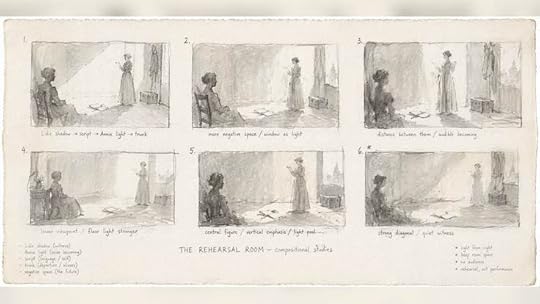
Compositional thumbnail sheet – Early thumbnail studies test the visual argument of “The Rehearsal Room,” placing Lidie in shadow, Annie in light, the script between them, and the trunk at the edge of the room as the first quiet sign of departure.
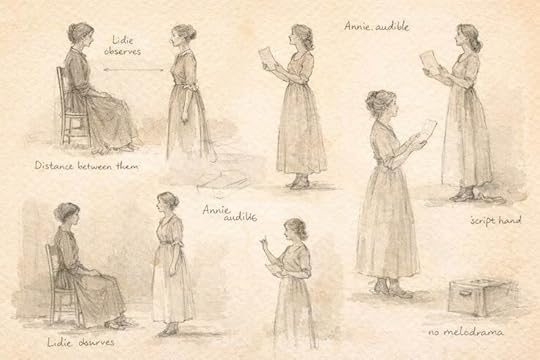
Character anatomical study – Figure studies refine the emotional posture of the scene, making Lidie observant rather than passive and Annie newly audible rather than theatrical in any easy or triumphant sense.
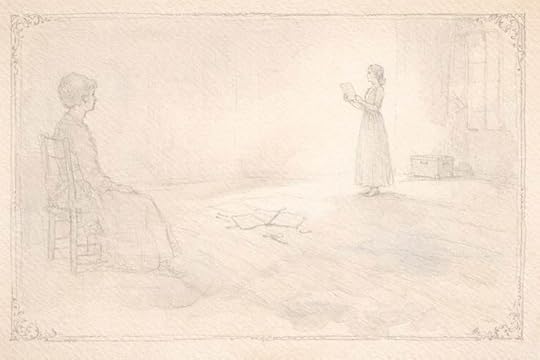
Faint pencil underdrawing – The pencil underdrawing establishes the room’s bones before atmosphere enters: two women, one watching and one rehearsing, held inside a spare architecture of light, floor, script, trunk, and negative space.

Color swatch sheet – Cover-palette swatches in coral, terracotta, parchment, olive-gold, mint-gray, teal-green, and deep brown define the sequel watercolor’s emotional weather: warmer than Kansas, but still touched by shadow.
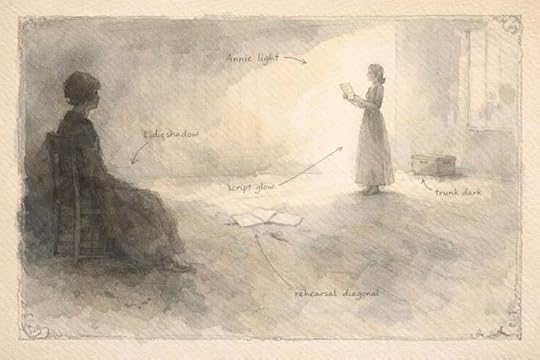
Value / light-map study – The light-map study weighs Annie’s rehearsal glow against Lidie’s cooler watchfulness, showing how the final image balances theatrical possibility with the grief that has followed Lidie from K.T.

Pencil-plus-first-wash stage – The first wash begins turning drawing into atmosphere, letting coral-peach light, pale parchment, soft green-gray, and muted teal settle over the room before the figures fully emerge.

Watercolor border study – The border study develops the antique botanical frame as a quiet visual echo of roles, aliases, and social containment, while allowing the image to feel warmer, more theatrical, and more open than the first Lidie watercolor.

Figure-and-light / shadow-deepening stage – In this late process stage, Annie’s light and Lidie’s shadow are tuned against each other, letting rehearsal, grief, and future motion hold the room without crowding its silence.
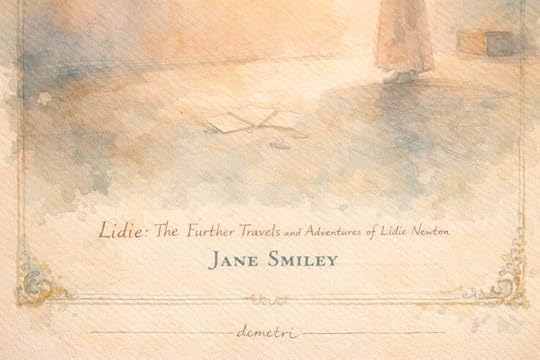
Lettering and signature placement study – This late-stage process study shows how the handwritten title, author name, botanical border, and artist signature settle into the paper, turning the review image’s final frame into another form of naming.
All watercolor illustrations by Demetris Papadimitropoulos.
In “Lidie: The Further Travels and Adventures of Lidie Newton,” Jane Smiley turns sequelhood into aftermath, following a woman already educated by violence into theater, service, aliases, and the difficult art of continuing.
By Demetris Papadimitropoulos | April 18th, 2026
“The Rehearsal Room” – Inspired by Jane Smiley’s “Lidie: The Further Travels and Adventures of Lidie Newton,” this companion image to the first Lidie watercolor shows Lidie watching Annie rehearse herself into audibility, as theater light, shadow, script, and waiting trunk gather the sequel’s question of whether freedom must first practice before it can leave.
Disaster knows how to enter a room. The breakfast after the room stops shaking is harder to score. A murder, a failed rescue, a dead horse in the traces, a lost child, a territory chewing itself into argument and blood – these make their own weather. What is harder, and often more revealing, is the errand-life that follows: dishes, laundry, old family rooms one has returned to but no longer fits inside, and relatives who expect grief to sit down politely and be useful by supper.
Jane Smiley’s “Lidie: The Further Travels and Adventures of Lidie Newton” begins in that gray life after K.T. Lidie Newton has already survived the rough schooling of “The All-True Travels and Adventures of Lidie Newton”: Kansas Territory, slavery’s intimate horrors, Thomas’s murder, Lorna’s failed escape, and the discovery that conviction, once dragged through mud and gunfire, does not stay clean. Smiley does not try to out-Kansas Kansas. She sends Lidie back to Quincy, Illinois, puts her in mourning clothes, surrounds her with sisters, chores, winter streets, and family supervision, and then lets escape begin through the least martial door available: the local theater. The first book left Kansas in the hem; this one asks what happens when the dust keeps falling out in ordinary rooms.
The question under the tongue is not survival; Kansas has already taught her the brutality of that. The book is freedom trying its lines. Can a woman cracked by history practice a life that neither repeats the damage nor pretends it never happened? Smiley’s answer comes through theater, aliases, wages, servant stairs, travel, and the unsettling possibility that a role taken up for protection may, with enough use, begin to answer back.
Annie is the match struck in the cold room. Lidie’s niece, a year younger and nearly invisible under household work, has spent her life listening to Alice’s worries, doing what needed doing, and saying almost nothing. Then she produces a theater ticket: she has a part in “A Christmas Carol,” playing Belle, Scrooge’s lost betrothed. In Quincy, this is not merely a role but a household alarm bell. The town may have river traffic, gossip, pigs’ trotters, and men with opinions on Kansas, but let a young woman stand on a stage and everyone must take out the moral smelling salts.
Annie’s stage work becomes the book’s first door with a loose latch. Her escape begins in bruised ribs and borrowed vowels: the corset tightened until it marks her back, the Dickensian accent practiced through the bedroom wall, the weeping tested so convincingly that Lidie mistakes rehearsal for heartbreak. When the performance comes, Annie does not merely receive applause. She acknowledges it, with the serene audacity of someone who has discovered that praise may be deserved, not bestowed as charity. She does not simply perform Belle. She discovers that being looked at can be different from being judged.
Lidie keeps the ledger. She notices Annie’s new gloves, voice, posture, and capacity to become visible before retreating into household usefulness as though nothing has happened. She sees the family beginning, as families do, to convert female vitality into marriage prospects and respectability management. Theater makes Annie first legible, then vulnerable, then portable. A Liverpool connection opens a route abroad, and soon Annie is not merely acting; she is escaping. Because travel is dangerous for a young unmarried woman, Lidie goes with her. That sentence could belong to a blunt adventure novel. Smiley, who knows exactly how many petticoats and lies an adventure must smuggle, makes it into something slyer.
On the Atlantic, the two women rename themselves. Annie becomes Anne Revere. Lidie becomes Helen Longbourn. The scene is a hinge hidden in traveling papers. A new name is not rebirth, exactly; Lidie is too sensible for phoenix business. It is closer to being rinsed, wrung, and hung under different weather. But the names matter because freedom comes with forms. To move through the world, especially as a woman, one needs more than longing. One needs papers, wages, introductions, acceptable sleeves and skirts, a plausible story, and a part others can recognize quickly enough not to stop you at the door.
In Liverpool, Anne pursues the stage under Mallory Cunningham’s patronage, while Lidie becomes her ladies’ maid. The demotion is the trick. Respectable womanhood in Quincy was a cage with clean curtains; service in Liverpool gives Lidie errands, streets, conversations, anonymity, and access. She can walk. She can observe without explaining why she is observing. She can pass through rooms closed to a lady and beneath the notice of those who think servants are furniture with hands. The role confines her, but its confinement has doors. Class, here, is not only a ladder; it is a lighting scheme, deciding who is seen, who is missed, and who may cross the room unnoticed.
That reversal is one of the sequel’s best ideas, because Smiley is too sly to confuse lowered status with simple defeat. Lidie’s servant name is a disguise, a job, a reduction, and a passport. It does not free her in any grand sense; no one should be asked to clap for a cage because it has a back staircase. But it gives her usable mobility, which is sometimes the first practical form freedom takes. Under the name Helen, Lidie can move through Liverpool as a pair of eyes with wages attached. She becomes useful again, but not in the cramped Quincy sense. She is useful as witness, chaperone, errand-runner, watcher, and woman temporarily misfiled in a way that lets her keep going.
Theater here is not a tidy “follow your dream” machine; it is labor with bruises. Annie works with her voice, posture, timing, hunger for applause, and willingness to be interpreted by strangers. She is not ennobled by inspiration. She rehearses. The book is alert to vanity, but also to discipline. It knows a stage name can be both advertisement and self-rescue. It knows a costume can wound the body and release the person inside it. Pretending, under certain conditions, is not truth’s opposite but its rehearsal room.
Lidie’s voice remains the steady current. The sentences are long, elastic, and observant, carrying chores, gossip, theater tickets, winter roads, corsets, horses, family suspicion, political memory, and sudden grief in one walking rhythm. Smiley lets Lidie think the way a person moves through a town: noticing mud, weather, eggs, gloves, church affiliations, a man’s mustache, a letter half-hidden under a chest, and then – without asking permission – Thomas, Jeremiah, Lorna, the lost baby, Kansas. Chores keep opening trapdoors.
That is one of the book’s loveliest continuities with the first Lidie novel. In “The All-True Travels and Adventures of Lidie Newton,” Lidie became a narrator by overhearing the terms of her own uselessness. In “Lidie,” she watches Annie become audible. Smiley still has an exact comic ear for household pressure. Quincy women do not simply worry; they organize worry into errands. Alice’s dread of epidemics, provisions, gossip, weather, church opinion, and insufficient household order becomes practically a second pantry. The sisters are often absurd, but Smiley does not flatten them into scolds. They know the world is dangerous. Their failure is that they try to answer danger by shrinking female life to the size of a manageable drawer.
The prose is period-inflected without getting trapped under a bell jar. It has old-fashioned turns, practical vocabulary, and a fondness for social accounting, yet it remains briskly readable. Lidie can move from corn mush to theological disgust, from a theater accent to Border Ruffians, from fruitcake in the cellar to the ethics of slavery, without sounding like a modern narrator in borrowed sleeves. The sentences have pockets. They collect lint, scraps, coins, gossip, sorrow, and occasionally a knife.
Gone are the Beecher epigraphs and the more visible formal counterweight of “The All-True Travels and Adventures of Lidie Newton.” “Lidie” has a simpler fifteen-chapter shape, and the difference matters. It moves by doors opening: ticket, rehearsal, performance, letter, escape, ship, Liverpool, service, walking, docks, another ship. This gives the novel air and charm. It also gives it drift. The book loosens into a corridor. And while corridors are excellent for travel, they do not always press revelation from the walls.
When that loose design works, it becomes meaning. Lidie is no longer in the crucible; she is in its afterlife. Her world should not feel as compressed as Kansas did, because compression was part of Kansas’s terror. The book’s wider field becomes a survivor’s return to curiosity. Rooms, streets, theaters, gardens, households, and docks are not distractions from the story; they are the story’s attempt to discover whether the world still contains invitations.
But the bill comes due. There are stretches, especially in the Liverpool middle, where the novel surveys more than it intensifies. The household scenes, servant economies, errands, gardens, new acquaintances, and social observations are humane and often delightful, yet not all carry equal charge. At times the book walks with superb posture through material it might have pressed harder. Annie’s ascent, too, can be so buoyant that Lidie’s darker afterlife recedes for a while. The novel never becomes weak, but it sometimes becomes less urgent than its best idea deserves. If the first Lidie book made every road feel as though it might turn into a reckoning, this one occasionally lets a road remain scenery: pleasant, observed, useful, and not quite burning underfoot.
Smiley’s finest move is to let continuation change the terms of adventure. The first book asked what violence does to moral understanding. This one asks what performance can do with the person violence leaves behind. That shift is not a retreat from pressure; it is another room in the same damaged house. After K.T., Thomas, Lorna, Jeremiah, and the lost child, the next life may arrive first as costume, job, errand, accent, alias, or obligation. One may not believe in it immediately. One may have to rehearse.
The comparison to “Moll Flanders” by Daniel Defoe is useful if kept tidy. Like Defoe’s heroine, Lidie moves through roles, names, social calculations, and survival strategies in a world that makes female mobility both necessary and suspect. But Smiley is less confessional, less moralizing, and far more interested in the hesitation between role and person. Her machinery runs on errands, not thunderclaps. It is powered by train schedules, corset laces, hidden letters, servants’ stairs, and the delicate terror of being asked who you are when you have been answering to someone else’s name.
This may divide readers precisely because it refuses to feed the appetite sequels often encourage. Readers wanting Kansas again – sharper danger, harsher compression, the grim weather of slavery and border violence – may find this book lighter, looser, too charmed by theatrical and household motion. Readers willing to follow Lidie into a different form of risk will find something quieter but more unusual: a novel about how survival does not end in wisdom, stability, or even healing, but in renewed availability. Lidie has not been repaired. She has become curious again, which may be less pretty and more miraculous.
The book does not wave a lantern at the present; it keeps striking matches in old rooms. Its old ache is plain enough: after a life has been broken by violence, how does one continue without turning continuation into betrayal? Lidie’s grief is not resolved. It is interrupted by errands, books, Annie’s talent, travel, service, and weather. That feels right. Grief rarely respects narrative placement. It arrives while someone is sorting vegetables, walking past a house, tightening a corset, looking at a ship, or trying very hard not to think about Missouri.
The ending is the book’s best snap of the latch. Anne has begun to become what she set out to be; Lidie has not quite become anything so easily named. At the docks, she sees a ship called Revelation, bound for Christiania. She learns that means Norway. She catches the nearly blind Mabel before the child falls toward the water, and she is offered a paid place traveling with the Kents to Norway and then Russia. When asked who she is, after Helen Longbourn, ladies’ maid, widow, aunt-companion, failed rescuer, witness, and watcher, she pauses and says, “I’m Lidie. I’m Lidie.”
The doubled name is quiet, but once spoken, it rearranges the whole journey behind it. It is not a curtain call, not an embrace in a doorway, not a homecoming in disguise. It is a self-name spoken at the edge of another departure. Smiley knows Lidie does not need to be settled to be alive. She needs a form of motion that is no longer merely flight.
I rate “Lidie: The Further Travels and Adventures of Lidie Newton” 83/100, or 4/5 stars: shrewd, warm, and wandering, less compressed and less devastating than its predecessor, but alive to the strange labor of becoming someone after the first version of the self has been made impossible.
The stage gives the book its sparkle. The dock tells the truth: a half-known destination, a child pulled back from danger, a ship named with more confidence than any person can honestly claim, and Lidie at the edge of the water – not healed, not housed, not finished, but able, after all the costumes and borrowed names, to answer with her own.
Compositional thumbnail sheet – Early thumbnail studies test the visual argument of “The Rehearsal Room,” placing Lidie in shadow, Annie in light, the script between them, and the trunk at the edge of the room as the first quiet sign of departure.
Character anatomical study – Figure studies refine the emotional posture of the scene, making Lidie observant rather than passive and Annie newly audible rather than theatrical in any easy or triumphant sense.
Faint pencil underdrawing – The pencil underdrawing establishes the room’s bones before atmosphere enters: two women, one watching and one rehearsing, held inside a spare architecture of light, floor, script, trunk, and negative space.
Color swatch sheet – Cover-palette swatches in coral, terracotta, parchment, olive-gold, mint-gray, teal-green, and deep brown define the sequel watercolor’s emotional weather: warmer than Kansas, but still touched by shadow.
Value / light-map study – The light-map study weighs Annie’s rehearsal glow against Lidie’s cooler watchfulness, showing how the final image balances theatrical possibility with the grief that has followed Lidie from K.T.
Pencil-plus-first-wash stage – The first wash begins turning drawing into atmosphere, letting coral-peach light, pale parchment, soft green-gray, and muted teal settle over the room before the figures fully emerge.
Watercolor border study – The border study develops the antique botanical frame as a quiet visual echo of roles, aliases, and social containment, while allowing the image to feel warmer, more theatrical, and more open than the first Lidie watercolor.
Figure-and-light / shadow-deepening stage – In this late process stage, Annie’s light and Lidie’s shadow are tuned against each other, letting rehearsal, grief, and future motion hold the room without crowding its silence.
Lettering and signature placement study – This late-stage process study shows how the handwritten title, author name, botanical border, and artist signature settle into the paper, turning the review image’s final frame into another form of naming.
All watercolor illustrations by Demetris Papadimitropoulos.

June 15, 2026
Abrupt, unexpected out of character (to me) ending that made no sense but leaves room for yet another book in the series. Got tired of Lidie analyzing what happened in K.T. Felt the author had the concepts of slavery, reparations, civil war, abolition in mind and built a loose story around them. Felt forced. Have enjoyed other books by Jane Smiley more.
This entire review has been hidden because of spoilers.

April 27, 2026
A deeply immersive novel set in the 1850's--pre-American Civil War. LIDIE follows life of a young American in Europe as she works through the immense loss and trauma of losing her husband to political violence. The plot and process of the novel is largely underground, as the title character goes about dealing with her daily life. I found this depiction of grief very believable even if it was sometimes a bit too slow and mundane.

June 5, 2026
When I saw this was published, I went back to read the first Lidie Newton book then went right on to this. It was so disappointing! Really quite tedious… I kept putting it down to read something else. As I was finally finishing, I had to wonder how she’d untangle what she created. And the answer was a set up for book 3. I won’t be reading that one!

August 7, 2026
“But the longer that dough rises, and the more you pound it, the tastier it is”. Pg. 316.
I think Jane Smiley pounded this book. Because it was very tasty. Among the subjects presented in this book were slavery, abolitionism, death, love, sacrifice, PTSD, religion/spiritualism, English life, theater of the time, train travel, ship travel, health treatments, gardening, naturalism, horse racing, horse training, and in the middle we find Lidie. She and her cousin have camouflaged their American life so as to get a fresh start in Liverpool, England. Certainly not the most perfect place to work out grief.
A quiet person was Lidie. But if the mind burns energy, Lidie was molten rock.
I look forward to book 3 for additional travels and adventures of Lidie Newton.
I think Jane Smiley pounded this book. Because it was very tasty. Among the subjects presented in this book were slavery, abolitionism, death, love, sacrifice, PTSD, religion/spiritualism, English life, theater of the time, train travel, ship travel, health treatments, gardening, naturalism, horse racing, horse training, and in the middle we find Lidie. She and her cousin have camouflaged their American life so as to get a fresh start in Liverpool, England. Certainly not the most perfect place to work out grief.
A quiet person was Lidie. But if the mind burns energy, Lidie was molten rock.
I look forward to book 3 for additional travels and adventures of Lidie Newton.

May 23, 2026
I read the first Lidie Newton book several years ago and really liked it. In it we saw, through Lidie's eyes, the strange, violent world of Kansas Territory just before the Civil War. Now we discover the world of Liverpool England, just a few years later. Not as violent, but equally strange to Lidie. I just LIKE Lidie. She's not educated, but she is incredibly smart and I found her observations so entertaining. This book is more character-driven than plot-driven. I've read most of Jane Smiley's books and she seems to be moving in this direction - which I love.
Thank you for the ARC, Netgalley!
Thank you for the ARC, Netgalley!

July 5, 2026
In the second book in this historical fiction series, readers join Lidie Newton in December 1857 after she leaves Kansas Territory for her hometown of Quincy, Illinois, after her husband’s death. Haunted by the memories of her failures and unsupported by her sisters, Lidie soon takes an interest in her actress niece Annie, who is offered the chance to perform abroad and seizes it. Armed with her pistol, Lidie heads across the Atlantic with Annie towards an uncertain future in Liverpool where Annie’s benefactor, Mallory Cunningham, lives and helps Annie find her way to the stage, with Lidie as her lady’s maid. Packed with incredible details and fascinating characters, readers will love the contrast between Quincy, the steamship, and Liverpool and the challenges the two women face on their newest adventure. Lidie is a complicated and fascinating protagonist who grows in confidence as her stay in England lengthens, and the relationships she forms and neglects over the course of the narrative really help expand her story. The historical details are absolutely fascinating, and readers will love the two sides of life Lidie experiences while in Liverpool. Brilliantly written and packed with new adventures and experiences, readers will love this new release from Jane Smiley.
Thanks to NetGalley, Knopf, Pantheon, Vintage, and Anchor, and Knopf for the advance copy.
Thanks to NetGalley, Knopf, Pantheon, Vintage, and Anchor, and Knopf for the advance copy.

May 4, 2026
Lidie is the second in a series. I believe the first one was published in 1998. I have not read it and don’t think it’s necessary to have done so, as the author provides plenty of detail to Lidie’s backstory. Set in 1855, Lidie is an unusual woman both in appearance and manner. The story begins in America, as Lidie is mourning the death of her abolitionist husband and living with her much older sister. Lidie, in her early 20’s, and her niece, Annie who is two years younger and an aspiring actress, run off one day to Liverpool.
Told from Lidie’s point of view, I found her character to be interesting but overall, not much of a story. There were many scenes that I felt were overly descriptive - I did not need to be told the entire plot of Jack and the Beanstalk - and weighed down the novel. However, I thought the ending was unexpected but also in character with Lidie. I have read several of the author’s books and will continue to do so.
Thanks to the author, NetGalley and Knopf for the opportunity to read and review this digital ARC.
Told from Lidie’s point of view, I found her character to be interesting but overall, not much of a story. There were many scenes that I felt were overly descriptive - I did not need to be told the entire plot of Jack and the Beanstalk - and weighed down the novel. However, I thought the ending was unexpected but also in character with Lidie. I have read several of the author’s books and will continue to do so.
Thanks to the author, NetGalley and Knopf for the opportunity to read and review this digital ARC.

May 27, 2026
As good as book 1.

April 26, 2026
Lidie Newton, a tall, curious, plainspoken and orphaned young woman facing life in the divided America of the 1850s, is made for adventure --- or perhaps misadventure. Now back home in Quincy, Illinois, in the forgiving but somewhat stultifying bosoms of her much older sisters, she struggles to forget the tragedies of the first book of her adventures --- the murder of her abolitionist husband, Thomas, and her beloved horse. (So if you haven’t read Jane Smiley's THE ALL-TRUE TRAVELS AND ADVENTURES OF LIDIE NEWTON, you get the gist.)
Lidie takes a new interest in her niece, Annie, who has caught the acting bug. Annie steals the show in a production of Dickens' A Christmas Carol and secures a benefactor, Mr. Mallory Cunningham. Seeing them together walking arm in arm around Quincy, Lidie wonders if he is a suitor, but it turns out he just wants to pay her way to England to act in the productions in which he invests.
Naturally, a young and beautiful woman cannot travel on her own without a chaperone, and so begins Lidie’s next big adventure: stealing away from Quincy and sailing across the ocean to Liverpool, England. Here she adopts a new role as Annie’s ladies’ maid, as well as the name Helen Longbourn. As a ladies’ maid, she is expected to do errands for the family: pick up meat, fish, flowers and Mr. Cunningham’s new hat. But this is far from a burden for her, as she meets several simpatico humans in her wanderings around Liverpool --- and even falls in love.
The adventures are plentiful, but Lidie’s keen mind and judgments are equally good reasons to read LIDIE. The political similarities between 1855 and now are surprising. The “goose question,” which was a polite way of signaling how one felt about slavery (if you were sound on the goose question, you were pro-slavery), casts a heavy shadow over Quincy and indeed all of America at that time. Relating the different conceptions of sin in the various Quincy churches, she muses, “I wondered what would be the greatest sin: some folks were agitating for a conflict, desiring to kill one another for what they considered ‘conscience,’ while others, thinking of their bank accounts, were avoiding the conflict.”
Lidie is a perceptive judge of human nature, and that’s one of the treasures of this novel: “One thing I always thought interesting about the Border Ruffians was that, although many of them did not actually have the money to own slaves, they were outraged by the idea that they might be prevented by others from doing as they pleased.” While Lidie has never been a churchgoer, she is open to wondering about the ways God might be present in her world. Before she died, her mother had claimed that she saw Jesus, and Lidie spends a lot of time pondering this. Lying in bed in Liverpool, remembering a man who helped an old woman across the street that day, “I decided that he was Jesus, that one of his qualities was that he was everywhere, doing his errands, and he was too busy to be bothered about whether he went unseen.”
Lidie’s Liverpool adventures --- helping with the family’s wayward horse, attending the races with the Cunninghams’ butler, roaming the city and exploring her feelings upon seeing free Black people on the streets, watching Annie fulfill her promise as an actress --- are illuminating, filtered as they are through her fine and observant mind. We feel like we are there with her in busy Liverpool, taking in the parks, businesses and docks, hearing the accents and church bells. Will her budding relationship with her beau result in a settled Liverpool life? Or will a further adventure beckon? I am hoping for the latter.
Reviewed by Eileen Zimmerman Nicol
Lidie takes a new interest in her niece, Annie, who has caught the acting bug. Annie steals the show in a production of Dickens' A Christmas Carol and secures a benefactor, Mr. Mallory Cunningham. Seeing them together walking arm in arm around Quincy, Lidie wonders if he is a suitor, but it turns out he just wants to pay her way to England to act in the productions in which he invests.
Naturally, a young and beautiful woman cannot travel on her own without a chaperone, and so begins Lidie’s next big adventure: stealing away from Quincy and sailing across the ocean to Liverpool, England. Here she adopts a new role as Annie’s ladies’ maid, as well as the name Helen Longbourn. As a ladies’ maid, she is expected to do errands for the family: pick up meat, fish, flowers and Mr. Cunningham’s new hat. But this is far from a burden for her, as she meets several simpatico humans in her wanderings around Liverpool --- and even falls in love.
The adventures are plentiful, but Lidie’s keen mind and judgments are equally good reasons to read LIDIE. The political similarities between 1855 and now are surprising. The “goose question,” which was a polite way of signaling how one felt about slavery (if you were sound on the goose question, you were pro-slavery), casts a heavy shadow over Quincy and indeed all of America at that time. Relating the different conceptions of sin in the various Quincy churches, she muses, “I wondered what would be the greatest sin: some folks were agitating for a conflict, desiring to kill one another for what they considered ‘conscience,’ while others, thinking of their bank accounts, were avoiding the conflict.”
Lidie is a perceptive judge of human nature, and that’s one of the treasures of this novel: “One thing I always thought interesting about the Border Ruffians was that, although many of them did not actually have the money to own slaves, they were outraged by the idea that they might be prevented by others from doing as they pleased.” While Lidie has never been a churchgoer, she is open to wondering about the ways God might be present in her world. Before she died, her mother had claimed that she saw Jesus, and Lidie spends a lot of time pondering this. Lying in bed in Liverpool, remembering a man who helped an old woman across the street that day, “I decided that he was Jesus, that one of his qualities was that he was everywhere, doing his errands, and he was too busy to be bothered about whether he went unseen.”
Lidie’s Liverpool adventures --- helping with the family’s wayward horse, attending the races with the Cunninghams’ butler, roaming the city and exploring her feelings upon seeing free Black people on the streets, watching Annie fulfill her promise as an actress --- are illuminating, filtered as they are through her fine and observant mind. We feel like we are there with her in busy Liverpool, taking in the parks, businesses and docks, hearing the accents and church bells. Will her budding relationship with her beau result in a settled Liverpool life? Or will a further adventure beckon? I am hoping for the latter.
Reviewed by Eileen Zimmerman Nicol

Review of advance copy received from Netgalley
Thank you to Knopf and NetGalley for providing an advance copy of this book in exchange for my honest review. The book will be published on April 21st, 2026.
I love Jane Smiley’s books — they always immerse you in a place and time and unfold at a tempo that mimics the pace of life, rather than that of a novel. In this book, the titular Lidie is a young woman living in rural Illinois in the 1850s. Think Lincoln - Douglas debates, intense polarization around slavery, and rapid westward expansion in the US. She is (already) a widow, her husband having been shot in KT (Kansas Territory) for being an abolitionist. She is very tall and rather plain, and it is the general consensus that her chances of attracting another man onto which the family might offload her are bleak. However, this is the story of her life from her own viewpoint, and she is not terribly bothered by the opinions of others. Her life veers off in unexpected ways (she makes it to Liverpool!) and we go along for the thoroughly detailed ride. This is historical fiction at its best — accurate in physical, cultural, familial, and emotional description.
What interested me was her ongoing thorough observations and reflections. She is not driven towards any particular goal, nor does she worry excessively about the expectations of others, but she is extremely observant and intelligent. She is not well educated in any kind of modern sense, but she reads, sees, converses, and appears to think in a way I found quite absorbing. Through a variety of happenstances, she sees and grabs on to opportunities that lead her to veer off the typical track of a woman of her age and era. I never saw those opportunities coming, but they fit into an older, less propelled style of life. At first I found the pace of the narrative a bit slow, but when I calmed down and stopped expecting non stop action, I was able to thoroughly live a completely (to me) alien life vicariously. This book felt so real! It’s not often that a modern person can put me so thoroughly in the mind of someone from a completely different age.
Great writing, intriguing characters, and a world brought fully to life. And — I absolutely loved the (completely unexpected) ending. I will say no more about that!!
I love Jane Smiley’s books — they always immerse you in a place and time and unfold at a tempo that mimics the pace of life, rather than that of a novel. In this book, the titular Lidie is a young woman living in rural Illinois in the 1850s. Think Lincoln - Douglas debates, intense polarization around slavery, and rapid westward expansion in the US. She is (already) a widow, her husband having been shot in KT (Kansas Territory) for being an abolitionist. She is very tall and rather plain, and it is the general consensus that her chances of attracting another man onto which the family might offload her are bleak. However, this is the story of her life from her own viewpoint, and she is not terribly bothered by the opinions of others. Her life veers off in unexpected ways (she makes it to Liverpool!) and we go along for the thoroughly detailed ride. This is historical fiction at its best — accurate in physical, cultural, familial, and emotional description.
What interested me was her ongoing thorough observations and reflections. She is not driven towards any particular goal, nor does she worry excessively about the expectations of others, but she is extremely observant and intelligent. She is not well educated in any kind of modern sense, but she reads, sees, converses, and appears to think in a way I found quite absorbing. Through a variety of happenstances, she sees and grabs on to opportunities that lead her to veer off the typical track of a woman of her age and era. I never saw those opportunities coming, but they fit into an older, less propelled style of life. At first I found the pace of the narrative a bit slow, but when I calmed down and stopped expecting non stop action, I was able to thoroughly live a completely (to me) alien life vicariously. This book felt so real! It’s not often that a modern person can put me so thoroughly in the mind of someone from a completely different age.
Great writing, intriguing characters, and a world brought fully to life. And — I absolutely loved the (completely unexpected) ending. I will say no more about that!!
July 2, 2026
Many references to the first book and we could do without most of them. Not to be harsh, but who cares? Nothing new or relevant is learned and the plot to the present book isn’t advanced or enhanced. It only makes us wish we were reading the first one.
Lidie is a nineteenth century anomaly in many ways. She’s taller than most men and has a “plain” face. She is nothing like Jane Eyre or Elizabeth Bennet or Dorothea Brooke or any other lovely young marriageable protagonist. With her many masculine characteristics and very few feminine ones, the reader suspects Lidie would be far happier in our own twenty-first century times. But she is cheerful above all as she accompanies her niece Annie from Quincy, Illinois, to Liverpool England in 1855. Lidie loves seeing and learning about England and the beauties and charms of the life there. Her curiosity and strong work ethic win her a place in many hearts starting with the Cunningham home, where niece Annie is being turned into a legitimate stage actress.
In another book the story would be about that. I kept waiting for Mr. Cunningham, Annie's mentor/benefactor, to end up having evil motives but he doesn't. In yet another story there would be villains and tribulations and maybe a murder or two, certainly hopes dashed here and there. But the characters seem truly honest and charming and kind. There are no villains and certainly no murderers.
JS has written some superb books including her Pulitzer Prize winner A Thousand Acres. No one writes the farm like Jane Smiley. Her grasp of family dynamics and love for the land is unsurpassed. With that said, I found myself disinterested in this book. If Lidie were a lower ranking harridan running a scam or two, you could call this a picaresque novel. But she keeps to herself and follows the rules, making her observations silently.
For all that Lidie is a plucky sympathetic heroine and deserving of our sympathy, nothing much happens.
Lidie is a nineteenth century anomaly in many ways. She’s taller than most men and has a “plain” face. She is nothing like Jane Eyre or Elizabeth Bennet or Dorothea Brooke or any other lovely young marriageable protagonist. With her many masculine characteristics and very few feminine ones, the reader suspects Lidie would be far happier in our own twenty-first century times. But she is cheerful above all as she accompanies her niece Annie from Quincy, Illinois, to Liverpool England in 1855. Lidie loves seeing and learning about England and the beauties and charms of the life there. Her curiosity and strong work ethic win her a place in many hearts starting with the Cunningham home, where niece Annie is being turned into a legitimate stage actress.
In another book the story would be about that. I kept waiting for Mr. Cunningham, Annie's mentor/benefactor, to end up having evil motives but he doesn't. In yet another story there would be villains and tribulations and maybe a murder or two, certainly hopes dashed here and there. But the characters seem truly honest and charming and kind. There are no villains and certainly no murderers.
JS has written some superb books including her Pulitzer Prize winner A Thousand Acres. No one writes the farm like Jane Smiley. Her grasp of family dynamics and love for the land is unsurpassed. With that said, I found myself disinterested in this book. If Lidie were a lower ranking harridan running a scam or two, you could call this a picaresque novel. But she keeps to herself and follows the rules, making her observations silently.
For all that Lidie is a plucky sympathetic heroine and deserving of our sympathy, nothing much happens.

Review of advance copy received from Netgalley
The Further Travels and Adventures of Lidie Newton picks up where The All-True Travels and Adventures of Lidie Newton, Jane Smiley's excellent 1998 historical novel, leaves off. Her husband murdered in Bloody Kansas of the 1850s, the adventurous yet pragmatic Lidie heads home to Quincey, Illinois to regroup and recover from her search to find her husband's killer. Quincy is small in size and mind, and if it were not for her niece Annie, she would be a sad soul indeed.
But Annie is talented, smart, and beautiful, and she has found a theatrical agent who will advance her career in England. With plain Lidie as her companion, and, later, maid, they board a ship and head for Liverpool. Here Lidie is re-engaged in the world, finding a home with the agent's family and exploring a new world with shining eyes. She's there to support Annie in her career but she is also finding new possibilities for her own life.
Lidie is a wonderful creation, the kind of woman who would shake Huck Finn by the ear and ask to go along on his next escapade. Her brutal experiences as the wife of an abolitionist in the Kansas Territory haunt her, but have not daunted her. And Jane Smiley fills every page with rich detail and genuine characterizations. Shining her light on 19th century Liverpool gives her fresh opportunities to highlight the place of women during that time. Engaging from start to finish, the Further Travels is as satisfying as a historical novel can be.
Many thanks to Knopf and Netgalley for a DRC of this marvellous novel. 4.5 stars rounded up.
But Annie is talented, smart, and beautiful, and she has found a theatrical agent who will advance her career in England. With plain Lidie as her companion, and, later, maid, they board a ship and head for Liverpool. Here Lidie is re-engaged in the world, finding a home with the agent's family and exploring a new world with shining eyes. She's there to support Annie in her career but she is also finding new possibilities for her own life.
Lidie is a wonderful creation, the kind of woman who would shake Huck Finn by the ear and ask to go along on his next escapade. Her brutal experiences as the wife of an abolitionist in the Kansas Territory haunt her, but have not daunted her. And Jane Smiley fills every page with rich detail and genuine characterizations. Shining her light on 19th century Liverpool gives her fresh opportunities to highlight the place of women during that time. Engaging from start to finish, the Further Travels is as satisfying as a historical novel can be.
Many thanks to Knopf and Netgalley for a DRC of this marvellous novel. 4.5 stars rounded up.

Review of advance copy received from NetGalley
I admire Jane Smiley's writing skill, but I didn't love Lidie: The Further Travels and Adventures of Lidie Newton. It took me a long time to get into the story; I typically like a lot of exposition about the characters, setting, plot, etc. but there was so much that I felt like I was meandering through softly rustling tall grasses, trying to find my way to the story. I wondered if I would have enjoyed it more if I had read Lidie Newton.
The story begins in the "KT," or Kansas Territory. Lidie, a tall and plain widow who is deemed unlikely to attract another husband, is keen to accompany her niece, Annie, out of the country. Annie has an opportunity to leave the KT to pursue a career on the stage. After her husband, an abolitionist. is killed, Lidie is eager to flee a country she describes as a place where abolitionists are murdered. It made me consider the parallels between pre-Civil War America and the America of 2026.
Lidie's life in Liverpool allows her world to open broadly in ways it never could have in the KT. She's is agreeable to being identified as Annie's maid and helping other service employees in Annie's agent's home. The extensive description of everything provided an enjoyable commentary on 19th century England, specifically in Liverpool, and women's roles.
I am appreciative of Knopf and NetGalley for providing me an e-ARC of Lidie. All opinions expressed here are solely my own.
The story begins in the "KT," or Kansas Territory. Lidie, a tall and plain widow who is deemed unlikely to attract another husband, is keen to accompany her niece, Annie, out of the country. Annie has an opportunity to leave the KT to pursue a career on the stage. After her husband, an abolitionist. is killed, Lidie is eager to flee a country she describes as a place where abolitionists are murdered. It made me consider the parallels between pre-Civil War America and the America of 2026.
Lidie's life in Liverpool allows her world to open broadly in ways it never could have in the KT. She's is agreeable to being identified as Annie's maid and helping other service employees in Annie's agent's home. The extensive description of everything provided an enjoyable commentary on 19th century England, specifically in Liverpool, and women's roles.
I am appreciative of Knopf and NetGalley for providing me an e-ARC of Lidie. All opinions expressed here are solely my own.

July 10, 2026
I picked this up thinking that I'd read the first of Smiley's novels about Lidie Newton, but I quickly realized I hadn't. Didn't matter; you get enough clues of what happened to Lidie before the action of this novel to make it make sense. I wrote "the action" of this novel, but it's not exactly action-packed. Lidie, recently widowed when her abolitionist husband is murdered in Kansas Territory on the brink of the Civil War, returns to her family, which consists of a group of older half-sisters, in Illinois. She reconnects with her niece Annie, who's just a couple years younger. They both feel constrained by their roles as young women of their times. Annie has a flair for the stage and after a few performances, she gets the backing of an English gentleman who says he can get her on stage in Liverpool. Annie runs off, taking Lidie with her as a companion. Lidie hides her background, though it's not clear why she has to -- seems like she just itches for reinvention. As Helen Longbourne, Annie's maid/helper, she fits into the household in Liverpool, running errands, befriending the butler, who shares her love of horses, and finds friends in the city, including a gardener and a mysterious Irish abolitionist she quietly falls in love with. Her life is constrained by the times she lives in, but her mind is free. The story plods a bit, and it ends on a totally surprising note which I will not spoil. But it certainly looks like there are more adventures ahead for Lidie.

August 15, 2026
She wrote The All-True Travels and Adventures of Lidie Newton in 1998, and I read it more than twenty years ago. So I was a little rusty, but Smiley makes sure that many of the first novel's key incidents get covered frequently in this follow-up, as Lidie is dealing with some low-level PTSD from those harrowing events.
In some ways, this sequel feels as if Mark Twain had written Huck Finn first and followed it up with Tom Sawyer. The questions of slavery and potential for a Civil War are still here, but always in the background. For one thing, most of this story, which takes place in 1859, is set in Liverpool. (With all the street names included from Lidie's walks around that town, I was disappointed she never came to Penny Lane.)
Lidie has such a well-developed voice as a character and narrator that I'm willing to follow her anywhere, even if the stakes are considerably lower. Smiley describes essential differences between Americans and British of this period, and gives us several new characters to enjoy, most notably Barnsby, the perfectly organized butler who loves horses and placing bets, and John, the somewhat mysterious but fascinating man Lidie falls in love with, not to mention Reggie, the gardener who never stops messing with plants.
It's pretty clear from the ending that Smiley isn't done with Lidie Newton. Bring on another book - I'm curious to see what she experiences in the next places she goes.
In some ways, this sequel feels as if Mark Twain had written Huck Finn first and followed it up with Tom Sawyer. The questions of slavery and potential for a Civil War are still here, but always in the background. For one thing, most of this story, which takes place in 1859, is set in Liverpool. (With all the street names included from Lidie's walks around that town, I was disappointed she never came to Penny Lane.)
Lidie has such a well-developed voice as a character and narrator that I'm willing to follow her anywhere, even if the stakes are considerably lower. Smiley describes essential differences between Americans and British of this period, and gives us several new characters to enjoy, most notably Barnsby, the perfectly organized butler who loves horses and placing bets, and John, the somewhat mysterious but fascinating man Lidie falls in love with, not to mention Reggie, the gardener who never stops messing with plants.
It's pretty clear from the ending that Smiley isn't done with Lidie Newton. Bring on another book - I'm curious to see what she experiences in the next places she goes.

April 23, 2026
I read the e-arc of Lidie: The Further Travels and Adventures of Lidie Newton by Jane Smiley. This is the second Lidie Newton book. You can read this book without having read book one. The author provides all the backstory you will need for this story to make sense if you read it as a standalone. Lidie is a character driven novel and Lidie is a fascinating character. At the start of the story, Lidie is living in Quincy, Illinois with one of her older sisters. Lidie's niece, Annie, is someone Lidie's sisters are concerned about as they want to find a suitable man to marry Annie. Lidie wants to know if Anna wants to get married, but she is the only person who seems concerned with what Annie wants. Turns out Annie does not wish to be married. She wants to be a stage actress and she wants to go to Liverpool, England because she has a benefactor that is willing to pay for her and a companion to travel to Liverpool. Annie asks Lidie to go with her. So the two women set off without letting the family know. Lidie decides to change her name to something Jane Austen inspired. The backdrop to the story is the abolition movement and, of course, Annie's stage career. This moves at a nice leisurely pace and is completely character driven. I thoroughly enjoyed this read. Thank you to Net Galley and Knopf for my e-arc.
August 3, 2026
I liked this one better than its predecessor. However, that is not saying much bc I started this one not knowing or remembering that there was another, Lol. I just knew that I vaguely recognized the title. I truly think I read it in another life, and I definitely read it in another season of my life. And I appreciate that a lot because it speaks to how much, how deeply, books - stories impact our lives and vice versa. All I remember of the prior Lidie Newton book was how much I disliked it and how disappointed I was bc I love Jane Smiley’s work. So reading this one was an eye opener for me. Yes, I liked the book: the story, characters, arc and development, writing and settings. I appreciated the multi-personalities and cultural perspectives on the global history and practice of slavery. I sank into the writing; I had time and head space to do that. Some or all of that was likely lacking with the first book is my guess. Im guessing that’s why I disliked it the first book so much. And that is helpful learning about writing and books and me. So yes I like this book quite a lot, and Lidie will stay with me for some time (likely until I forget that I read these books … again 😆 …). But this time, I learned as much if not more about books and writing and me than I did from the book itself.
Review of advance copy received from Netgalley
Lidie Newton is back in Quincy, Illinois, following her husband's brutal death at the hands of the Bushwhackers. Feeling stifled, she's not quite sure what to do with the rest of her life. Her niece, Annie, decides to try out for the local play, and to everyone's surprise, she becomes the hit of the play. Annie believes Quincy is too small for the amount of talent she has to offer. She finds a theatrical agent who agrees to help her if she is willing to move to England. She and Lidie travel by boat to Liverpool, England. Lidie, now acting as Annie's maid, cares for Annie as well as helping the other household staff as they go about their daily lives. Lidie is free to come and go for much of the day and she meets all sorts of interesting people. Her horizons are greatly expanded.
As the horrors of her husband's death fade, Lidie discovers a whole new world waiting for her and not being a shrinking violet, she is ready to go out and grab whatever life might hold for her.
I received an ARC from NetGalley and Knopf, Pantheon, Vintage, and Anchor | Knopf, in exchange for a review.
As the horrors of her husband's death fade, Lidie discovers a whole new world waiting for her and not being a shrinking violet, she is ready to go out and grab whatever life might hold for her.
I received an ARC from NetGalley and Knopf, Pantheon, Vintage, and Anchor | Knopf, in exchange for a review.

August 17, 2026
The All -True Travels and Adventures of Lidie Newton0 is one of my favorites of the 9 Jane Smiley novels I've read, although it's one of her least widely read, so I was pleased to learn that she had written a sequel. It is, though, a quite different book, much less dramatic than its precursor. Lidie is the same person, though. She carries her curiosity to Liverpool, England, and much of the novel is taken up with her contrasting the ways of the people there with those in Quincy, Illinois, and Kansas Territory, especially their attitudes about race relations, and those observations are interesting. (She's also obsessed with trying, mostly unsuccessfully, to forget the tragic events that happened to her in Kansas.) There's also a will-they-or-won't-they love story of sorts, one that avoids the cliches of the theme and is likely unlike any of that sort that you've ever read. Most of all, though, it's a story of her attempt to discover who she is. All in all, it's a pleasant reading experience--and, no, you wouldn't have to have read the earlier book to enjoy this one--but I wouldn't rate it among Smiley's best.

Review of advance copy received from Publisher
Just before the Civil War begins Lidie's husband is brutally murdered for his abolitionist views in the untamed Kansas territory. Lidie returns home to Illinois to live with family in her new life as a widow. With no money and no desire to marry again she has little to look forward to until she and her young niece get involved in community theater. When an opportunity to join a theater company in London arrives at their doorstep the two grab what looks like their only chance for freedom and adventure and run away. As they navigate their new lives in England with Annie on the stage and Lidie as a lady's maid ,the two contemplate the path they chose and the surprises along the way. Written in the writing style of the times readers of Jane Austen, the Bronte sisters, and Louisa May Alcott and other stories of women showing some character and willfullness will enjoy this as will fans of Jane Smiley's first book of Lidie Newton. My thanks to the publisher for the advance copy.
Displaying 1 - 30 of 67 reviews