

What do you think?
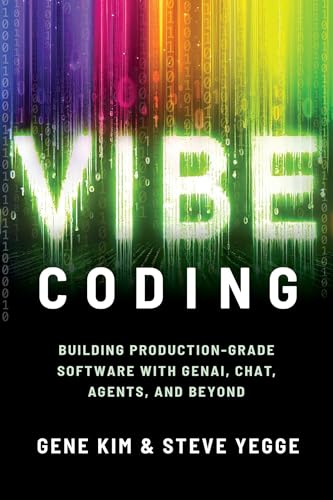
Vibe Coding: Building Production-Grade Software With GenAI, Chat, Agents, and Beyond
GenAI is fundamentally changing the world of software development like nothing since the internet. Vibe Coding is a first-of-its-kind, groundbreaking book that shows developers how to embrace this new frontier.
Science fiction is now reality. Programmers no longer need to toil over code and syntax. They can now describe what they want and watch it materialize instantly. Welcome to the future—Vibe Coding.
In this groundbreaking book, industry veterans Steve Yegge (Google, Amazon, Sourcegraph) and WSJ bestselling author Gene Kim (The Phoenix Project and The DevOps Handbook) reveal how vibe coding is transforming software development as we know it. By leveraging the power of AI assistance—where intent and flow matter more than syntax—developers can achieve unprecedented levels of productivity, creativity, and joy.
Drawing from decades of combined experience in software engineering and developer productivity, Yegge and Kim demonstrate how Vibe Coding enables developers
Transform complex programming challenges into fluid conversations with GenAI. Build more ambitious projects faster while maintaining code quality you can be proud of. Achieve incredible things yourself that otherwise would require a team. Master the art of co-creating with your AI companion. Break free from traditional programming constraints such as syntax and setup. Build confidently in multiple programming languages and frameworks you've never used before.
But this isn't just about coding faster—it's about fundamentally changing how we approach software development. The authors share practical strategies for implementing GenAI-powered development in real-world scenarios, from small projects to enterprise-scale applications, while maintaining the engineering excellence that modern systems demand.
Whether you're a seasoned developer looking to stay ahead of the AI revolution, a technical leader guiding your team through this transformation, a former coder returning after a break, or someone just starting their career, this handbook provides the roadmap you need to thrive in the new era of software development.
Don't get left behind in the biggest transformation our industry has seen since the internet revolution. Learn how to harness the power of vibe coding and unlock your full potential as a developer.
Science fiction is now reality. Programmers no longer need to toil over code and syntax. They can now describe what they want and watch it materialize instantly. Welcome to the future—Vibe Coding.
In this groundbreaking book, industry veterans Steve Yegge (Google, Amazon, Sourcegraph) and WSJ bestselling author Gene Kim (The Phoenix Project and The DevOps Handbook) reveal how vibe coding is transforming software development as we know it. By leveraging the power of AI assistance—where intent and flow matter more than syntax—developers can achieve unprecedented levels of productivity, creativity, and joy.
Drawing from decades of combined experience in software engineering and developer productivity, Yegge and Kim demonstrate how Vibe Coding enables developers
Transform complex programming challenges into fluid conversations with GenAI. Build more ambitious projects faster while maintaining code quality you can be proud of. Achieve incredible things yourself that otherwise would require a team. Master the art of co-creating with your AI companion. Break free from traditional programming constraints such as syntax and setup. Build confidently in multiple programming languages and frameworks you've never used before.
But this isn't just about coding faster—it's about fundamentally changing how we approach software development. The authors share practical strategies for implementing GenAI-powered development in real-world scenarios, from small projects to enterprise-scale applications, while maintaining the engineering excellence that modern systems demand.
Whether you're a seasoned developer looking to stay ahead of the AI revolution, a technical leader guiding your team through this transformation, a former coder returning after a break, or someone just starting their career, this handbook provides the roadmap you need to thrive in the new era of software development.
Don't get left behind in the biggest transformation our industry has seen since the internet revolution. Learn how to harness the power of vibe coding and unlock your full potential as a developer.
384 pages, Kindle Edition
Published October 21, 2025
About the author
Gene Kim
25 books1,041 followersGene Kim is a multiple award-winning CTO, Tripwire founder, Visible Ops co-author, IT Ops/Security Researcher, Theory of Constraints Jonah, a certified IS auditor and a rabid UX fan.
He is passionate about IT operations, security and compliance, and how IT organizations successfully transform from "good to great."
He is passionate about IT operations, security and compliance, and how IT organizations successfully transform from "good to great."
Ratings & Reviews
Friends & Following
Create a free account to discover what your friends think of this book!
Community Reviews
Displaying 1 - 30 of 61 reviews

November 1, 2025
When something seems easy, usually one of three things is happening: you’re a very smart individual, the Dunning-Kruger effect is at play, or the thing is actually easy. In my personal experience, the first option can be quickly ruled out, so I usually bet on the second one. That’s why I was hoping for some deep and unexpected insights from this book. However, there don’t seem to be many, which suggests that AI-assisted software development might just not be that hard.
If you’ve already tried coding with an agent, you’ve probably come to most of the same conclusions as this book. The agent messed up your project? Ouch, you need to commit more often and proceed step by step. Thinking about parallelization? The code needs clear boundaries and modular design. Want to maintain quality? You have to check everything carefully. The application doesn’t do what you had in mind? Maybe start with tests. And so on. It’s all pretty easily figure-out-able.
The last parts of the book are more interesting, as they explore scaling the process, but the advice remains superficial, nothing you couldn’t come up with yourself.
So the best advice is simply to start coding with an agent. If you actually struggle, then this book might be worth reaching for, but most of the time it probably won’t be necessary.
If you’ve already tried coding with an agent, you’ve probably come to most of the same conclusions as this book. The agent messed up your project? Ouch, you need to commit more often and proceed step by step. Thinking about parallelization? The code needs clear boundaries and modular design. Want to maintain quality? You have to check everything carefully. The application doesn’t do what you had in mind? Maybe start with tests. And so on. It’s all pretty easily figure-out-able.
The last parts of the book are more interesting, as they explore scaling the process, but the advice remains superficial, nothing you couldn’t come up with yourself.
So the best advice is simply to start coding with an agent. If you actually struggle, then this book might be worth reaching for, but most of the time it probably won’t be necessary.

November 15, 2025
This is a very shallow book that suffers from confirmation bias, as the authors ignore the DORA report, METR study, and other sources that show that the 10x hype doesn't match reality. Referring to the DORA report findings as the DORA Anomaly is ridiculous - it isn't an anomaly, they're just resisting data that doesn't align with their beliefs.
They're also prone to assuming that things will get better and problems will just go away. There's no coverage of the security issues with vibe coding, no guidance around isolating your agent in a sandbox, no suggestion to configure which commands the agent can run, no warnings about slop squatting. Hope is not a strategy.
They use proxy metrics that are not helpful, e.g. lines of code created - the industry realized that this is a useless metric long ago for so many reasons. More code is often a liability, and a 20 line solution might beat a 2000 line solution in every way. Having a leader board for tokens burned is dumb, you might as well say leaderboard for money burned.
Someone new to using agents to help with code might get some tips from the book, but as someone who has used Claude Code and others extensively I got zero value from it.
They're also prone to assuming that things will get better and problems will just go away. There's no coverage of the security issues with vibe coding, no guidance around isolating your agent in a sandbox, no suggestion to configure which commands the agent can run, no warnings about slop squatting. Hope is not a strategy.
They use proxy metrics that are not helpful, e.g. lines of code created - the industry realized that this is a useless metric long ago for so many reasons. More code is often a liability, and a 20 line solution might beat a 2000 line solution in every way. Having a leader board for tokens burned is dumb, you might as well say leaderboard for money burned.
Someone new to using agents to help with code might get some tips from the book, but as someone who has used Claude Code and others extensively I got zero value from it.

April 13, 2026
Other than the AI excitement around human like language comprehension & writing, image generation, another area which has advanced rapidly is AI-assisted Vibe Coding. Apparently, Dr Andrej Karpathy, AI Pioneer coined the term. The authors – Steve and Gene have different backgrounds & strengths, but both now enjoy being hands-on with Vibe Coding. They mention that many programmers are now coming back from retirement to code.
Large part of the book is conceptual, and this should not be considered a reference guide on Vibe Coding. Since becoming popular 2 years back, the advance is rapid and has evolved from chat-based programming to agentic development. While traditional development requires lot of co-ordination artifacts (typically as documents exchanged among people and teams) and misunderstanding/missteps are costly, AI promises to significantly improve this and also provide various development & deployment options. There are still issues with incorrect outputs, configuration issues etc.
This is a well-structured book for those who want to take some initial steps. There are a good number of references on how companies are using Vibe Coding at a high level in diverse areas. In the initial description, there is a small example of a bouncing ball leaving a trail with Javascript created with a simple prompt. I took at a shot at creating something a little more significant. ‘Aadu Puli Aatam’ is a simple board game which is played in Tamil Nadu (probably far less now) where it is few tigers (who try to eat the goats) vs many goats (who try to trap the tigers). With a fairly simple prompt and some follow-up clarifications, was able to create a working version (which can run in a browser) within 30 minutes using Claude. There were 2 rounds of run-time errors which the AI was able to resolve quickly. I have to agree with the authors that Vibe Coding is an enjoyable experience. The more detailed examples are few though.
A good introductory book.
Large part of the book is conceptual, and this should not be considered a reference guide on Vibe Coding. Since becoming popular 2 years back, the advance is rapid and has evolved from chat-based programming to agentic development. While traditional development requires lot of co-ordination artifacts (typically as documents exchanged among people and teams) and misunderstanding/missteps are costly, AI promises to significantly improve this and also provide various development & deployment options. There are still issues with incorrect outputs, configuration issues etc.
This is a well-structured book for those who want to take some initial steps. There are a good number of references on how companies are using Vibe Coding at a high level in diverse areas. In the initial description, there is a small example of a bouncing ball leaving a trail with Javascript created with a simple prompt. I took at a shot at creating something a little more significant. ‘Aadu Puli Aatam’ is a simple board game which is played in Tamil Nadu (probably far less now) where it is few tigers (who try to eat the goats) vs many goats (who try to trap the tigers). With a fairly simple prompt and some follow-up clarifications, was able to create a working version (which can run in a browser) within 30 minutes using Claude. There were 2 rounds of run-time errors which the AI was able to resolve quickly. I have to agree with the authors that Vibe Coding is an enjoyable experience. The more detailed examples are few though.
A good introductory book.

December 30, 2025
First off, the elephant: Yes, it's called vibe coding and that feels a little cringe. No, it's not about never-look-at-the-code, YOLO vibe coding. The book itself is full of high quality content. It's unfortunate the the relatively speed of publishing cycles for books makes choosing titles for books in this space hard.
Second, disclosure: I know Steve and worked with him the past several years. He and I discussed many of the ideas in this book as they were being developed.
Third, this book has a really cool cover. I love the rainbow matrix vibe.
This book is most valuable to folks who have experimented with AI-assisted coding, kind of get it, but want to be more effective. People with less experience (or more skepticism) should start by getting more hands on experience. Those who do AI-assisted coding regularly will likely find some gems but also a lot that is familiar.
The authors deliver concrete strategies for AI assisted development while acknowledging real challenges. They provide principles for effective AI assisted coding illustrated with stories, largely from the authors' experience. The book progresses from individual to organization: Part 1 establishes the "why" of AI-assisted coding through the FAAFO framework (Fast, Ambitious, Autonomous, Fun, Optionality), Part 2 dives into theory and practice with the "head chef" metaphor and detailed advice, Part 3 covers tools and inner/middle/outer developer loops, while Part 4 addresses organizational transformation and culture building. Each chapter has a useful conclusion which summarizes the key points.
I like the FAAFO framework. It goes beyond the question of "does AI make us faster or not?" and explores a broader way of looking at the value delivered through AI assisted coding. When implementation becomes cheap, new categories of projects become feasible (ambition), parallel exploration becomes practical (optionality), and coordination overhead decreases (autonomy). And, as they emphasize again and again, once you get into the flow, AI assisted coding is just plain fun.
The "head chef" metaphor used throughout the book works well for communicating the change in individual mindset required to work effectively with AI. The core idea is that when working with agents, you delegate some of the work but you're still on the hook for the final result, and you need to set things up so that they work effectively. Using AI isn't a way to delegate the thinking.
But it's not all acronyms and metaphors. The authors document a large number of genuinely useful development patterns for using AI, with a strong emphasis on validation and guardrails. They also share a number of "war stories", real life experiences where AI assisted coding went well... or went wrong. The weakness of these stories is that they mostly draw from the experience of the two authors with only occasional examples from others. That's not unreasonable, but a wider diversity of examples would have made the book stronger.
The end of the book starts to go into organizational implications of AI but it's largely speculative at this point. That's honest-we're just starting to see how these tools impact how organizations operate. But I hope to have front row tickets to the next chapter in our industry's development. This journey is only at the beginning.
Overall, this book is a valuable, entertaining resource for devs want to become more effective with AI assisted coding.
Note: If you want a taste, there are some good articles from the book on the IT Revolution site, including this one on the vibe coding loop and this one on FAAFO.
Second, disclosure: I know Steve and worked with him the past several years. He and I discussed many of the ideas in this book as they were being developed.
Third, this book has a really cool cover. I love the rainbow matrix vibe.
This book is most valuable to folks who have experimented with AI-assisted coding, kind of get it, but want to be more effective. People with less experience (or more skepticism) should start by getting more hands on experience. Those who do AI-assisted coding regularly will likely find some gems but also a lot that is familiar.
The authors deliver concrete strategies for AI assisted development while acknowledging real challenges. They provide principles for effective AI assisted coding illustrated with stories, largely from the authors' experience. The book progresses from individual to organization: Part 1 establishes the "why" of AI-assisted coding through the FAAFO framework (Fast, Ambitious, Autonomous, Fun, Optionality), Part 2 dives into theory and practice with the "head chef" metaphor and detailed advice, Part 3 covers tools and inner/middle/outer developer loops, while Part 4 addresses organizational transformation and culture building. Each chapter has a useful conclusion which summarizes the key points.
I like the FAAFO framework. It goes beyond the question of "does AI make us faster or not?" and explores a broader way of looking at the value delivered through AI assisted coding. When implementation becomes cheap, new categories of projects become feasible (ambition), parallel exploration becomes practical (optionality), and coordination overhead decreases (autonomy). And, as they emphasize again and again, once you get into the flow, AI assisted coding is just plain fun.
The "head chef" metaphor used throughout the book works well for communicating the change in individual mindset required to work effectively with AI. The core idea is that when working with agents, you delegate some of the work but you're still on the hook for the final result, and you need to set things up so that they work effectively. Using AI isn't a way to delegate the thinking.
But it's not all acronyms and metaphors. The authors document a large number of genuinely useful development patterns for using AI, with a strong emphasis on validation and guardrails. They also share a number of "war stories", real life experiences where AI assisted coding went well... or went wrong. The weakness of these stories is that they mostly draw from the experience of the two authors with only occasional examples from others. That's not unreasonable, but a wider diversity of examples would have made the book stronger.
The end of the book starts to go into organizational implications of AI but it's largely speculative at this point. That's honest-we're just starting to see how these tools impact how organizations operate. But I hope to have front row tickets to the next chapter in our industry's development. This journey is only at the beginning.
Overall, this book is a valuable, entertaining resource for devs want to become more effective with AI assisted coding.
Note: If you want a taste, there are some good articles from the book on the IT Revolution site, including this one on the vibe coding loop and this one on FAAFO.

December 7, 2025
Built on big names and good stories, it might even be seen entertaining but far too light. It leans on metaphors and slogans instead of tackling the hard questions: how to measure quality, how to make the process repeatable, where AI actually breaks things, what it means for security, and how it reshapes engineering culture. It never offers anything you couldn’t figure out yourself just by using the tools. In the end, the book talks about vibe coding more than it gives you a real way to do it with rigor.

January 16, 2026
Last time I was writing computer code regularly more than 20 years ago, planning to also try vibe coding in the near future, probably for some productivity and home automation stuff. I believe that the most people/organizations are not really ready to realize the benefits from the AI empowerment in programming and it should mostly be viewed as an advanced automation solution, that requires a lot of critical thinking and sensemaking on a continuous basis. When looking at all the work and rework and having to question almost everything then there is immense waste in this approach which definitely supports innovation, but unpredictable value and mountains of rework, not to mention impact on maintainability, complexity growth etc. What if the coordination cost exceeds the vibe? So let's proceed with modest and realistic expectations to get further without a collapse.
Principally the book covers that I expected when picking it up - understanding what are the keywords and appraoches behind what the tiktok generation means when talking about vibe coding. For something more serious it remains too shallow and also repetative (but still respect trying to put this into a book). This book is also haunted by the same limitation as most other IT Revolution books, the real-world examples are few and not that inspiring.
In the 1980s, General Motors spent billions on robots that promised efficiency but delivered chaos because the underlying work was never understood, let alone simplified. Today’s enterprises are doing the same with artificial intelligence. Latest surveys conclude that the vast majority of AI pilots produce no measurable return, not because the models are inadequate, but because the organisations deploying them remain structurally unreadable. Workflows still depend on tribal knowledge, undocumented approvals, and assumptions inherited from another era.
Toyota’s old lessons remain the clearest guide. Automation only works when the process beneath it is stable, transparent, and relentlessly improved through small, local experiments. Companies that skip this step end up multiplying dysfunction at scale, replacing bad work with faster bad work. AI is not the problem. The refusal to redesign the work is.
The Vibe Coding Loop:
1. Frame your objective.
2. Decompose the tasks.
3. Start the conversation.
4. Reveiw with care.
6. Test and verify.
7. Redefine and iterate.
8. Bonus: automate the workflow.
Inner developer loop - from seconds to minutes
Prevent
• Checkpoint and save your game frequently
• Keep your tasks small and focused
• Get the AI to write specifications
• Have AI write the tests
• AI is a Git maestro
Detect
• Verify AI’s claims yourself
• Always on watch: keeping your AI on the rails
• Use test-driven development
• Learn while watching
• Put your sous chef on cleanup duty
• Tell your sous chef where the freezer is
Correct
• When things go wrong: fix forward or roll back
• Automate linting and correction
• When to take back the wheel
• Your AI as a rubber duck
Middle developer loop - hours to days
Prevent
• Written rules: because your sous chefs can’t read your mind
• The Memento Method
• Design for AI manufacturing
• Working with two agents at once, and more
• Intentional AI coordination
• Keeping your agents busy when you’re busy
Detect
• Waking up to eldritch AI-generated horrors
• Too many cooks: detecting agent contention
Correct
• Kitchen line stress tests: using tracer bullets
• Sharpen your knives: investing in workflow automation
• The economics of optionality
Outer developer loop - weeks to months
Prevent
• Don’t let your AI torch your bridges
• Workspace confusion: avoiding the “stewnami”
• Minimize and modularize
• Managing fleets of agents: four and beyond
• Auditing through or around the kitchen
• Channel your inner product manager
• Making operations fast, ambitious, and fun
Detect
• When the AI throws everything out
• CI/CD in the age of AI
Correct
• Steve’s harrowing merge recovery tale
• When you’re stuck with awful processes and architecture
“Delegation of implementation doesn’t mean delegation of responsibility. Your users, colleagues, and leadership don’t (or shouldn’t) care which parts were written by AI—they rightfully expect you to stand behind every line of code. When something breaks in production at 2 a.m., no one wants to hear, “Well, AI wrote that part.” You own the final result, period. This is both liberating and challenging.”
“Your judgement and experience is are more important than ever. AI can be wrong.” (yet this part is ignored by most).
“Sometimes it’s awful, sometimes it’s close but not quite there, and sometimes it blows your socks off. Each of the good payouts delivers a tiny hit of dopamine, a neurochemical reward that makes us feel good and encourages us to pull the lever again.” (yep, vibe coding is psychologically not that different from gambling).
Principally the book covers that I expected when picking it up - understanding what are the keywords and appraoches behind what the tiktok generation means when talking about vibe coding. For something more serious it remains too shallow and also repetative (but still respect trying to put this into a book). This book is also haunted by the same limitation as most other IT Revolution books, the real-world examples are few and not that inspiring.
In the 1980s, General Motors spent billions on robots that promised efficiency but delivered chaos because the underlying work was never understood, let alone simplified. Today’s enterprises are doing the same with artificial intelligence. Latest surveys conclude that the vast majority of AI pilots produce no measurable return, not because the models are inadequate, but because the organisations deploying them remain structurally unreadable. Workflows still depend on tribal knowledge, undocumented approvals, and assumptions inherited from another era.
Toyota’s old lessons remain the clearest guide. Automation only works when the process beneath it is stable, transparent, and relentlessly improved through small, local experiments. Companies that skip this step end up multiplying dysfunction at scale, replacing bad work with faster bad work. AI is not the problem. The refusal to redesign the work is.
The Vibe Coding Loop:
1. Frame your objective.
2. Decompose the tasks.
3. Start the conversation.
4. Reveiw with care.
6. Test and verify.
7. Redefine and iterate.
8. Bonus: automate the workflow.
Inner developer loop - from seconds to minutes
Prevent
• Checkpoint and save your game frequently
• Keep your tasks small and focused
• Get the AI to write specifications
• Have AI write the tests
• AI is a Git maestro
Detect
• Verify AI’s claims yourself
• Always on watch: keeping your AI on the rails
• Use test-driven development
• Learn while watching
• Put your sous chef on cleanup duty
• Tell your sous chef where the freezer is
Correct
• When things go wrong: fix forward or roll back
• Automate linting and correction
• When to take back the wheel
• Your AI as a rubber duck
Middle developer loop - hours to days
Prevent
• Written rules: because your sous chefs can’t read your mind
• The Memento Method
• Design for AI manufacturing
• Working with two agents at once, and more
• Intentional AI coordination
• Keeping your agents busy when you’re busy
Detect
• Waking up to eldritch AI-generated horrors
• Too many cooks: detecting agent contention
Correct
• Kitchen line stress tests: using tracer bullets
• Sharpen your knives: investing in workflow automation
• The economics of optionality
Outer developer loop - weeks to months
Prevent
• Don’t let your AI torch your bridges
• Workspace confusion: avoiding the “stewnami”
• Minimize and modularize
• Managing fleets of agents: four and beyond
• Auditing through or around the kitchen
• Channel your inner product manager
• Making operations fast, ambitious, and fun
Detect
• When the AI throws everything out
• CI/CD in the age of AI
Correct
• Steve’s harrowing merge recovery tale
• When you’re stuck with awful processes and architecture
“Delegation of implementation doesn’t mean delegation of responsibility. Your users, colleagues, and leadership don’t (or shouldn’t) care which parts were written by AI—they rightfully expect you to stand behind every line of code. When something breaks in production at 2 a.m., no one wants to hear, “Well, AI wrote that part.” You own the final result, period. This is both liberating and challenging.”
“Your judgement and experience is are more important than ever. AI can be wrong.” (yet this part is ignored by most).
“Sometimes it’s awful, sometimes it’s close but not quite there, and sometimes it blows your socks off. Each of the good payouts delivers a tiny hit of dopamine, a neurochemical reward that makes us feel good and encourages us to pull the lever again.” (yep, vibe coding is psychologically not that different from gambling).
November 12, 2025
Hard to rate: liked a lot, disliked some (too fluffy, abstract). So 3 or 4 stars?

November 1, 2025
Too basic
January 16, 2026
I was torn between 3/5 and 4/5 on the rating here.
There is some great content, but I do feel like to book was quite a bit longer than it needed to be, and by the end I was really dragging.
For people who are good at picking-and-choosing chapters, I think this could be great. But I have a cover-to-cover compulsion.
I also read Addy Osmani's "Beyond Vibe Coding" book. The scope of things there was quite different, but this book felt more refined and better put together. I think the content in this book is more likely to stay relevant longer than "Beyond Vibe Coding", so that book getting a bit rushed out the door was probably not the worst choice however.
I "Vibe-coded" some Key takeaways from this book (auto-summarized from my notes)
1. Fast Feedback Loops and High Velocity: AI's speed enables fast feedback loops, making more projects feasible and reshaping the project landscape by turning previously unfeasible tasks into quick wins.
2. Autonomy and Reduced Friction: Vibe coding allows developers to work at their own pace, reducing the need for constant negotiation and coordination, which traditionally slows down teams.
3. Modularity and Parallel Work: Creating modular systems is crucial as it reduces complexity, enables parallel work, and allows for exploring multiple options simultaneously.
4. Guardrails and Documentation: Establishing guardrails and maintaining persistent references and documentation are essential to prevent AI from transforming codebases in undesirable ways.
5. Explicit Quality Standards: It's important to define explicit quality standards and verify that every component delivered by AI meets these standards. This includes demanding excellence and ensuring that AI-generated code is not just superficially correct but genuinely robust.
6. AI as a Teammate: Treat AI as a teammate rather than just a tool, requiring conscientious oversight, reviewing, validating, and testing AI-generated code more than usual.
7. Managing Complexity: Breaking down complex tasks into smaller, manageable parts that AI can handle effectively is crucial. This involves using "tracer bullets" to ensure a complete path through the system works.
8. Parallel Work and Workflow Automation: Leveraging AI for parallel work and investing in workflow automation can significantly enhance productivity. This includes using version control effectively and documenting standards thoroughly.
9. Avoiding Context Saturation: Managing AI's context effectively is important to prevent performance degradation due to context saturation. This involves using focused or comprehensive context management strategies as needed.
10. Continuous Learning and Adaptation: Embracing continuous learning and adapting to fast-changing environments is vital for thriving in a vibe coding world.
There is some great content, but I do feel like to book was quite a bit longer than it needed to be, and by the end I was really dragging.
For people who are good at picking-and-choosing chapters, I think this could be great. But I have a cover-to-cover compulsion.
I also read Addy Osmani's "Beyond Vibe Coding" book. The scope of things there was quite different, but this book felt more refined and better put together. I think the content in this book is more likely to stay relevant longer than "Beyond Vibe Coding", so that book getting a bit rushed out the door was probably not the worst choice however.
I "Vibe-coded" some Key takeaways from this book (auto-summarized from my notes)
1. Fast Feedback Loops and High Velocity: AI's speed enables fast feedback loops, making more projects feasible and reshaping the project landscape by turning previously unfeasible tasks into quick wins.
2. Autonomy and Reduced Friction: Vibe coding allows developers to work at their own pace, reducing the need for constant negotiation and coordination, which traditionally slows down teams.
3. Modularity and Parallel Work: Creating modular systems is crucial as it reduces complexity, enables parallel work, and allows for exploring multiple options simultaneously.
4. Guardrails and Documentation: Establishing guardrails and maintaining persistent references and documentation are essential to prevent AI from transforming codebases in undesirable ways.
5. Explicit Quality Standards: It's important to define explicit quality standards and verify that every component delivered by AI meets these standards. This includes demanding excellence and ensuring that AI-generated code is not just superficially correct but genuinely robust.
6. AI as a Teammate: Treat AI as a teammate rather than just a tool, requiring conscientious oversight, reviewing, validating, and testing AI-generated code more than usual.
7. Managing Complexity: Breaking down complex tasks into smaller, manageable parts that AI can handle effectively is crucial. This involves using "tracer bullets" to ensure a complete path through the system works.
8. Parallel Work and Workflow Automation: Leveraging AI for parallel work and investing in workflow automation can significantly enhance productivity. This includes using version control effectively and documenting standards thoroughly.
9. Avoiding Context Saturation: Managing AI's context effectively is important to prevent performance degradation due to context saturation. This involves using focused or comprehensive context management strategies as needed.
10. Continuous Learning and Adaptation: Embracing continuous learning and adapting to fast-changing environments is vital for thriving in a vibe coding world.

February 1, 2026
If you are new to vibe coding, or maybe new to coding in general, this is probably a helpful stepping off point. If you've been at it at least a while, maybe slinging between two to three agents, there are still some useful tips in here. I walked away with a handful of practical additions to my approach. If you are a seasoned individual, who has already settled on your workflow and solved some of the classic problems at this point (token context, hallucinations, inappropriate task definition), this is definitely too many words on the subject. Carry on. If you are on the fence or have a few reservations, this book may help you iron out your position or convince you to give vibe coding a shot. Nevertheless, the barrier to entry still seems to be tokens - if you have a limited investment, it seriously hamstrings your development cycles. While you can work on the basics and principles outlined here, you may not be having as much fun.

August 20, 2026
While reading this book about vibe coding, I couldn't shake off the feeling it was also vibe-written. I had the same urge to fast-forward as while reading the answers generated by LLMs 🥱
There were many interesting ideas and learnings, but certainly not enough for a 300+ page book. It would be more appropriate as 100 page book, or simply a dozen of Medium articles.
You can get a better understanding of the vibe coding if you spend the same amount of time with Claude Code directly, no book needed 😆
There were many interesting ideas and learnings, but certainly not enough for a 300+ page book. It would be more appropriate as 100 page book, or simply a dozen of Medium articles.
You can get a better understanding of the vibe coding if you spend the same amount of time with Claude Code directly, no book needed 😆
October 30, 2025
I've been following Steve Yegge for many years. He formed my junior opinions on so many topics in software. It's not an exaggeration to credit him with inspiring me to go to Amazon, which changed my life forever.
The promise of AI is multifaceted for the lay person in 2025. We can use it to fake coherent videos and there are huge controversies and lawsuits around using copyrighted training data. Amazon layoffs of knowledge workers are in the news, and we have books warning about the potentially civilization ending downsides of this technology. It is a lot.
What this book delivers is less a manifesto than a time capsule, and one leaving most of these problems for later, in favor of talking about the unprecedented power these AIs give to software engineers. The fact of the matter in Fall 2025 is that a top tier model can program for you, much faster than you. Those who take advantage of this are engineering software in an entirely different modality, where the compiler and the editor fade into the background and the engineer merely converses with agents and checks their work.
The book does an admirable job of giving the reader this aha moment (especially if they have access to, say. Claude Code), but then provides the extremely valuable information about how to handle this power once you are convinced that it is not a mirage, but the real thing.
Software engineers, they instruct, are no longer potwashers and drudges, but the head chefs of a gourmet kitchen. This confers power and responsibility, but it also implies the end of our old way of work, and the need for the new skills to wrangle a virtual staff of highly skilled specialists who might delete the kitchen if you're not careful.
The book does its best not to ground you in the hit tool of the moment (Cursor 2.0 literally came out today) but in the more timeless principles and practices that will keep the agents and your overall effort operating at production quality. They share their experiences with vibe coding as examples that illustrate patterns. The book is full of practical takeaways in every chapter.
I work for a company that is bullish on these tools. It took an interview with Steve and this book for me to understand why, but I can see how my company has been encouraging adoption of vibe coding in much the manner prescribed in the book. It's hard to understand from the other side of the line. The technology looked unready. There is a lot of FUD about the technology taking software jobs.
But it is here. Very hard not to sound cultish while describing the experience of watching Claude make production worthy code that I reviewed and published. And I'm just scratching the surface of the deep workflows described here.
Do yourself a favor and ride this wave before it's too late. Whatever book or influence gets you across that line, we could be talking about a career altering watershed moment. But I recommend this one for $20 well spent.
The promise of AI is multifaceted for the lay person in 2025. We can use it to fake coherent videos and there are huge controversies and lawsuits around using copyrighted training data. Amazon layoffs of knowledge workers are in the news, and we have books warning about the potentially civilization ending downsides of this technology. It is a lot.
What this book delivers is less a manifesto than a time capsule, and one leaving most of these problems for later, in favor of talking about the unprecedented power these AIs give to software engineers. The fact of the matter in Fall 2025 is that a top tier model can program for you, much faster than you. Those who take advantage of this are engineering software in an entirely different modality, where the compiler and the editor fade into the background and the engineer merely converses with agents and checks their work.
The book does an admirable job of giving the reader this aha moment (especially if they have access to, say. Claude Code), but then provides the extremely valuable information about how to handle this power once you are convinced that it is not a mirage, but the real thing.
Software engineers, they instruct, are no longer potwashers and drudges, but the head chefs of a gourmet kitchen. This confers power and responsibility, but it also implies the end of our old way of work, and the need for the new skills to wrangle a virtual staff of highly skilled specialists who might delete the kitchen if you're not careful.
The book does its best not to ground you in the hit tool of the moment (Cursor 2.0 literally came out today) but in the more timeless principles and practices that will keep the agents and your overall effort operating at production quality. They share their experiences with vibe coding as examples that illustrate patterns. The book is full of practical takeaways in every chapter.
I work for a company that is bullish on these tools. It took an interview with Steve and this book for me to understand why, but I can see how my company has been encouraging adoption of vibe coding in much the manner prescribed in the book. It's hard to understand from the other side of the line. The technology looked unready. There is a lot of FUD about the technology taking software jobs.
But it is here. Very hard not to sound cultish while describing the experience of watching Claude make production worthy code that I reviewed and published. And I'm just scratching the surface of the deep workflows described here.
Do yourself a favor and ride this wave before it's too late. Whatever book or influence gets you across that line, we could be talking about a career altering watershed moment. But I recommend this one for $20 well spent.

March 27, 2026
I recommend giving this book a good skim even if not a thorough read. I found its best parts to be their advice about the day-to-day approach a software developer can take with respect to coding assistants (Part 3 of the book). But should you even invest time in learning a tool that changes every few months? The book claims that the principles which they recommend here will be relevant even if models and tools keep improving (more on this later). Towards the end they cite an economist, Matt Beane, whose research regarding warehouse automation showed that ground-level workers who adopted new automation technologies usually gained valuable tacit knowledge and skills. This helped them grow faster in their career, including through roles and titles that didn't even exist before the advent of that automation! Another strong point of view emphasized throughout the book (that I’m not yet convinced of) is that programmers are now "head chefs": they have to manage a team of coding agents and can no longer be expected to work on a single task at a time! Since both authors are experienced and reputed professionals in the field of software, the book features interviews with other technology leaders and economists, and also links to quite a few good talks and articles regarding AI assisted coding. These references alone are worth dipping into it!
The book tries to cover all aspects of AI assisted coding (up to organizational transformation) but comes across as superficial at places. After reading it, I was not particularly more enlightened about the fundamental strengths/weaknesses of an "LLM" or "GPT" as regards to generating code. They admit upfront that there's going to be no maths or linear algebra in this book. But there are so many instances of "AI will" and "AI can" in wildly varying contexts that you begin to doubt whether you've understood the essence of this technology at all! At one place the authors caution us against anthropomorphizing these assistants, and insist that you use them like tireless workers who never complain no matter how tedious or repetitive your requests are. But that message could get lost in the rest of their verbiage.
I also found the descriptions of multi-agent orchestration and organizational adoption to be lacking in details (or perhaps I couldn't grasp them properly). I wish the book had explored in more depth the impact on workflows of specific roles like Frontend Engineer, Backend Engineer, Principal Engineer etc. Instead they resort one too many a time to the many side projects of the authors, one of which has to do with tools for book writing - hardly representative of the software industry at large!
FAAFO and Optionality
Inside this book is a useful equation, drawn from the world of finance:
Option Value = (N * K * Sigma)/T
Here Option Value is a measure of how many future courses of action you can possibly take (higher the better).
Here:
N → The no. of parallel modules that are being worked on within a project.
K → The (average?) no. of parallel experiments possible within a module.
Sigma → A measure of uncertainty. Ranges from 1 to Infinity. Higher implies more uncertain.
T → (Average?) Time per experiment.
It's obvious that AI reduces T (time per experiment) dramatically. So that automatically implies your Option Value goes up, and even more so in situations of high uncertainty (high Sigma). Let's keep aside for a moment whether AI code is "Better". This increase in speed should benefit us directly. Since AI code assistants are also extreme generalists, they enable a single person or team to work Autonomously, reducing the need for cross-functional collaboration. This lets you attempt more Ambitious projects (observable in the trivial case of weekend side projects that get done in hours). The authors' FAAFO mnemonic ties all these together: Fast, Ambitious, Autonomous, Optionality (the other F stands for Fun, which I'll ignore as it's not relevant for professional contexts).
But remember that there's no "B for Better" in FAAFO! If we assume that you're satisfied (even if not particularly happy) with AI code, you still need to keep a close watch on it. There's a detailed chapter with anecdotal evidence on how AI generated code can go horribly wrong. A timely reference to the concept of "jagged frontier" and its background here, is the kind of stuff that makes this book worthwhile - but again one wishes there had been a more detailed explanation of this concept. And there's also a discussion of a recent industry survey (DORA 2024) where it emerged that reliability actually dropped after adoption of AI! To address these, the book recommends not losing sight of the following age old engineering practices: Modularity, fast feedback loops, and exercising good judgment. How much new Option Value you gain depends entirely on those three conceptual guardrails. In their words, "Taking your hard won engineering discipline and applying it at greater intensity".
For a given project, if you are able to keep an optimally high N (no. of modules), optimally high K (experiments per module), in such a way that AI code does not veer off the quality bar, you stand to gain most from the reduction in T (time per experiment). To quote, "The main value of going faster is the extent to which it multiplies the value in the other dimensions of FAAFO".
The numerous practical tips presented in the book can probably be seen as ways to implement these guardrails in your day-to-day software development process (Part 3 in the book, as I mentioned earlier). Given that AI can accomplish certain inner-loop tasks in seconds or minutes, how do you ratchet up all the rest of your quality controls around this new reality? How best to decompose tasks? What granularity of work to hand over to AI? When to intervene? How often to check back? The context window of AI's gets a good amount of discussion here. They encourage you to think of delegating tasks along the lines of Andy Grove's High Output Management. In brief, you delegate based on: Task novelty, Past experience, Skill level, Task size and impact, Frequency of reporting. But the maturity of the AI for a particular task is something you can only gauge through practice and a lot of trial-and-error.
A big downside of the book is that the many great pieces of info are sprawled across its verbose, stretched out length (hence my suggestion to skim). To be fair, the book is targeted at people who are programmers or tech-adjacent, but may have never played with coding assistants. So there's a lot of introductory and motivating material about the overall landscape. It seems to be designed as a leisurely read and not an executive summary. There’s an Appendix and a Glossary at the end which are very handy. I made my own Notes when reading it.
The book tries to cover all aspects of AI assisted coding (up to organizational transformation) but comes across as superficial at places. After reading it, I was not particularly more enlightened about the fundamental strengths/weaknesses of an "LLM" or "GPT" as regards to generating code. They admit upfront that there's going to be no maths or linear algebra in this book. But there are so many instances of "AI will" and "AI can" in wildly varying contexts that you begin to doubt whether you've understood the essence of this technology at all! At one place the authors caution us against anthropomorphizing these assistants, and insist that you use them like tireless workers who never complain no matter how tedious or repetitive your requests are. But that message could get lost in the rest of their verbiage.
I also found the descriptions of multi-agent orchestration and organizational adoption to be lacking in details (or perhaps I couldn't grasp them properly). I wish the book had explored in more depth the impact on workflows of specific roles like Frontend Engineer, Backend Engineer, Principal Engineer etc. Instead they resort one too many a time to the many side projects of the authors, one of which has to do with tools for book writing - hardly representative of the software industry at large!
FAAFO and Optionality
Inside this book is a useful equation, drawn from the world of finance:
Option Value = (N * K * Sigma)/T
Here Option Value is a measure of how many future courses of action you can possibly take (higher the better).
Here:
N → The no. of parallel modules that are being worked on within a project.
K → The (average?) no. of parallel experiments possible within a module.
Sigma → A measure of uncertainty. Ranges from 1 to Infinity. Higher implies more uncertain.
T → (Average?) Time per experiment.
It's obvious that AI reduces T (time per experiment) dramatically. So that automatically implies your Option Value goes up, and even more so in situations of high uncertainty (high Sigma). Let's keep aside for a moment whether AI code is "Better". This increase in speed should benefit us directly. Since AI code assistants are also extreme generalists, they enable a single person or team to work Autonomously, reducing the need for cross-functional collaboration. This lets you attempt more Ambitious projects (observable in the trivial case of weekend side projects that get done in hours). The authors' FAAFO mnemonic ties all these together: Fast, Ambitious, Autonomous, Optionality (the other F stands for Fun, which I'll ignore as it's not relevant for professional contexts).
But remember that there's no "B for Better" in FAAFO! If we assume that you're satisfied (even if not particularly happy) with AI code, you still need to keep a close watch on it. There's a detailed chapter with anecdotal evidence on how AI generated code can go horribly wrong. A timely reference to the concept of "jagged frontier" and its background here, is the kind of stuff that makes this book worthwhile - but again one wishes there had been a more detailed explanation of this concept. And there's also a discussion of a recent industry survey (DORA 2024) where it emerged that reliability actually dropped after adoption of AI! To address these, the book recommends not losing sight of the following age old engineering practices: Modularity, fast feedback loops, and exercising good judgment. How much new Option Value you gain depends entirely on those three conceptual guardrails. In their words, "Taking your hard won engineering discipline and applying it at greater intensity".
For a given project, if you are able to keep an optimally high N (no. of modules), optimally high K (experiments per module), in such a way that AI code does not veer off the quality bar, you stand to gain most from the reduction in T (time per experiment). To quote, "The main value of going faster is the extent to which it multiplies the value in the other dimensions of FAAFO".
The numerous practical tips presented in the book can probably be seen as ways to implement these guardrails in your day-to-day software development process (Part 3 in the book, as I mentioned earlier). Given that AI can accomplish certain inner-loop tasks in seconds or minutes, how do you ratchet up all the rest of your quality controls around this new reality? How best to decompose tasks? What granularity of work to hand over to AI? When to intervene? How often to check back? The context window of AI's gets a good amount of discussion here. They encourage you to think of delegating tasks along the lines of Andy Grove's High Output Management. In brief, you delegate based on: Task novelty, Past experience, Skill level, Task size and impact, Frequency of reporting. But the maturity of the AI for a particular task is something you can only gauge through practice and a lot of trial-and-error.
A big downside of the book is that the many great pieces of info are sprawled across its verbose, stretched out length (hence my suggestion to skim). To be fair, the book is targeted at people who are programmers or tech-adjacent, but may have never played with coding assistants. So there's a lot of introductory and motivating material about the overall landscape. It seems to be designed as a leisurely read and not an executive summary. There’s an Appendix and a Glossary at the end which are very handy. I made my own Notes when reading it.

December 31, 2025
This is a good entry-level book for someone who has no clue about vibe coding. It gives a few starting points, watchouts and specifics of working with AI agents.
Unfortunately, it doesn't provide much more than that. Neither does it go deeper into explaining how AI agents / models work, not does it give specific solutions to the problems it highlights when using vibe coding on a professional scale.
It feels more like a conversation you would have with a few people you've met at a vibe coding conference where they share their stories and pieces of knowledge they have. Actually, a lot of the book contents is based on personal experiences of the authors, rather than large-scale studies or papers published by the companies in the field.
Unfortunately, it doesn't provide much more than that. Neither does it go deeper into explaining how AI agents / models work, not does it give specific solutions to the problems it highlights when using vibe coding on a professional scale.
It feels more like a conversation you would have with a few people you've met at a vibe coding conference where they share their stories and pieces of knowledge they have. Actually, a lot of the book contents is based on personal experiences of the authors, rather than large-scale studies or papers published by the companies in the field.
January 20, 2026
A bit mixed bag, book reads like written by LLM (authors say it is), meaning authors optimize for writer, not reader. Lots of duplication, same few examples are dragged through every chapter.
Authors bring a lot of good points, while I don't agree with some, overall I think book is great for any AI skeptic tech leader to read and consider more perspectives.
Authors bring a lot of good points, while I don't agree with some, overall I think book is great for any AI skeptic tech leader to read and consider more perspectives.

November 19, 2025
I am sorry but this book was most likely "vibe written".
March 11, 2026
I read this book to try and get useful insights on how to use AI beyond vibecoding. I did not find that in this book. Now excuse me while I go off on the biggest rant for a book I may ever write.
I am in software, and I wanted to like this book so much. I forced myself to get through the whole book to give it a fair shot (I even read the “just checking if you’re reading carefully tricks” that were slotted in -- no, Clojure is not the future of programming languages, Steve), because I greatly respect the two authors and their previous writing. I had read Gene’s Phoenix Project, and it introduced me to the DevOps movement. Steve’s blog posts are a big reason I took the compilers class during university.
Unfortunately, this ended up being the first book that I have read that I unequivocally think deserves the lowest rating possible. It’s possible they were pressured to release this earlier because it’s such a hot topic, but I’m actually offended they saw fit to release this in its current state.
Firstly, this book is marketed towards developers, and it’s got “building production grade software” in the title, but I feel like they couldn’t make up their mind throughout the book about their target audience (developers, technical leadership, hobbyists?), pingpong-ing from talking about Gradle, unit testing and Clojure in one chapter (clearly developer-focused) and explaining what an API is in another (very basic). If they got this straight, I feel like they would have been able to have a much more cohesive narrative. As it stands, I feel like leadership was more of the target audience, just because most developers wouldn’t find anything really of value here. This was like those workshops you hear about that are really just fluff and talk about things at very high levels, making you feel good about yourself but not really giving you anything actionable to take away.
Secondly, the first ~1/3 of the book is basically dedicated to scaring you into feeling left behind. It could really be summarized in a few pages - lots of people are using AI, agentic coding is becoming the norm, it’s changing workflows forever, and if you tried it in 2023/204 and think it’s crap, you need to try it again. Well worth stating, but not over and over.
Thirdly, I don’t agree with a lot of the central premise of the book. There is so much focus on tying success to lines of code (LOC) generated, which is famously a horrid way of measuring output (and stinks of something only leadership focuses on). I don’t care that you wrote 10,000 lines of Clojure code in 4 days across how many files. Is that robust? Do you know how it works? And there is barely any talk about how to ensure code quality beyond them really just saying “use version control. Tests are mandatory now.” There is barely any concrete acknowledgement about how jamming in 10,000 new lines of code means you now have 10,000 LOC to support, with a fraction of time spent working with and understanding that new system.
Their experience is so different to mine - there is a lot of talk about the dopamine rush of when AI implements things so quickly. When I use AI, I like that it can automate writing code, and it is a great pair programming and thinking partner, but if I were to use it to the extent they are recommending, I get anxious about not fully understanding how the code I’ve written works. Maybe that’s a sign of me not letting go of the wheel enough, but I don’t like how they don’t seem to acknowledge that one of the core responsibilities of being a developer is having a proper mental model to know how to build and modify a system correctly, not just to deliver features.
But the main reason why I hate this book (truly, truly hate it) is nothing to do with the content. It’s 100% the writing.
This was the first book I “skimmed” in the truest sense of the word (practically skipping some chapters, flying through some of them within minutes towards the end). And it wasn’t for a lack of trying. This book is so bad I feel guilty for counting it towards my read challenge.
I eventually gave up and started skimming because it’s actual literal AI slop. Without them even telling me, I began to suspect 1/5th of the way through the book that it was written with AI. Only for them to admit a few chapters later that they used it directly to help with the writing process. You would think that them acknowledging it would mean they were well aware of its limitations and used it responsibly. But it’s the opposite. There is just so much repetition everywhere, and it absolutely ruins the book (not to mention, makes me feel like I got conned into spending more money because the actual content is so minimal).
Just as with AI code, if I start to doubt the integrity and quality of a block of code, I start to doubt the whole PR. Here, I’m questioning the quality of the entire book (and whoever agreed to publish this).
Why is there so much intro and prefacing before diving into each topic? Why does every chapter need a conclusion section? Why is there signposting everywhere? In Chapter 2: there is an intro and conclusion to something that can be read within 5-10 minutes.
There are countless repeated stories across chapters. The writing tools developed by Gene, the “should have been a summer intern project”, the “ai deleted the last copy of something for wyvern and it only existed in this one terminal.” They especially kept referencing the same 2 examples (Gene’s writing bench and the Wyvern project), as if I haven’t heard the horror stories like 15 times already, ad nauseum. It’s one thing if we look at different aspects of that story/project, but it’s pretty much just the same story, repeated again but written slightly differently (because it’s AI WRITTEN).
There are needless analogies and explanations cluttering the book “it was like asking your dog to put back the shoes it ruined” - I don’t need that analogy when you say AI deleted your tests, and you then asked it to bring it back. What is the point of that?
When I use AI-assisted coding, I find that if you’re not careful, it is very easy to get wrapped up in following the logic it puts out, especially if things are working, and at some point, you forget the big picture and don't take a step back and see the spaghetti code you are writing. I feel like the same thing happened here.
They talk so much about using AI to improve this draft. At one point they even talk about a parallel draft ranking system for this book. The one thing I just wish they would have done is read the dang book cover to cover and actually proofread/copy-edit it properly.
If I could, I would consider giving this a 1.5, just because there are some tidbits of useful insight here. The bit about how LLM context works is a good breakdown. And the bit about implementing features via a tracer bullet style, one vertical slice at a time, is good. But the writing is so bad that I could never, ever recommend this book to anyone.
I thought AI code slop was bad. They’ve now introduced me to dystopian world of AI literature slop, and it hurts my soul 100x worse. I truly hope this is not the future of writing, because I hate it.
I am in software, and I wanted to like this book so much. I forced myself to get through the whole book to give it a fair shot (I even read the “just checking if you’re reading carefully tricks” that were slotted in -- no, Clojure is not the future of programming languages, Steve), because I greatly respect the two authors and their previous writing. I had read Gene’s Phoenix Project, and it introduced me to the DevOps movement. Steve’s blog posts are a big reason I took the compilers class during university.
Unfortunately, this ended up being the first book that I have read that I unequivocally think deserves the lowest rating possible. It’s possible they were pressured to release this earlier because it’s such a hot topic, but I’m actually offended they saw fit to release this in its current state.
Firstly, this book is marketed towards developers, and it’s got “building production grade software” in the title, but I feel like they couldn’t make up their mind throughout the book about their target audience (developers, technical leadership, hobbyists?), pingpong-ing from talking about Gradle, unit testing and Clojure in one chapter (clearly developer-focused) and explaining what an API is in another (very basic). If they got this straight, I feel like they would have been able to have a much more cohesive narrative. As it stands, I feel like leadership was more of the target audience, just because most developers wouldn’t find anything really of value here. This was like those workshops you hear about that are really just fluff and talk about things at very high levels, making you feel good about yourself but not really giving you anything actionable to take away.
Secondly, the first ~1/3 of the book is basically dedicated to scaring you into feeling left behind. It could really be summarized in a few pages - lots of people are using AI, agentic coding is becoming the norm, it’s changing workflows forever, and if you tried it in 2023/204 and think it’s crap, you need to try it again. Well worth stating, but not over and over.
Thirdly, I don’t agree with a lot of the central premise of the book. There is so much focus on tying success to lines of code (LOC) generated, which is famously a horrid way of measuring output (and stinks of something only leadership focuses on). I don’t care that you wrote 10,000 lines of Clojure code in 4 days across how many files. Is that robust? Do you know how it works? And there is barely any talk about how to ensure code quality beyond them really just saying “use version control. Tests are mandatory now.” There is barely any concrete acknowledgement about how jamming in 10,000 new lines of code means you now have 10,000 LOC to support, with a fraction of time spent working with and understanding that new system.
Their experience is so different to mine - there is a lot of talk about the dopamine rush of when AI implements things so quickly. When I use AI, I like that it can automate writing code, and it is a great pair programming and thinking partner, but if I were to use it to the extent they are recommending, I get anxious about not fully understanding how the code I’ve written works. Maybe that’s a sign of me not letting go of the wheel enough, but I don’t like how they don’t seem to acknowledge that one of the core responsibilities of being a developer is having a proper mental model to know how to build and modify a system correctly, not just to deliver features.
But the main reason why I hate this book (truly, truly hate it) is nothing to do with the content. It’s 100% the writing.
This was the first book I “skimmed” in the truest sense of the word (practically skipping some chapters, flying through some of them within minutes towards the end). And it wasn’t for a lack of trying. This book is so bad I feel guilty for counting it towards my read challenge.
I eventually gave up and started skimming because it’s actual literal AI slop. Without them even telling me, I began to suspect 1/5th of the way through the book that it was written with AI. Only for them to admit a few chapters later that they used it directly to help with the writing process. You would think that them acknowledging it would mean they were well aware of its limitations and used it responsibly. But it’s the opposite. There is just so much repetition everywhere, and it absolutely ruins the book (not to mention, makes me feel like I got conned into spending more money because the actual content is so minimal).
Just as with AI code, if I start to doubt the integrity and quality of a block of code, I start to doubt the whole PR. Here, I’m questioning the quality of the entire book (and whoever agreed to publish this).
Why is there so much intro and prefacing before diving into each topic? Why does every chapter need a conclusion section? Why is there signposting everywhere? In Chapter 2: there is an intro and conclusion to something that can be read within 5-10 minutes.
There are countless repeated stories across chapters. The writing tools developed by Gene, the “should have been a summer intern project”, the “ai deleted the last copy of something for wyvern and it only existed in this one terminal.” They especially kept referencing the same 2 examples (Gene’s writing bench and the Wyvern project), as if I haven’t heard the horror stories like 15 times already, ad nauseum. It’s one thing if we look at different aspects of that story/project, but it’s pretty much just the same story, repeated again but written slightly differently (because it’s AI WRITTEN).
There are needless analogies and explanations cluttering the book “it was like asking your dog to put back the shoes it ruined” - I don’t need that analogy when you say AI deleted your tests, and you then asked it to bring it back. What is the point of that?
When I use AI-assisted coding, I find that if you’re not careful, it is very easy to get wrapped up in following the logic it puts out, especially if things are working, and at some point, you forget the big picture and don't take a step back and see the spaghetti code you are writing. I feel like the same thing happened here.
They talk so much about using AI to improve this draft. At one point they even talk about a parallel draft ranking system for this book. The one thing I just wish they would have done is read the dang book cover to cover and actually proofread/copy-edit it properly.
If I could, I would consider giving this a 1.5, just because there are some tidbits of useful insight here. The bit about how LLM context works is a good breakdown. And the bit about implementing features via a tracer bullet style, one vertical slice at a time, is good. But the writing is so bad that I could never, ever recommend this book to anyone.
I thought AI code slop was bad. They’ve now introduced me to dystopian world of AI literature slop, and it hurts my soul 100x worse. I truly hope this is not the future of writing, because I hate it.

March 13, 2026
This book had a 4 out of 5 impact on me. The title felt clickbait, but the content delivered real substance. The author is well-known as the author of The Phoenix Project and The Unicorn Project, so I was eager to read it. I picked it up while I was vibe coding day and night and building AI systems at work. Much of the content was not new to me, but it reinforced AI context engineering beliefs I was already forming and priorities I was setting for my product team.
The author says coding is fun now. You worry less about the pain and get to focus on the enjoyable parts. AI handles the complicated or tedious tasks and can refactor code for you. You stay in charge of direction, product features, and benefits. I found this true, and loved the author's description and examples. That added weight to how I see knowledge work going: you have less excuse to avoid doing something or to not know something. At home we have largely stopped leaving it at "I don't know"; we add "but I can look it up with AI." The authors talk about this kind of shift too. With vibe coding, whether you have a process automation, a web app, or a new concept in mind, AI can help you get there.
The authors' claim that programming and building products are undergoing a structural change, and that this is not a fad. This resonated with me. They mention you can be faster, more ambitious, more autonomous, and have fun by using AI in your work, and I am experiencing that. The concerns they raise about vibe coding going rogue made sense, but most of that was not new to me. They also describe using a vibe-coding approach for knowledge work (documentation, analysis, research), not only coding, which aligned with how I use AI. A tech blogger coined "vibe engineering" as a more thought-through version of "Vibe coding" - that idea appealed to me. Authors also say if you vibe code with blinders on and do not read what is happening or think things through, you still will not get a good product. You cannot fall asleep at the wheel. You also start thinking in terms of conversations as your units instead of code, functions, or files.
I first wrote this reviews at: https://www.harshal-patil.com/post/vi...
The author says coding is fun now. You worry less about the pain and get to focus on the enjoyable parts. AI handles the complicated or tedious tasks and can refactor code for you. You stay in charge of direction, product features, and benefits. I found this true, and loved the author's description and examples. That added weight to how I see knowledge work going: you have less excuse to avoid doing something or to not know something. At home we have largely stopped leaving it at "I don't know"; we add "but I can look it up with AI." The authors talk about this kind of shift too. With vibe coding, whether you have a process automation, a web app, or a new concept in mind, AI can help you get there.
The authors' claim that programming and building products are undergoing a structural change, and that this is not a fad. This resonated with me. They mention you can be faster, more ambitious, more autonomous, and have fun by using AI in your work, and I am experiencing that. The concerns they raise about vibe coding going rogue made sense, but most of that was not new to me. They also describe using a vibe-coding approach for knowledge work (documentation, analysis, research), not only coding, which aligned with how I use AI. A tech blogger coined "vibe engineering" as a more thought-through version of "Vibe coding" - that idea appealed to me. Authors also say if you vibe code with blinders on and do not read what is happening or think things through, you still will not get a good product. You cannot fall asleep at the wheel. You also start thinking in terms of conversations as your units instead of code, functions, or files.
I first wrote this reviews at: https://www.harshal-patil.com/post/vi...

November 8, 2025
Imagine sitting at your desk, staring at a complex codebase and realizing that you don’t have to type a single line yourself. Instead, a team of intelligent agents—your digital collaborators—listens, interprets, writes, tests and iterates while you guide the process like a conductor orchestrating a symphony.
This is not science fiction. It’s the world that Gene Kim and Steve Yegge unveil in Vibe Coding. The book doesn’t just explore AI-assisted programming—it redefines what it means to be a software engineer. It asks us to move beyond keystrokes and syntax into a realm where intent, verification and orchestration become the core of our craft.
Through vivid examples, practical frameworks and stories drawn from real engineering experience, Kim and Yegge show how developers can evolve from manual coders into strategic directors of intelligent systems. And when paired with Steve Yegge’s Medium articles on Beads, the vision becomes tangible: a blueprint for orchestrating AI agents to build production-grade software with precision, speed and creativity.
The question isn’t whether AI will change software development—it’s whether you’re ready to step into the future and lead the change.
I strongly recommend Vibe Coding for senior engineers, tech leads, architects and engineering managers who are looking to not just “experiment with AI coding assistants”, but to strategically transform how their teams build software. Developers who are curious about stepping into this next frontier should read it too—it will challenge your assumptions about what coding is.
This book doesn’t just predict the future, it attempts to architect it. It says: the writing is on the wall–AI, agents, conversational dev are here and you either adopt the orchestration mindset now or risk being left playing catch-up. If you approach it with both optimism and discipline (the book emphasises hardening and governance), you can ride the wave rather than be swamped by it.
This is not science fiction. It’s the world that Gene Kim and Steve Yegge unveil in Vibe Coding. The book doesn’t just explore AI-assisted programming—it redefines what it means to be a software engineer. It asks us to move beyond keystrokes and syntax into a realm where intent, verification and orchestration become the core of our craft.
Through vivid examples, practical frameworks and stories drawn from real engineering experience, Kim and Yegge show how developers can evolve from manual coders into strategic directors of intelligent systems. And when paired with Steve Yegge’s Medium articles on Beads, the vision becomes tangible: a blueprint for orchestrating AI agents to build production-grade software with precision, speed and creativity.
The question isn’t whether AI will change software development—it’s whether you’re ready to step into the future and lead the change.
I strongly recommend Vibe Coding for senior engineers, tech leads, architects and engineering managers who are looking to not just “experiment with AI coding assistants”, but to strategically transform how their teams build software. Developers who are curious about stepping into this next frontier should read it too—it will challenge your assumptions about what coding is.
This book doesn’t just predict the future, it attempts to architect it. It says: the writing is on the wall–AI, agents, conversational dev are here and you either adopt the orchestration mindset now or risk being left playing catch-up. If you approach it with both optimism and discipline (the book emphasises hardening and governance), you can ride the wave rather than be swamped by it.

August 17, 2026
They make an analogy to being a head chef with AI as a sous chef. They really, really, really, really like this analogy. A lot. Like, really a lot. The metaphor gets extended past the point of usefulness, and more than once gets so far divorced from the actual topic of AI that it is hard to see what point they are even making.
It was mostly useful. Many AI books are just a pile of techno-optimism disconnected from any reality, but this wasn't. The authors addressed many of the serious issues that come up when coding via AI, but some of their claims were a bit overstated. For example:
But, while the chapter detailed examples of AI going rogue and doing things badly, the authors didn't quite fulfill the promise of gaining "practical techniques to" identify and prevent AI sloppiness. They described times when they were vibe coding, then felt suspicious, then checked something and found a major problem, but they didn't go through how someone else could actually identify and prevent that type of AI problem.
I also have to point out that the authors also credited Henry Ford with inventing the assembly line. He very much didn't, and the author's didn't bother to check the information they were using as examples, which doesn't reflect favourably upon the book as a whole.
It was mostly useful. Many AI books are just a pile of techno-optimism disconnected from any reality, but this wasn't. The authors addressed many of the serious issues that come up when coding via AI, but some of their claims were a bit overstated. For example:
In this chapter, you’ll gain practical techniques to:
• Recognize when AI is rushing through tasks and leaving work systematically unfinished.
• Detect when your AI is prioritizing the appearance of completion over quality.
• Prevent AI from choosing surprisingly bare-minimum standards when excellence is required.
• Detect and mitigate the risks of AI being a litterbug and a slob.
But, while the chapter detailed examples of AI going rogue and doing things badly, the authors didn't quite fulfill the promise of gaining "practical techniques to" identify and prevent AI sloppiness. They described times when they were vibe coding, then felt suspicious, then checked something and found a major problem, but they didn't go through how someone else could actually identify and prevent that type of AI problem.
I also have to point out that the authors also credited Henry Ford with inventing the assembly line. He very much didn't, and the author's didn't bother to check the information they were using as examples, which doesn't reflect favourably upon the book as a whole.

October 27, 2025
🌟 5/5 Stars: The Manifesto for GenAI and Production-Grade Software
💡 Essential Reading: Intent Over Syntax
📘 Vibe Coding: Building Production-Grade Software With GenAI, Chat, Agents, and Beyond by Gene Kim (The Phoenix Project) and Steve Yegge is the definitive manifesto for the next era of development. If you are an architect or leader grappling with GenAI and AI Agents, this is essential reading for building truly Production-Grade Software.
🧑💻 The book introduces Vibe Coding, fundamentally shifting the developer's focus from tedious syntax to high-level intent and product outcomes. You will learn to move from manual coding to AI orchestrator—a blueprint for mastering the future of engineering.
🚀 Mastering Agentic Development
⚡ This approach unleashes massive developer productivity, arguing that focused use of AI can turn a 10x engineer into a "100x" force. Key strategies include:
* 🎯 Prompt Engineering: Mastering the craft of precise, architectural guidance for AI agents.
* 🛡️ Quality Control: Leveraging AI for unit tests, while maintaining the crucial human oversight needed for security and reliability.
🔗 Stop Guessing. Start Building.
➡️ Want the full, actionable playbook for accelerating your team with GenAI? Read the complete strategic analysis and key takeaways:
CLICK HERE: Dive into the Vibe Coding Strategy & Key Takeaways
💡 Essential Reading: Intent Over Syntax
📘 Vibe Coding: Building Production-Grade Software With GenAI, Chat, Agents, and Beyond by Gene Kim (The Phoenix Project) and Steve Yegge is the definitive manifesto for the next era of development. If you are an architect or leader grappling with GenAI and AI Agents, this is essential reading for building truly Production-Grade Software.
🧑💻 The book introduces Vibe Coding, fundamentally shifting the developer's focus from tedious syntax to high-level intent and product outcomes. You will learn to move from manual coding to AI orchestrator—a blueprint for mastering the future of engineering.
🚀 Mastering Agentic Development
⚡ This approach unleashes massive developer productivity, arguing that focused use of AI can turn a 10x engineer into a "100x" force. Key strategies include:
* 🎯 Prompt Engineering: Mastering the craft of precise, architectural guidance for AI agents.
* 🛡️ Quality Control: Leveraging AI for unit tests, while maintaining the crucial human oversight needed for security and reliability.
🔗 Stop Guessing. Start Building.
➡️ Want the full, actionable playbook for accelerating your team with GenAI? Read the complete strategic analysis and key takeaways:
CLICK HERE: Dive into the Vibe Coding Strategy & Key Takeaways

November 15, 2025
Interacting with AI chatbots to create is something I’ve been yearning to do this entire year but work has kept me quite busy. I’ve taken a couple of training courses and used it for personal inquires and also for professional assistance. I was never too impressed but quite pleased.
While reading this book and practicing along with the teachings, I was pleasantly surprised at the level of ability and proficiency of a chatbot creating scripts. Chapter 8 was ver exciting! It took me back to my Computer science undergrad days. Programming simple things like a moving 3D object was time consuming and tedious. I remember building a little helicopter game with spinning rotors. It was a nightmare, the rotor would spin outside the canvas while the helicopter crashed upwards. It took weeks to complete that little project. With AI vibe coding concepts this task took a few minutes.
It’s exciting but there are many obvious flaws with relying on AI to produce production level software for ERP systems. Modularity and attention to detail is paramount since AI chatbots are notoriously chaotic.
Nevertheless, this book was exactly what I needed in order to get a better grasp of what vibe coding is and how it can be achieved. Very exiting times ahead.
While reading this book and practicing along with the teachings, I was pleasantly surprised at the level of ability and proficiency of a chatbot creating scripts. Chapter 8 was ver exciting! It took me back to my Computer science undergrad days. Programming simple things like a moving 3D object was time consuming and tedious. I remember building a little helicopter game with spinning rotors. It was a nightmare, the rotor would spin outside the canvas while the helicopter crashed upwards. It took weeks to complete that little project. With AI vibe coding concepts this task took a few minutes.
It’s exciting but there are many obvious flaws with relying on AI to produce production level software for ERP systems. Modularity and attention to detail is paramount since AI chatbots are notoriously chaotic.
Nevertheless, this book was exactly what I needed in order to get a better grasp of what vibe coding is and how it can be achieved. Very exiting times ahead.

March 28, 2026
Vibe coding is more than “using AI to write code faster.” It’s a shift in the economics, responsibilities, and creative scope of software work.
It increases what an individual can attempt. The developer’s role is morphing from line-by-line implementer to director/operator, creating new possibilities provided it is approached with discipline.
Gene Kim is a multiple award-winning CTO, Tripwire founder, Visible Ops co-author, IT Ops/Security Researcher, Theory of Constraints Jonah, a certified IS auditor and a rabid UX fan. source
Steve Yegge is ex-Geoworks, ex-Amazon, ex-Google, ex-Grab, and ex-Sourcegraph, with over 30 years of tech industry experience, 40 years coding total. source
Together, the two have captured the zeitgeist and distilled the core essence of vibe coding, providing a clear, structured path to embrace the new style of work on a spectrum from embrace the exponentials to head chef.
Here’s what it means to embrace the exponentials, again from Mat Velloso: “This year, very likely AI will surpass human ability in coding. It’s happening. Just like it crossed the bar in many other things before (playing Chess, Go, etc.).” (Kim and Yegge 51)
https://pbrazeale.github.io/posts/vib...
It increases what an individual can attempt. The developer’s role is morphing from line-by-line implementer to director/operator, creating new possibilities provided it is approached with discipline.
Gene Kim is a multiple award-winning CTO, Tripwire founder, Visible Ops co-author, IT Ops/Security Researcher, Theory of Constraints Jonah, a certified IS auditor and a rabid UX fan. source
Steve Yegge is ex-Geoworks, ex-Amazon, ex-Google, ex-Grab, and ex-Sourcegraph, with over 30 years of tech industry experience, 40 years coding total. source
Together, the two have captured the zeitgeist and distilled the core essence of vibe coding, providing a clear, structured path to embrace the new style of work on a spectrum from embrace the exponentials to head chef.
Here’s what it means to embrace the exponentials, again from Mat Velloso: “This year, very likely AI will surpass human ability in coding. It’s happening. Just like it crossed the bar in many other things before (playing Chess, Go, etc.).” (Kim and Yegge 51)
https://pbrazeale.github.io/posts/vib...

February 2, 2026
If you can get past the fanboy enthusiasm that the two authors have, this isn't a bad take on agentic coding (at the end of 2025/start of 2026). It's a little light on concrete examples, and you can tell they relied heavily on LLMs for the writing - each chapter is like a glorified five-paragraph theme, with the intro, body, and a conclusion that is basically repeating/summarizing each point. The authors (or the LLM) seems to have gotten a little carried away with metaphors, using a chef/kitchen metaphor that's beat into the ground, even for a pop business book.
If you get past the stanning and the repetitiveness, the ideas aren't terrible, especially the ideas of different time scales of feedback loops. Personally, I'm not sold on the idea of having lots of agents in parallel and lots of context switching for anything beyond prototypes/hobby projects, but the authors do a decent job of introducing the ideas, and you can definitely see how Yegge was thinking about beads and Gas Town while this book was coming together.
If you get past the stanning and the repetitiveness, the ideas aren't terrible, especially the ideas of different time scales of feedback loops. Personally, I'm not sold on the idea of having lots of agents in parallel and lots of context switching for anything beyond prototypes/hobby projects, but the authors do a decent job of introducing the ideas, and you can definitely see how Yegge was thinking about beads and Gas Town while this book was coming together.

January 25, 2026
Starting the year reading book about activity that starting to catch on the last three months.
I don't know how to feel about this particular activity but I know it's going to be standard moving forward just like how CI CD became standard. The book is actually educational in terms of here what you should and shouldn't do at personal, team and organizational level. I think at personal level, as model evolves, the do and don't also evolving.
I feel like if the problems are going to be software shaped then developers are going to be more and more things. Again just like how CI CD and shift left principles, at first you build it, test it and run it. With the emergence of forward deployment or technical sales engineer, you may also to sell it.
Heads up for people whose chosen IT major because of they doesn't like to deal with other people because the reality are changing, faster than curriculum able to keep up.
I don't know how to feel about this particular activity but I know it's going to be standard moving forward just like how CI CD became standard. The book is actually educational in terms of here what you should and shouldn't do at personal, team and organizational level. I think at personal level, as model evolves, the do and don't also evolving.
I feel like if the problems are going to be software shaped then developers are going to be more and more things. Again just like how CI CD and shift left principles, at first you build it, test it and run it. With the emergence of forward deployment or technical sales engineer, you may also to sell it.
Heads up for people whose chosen IT major because of they doesn't like to deal with other people because the reality are changing, faster than curriculum able to keep up.

April 29, 2026
If you've been working with AI coding tools for a while, the first two-thirds of Vibe Coding will feel like familiar ground. Kim and Yegge cover solid, practical advice — but for practitioners already deploying AI agents in their daily workflow or even at the organizational level, much of it reads as confirmation rather than revelation. Somewhere around the halfway mark, I'll admit, my enthusiasm started to dip.
Then the final third hits — and the book earns its place on the shelf.
That last section is a genuine treasure chest. Kim and Yegge stop recapping the current state of the art and start pointing at what comes next: the deeper shifts in how development teams operate, how AI agency scales beyond individual productivity, and what "the next level" actually looks like for professionals who think they've already figured this out.
If you're new to AI-assisted development, read it cover to cover. If you're already a power user — push through the familiar first half. The payoff is real, and it's in the back.
Then the final third hits — and the book earns its place on the shelf.
That last section is a genuine treasure chest. Kim and Yegge stop recapping the current state of the art and start pointing at what comes next: the deeper shifts in how development teams operate, how AI agency scales beyond individual productivity, and what "the next level" actually looks like for professionals who think they've already figured this out.
If you're new to AI-assisted development, read it cover to cover. If you're already a power user — push through the familiar first half. The payoff is real, and it's in the back.

September 23, 2026
I’m going to give this 3.5 stars—3 if you are a battle-scarred senior software developer and 4 if you are informally trained. Depends on what you know coming in.
For a book at the early part of the adoption curve this isn’t bad. The first third is mostly “holy cow look at all the things we can do.” Not particularly useful because I feel like we are all collectively doing the same thing. What’s good is these authors have been around.
The last 3rd of the book is looking ahead at best practices and how to change your organization—that is the best part. I expect because this book is ahead of the curve that better ideas will evolve over time, but you know what, it does have good ideas.
For a book at the early part of the adoption curve this isn’t bad. The first third is mostly “holy cow look at all the things we can do.” Not particularly useful because I feel like we are all collectively doing the same thing. What’s good is these authors have been around.
The last 3rd of the book is looking ahead at best practices and how to change your organization—that is the best part. I expect because this book is ahead of the curve that better ideas will evolve over time, but you know what, it does have good ideas.

December 15, 2025
Super helpful!
If you’re already using a tool like Claude Code or GitHub Copilot for coding with AI, this will give some good tips and tricks from an engineering manager who just got back to coding after a long time because he found agentic AI. Revitalizing old projects, taking on new challenges rapidly, and being very productive.
If you’re wondering how coding with AI can fit into the work you do, this will provide a starter kit with some inspiration to boot.
It was a fun read.
If you’re already using a tool like Claude Code or GitHub Copilot for coding with AI, this will give some good tips and tricks from an engineering manager who just got back to coding after a long time because he found agentic AI. Revitalizing old projects, taking on new challenges rapidly, and being very productive.
If you’re wondering how coding with AI can fit into the work you do, this will provide a starter kit with some inspiration to boot.
It was a fun read.

January 18, 2026
Lots of respect for Steve and love his blogging. On an interview about this book, he said something like "we had too much content for a blog post (even for me, ha ha!) so we had to write a book instead".
About 1/3 through the book now and have found the prose to be repetitive and shallow (despite the authors bragging about vibe coding a system to check their prose for repetitive ideas...). I don't doubt the skill of the authors, but so far, it has not been super insightful if you're an engineer who has been using these tools already.
About 1/3 through the book now and have found the prose to be repetitive and shallow (despite the authors bragging about vibe coding a system to check their prose for repetitive ideas...). I don't doubt the skill of the authors, but so far, it has not been super insightful if you're an engineer who has been using these tools already.

February 14, 2026
It's a bold challenge to write a book about something you know will change every week from it's release. If you take away technology which has been outdated in the last few months, there are some good viewpoints and predictions that may not be predictions in another year. But while the authors have profound and contemplated perspectives, a lot of the scaffolding looks like my LinkedIn feed. And I am left with a feeling that I should've asked ChatGPT to give me an updated version of the book considering the state-of-the-art tools of agentic engineering.
Displaying 1 - 30 of 61 reviews