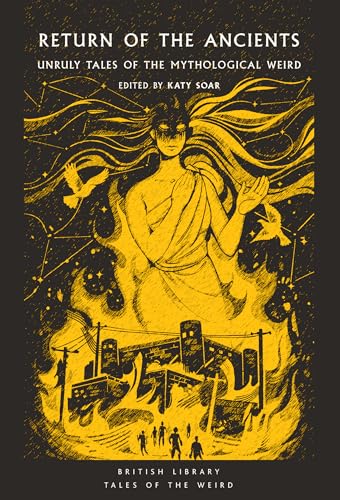
A goddess incarnate drives her worshipper to a glorious destruction in 1880s Italy. Archaeologists in 1940s Persia discover a maddening secret in Tiamat’s tomb. In 1990s Britain, an avowed sceptic is lured into a bloody initiation to the cult of Mithras.
Ancient tales of mythical gods and monsters are embedded deep in the world’s cultures, and as weird fiction developed, a haunting sub-genre emerged in which these eternal beings – and their power to wreak havoc and enthral mortals – remained alive in sacred ruins, cursed relics and the hushed whispers of their followers.
Delving into the rich lore of Greek, British, Norse and Egyptian myth and through lost pantheons from Carthage to Mesoamerica, Katy Soar has unearthed fourteen strange stories of beasts and deities tyrannizing the modern world. Offering classics and rare finds by Stephen Baxter, John Wyndham, Flavia Richardson and more, this collection also includes notes on the mythical figures of each tale.
Dare I say, every story hit in this one? Definitely a top 5 entry in the series for me.
There was a really food mix of deities - Greco-Roman, Egyptian, from the British Isles, etc. - and a variety of settings and tones. This helped keep up the pace of the collection and brings something for every reader.
Favourite stories: "Dionea" by Vernon Lee, "The Wind in the Portico" by R. Ellis Roberts, "The Veil of Tanit" by Eugene de Rezske, "The Face in the Wind" by Carl Jacobi, "Above Ker-Is" by Evangeline Walton, and "Justice Tresilian in the Tower" by Ken Alden
A fun and creepy collection of stories. Pretty much every story hit. Varying from the spooky (The Owl), to the funny (More Spinned Against).
The standout stories for me were: 'The Owl' F. A.M. Webster:- Simeon is just a freaky dude who likes owls a bit too much. He'd have loved ConFuzzled. Genuinely maybe the scariest scenario to be in? 'Pussy' Flavia Richardson: The idea of being stuck in a room while a cat statue messes with you sound fun, apparently not. If he'd had Dreamies it would have ended differently. 'The Veil of Tanit' Eugene De Rezske: Obsessed with Mr Smith's "Fuck it" attitude. If you too, are bored with your life, just get involved in a ancient cult. 'More Spinned Against...' John Wyndham: Such a fun little story. The whole time I assumed Lydia would be stuck as a spider so when Arachne kept her word I was shocked. Loved the ending, great twist. 'Above Ker-Is' Evangeline Walton: The uncertainty around Guennole's crime (or not) was fab and I loved the Ker-Is mentions!
As always with the Tales of the Weird collection, a very entertaining and stylistically diverse anthology of weird encounters with long forgotten gods or godlike beings you better not mess with. Vernon Lee's Dioneia is a bit of an outlier, because of its highly literary style, especially the superb descriptions of landscape and atmosphere. (I've read the eBook version.)
Now this is a fantastic and entertaining little anthology with nearly no duds. Great and diverse selection of pantheons and mythologies. The stories within:
‘Dionea’ Vernon Lee: The anthology starts off with a solid but subdued tale. ‘The Ring’ Thomas Graham Jackson: Now this shows the dangers by ‘The Great Mother’ R. Ellis Roberts: Probably the weakest story in the anthology (for me). ‘The Wind in the Portico’ John Buchan: Great tale from Buchan. Glad I have his collection next in my to-read pile! ‘The Owl’ F. A.M. Webster: There is something unsettling with this story. The way Stroud is described, and his general mannerisms are just off-putting. Good creepy tale! ‘Pussy’ Flavia Richardson: Gotta love Egyptian mythology. Beware of the cat! ‘The Veil of Tanit’ Eugene De Rezske: Best example of the old saying “The clothes maketh the man”! ‘The Face in the Wind’ Carl Jacobi: Shows the importance of fixing broken walls on your property! ‘Serpent Princess’ Edmond Hamilton: nice Lovecraftian feel to this one! ‘More Spinned Against….’ John Wyndham: Now this was a fun one! ‘Above Ker-Is’ Evangeline Walton: Not much to say besides that this was another solid story! ‘Justice Tresilian in the Tower’ Ken Alden: This one was a bit discombobulated for me, slightly confused in the end. ‘Family History’ Stephen Baxter: Maybe the grittiest of all the tales but also maybe the tensest one too. ‘The House of Fenris’ John Cooling: Moral of the story “be careful where you build your house”. Great finisher!
This made me want to read more of Tales of the weird from British Library. So that’s what I am going to do!
La mayoría de los cuentos aquí incluidos me gustaron bastante y me encantó ver cómo retomaban o reimaginaban la mitología y los dioses antiguos. Mis cuentos favoritos fueron Dionea de Vernon Lee (pffft, cualquier cosa de esta autora es 100/10, pero éste particularmente me gusta por todas las referencias Grecia y Roma) y The Wind in the Portico de John Buchan (su estilo y trama me recordaron, a un tiempo, a M.R. James y a Borges <3, además, también hubo mucha cosa clásica). Otros que disfruté porque me parecieron entretenidos, irónicos o sorprendentes fueron The Ring de Thomas Graham Jackson (sé nada de mitología etrusca y el final me pareció irónico); Pussy de Flavia Richardson (me encantaron las referencias a las canciones egipcias y la aparición del gatito de la posada); The Veil of Tanit de Eugene de Rezske (me hizo caer en un rabit hole sobre diosas del antiguo este próximo, el cuento es muy entretenido a pesar de ser extenso y, de nuevo, el final súper irónico, 10/10); y More Spinned Against... de John Wyndham (sorprendentemente humorístico y con un final gracioso y oscuro, me gustó mucho a pesar de hablar sobre arañas). Mención especial a Above Ker-Is de Evangeline Walton por tratar sobre mitología/folclore bretón del que, de nuevo, no sabía nada, pero me interesó mucho (gods know i'm a sucker for minorised languages) y The Face in the Wind de Carl Jacobi, que me entretuvo mucho, se lee muy rápido y es trepidante, pero no me acabó de encantar su representación/inserción del elemento mitológico. Ahora, dos relatos que no me gustaron para nada: The Owl de F.A.M. Webster (además de que hace mala propaganda de mis congéneres los búhos, su «representación» de las culturas latinoamericanas y sus mitologías —que parece que ni siquiera investigó bien, pues las trata todas como si fueran un grupo homogéneo— me pareció súper racista) y Family History de Stephen Baxter (el protagonista piensa repetidamente en violar a una adolescente y, aunque el relato no lo condona, sino que presenta a este personaje como una persona reprobable en más de un aspecto, me incomodó mucho leer eso, además de que el cuento me pareció mñeh, le faltó). Los otros cuatro cuentos que no mencioné, me dieron un poco igual, principalmente porque sentí que les faltó espacio para desarrollarse de manera satisfactoria (Justice Tresilian in the Tower de Ken Alden y, sobre todo, The House of Fenris de John Cooling) o porque no me entretuvieron ni me dejaron pensando en ellos (The Great Mother de R. Ellis Roberts y Serpent Princess de Edmond Hamilton).
Picked this one up after really enjoying Soar's earlier editorial effort on Circles of Stone, and while I'm glad to say that it's similarly well edited (having the mythological context for each story in an appendix at the end so as not to spoil them is an excellent way of doing it), I wasn't as much of a fan of the actual stories.
In a lot of ghost stories/weird tales/whatever you want to call them, the return of something from the past can generate an effective sense of the eerie/weird/uncanny (don't @me Mark Fisher). See for instance pretty much anything M. R. James ever did. Yet by having the thing that returns ultimately be a known mythological entity, I think you lose a lot of the inexplicability, mystery, and vagueness that make the best of these sorts of stories so effective. By putting a name and a face to the supernatural incursion into modernity, it becomes explicable, even controllable (see The House of Fenris in this collection: once the unsettling visions are properly identified, they are relatively easily dealt with). This is perhaps part of why modern works playing in Lovecraft’s sandbox do so little for me. As soon as Cthulhu and company show up all sense of mystery and the unknowable evaporates entirely: turns out it wasn’t some inconceivable entity, it was Blorbo. From your shows.
The best stories in the collection get around this in one way or another. For me the absolute highlight was Wyndham’s More Spinned Against, which is excellent and silly in equal measure, but at no point tries to be particularly unsettling. Vernon Lee’s Dionea keeps things vague enough in the narrative that nothing ever feels particularly explicable and really makes the most of the epistolary format. Similarly, The Wind in the Portico and The Face in the Wind are relatively enigmatic, and though the latter drops the pretence and gets quite pulpy towards the end, they both leave enough unsaid to stay at least a little bit eerie. I also enjoyed Serpent Princess (honestly a better Lovecraft story than any of the actual Lovecraft I’ve read so far) and Above Ker Is (don’t trust watery ladies!).
The only massive dud for me was The Owl which to me felt like everything bad about pulp adventure fiction rolled into one, but also wasn’t a huge fan of The Ring (sub-M.R. James but not in a fun way) or Family History (solid idea, and I’m a sucker for a Mithraeum, but I couldn’t stand the writing style).
"They have queer names in those parts, and other things queerer than the names"
Very nice collection. Have usually enjoyed the references to (directly or indirectly) ancient history in weird horror. These stories were all new to me, varied in style and all enjoyable.
Some of the stories that stood out most were:
The Great Mother: Mostly for the final or most climactic scene which features some great imagery of grass being trampled by invisible feet.
The Veil of Tanit: Loved the theme of someone who is terrified of what he has done coming back to haunt him, and who has lived such a boring life that he seeks out his own destruction. Cool little details like the idea of different kinds of tans and recognising a fellow traveller to the desert.
The Face in the Wind: Probably my favourite of the collection. Great plot well told. Loved the art theme and the way that the history of the place and its powerful architecture is hinted at. Never heard of multiple bibles being encased within a building to protect it, thought this was cool. Good amount of action and unpredictable plot.
More Spinned Against: A silly comedic story from the great John Wyndham. Enjoyable and refreshing read.
Above Ker-Is: Loved the writing style here and the framing as a confession to a priest.
Quotes I liked: - "What he really wanted was magic... I have often wondered whether official Christianity... is not too hard on those who need magic" - "In all my life, until that time, nothing had happened to me. Nothing had even come near to happening to me. Absolutely nothing" - "The feeling of some vast inhuman mind also persisted"
Part of the British Library Tales of the Weird series, collecting long-neglected short stories, this anthology has ancient mythological powers clashing with the modern world. Featuring gods and monsters from the pantheons of the Greeks, Romans, Carthaginians, Norse, Etruscans, Aztecs, Celts, Egyptians, Babylonians and Bretons.
The styles and tones of the stories in this book vary wildly, thematically similar to the great variety of mythologies that are tapped into here. However, that variation meant that, more than any of the other '...Tales of the Weird' book I've read so far, this book had the biggest gulfs for me in the enjoyability of the stories themselves. It didn't help that my least favourite of all those on offer here was the very first one, Vernon Lee's 'Dionea', which felt ponderous and self-indulgent.
However, the stuff that is good here is very good and most of the stories do a brilliant job of showing ordinary men and women far out of their depths when confronted with the ancient and often malignant powers of the pre-Christian gods. It was that sense of mystery, age and unknowable power that gave the book as a whole a somewhat Lovecraftian feel.
So, whilst they're not all winners, the book as a whole comes together nicely and is a very enjoyable read, particularly for someone like me, who has a life-long fascination with mythology.
Probably the best yet of the many short story anthologies that the British Library have published.
Editor Katy Soar has an excellent nose for a good story, there’s variety and lots of lesser known authors are featured, rather than the usual suspects.
The stories themselves range from a whimsical tale with a twist from John Wyndham to Rider Haggard style adventure stories set in far distant lands. Featured mythology has a fair sprinkling of British/Celtic with appearances from Etruscan, Babylonian and Aztec as well as the more familiar Greek and Egyptian myths. There’s a handy summary at the back of the book of the various belief systems.
The stories progress through the years, from the late nineteenth century to the early twenty-first. None of them really stands out as memorable or ground-breaking, yet when read in sequence they provide an interesting insight into the development of the medium. For example, the use of framing devices changes quite dramatically, as does the pacing and denouement of the tales. Given the nature of a colelction drawing from the British Library, this seems weirdly appropriate.
Another excellent set of short stories under the banner of British Library of the Weird. Return of the Ancients was very very good. I had never come across any of the stories within its covers. Stand out stories for me were, The Owl by F.A.M. Webster, Pussy by Flavia Richardson, More Spinned Against by John Wyndham, and The Face in the Wind by Carl Jacobi. But all stories were very good. 10/10.