

What do you think?

ערבסקות
"Arabesques is a classic of the exploration of identity. . . . A Palestinian master of Hebrew, living at the seam between Jews and Arabs, between the ancient and the modern, between loyalties and appetites, Shammas has written beautifully about his search for design. He transforms fact into fantasy without changing a thing."-Leon Wieseltier
"This book is a history of its author's youth and the memoir of a family and a fabled region-Galilee. . . . A beautifully impressive piece of prose." (William H. Gass, New York Times Book Review)
"Arabesques really brings, as novels were once supposed to bring, 'news' from elsewhere. . . . This book has already added something notable to Israeli literature." (Irving Howe, New York Review of Books )
"If Hebrew literature is at all destined to have its Conrads, Nabokovs, Becketts and Ionescos, it could not have hoped for a more auspicious beginning." (Muhammed Siddiq, Los Angeles Times Book Review)
"Intricately conceived and beautifully written. . . . A crisp, luminous, and nervy mixture of fantasy and autobiography. . . [and] an elegant example of postmodern baroque." (John Updike, The New Yorker)
Author Biography: Anton Shammas is Professor of Near Eastern Studies and Comparative Literature at the University of Michigan.
238 pages, Hardcover
First published April 1, 1986
Ratings & Reviews
Friends & Following
Create a free account to discover what your friends think of this book!
Community Reviews
Displaying 1 - 30 of 78 reviews

December 28, 2018
IN TRE LINGUE: EBRAICO, ARABO E MORTE

Dia al Azzawi: Il massacro di Sabra e Shatila, (1982–3). La foto di un uomo in bicicletta che nel campo di Sabra guarda due cadaveri è immagine che si ripete nel romanzo.
Shammas descrive spesso la polvere di quella terra (Alta Galilea, vicino al confine col Libano) che si posa su tutto, cose animali ed esseri umani, tutto copre e riveste con indifferente senso di giustizia: così usa la sua ironia, mai greve, mai forzata, a modellare il racconto.

Si parla molto anche del romanzo di Willa Cather “My Ántonia” (1918). Qui, Andrew Wyeth: Christina’s World, 1948. Il quadro è stato usato spesso come copertina del romanzo della Cather.
Racconto che odora di olio d’oliva, per le descrizioni di frantoio e mole che macinano e bestie da soma che fanno girare le pietre e liquido oleoso che si sprigiona. Nel quale si intinge il pane (qui sempre chiamato focaccia), descritto in tutto il processo di nascita: le palline di lievito madre appese all’aperto che diventano matrice per tutto l’anno, le mani che impastano e stendono la pasta, il forno.
Sul forno si arrostiscono anche i fichi e la descrizione di come si aprono al calore e come sgorga il liquido trasmette libidine.
Si coltiva il tabacco, lo si sistema negli stenditoi, i contrabbandieri lo smerciano in Libano.
Nell’olio d’oliva, oltre che insaporire il pane, si guarda il futuro, si vedono presagi.

Torna alla mente “Incendies” di Wajdi Mouawad, 2003, diventato film diretto da Denis Villeneuve, in Italia col titolo “La donna che canta”.
Pratiche che portano fuori dal tempo come certi rituali della campagna.
Come misurare la distanza a “tiro di sasso”.
Come le case costruite con la “porta del segreto”, l’uscita posteriore delle case arabe, una specie di finestra bassa priva di sbarre dalla quale si poteva fuggire all’esterno in caso di pericolo.
Come la Palestina, la Terra Santa, terra su cui piove pochissima acqua ma molto sangue.
Tuttavia Shammas si astiene da commenti sulla situazione politica, soprattutto trattiene qualsiasi parola di rimprovero o d’odio, qualsiasi giudizio.
Alcune perle che voglio ricordare:
Giryes era il solo dei sei figli – maschi e femmine – ad aver ereditato quella che la nonna chiamava la corrente d’aria nel cervello degli Shammas. Fu sicuramente a causa di questa corrente d’aria nel cervello che decise di partire per l’Argentina, dalla quale non fece mai ritorno. La madre non voleva farlo partire, e tentò di commuoverlo ricordandogli quanto aveva sofferto per nutrirlo al seno, latte andato sprecato se lui partiva. Per tutta risposta Giryes stabilì la quantità esatta di latte che le aveva succhiato e, a furia di calcoli, arrivò alla conclusione che doveva corrispondere al contenuto di due bidoni. Una settimana prima della partenza per l’Argentina si recò al villaggio portandosi dietro l’asino e fece ritorno a casa con due bidoni di latte che consegnò alla madre.
Scriveva lettere, tutte, ma proprio tutte, concluse come segue: Se poi qualcuno sosterrà di non aver ricevuto i miei saluti, gliene mando mille e uno.
Ilas neppure lui venne meno alla tradizione familiare e, con l’età, perdette l’uso della ragione: ragion per cui lo si vedeva correre nudo nel villaggio o portare fuori il suo materasso nella via principale e prenderlo a sassate, accusandolo del tempo che sprecava nel sonno.
Al cimitero di Père-Lachaise nella sezione 85 è sepolto Mahumud el Hamshari nato in Palestina il 29 agosto 1939, ucciso a Parigi il 9 gennaio 1973. Era rappresentante dell’OLP. È sepolto sotto una grande lastra di marmo nero opera della ditta Lecreux Frères. Una decina di tombe più in là, sull’altro lato di una siepe, riposa Marcel Proust, in una tomba quasi identica, stessa lastra di marmo nero opera della ditta Lecreux Frères. Da una parte l’uomo della patria perduta, dall’altro quello del tempo perduto: l’Ebreo del Tempo e l’Arabo del Luogo riposano vicini in due tombe quasi identiche.

Shammas sembra voler disegnare un memoir. Ma presto divaga nel ricordo e vaga nel tempo e nello spazio geografico, mescola prima e terza persona, confonde racconto e narratore, eccede in struttura, intreccia le linee del parentado e tra zii cugini nipoti cognati genitori figli suoceri è facile smarrirsi, intreccia realtà a mondo magico e leggenda, ricordo a immaginazione, complica la vita del lettore tra agnizioni ed epifanie.
Per una storia è assai meglio non essere raccontata. Perché, una volta che lo sia stata, altro non è che un piccolo sportello aperto in un grande portone.
Così dunque, da una storia apparentemente finita veniva fuori all’improvviso un filo capriccioso che la portava verso territori insospettati.
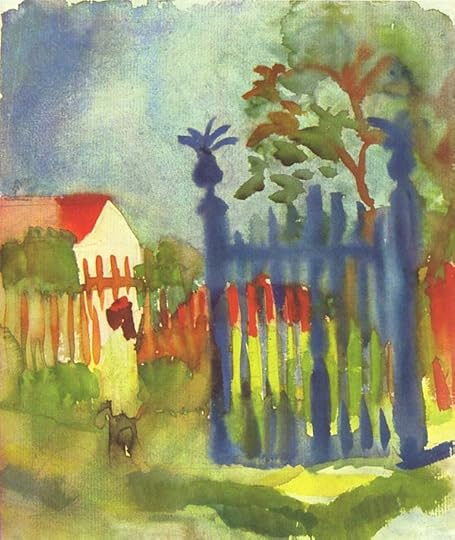
August Macke: Gartentor, 1914. Il dipinto è usato sulla copertina dell’edizione italiana.
Però, in fondo, lo dichiara sin dal titolo, si tratta di arabeschi. Incastri d’immagini. Dentro e fuori la terra contesa.
PS
Anton Shammas, nato nel 1950, è arabo cattolico più israeliano che palestinese, scrive in ebraico, è tradotto in inglese, francese, tedesco e italiano ma non in arabo. Vive ormai da tempo in USA, dove insegna, senza scrivere più né in arabo né in ebraico.

Arabeschi dell’Alhambra di Granada in Spagna.
Dia al Azzawi: Il massacro di Sabra e Shatila, (1982–3). La foto di un uomo in bicicletta che nel campo di Sabra guarda due cadaveri è immagine che si ripete nel romanzo.
Shammas descrive spesso la polvere di quella terra (Alta Galilea, vicino al confine col Libano) che si posa su tutto, cose animali ed esseri umani, tutto copre e riveste con indifferente senso di giustizia: così usa la sua ironia, mai greve, mai forzata, a modellare il racconto.
Si parla molto anche del romanzo di Willa Cather “My Ántonia” (1918). Qui, Andrew Wyeth: Christina’s World, 1948. Il quadro è stato usato spesso come copertina del romanzo della Cather.
Racconto che odora di olio d’oliva, per le descrizioni di frantoio e mole che macinano e bestie da soma che fanno girare le pietre e liquido oleoso che si sprigiona. Nel quale si intinge il pane (qui sempre chiamato focaccia), descritto in tutto il processo di nascita: le palline di lievito madre appese all’aperto che diventano matrice per tutto l’anno, le mani che impastano e stendono la pasta, il forno.
Sul forno si arrostiscono anche i fichi e la descrizione di come si aprono al calore e come sgorga il liquido trasmette libidine.
Si coltiva il tabacco, lo si sistema negli stenditoi, i contrabbandieri lo smerciano in Libano.
Nell’olio d’oliva, oltre che insaporire il pane, si guarda il futuro, si vedono presagi.
Torna alla mente “Incendies” di Wajdi Mouawad, 2003, diventato film diretto da Denis Villeneuve, in Italia col titolo “La donna che canta”.
Pratiche che portano fuori dal tempo come certi rituali della campagna.
Come misurare la distanza a “tiro di sasso”.
Come le case costruite con la “porta del segreto”, l’uscita posteriore delle case arabe, una specie di finestra bassa priva di sbarre dalla quale si poteva fuggire all’esterno in caso di pericolo.
Come la Palestina, la Terra Santa, terra su cui piove pochissima acqua ma molto sangue.
Tuttavia Shammas si astiene da commenti sulla situazione politica, soprattutto trattiene qualsiasi parola di rimprovero o d’odio, qualsiasi giudizio.
Alcune perle che voglio ricordare:
Giryes era il solo dei sei figli – maschi e femmine – ad aver ereditato quella che la nonna chiamava la corrente d’aria nel cervello degli Shammas. Fu sicuramente a causa di questa corrente d’aria nel cervello che decise di partire per l’Argentina, dalla quale non fece mai ritorno. La madre non voleva farlo partire, e tentò di commuoverlo ricordandogli quanto aveva sofferto per nutrirlo al seno, latte andato sprecato se lui partiva. Per tutta risposta Giryes stabilì la quantità esatta di latte che le aveva succhiato e, a furia di calcoli, arrivò alla conclusione che doveva corrispondere al contenuto di due bidoni. Una settimana prima della partenza per l’Argentina si recò al villaggio portandosi dietro l’asino e fece ritorno a casa con due bidoni di latte che consegnò alla madre.
Scriveva lettere, tutte, ma proprio tutte, concluse come segue: Se poi qualcuno sosterrà di non aver ricevuto i miei saluti, gliene mando mille e uno.
Ilas neppure lui venne meno alla tradizione familiare e, con l’età, perdette l’uso della ragione: ragion per cui lo si vedeva correre nudo nel villaggio o portare fuori il suo materasso nella via principale e prenderlo a sassate, accusandolo del tempo che sprecava nel sonno.
Al cimitero di Père-Lachaise nella sezione 85 è sepolto Mahumud el Hamshari nato in Palestina il 29 agosto 1939, ucciso a Parigi il 9 gennaio 1973. Era rappresentante dell’OLP. È sepolto sotto una grande lastra di marmo nero opera della ditta Lecreux Frères. Una decina di tombe più in là, sull’altro lato di una siepe, riposa Marcel Proust, in una tomba quasi identica, stessa lastra di marmo nero opera della ditta Lecreux Frères. Da una parte l’uomo della patria perduta, dall’altro quello del tempo perduto: l’Ebreo del Tempo e l’Arabo del Luogo riposano vicini in due tombe quasi identiche.
Shammas sembra voler disegnare un memoir. Ma presto divaga nel ricordo e vaga nel tempo e nello spazio geografico, mescola prima e terza persona, confonde racconto e narratore, eccede in struttura, intreccia le linee del parentado e tra zii cugini nipoti cognati genitori figli suoceri è facile smarrirsi, intreccia realtà a mondo magico e leggenda, ricordo a immaginazione, complica la vita del lettore tra agnizioni ed epifanie.
Per una storia è assai meglio non essere raccontata. Perché, una volta che lo sia stata, altro non è che un piccolo sportello aperto in un grande portone.
Così dunque, da una storia apparentemente finita veniva fuori all’improvviso un filo capriccioso che la portava verso territori insospettati.
August Macke: Gartentor, 1914. Il dipinto è usato sulla copertina dell’edizione italiana.
Però, in fondo, lo dichiara sin dal titolo, si tratta di arabeschi. Incastri d’immagini. Dentro e fuori la terra contesa.
PS
Anton Shammas, nato nel 1950, è arabo cattolico più israeliano che palestinese, scrive in ebraico, è tradotto in inglese, francese, tedesco e italiano ma non in arabo. Vive ormai da tempo in USA, dove insegna, senza scrivere più né in arabo né in ebraico.
Arabeschi dell’Alhambra di Granada in Spagna.

January 4, 2017
An unusual book by an unusual author. When published in 1988, it was reviewed on the front page of The New York Times Book Review and that publication later chose it as one of the seven best works of fiction for that year.
The blurbs tell us that the book is the first publication written in Hebrew by an Arab (Palestinian) author. The author, now a professor at the University of Michigan, was educated at the Hebrew University of Jerusalem and later participated in the Iowa Writers’ Workshop.
There isn’t a lot of plot. The narrative starts with his parents back in 1938 and is basically a quasi-autobiographical coming of age story interspersed with the story of a young man returning home to interview relatives to find out the true stories of his complex upbringing -- a Palestinian father and a Lebanese Arabic (but Catholic) mother. There’s a story among the relatives and neighbors that in the hospital at the time of his birth, one couple lost their baby and the nurses switched another baby to give to them. Was that him?
Despite their Catholicism, the family is Arab and some of the story narrates the family’s displacement from their home by the Israeli authorities (they had “no papers”). Thus the desire to return home becomes an overriding theme in their lives. His mother had been displaced within Palestine and then from Israel to Jordan. Her parents were killed and no relatives could afford to take her in so she was farmed out as a servant at an early age. We read of injustices when Israeli soldiers broke into their homes and dumped their only valuable possessions (flour and olive oil) onto the floor … just because.

Times are tough. These are folks who cook on stoves fueled by twigs and gather all household water in cisterns. We read of puppy love and pranks by boys with bullets and learning about the birds and bees by spying on adults. These are folks who believe in amulets and curses. We learn some of their sayings: “When the camel’s gone, there’s no use crying over the reins.” “It is better for a story not to be told, for once it is, it is like a gate that has been left ajar.”
This is the Holy Land so a continuous theme is war, destruction and displacement “Our village is built on the ruins of the Crusader castle of Fassove, which was built on the ruins of Mifshata, the Jewish village that had been built after the destruction of the Second Temple by the Harim.” What else is new?
Not an easy read – there were times I had to re-read passages to figure out what was going on – but a worthwhile read.
The blurbs tell us that the book is the first publication written in Hebrew by an Arab (Palestinian) author. The author, now a professor at the University of Michigan, was educated at the Hebrew University of Jerusalem and later participated in the Iowa Writers’ Workshop.
There isn’t a lot of plot. The narrative starts with his parents back in 1938 and is basically a quasi-autobiographical coming of age story interspersed with the story of a young man returning home to interview relatives to find out the true stories of his complex upbringing -- a Palestinian father and a Lebanese Arabic (but Catholic) mother. There’s a story among the relatives and neighbors that in the hospital at the time of his birth, one couple lost their baby and the nurses switched another baby to give to them. Was that him?
Despite their Catholicism, the family is Arab and some of the story narrates the family’s displacement from their home by the Israeli authorities (they had “no papers”). Thus the desire to return home becomes an overriding theme in their lives. His mother had been displaced within Palestine and then from Israel to Jordan. Her parents were killed and no relatives could afford to take her in so she was farmed out as a servant at an early age. We read of injustices when Israeli soldiers broke into their homes and dumped their only valuable possessions (flour and olive oil) onto the floor … just because.
Times are tough. These are folks who cook on stoves fueled by twigs and gather all household water in cisterns. We read of puppy love and pranks by boys with bullets and learning about the birds and bees by spying on adults. These are folks who believe in amulets and curses. We learn some of their sayings: “When the camel’s gone, there’s no use crying over the reins.” “It is better for a story not to be told, for once it is, it is like a gate that has been left ajar.”
This is the Holy Land so a continuous theme is war, destruction and displacement “Our village is built on the ruins of the Crusader castle of Fassove, which was built on the ruins of Mifshata, the Jewish village that had been built after the destruction of the Second Temple by the Harim.” What else is new?
Not an easy read – there were times I had to re-read passages to figure out what was going on – but a worthwhile read.

April 1, 2023
It is astounding how deftly Anton Shammas translates the form of arabesque into the language of literature. The way he tells the history of his Palestinian family resembles an arabesque indeed, with its complexity, swiftly spiralling motifs, interlacing stories within stories and the swirling structure. Besides, arabesques are seamless and neverending — so is this labyrinthine novel with its open structure.
Besides, arabesques are mentioned a few times in the book, for instance: Uncle Yusef, in his great cunning, gives me a tiny key to use to find my way through the winding chambers of the arabesque, where I stand at the gate, ajar, behind which lies another story that will invent itself in a different way. The author delves into the philosophical aspect of arabesques also — the narrator’s life is compared to this form of artistic oriental decoration: Now that my life has followed the course of this winding arabesque, I find myself once more at the place where I started. There are many more recurring symbolic images in Arabesques (1986), subtly interwoven into the story, for instance, smoke.
Arabesque is also a ballet position in which the dancer stands on one foot and holds one arm forward while the other arm and leg are held out behind. I have the impression this is reflected in the novel too: the narrator is reaching back to the past, grappling with the memories of a few generations of his ancestors, and forward at the same time. A part of his book deals with history (The Tale) but there is also an account of what is happening now (The Teller). To be honest, I found the narrator's current adventures at the International Writing Program retreat much less engaging than the family saga.
There is also a metafiction undercurrent plus many literary references. Anton Shammas's book oftentimes feels like a delicious, baffling mixture of A Thousand and One Nights, Borges and Proust. In Arabesques not cookies but plants frequently trigger memories and evoke forgotten emotions, for example, flowers of yellow calycanthus or olive husks: I see myself at the entrance to the olive press. I can smell the olive husks from the distance of many years. It is a thick smell that warmly embraces your senses and then withdraws when a breeze blows touched with the edge of autumn. There are so many voluptuous descriptions in Arabesques which immediately engage all your senses. Thanks to Maryana’s brilliant comment I realized that arabesque is also a music term, referring to a meandering intricate melody built around circling phrases. This novel is exactly like that!
In the beginning, Anton Shammas declares: I’ll write about the loneliness of the Palestinian Arab Israeli, which is the greatest loneliness of all. He keeps his promise. His novel is a story of futile efforts to belong while being always 'the other', 'the foreigner', always in between: countries, religions, cultures. Even the words Palestinian Arab Israeli sound like a farfetched oxymoron but this is exactly who the narrator and his ancestors were.
Despite the many strengths of this novel — and I have only discussed the ones which especially stand out in my view — it was not a reading experience I am likely to repeat. As I tend to be a capricious reader and may change my mind, a note to self, just in case: draw the family tree while reading. The number of characters in this book is overwhelming and the constant feeling of befuddlement was irksome and frustrating in the long run. Just to give you an idea: five different characters are called Anton Shammas. I hoped Afterword by Elias Khoury would be helpful but besides admitting he felt confused also and discreetly promoting his own book he did not offer much enlightenment. I am aware that this is a labyrinthine novel and my feeling of being lost was exactly what the author was aiming at but it annoyed me anyway. I enjoyed and appreciated Arabesques but it is rather love out of convenience, not spontaneous, passionate enchantment.
Anton Shammas's novel is truly impressive in scope and structure. The information that the afterword was originally written for a conference on Arabesques at the University of Michigan in 2010 startled me a bit at first. The whole conference devoted solely to one obscure book? After having read this multilayered, ambitious, kaleidoscopic novel, which can be approached from so many angles, I am no longer surprised.
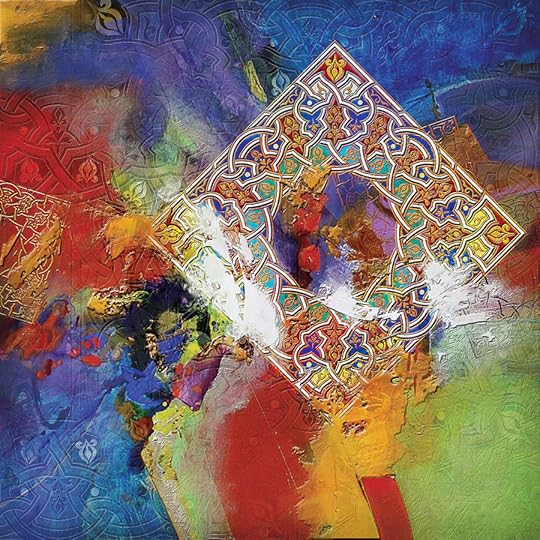
Arabesque 11, painting by Shah Nawaz.
Besides, arabesques are mentioned a few times in the book, for instance: Uncle Yusef, in his great cunning, gives me a tiny key to use to find my way through the winding chambers of the arabesque, where I stand at the gate, ajar, behind which lies another story that will invent itself in a different way. The author delves into the philosophical aspect of arabesques also — the narrator’s life is compared to this form of artistic oriental decoration: Now that my life has followed the course of this winding arabesque, I find myself once more at the place where I started. There are many more recurring symbolic images in Arabesques (1986), subtly interwoven into the story, for instance, smoke.
Arabesque is also a ballet position in which the dancer stands on one foot and holds one arm forward while the other arm and leg are held out behind. I have the impression this is reflected in the novel too: the narrator is reaching back to the past, grappling with the memories of a few generations of his ancestors, and forward at the same time. A part of his book deals with history (The Tale) but there is also an account of what is happening now (The Teller). To be honest, I found the narrator's current adventures at the International Writing Program retreat much less engaging than the family saga.
There is also a metafiction undercurrent plus many literary references. Anton Shammas's book oftentimes feels like a delicious, baffling mixture of A Thousand and One Nights, Borges and Proust. In Arabesques not cookies but plants frequently trigger memories and evoke forgotten emotions, for example, flowers of yellow calycanthus or olive husks: I see myself at the entrance to the olive press. I can smell the olive husks from the distance of many years. It is a thick smell that warmly embraces your senses and then withdraws when a breeze blows touched with the edge of autumn. There are so many voluptuous descriptions in Arabesques which immediately engage all your senses. Thanks to Maryana’s brilliant comment I realized that arabesque is also a music term, referring to a meandering intricate melody built around circling phrases. This novel is exactly like that!
In the beginning, Anton Shammas declares: I’ll write about the loneliness of the Palestinian Arab Israeli, which is the greatest loneliness of all. He keeps his promise. His novel is a story of futile efforts to belong while being always 'the other', 'the foreigner', always in between: countries, religions, cultures. Even the words Palestinian Arab Israeli sound like a farfetched oxymoron but this is exactly who the narrator and his ancestors were.
Despite the many strengths of this novel — and I have only discussed the ones which especially stand out in my view — it was not a reading experience I am likely to repeat. As I tend to be a capricious reader and may change my mind, a note to self, just in case: draw the family tree while reading. The number of characters in this book is overwhelming and the constant feeling of befuddlement was irksome and frustrating in the long run. Just to give you an idea: five different characters are called Anton Shammas. I hoped Afterword by Elias Khoury would be helpful but besides admitting he felt confused also and discreetly promoting his own book he did not offer much enlightenment. I am aware that this is a labyrinthine novel and my feeling of being lost was exactly what the author was aiming at but it annoyed me anyway. I enjoyed and appreciated Arabesques but it is rather love out of convenience, not spontaneous, passionate enchantment.
Anton Shammas's novel is truly impressive in scope and structure. The information that the afterword was originally written for a conference on Arabesques at the University of Michigan in 2010 startled me a bit at first. The whole conference devoted solely to one obscure book? After having read this multilayered, ambitious, kaleidoscopic novel, which can be approached from so many angles, I am no longer surprised.
Arabesque 11, painting by Shah Nawaz.
May 9, 2024
I usually forget epigraphs immediately after reading them but in this case it created a puzzle that tugged at me throughout the text: “Most novels are disguised autobiographies. This autobiography is a disguised novel.” (Clive James). Even now, at the end, I’m not quite sure what it means. My brain refused to grasp the concept of “disguised novel.” But it’s clearly an exceptionally apt epigraph for setting up a book that is part atemporal memoir of village life, and part metaliterary novel indelibly tied to the moment it was written (published in 1986). This strange layering of the classic with the postmodern reminded me of Grendel; in fact, you could probably write an essay about the monstrous referencing both of them, but there similarities end).
Anton Shammas is a Christian Palestinian citizen of Israel who writes in Hebrew, a language he learned at the age of twelve. He is also referred to at points in the text as “an educated Arab” which he denies, claiming to be “just another intellectual.” His apparent aim is to tell stories from his village of Fassuta, about his father, mother, various aunts and uncles, an earlier deceased child also named Anton Shammas, various maids who end up working in Beirut, emigrants to Buenos Aires, an American doctor — and then, moving the story surprisingly out of the realm it seems to belong in, about a group of international writers in the Iowa creative writing program.
There are different interesting structural things going on. One is the way Shammas tries to reproduce the Arabesque on the page. Each chapter set in the village follows its own peculiar logic, with one anecdote leading to another, themes looping back or curling off in unexpected directions, jumping backwards or forwards in time following a dominant theme, but always returning, to some degree, to its point of departure. I am a big geek for structural repetitions and stories with narrative loops, so these chapters were immensely satisfying.
Shammas lulls the reader into this with a whole run of such chapters at the beginning. This is “The Tale.”
Then come interspersed chapters of “The Teller.” These are set during a layover in Paris and some months in Iowa, where we don’t see Shammas writing much but presumably he is creating what will become this book, while also trying to avoid being used as a subject by an Israeli writer on the program (who in any case dumps him for a more conventional Palestinian). Between the two sections of the story, another mystery is being slowly unwound — what happened to the original Anton Shammas, the dead child?
While “The Teller” chapters undoubtedly give the book some of its tricksy intellectual richness, they feel a little dated, a few too many postmodern layers and flourishes. I was a little impatient with them. And yet, they are thematically apt.
There is a “twist” of sorts at the end that my first instinct was to dismiss. The afterword to my edition, by Lebanese writer Elias Khoury, helped me see it in quite another light.
Arabesques is both a simple book and a complex one. Reams could no doubt be written at what it obliquely says (see for example this wonderful essay in The Yale Review), and also about which literary traditions it fits into, yet most of the tales told within are simple, recognizable vignettes of village life: cleaning a well, making olive oil, moments of sexual awakening. Undeniably fascinating and slippery, and also undeniably well written.
And one of a kind. Shammas has written no other novels since.
Anton Shammas is a Christian Palestinian citizen of Israel who writes in Hebrew, a language he learned at the age of twelve. He is also referred to at points in the text as “an educated Arab” which he denies, claiming to be “just another intellectual.” His apparent aim is to tell stories from his village of Fassuta, about his father, mother, various aunts and uncles, an earlier deceased child also named Anton Shammas, various maids who end up working in Beirut, emigrants to Buenos Aires, an American doctor — and then, moving the story surprisingly out of the realm it seems to belong in, about a group of international writers in the Iowa creative writing program.
There are different interesting structural things going on. One is the way Shammas tries to reproduce the Arabesque on the page. Each chapter set in the village follows its own peculiar logic, with one anecdote leading to another, themes looping back or curling off in unexpected directions, jumping backwards or forwards in time following a dominant theme, but always returning, to some degree, to its point of departure. I am a big geek for structural repetitions and stories with narrative loops, so these chapters were immensely satisfying.
Shammas lulls the reader into this with a whole run of such chapters at the beginning. This is “The Tale.”
Then come interspersed chapters of “The Teller.” These are set during a layover in Paris and some months in Iowa, where we don’t see Shammas writing much but presumably he is creating what will become this book, while also trying to avoid being used as a subject by an Israeli writer on the program (who in any case dumps him for a more conventional Palestinian). Between the two sections of the story, another mystery is being slowly unwound — what happened to the original Anton Shammas, the dead child?
While “The Teller” chapters undoubtedly give the book some of its tricksy intellectual richness, they feel a little dated, a few too many postmodern layers and flourishes. I was a little impatient with them. And yet, they are thematically apt.
There is a “twist” of sorts at the end that my first instinct was to dismiss. The afterword to my edition, by Lebanese writer Elias Khoury, helped me see it in quite another light.
Arabesques is both a simple book and a complex one. Reams could no doubt be written at what it obliquely says (see for example this wonderful essay in The Yale Review), and also about which literary traditions it fits into, yet most of the tales told within are simple, recognizable vignettes of village life: cleaning a well, making olive oil, moments of sexual awakening. Undeniably fascinating and slippery, and also undeniably well written.
And one of a kind. Shammas has written no other novels since.

May 11, 2025
Qué novela, qué manera de tejer un gran telar a partir de los hilos de la memoria, la historia de la tierra palestina, las fábulas familiares, la imaginación infantil y literaria, los cuentos que se repiten una y otra vez en patrones enormes y diminutos también... Qué pieza tan total, escrita en tres idiomas: el hebreo, el árabe y la muerte.
(Voy a necesitar más tiempo para procesar esta experiencia de lectura, es probable que merezca un video entero. No sé... es que creo que no voy a dejar de pensar en esta novela).
(Voy a necesitar más tiempo para procesar esta experiencia de lectura, es probable que merezca un video entero. No sé... es que creo que no voy a dejar de pensar en esta novela).

i-want-money
November 3, 2018from the untranslated, interviewing one Josh Calvo who says ::
The fact is that Hebrew literature has for a long time been organized both in Israel and in translation around a rather rigid model of center — comfortably Zionist and comfortingly liberal, usually Ashkenazi and with some relation to the State’s founding families and institutions — and periphery — ethnic, multilingual, female, Arab, ex-Soviet, Ethiopian, Mizrahi, working class, religious, Hassidic, exilic, etc.. That there have been more and more translations from the latter category has not yet broken the resilience of this model in the minds of critics and readers alike; in English, at least, we have a beautiful translation of Anton Shammas’ Arabesques, one of the first Hebrew novels written entirely by and about Arab Christians, but it is not the sort of thing one expects to see in (non-used) bookstores — instead, one might cynically say that it exists solely to serve the just needs of academics in search of syllabus diversity, and the occasional, usually Jewish reader who wants to compliment his or her reading from the major Israeli names mentioned above with a variation (ethnic, religious, etc.) on their themes. In other words, while the center/periphery model continues to dominate, it is after all merely a cultural reflection of a much larger and more insidious political reality in Israel and the US, and in spite of its dominance readers of Hebrew literature in translation are at least lucky enough to be able to find so-called “peripheral” names like Ronit Matalon, Shimon Ballas, and Orly Castel-Bloom in fiction, and Erez Biton and Ronny Someckin poetry (among many others still). Many of these, sadly, are only available in print-on-demand editions, whereas one could reasonably expect to find representatives of the would-be Hebrew “center” in one’s neighborhood Barnes & Noble. (But again, better they exist than not.)
https://theuntranslated.wordpress.com...
The fact is that Hebrew literature has for a long time been organized both in Israel and in translation around a rather rigid model of center — comfortably Zionist and comfortingly liberal, usually Ashkenazi and with some relation to the State’s founding families and institutions — and periphery — ethnic, multilingual, female, Arab, ex-Soviet, Ethiopian, Mizrahi, working class, religious, Hassidic, exilic, etc.. That there have been more and more translations from the latter category has not yet broken the resilience of this model in the minds of critics and readers alike; in English, at least, we have a beautiful translation of Anton Shammas’ Arabesques, one of the first Hebrew novels written entirely by and about Arab Christians, but it is not the sort of thing one expects to see in (non-used) bookstores — instead, one might cynically say that it exists solely to serve the just needs of academics in search of syllabus diversity, and the occasional, usually Jewish reader who wants to compliment his or her reading from the major Israeli names mentioned above with a variation (ethnic, religious, etc.) on their themes. In other words, while the center/periphery model continues to dominate, it is after all merely a cultural reflection of a much larger and more insidious political reality in Israel and the US, and in spite of its dominance readers of Hebrew literature in translation are at least lucky enough to be able to find so-called “peripheral” names like Ronit Matalon, Shimon Ballas, and Orly Castel-Bloom in fiction, and Erez Biton and Ronny Someckin poetry (among many others still). Many of these, sadly, are only available in print-on-demand editions, whereas one could reasonably expect to find representatives of the would-be Hebrew “center” in one’s neighborhood Barnes & Noble. (But again, better they exist than not.)
https://theuntranslated.wordpress.com...
January 18, 2024
I finished this book confused, but mostly in a good way. Actually, I didn't just finish confused, I was confused most of the time. The metaphor of an arabesque really does describe very well the way in which this story--or rather, stories--is told, with intertwining narratives and characters and realities where sometimes you lose the thread. While I did get lost in the details and the tangents at times, I also really loved the engrossing and beautiful storytelling and prose at others, and I'm sure I also missed a lot of the nuance, for many reasons.

March 9, 2023
The writing, in general, in this novel is quite dense and sophisticated and, for that matter, quite unlike a few other novels I have read coming from the middle east. The voice of the narrator, a Christian Arab from Palestine, is rendered in Hebrew unlike any other Arab novel before or after it. This, in general, creates a polyphonic saga of a family through several generations in rural Palestine-in the first part- and then into the Western world of Paris and the state of Iowa in the United States where the writer discovers his vocation and voice as an author. Indeed it is a journey of self-discovery and memory as a vehicle that intersects with history and politics in a multifarious community where religion and customs collide, and how people of different communities live and struggle together throughout generations that was witness to the vices of Arab-Israel conflict. This is an autobiography that acts more like a 'disguised' novel.
In a wonderful afterword to this work the great Lebanese novelist Elias Khoury writes:
'There are books that never relinquish their readers, for they become mirrors for their souls, as their tales and characters seep into the fabric of their inner lives. And that’s what Arabesques did to me: a novel written in a Hebrew that conceals its Arabic language but doesn’t erase it, and one reads it only to find out that underneath one language there’s another, “looming like a faded tattoo on the back of a hand,” in the words of the pre-Islamic poet Tarafah, who compared the ruins of the abandoned campsite of the tribe of his beloved to a tattoo that would never be erased. The tattoo of Arabesque doesn’t only loom but rather invades the space....'
And yes, this is another winner from NYRB which does a great job at bringing back forgotten and obscure works of literature to light, this one being a novel originally published in Hebrew language in 1988.
In a wonderful afterword to this work the great Lebanese novelist Elias Khoury writes:
'There are books that never relinquish their readers, for they become mirrors for their souls, as their tales and characters seep into the fabric of their inner lives. And that’s what Arabesques did to me: a novel written in a Hebrew that conceals its Arabic language but doesn’t erase it, and one reads it only to find out that underneath one language there’s another, “looming like a faded tattoo on the back of a hand,” in the words of the pre-Islamic poet Tarafah, who compared the ruins of the abandoned campsite of the tribe of his beloved to a tattoo that would never be erased. The tattoo of Arabesque doesn’t only loom but rather invades the space....'
And yes, this is another winner from NYRB which does a great job at bringing back forgotten and obscure works of literature to light, this one being a novel originally published in Hebrew language in 1988.
February 7, 2023
2024 Reread
Further analysis to come.
2023 First Read
This book has caught my eye for a while now. Last year I was looking at the upcoming releases from NYRB and noticed Arabesques. As someone who is from Palestinian Christian ancestry I immediately knew to add this my TBR. Stories from someone of this background are near non existent and even just awareness of their being such a thing as a Palestinian Christian is baffling to some people.
I was also drawn to the the idea of an ancestorial, multigenerational tale that took place not only in the Levant but in Iowa. As someone who's spent their life in the Midwest, these correlations were too good to be true. Of course, a good book doesn't need to appeal to every aspect of your personal life but it definitely put it higher up on my list of books to read.
When I actually got to reading Arabesques I was surprised by just how much more this book has in store for its readers. Yes, it is a multigenerational tale that is written as an autobiography but in terms of prose, form, and overall concept this book offers so much more.
This book is split into two distinct sections that are alternated between sections of the book. These are the sections of "The Tale" and "The Teller". The tale is the multigenerational tale of author Anton Shammas' extended family as they live through the actual events of the last century in Lebanon, British Mandate Palestine, and Occupied Palestine. "The Tale" offers insight into the story of Shammas family and the motives of various members. This section is told in a very jumbled manner, jumping time periods and perspectives often. This can make for a confusing or even difficult read but I found it to be reflective of an elder family member actively telling you the story of your ancestors. That being said I still did find it difficult to manage and maintain clarity throughout the story.
The second section is "The Teller" which tells the story of an international writers conference being held in Iowa City. This section feels a lot more abstract and symbolic, rather than telling a grounded story. Here we meet a vast array of characters from various nationalities; some of which are Palestinian and Israeli. It isn't initially made clear the point of this portion of the book and I will avoid delving too far into it for spoilers but you know early on there is something to look out for. While both sections hold mystique this one is more so where my attention was drawn.
I began to wonder what "The Teller" was trying to convey. Were the interactions between the narrator and the Israeli character just split components of the author's mind? This book was initially written in Hebrew, a very unlikely choice for a non Jewish Palestinian, and the author did go to an integrated high school. I could very easily see this as a way to explore and reckon with conflicting ideals; it's even hinted at that these two characters are a schizophrenic mindset of the same being early on.
The other hypothesis I was working with was that these international writers were a stand in for a model UN of sorts. Where many of them would act on their national stereotype rather than as individuals. This was made apparent with many of the European onlookers who would gawk and be amazed at a Palestinian and Israeli existing in the same space; almost coaxing them into conflict. Another example was towards the end where the narrator and Michael Abyad are having a very important and bonding conversation just to be rudely interrupted by the Israeli character. This could be seen as the way Arabs are unable to work together or connect better due to constant distraction from Israeli involvement.
After reading Elias Khoury's afterward I'm more confident in my hypotheses, as he hints at similar interpretations as well. That being said I'm sure there are even more ways to interpret this section as I cannot confidently say I caught everything on this initial read. There is so much packed into this sub 300 page book that I know I did not get it all.
While I am not usually someone for stylistically embellished prose I did enjoy it quite a bit. There are so many beautifully written sections and I can only commend the translator for capturing as much of this beauty as they did. The sections in "The Tale" often feel like ancient folklore the way they are told but it's important to remember how modern the events of this book are, even for being published 35 years ago. If anything, this book is worth reading just for Part 3's description of the Nakba.
I got way more out of this book than I was expecting and really enjoyed it. I will say you do need to know a decent amount of the history, geography, and culture of the region to fully get into this book. Shammas may indulge in the familial tale but doesn't really clarify much of the world it inhabits for readers who are unaware. This may be its biggest barrier to entry. I am by no means an expert in these things and would sometimes find myself lost, which isn't easy when the narrative is confusing enough already.
That being said, this book is rewarding to those who put in the effort. I found the ending to be great and a payoff for working through more difficult sections. This is definitely a book that will get you thinking about the bigger elements surrounding it. I'd recommend this book to anyone looking for great literature from this part of the world, those who like unique and experimental works from NYRB, and fans of Borges and Barth (two names that were mentioned towards the end of the book that I've read and agree offer a similar feeling).
Further analysis to come.
2023 First Read
This book has caught my eye for a while now. Last year I was looking at the upcoming releases from NYRB and noticed Arabesques. As someone who is from Palestinian Christian ancestry I immediately knew to add this my TBR. Stories from someone of this background are near non existent and even just awareness of their being such a thing as a Palestinian Christian is baffling to some people.
I was also drawn to the the idea of an ancestorial, multigenerational tale that took place not only in the Levant but in Iowa. As someone who's spent their life in the Midwest, these correlations were too good to be true. Of course, a good book doesn't need to appeal to every aspect of your personal life but it definitely put it higher up on my list of books to read.
When I actually got to reading Arabesques I was surprised by just how much more this book has in store for its readers. Yes, it is a multigenerational tale that is written as an autobiography but in terms of prose, form, and overall concept this book offers so much more.
This book is split into two distinct sections that are alternated between sections of the book. These are the sections of "The Tale" and "The Teller". The tale is the multigenerational tale of author Anton Shammas' extended family as they live through the actual events of the last century in Lebanon, British Mandate Palestine, and Occupied Palestine. "The Tale" offers insight into the story of Shammas family and the motives of various members. This section is told in a very jumbled manner, jumping time periods and perspectives often. This can make for a confusing or even difficult read but I found it to be reflective of an elder family member actively telling you the story of your ancestors. That being said I still did find it difficult to manage and maintain clarity throughout the story.
The second section is "The Teller" which tells the story of an international writers conference being held in Iowa City. This section feels a lot more abstract and symbolic, rather than telling a grounded story. Here we meet a vast array of characters from various nationalities; some of which are Palestinian and Israeli. It isn't initially made clear the point of this portion of the book and I will avoid delving too far into it for spoilers but you know early on there is something to look out for. While both sections hold mystique this one is more so where my attention was drawn.
I began to wonder what "The Teller" was trying to convey. Were the interactions between the narrator and the Israeli character just split components of the author's mind? This book was initially written in Hebrew, a very unlikely choice for a non Jewish Palestinian, and the author did go to an integrated high school. I could very easily see this as a way to explore and reckon with conflicting ideals; it's even hinted at that these two characters are a schizophrenic mindset of the same being early on.
The other hypothesis I was working with was that these international writers were a stand in for a model UN of sorts. Where many of them would act on their national stereotype rather than as individuals. This was made apparent with many of the European onlookers who would gawk and be amazed at a Palestinian and Israeli existing in the same space; almost coaxing them into conflict. Another example was towards the end where the narrator and Michael Abyad are having a very important and bonding conversation just to be rudely interrupted by the Israeli character. This could be seen as the way Arabs are unable to work together or connect better due to constant distraction from Israeli involvement.
After reading Elias Khoury's afterward I'm more confident in my hypotheses, as he hints at similar interpretations as well. That being said I'm sure there are even more ways to interpret this section as I cannot confidently say I caught everything on this initial read. There is so much packed into this sub 300 page book that I know I did not get it all.
While I am not usually someone for stylistically embellished prose I did enjoy it quite a bit. There are so many beautifully written sections and I can only commend the translator for capturing as much of this beauty as they did. The sections in "The Tale" often feel like ancient folklore the way they are told but it's important to remember how modern the events of this book are, even for being published 35 years ago. If anything, this book is worth reading just for Part 3's description of the Nakba.
I got way more out of this book than I was expecting and really enjoyed it. I will say you do need to know a decent amount of the history, geography, and culture of the region to fully get into this book. Shammas may indulge in the familial tale but doesn't really clarify much of the world it inhabits for readers who are unaware. This may be its biggest barrier to entry. I am by no means an expert in these things and would sometimes find myself lost, which isn't easy when the narrative is confusing enough already.
That being said, this book is rewarding to those who put in the effort. I found the ending to be great and a payoff for working through more difficult sections. This is definitely a book that will get you thinking about the bigger elements surrounding it. I'd recommend this book to anyone looking for great literature from this part of the world, those who like unique and experimental works from NYRB, and fans of Borges and Barth (two names that were mentioned towards the end of the book that I've read and agree offer a similar feeling).
Read
July 29, 2026I wish I had read this book in a seminar class because so much of its depth was lost on me. I feel like I can’t rate it because I didn’t fully get it. I think the style (or maybe it’s a product of it being translated from its original tongue) was too meandering/post-modern for me to keep track of in the Tale portions especially.
Once I freed myself from building the family tree or figuring out where narrator fit into each story, I began to enjoy reading it more. Each little puzzle piece said something about being Palestinian and Christian, and taking all those truths as a single thread to focus on within of a complicated tapestry (hello, fitting title) finally made the Teller portions come to life.
So overall I’m confused but I’m glad I read it.
Once I freed myself from building the family tree or figuring out where narrator fit into each story, I began to enjoy reading it more. Each little puzzle piece said something about being Palestinian and Christian, and taking all those truths as a single thread to focus on within of a complicated tapestry (hello, fitting title) finally made the Teller portions come to life.
So overall I’m confused but I’m glad I read it.

Read
October 12, 2025This article sums up this book better than I could.
https://yalereview.org/article/ratik-...
I agree with what it says that parts about his Palestinian village ( now part of Israel) are way more interesting than than the parts that take place in an international writers conference in Iowa. Anton Shammas is a professor and journalist and usually writes articles. This is his only novel. There is no linear story and also an unreliable narrator which makes it difficult to follow, yet I am glad I read it. It’s also note worthy that Shammas is a Christian Palestinian born when his hometown was already Israel. His education was mainly in Hebrew. The fact that this book is also written in Hebrew was controversial on both sides. Many Palestinians felt it was traitorous, but many Israelis were also offended because he is highly critical of Israel.
This book was published in 1988 and the author was a proponent of one secular state with equal rights for all, decades before this idea became popular.
My rating of 3 stars is just because it was sometimes a confusing read
https://yalereview.org/article/ratik-...
I agree with what it says that parts about his Palestinian village ( now part of Israel) are way more interesting than than the parts that take place in an international writers conference in Iowa. Anton Shammas is a professor and journalist and usually writes articles. This is his only novel. There is no linear story and also an unreliable narrator which makes it difficult to follow, yet I am glad I read it. It’s also note worthy that Shammas is a Christian Palestinian born when his hometown was already Israel. His education was mainly in Hebrew. The fact that this book is also written in Hebrew was controversial on both sides. Many Palestinians felt it was traitorous, but many Israelis were also offended because he is highly critical of Israel.
This book was published in 1988 and the author was a proponent of one secular state with equal rights for all, decades before this idea became popular.
My rating of 3 stars is just because it was sometimes a confusing read

October 28, 2024
sorry one star is so bold but it’s actually a wonder i finished this book i’ve never read something so wayward and miserable and ramble in my life i hated it im sorry my prof says the point was the ramble but i hated it so bad

Read
March 6, 2024With respect to form & content, this is quite a special book as many have already suggested. The winding, interrupting & interlacing stories always come back to some key knot points, which is satisfying to read. I think this structure made it hard for me to want to keep picking up the book, but I’m glad I’ve read it now especially to gain more perspective on Palestinian life, especially just after the initial British / Zionist colonization attempts.

May 18, 2024
I am always surprised when a translation is so artfully crafted. This book is a winding story of identity: home, distance, language, family, strangers—how the paths of each are interconnected and confused, beautiful and tragic. I wish I had the time to read this all in one sitting because its complex storylines can be confusing, but very worth it !
October 5, 2015
Upon reading the first few chapters of Anton Shammas’ Arabesques, it would be easy to assume the novel was simply his memoir, beginning with his growing up in a northern Palestinian village and presumably progressing into the adulthood from which he is narrating. In truth, it is much different than that. After setting a nostalgic tone with recollections of advice from his uncle, childhood pranks, and prepubescent love that lasts less than a day, Shammas inserts a crack of uncertainty that clouds the bright confidence that began the book: rumors of a lost cousin. This recollection is not only uncertain—different family members, different rumors—but unwelcome: Shammas is hesitant to pursue the truth of this story, a truth which could upend his understanding of the past.
After Shammas brings readers near to his present, the early 1980s, he finds an article in Time magazine about the Sabra and Shatila massacre that featured a picture of a man whose name and description fit that of Shammas’ lost cousin, originally named Anton Shammas as well but after adoption named Michael Abyad. The story immediately turns to chaos, and the ensuing chapter feels like the start of a new book.
In Shammas’ active but reluctant pursuit of his cousin, he is forced to past events and characters, partly because they are clues, but partly because his understanding of the past is being rewritten as he views it through the filter that his cousin might actually exist. But a lack of clarity is par for the course with this novel that constantly shifts tense and voice, imagination and reality, past and present, often within the same chapter. Only uncertainty is reliable, the novel indicates, which speaks not only to the modernist age in which it is written but also to what it means to be a Palestinian, a people uncertain of their identity, land, or direction.
After Shammas brings readers near to his present, the early 1980s, he finds an article in Time magazine about the Sabra and Shatila massacre that featured a picture of a man whose name and description fit that of Shammas’ lost cousin, originally named Anton Shammas as well but after adoption named Michael Abyad. The story immediately turns to chaos, and the ensuing chapter feels like the start of a new book.
In Shammas’ active but reluctant pursuit of his cousin, he is forced to past events and characters, partly because they are clues, but partly because his understanding of the past is being rewritten as he views it through the filter that his cousin might actually exist. But a lack of clarity is par for the course with this novel that constantly shifts tense and voice, imagination and reality, past and present, often within the same chapter. Only uncertainty is reliable, the novel indicates, which speaks not only to the modernist age in which it is written but also to what it means to be a Palestinian, a people uncertain of their identity, land, or direction.

March 19, 2021
one reviewer stated that Turquoise, Saha, and Saraband were the best three cookbooks they ever did, and the rest of them you can't get excited about
---
as the others say, the baba ghannoush and tabbouleh
are worth the price of the book, and the rest is just wild and weird
---
i think of most of their books as beautifully spiced
yet overrated fusion food that just begs to clash
Give me Diana Henry any day!
but hey it's got
Garlic Yorkshire Pudding
My guess is soemone wanted an Australian Restaurant that wasn't boring
and the rest was history
---
as the others say, the baba ghannoush and tabbouleh
are worth the price of the book, and the rest is just wild and weird
---
i think of most of their books as beautifully spiced
yet overrated fusion food that just begs to clash
Give me Diana Henry any day!
but hey it's got
Garlic Yorkshire Pudding
My guess is soemone wanted an Australian Restaurant that wasn't boring
and the rest was history

February 27, 2023
Failing the glow of cultural constellations overhead by which to orient myself in Anton Shammas’s dusky, magical, world, I traipsed this hall of mirrors mostly lost, delighting here and there at the author’s invention and play.

Read
October 29, 2023This is an interesting book written by Anton Shammas, a Palestinian Christian, who wrote in Hebrew, perhaps to stir readership among an Israeli audience. This book is divided into segments, seemingly unconnected but which taken together compose a fragmentary look at Israeli Arab life and sentiment.
The first one is a peripatetic series of reminiscences about scattered members of the Shammas family tree, from a grandma who was abandoned by a globetrotting husband for 10 years for a chance to go to South America, a colorful uncle who admits loudly that he escaped Muslim persecution and torture for his faith, a parish priest who always carried a parasol, the Shammas family that lived 'a Hail Mary recitation' away from the church, but most of all a dissection of the life of Layla Khoury, who entered cleaning service to wealthier families as a child, was denied citizenship and right to stay by the new Israeli government, and came to abandon Christianity for Islam and married the son of one of the leaders of the Arabic rebellion. The second segment is I suppose a general reminiscence on the plight of the Arab Israeli, in the author's words the loneliest people on Earth, torn by contradictions of loyalties on both sides. In this segment, the Arab man has an affair with a married Jewish woman and procreates a child, a symbol of love that cannot be. The third segment follows the plight of Arab residents of the land during the time when they are being made to leave, in a war they are losing. They would be made to line up, stand against the wall, their belongings razed and preciously pressed olive oil drained. The next segment follows a youthful member of the diaspora, as he participates in a writer's residency in Iowa among a constellation of fellow literary foreign nationals that include an Irishman, a fellow Palestinian, an Israeli, and a Filipino.
This is an interesting book that showcases the voice of the perhaps obscurely known group, the Palestinian Christians.
The first one is a peripatetic series of reminiscences about scattered members of the Shammas family tree, from a grandma who was abandoned by a globetrotting husband for 10 years for a chance to go to South America, a colorful uncle who admits loudly that he escaped Muslim persecution and torture for his faith, a parish priest who always carried a parasol, the Shammas family that lived 'a Hail Mary recitation' away from the church, but most of all a dissection of the life of Layla Khoury, who entered cleaning service to wealthier families as a child, was denied citizenship and right to stay by the new Israeli government, and came to abandon Christianity for Islam and married the son of one of the leaders of the Arabic rebellion. The second segment is I suppose a general reminiscence on the plight of the Arab Israeli, in the author's words the loneliest people on Earth, torn by contradictions of loyalties on both sides. In this segment, the Arab man has an affair with a married Jewish woman and procreates a child, a symbol of love that cannot be. The third segment follows the plight of Arab residents of the land during the time when they are being made to leave, in a war they are losing. They would be made to line up, stand against the wall, their belongings razed and preciously pressed olive oil drained. The next segment follows a youthful member of the diaspora, as he participates in a writer's residency in Iowa among a constellation of fellow literary foreign nationals that include an Irishman, a fellow Palestinian, an Israeli, and a Filipino.
This is an interesting book that showcases the voice of the perhaps obscurely known group, the Palestinian Christians.

July 2, 2025
i’m not sure how to feel.. Anton Shammas writes directly from the perspective of a palestinian who was never exiled and whose family goes from living in their small town of Fassuta (Galilee region of northern historic palestine) to eventually moving further into the newly established zionist entity in Haifa. there is supposed to be tension in his arab/palestinian experience as a new “citizen” of the zionist entity. however, this fictionalized autobiography does not offer a particular message. the story is closely centered on the generations of the Shammas in the first part and then these random, not well fleshed out characters at an Iowa writing workshop in the second. i think the expectation is that this book is unique and subversive because it was originally published in hebrew (by a palestinian author obv) for an “israeli” audience, however, i don’t find that the story has much to say. even the character who is a member of the PLO doesn’t feel real or have any depth, more like a stand in for the author to check a box…

May 21, 2023
Split the difference. If you like post-modern, disjointed and confusing plots, this is your book. Interesting concept, but not really my cup of tea. I felt a lot better when I read the afterword and realized that the point was to confuse me, because the author definitely succeeded in that. I can appreciate a perspective I've never seen, though. I'd advise going through this slowly and with a group, preferably with people who have some knowledge of Israel-Palestine.

January 28, 2024
fantastic, with beautiful prose. like Running in the Family, but Palestinian and at a slower pace. the only thing is that the constant introductions of the umpteenth small side character, even in the last third of the book when things should have been resolving more, were utterly distracting, difficult to follow, and didn't serve the plot as much after a while. i enjoyed the mystery and the ending.

January 28, 2024
Quite embarrassed how long “Arabesques” took me to read! It’s incredibly dense, and some passages need to be reread three or four times to be comprehensible. That said, this book is a stunning achievement. The narrative moves fluidly between first and third person, magical realism and autobiography, and earnestness and humor—creating a rich yet supple tale of Palestinian identity and its many possible expressions.

December 4, 2018
Ξήλωσα νήμα-νήμα το πυκνό δίχτυ αυτών των μπλεγμένων αριστοτεχνικά ιστοριών, ονομάτων, μύθων, πραγματικότητας και αναμνήσεων, πραγματικών αραβουργημάτων που κάποια στιγμή, εξοντωμένος, ανακαλύπτεις ότι συνδέονται στο ίδιο πολύπλοκο μοτίβο.
January 20, 2024
first book club book!! found this very tough and confusing, but appreciate it much more after talking about it for an hour. also proud of myself for challenging myself with this one
April 10, 2025
For me, an encounter with entirely new forms, shapes.

July 26, 2025
Interesting and unique, occasionally beautiful, but probably not one I'll reread.
July 12, 2025
I found myself rereading passages again and again as their beauty struck me only once I’d moved to the next page, or the next moment, and I felt the immense arabesque Shammas had created as the page turned. There are moments in this that created a deep feeling that is akin to how I felt reading ‘Minor Detail’ by Adania Shibli. These two novels are incredibly different, though, and as that novel evoked so much from the setting in particular— the heat, the noises— ‘Arabesques’ managed to incorporate quite a few of my favorite things: multiple characters with the same name, disorientation through change of place, pace, time, and structure.
Ratik Asokan wrote about this novel for the Yale Review, and quoted a poem by Taha Muhammad Ali: “What seems to you / so nimble and fine, / like a fawn, / and flees / every which way, / like a partridge / isn’t happiness. / Trust me: / my happiness bears / no relation to happiness.”
Similar to this poem, I found that ‘Arabesques’ was a sort of ephemeral, quiet study of history and human feeling that is unique because of Shammas’s complex prose that I underlined out of sheer admiration.
A quote I like: “Deep inside me a cistern gaped open, and I am again a ten-year-old boy far down inside it, alone in my dim, enchanted kingdom, rejoicing in the musty smells and the bewitching sights, and now the silhouette of Laylah Khoury, framed in the square of light way up at the top of the cistern, coils the other Anton Shammas down to me and jerks away the rope.”
Ratik Asokan wrote about this novel for the Yale Review, and quoted a poem by Taha Muhammad Ali: “What seems to you / so nimble and fine, / like a fawn, / and flees / every which way, / like a partridge / isn’t happiness. / Trust me: / my happiness bears / no relation to happiness.”
Similar to this poem, I found that ‘Arabesques’ was a sort of ephemeral, quiet study of history and human feeling that is unique because of Shammas’s complex prose that I underlined out of sheer admiration.
A quote I like: “Deep inside me a cistern gaped open, and I am again a ten-year-old boy far down inside it, alone in my dim, enchanted kingdom, rejoicing in the musty smells and the bewitching sights, and now the silhouette of Laylah Khoury, framed in the square of light way up at the top of the cistern, coils the other Anton Shammas down to me and jerks away the rope.”

February 13, 2023
Quite a book! Not for those who like to gallop through a book and move on to the next. This one requires your full attention and is well worth the effort. From the back cover, the John Updike quote says, "Intricately conceived and beautifully written...A crisp, luminous, and nervy mixture of fantasy and autobiography...[and] an elegant example of postmodern baroque."
Yes, and a bit more. I hadn't expected what I learned about the late 1940s in the land that has become modern day Israel. There's plenty of the fantasy mentioned above to soften stark realities without losing their importance; enough to realize that it's a very complex mix of interests.
Great read. A keeper and revisit work for sure.
Yes, and a bit more. I hadn't expected what I learned about the late 1940s in the land that has become modern day Israel. There's plenty of the fantasy mentioned above to soften stark realities without losing their importance; enough to realize that it's a very complex mix of interests.
Great read. A keeper and revisit work for sure.

December 27, 2010
This is the first ever Hebrew-language novel by an Arab author. It is a chronicle of an Arab Christian family living in the Galilee, in a village built on the ruins of a Crusader castle, which in turn was built on the ruins of an ancient Jewish village, from the 1930s into the 1980s. A character is angry at the world's indignation at the Sabra and Shatilla massacre, in which Christians murdered Muslims; he says that when Muslims murdered Christians, the world didn't care. A girl can see the future in an olive oil slick on a saucer of water. At the end it is revealed that an aunt raped a girl adopted from a Beirut orphanage; when the girl grew up, she converted to Islam and married an imprisoned PLO fighter. Some chapters are about the author of the first ever Hebrew-language novel by an Arab author going to the United States for some literary convention together with an Israeli Jewish author, and arguing about politics with him.

July 21, 2017
This beautiful written memoir is a novelized version of the writer, Anton Shammas's early life, whose Christian-Arab family lived in the British Mandate of Palestine. Written originally in Hebrew it is translated wonderfully into English. He tells of his family living in a small village in the northern part of the country, his father, a barber turned cobbler,his mother, a teacher born in Lebanon, his uncles and aunts, cousins and neighbors jumping back and forth from 1936 to the 1960s, weaving stories of dying relatives, weddings, abandonments, war with the British, war with the early Israeli army, reminiscent of the style of 100 Years of Solitude. I got lost among all the uncles and the stories, but a good way to see the other side.
Displaying 1 - 30 of 78 reviews