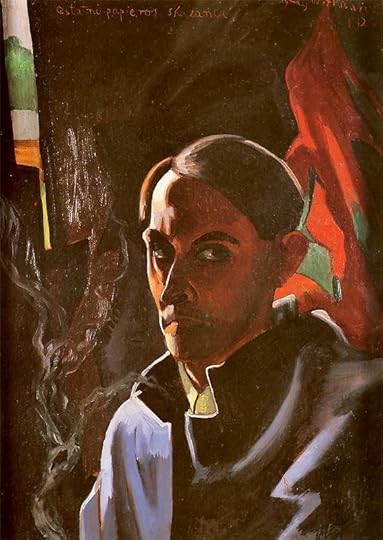
This has to be one of the most remarkable books I have ever read. It was written by, predominantly artist and playwright, Polish Witkiewicsz in 1929(who sadly committed suicide as Russia invaded Poland in 1939. I must, at the outset warn you of the reasons why you might not like this book first, because if you can overcome the hurdles, what awaits is quite astounding.
Ok the problems with this book are: It has the smallest and most densely packed font I have ever seen in a novel and then it has many parts in the story under ‘Information’ of even smaller text. This means there are about 670 words per page – I think the industry standard is nearer 250 words or so? – this means the 410 pages is really nearer 1100 pages – quite an undertaking! Your eyes are physically challenged. The next is that the story is completely unapologetic about drug use, the C word, some brutal sex and violence against women – though not graphic or gratuitous in a modern ‘x–rated sense’ for its time and now it is very unambiguous and quite adult. A final challenge is the frequent use of difficult, long and obscure words mixed with a very condensed, erudite, innovative, complex and challenging writing style – it does get easier but, mainly in the first half, you may have to refer to a dictionary or philosopher’s manual.
Ok ready. This is the remarkable and stunning mix of Emile Zola’s earthy realism (e.g. Nana), the density of any classic Russian revolutionary novel (War and Peace), the erudition and character development of any classic English period novel (Middlemarch), the off-the-wall philosophy of Nietzsche (Thus Spake Zarathustra), the future-thinking of Philip Dick (Man in the High Castle), the drug trip of Ageyev (Novel with Cocaine), the existentialism of Sartre, the innovation and its own unique style as of Joyce (Ulysses), some erotic notes of Anais Nin, and finally (and actually the most important) the clever story telling of G G Marquez (General in his Labyrinth). Impossible you think! Wrong - read this book. {It even has my most obscure requirement – a direct reference/allusion to a work by Emile Zola}.
Let me explain only some of the basic story to illustrate:
Genezip is a 19 year old adolescent virgin embarking on life in aristocratic Poland; at a time when the West is Bolshevik, Russian is soon to fall to the invading Chinese horde and a new religion inspired by a mind expanding drug is growing in the country. Classic religion is ignored while people take hard drugs; the elite and intellectual class appear sexually degenerate. After an introduction to masturbation by his cousin, gay sex by avante garde Composer (and cripple) Hardonne (pun intended?) – he meets aged Princess Irina Vsevolodovra (about 50 or so) and frustratingly becomes her new and final lover. Catholic Prince Basil, writer Sturfan Abnol and Professor Bends provide all sorts of intellectual discourse and ideas, whilst Genezip deals with family issues like his father’s death, his mother’s lover, his younger sister entering the theatre. At the same time, elusive Sloboluchowicz is in command of the Polish forces, he has a classic courtesan Persy. Why does the ‘Syndicate’, a clandestine anti-government group, dislike the General?. What is the destiny of Genezip and Poland? How do the “Insatiability’s” of drugs, religion, history, sex, perversion, war, revolution, incest, adultery, insanity, power and murder lead to the riveting and thought provoking ending.
I’ve always said “There are too many books in the world to re-read any”, despite having read so many of the World’s undoubted ‘Best'; I’m wrong – one day I will re-read this truly amazing and brilliant book.
There are limitless ideas of prose, thought and turns of phrase; this has to be the book for which I found the most stunning quotes, here’s some:
“That’s not religion anymore. Some of them know this, yet knowingly poison themselves with their own flaccidity of spirit, their unwillingness to seek out the truth, and their fear of the absurd which sooner or later every definitive truth reveals if it’s not hermetically sealed by means of all sorts of exceptions and qualifications”
“It was as if a peal of thunder from man’s subterranean guts hand banged against the sky – not an earthly sky, but a cosmic sky of nothingness – that was truly infinite and vacuous and whence, originating from metaphysical storm clouds, it plummeted down to the very bottom of that creeping, flaming, flattened-out, barren mystery. The beams of the world trembled; in the distance radiated the solace of death, transformed into the peaceful sleep of a mysterious deity broken on the wheel of superdivine tortures; the immediate apperception of eternity.”
“The sexual relations of such a couple must have been an insufferable agony, similar to that acute malaise of the skin that often accompanies influenza, to that boredom prevailing in the parlour filled with sleazy guests – but raised to an incalculable power, to a prisoner’s abject despair, to the powerful longing of a dog on a leash watching other dogs frolic in freedom”
“The apparent aimlessness of his postgraduate vision of the future, a vestige of his undergraduate days, contracted now into the electable sameness of everything. Gone now were all those non-existent days full of events and expectations, those evenings spent in anticipation of a predestined Fate, of a life with no exit and an enigmatic premature death – a living death, even.
“the world is not an absurdity. But it’s not an absurdity, despite all your doubts – which tells me more about your ignorance than your religion does – and the reason why it isn’t is because logic is possible. There’s your proof. The sense of an ideal world whose miserable function is nothing but a limited (and not absolute) rationality is far more important than whether some little boob can endure live or not”
“To live as though existence were rational, being all the while conscious of its irrationality - that’s a little more respectable, something between suicide and bestiality”`
“He could feel her swimming about inside him, acquiring an invincible power and a kind of satanic, supermundane charm that pierced his adolescent soul with lacerating pain of life somehow incomplete. With all this witchcraft, how utterly unimportant were all those wrinkles….Dreams, statues, the paradise of Mohammed… what were all these in comparison to that pageantry of flesh.
“In every realm the positive value of individual extravagances has become depleted: only in madness can man’s most intrinsic life be fulfilled: only in perversity whose boundaries are primordial chaos can truly creative art be realised. Philosophy has abdicated”
“the newspapers, that truly abominable ‘press’ of minds that was daily grinding millions of people into a brainless marmalade suitable for the prevailing political fiction”
“An odour redolent of sexual affliction merged with the sultry humidity of a drizzly and melancholy spring evening. He was hopelessly overcome with unmitigated despair”
PS
just in case you were wondering here is a selection of words the author uses in the first 50 pages or so:
hamadryad, autoerotic, sublimation, ontology, animistic, illumined, ambivalence, immutability, perturbations, imperceptibility, intralevelers, intraductible, intramissible, dualism, perfidiousness, asymptotically, expiation, pornographic, trichinae, pseudoclassical, self-humiliation, objectivism, debauchery, over-intellectualized, omniscience, lugubrious, multifarious, pseudopalatine, erotomania, apotransformine, quasi-mechanized, prostration, addict-adepts, transcendental, hypocritical, nonqualitative, galimatias, phantasmagoria, magnanimity, disingenuous, hyperrealist, plenitude, nondimensional, solidification, insouciance, intoxication, ineffable, monotonous, infinitude, portentous, incarnation, improvisation, unparalleled, machinations, profundity, asceticism, antithesis, debauchery, transfinite, distillation, dissonance, thematics, abstruseness, autochthonous, syndicalism, preordained, gargantuan, refulgence, masturbation, ubiquitous, improvisational, hyperultrasophisticated, osmotic, somnolent, megalomaniac.