

What do you think?

One of Cleopatra's Nights
One of Theophile Gautier's most famous collections of stories, One of Cleopatra's Nights contains his classic Egyptian tale "The Mummy's Foot," as well as "Clarimonde," "Arria Marcella," "Omphale," and "King Candaules." Translated by Lafcadio Hearn.
345 pages, Paperback
Published October 14, 2022
About the author
Théophile Gautier
2,374 books326 followersPierre Jules Théophile Gautier was a French poet, dramatist, novelist, journalist, and literary critic. In the 1830 Revolution, he chose to stay with friends in the Doyenné district of Paris, living a rather pleasant bohemian life. He began writing poetry as early as 1826 but the majority of his life was spent as a contributor to various journals, mainly for La Presse, which also gave him the opportunity for foreign travel and meeting many influential contacts in high society and in the world of the arts, which inspired many of his writings including Voyage en Espagne (1843), Trésors d'Art de la Russie (1858), and Voyage en Russie (1867). He was a celebrated abandonnée of the Romantic Ballet, writing several scenarios, the most famous of which is Giselle. His prestige was confirmed by his role as director of Revue de Paris from 1851-1856. During this time, he became a journalist for Le Moniteur universel, then the editorship of influential review L'Artiste in 1856. His works include: Albertus (1830), La Comédie de la Mort (1838), Une Larme du Diable (1839), Constantinople (1853) and L'Art Moderne (1856)
Ratings & Reviews
Friends & Following
Create a free account to discover what your friends think of this book!
Community Reviews
Displaying 1 - 17 of 17 reviews

June 13, 2018
Decadent Romanticism at it's finest. Gautier had such a golden touch when it came to the flow of his work. Here, the prose takes on the form of dense lyrical poetry. And it's Cleopatra! what's not to like.
An extract -
"It is a strange situation to love a queen; it is as if one loved a star, and still the star comes each night to shine in its place in the sky; it is a kind of mysterious rendezvous; you find her there, you see her, she is not angry at you for looking at her! Oh, misery! to be poor, unknown, obscure, seated at the very bottom of the ladder, and to feel your heart full of love for something solemn, sparkling, and splendid, for a woman whose meanest servant would have nothing to do with you! to have your eyes fixed on someone who does not see you, who will never see you, for whom you are nothing but a figure in the crowd like all the other figures, and who would meet you a hundred times without recognizing you! to have, if ever the opportunity for speaking arises, no reason to give for such a
crazy audacity, neither a poet's talent, nor great genius, nor superhuman qualities, nothing but love; and in exchange for beauty, nobility, power, all the splendours of your dreams, to bring only passion or your youth, rare things indeed!"
An extract -
"It is a strange situation to love a queen; it is as if one loved a star, and still the star comes each night to shine in its place in the sky; it is a kind of mysterious rendezvous; you find her there, you see her, she is not angry at you for looking at her! Oh, misery! to be poor, unknown, obscure, seated at the very bottom of the ladder, and to feel your heart full of love for something solemn, sparkling, and splendid, for a woman whose meanest servant would have nothing to do with you! to have your eyes fixed on someone who does not see you, who will never see you, for whom you are nothing but a figure in the crowd like all the other figures, and who would meet you a hundred times without recognizing you! to have, if ever the opportunity for speaking arises, no reason to give for such a
crazy audacity, neither a poet's talent, nor great genius, nor superhuman qualities, nothing but love; and in exchange for beauty, nobility, power, all the splendours of your dreams, to bring only passion or your youth, rare things indeed!"

October 24, 2017
One of Cleopatra’s Night is a historical novel by Théophile Gautier, written in 1838.
« Nineteen hundred years ago, a beautifully gilded and painted boat descended the Nile with all the rapidity that could gave it fifty long, flat oars crawling over the scratched water like the legs of a gigantic scarab. Here comes Cleopatra. »
In her summer palace, Cleopatra "is horribly bored". Meïamoun, in love with the queen, is caught spying her in her bath. Having the whim to be clement, Cleopatra gives him an orgiastic night : divine meals and dancers.
« Today, deprived of this dazzling spectacle of the all-powerful will, of this high contemplation of a human soul, whose slightest desire is translated into unheard-of actions, into enormities of granite and brass, the world is bored madly and desperately; man is no longer represented in his great imperial imagination, creativy. »
« We have to describe a supreme orgy, a feast to make pale that of Balthazar : one of Cleopatra’s night. How, with the French language, so chaste, so frostly prude, will we make this frenzied outburst, this broad and powerful debauchery that does not fear to mix the blood and the wine, these two purple, and these furious impulses of the unfulfilled pleasure rushing to the impossible, with all the ardor of meaning that the long Christian fasting has not yet mastered? »
Ô my beloved master Théophile Gautier ! you were the only one able to describe a Cleopatra’s night, and you did it, with your divine pen:
I was in Cleopatra's summer palace on the banks of the Nile, I was dazzled by the splendors, the wealth, the delicacies and the lascivious dances... but I was scared too, for this innocent lover Meïamoun because the threat hovers over him, oppressive, invisible, but present.
Gabrielle Dubois
« Nineteen hundred years ago, a beautifully gilded and painted boat descended the Nile with all the rapidity that could gave it fifty long, flat oars crawling over the scratched water like the legs of a gigantic scarab. Here comes Cleopatra. »
In her summer palace, Cleopatra "is horribly bored". Meïamoun, in love with the queen, is caught spying her in her bath. Having the whim to be clement, Cleopatra gives him an orgiastic night : divine meals and dancers.
« Today, deprived of this dazzling spectacle of the all-powerful will, of this high contemplation of a human soul, whose slightest desire is translated into unheard-of actions, into enormities of granite and brass, the world is bored madly and desperately; man is no longer represented in his great imperial imagination, creativy. »
« We have to describe a supreme orgy, a feast to make pale that of Balthazar : one of Cleopatra’s night. How, with the French language, so chaste, so frostly prude, will we make this frenzied outburst, this broad and powerful debauchery that does not fear to mix the blood and the wine, these two purple, and these furious impulses of the unfulfilled pleasure rushing to the impossible, with all the ardor of meaning that the long Christian fasting has not yet mastered? »
Ô my beloved master Théophile Gautier ! you were the only one able to describe a Cleopatra’s night, and you did it, with your divine pen:
I was in Cleopatra's summer palace on the banks of the Nile, I was dazzled by the splendors, the wealth, the delicacies and the lascivious dances... but I was scared too, for this innocent lover Meïamoun because the threat hovers over him, oppressive, invisible, but present.
Gabrielle Dubois

July 16, 2018
Lovely story about a great queen. I love Egipt and all that talks about Roma Imperium

June 14, 2015
Very Baroque and ultimately a sense of style over substance, this book has some lovely passages but tedious pages. Partly because of the translation, I suspect, the writing comes out as overwrought, overemotional, melodrama.

September 12, 2022
Pure magic...what an amazing wordsmith, forging the antiquity in such exquisite splendor. Lucky to have discovered him!
March 21, 2025
Mind expanding romance. Never thought of Egypt depicted as a place of death.

July 18, 2022
"It is easily to be seen," muttered Charmion to herself, "that the queen has not had a lover nor had anyone killed for a whole month."
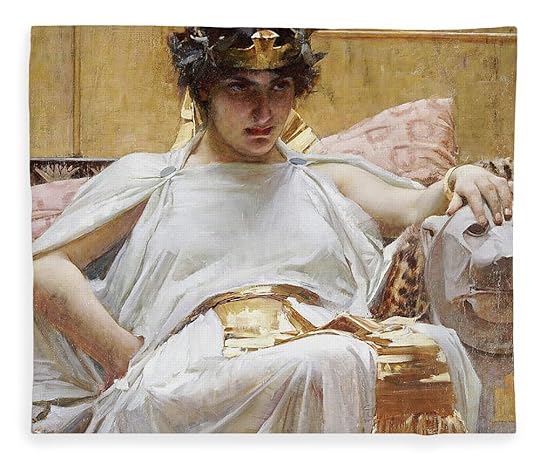
[Cleopatra (1888) by John William Waterhouse]
I read the novelette* “One of Cleopatra’s Nights” because it is featured in The Literature of Lovecraft, Vol. 1. The creators of the audiobook chose stories that influenced the American writer H.P. Lovecraft (1890-1937). HPL praised Théophile Gautier in his literary essay Supernatural Horror in Literature, calling the author the first of his countrymen “to find an authentic French sense of the unreal world.” He goes on to state that in Gautier’s work:
Unlike most of the stories praised by Lovecraft in this essay, “One of Cleopatra’s Nights” has nothing supernatural about it. Instead, it is a work of historical fiction that features the famous Queen Cleopatra VII Philopator of Egypt. The character that Gautier depicts has little to do with the real person, who the ancient historian Plutarch described as being renowned more for her brilliance, political cunning, and powerful personality than her physical attractiveness. Instead, this depiction of her has more to do with later literary and cultural depictions of Cleopatra created by the likes of William Shakespeare. This character’s unearthly beauty is matched only by her decadence. Fifer & Lackey (2014) point out that Gautier appears to be mocking Cleopatra throughout the story, especially evident in the quote that begins this review and this line from chapter five: “Hither came Cleopatra, leaning with one hand upon the shoulder of Charmion. She had taken at least thirty steps all by herself. Mighty effort, enormous fatigue!” This level of humor came as a pleasant surprise to me.
An ongoing theme of “One of Cleopatra’s Nights” is how much grander the ancient world was compared to the modern world. Or, in this case, the early 19th century. The beginning of chapter six is particularly poignant:
Then again, Gautier may be stating these things ironically. He does not shy away from the fact that many people in the ancient world were poor slaves. The decadence available to the select few can turn people into pampered and arbitrarily cruel brats, such as the queen of Egypt. This dissonance makes “One of Cleopatra’s Nights” interesting.
Gautier’s clearest influence on Lovecraft is in his prose style. “One of Cleopatra’s Nights” is filled with long-winded descriptions of the sights, sounds, and culture of ancient Egypt. Readers of HPL often complain about his long digressions depicting architecture. Fans of his work consider these to be a feature rather than a bug. The long-winded prose in Gautier’s “One of Cleopatra’s Nights” and Lovecraft’s best stories set up vivid images in the readers’ mind and develop a powerful sense of mood.
Title: “One of Cleopatra’s Nights”
Author: Théophile Gautier, translated by Lafcadio Hearn
Dates: 1838 (first published in its original French), 1882 (translated into English)
Genre: Fiction - Novelette*, historical fiction
Word count: 13,180 words*
Date(s) read: 7/17/22-7/18/22
Reading journal entry #215 in 2022
Link to the story: https://www.gutenberg.org/files/39397...
Link to Lovecraft’s essay: https://www.hplovecraft.com/writings/...
Sources:
Fifer, C., & Lackey, C. (2014, April 24). Episode 206 – One of Cleopatra’s nights. H.P. Lovecraft Literary Podcast. https://www.hppodcraft.com/list/2014/...
Lovecraft, H. P., & Joshi, S. T. (2012). The annotated supernatural horror in literature (second edition). Hippocampus Press. https://www.hplovecraft.com/writings/... (Original work published 1927)
Gautier, L. (2021). One of Cleopatra’s nights. In H.P. Lovecraft Historical Society (Ed.), The literature of H.P. Lovecraft (S. Branney, Narr.; A. Leman, Narr.) [Audiobook]. HPLHS. https://www.hplhs.org/lol.php (Original work published 1882)
Plutarch. (2015). Parallel Lives of the Noble Greeks and Romans (A. H. Clough & J. Dryden, Trans.; C. Griffin, Narr.). [Audiobook]. Audio Connoisseur. (Original work published 1864, second century CE) https://www.audible.com/pd/Parallel-L...
Link to the image:
The contents of The Literature of H.P. Lovecraft, Volume 1 are:
"The Adventure of the German Student" by Washington Irving
"The Avenger of Perdóndaris" by Lord Dunsany
"The Bad Lands" by John Metcalfe
"The Black Stone" by Robert E. Howard
The Boats of the "Glen Carrig" by William Hope Hodgson
"Count Magnus" by M.R. James
"The Dead Valley" by Ralph Adams Cram
"The Death Mask" by Henrietta Everett
"The Fall of the House of Usher" by Edgar Allan Poe
"The Ghost of Fear" by H.G. Wells (also called “The Red Room”)
"The Ghostly Kiss" by Lafcadio Hearn
"The Horla" by Guy de Maupassant
"The House and the Brain" by Edward Bulwer-Lytton
"The House of Sounds" by Matthew Phipps Shiel
"Idle Days on the Yann" by Lord Dunsany
"Lot #249" by Arthur Conan Doyle
"The Man-Wolf" by Erckmann-Chatrian
"The Middle Toe of the Right Foot" by Ambrose Bierce
"The Minister's Black Veil" by Nathaniel Hawthorne
"The Monkey's Paw" by W.W. Jacobs
"One of Cleopatra's Nights" by Théophile Gautier
"The Phantom Rickshaw" by Rudyard Kipling
The Place Called Dagon by Herbert Gorman
"Seaton's Aunt" by Walter de la Mare
"The Shadows on the Wall" by Mary E. Wilkins
"A Shop in Go-By Street" by Lord Dunsany
"The Signal-Man" by Charles Dickens
"Skule Skerry" by John Buchan
"The Spider" by Hanns Heinz Ewers
"The Story of a Panic" by E.M. Forster
"The Strange Case of Dr. Jekyll and Mr. Hyde" by Robert Louis Stevenson
"The Tale of Satampra Zeiros" by Clark Ashton Smith
"The Tapestried Chamber" by Sir Walter Scott
"The Upper Berth" by F. Marion Crawford
"The Vampyre" by John Polidori
"The Venus of Ille" by Prosper Mérimée
"The Were Wolf" by Clemence Housman
"What Was It?" by Fitz-James O'Brien
"The White People" by Arthur Machen
"The White Wolf of the Hartz Mountains" by Frederick Marryat
"The Willows" by Algernon Blackwood
"The Yellow Sign" by Robert W. Chambers
"The Yellow Wallpaper" by Charlotte Perkins Gilman
If you want to hear the stories in the order in which they were written, here's a guide.
The Vampyre (1819) - Chapter 46
The Adventure of the German Student (1824) - Chapter 1
The Tapestried Chamber (1828) - Chapter 44
The Minister's Black Veil (1836) - Chapter 25
The Venus of Ille (1837) - Chapter 47
The White Wolf of the Hartz Mountains (1839) - Chapter 51
The Fall of the House of Usher (1839) - Chapter 13
What Was It? (1859) - Chapter 49
The House and the Brain (1859) - Chapter 17
The Signal-Man (1866) - Chapter 37
The Man-Wolf (1876) - Chapters 21-23
The Ghostly Kiss (1880) - Chapter 15
One of Cleopatra's Nights (1882) - Chapter 27
The Upper Berth (1886)
The Strange Case of Dr. Jekyll and Mr. Hyde (1886)
The Horla (1887)
The Phantom Rickshaw (1888)
The Middle Toe of the Right Foot (1891)
Lot #249 (1892)
The Yellow Wallpaper (1892)
The Ghost of Fear (1894) - also called The Red Room
The Yellow Sign (1895)
The Dead Valley (1895)
The Were-Wolf (1896)
The Monkey's Paw (1902)
The Shadows on the Wall (1903)
Count Magnus (1904)
The White People (1904)
The Willows (1907)
The Boats of the "Glen Carrig" (1907)
Idle Days on the Yann (1910)
The Story of a Panic (1911)
The House of Sounds (1911)
A Shop in Go-By Street (1912)
The Avenger of Perdóndaris (1912)
The Spider (1915)
The Death Mask (1920)
The Bad Lands (1920)
Seaton's Aunt (1922)
The Place Called Dagon (1927)
Skule Skerry (1928)
The Tale of Satampra Zeiros (1929)
The Black Stone (1931)
This review was written on 7/19/22
[Cleopatra (1888) by John William Waterhouse]
I read the novelette* “One of Cleopatra’s Nights” because it is featured in The Literature of Lovecraft, Vol. 1. The creators of the audiobook chose stories that influenced the American writer H.P. Lovecraft (1890-1937). HPL praised Théophile Gautier in his literary essay Supernatural Horror in Literature, calling the author the first of his countrymen “to find an authentic French sense of the unreal world.” He goes on to state that in Gautier’s work:
there appears a spectral mastery which, though not continuously used, is recognisable at once as something alike genuine and profound. Short tales like “Avatar”, “The Foot of the Mummy”, and “Clarimonde” display glimpses of forbidden visits that allure, tantalise, and sometimes horrify; whilst the Egyptian visions evoked in “One of Cleopatra’s Nights” are of the keenest and most expressive potency. Gautier captured the inmost soul of aeon-weighted Egypt, with its cryptic life and Cyclopean architecture, and uttered once and for all the eternal horror of its nether world of catacombs, where to the end of time millions of stiff, spiced corpses will stare up in the blackness with glassy eyes, awaiting some awesome and unrelatable summons.
Unlike most of the stories praised by Lovecraft in this essay, “One of Cleopatra’s Nights” has nothing supernatural about it. Instead, it is a work of historical fiction that features the famous Queen Cleopatra VII Philopator of Egypt. The character that Gautier depicts has little to do with the real person, who the ancient historian Plutarch described as being renowned more for her brilliance, political cunning, and powerful personality than her physical attractiveness. Instead, this depiction of her has more to do with later literary and cultural depictions of Cleopatra created by the likes of William Shakespeare. This character’s unearthly beauty is matched only by her decadence. Fifer & Lackey (2014) point out that Gautier appears to be mocking Cleopatra throughout the story, especially evident in the quote that begins this review and this line from chapter five: “Hither came Cleopatra, leaning with one hand upon the shoulder of Charmion. She had taken at least thirty steps all by herself. Mighty effort, enormous fatigue!” This level of humor came as a pleasant surprise to me.
An ongoing theme of “One of Cleopatra’s Nights” is how much grander the ancient world was compared to the modern world. Or, in this case, the early 19th century. The beginning of chapter six is particularly poignant:
Our world of to-day is puny indeed beside the antique world. Our banquets are mean, niggardly, compared with the appalling sumptuousness of the Roman patricians and the princes of ancient Asia. Their ordinary repasts would in these days be regarded as frenzied orgies, and a whole modern city could subsist for eight days upon the leavings of one supper given by Lucullus to a few intimate friends. With our miserable habits we find it difficult to conceive of those enormous existences, realizing everything vast, strange, and most monstrously impossible that imagination could devise. Our palaces are mere stables, in which Caligula would not quarter his horse.
Then again, Gautier may be stating these things ironically. He does not shy away from the fact that many people in the ancient world were poor slaves. The decadence available to the select few can turn people into pampered and arbitrarily cruel brats, such as the queen of Egypt. This dissonance makes “One of Cleopatra’s Nights” interesting.
Gautier’s clearest influence on Lovecraft is in his prose style. “One of Cleopatra’s Nights” is filled with long-winded descriptions of the sights, sounds, and culture of ancient Egypt. Readers of HPL often complain about his long digressions depicting architecture. Fans of his work consider these to be a feature rather than a bug. The long-winded prose in Gautier’s “One of Cleopatra’s Nights” and Lovecraft’s best stories set up vivid images in the readers’ mind and develop a powerful sense of mood.
Title: “One of Cleopatra’s Nights”
Author: Théophile Gautier, translated by Lafcadio Hearn
Dates: 1838 (first published in its original French), 1882 (translated into English)
Genre: Fiction - Novelette*, historical fiction
Word count: 13,180 words*
Date(s) read: 7/17/22-7/18/22
Reading journal entry #215 in 2022
Link to the story: https://www.gutenberg.org/files/39397...
Link to Lovecraft’s essay: https://www.hplovecraft.com/writings/...
Sources:
Fifer, C., & Lackey, C. (2014, April 24). Episode 206 – One of Cleopatra’s nights. H.P. Lovecraft Literary Podcast. https://www.hppodcraft.com/list/2014/...
Lovecraft, H. P., & Joshi, S. T. (2012). The annotated supernatural horror in literature (second edition). Hippocampus Press. https://www.hplovecraft.com/writings/... (Original work published 1927)
Gautier, L. (2021). One of Cleopatra’s nights. In H.P. Lovecraft Historical Society (Ed.), The literature of H.P. Lovecraft (S. Branney, Narr.; A. Leman, Narr.) [Audiobook]. HPLHS. https://www.hplhs.org/lol.php (Original work published 1882)
Plutarch. (2015). Parallel Lives of the Noble Greeks and Romans (A. H. Clough & J. Dryden, Trans.; C. Griffin, Narr.). [Audiobook]. Audio Connoisseur. (Original work published 1864, second century CE) https://www.audible.com/pd/Parallel-L...
Link to the image:
The contents of The Literature of H.P. Lovecraft, Volume 1 are:
"The Avenger of Perdóndaris" by Lord Dunsany
"The Bad Lands" by John Metcalfe
"The Black Stone" by Robert E. Howard
The Boats of the "Glen Carrig" by William Hope Hodgson
"Count Magnus" by M.R. James
"The Dead Valley" by Ralph Adams Cram
"The Death Mask" by Henrietta Everett
"The Ghost of Fear" by H.G. Wells (also called “The Red Room”)
"The Ghostly Kiss" by Lafcadio Hearn
"The Horla" by Guy de Maupassant
"The House and the Brain" by Edward Bulwer-Lytton
"The House of Sounds" by Matthew Phipps Shiel
"Idle Days on the Yann" by Lord Dunsany
"Lot #249" by Arthur Conan Doyle
"The Middle Toe of the Right Foot" by Ambrose Bierce
"The Monkey's Paw" by W.W. Jacobs
"The Phantom Rickshaw" by Rudyard Kipling
The Place Called Dagon by Herbert Gorman
"Seaton's Aunt" by Walter de la Mare
"The Shadows on the Wall" by Mary E. Wilkins
"A Shop in Go-By Street" by Lord Dunsany
"The Signal-Man" by Charles Dickens
"Skule Skerry" by John Buchan
"The Spider" by Hanns Heinz Ewers
"The Story of a Panic" by E.M. Forster
"The Strange Case of Dr. Jekyll and Mr. Hyde" by Robert Louis Stevenson
"The Tale of Satampra Zeiros" by Clark Ashton Smith
"The Upper Berth" by F. Marion Crawford
"The Were Wolf" by Clemence Housman
"The White People" by Arthur Machen
"The Willows" by Algernon Blackwood
"The Yellow Sign" by Robert W. Chambers
"The Yellow Wallpaper" by Charlotte Perkins Gilman
If you want to hear the stories in the order in which they were written, here's a guide.
The Adventure of the German Student (1824) - Chapter 1
The Tapestried Chamber (1828) - Chapter 44
The Minister's Black Veil (1836) - Chapter 25
The Venus of Ille (1837) - Chapter 47
The White Wolf of the Hartz Mountains (1839) - Chapter 51
The Fall of the House of Usher (1839) - Chapter 13
What Was It? (1859) - Chapter 49
The House and the Brain (1859) - Chapter 17
The Signal-Man (1866) - Chapter 37
The Man-Wolf (1876) - Chapters 21-23
The Ghostly Kiss (1880) - Chapter 15
One of Cleopatra's Nights (1882) - Chapter 27
The Upper Berth (1886)
The Strange Case of Dr. Jekyll and Mr. Hyde (1886)
The Horla (1887)
The Phantom Rickshaw (1888)
The Middle Toe of the Right Foot (1891)
Lot #249 (1892)
The Yellow Wallpaper (1892)
The Ghost of Fear (1894) - also called The Red Room
The Yellow Sign (1895)
The Dead Valley (1895)
The Were-Wolf (1896)
The Monkey's Paw (1902)
The Shadows on the Wall (1903)
Count Magnus (1904)
The White People (1904)
The Willows (1907)
The Boats of the "Glen Carrig" (1907)
Idle Days on the Yann (1910)
The Story of a Panic (1911)
The House of Sounds (1911)
A Shop in Go-By Street (1912)
The Avenger of Perdóndaris (1912)
The Spider (1915)
The Death Mask (1920)
The Bad Lands (1920)
Seaton's Aunt (1922)
The Place Called Dagon (1927)
Skule Skerry (1928)
The Tale of Satampra Zeiros (1929)
The Black Stone (1931)
*The difference between a short story, novelette, novella, and a novel: https://owlcation.com/humanities/Diff...
Vignette, prose poem, flash fiction: 53 - 1,000 words
Short Stories: 1,000 - 7,500
Novelettes: 7,500 - 17,000
Novellas: 17,000 - 40,000
Novels: 40,000 + words
This review was written on 7/19/22

April 21, 2022
(I read this as part of a collection that I can't find at this point of time of GR - translated as "A Night with Cleopatra")
Romantic orientalist decadence par excellence from the man in the red waistcoat (or pink doublet, depending on who you listen to). Absolutely saturated in detail, especially during the inevitable feast and orgy scene ("dishes of flamingo tongues and parrot-fish liver(!)"). In some ways kind of a predecessor to the various Salome tales the decadent crew loved so much, while in other ways looking back to Salammbô (or so I have gathered - have yet to read that one, but it's definitely on my radar)
Romantic orientalist decadence par excellence from the man in the red waistcoat (or pink doublet, depending on who you listen to). Absolutely saturated in detail, especially during the inevitable feast and orgy scene ("dishes of flamingo tongues and parrot-fish liver(!)"). In some ways kind of a predecessor to the various Salome tales the decadent crew loved so much, while in other ways looking back to Salammbô (or so I have gathered - have yet to read that one, but it's definitely on my radar)

April 13, 2013
I was originally intrigued by the cover art and the title (e-book version); then by the translator's opening essay In his time, . Gautier was considered a wordmaster, an artist who created a painting by carefully choosing and placing words to achieve his creation. For me, the ornate descriptions sometimes interrupted the storytelling; but these tales are gems of Romanticism filled with deep emotion, exotic locales, a touch of the supernatural. Interestingly, one of the recurring themes of these stories is woman as temptress and seductress, yet cold and distant.

August 8, 2009
C'est une Cléopâtre bien inhabituelle que dépeint ici Théophile Gautier : une reine effrayée par cette Egypte monumentale sur laquelle elle règne et, par-dessus tout, une reine qui s'ennuie...
La survenue d'un audacieux jeune homme qui brave tous les dangers pour elle introduit dans se fastueuse existence un trouble qui la séduit.
Mais séduire Cléopâtre s'avère peut-être le plus périlleux des exploits.
Les voluptueux caprices de la reine ne sont-ils pas les plus dangereux ?
La survenue d'un audacieux jeune homme qui brave tous les dangers pour elle introduit dans se fastueuse existence un trouble qui la séduit.
Mais séduire Cléopâtre s'avère peut-être le plus périlleux des exploits.
Les voluptueux caprices de la reine ne sont-ils pas les plus dangereux ?

April 21, 2014
Demasiadas descripciones mientras pasa muy poco para mi gusto. La historia es interesante pero inconsecuente.

March 25, 2026
Selected stories from Théophile Gautier's "Nouvelles" and "Romans et Contes" showcase his literary craftsmanship, characterized by rich language and a deep historical perspective on themes of love and beauty.
The narratives, notable for being translated into English for the first time, depict Cleopatra in "One of Cleopatra's Nights," exploring her glamorous yet stifling existence in Egypt. As she contemplates life beyond her opulent surroundings, the young Kemi man, Meïamoun, symbolizes desire and ambition, ultimately leading to tragedy and deep emotional complexities.
Gautier further intertwines spirituality with romance through the plight of a country priest torn between his vows and his love for Clarimonde, culminating in an existential exploration of love and loss. Their tale culminates in haunting memories that blur reality and dreams, intensifying the tension between spiritual devotion and earthly desire.
The narrative shifts to a group reflecting on the historical vestiges of Pompeii, where characters navigate themes of love, memory, and societal contrasts amidst supernatural occurrences.
In exploring antiquities, a protagonist's encounter with an embalmed foot of Princess Hermonthis leads to a fantastical dialogue on loss and companionship, exemplifying Gautier's exploration of nostalgia and beauty.
The stories traverse complex layers of desire surrounding King Candaules and Nyssia, particularly focusing on societal norms and the ethical conundrums tied to beauty and voyeurism.
Overall, the narratives combine themes of admiration, betrayal, and the moral implications surrounding love and desire, offering a rich analysis of intimacy and power dynamics within human relationships.
The narratives, notable for being translated into English for the first time, depict Cleopatra in "One of Cleopatra's Nights," exploring her glamorous yet stifling existence in Egypt. As she contemplates life beyond her opulent surroundings, the young Kemi man, Meïamoun, symbolizes desire and ambition, ultimately leading to tragedy and deep emotional complexities.
Gautier further intertwines spirituality with romance through the plight of a country priest torn between his vows and his love for Clarimonde, culminating in an existential exploration of love and loss. Their tale culminates in haunting memories that blur reality and dreams, intensifying the tension between spiritual devotion and earthly desire.
The narrative shifts to a group reflecting on the historical vestiges of Pompeii, where characters navigate themes of love, memory, and societal contrasts amidst supernatural occurrences.
In exploring antiquities, a protagonist's encounter with an embalmed foot of Princess Hermonthis leads to a fantastical dialogue on loss and companionship, exemplifying Gautier's exploration of nostalgia and beauty.
The stories traverse complex layers of desire surrounding King Candaules and Nyssia, particularly focusing on societal norms and the ethical conundrums tied to beauty and voyeurism.
Overall, the narratives combine themes of admiration, betrayal, and the moral implications surrounding love and desire, offering a rich analysis of intimacy and power dynamics within human relationships.

July 15, 2024
«Aquí, en cambio, diríase que los vivos no tienen más ocupación que la de conservar a los muertos; poderosos balsamos impiden su destrucción y conservan su traza y su forma; evaporado el alma, los despojos permanecen: bajo este pueblo existen veinte pueblos; cada ciudad tiene bajo ella veinte pisos de necrópolis; cada generación que desaparece crea, en tenebroso recinto, una población de momias; bajo el padre, se encuentra al abuelo y al bisabuelo en su pintado sarcófago.»
«Una reina no es ya una mujer; es una augusta y sagrada figura que carece de sexo, y a la que, como la estatua de una diosa, se le adora de rodillas sin amarla.»
Relato corto basado en el antigua Egipto , en concreto sobre un romance ficticio de Cleopatra. El relato no es muy ambicioso, pero Gautier se luce en la ambientación. Los decorados son minuciosos y transporta muy bien la imagen al papel.
En cuanto a Cleopatra, si bien no es un personaje profundo, si tiene su gracia con ese hastío que siente por Egipto y sus tradiciones y por su condición de reina. También me pareció que el final le daba una caracterización interesante, aunque, bueno, esta no se desvía demasiado de ese mito falso de mujer fatal que carga a sus espaldas.
La edición, en cambio, es floja. La traducción esta desfasada, con esos verbos que incluyen el se al final (diríase), y tambien con su presencia del hipérbaton, lo que hace que la lectura sea un tanto incómoda. Puedo entender que se buscara ese tono arcaico, pero no creo que le favorezca en ningún sentido.
«Una reina no es ya una mujer; es una augusta y sagrada figura que carece de sexo, y a la que, como la estatua de una diosa, se le adora de rodillas sin amarla.»
Relato corto basado en el antigua Egipto , en concreto sobre un romance ficticio de Cleopatra. El relato no es muy ambicioso, pero Gautier se luce en la ambientación. Los decorados son minuciosos y transporta muy bien la imagen al papel.
En cuanto a Cleopatra, si bien no es un personaje profundo, si tiene su gracia con ese hastío que siente por Egipto y sus tradiciones y por su condición de reina. También me pareció que el final le daba una caracterización interesante, aunque, bueno, esta no se desvía demasiado de ese mito falso de mujer fatal que carga a sus espaldas.
La edición, en cambio, es floja. La traducción esta desfasada, con esos verbos que incluyen el se al final (diríase), y tambien con su presencia del hipérbaton, lo que hace que la lectura sea un tanto incómoda. Puedo entender que se buscara ese tono arcaico, pero no creo que le favorezca en ningún sentido.

May 31, 2020
Original y pionero acercamiento literario al mundo del Antiguo Egipto del escritor francés Gautier publicado en 1839. Sin embargo el resultado es fallido. Más que una novela corta, es casi un relato largo, lleno de descripciones sobre elementos, utensilios y nomenclaturas de el Egipto helenístico, que demuestra que Gautier era uno de los adelantados de su tiempo sobre el tema. Pero literariamente el texto es casi un horror. Buenas intenciones pero pésimo resultado.
Aún así, hay que valorar por encima de todo que es uno de los primeros acercamientos literarios a un mundo que llevaba siglos oculto debajo de la arena y que la campaña napoleónica de Egipto puso tan de moda que nació la mismísima Egiptología.
Nota: 5
Aún así, hay que valorar por encima de todo que es uno de los primeros acercamientos literarios a un mundo que llevaba siglos oculto debajo de la arena y que la campaña napoleónica de Egipto puso tan de moda que nació la mismísima Egiptología.
Nota: 5

March 5, 2021
>70/100. Muy bueno.
Leído en marzo de 2021.
Leído en marzo de 2021.

March 26, 2023
I love Theophile Gautier but it took me forever to read this book. I think I need to give it another chance but in French!

December 21, 2024
Muy interesante a nivel conceptual y narrativo, pero me parece difícil hacer unas descripciones más aburridas.
Displaying 1 - 17 of 17 reviews