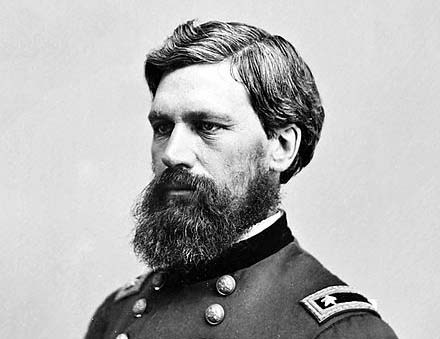
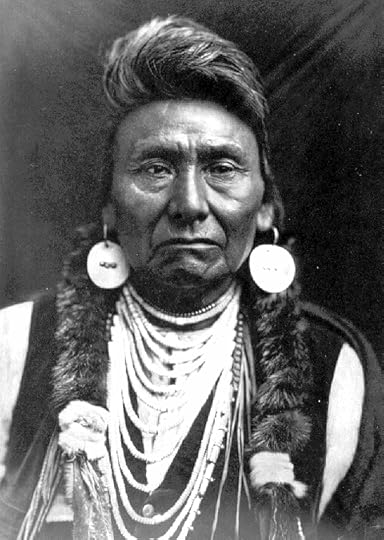
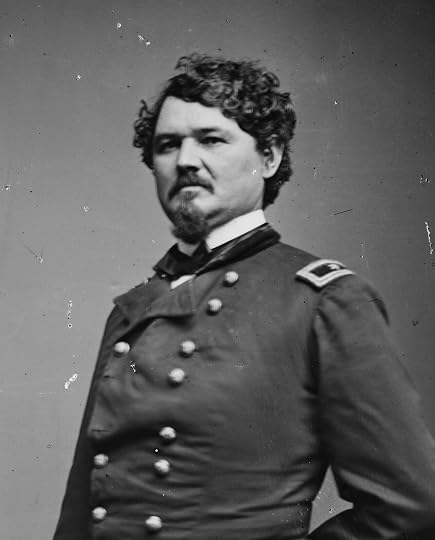
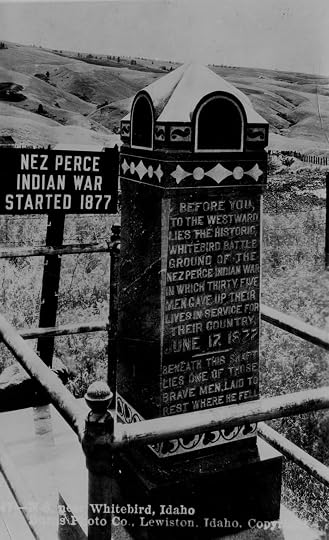
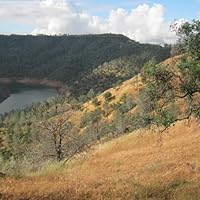
In this new installment in his series of novels examining the collisions between Native Americans and European colonizers, William T. Vollmann tells the story of the Nez Perce War, with flashbacks to the Civil War. Defrauded and intimidated at every turn, the Nez Perces finally went on the warpath in 1877, subjecting the U.S. Army to its greatest defeat since Little Big Horn as they fled from northeast Oregon across Montana to the Canadian border. Vollmann’s main character is not the legendary Chief Joseph, but his pursuer, General Oliver Otis Howard, the brave, shy, tormented, devoutly Christian Civil War veteran. In this novel, we see him as commander, father, son, husband, friend, and killer.
Teeming with many vivid characters on both sides of the conflict, and written in a style in which the printed page works as a stage with multiple layers of foreground and background, The Dying Grass is another achievement from one of the most ambitious writers of our time.
William Tanner Vollmann is an American author, journalist, and essayist known for his ambitious and often unconventional literary works. Born on July 28, 1959, in Los Angeles, California, Vollmann has earned a reputation as one of the most prolific and daring writers of his generation.
Vollmann's early life was marked by tragedy; his sister drowned when he was a child, an event that profoundly impacted him and influenced his writing. He attended Deep Springs College, a small, isolated liberal arts college in California, before transferring to Cornell University, where he studied comparative literature. After college, Vollmann spent some time in Afghanistan as a freelance journalist, an experience that would later inform some of his works.
His first novel, You Bright and Risen Angels (1987), is a sprawling, experimental work that blends fantasy, history, and social commentary. This novel set the tone for much of his later work, characterized by its complexity, depth, and a willingness to tackle difficult and controversial subjects.
Vollmann's most acclaimed work is The Rainbow Stories (1989), a collection of interlinked short stories that explore the darker sides of human nature. His nonfiction is equally notable, particularly Rising Up and Rising Down (2003), a seven-volume treatise on violence, which was a finalist for the National Book Critics Circle Award.
Over the years, Vollmann has continued to write prolifically, producing novels, short stories, essays, and journalistic pieces. His work often delves into themes of violence, poverty, and the struggles of marginalized people. He has received several awards, including the National Book Award for Fiction in 2005 for Europe Central, a novel about the moral dilemmas faced by individuals during World War II.
Vollmann is known for his immersive research methods, often placing himself in dangerous situations to better understand his subjects. Despite his literary success, he remains somewhat of an outsider in the literary world, frequently shunning public appearances and maintaining a low profile.
In addition to his writing, Vollmann is also an accomplished photographer, and his photographs often accompany his written work. Painting is also an art where's working on, celebrating expositions in the United States, showing his paintings. His diverse interests and unflinching approach to his subjects have made him a unique voice in contemporary American literature.
"The destiny of the white race in America is to eat up the red men, and in this rising tide of population that rolls toward the setting sun there is no one who is backward in taking his bite -- no one except the government that temporizes and buys peace, to avoid doing the duty that the individual is doing from choice or from necessity." -- Phillippe Régis Denis de Keredern de Trobriand (1867)
This might not be my favorite novel of the last several years, but it is one of the best. And I can't easily grasp a novel that I liked more. I just don't know. My brain is fried. My emotions are fried. My ability to look objectively at this book, and history, and the United States is fried.
One of the best compliments I can give to the best historical fiction is that it doesn't break history, but fills in the gaps and bends it. Hillary Mantel does this very well. So too does Robert Graves, John Williams, and Patrick O'Brian. These other authors seem content to carve prose castles to tell their stories of leaders, kings, and periods. Vollmann just drops a volcano on the reader. There is just so much.
I was trying to describe the feeling of reading Vollmann (I've only read three Vollmann, the other two were Europe Central and Whores for Gloria) to my wife. To me it is equivalent of reading a strange cut-up method combination of Mantel, Pynchon, and Burroughs WHILE tripping on mushrooms. But that still doesn't do it justice. There is no easy metaphor for Vollmann. There is no way to explain Vollmann without using Vollmann. What is the only way to understand Vollmann? You have to grab the biggest Vollmann you can find and jump in without fear and without looking back. He is big, vicious, kind, detailed, warm, clinical. He just doesn't stop. He is exhausting and frustrating. He is the literary equivalent of Hieronymus Bosch. He is the hardest working hypergraphic around.
I can't imagine Vollmann is very profitable to Viking. There are just NOT that many people jostling in the age of Twitter (where the demands of reading and writing are limited to 140 characters) to read 1376 pages of digressive, experimental, inner/outer stream of consciousness narrative fiction. However, I know why they keep him on their Viking reservation: the guy WILL win the Nobel prize someday. Guaranteed. This dude has a long, harsh tail.
Over the next couple days I'm going to add paragraphs on:
1. Nez Perce War 2. Nez Perce vs. US Army 3. US treatment of Native Americans 4. Nez Perce Trail 5. My own Private Idaho 6. American Indian as myth. 7. Names and Naming
This fifth volume of Vollman’s planned Seven Dreams series was very rewarding to me in the long run, but at 1,300-plus pages it took a commitment equivalent to reading four ordinary books. That kind of reminds me how in grade school, I would brag how I read a great book (probably about ants) and gesture it was “this thick”. But if you are going to take a journey into the hearts and minds of European Americans and Native Americans at war, it makes sense that it might take a long time to elucidate the full story.
How was it that General Otis Howard, the “Christian general” who worked so hard to advance the opportunities for emancipated slaves after the Civil War (he was a commissioner of the ill-fated Freedman’s Bureau and co-founder of Howard University), could lead a bloody campaign to fulfill a robbery of the land of the Nez Perce tribe? How was it that this tribe, such peaceful friends with the white man starting with Lewis and Clarke at the beginning of the century, would not go meekly onto a reservation and instead end up fighting back so desperately?
The Long Chase: For modern people who feel bad from a distance over the tragedy of the brutal U.S. policies to get rid of or otherwise contain the pesky Indians, there is a bit of romantic reprieve in the tale of a band of about 250 warriors, accompanied with perhaps 500 family members, leading about 2,000 soldiers on a 1,200 plus mile chase over three months while fighting effectively in intervals along the way. Over four pitched battles and several skirmishes the losses amounted to about 150 were killed on each side, which is small on the scale of atrocities and slower adversity-induced deaths that comprise the overall sweep of actions that fit most definitions of genocide. Still, the “Nez Perce War” continues to capture our imagination and is subject to a national park and a national historic trail. Treat yourself to this folksong, Heart of the Appaloosa--YouTube, by Fred Small to tap into a source of pride (and tears) in the mythic heroics of the tribe and Chief Joseph (with accompanying images composed by school kids; I was pleasantly surprised to find the link cited in the Wiki history).
Nez Perce homeland and route of their fighting retreat
Alien Communications:This well researched historical novel dispels sentimentality in such a song with intense efforts at realism. Provocations in the form of brutal murders of the innocent are revealed by both whites and Indians. That the majority on both sides of the conflict were sincerely interested in peaceful, dignified solutions adds to a sense of tragedy and at the same time begs the question of why the human race continues year after year to escalate differences and crimes of individuals into murder and war between peoples. This appears to be a huge subject of interest for Vollman, which I learn from other readers reporting back on his “Rising Up and Rising Down”, a massive effort to elucidate a sort of moral algebra to account for the causes and ethics of violence. With his Seven Dreams series, which started in 1990 with a fictional account of Viking incursions over a millennium ago, he plumbs the history of the European conquest of North America to glean meaning in the imagined evolution of relations between the invaders and indigenous peoples. Given that the peoples in the New World were on their own path for 10-20 thousand years before the Europeans arrived, I am struck how their differences are so extreme as to resemble a cultural collision between alien species.
The difficulties in communication between the tribe and U.S. Army members have a lot to do with the events that unfolded. Very few individuals could speak each other’s language. In one sense the overall motivation of the Nez Perce to live in freedom and autonomy and that of the whites as a whole to take their land and exploit its resources needs little translation to comprehend the irreconcilable differences. Regardless, the “take me to your leader” mentality coincides with a problem of picking an unrepresentative leader to negotiate an behalf of the diverse bands of the tribe. The coerced 1855 treaty that reduced their land from 13 million acres to 7.5 million acres spanning parts of Washington, Oregon, and Idaho Territories was followed in 1863 by an agreement with a Christianized subset of the tribe to sell 90% of that land for a pittance, leaving only 750,000 acres in Idaho. A number of bands (“non-treaty” Nez Perce) refused to comply with the “thief treaty”, and violent conflicts between them and invading settlers and miners led General Sherman by 1877 to order General Howard to force their removal to the reservation. The way Vollman presents it, most were ready to comply, but the disrespect and overnight jailing of one old chief set a trio of young bucks to commit atrocities on a few settlers in their rage and bravado. Despite Howard’s efforts to act with restraint, the next step in escalation was for some of his soldiers and civilian volunteers in his force to open fire with no provocation on members of one band already committed to comply with the order, that led by Chief Looking Glass.
A chief problem in communication seen in all conflicts with Indians from colonial times is to attribute the actions of unruly individuals on both sides to the tribe or colonial people as a whole. Here, every depredation by individual Indians or canny stratagem in battle is attributed by the army as due to Joseph, and, for the converse, the Indians see aggressive actions by whites as effectively carried out by Howard, whom they refer to as “Cut Arm” due to arm he lost to injury in the Union defeat at Chancellorsville. In fact, Joseph was such a pacifist, he served essentially as a “camp chief” throughout this campaign, important as a moral center for the tribe but responsible mainly for logistics and assuring the safety of the women and children. And Howard struggled mightily to get consistent professional service out of his captains, lieutenants, civilian volunteers, and Indian guides. His Christian charity and teetotling ways were almost universally despised. The desecration of Nez Perce bodies by their Bannock Indian contingent and by souvenir hunters among the whites was a major affront to the spiritual beliefs of the Nez Perce and key element of pervasive mistrust any promises on the part of Howard.
The narrative alternates between perspectives of the Indians and that of their pursuers, with the cast of characters reaching perhaps a couple dozen. Through some innovative ways of rendering his prose, Vollman layers present events conveyed largely through dialog with indented lines to reach into the characters’ unspoken perceptions, emotions, memories, thoughts of distant families, and recent visits to a brothel. It takes some getting used to as racist and misogynist attitudes, jealousies, fears, and egotistical reveries bubble up between the regular military forms of discourse among the soldiers. The Civil War, both Union and “Seccesh” experiences figures prominently in the minds of many, and anger over the disaster for Custer at the Battle of Little Bighorn in the previous year is common. That the Nez Perce did not participate in the pan-Indian call for war by Lakota Chief Sitting Bull means less than the treacheries experienced in their recent rounding up of the Modocs in California. For the Indians, I give a lot of credit to Vollman’s courage and imagination to try to render their unique cultural and spiritual outlook in their daily lives and relationship with the natural world, including elements of their language. Horses go “himini” and crickets speak “aikh, aikh.” The two wives of Joseph are incredibly industrious in diverse activities such as child care, tending horses, gathering herbs, preparing camas roots or game for meals, and making his member grow long as a deer neck.
Looking for Love in All the Wrong Places: Historical relations with other tribes and with particular sites in the west also figure largely in the Indian’s mental concerns. As they pass though their beloved haunts, perhaps for the last time, they try to settle on where to seek refuge. In the lands of the Salish and Crow tribes, they find they are not welcome enough for long friendships to outweigh the risk of facing war with the U.S. Army. Could an enemy of their enemies make for friendship with a traditional enemy? They pin their hopes on crossing Montana and joining up with Sitting Bull and the Lakotas, who successfully escaped to Canada. However, Howard’s old friend from Civil War days. Colonel Miles, traveling from a northern fort along with Cheyenne scouts was able to trap the Nez Perce 90 miles from the Canadian border. While about 400 surrendered, perhaps 200 did escape to Canada, including Joseph’s daughter. This ending of the long chase was particularly moving in Vollman’s rendering. He doesn’t bother with repeating the iconic speech rendered as ending with: “Hear me, my chiefs! I am tired. My heart is sick and sad. From where the sun now stands I will fight no more forever”. He seems to have doubts about the accuracy of translation and amplifying a comment into a speech.
Howard’s End and Picking Up the Pieces: Vollman has a mission of making the reader as interested in Howard as Joseph. Seeing Joseph as a special hero is fulfillment of hope, a guilt-assuaging fantasy, while Howard holds great potential for surprise. How to judge him as a hero or a villain? The compulsion to think that way is because of the situation we are stuck with now for problems in relations between the dominant culture (aka white folks and their emulators), its (my) government in relation to the Indians. Thomas King's The Inconvenient Indian was a wonder for me in confirming the continuity from destructive national Indian policies in the 19th century through phases of merely repressive policies to the current quagmires on the issues such as sovereignity, resource exploitation, and survival of cultural identity.
I know there was virtually no political way to stop the settlers and the economic interests of the government from taking as much away from the Indians as possible. But still we must want to see a person of the time trying to achieve a more humane outcome, for Howard to have a more enlightened moral calculus. If Howard was an essential part of the machine to effect a drastic constraint on the fate of the Nez Perce, his aim was at least to effect a humane implementation of what was inevitable in his mind. His expectation was that the few murderers of women and children would be hung and the rest peaceably moved to the reservation. Miles took the credit for ending the war, and he had no say over the sad fate of the survivors. His success in talking the Apache chief Cochise into surrendering was similarly undermined by the later revival of the war by Geronimo. I am left with ambivalent feelings about Howard. Hampton Side left me feeling the same way about Kit Carson in his wonderful history of an Indian lover (he even married an Indian) who ended up perpetrating a devastating death march in the removal of the Navaho from their sacred lands ( Blood and Thunder). I end up most admiring Howard for his military feat of moving his forces so long through countless adversities against a worthy and respected opponent.
Gone are those days, but there is no benefit just to say “drive on, that was then, and this is now”. Today the courageous task is to make something meaningful come out of what are called Truth and Reconciliation Commissions, like what is taking place in my current home of Maine. There is plenty of good food for thought in deep examination of past sources of what Indians I have known refer to as “cultural trauma”. I admire Vollman for demonstrating how his idea for a “dream” can use invention to tell truths that a sketchy account based on known history can’t. He shares some on his intentions and their factual origins in his extensive sections of notes and sources, chronologies and glossaries. His 200 pages of extras also includes an extensive section of historical follow-ups on people and tribes. Throughout, the book is graced with hand-drawn maps and images of plants. In other words, the book is an extravaganza.
I was glad to be loaned an e-book version from Penguin Viking through the Netgalley program (publication date July 28). I know the hardcopy book will be attractive to some of my friends, but I can’t guess who. Surely there will be more readers than those who took on the seriously longer book ““Rising Up and Rising Down.” After enjoying so much Philbrick’s account of the first 100 years of the Plymouth Colony in “Mayflower”, I think his 2001 dream book "Argall" on the settlement of Jamestown is my best bet for a next read by this masterful author.
GEORGES CHARBONNIER: Raymond Queneau, you said to me one day that two great currents exist in literature and that basically one could, if I understood you correctly, link most novels either to the “Iliad” or to the “Odyssey.”
RAYMOND QUENEAU: I think that those are in fact the two poles of Western novelistic activity since its creation, that is to say since Homer, and that one can easily classify all works of fiction either as descendants of the “Iliad” or of the “Odyssey.” I had the pleasure of hearing this idea of the Occidental novel as a continuation of the Iliad summarized recently by Butor during a conference [25 July 1961]. He said excellent things in this regard, but he didn’t speak about the Odyssey, and it seems to me that the Odyssey represents the other pole of Western literature.
GC: When would you say there’s an Iliad, and when would you say there’s an Odyssey?
RQ: First of all, these two works have one thing in common: one finds in them nearly all the techniques of the novel. It doesn’t seem to me that anyone has discovered much that’s new since then.
The “Iliad” is already an extremely erudite work, with a very well-defined subject; it is, as you know, the story of Achilles’ anger, that is, something very specific, placed in a very vast historical and mythological context. One incident projects in a way a glimmer of light on the historical world which surrounds it and vice versa, but it is the incident which makes the story; the rest contributes only to the “suspense” and to the development of the story.
Many novelists likewise take well-defined, precise characters, whose stories are sometimes of mediocre interest, and place them in an important historical context, which remains secondary in spite of everything.
“The Charterhouse of Parma” and “War and Peace” are novels of the Iliad genre, not because they tell of battles, like Homer (that counts, too), but because the important things are the characters plunged into history and the conflict between characters and history; for example, the work of Proust is also an Iliad. The battles take place in drawing rooms, but they are still battles, and the nucleus is the narrator’s personality and the people who interest him.
Moreover, there is the “Odyssey.” The “Odyssey” is demonstrably much more personal; it is the story of someone who, in the course of diverse experiences, acquires a personality or, if you will, affirms and recovers his personality, like Ulysses, who finds himself unchanged, aside from his “experience,” at the end of his odyssey.
So there the examples are extremely numerous: “Don Quixote,” “Moby Dick,” “Ulysses,” naturally, but also a book like “Bouvard and Pecuchet,” for example, which is well-situated in this line of descent. The story of “Bouvard and Pecuchet” is an Odyssey through the sciences, the letters, and the arts. Bouvard and Pecuchet as well find themselves as they were at the beginning of the novel since the book’s conclusion is that they start to copy again, just as Ulysses returns to be the king of his little island. Rabelais also, certainly Rabelais is an Odyssey; “The Red and the Black” is an Odyssey, whereas “The Charterhouse of Parma” seems to me to be an Iliad. And in the “Odyssey” there are, as much as in the “Iliad,” technical refinements which are extremely remarkable, and I’m surprised they aren’t mentioned more often. For example, when Ulysses hears his own story sung by an epic poet and then he reveals his identity and the poet wants to continue singing and Ulysses isn’t interested any longer; that’s very astonishing, modern, shall we say, because it’s really a novel within a novel. To have one’s own story told by a third party who doesn’t know that the character in question is himself the hero of the story being told, that’s a technical refinement which could date from the twentieth century. It’s true that one finds this sophistication also in “Don Quixote.”
… …
GC: In a general way, would the “Iliad” and the “Odyssey” correspond to two realizations, two ways of apprehending things, two ways of conceiving them?
RQ: Yes. In one we think of giving importance to history, but it is the individual who is interesting, and in the other the individual is interesting and we want to give him a historical importance. In fact, it’s the same point of view, that is to say the novelist’s point of view, the creator of fiction’s point of view. It is the character who interests him. Sometimes he wants to convince the reader that the story he is telling is as interesting as universal history, and sometimes he thinks that he will render this story interesting by slipping it into universal history. The story of Achilles could take place anywhere; that the all-powerful lord comes to take his favorite slave from him, it could happen in a completely different historical context from the Trojan War. It is obviously only the author’s genius which persuades the reader that the story cannot be otherwise, that it must be accepted that way.
GC: Would the truth be a synthesis of these two?
RQ: Either a synthesis or a way out.
~~
This conversation with Queneau was in the back of my mind throughout my reading of The Dying Grass - it seems to me that what Vollmann is accomplishing with his Seven Dreams is precisely this synthesis, this “way out” for the novel, a way to have it both ways. Even the language employed, especially in the Nez Perce sections of this book, is reminiscent of Fagle’s translations of Homer. Vollmann has given us an American Iliad, a grand epic battle-march, presented in the personal terms of hundreds of little Odysseys, unfolding across a hypnagogic Reconstruction-era frontier and an infinite march and corresponding retreat of attrition, atomized into individual suffering days from July to October of 1877. The hyper-impressionistic landscape descriptions are among the most strangely, malevolently beautiful writings Vollmann has given us. The land itself is a most vivid entity among the sprawling cast of deeply drawn characters in this book. Much has rightly been made of the typesetting and use of page space in this novel - in addition to giving it a look of the old Epics (and in some cases the visual style of Whitman’s capacious lyric-enjambments) it is utilized to manipulate or cut through the distance of external/internal narration. We follow these characters, for 1300 pages, from the onomatopoetic chaos of the battle field, into the phantasmagoric doldrums of their great slog across the midwest, in and out of remembrances, desires, longings, their malicious wishes, their basest thoughts, even their dreams, Vollmann utilizing song and repetition and a multitude of distinct speech-styles to create a kind of polyphonous orchestra of imagined voices. These are some of the most fully realized characters of Vollmann’s career, both the soldiers and the American Indians, and we the readers find ourselves faltering with heartbreak and loss and sadness and bewilderment, and nothing like a sense of forgiveness across time, for all of their fates. The Dying Grass is about the Very Beautiful and Almost Automatic human-machinery of Westward American Progress against the dying light of the Native Americans’ animistic, nomadic days of Dreaming their lives on plentiful plains in freedom - hegemony or extinction. (The mechanical supplanting of The American Dream, in its many modes and narrowing conceptions.) It is a book of the oncoming technological century, and the brutal implementation of capitalist modes of industrial life onto the unwilling, by the unwilling. It is a book of our collective lost time. It is something of a grim creation myth for our age, for we all know the end result of this campaign - we are its successors and beneficiaries. We are its echo. Vollmann, here and in the other Seven Dreams, is taking on the monumental task of asking us to ask ourselves : how do we hold, how do we hear these time-bleached echos? How do we go about interring these bones, which are only ours to inter?
Before I say anything about Greatness I’d like to say that I am grateful for having read The Dying Grass. For being able to read it, privileged to read it. To have had the opportunity to read it. Thankful to Viking for having stuck by Vollmann so long, for having supported his novels. I am sad to know that Carla Bolte was not able to design this book as she had so many of Vollmann’s ; I can’t help but think it would have been better in her hands.
The Dying Grass is a sad novel, a tragedy I think. And so odd to say one is grateful to have read such a thing and to even have delighted in reading it. But such is the experience of art. If that experience is cathartic, is it good for me, and merely for me? Should such an experience place me into an anguish of guilt for having inherited the displacement of our native peoples? because I have never not lived on expropriated land. Does it assist in a working=through of where we have found ourselves? Doesn’t it bring to our attention that there is even something to be worked through in the first place? Isn’t it simply a novel by a white american for other white americans? I don’t know ; what would it be like for a Native American to read Vollmann’s Seven Dreams? Painful and hurtful ; which fact Vollmann acknowledges. Without going into an analysis beyond my abilities, when Benjamin said that history is written by the victor, did the possibility of Vollmann’s Dreams occur to him? that the victor might be capable of writing this kind of history?
I am grateful for the reception The Dying Grass has received, both from the dedicated Vollmanniac (to be expected) but too from those not already immersed in and dedicated to his books. Frankly the reception took me by surprise. The page count is remarked upon but repeatedly found to be either necessary or immersive. The arrangement of words and sentences on the page is remarked upon and found to be engaging. I can’t help but contrast its reception with that of Argall which seemed to be too much for not only the reading public but for the professional reviewers ; the LA Times resorting to hiring William the Blind to review it. But Argall is engaging and rewarding and immersive beyond that initial set of off-putting characteristics ; it appears difficult, but is not beyond readerly capabilities. I can’t help but think the internet community of readers has better prepared the world to take on this kind of fiction ; having supplanted a lackadaisical professional reviewing culture which already knows what a fiction should be (James Wood, et al). Time was when learning about books and what they are like was limited to a small set of jaded professionals ; now we have a more engaged readership passing word about what it’s like, what it feels like. Maybe I’m too optimistic here, but just imagine what reviews of The Dying Grass would have looked like in 2001.
Some of this is due to a certain ‘maturing’ in Vollmann’s writing, in his strategies and orientations toward his material. The Dying Grass feels so different from earlier Dreams, less playful, less winking, fewer appearances of William the Blind. Those elements I missed here. But that change or shift or ‘maturing’ simply reflects both the stuff about which Vollmann is writing and the mode he employs, the two always mutually determining each other. The Seven Dreams was conceived more than twenty five years ago, The Ice-Shirt being published in 1990. And the stuff of these Dreams moves closer to our own times. The Ice-Shirt is full of european mythology, of transformations, it takes place in those days when putting on The Bear-Shirt transformed a person into a bear. The land of Vinland began to transform. The same happens with T-girls in the Tenderloin. But as our european civilization moves toward our present day, transformation and mythical experience attenuates, there are fewer and fewer experiences of transformation, or transformation overwhelms us in technology (beautiful and almost automatic) rather than liberating us within our being with one another. Vollmann’s Dreams develop from mythical transformation to the question of what is in one’s heart. Uh Oh Howard, what is in your heart?
And The Dying Grass is called a masterpiece. Dare me to disagree!! Scarcely can one say that a 1200+ page novel might be perfect! And of course it is, inclusive of whatever flaws in may contain. And if only to agree with the masterpiece judgement, I’d insist that it is not so much The Dying Grass, but the entire Seven Dreams which constitute his masterpiece. The entire project in both its unity and diversity ; within its development and persistence of theme. Much as I adore his other novels and find many of his non-fiction books less than fully satisfying, my jaw simply drops to Joycean levels when I contemplate the five extant Dreams. I’m not intimate with the Nobel, but if anything qualifies via its criteria, these Seven Dreams.
Much of what holds these Dreams together in their totality, despite the diversity of materials and manners of composition, of authorial orientation towards the text, is the mode Vollmann has taken to represent the Native American characters. And in The Dying Grass I think he’s brought this mode to its pinnacle, a pinnacle several of us have identified as Homeric, an epic mode. I won’t say Vollmann had Homer specifically in mind, but it is enough to recall how central the Icelandic Sagas have been for Vollmann, those Sagas employing what I (following Bakhtin) think of as the epic mode. Such a mode is above all a manner of presenting characters. Whereas the development and history of the novel can be traced along the lines of ever increasing degrees of portrayal of the inner life of characters, culminating in the Molly chapter of Ulysses, the epic mode is all externality, all gesture. All words spoken (no thoughts!), all action. The part about interiority as central to the novel mode is something James Woods gets right ; but what he gets wrong is that the novel has no troubles incorporating non-novelistic modes, and thus Vollmann incorporates the epic mode of characterization in his Seven Dreams. Why? Because of his respect for what is other, other not as exotic, but other as independent ; the Kantian respect of persons. I call this making room for his characters, allowing them their space rather than impinging, trespassing into an inner realm into which we have not been invited, frankly. To have entered the mind of Joseph would have been overstepping a respectful relation with Joseph, would have been imperialistic, would have been expropriative. While Howard’s mind is our own and thus ought to be probed, because he have inherited it. And in The Dying Grass this epic mode is brought to completion with the extended use of extended metaphor, feeling so close to the Fagles treatment of Homer, the centrality of the Landscape being a near culmination of the heart of the Seven Dreams project.
In short, I am simply grateful for having the opportunity to delight in this Dream.
The unabridged edition of "The Dying Grass" is slated for release on November 23, 2020. It's believed to have another 720 pages and 34 illustrations by the author...
...oh no, it can't be true! (Shome mishtake, shurely? Ed.)
AVERSE:
Leaves From You I Yield
Nested in the crotch of the fence Around Chief Joseph's grave, A copy of Leaves of Grass, A drying quill, a blotted blotter, and A twisted white dick dangling.
The Patron Saint of Empathy (for Women and Men)
In my fiction, I Invent young women Who stem from diverse Ethnic origins And whom I rescue From the desire Of all other men.
Come to Me Girl ("I Beg You, Sir! No, Please Don't")
That was how I met The gaze of a half-breed girl Who did as I said.
Fee Fye Faux Fumm
Ingratiation Is a poor substitute for True blue empathy.
(The Fifth of) Seven Wet Dreams
Observe our Voyeuristic, Vainglorious, And self-esteemed Minstrel-writer, William the Single-handed, Wander around, Insert himself Into the crotch Of the matter And tirelessly Probe the awful Battle action And amorous Bedroom scenes of The Nez Perce War.
No Litterwitcher Kwitter
You won't read this Anywhere on Twitter: This mongrel book Makes McElroy Look even more like The runt of the litter.
William, William
The rain falls hard On a humdrum plain. This plain has Dragged you down. William, William, It was really nothing.
The Author's Covenant with the Reader (A Dream)
From where The sun Now stands... I will write No more Forever.
Shot with His Own Sex Pistol
Never mind The dead horse: Let's flog The Dying Grass.
SOUNDTRACK:
Nick Cave & The Bad Seeds - "We Call Upon The Author to Explain" (Live at St Luke's, London) [Dedicated to William the Long-winded]
"Well, who is this great burdensome slavering dog thing That mediocres my every thought? I feel like a fucking vacuum cleaner, a complete sucker Its fucked up and he is a fucker Another volume of unreconstructed rubbish But what an enormous and encyclopedic brain! There's a planetary conspiracy against the likes of you and me I ask him to desist and to refrain I call upon the author to explain Well, you know, I say prolix, prolix There's nothing a pair of scissors can't fix."
AWARDS AND NOMINATIONS:
Is Long, Is Good
Nominee for the 2015 "Is Long, Is Good" Award [1,300 to 1,400 Pages Division]
White Teeth, Red Skin
Nominee for the 2015 James Wood/Zadie Smith Historical Realism Award
Verimisillitude
Nominee for the 2015 Authentic Re-enactment of an Historical Event You Had Forgotten About Since School Award [Four Time Winner]
Millennium Award
"In my opinion The Dying Grass: A Novel of the Nez Perce War may be the best book of the third millennium (so far)[ed: 2017 - only 983 years to go!]."
Pinnochinose
Never-Ending Story
Nominee for the 2015 Gilderoy Lockhart Best Historical Fiction Series Award
Future Titles in "The Seventeen Dreams Series":
"Break with a Beothuk", "Galivanting with Young Mi'kmaq Ghouls", "Holidays with Half-breed Whores", "Travels with Tsitsistas", "Voyages with Jumlin Vampires", "Wanderings with Wolastoqiyik" and "Year with the Yurok"
"Everything you ever wanted to know about the Nez Perce War, but were afraid to ask."
Dr. Reuben Sandwich
"1,376 pages is just the right length to segregate readers between those who'll rate a book five stars and those who won't read it at all."
Unser Wilhelm
"It's long, it's hard, it's uncut."
New York Review of Book Porn
"I loved this book. Once I picked it up, I just couldn't put it down. I didn't want it to end. I didn't think I'd ever be able to stop writing it."
Unser Wilhelm
"A note-perfect incantation."
Kickass Reviews (an anonymous review by someone who was obviously incanted at the time)
"It's called 'A Novel of the Nez Perce War' for a reason... Vollmann's writing at least one sequel."
Publishers Weakly
"Amongst our people, he's known as William the Longhand." . Ira Kwoyz, Native American author of "Learn to Speak without Any Reservation"
"Each page is not just a big slab of type: on many pages, there is a fair amount of white space."
Paul Novak, Viking editor (extract from editorial report to the Viking Board)
"We will use elegant, thinner paper . . . so the book does not massively bulk up."
Paul Novak,Viking editor
"If I'd known Viking would do that, I'd have bulked it up to 3,000 pages!"
Unser Wilhelm
"I obviously need to replace my glasses. I thought it was going to be about the Pince Nez Wars."
Ethyl Eyebobs
"Big fat brainy overwrought William T Vollmann continues his wikinovelisation project in which he plans to fictionalise every single entry in Wikipedia in not less than 700 pages...per entry!"
"The Wikipaedic Novel", The Milleons
"Why I Am So Wise," "Why I Am So Clever," "Why I Write Such Excellent Books."
Unser Wilhelm (unused chapter headings from his Nietzschean phase)
"NBA #2 for this man. And the Nobel goes without saying... "
Daisy Chain (from Motley Posse)
"How strange, then, that Vollmann, too, has become lit-bro shorthand. This occurred to me last week, after listening to a friend discuss the foibles of a bookish male acquaintance with a man-bun. 'That guy,' she said. 'I just feel like he’s first in line to see the William T Vollmann movie.'...And this may be what drives some women to treat 'loves WTV' as synonymous with 'is one of those motherfuckers': The sense that Vollmann’s status depends on something in which their participation is tacitly not required, a clamoring among men for one another’s esteem."
Molly Flescher, THE CLIT
"It really does feel like a culmination of Bill's career and a total refinement of his style. "
Mia Pufferie
"I absolutely, totally love this dude's shit! And you should too!"
"The Pedagogic Coprophagiographer"
"[The subject of another novel is Charles, a writer, struggling to write a novel] that would secure him his place in the modern American canon...Once upon a time, it had sufficed to write ‘The Sound and the Fury’ or ‘The Sun Also Rises.’ But now bigness was essential. Thickness, length."
Jonathan Franzen
"Unaccustomed as I am to descending from my chair, my throne, my pedestal, or getting off on my hobby-horse, I shall remain here and condescend instead. I hereby declare myself honoured, privileged, grateful and aggrandised to be able to pronounce this novel delightful, delectable, deluxe, delovely. On behalf of the National Word Association Board, I make, recognise and commend allusions to Homer, Kant, Joyce, Benjamin and Bakhtin, not to mention Hegel, Heidegger and Gass. Need I say Moore? If you only have time to read another 90 million words in what remains of your lifetime, you could do no worse than make them all Bill's."
Michael "Noddy" Cirqle-Jirque, KCR-Sera
"This man is not only irritating but ridiculous, with the particular ridiculousness of self-dramatisers and poor fools convinced they've been present at a decisive moment in history, when it's common knowledge that history, which is a common whore, has no decisive moments but is a proliferation of instants, brief interludes that vie with one another in monstrousness."
Benno von Archimboldi
A NATIVE AMERICAN PERSPECTIVE:
"It does not require many words to speak the truth."
Chief Joseph, leader of the Wal-lam-wat-kain (Wallowa) band of Nez Perce
Before it was called The United States of America. In 1865 there was approximately nine and one-half million Buffaloes. Also, there was 165,000 Pawnees, Sioux, Cheyennes, and Arapahoes. Including other tribes that are not mentioned.
The white man came and saw the land and wanted it for themselves. But couldn't have it because of the Indians. So, they tried to relocate the Indians where they wanted them to go. The Indians didn't want that. So, the white man used force to slaughter them. Many Indians died during that time.
Each one of us are made up of past traits. That goes back a lot of years. There are some people that want to take that away from us. It is those traits that make us who we are. It is those things that defined us. We got them from our parents. And they got them from theirs. And so on and so on. I will never trade my Heritage for anything.
And I hope you don't either.
This entire review has been hidden because of spoilers.
And here, because it is well worth reading, is the Nez Perce creation myth:
This story tells how Coyote made the different people, including the Nez Perce, and how certain animals came to look as they do today. Without Coyote's cleverness in outwitting the monster, the people and animals today would still be imprisoned in the Mon ster's belly.
Once upon a time, Coyote was tearing down the waterfall at Celilo and building a fish ladder, so that salmon could go upstream for the people to catch. He was very busy at this, when someone shouted to him, "Why are you doing that? All the people are gone now because the Monster has eaten them."
"Well," said Coyote to himself, "then I'll stop doing this because I was doing it for the people, and they are gone. Now I'll go along, too."
From there he went upstream, by way of the Salmon River country. As he was walking along, he stepped on the leg of Meadowlark and broke it. Meadowlark got mad and shouted, "Lima, lima, lima! What chance do you have of finding people, walking along lik e this?"
Coyote said, "My Aunt! Please tell me what is happening, and I will make for you a new leg from the wood of a chokecherry tree."
So the Meadowlark told him, "Already all the people have been swallowed by the Monster."
Coyote replied, "Well, that is where I, too, am going." Then he fixed Meadowlark's leg with a chokecherry branch. From there, he traveled on. Along the way he took a good bath, saying to himself, "I will make myself tasty to the Monster." Then he dres sed himself all up, saying, "This is so he won't vomit me up." Coyote tied himself with rawhide rope to three great mountains, Tuhm-lo-yeets-mekhs (Pilot Knob), Se-sak-khey-mekhs (Seven Devil's Mountain), and Ta-ya-mekhs (Cottonwood Butte). After the people came, these same mountains were used by young men and women as special places to seek the wey-a-kin, or spirit who helped guide them through life.
From there, Coyote went along the mountains and over the ridges. Suddenly, he saw a great head. He quickly hid himself in the grass and gazed at it. Never before in his life had he seen anything like it. The head was huge, and sweating off somewhere i n the distance was its big body. Then Coyote shouted to him, "Oh Monster, let us inhale each other!" The big eyes of the monster looked all around for Coyote, but did not find him, because Coyote's body was painted with clay and was the same color as the grass. Then Coyote shouted again, "Oh Monster, let us inhale each other!" Coyote shook the grass back and forth where he sat.
Suddenly the Monster saw the swaying grass and said, "Oh you Coyote, you inhale first. You swallow me first." So Coyote tried. Powerfully and noisily he drew in his breath, but the great Monster only swayed and shook.
Then Coyote said, "Now you inhale me. You have already swallowed all the people, so you should swallow me too, so I won't be lonely." The Monster did not know that Coyote had a pack strapped to his back with five flintstone knives, a flint fire-making set, and some pure pitch in it.
Now the Monster inhaled like a mighty wind. He carried Coyote right towards him, but as Coyote Went, he left along the way great keh-mes (Camas bulbs) and great serviceberry fields, saying, "Here the people will find them and will be glad, for only a short time away is the coming of the La-te-tel-wit (Human Beings)." Coyote almost got caught on one of the ropes, but he cut it with his knife. Thus he dashed right into the monster's mouth.
Coyote looked around and walked down the throat of the Monster. Along the way he saw bones scattered about, and he thought to himself, "I can see that many people have been dying." As he went along he saw some boys and he said to them, "Where is the M onster's heart? Come, show me." As they were heading that way, Grizzly Bear rushed out at them, roaring. Coyote said, "So! You make yourself scary only to me," and he kicked Bear on the nose. Thus, the bear today has only a short nose.
As they went on, Rattlesnake rattled at them in fury. "So, only towards me you are vicious. We are nothing but dung to you." Then he stomped on Rattlesnake's head, and flattened it out. It is still that way.
Coyote then met Brown Bear who said, "I see the Monster has kept you for last. Hah! I'd like to see you try to save your people!"
But then, all along the way, people began to greet Coyote and talk to him. His close friend, Fox, greeted him from the side and said, "The Monster is so dangerous. What are you going to do to him ?"
Coyote told him, "You and the boys go find some wood or anything that will burn."
About this time, Coyote had arrived at the heart of the Monster. He cut off slabs of fat from the great heart and threw them to the people. "It's too bad you are hungry. Here, eat this." Coyote now started a fire with his flint, and smoke drifted up through the Monster's eyes, nose, ears, and anus.
The Monster said, "Oh you Coyote! That's why I didn't trust you. Let me cast you out."
Coyote said, "If you do, people will later say, 'He who was cast out is giving salmon to the people.'" "Well, then, go out through the nose," the Monster said. "But then they will say the same thing." "Well, then, go out through the ears," the Monster said.
"If I do," answered Coyote, "they will say, 'There is old ear-wax, giving food to the people."
"Hn, hn, hn, Oh you Coyote! This is why I didn't trust you. Then, go out through the anus."
And Coyote replied, "Then people will say, 'Old faeces is giving food to the people."
The fire was now burning near the Monster's heart, and he began to feel the pain. Coyote began cutting away on the heart, but then broke one of his stone knives. Right away he took another knife and kept cutting, but soon that one broke, too. Coyote t hen said to the people, "Now gather up all the bones around here and carry them to the eyes, ears, month, and anus of the Monster. Pile them up, and when he falls dead, kick them out the openings." With the third knife he began cutting away at the heart. The third knife broke, and then the fourth, leaving only one more. He told the people, "All right, get yourselves ready because as soon as he falls dead, each one of you must go out through the opening that is closest to you. Take the old women and old me n close to the openings so that they may get out easily."
Now the heart hung by only a small piece of muscle and Coyote was cutting away on it, using his last stone knife. The Monster's heart was still barely hanging when Coyote's last knife broke. Coyote then threw himself on the heart, just barely tearing it loose with his hands. Then the Monster died and opened up all the openings of his body. The people kicked the bones out and then went out themselves. Coyote went out, too.
The Monster fell dead and the anus began closing, but Muskrat was still inside. Just as the anus closed he squeezed out, barely getting his body out, but his tail was caught. He pulled and pulled and all the hair got pulled right off it. Coyote scold ed him, "Now what were you doing? You probably thought of something to do at the last minute. You're always behind in everything."
Then Coyote told the people, "Gather up all the bones and arrange them well." They did this. Then Coyote said, "Now we are going to cut up the Monster." Coyote smeared blood on his hands and sprinkled this blood on the bones. Suddenly there came to li fe again all those who had died while inside the Monster. Everyone carved up the great Monster and Coyote began dealing out parts of the body to different areas of the country all over the land, towards the sunrise, towards the sunset, towards the north, and towards the south. Where each part landed, he named a tribe and described what their appearance would be. The Cayuse were formed and became small and hot tempered. The Flatheads got a flat headed appearance. The Blackfeet became tall, slender, and war -like. The Coeur d'Alene and their neighbors to the north became skillful gamblers. The Yakima became short and stocky and were good fishermen.
He used up the entire body of the Monster in this way. Then Fox came up to Coyote and said, "What is the meaning of this, Coyote? You have used up the body of the Monster and given it to far away lands, but have given yourself nothing for this area."
"Well," snorted Coyote, "Why didn't you tell me this before? I was so busy that I didn't think of it." Then he turned to the people and said, "Bring me some water with which to wash my hands." He washed his hands and made the water bloody. Then with t his bloody water, he threw drops over the land around him and said, "You may be little people, but you will be powerful. You will be little because I did not give you enough of the Monster's body, but you will be very brave and intelligent and will work h ard. In only a short time, the La-te-tel-wit (Human Beings) are coming. And you will be known as the Nu-me-poo (later referred to as Nez Perce), or Tsoop-nit-pa-lu (People Crossing over into the Divide). Thus, the Nu-me-poo Nation was born. Today, the heart and liver of the Monster are to be found in the beautiful Kamiah Valley in Idaho, the home of the Nez Perce tribe. Thus, the beginning of the La-te-tel-wit (Human Beings) was at hand.
The Dying Grass appears to me as a culmination of all that Vollmann has been developing through his other works that I have read. We can see more of what I've termed "his shifting-narrative-voice tricks, as seen in Rifles, and starkly displayed in Europe Central," but I have subsequently been informed that this can be called "pronomial blurring." That seems a good term for it. We can see language experiments and writing in dialect. We can see the cycling of many leitmotivs to the extent that Vollmann seems to be creating a self-contained language/lexicon of phrases within the work. We can see the incredible power to make us empathize with characters we may otherwise be inclined to despise. We can see irony and ambivalence which is sometimes quite difficult to disentangle from sincerity and conviction.
This book cannot be anything less than Vollmann's greatest work, though there may be several works that are in fair contention for that title. That is to say, he may have equaled this achievement, but I find it hard to imagine he has exceeded it.
This book is like a life lived—or several lives lived. The experience of reading it is quite different from the experience of having read it. Having read it, one can look back and see a unity—a rather simple narrative thread—the playing out of certain themes. One can also recall, by conscious effort, a vast array of events and details, by focusing on one or two at a time while allowing the others to rest safely in the unconscious. These "Detached Pictures" (the title of the section in which most of the central drama is developed to its denouement) are only rationalized to one another by the action of a memory/criticism which fills in the blanks with its own imaginings, to create a meaningful, essential whole.
Yet, since the events are rooted in history, as individual events they function merely as statements of what happened. The holistic image is largely an illusion.
The author, however, supplies us with many leitmotivs and thematic musings to encourage our drawing connections and deriving meaning, even while he resists constructing a firm and certain interpretation of events on our behalf... much remains strange... enigmatic.
In the reading of it, we are in the midst of vivid details, and the immediacy of events is very involving. One cannot imagine, even though one knows it to be true, that this is only one of many Indian wars, that for the career officers this is only one of many military campaigns, that their past and future lives are not entirely rooted in this present moment. No. In the reading of it, the present is all there is, it's all-important, it's the only truth.
There are a thousand surprises in a campaign which is paradoxically portrayed as fated and inevitable—so, how could it surprise? But reality is incredible. For instance, choosing to trust an eternal optimist and eternal blunderer with doom written all over him, at a critical moment, when experience has already proven time and again that it is impossible to trust him... this seems impossible, yet it is true to human nature. To delude oneself at a moment when clear-sight could potentially save one's life seems impossible, yet it's common. War is full of its accidents and chance occurrences, but human nature is also prone to routine failures of judgment which are often predictable.
All of this is present within the novel.
But let's step back again, and consider themes.
I saw one of the challenges of the book to be how to reconcile a fatalistic view with the notion that moral decisions in the moment are meaningful. There is a gloomy cynicism akin to the mood of some Icelandic sagas, particularly Njal's Saga: the suggestion that violent conflict may be inevitable, either due to human nature, or due to specific cultural factors such as a sense of honor which compels rash and ultimately self-destructive (or others-destructive!) acts. Even if some noble individuals with nominal power wish to proceed peacefully and serve justice, the context of historical injustice, the actions of a few rash individuals, or the influence of insults to one's honor and dignity can compel a ruinous war to occur. Atrocities and violations of what is right cannot be averted.
Yet in the midst of this, Vollmann causes us to sympathize/empathize with many parties on opposite sides of the conflict, and it seems he does not want to allow us to succumb to a completely fatalistic view. We still desire a justice we know cannot be served, and we still want to hold the individuals accountable for their own moral decisions, even if this conflicts with our tendency to forgive or rationalize their weaknesses.
At the risk of being redundant, I earlier posted a comment about fatalism in this book, in which I said:
I think that Vollmann, in presenting this tale, confronts us with the challenge of seeing how we are morally culpable, and suggests that questions of honor do matter, even in the midst of practically unavoidable historical cataclysms. Just as, on a microcosmic scale, what we choose to do in our own lifetimes does matter regardless of the fact that we and everyone we meet are sure to ultimately die. Death does not have to lead to nihilism. But Manifest Destiny only allows an act or a life to be meaningful to the degree that it contributes to an inhumane, automatic "progress."
Looking further into themes, as I commented in a conversation on this novel:
It seems that this book was conceived, in part, to undermine the view of history as the actions of great men. Uh-Oh Howard isn't so much in control of things as he and others might like. Joseph is nothing akin to the sort of leader the Americans might suppose, as his society is not structured like a military hierarchy, and though every Indian action is attributed to him, they have little to do with either his will or his acts. Even in the midst of this, the men believe their leaders to be responsible for determining everything, though it's really the little people who do most of the acts of consequence.
But this doesn't relieve anyone of the moral burden implied by their own decisions.
And it seems far easier to do mischief than to do good, whatever one's intentions may be. It is sometimes infuriating (I'm sure intentionally so) how naive/complicit/self-deceiving [certain characters] can be.
I think we cannot get away from the fact that this also plays the role of a military adventure novel. While I am not a combat veteran, and have no special knowledge on the topic, it appears to me from all I've gathered so far on related topics, that:
The book effectively communicates that chaotic, mysterious element of warfare... Vollmann also seems to understand (or his sources understand and he transmits) what marine corp theorists call "friction"...: the fact that battlefield conditions quickly produce obstacles to progress and the successful execution of any plan. He also [understands] how crazy [and important] logistics and supply can be.
Vollmann, as always, sites sources for his information, and he draws out several suggestive quotations, sometimes poignant, sometimes ironic, to complement the reading of the various chapters and sections. Now I find myself reading Thucydides, and in that book I find a quote which could just as well be placed in this novel, as an expression of the American attitude towards the Indians, in light of the theory of manifest destiny. In this quotation, we have Thucydides's version of a speech given by the Athenians, before the Peloponnesian War, in which they justify their unjust actions, knowing that in the absence of law, might makes right is the accepted law, but when law exists to uphold justice, people are more offended by injustice than even by naked aggression:
“… our subjects are so habituated to associate with us as equals that any defeat whatever that clashes with their notions of justice, whether it proceeds from a legal judgment or from the power which our empire gives us, makes them forget to be grateful for being allowed to retain most of their possessions, and more vexed at a part being taken, than if we had from the first cast law aside and openly gratified our covetousness.”
Yes, in this war, as seen in this novel, it is often betrayal of trust, betrayal of honor, betrayal of one's word, or betrayal of what is right that is held more offensive even than the physical acts of cruelty which confront our heroes on every side. Yet so much occurs as a consequence of our failure to comprehend the other as kin to ourselves.
Indeed we are setting fire; we are burning the dying grass; we shall kill these Bluecoats as they have killed our people; we shall catch them all on fire.
Mighty brave, seeing you still here, son. Not many in a proper mind would keep pushing, over 1200 pages. Means you got "sand".
Do you pray, young Reader? Do you see the celestial dynamics unfolding in our triumph?
What's that, you mumbling? Can't stand that: enunciate, D____n you.
That weary ache from holdin' and reading? Son, that's admiration.
See, son, I wanted balance and to uphold that fluidity and follow the facts, I had to digress as well as maintain -- for the full duration. Uncle Billy would agree. Don't forget General Sherman ain't no war criminal, because we are winners. This train is bound for Glory -- not the Hague, mind you. We have Progress in our hearts and I remain ever so thankful that you've lugged around this tome this past month. Dismissed.
Likely 3.5 stars. I was hoping for more Authorial intrusion and hoodwinks. Where are you Blind One?
A 1400 page epic about the Nez Perce war of 1877 written in such a peculiar but addictive style; The Dying Grass is one of the most incredibly, important and phenomenally realised books I have ever read.
There is nothing else out there like The Dying Grass - well maybe there are other books like this but they will only have been written bbq William T. Vollmann. His writing is so experimental, but something that conveys so much. He uses the layout of the page as a landscape, something that reflects the beauty and harshness of the American West as well as explore a whole host of characters in a matter of sentences.
This is a historical fiction that explores the violence that occurred between the Nez Perce and the U.S. Army after the Battle of Little Bighorn. We follow the key characters who lived during this period.
I can honestly say I've never read anything that has been researched like this. There are footnotes, a hundred pages of notes and references, everything is done to the last minute detail. Vollmann is my kind of author and I cannot wait to read some more by him.
The Dying Grass took quite a while to acclimatise to given the grandiose style but after a hundred pages or so I was in, immersed, hooked and couldn't put it down. There is so much beauty here, such amazing dialogue and language and the content reflects exactly the happenings of 1877 - it is honestly heartbreaking. Three scenes absolutely destroyed me and the connection I had to the characters, the animals, even the landscapes, had me in a chokehold.
I was given a free advance reader copy of this book by the publisher through NetGalley.com (https://www.netgalley.com) in exchange for an honest review.
New readers of Vollmann ' s dream series will find an exhaustive telling of the flight of the Nez Perce from the American forces led by General O.O. Howard. As explained in the notes section, Vollmann does not attempt to get every detail factually correct, but rather to tell a great story while revealing the relative truth of the conflict between natives of the new world and Europeans and their descendants. I have yet to read, the Rifles, but for my money the Dying Grass is perhaps the best of the bunch. My recollection of Chief Joseph's war consisted of it being a long drawn out fight due to the Nez Perce being denied access to their Camas grounds. Camas is a native plant, which was a staple of many Native Americans found throughout the Great Basin Desert. Readers who know little of the events may be better served from a story telling point of view to wait until afterwards to learn more. The story will be more interesting that way, and Vollmann gives summaries for all of his source material, so you'll have a great idea of where to start.
The Players
The Dying Grass presents a few of the most compelling characters in the Dream series. The characters seem to be rounder to me, which makes me suspect that Vollmann was able to benefit greatly from reading diaries, correspondence, first-hand accounts, newspapers and autobiographies to craft the fictional side of so many people. In particular, the Native American characters are fuller. The two main characters of the book are General O.O. Howard and Chief Joseph of the Nez Perce.
Howard is a deeply Christian man who led the Freedman ' s Bureau after the Civil War (stylized here as the War of Succession), which resulted in years of scandalous attacks on his good name along with legal charges of graft. He spends the rest of his life trying to fight and pay for these legal battles. He also founded Howard University and a chain of banks for freed slaves that eventually went bankrupt. Juxtaposed against this willingness to work for the downtrodden Negros is his dealing with the Indian tribes. While known for convincing Cochise to lay down arms, Howard takes a hard line stance towards the Nez Perce.
Chief Joseph is portrayed as a reasoned man who seeks peace rather than war. He is styled as "the Red Napoleon” by the press, but within the tribe several other men are the overall chief of the Nez Perce. These include the vain Looking Glass and the steady Lean Elk. Joseph is often considered a "camp chief" by the best men of the Nez Perce while other chiefs including his younger brother Ollokot are actually the war leaders.
There are numerous characters that play large roles on either side of of the campaign. The most interesting include Lieutenant Wood, who begins to have deep misgivings about the action against the Nez Perce and Colonel Perry who is haunted by numerous high profle setbacks during the action. The interaction of the remaining officers in relation to Howard over the course of the campaign is fascinating. Their jockeying for favor with the General is mirrored by Howard's competition to retain his position as leader under the threat of rival officers currying favor with General Sherman.
The Native American contingent focuses on the chiefs and sub chiefs of the Nez Perce, but also more fully explores the tribe to include the Three Red Blankets who begin the war, scouts and other best men who engage in the heavy fighting. A welcome spotlight is shown on the wives, mothers and children of the Nez Perce, mainly zeroing in on the relations of Chief Joseph and Ollokot.
Vollmannian Tropes
Two characters who appear throughout the novel are Doc and Welweyas. Doc is featured heavily in the beginning of the novel as a guard with a wagon train, but has joined the army just in time to take part in every battle. Doc is reminscent of past characters in the dream series who seem slightly demonic in nature and was compared to Argall a recent interview. Doc is often seen as an indefatigable force pushing less experienced soldiers forward through a mix of wisdom and nips at a cocaine bottle. Welweyas is described as a half woman throughout the text. I initially thought she was a hemaphrodite, but I believe the intention was that the character was actually a transvestite. Nonetheless, Welweyas is consistent with other characters within the dream series who explore the blurring of gender. Doc is an entirely fictionl character, whereas Welweyas was a historical figure.
William the Blind
One of the conceits of Vollmann for the dream series is that he writes himself into the narrative and refers to himself as William the Blind. The practice isn't nearly as obtrusive as it sounds. These moments of self awareness can take the form of Vollmann consulting with an expert, in this book a photographer, or Vollman can surface within the period text. The reader can decide how to feel about this, but I find it adds a little fun and texture to the work. The following are two examples:
1) Told in this order, Joseph's story becomes happy. From bone-gravel and worm-grass I sought to assemble it, in the cool rich night, Labor Day night, now seventy-five degrees according to the neon clock-thermometer over First Bank; before dark the temperature had been nearly a hundred. On the moon, which a moment ago had offered a dark continent upon its yellow disk, a furry yellow ring disguised it's own origins, like a story growing out of the ground. And I, William the Blind, who must myself soon go underground, have begun several stories in this way, ashes to ashes and dust to life; here I am still doing it with the same stubbornness exemplified by the flagpole in the rock before the courthouse (Anno Domini MCMIX), the four faced clock above the bench on the courthouse lawn, the concrete arch in commemoration of the WALLOWA COUNTY PIONEERS, and inside this arch, in case one might not understand, an arch of words reads: IN MEMORY OF THE FIRST SETTLERS, who drove the Nez Perce off this property
2) Every volunteer has a star-pointed soul and although I crave to tell you about Captain Caitlin the wise Indian fighter, and Myron Lockwood the experienced Indian hater (it was his house that Toohhoolhoolzote's bunch pillaged back in the Bitter Root Valley), not to mention the steadfast German privates who will soon punctured, it behooves me not to interrupt our narrative mechanism"(those two main automata are General Howard and that SATANIC Red Napoleon, Mr Joe) by dwelling on the accidental personalities of this other army which will shortly perform it's purpose and withdraw, leaving our protagonist and antagonist alone again; so please let me limit my gaze to Gibbon on his old grey horse, plotting against Miles and Crook, scorning scorning Howard, continuing to judge Benteen unforgivable thanks to his desertion of Custer, remembering the pleasant sight of those Cheyenne squaw in their ribbon hemmed dresses and Bradley, defender of women.
Notes (and notes about notes)
Vollmann includes over a hundred pages of glossaries and notes. These include such items as lists of characters, place names, a complete historical timeline and Native American terms. Also included are notes on the source material for every section which divulges how Vollmann made decisions for altering the historical circumstances, how he developed the personalities of his characters and numerous other details. Some readers find the inclusion of these details indulgent, but the reality is that few authors would willingly draw back the curtain and give their readers such insight into the sausage making of writing a historical volumes. In some volumes I have chosen to superficially glance at these sections, but there is a lot of fun to be had within, especially for a repeat reading.
Where are my line drawings?
Vollmann typically includes several bits of line art in the Dream novels. However, the advance reader copy I was given seemed to contain more historical photos and scans of pressed specimens. Vollmann does include several hand drawn maps, which compare and contrast the understanding of the country between the Nez Perce and the US Army. These maps are a lot of fun, especially for those somewhat familiar with the country involved. In particular, I was a little let down not to see a line drawing of camas, one of the likely suspects for illustration. Vollmann’s art is somewhat crude and roughhewn to me, so some readers might not mind it being deemphasized in this dream.
The Writing
Vollmann employs some unusual text formatting to show multiple points of view, internal dialogue in some cases emotional and geographical distance from the action. Like all typographical shenanigans of this sort, there are times when it is very successful and times when it adds little to the proceedings. My advance reader copy included pages that had lost the formatting and I felt I still understood the point, but the formatting does aid in comprehension. In fact, it contrasts greatly with text that is largely dialogue such as Gaddis’ JR in that Vollmann is attempting to bring clarity to a difficult style, whereas Gaddis is using a difficult style to emphasize the chaos inherent in JR. Overall, I think the result is very effective and shouldn’t be too off putting to a reader.
My overall thoughts
If you’ve made it through to this point you are probably a good candidate for reading the Dying Grass. I found this to be the best of the Dreams (although I have yet to read The Rifles). The Nez Perce are given a fuller treatment and I think the text gains from the existence of more comtemporary first person accounts of the Nez Perce War. I also found the typographical experimentation to be effective. This book is a more mature Vollmann at his best, stretching to tell us a new tale of the conflict between the New and Old Worlds in a new way. Clear out some time in your reading schedule and tie into this one. Even if it takes a few nips of Docs cocaine bottle to see you through, it is definitely worth the effort. 5/5 Stars
The story of this campaign is one somehow not included in any of my American History classes. The Nez Perce were moved from a large reservation and told to go to another, about 1/10th the size. Most refused. There were some retaliations and the war began. The US Army chased Joseph and his tribe from southeast Washington, across Idaho, into Montana, into Yellowstone, and back north to almost the Canadian border. There were skirmishes along the way. By October 1877, in northern Montana, the People (Indians) were cold, wounded, and beginning to starve.
If I had understood how Vollmann writes, I might never have started this and that would have been my loss. While the novel is long - War and Peace long - that isn't the real challenge in reading this novel. The prose itself flows easily enough. Vollmann has chosen to have nested paragraphs and sometimes he interrupts himself - often in mid-sentence - to provide a character's thoughts. There might be a conversation and one of the characters then has private thoughts, which might also lead to a side conversation between characters not party to the original. He does this by indenting the paragraphs, so there is at least a visual of when this is happening. When the reader is returned to the original conversation, it might be more than a page later, when I had all but forgotten where the side-tracking began.
Dialogue doesn't have quote marks. In almost any other context I might have been exasperated, but in this, for some reason, the exchanges were clear. Much of this is General Howard talking with his officers. We see him try to administer the campaign. He gives orders, he sends dispatches to headquarters, and he also writes letters of condolence to the family of the fallen. Vollmann uses either indents or italics so that what is being said and to whom is clear.
While there are women Nez Perce, there are no European women, other than the women the men left behind. Like it or not, men think about women a lot and in a sexual context. We are privy to their thoughts, though there isn't any graphic sex. Very rarely do they speak to each other on the subject.
Can I buy a squaw? What for? What else?
he wrote in first person ominiscient. At first, I wondered if this was Joseph talking, but then he would refer to Joseph in the third person. I finally came to realize this was simply the way Vollmann wanted to represent the Nez Perce. Maybe he does the same in the other novels in the series. His prose in these sections was different, in that the cadence was more appropriate for a Native speaker, which still has the trace of an accent despite being English speakers for several generations, and isn't as fluid as Europeans who have been here for many generations.
Sometimes the Indian names slowed me down. Each time I encountered Toohhoolhoolsote, Peopeo Tholekt, or Heinmot Tooyalakekt, I stumbled. But there were other beautiful Indian names as well such as Sound Of Running Feet or Springtime. When writing from the Indian point of view, he changed some of the white names. General Howard was Cut Arm. But more challenging were Chapman and James Reuben, who became Tsepmin and Tsams Lupin. I didn't understand at first, of course. There are extensive glossaries, one of which is personal names. I didn't refer to them immediately, thinking there might be clarification. I didn't find it necessary to look up everything.
Did I say this is long? There were times when I simply wished they'd get to the end of it. But the Indians kept ahead of the Army and the Army kept chasing them. When the end happened, it wasn't the real end. Not all of the Indians were killed and, of course, something had to be done with them.
And so I have reiterated everything that could possibly be wrong for a reader. And yet I was fascinated. Another reviewer has said, though he knew how it turns out, Vollmann has written a thriller. For me, "thriller" isn't in the ballpark for this. I simply found it sad - not tears running down my face sad, just that the clash of the cultures is sad. I'm glad I didn't know all of the negatives. I'm probably not interested in most of the others of this series, but I have added his The Rifles to my over burdened wish list.
And so I come to the final decision. How do I rate this? A couple of days ago, when I despaired they wouldn't put an end to chasing the Indians to the ends of the earth, I would have said no more than 4-stars. But this is an experience I won't long forget.
His was one of those cases when enlightenment, instead of being something we achieve, is a felony committed upon us.
Your numbers are good. Weight's down. Blood pressure's good. Any complaints? My elbow. Your elbow? Could be tennis elbow, but, you know, golf elbow, because__ I don't think so__ __I play a lot of golf, Doc. But then I'd expect to see more injury to the joint. No, this involves more of the musculature, as if -- and I know this sounds crazy -- as if you were lifting a heavy object, maybe 3 or 4 pounds, with your left arm, while laying on a couch, listening to Bill Frisell. Well, I__
--So Passinggass enters the review. As our author does his book. He cries at all movies. He cried at Bury my Heart at Wounded Knee, so he's ripe. But he does not puddle here.
To Married Women Only:You can get Medical Literature by mail sealed, that will teach you how to obtain happiness, pleasure and prosperity, by sending your address and two 2-cent stamps to DR. E. M. CLEMENTS, Enterprise, Wallowa County, Oregon.
Vollmann's heart is right, and his agenda is (mostly) okay. As always, he admits in afternotes that he has played very fast and loose with the facts, which might be fine if he didn't have an agenda. Structurally, he counterplays chapters of the U.S soldiers with those of the Nez Perces. The soldiers' tale is told in fractured dialogue. The main player is O.O. Howard, late of a Chancellorsville debacle. We learn he was maniacally Christian, Army pedantic, patronizingly Liberal, militarily myopic, of the no one likes a snitch, Danny...except for me, of course school of interpersonal relationships, and prone to think of himself in the third person. And he was one of the good ones. The Nez Perces' tale is told in a kind of poem, where Vollmann, well-researched and good-intentioned as always, seems to want to paint his face and go native. The result, to me, was unfortunate, if unintended. He has the Nez Perces speak in a kind of Indian-English, which recalled F-Troop -- "It is Balloooon!": A pair of Bostons sell getting-drunk liquid; Burning Coal's daughter keeps acting husband-hungry; once we arrive in the Crow Country, we shall kill much meat; Ollokot entices Cloudburst to open her butterfly so that their hearts forget to grieve, just for awhile. To my ears it sounded like the reporters in the 1970's who quoted Roberto Clemente, "I want to heet zee ball."
How long you been reading this? Well, see, this is book five of a proposed seven book series, of which I've read four now, but, completist that I am, I will read 'em all. Are they all.... His self-indulgence seems to be growing. Well, as your doctor, I mean, have you considered just smoking like my other patients?
No, Passinggass does not puddle. He blames Vollmann for that. Yet, he likes what he did with Howard, even with the excess. He 'likes' the Chapman character, because, well, he likes characters.
Why do you keep switching your point of view, without, frankly, much warning? This whole review is getting annoying. You're not my doctor, are you? No, I'm not your G________d doctor! Put this man in irons and dock him a month's pay.
What do you think about all this, Miles? A sad sight-- You said it, general! But we've both seen worse. For instance, Fair Oaks . . . Interesting that you should mention the war. Of course one can't help comparing the past to the present, and then trying to locate the precise rung we've reached on the ladder of Progress. Do you realize, gentlemen, that notwithstanding our great improvements in arms, the aggregate casualties at Gettysburg were no greater than at Waterloo?
I can't rate this, annoying me and thrilling me in equal measures as it did. I put myself in the review because Vollmann put me in this book. Not a character, but a self-reflection. As in: when you know your heart is right you think you can say or do whatever you want. When, really, it's who you hurt. I know Vollman wants to make this about America, but I keep wanting to make this about me. But, let's give Vollmann the last word:
Read along with some friends so I’ll write up something later but, WOW! A truly one-of-a-kind reading experience. It’s everything great literature aspires to be. Absolutely phenomenal.
Grass dies quietly under hooves and boots alike in this sprawling account of the 1877 Nez Perce flight toward Canada. Vollmann builds a structure resembling a musical score, indentations marking each speaker's register, voices layered like blades bent by wind and gunfire. The effect turns reading into listening, a chorus of Nez Perce leaders and army officers singing past each other across a thousand pages of prairie.
Chief Joseph anchors the Nez Perce side, a diplomat pressed into generalship by circumstance. Beside him stand White Bird, an elder given to caution, Looking Glass, proud and often wrong, and Toohoolhoolzote, blunt and destined for the worst outcome a war offers. Their bands move across Idaho, Montana, and toward the Bear Paw Mountains, carrying children, elders, and horses through terrain that punishes every mile.
Opposing them, General Oliver Otis Howard carries piety and stubbornness, chasing bands faster and cleverer than his columns. Colonel John Gibbon brings fresh troops to the Big Hole, where dawn delivers slaughter in place of the surprise victory planned on paper. Officers speak in clipped military prose, a register distinct from the cadenced grief of Nez Perce testimony. Vollmann lets both stand side by side, unfiltered by authorial judgment. Prairie grass dies under wagon wheels, treaties wither on paper before ink dries, and promises planted early in the campaign wilt before rooting by autumn. Bear Paw becomes a season's harvest of exhaustion, surrender decided through frost and hunger as much as through gunfire.
Grass doubles as pasture and metaphor for a people cut down season after season, their names mown into textbooks, reduced to a subordinate clause within Manifest Destiny. Vollmann lets battle reports, weather observations, and council speeches gather force through juxtaposition, the documents doing their own persuading.
Pacing tests patience. Sentences stretch, paragraphs sprawl, and repetition mimics the plod of exhausted horses and hungrier soldiers. I knew not to expect brevity and prepare for density, a deliberate slowness matching the actual pace of a five-month pursuit across four future states. [image error] Historical texture, military dispatches, oral testimony, and invented interior monologue braid together, giving both sides equal weight and gravity, an uncommon choice for war fiction centered on American expansion. Joseph's famous surrender speech closes the campaign, its plain cadence carrying greater force for the more than a thousand pages standing behind it.
White Bird Canyon opens the bleeding on June seventeenth. Perry's cavalry rides into a ravine expecting surrender and meets rifle fire instead, and within minutes a third of his troopers lie dead among the bunchgrass, a bugler shot before he can finish his call. Weeks later, at Cottonwood, another camp burns before dawn, lodges collapsing into embers while families scatter barefoot into sagebrush, an overture for worse mornings ahead.
The Clearwater brings two days of artillery and rifle duels along a river bluff, Howard's howitzers coughing shells into a camp where children crouch in dug-out pits, hunger and thirst compounding damage that bullets leave unfinished. Then comes the punishing climb over the Bitterroot passes, horses foundering on shale, elders carried lashed to travois through timber so dense that daylight barely reaches the trail.
Big Hole delivers the harshest morning of all. Gibbon's soldiers creep into a sleeping village at dawn on August ninth and open fire into lodges still warm with breath, cutting down mothers and infants before the camp can rally. Survivors counterattack through willow brush, pinning soldiers into a hasty rifle pit, and for a day corpses of both sides lie tangled in the same meadow grass. At Camas Meadows, warriors slip through darkness to scatter Howard's pack mules, buying precious hours with braying animals instead of gunfire, a rare episode where cunning replaces carnage.
Cunning gives way again to horror at Yellowstone, where tourists wander into the retreating column and George Cowan takes a bullet to the forehead in front of his wife, left twice for dead among boulders before crawling back to life through sheer stubborn will. Canyon Creek turns into a running gun battle through badland coulees, Sturgis's troopers chasing a rear guard that trades shots from ridge to ridge while the main column pushes its herds through a gap barely wide enough for two riders abreast.
At Cow Island, soldiers arrive to find a supply depot plundered and comrades already killed, one trooper shot through the back while fleeing.
Cold settles in for the final stretch. Bands push north through frost-crisped grass, the temperature dropping with every mile toward the medicine line, elders coughing blood, children wrapped in whatever hide remains dry. At Bear Paw on September thirtieth, Miles's cavalry charges the camp at a gallop, and Ollokot and Toohoolhoolzote fall within minutes, Joseph's own kin caught in the chaos of horses and bullets tearing through tipis.
Five days of siege follow in frozen rifle pits scraped from hard prairie soil, warriors and soldiers alike burrowing like prairie dogs under an unrelenting hail of shells, a boy's thumb frostbitten black as he swims an icy creek to escape capture. [image error] Under cover of one such freezing night, White Bird's remaining people slip past the lines entirely, crossing toward Canada through fog thick enough to hide a whole village from patrols hunting only yards away.
Joseph's surrender on October fifth closes the siege with a speech quoted ever since, delivered through an interpreter to Howard and Miles both, its plain grief harder than any of the shells that preceded it. Sitting Bull receives White Bird's survivors soon after on the far side of that same medicine line, offering shelter that comes wrapped in its own uncertainty and cold. [image error] Exile finishes what battle began. Sent south to a fever-ridden stretch of Indian Territory the captives call the hot place, dozens die of malaria and grief within a single year, children buried faster than tallies can track them, until decades later an old man stands at his father's grave in the Wallowa country he was kept from calling home again.
Grass, dying or otherwise, returns green each spring. Vollmann leaves that fact unstated, letting history's cruelty speak through documents alone, sparing us editorial grief. A monumental read for patient readers willing to walk alongside armies and bands both, mile by punishing mile, toward a border offering safety to some and captivity to others.
List of Maps Grass-Texts: A Speech and a Report (1877-78)
--The Dying Grass
Dinosaurs and Cycads (1878-2013) A Chronology of the Seven Ages of Wineland: V. The Age of Dying Grass
I Glossary of Personal Names II Glossary of Orders, Isms, Nations, Professions, Hierarchies, Divisions, Races, Shamans, Tribes and Monsters III Glossary of Places IV Glossary of Texts V Glossary of Calendars, Currencies, Forms, Legalisms and Measures VI General Glossary
Orthographic Notes Sources [and a Few Notes] Captions Acknowledgments
Leaving that as a placeholder for now. I intend to do some sketching of what this work has done to me over the months it’s taken me to finish it. But not right now.
Like the other long Dreams, The Dying Grass pulls one deep into its world, excessively, one thinks at times. But its the length and depth that in the end create the effect Vollmann's going for, a kind of total immersion in the past, with the peoples who lived and died there. I think all told my favorite of Vollmann's Dreams remains Fathers And Crows. But The Dying Grass is amazing in its own way.
Its own way is a kind of unmetered, unrhyming poetry, where dialogue and descriptions and inner thoughts are all indented varying distances on the page, creating visually a waterfall of words, some pages sparse, some dense, that is, when taken as a whole, mind-blowing. I have no idea how Vollmann's brain found this way of patterning the text, and maintaining it flawlessly for 1200 pages.
Compared to his other books, this one, because of its style, is actually easier to read. It's a lot of pages, but often very few words.
At times the pages and pages of dialogue create a kind of distancing effect, keeping one on the outside of these people, yet by the time I finished the book, I felt as though I'd been deep in another world.
No one writes like Vollmann. His Dreams are beautiful and sad. Very, very sad.
The Dying Grass is fully deserving of any major upcoming literary award. But wait, this should be turned around: Is any award good enough for it? Judging by some recent winners, such recognition would only lower this book while raising the prestige of the award itself.
As one professional reviewer says:
"William Vollmann is defying the ethos of an adult reading public increasingly enamored with reading children's books on their iPads and smart phones. The book is a decorated staff wielded in the face of an enemy who's sure of victory. With this great mass of pages – unapologetically vast, steeply erudite – Vollmann is counting coup on the Republic of Letters." — Christian Science Monitor
4/5 5/5 for effort 3.5/5 for readability and enjoyment
This book is, in no way, an easy read: - dialogue is unattributed and unquoted: you have to guess from context who is speaking and when, and there are many characters, and they can each have multiple names - thoughts are unattributed and unstylized, so again, you need to be able to figure out when someone is talking, vs thinking - William the Blind, aka Vollmann, is sometimes writing to you the reader, and this you also have to pick up on - tabs are used to separate out dialogue from thoughts, or distance (conversations that are happening at the same time), or someone writing in a book, etc. And these often cut into each other, and continue on pages later, so you really have to work to keep everything straight in your head.
The writing itself is relatively simple, however. And I actually think this is a detriment to the book. One of my favourite things about reading Vollmann is when he writes in purple prose. The Rifles is a great example of this. I love love LOVE that romantic gothic pynchon-esque writing. The Dying Grass, however, is mostly made up of simple dialogue, and simple thoughts. How he structures those thoughts and dialogue, however, is where he is truly being experimental. This style, however, mostly had me confused. And being confused while making your way through 1200 pages does not make for the most enjoyable experience, sadly.
And it is sad, because this story, its characters, what they go through, is fascinating! I want to know more about all of this. But I fear I would have to re-read the book in order to get a lot of things straight.
I think the book is amazing, honestly. I just wish I could have understood more of what I took in.
Here is a cheat-sheet for anyone else who is confused when they start reading this book. (Spoilers, I guess, below. But as this is a work of historical-fiction... I mean...) To start, a word of caution: I didn't really get into this book until maybe 300 to 500 pages in (of 1,200 total, not including glossaries, etc) That's not to say that I wasn't enjoying the book, but I was definitely confused a lot, and it wasn't 'flowing'. I think though, that I could help people with some quick facts to know before going in, that would really help them enjoy those first 300-500 pages before things 'clicked' for me:
Main Characters to know and remember: Americans: - President Rutherford B. Hayes: Republican who likely stole the election in 1876 - General Howard is the main 'Bluecoat', i.e. American Soldiers. He is the General, his wife is named Lizzie, and he has one arm (known to the Indians as Cut-Arm). His son, Guy, is his Aide-de-Camp - Blurick: more important at the beginning of the novel. He's a just a normal 'Boston', i.e. American, looking for a new life out west - Doc: he is everywhere. Obsessed with gold and killing indians - Ad Chapman: Howard's interpreter, as he is married to a Nez Perce woman - Perry: Shell-shocked Colonel who is generally incompetent and loses battles - Wood: anti-war aide-de-camp - Umatilla Jim: an Indian U.S. Army scout
Nez Perce: - Heinmot Tooyalakekt aka Chief Joseph: One of several Chiefs, the others being Looking Glass, White Bird, and Toohhoolhoolzote. His wives are Springtime, and Good Woman - Shore Crossing: gave land to a settler Ott, who took more land without asking. When Shore Crossing's father (Chief Siskan) attempted to stop him from plowing it, Ott killed Siskan. Together with Red Moccasin Tops and Swan Necklace, Shore Crossing ends up killing whites in 1877, precipitating the Nez Perce War. - Sound of Running Feet: Chief Joseph's 12 year-old daughter
I have left out many Indian characters, not because they aren't fleshed out in this book, but likely because I was more unfamiliar with their names (Three Feathers, Two Moons, White Bird, Swan Woman, Swan Necklace, etc.) The Glossary of names on page 1230 can REALLY be helpful here.
Basic Timeline (from this website) 1805 - Lewis and Clark arrive in Nez Perce country. They leave their horses in the care of the Nez Perce and are given canoes and directions for traveling down to the Pacific. 1853 - Washington Territory is established, dividing the Nez Perce homeland in two parts. 1855 - Isaac Stevens, governor of Washington Territory, negotiates a treaty with the Nez Perce reserving 7,000,000 acres of Idaho, Washington and Oregon for the tribe. 1860 - Gold is discovered on Nez Perce land at Pierce. 1863 - Idaho Territory is created, dividing the Nez Perce homeland into three parts. Chief Lawyer signs the Treaty of 1863, shrinking the Nez Perce Reservation to 700,000 acres. Chief Joseph's band refuses to sign 1871 - The first settlers arrive in the Wallowa Valley 1875 - Larry Ott kills Eagle Robe and is acquitted. 1876 - Two settlers murder a Nez Perce man, Wilhautyah, in the Wallowa at Whiskey Creek. His murderers, McNall and Findley, are acquitted. A five-man commission meets with Joseph, but the two sides fail to reach a settlement. The commission's report recommends that the non-treaty Nez Perce be moved onto the reservation. 1877 - May- The final council between the non-treaty Nez Perce and General Howard at Fort Lapwai, Howard gives the ultimatum that the non-treaty Nez Perce must quit roving and stay in one place. They must move onto a reservation in thirty days or be forced on by soldiers. Nez Perce spokesman Toohoolhoolzote is jailed. Joseph, White Bird, Husishusis Kute, and Looking Glass pick out their allotments on the reservation. 6 May- Following the defeat of Custer at the Battle of Little Bighorn in June of 1876, Dakota (Sioux) Chief Sitting Bull and 5,000 of his people arrive in Canada. 14 June - Anger at being forced to leave their homes and move onto the reservation three warriors took their personal revenge by killing four men living along the Salmon River. Looking Glass and Husishusis Kute hurry back to the reservation. The other three bands flee to a place of safety on Cottonwood Creek. The Norton and Chamberlin families leave Cottonwood for the safety of Mount Idaho at 9 p.m. Their wagons are attacked in the middle of the night. John Chamberlin, his three-year-old daughter Hattie, and Benjamin Norton are killed. Lew Day and Joe Moore are fatally wounded. They were buried in the Mount Idaho cemetery. A raiding party of seventeen warriors kills James Baker, Samuel Benedict, and August Bacon in White Bird and Harry Mason, William Osborne, and Francois Chodoze at Cooper Bar. Jack Manuel and his six-year-old daughter, Maggie, are wounded, and Jeanette Manuel is injured in a fall from her horse. Ninety soldiers leave Fort Lapwai at 8:00 p.m. to begin driving the Nez Perce onto the reservation. 17 June - The Battle of White Bird. Thirty-four soldiers are killed, and three Nez Perce are slightly wounded. 19 June - The Nez Perce camp crosses the Salmon River. 3 July - A scout and a squad of twelve men under the command of Lieutenant Rains are all killed near Cottonwood. 10 July - Howard surprises the Nez Perce, and the Battle of the Clearwater begins. 17 July - A scouting party is ambushed south of Weippe by the Nez Perce rear-guard. 9 August - Battle of Big Hole: Some 90 Nez Perce lives were lost in this battle _ many of them women and children 15 August - The Nez Perce kill freighters on Birch Creek. 20 August - The Nez Perce raid the soldiers' camp and make off with 150 mules. The Battle of Camas Meadows follows.
Well I've been finished for a few days now and sitting on the glossaries/endnotes awhile going back to things Wiki-ing others - even re-read first 67 pages to where [I think] this book really shoves off ()they Doc and Blurick (two of a blithering many to come characters not unlike DFW "Infinite Jest") are already well on to the Oregon Trail each hoping for a slightly different same utopian/dream outcome that may or may not... but that's the story part, that Vollmann spins as 'William the blind' who again apprised here riding scout on our journey through the Nez Perce War in the summer/fall of 1877 with two protag's Bgr. General O.O. Howard and the "Red Napoleon" Chief Joseph locked by history in epic form through this chase across time, more than what occurred, with "a" culminating showdown and the roll of so-called progress. It's "Gibbon-like" in scope I should think, Vollmann's whole seven-book series - I really must read them all. Howard, to me, and obvious "anti"- Ahab caught-up in historical web as if tentacle to a Red not White whale of a figure in Joseph who may have been more blow than go, but he it was who was penned living, yet to suffer the harpoons of shame and ruin, drowned afterall in waves of 'Dying Grass' - Blithe William's mantra that plays edgewise at every turn; I'll never forget it!
Read Faulkner for insights into the cultural and ethnic divides between whites and blacks in America, Vollmann for insights into the divides between whites and reds. An huge and astonishing novel, set within an even more vast series of works. Collect 'em all, kids! (Or maybe I should say "Read 'em, and weep!")
A fantastic book, I'm in awe of WTV for being able to produce this incredible series of American Dreams. So shameful what misery was inflicted on Native Americans.
Reading this book is akin to looking into an old family photo album and discovering your grandparents were proud genocidal murderers. The ethnic cleansing and genocide of the Native Americans has been well documented. Where this book shines is to put us inside the minds of the all the people involved in the campaign to bring the Nez Perce to heel. Each person; general, chief, wife, scout, grifter, civilian, gold hunter and thief is convinced that God has endowed him or her with the right unto death to prevail.
The horrors committed in the name of God are unspeakable, as usual. That the natives didn't go to war earlier is incredible. Only when pushed beyond human endurance did the Nez Perce fight, and even then the chiefs knew it was hopeless. Ultimately, the natives were robbed of their land, their livestock, their religion, their language, their food, their dignity and for most, their lives.
Imagine someone comes to your house and at gunpoint orders you out. You are ordered to a place with no food or shelter and are told to worship a strange god and wear strange clothing. You are given strange drink that renders you helpless. Your women are prostituted. Your children are taken from you, you are beaten if you speak your language and you begin to die of disease and starvation. No wonder modern Americans are frightened of immigrants, because that what we white immigrants did.
The first time I read this it floored me as one of the best books I've read, the second time around it's better and the WOW factor is still heavily prevalent. It's a book to be ready slowly and with no distractions, the cell phone turned off, no TV in the background and one will be transported back to 1877 on the Lo Lo Trail.
If I may propose an alternative to the chic literary movement dubbed THE NEW SINCERITY, it would be this: Vollmann's Seven Dreams, and I would dub it HISTORICAL DISAPPOINTMENT.
The Dying Grass is much reminiscent of the scope and disaster of Vasily Grossman's own masterpiece of the latter century Life and Fate, and equally set in terms of historical-constraint which is ultimately unchangeable. Despite its focus upon the minutiae of personal struggles for power and decision making within enclaves of either American soldiers or Nez Perce leadership, the scale and the stakes here are huge, the emotional weight heavy—and yet we already all know its ending. The underlying linkages between Vollmann and Grossman here (aside from WTV's own stated admiration of the latter's big war novel) are in their dual deployment of historical fiction as explanation and discourse upon the modern moment in which they find themselves. Despite the relative distance of WTV from his subject matter as opposed to Grossman, the despair over the loss of what has never been experienced is no less heartwrenchingly rendered herein.
This book is sincere in its disappointment, sincere in its scope of loss and death, and most sincere in its certainty of these events as the inescapable past and foundation upon which the entirety of the United States has come to be the country it is. Though it is a rather large book, one of its most impressive aspects is the way that it is constantly pointing beyond itself—to the process of the entire eradication and displacement of the Native populations in order to make way for the expansion of the nation state; to the anti-immigrant and anti-leftist fear-baiting that led so many otherwise good intentioned people into impoverished "territories" in which their only option was conscription into an army which was happy to use their lives as fodder against its current enemies; to the civil war as a destabilizing force that ultimately failed everyone who participated in it while extending its social disruption into the dispersal and rearrangement of populations that could feed the interest of the growing corporate behemoths we still live with today.
This book is far-reaching, far-damning, and consistently made me hope against hope that the resolution of events could be anything other than what I already knew it to be. It is from that disappointment and despair we must come to work against the foundation laid in blood and bone against the nature of American history and understanding which would prefer erasure and forgetfulness over remembrance and opposition. To understand clearly that we live on stolen land and that there must be some other option to passively justifying it—though I wouldn't say profound disappointment is enough, this book makes it a starting point to come to grips with the much larger question: What is to be done?