Jump to ratings and reviews
Rate this book

A Dance to the Music of Time #12

Hearing Secret Harmonies

Rate this book

A Dance to the Music of Time – his brilliant 12-novel sequence, which chronicles the lives of over three hundred characters, is a unique evocation of life in twentieth-century England.

The novels follow Nicholas Jenkins, Kenneth Widmerpool and others, as they negotiate the intellectual, cultural and social hurdles that stand between them and the “Acceptance World.”

272 pages, Hardcover

First published January 1, 1975

15 people are currently reading
581 people want to read

About the author

Anthony Powell

107 books334 followers
People best know British writer Anthony Dymoke Powell for A Dance to the Music of Time , a cycle of 12 satirical novels from 1951 to 1975.

This Englishman published his volumes of work. Television and radio dramatizations subjected major work of Powell in print continuously. In 2008, The Times newspaper named Powell among their list of "the fifty greatest British writers since 1945."

https://en.wikipedia.org/wiki/Anthony...

Ratings & Reviews

What do you think?
Rate this book

Friends & Following

Create a free account to discover what your friends think of this book!

Community Reviews

5 stars
325 (37%)
4 stars
368 (42%)
3 stars
142 (16%)
2 stars
27 (3%)
1 star
7 (<1%)
Displaying 1 - 30 of 138 reviews
Profile Image for Fergus, Weaver of Autistic Webs.
1,270 reviews18.4k followers
March 1, 2025
When I read the concluding trilogy of the epochal writer Anthony Powell’s 12-volume masterpiece, A Dance to the Music of Time in the late seventies and early eighties, I was enthralled.

And I was so carried away I even had a (postal) correspondence with the great Master himself, over in England, for a while.

I was a star-struck recent English graduate, and (quite stupidly) queried Powell as to the factual origins of one of his characters. Each novel, after all, HAS been seen as a type of roman-à-clef!

I can just hear old Powell harrumphing his response by return mail: to whit (in his usual elusive and mysteriously non-allusive way) that, while it is nice to speculate, what matters is enjoying the book itself!

But he was such a gentleman about it! Well, my mother the librarian was suitably impressed, and I got my few seconds of family fame, but that was all.

Igor Stravinsky, avid reader that he was - and he anxiously awaited each new novel in the Powell saga’s sequence, being a nearer contemporary - must’ve known the man quite well.

But now that I’m older and wiser, my own adulation for Powell, and my naïf pleasure in his books has waned dramatically.

I was never a social animal, as Powell’s characters are, bless ‘em. The endless treadmill of worldly vanities is something I’ve always studiously tried to avoid.

And as I am a bit reclusive and aloof, I take my time with novels I like and mull over them. I weigh each book’s value carefully, as one would calculate its weight right down to the gram.

Value, in my elderly years, is much more solid and vital a commodity than in my youth, and one of the first weighing scales I use is that of moral integrity.

On that first essential test Powell flunks out. Nicholas Is a wonderful narrator, though he sees through most of his prominent friends’ endless charades.

He avoids endlessly pirouetting in their manner, but pays the price in his increasingly enervating depression.

These folks in his novels have little hope. They seem so much like Dante’s damned in their bleak, private, midnight hours. And yet they continue to vainly strut their witticisms on the social stage.

His characters, by and large gentlemen and ladies, live only for the delights, intellectual or otherwise, of the moment.

“Is that ALL there is?” the sagging Peggy Lee once crooned late in her singing career. Well, there’s peace of mind too, too, Peggy, but if that’s what you really wanted you would have been far better off FORGETTING your anxious, acquisitive self!

Depression hounds all Nicolas’ friends like a pack of wolves. As it does for all of us who remain hedonists?

Now, I’m a glass-half-full type of guy who thrives on goodness and decency.

I’m no longer - thank heaven! - the callow kid I was in my youth.

The long and the short of this review is - though it is actually far less that, than my own flagrantly modernist type of belle-lettres - that Powell, though he remains charming and delightful like so many other 1930’s Bright Young Things... will have to find another fan!

For now such between-the-lines, self-serving communal gossip as fills these pages is for me just too outré.

And, frankly, a bit of a bore.
***

But now, a TREAT!I

Here, for your listening enjoyment, is this truly Epochal author, in a 1976 BBC Radio interview (and the year I wrote to him) selecting the music he would take with him to a Desert Island.

Haha, even the Music is now Dated...

https://youtu.be/4i_mVvVveOs
Profile Image for Algernon.
1,841 reviews1,164 followers
December 23, 2016

Such a long journey! We first met Nick Jenkins in school, as a teenager with a keen interest in the affairs of others and a rather reclusive, shy temperament. Now he is in his late sixties, and hopefully he has some wisdom to impart from all the events he witnessed, from all the people he has met and from all the books he has read or written.

Two compensations for growing old are worth putting on record as the condition asserts itself. The first is a vantage point gained for acquiring embellishments to narratives that have been unfolding for years beside one's own, trimmings that can even appear to supply the conclusion of a given story, though finality is never certain, a dimension always possible to add. The other mild advantage endorses a keener perception for the authenticities of mythology, not only of the traditional sort, but - when such are any good - the latterday mythologies of poetry and the novel.

The whole journey is allegorically portrayed as a Dance, the actors coming in and out of focus to the tune of a melody only they can hear. Careful observation might reveal recurring patterns and familiar faces, but the important thing is that the Dance is eternal. New players come in as old friends depart. Fancy new steps are claimed by a younger generation who unwittingly are repeating the same moves that were popular in their grandfather's times.

Case in point: The first chapter introduces a new character that will be central to the events unfolding in this last volume. His assumed name is 'Scorpio' Murtlock and he is the self appointed guru of a new sect that seeks communion with the higher spheres of existence, a harmonious life and a revival of pagan rites and beliefs. Since one of his adepts is Fiona Cutts, a relative of Nick's wife Isobel, Murtlock and his gang come to visit Jenkins at his country retreat, there to reenact some humorous scenes and dialogues from his childhood encounter with another guru, a Dr. Trelawney.

'How are we going to bring off an act of Harmony on a Saturday afternoon?'
'Through the Elements.'
'What elements?'
'Fire, Air, Earth, Water.'


In practical terms, the project devolves into a leisurely crayfish trapping. But, since Nick is in a contemplative mood, the whole opening scene is infused with portents and whimsical fancy, reiterating the closing verse of the penultimate episode, a quote from Thomas Vaughan about the "liberated soul ascending, looking at the sunset towards the west wind, and hearing secret harmonies."

Jenkins is watching a flight of ducks forming their customary arrow across the sunset clouds and draws connections between Roman auguries, military tactics and the coming winter of his soul, the end of all seasons: "What message do the birds foretell?"

If you haven't noticed until now, our narrator is a bit of a snob, and finally, he gets to acknowledge this less savoury aspect of his personality, throwing obscure words ( 'vaticinatory' ???) and literary allusions at the young hippies when he gets vexed by their smug appropriation of mystical powers:

One had to fight back. Murtlock made no comment. I hoped the quotation had floored him.

Side note : the reader is advised to be patient. The younger generation has its own way of getting back at the pompous elders

A second chapter expands on the role of mythologies and allegories in decoding the motivations and the personalities of the people involved in the Dance. Since over twelve volumes the 'soloist' so to speak turned out to be the person that first enters the scene in "A Question of Upbringing" (remember that grotesque, angular figure running alone in the mist?), Jenkins embarks on a study of "Orlando Furioso" and the way this Romantic hero can be assimilated with the controversial Widmerpool.

Riding a hippogryph, Astolpho undertook a journey to the Moon. There, in one of its valleys, he was shown all things lost on Earth: lost kingdoms: lost riches: lost reputations: lost vows: lost hours: lost love. Only lost foolishness was missing from this vast stratospheric Lost Property Office, where by far the largest accretion was lost sense.

I would not like to spoil the elegant and often funny arguments of Jenkins, but I cannot help admiring the way the author links Orlando losing his wits after being betrayed by his lover to Widmerpool's mind unraveling in the aftermath of Pamela's suicide. The analogy goes much deeper, touching on the central theme of the whole cycle, the battle between the World of Will and the World of Art, with the final stage set to mark the defeat of the man who painted himself as leading a Heroic Life.

Revisiting the past is apparently the favorite pastime of Jenkins in his later years, a melancholic pursuit that is only compensated by his still sharp wit and his still keen interest in the foibles of his contemporaries. The 'action', such as it is in this plotless series, takes place over a series of dinner functions - most of them concerned with the awarding of a literary prize for biographies. Widmerpool can be relied upon to make either a spectacular entry or a hilarious exit. One of the recurring characters (Matilda Donners), poring over old photographs illustrating the Seven Deadly Sins, observes about Kenneth:

He ought to have played the eighth Sin - Humbug.

The Donners Memorial Prize serves a double role here. Firstly, that of revisiting the past, of meeting old friends, of adding 'embellishments' to old stories and throwing new light on those events of the past that we thought we understood at the time. Secondly, it offers a platform for Jenkins and his literary friends to discuss art and the artist in the context of a rapidly changing society. For example, Emily Brightman comments on the rise of the 'yellow press' and the encouragement of scandalous speculations about the private life of public personalities (with emphasis on alleged homosexuality of established authors):

In its vulgar way, a painstaking piece of work, although one must always remember - something often forgotten today - that because things are generally known, they are not necessarily the better for being written down, or publicly announced. Some are, some aren't. As in everything else, good sense, taste, art, all have their place. Saying you prefer to disregard art, taste, good sense, does not mean that those elements do not exist - it merely means you lack them yourself.

Since the literary prize is awarded for biographies, Jenkins intervenes with a passage attributed to his friend Trapnell, a longish quote that I include here because I believe it has bearing on the whole Dance and on the relationship between fact and fiction in its inception:

People think because a novel's invented, it isn't true. Exactly the reverse is the case. Because a novel's invented, it is true. Biography and memoirs can never be wholly true, since they can't include every conceivable circumstance of what happened. The novel can do that. The novelist himself lays it down. His decision is binding. The biographer, even at his highest and best, can be only tentative, empirical. The autobiographer, for his part, is imprisoned in his own egotism. He must always be suspect. In contrast with the other two, the novelist is a god, creating his man, making him breathe and walk. The man, created in his own image, provides information about the god. In a sense you know more about Balzac and Dickens from their novels, than Rousseau and Casanova from their Confessions.

Leaving the literary criticism behind, let us get back the the Dancers and witness the final tour around the ballroom. I find it fascinating how Powell gives the impression that he coreographed everything right from the start, that everything happens for a reason. Two chance encounters make direct reference to events from the very first episode in the cycle - to the school days and the first visit to the Templer mansion. It is as if Powell believes in karma, no longer how long it takes for payback: We meet Sunny Farebrother in the underground, coming back from a funeral, only instead of being subdued, he smirks about how he foiled a practical joke attempted by the deceased, five decades ago. Sir Bertram Ackworth, a young boy probably everybody forgot about, gets his satisfaction from Widmerpool for being sent out of school in disgrace, also five decades ago.

In the same sphere of reassesments of past events and introducing new steps in the Dance, my favorite part of the last episode is the dynamic relationship between four people in love (of a sort) : Scorpio Murtlock is mostly in love with himself, interested in power games, but he accepts the adoration of Fiona Cutts and he wants to attract within his circle American biographer Russell Gwinnet. What he gets instead is an entanglement with Widmerpool - like two stags clashing horns over who is the true Master of Will. Fiona herself rebels at being treates as an object and tries to escape the influence of Scorpio with the help of poet and critic Delavacquerie, who is in turn involved in promoting Gwinnett's biography of Trapnel ... and so the Dance goes on: some will get married, some will be brought down, some will fade into oblivion. What the music is and where the Dance will lead us is never spelled out clearly, and probably this is one reason why the whole prospect is so fascinating and worth studying, even when we all know where the final curtain is:

People love where Beauty is, where Money is, where Power is - why not where Death is? An American poet said Death is the Mother of Beauty.

Death is one of the Dancers now, partnering both with the Will and with the Artist. Of the two path in life - the search for Power and the search for Enlightenment, illustrated through the years by the parallel paths of Widmerpool and Jenkins, only one leads to serenity and wisdom. The other leads to ruin and dissolution. But, like everything else in life, the borders between the two are blurred and the answers are often obscure, to be guessed by reading between the lines instead of finding them carved on stone tablets. Logic, determination and pragmatism can only take you this far and no further to the Elysean fields. Emotion, passion, acceptance are more faithful partners in the Dance:

Thinking - as General Conyers used to insist - damages feeling. No doubt he had got the idea from a book. That did not make it less valid. Something can get lost, especially in the arts, by thinking too much, which sometimes confuses the instinct for what ought to go down on paper.

Nostalgia is the major chord in the music of Time, as Jenkins visits a gallery of mythological paintings by his old friend, Mr Deacon, there to say a final farewell to a woman that was most probably the love of his youthful years, a departure performed with his usual undemonstrative, introverted manner when it comes to intimate details of his life:

Jean once more held her hand. Fashion, decreeing one kissed almost everyone these days, might not unreasonably have brought that about had she kept herself less erect. It was thus avoided without prejudice to good manners.
'So nice to have met.'
'Yes, so nice.'


This is an emotional farewell for me also, after spending the whole of 2016 under the spell of Anthony Powell's prose and allegories. 'We go through life lacking understanding of many things' is not the most cheerful final lesson to take with me as I say goodbye, but this is no reason to despair, even as we light a bonfire in which we throw all our 'might have beens' and 'do you remember whens' . Art, history, myth offer solace with the words of past masters, such as Richard Burton in his "Anatomy of Melancholy" - a reminder that the show must go on and that, despite its fleeting nature, life remains endless fascinating in its diversity and constant rebirth. Melancholy is tempered by joy to have been a part of the Dance.
Profile Image for Vit Babenco.
1,784 reviews5,792 followers
February 15, 2019
Sooner or later all things come to the end… Even the most beautiful ones.
“We are often told we must establish with certainty the values of the society in which we live. That is a right and proper ambition, one to be laid down without reticence as to yea or nay. Let me say at once what I stand for myself. I stand for the dictatorship of free men, and the catalysis of social, physical and spiritual revolution. I claim the right to do so in the name of contemporary counterculture…”

The riotous sixties are around and about… a general shift in mass consciousness, emancipation of youth, sexual liberation, a tremendous breakthrough in arts, experimentation with the altered state of mind, psychedelic mysticism…
…there being no death, only transition, blending, synthesis, mutation – just as there are no marriages, except mystic marriages. Marriages that transcend the boundaries of awareness…
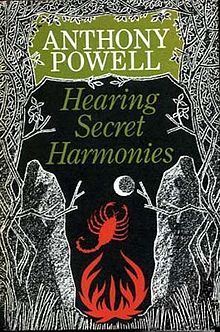
It’s an ideal world of celestial harmony… but the dark shadow of Aleister Crowley is always present there.
The old get older and the young are full of hopes. The young talk revolutions and the future, the old talk diseases and myths of the past…
Profile Image for Whitaker.
299 reviews578 followers
July 16, 2014
Certain books are age specific: not in a "Suitable for ages 7 and up" way; they just have to be read at the right time in life to truly resonate. Catcher in the Rye has, I think, to be read in one's adolesence; any older and the angst would just grate. On the other hand, I would say that Powell's A Dance to the Music of Time can't be read any younger than one's middle years. I don't think the way it captures so perfectly the unexpectedness of life's trajectories would make any sense to anyone younger.

I look at where I am now, and where my peers in university are now, and I don't think any of us could have thought that we'd be where we are. I've seen people who were written off as mediocre go on to have exciting careers in New York. The wild child settled down to a very respectable conservative Christian marriage. On the other hand, the star student from a respectable family ended up embezzling money from his clients and after several years on the run is now in jail. A few people came out; childhood sweethearts got divorced; the boy-next-door best-possible catch had an affair and then moved on to sleeping with the interns.

It's not as if I even followed any of these people's lives or that they were my closest friends. Some I read about in the papers (the embezzler), others were of the Foot-in-Mouth variety chance meeting (So, how are you and S doing? Oh, right, I'm so sorry to hear about the divorce. Er, so, nice weather we're having.), and others of course were the, OMG, did you hear about D? But that's how life is. We lead our own lives, hang out with our friends, go through our life changes and end up in places we never thought we would, see friends go through their own peculiar journeys, and hear about the many many others we never really kept in touch with.

A Dance to the Music of Time captures that ebb and flow perfectly. At 20, you think you got it all worked out. At 40, you realise that nothing is ever truly worked out, and the best you can do is just keep up with the changes. I can't think of a better work to have read at this juncture of my life. I would truly love to have thrust it into my sweaty eager 20-year old hands with the urgent injunction to "Read it, just read it. This is what living is going to be like. Not all of it is going to be fun, and it isn't going to work out the way you think it will, but I promise you, the experience is all worth it." But the truth is, at 20 I wouldn't have got it. Now in my 40's, with some wryness and recognition, I do. I can't wait to see how I'll react when I read it again in my 50's and in my 60's.
Profile Image for Diane Barnes.
1,616 reviews446 followers
December 12, 2016
It is with a great sense of accomplishment that I finish this twelfth volume in Powell ' s "A Dance to the Music of Time." I had wanted to read this for many years, but was daunted by the sheer scope of reading over 3000 pages. Last year I was invited to join a small group reading and discussing one volume per month, which seemed to be possible. It has been a wonderful experience; I have looked forward to each month's installment, the discussion of art, music, literature, and all the characters who brought the middle of the 20th century in England, between the wars and into the 1960's, to life.

These 12 volumes are narrated by Nick Jenkins, beginning with his time as a schoolboy just after WWI, and ending in the late 60's. They seem to encompass everyone (over 300 characters) and everything. The humor is amazing and witty, the passage of time handled brilliantly, and the characters unsurpassed. What can be said to explain the rise and fall of Kenneth Widmerpool? What a creation!

I am both thrilled and sad to finish this work. Thrilled to have read it, sorry that I won't have more to look forward to.
Profile Image for Ted.
515 reviews737 followers
December 16, 2016
Two compensations for growing old are worth putting on record as the condition asserts itself. The first is a vantage point gained for acquiring embellishments to narratives that have been unfolding for years beside one’s own, trimmings that can even appear to supply the conclusion of a given story, though finality is never certain, a dimension always possible to add. The other mild advantage endorses keener perception for the authenticities of mythology, not only of the traditional sort, but – when such are any good – the latterday mythologies of poetry and the novel.


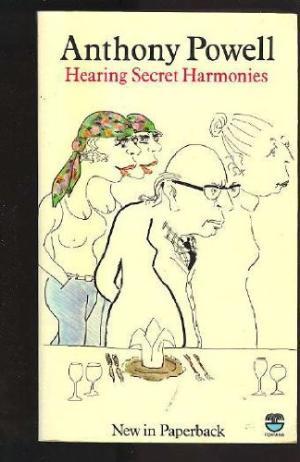
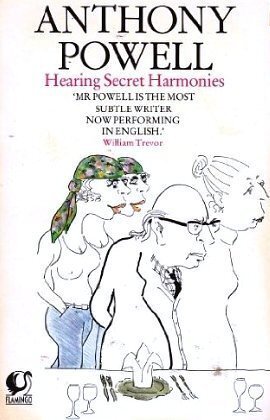
cover suggested by title-related themes

or perhaps


featuring the Quiggen twins


Takes place: spring 1968 to autumn 1971.
Nick Jenkins now in his early 60s – his seventh decade.
Book published: 1975, 24 years after the first volume. Anthony Powell then 70. Nick Jenkins came close, but will never be able to catch his creator in age. Powell will live to be 94, but for Nick the end has come, since this is the final book in the dodecology (to stretch a definition).

The eleven main characters (by roughly the number of pages they are referenced on – with new characters in bold) – Widmerpool (“Ken”, please), Leslie Murtlock, Russell Gwinnett, Fiona Cutts (almost a new character – her birth rated a brief notice in Books Do Furnish…), Isobel Jenkins (nee Tolland), Barnabas Henderson, Mark Members, ‘Bith’ Bithel, Amanda & Belinda Quiggin (new like Fiona Cutts), the Rev Canon Paul Fenneau (a very strange case), Sir Magnus Donners, X. Trapnel. The last two rise from the dead to dance one more time.

The war has been over for a quarter-century.

Three of the leads (Leslie Murtlock, Fiona Cutts, Barnabas Henderson) are two generations younger than Nick Jenkins.


Secret Harmonies

The first chapter finds a caravan parked on the Jenkins’ land, the four occupants (one being their niece Fiona Cutts) engaged in a crayfish expedition organized by Nick and Isobel. Besides another young woman (Rusty) the group includes both new/main characters, ‘Scorpio’ Murtlock and Henderson; the two girls wearing T-shirts advocating, or proclaiming, HARMONY. This seems harmless, even desirable. But Jenkins’ narrative suggests darker connections, as we read the group described, by Fiona’s parents, as a cult, Murtlock as ‘spooky’ and ‘creepy’; and soon enough Jenkins himself is using such as “gnomic pronouncements”, “Shortcuts to the Infinite, Wisdom of the East, Analects of the Sages”, “hypnotic powers”, “the ability to impose oneself on others” in describing his own reactions to Murtlock.

I was reminded of the astonishing scene in the penultimate chapter of the previous novel, involving Widmerpool, his wife Pamela, and Mrs. Erdleigh (“the Sorceress”) – witnessed by, most usefully for the telling afterwards, both Hugh Moreland and Odo Stevens – as perhaps a foretelling of aspects of the “secret harmony” theme. Mrs. Erdleigh’s enigmatic pronouncements to Pamela, the sequence described by Moreland as “the Sorceress in the ascendant, Lady Widmerpool afflicted”, the words themselves by Jenkins as “cabalistic dialectic”, her “final warning” enunciated thus:
Court at your peril those spirits that dabble lasciviously with primal matter, horrid substances, sperm of the world, producing monsters and fantastic things, as it is written, so that the toad, this leprous earth, eats up the eagle.

Here things began to coalesce, blend together for this reader. Mrs. Erdleigh herself, as seer, palm reader, medium, as well as Dr. Trelawny, are both types intimately associated with these narrative threads - but now have passed beyond the pale, and though mentioned in the finale, their spirits are not up to the task of providing a living, breathing exemplar.

For this, Powell reintroduces the Rev Canon Paul Fenneau, the only character I know of that appeared in the first volume (at a Sillery tea party in 1924, a bashful undergraduate, where Nick catches the “Paul”, but misses his surname) and has subsequently vanished from Jenkins’ life for over forty years, now appearing for representation of the type, even though with a religious pretext; and to play an intermediary’s role in the final movements of the dance. Fenneau, interested in Alchemy, mindful of the Philosopher’s Stone, occultism, having “the moist dreamy eyes of a medium”, whose “Your servant”, to an enquiry from Widmerpool, is voiced “like a djinn rising vaporously from an unsealed bottle.”

And what else is involved in this other-worldly narrative skein? The power of the Mage, Secrets only revealed to the initiate (thus secret harmonies); Dr. Trelawney’s role of thaumaturge; his and Mrs. Erdleigh’ s view that “death no more than transition, blending, synthesis, mutation”.

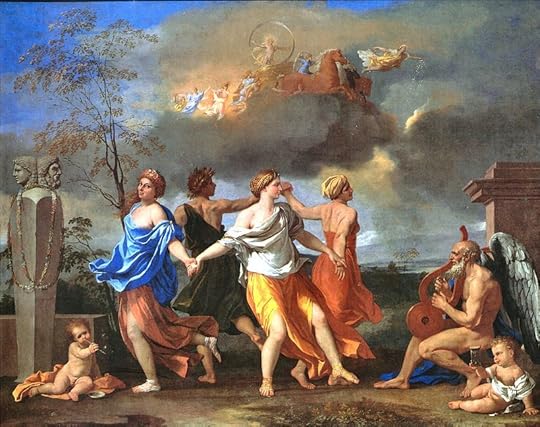
Time itself is woven in, by direct reference to the Nicolas Poussin 17th century painting, now called Dance to the Music of Time. (Yes, we’ve heard that title before, haven’t we?) Nick refers to this as a ‘painter’s time’, contrasting it to a ‘writer’s time’ as exemplified in Ariosto’s 16th century poem Orlando Furioso, which plays as significant a narrative role in this novel as Burton’s Anatomy of Melancholy did in Books Do Furnish …. Significantly, Nick mentions the Valley of Lost Things from the poem, a location on the moon holding all those things lost by the inhabitants of Earth: “lost kingdoms, lost reputations, lost hours, lost vows, lost love.” Might we add, "lost Time"?

The title, Hearing Secret Harmonies, finds its way into both a phrase used by Mrs. Erdleigh (“the liberated soul ascends, looking at the sunset towards the west wind, and hearing secret harmonies”), and a disquisition by Fenneau:
An element of Gnosticism emphasizes the duality of austerity and licence, abasement as a source of power, also elements akin to the worship of Mithras, where the initiate climbed through seven gates, or up seven ascending steps, imagery of the soul’s ascent through the spheres of the Planets – as Eugenius Philalethes says – hearing secret harmonies.
Powell brings the novel, and the Dance, to a sublime conclusion, writing of a bonfire on his property near a quarry, that its smoke “now brought back that of the workmen’s bucket of glowing coke, burning outside their shelter" – thus referencing the second sentence of the Dance, eleven novels and hundreds of thousands of words ago; and following with a “torrential passage” (Nick’s phrase) from Burton’s Anatomy: “I hear new news every day of … A vast confusion of … Now comes tidings of … then again, as in a new shifted scene, … Today we hear of … “. Then concludes:
The thudding sound of the quarry had declined now to no more than a gentle reverberation, infinitely remote. It ceased altogether at the long drawn wail of a hooter – the distant pounding of centaur’s hoofs dying away, as the last note on the conch trumpeted out over the hyperborean seas. Even the formal measure of the Seasons seemed suspended in the wintry silence.
The Grand Finale

For me, Powell’s finale to his series is magnificent, even transcendent. (It’s the only time in reading many hundreds of pages that tears came to my eyes.) I might argue that the entire series is worth reading for the sake of this concluding volume.

Harmonies, Time, Lost Things – and all the rest, woven into an astounding pattern, interconnections leading one to and fro, back and forth, stopping nowhere, time suspended, then advancing, the individual finally dropping out of the dance; which yet continues without her, younger generations having already filled in.


As we dance our way through Time, we discover new, surprising, exciting interpretations of steps already taken, without full knowledge of what was involved, or being unfolded, when we first learned those steps. Continually discovering anew, for our understanding, amusement, artistic appreciation, sexual and emotional reverberations, an always changing blend of each participant’s unique contribution – to the music, heard differently by everyone, ultimately composed by all.


A Dance to the Music of Time, Nicolas Poussin, ~1635 (this title first seen in 1913, various titles used prior to that)


Afterward For stat geeks only.


Profile Image for Nigeyb.
1,476 reviews404 followers
November 27, 2024
It's curious to consider that when Anthony Powell wrote Hearing Secret Harmonies the final novel in the twelve-novel series A Dance to the Music of Time, and despite the series starting in the early twentieth century, that it was almost contemporaneous, being published in 1975, and taking place in the late 1960s and early 1970s, and makes references to hippies, the permissive society, Vietnam, and Enoch Powell.

The final two volumes, Temporary Kings and Hearing Secret Harmonies, each move the narrative forward by around ten years, whih allows for some dramatic changes to have occurred, the most notable change is in Widmerpool whose trajectory changes in ways that would be difficult for anyone to imagine earlier in the series.

Anthony Powell finished the series with a real flourish. Hearing Secret Harmonies embraces the late sixties counterculture and contains some truly stunning scenes. He also manages to introduce yet more new characters, including the memorable Scorpio Murtlock and his Harmony cult.

A Dance to the Music of Time is magnificent. Reading the series has been such a fabulous experience. Anthony Powell is a master. Although the books can be read and enjoyed individually, and on their own terms, the real pleasure is in reading all twelve books, and enjoying a narrative that takes place over a seventy year time span. Calling his series ''A Dance" is a perfect metaphor, as Anthony Powell is akin to a choreographer, who intricately keeps track of over four hundred characters across more than a million words. It's a stunning achievement, and throughout, his beautiful writing is as much of a joy as the ingenious plot and his ambitious, and completely successful, cultural and social history of England throughout the twentieth century.

The star of the series is undeniably Kenneth Widmerpool, one of the most memorable characters I have ever encountered in a book. Widmerpool is a contemporary of narrator Nick Jenkins and, despite not being friends, he crops up somewhere in every volume. Whilst narrator Nick, along with many of the characters, represent musicians, poets, novelists, painters etc., Widmerpool is the opposite, a ruthlessly ambitious person but a deeply flawed human being. I wonder to what extent he might represent the triumph of commerce and bureaucracy, over more aesthetic considerations.

A Dance to the Music of Time is a masterpiece - and one of the best literary experiences I have ever enjoyed. Profound, funny, dramatic, and remarkably accessible and easy to read. I read it first in 2014 and then a second time in 2024. It is a series I want to return to yet again as it's such a joy.

5/5

Profile Image for Darwin8u.
1,835 reviews9,036 followers
December 15, 2016
Obviously I'm going to chew on this last book for a bit and try and roll the whole thing up. Powell reminds me of one of those extreme runners. Those masochists who seem to enjoy running 50, 100, or more miles. The amazing things about writing 12 novels that are together nearly 3000 pages and written over 24 years (1951 - 1971), is how uniform these books are. I'm not saying uniform in a boring way. I'm just saying there isn't a real weak link in them. They are beautifully constructed. I think of big canvasses like the ceiling in the Sistine Chapel. Certainly, with such a big canvas the risk of a disappointing section or segment isn't linear. A big book, with more pieces and pages, comes with an exponentially growing level or risk. Powell just didn't have a shitty two years anywhere in that 24 years.
Profile Image for Connie  G.
2,144 reviews710 followers
May 30, 2020
The final volume of "A Dance to the Music of Time" series shows life as a circular dance with the younger generation repeating the same steps to the dance as the older generation moves out of the circle. In "Hearing Secret Harmonies" a 1970s hippie cult camps overnight at Nick and Isobel Jenkins' home in the English countryside. Isobel's niece has been mesmerized by the cult leader, Scorpio Murtlock. He leads the group in pagan rituals often tied to the seasons and the sites of ancient standing stones.

The book ties in mythology, literature, art, and spiritualist characters from earlier books. The Seventies was a time of youthful rebellion, sexual freedom, and experimentation with drugs. Kenneth Winderpool, a college administrator now, embraces the new age. Russell Gwinnett is researching Gothic symbolism of mortality, and also comes into contact with the mystic cult. The occult rituals of the group become increasingly sinister, and there is a power struggle between two of the members.

The twelve books in the series have been following Nick Jenkins' observations about life since he was a teenager. It is the satirical view of someone in the British upper class, well-schooled in literature, art, music, history, and culture, like the author himself. Nick and his friends are getting older. However, the circular Dance of Life will continue moving to the Music of Time.
Profile Image for Katie Lumsden.
Author 3 books3,772 followers
March 13, 2019
A really moving and fascinating end to the series - a bit weird, very powerful, and all together fantastic.
Profile Image for Eleanor.
614 reviews57 followers
December 31, 2015
"In my beginning is my end."

A brilliant final act in Powell's Dance. This last volume charts the decline and fall of Kenneth Widmerpool and brings this great work to a very satisfactory end. Wonderful stuff.
Profile Image for Hibou le Literature Supporter.
213 reviews13 followers
September 15, 2025
This ends surely the only way it could have ended. One question is could Powell have kept writing more books? I don't see why not. Admittedly, this review is more of the total work, than just book 12. At first and continuing throughout, I admired his piling-on of psychological takes on class and ambition, the mini-portraits that evolved as individuals encountered love, war, marriage, betrayal, death, etc., but starting in book 7 (of 12), what I began to really appreciate was the seriously playful world he created, the narrator managing to keep tabs on all of characters's adventures (of course, Powell's intention). There is a part of me that now wants to reach for book 1...
Profile Image for Laura.
7,132 reviews606 followers
December 11, 2016
is the final novel in Anthony Powell's twelve-volume masterpiece, A Dance to the Music of Time. It was published in 1975 twenty-four years after the first book, A Question of Upbringing appeared in 1951.

Completing his meditation upon the themes of time and will, the author recounts the narrative in the voice of a convincingly middle-aged Jenkins. (In the television adaptation of the novels an older actor was chosen to play Nick in the final part.)


4* A Question of Upbringing (A Dance to the Music of Time, #1)
4* A Buyer's Market (A Dance to the Music of Time #2)
4* The Acceptance World (A Dance to the Music of Time, #3)
4* At Lady Molly's (A Dance to the Music of Time, #4)
4* Casanova's Chinese Restaurant (A Dance to the Music of Time, #5)
4* The Kindly Ones (A Dance to the Music of Time, #6)
4* The Valley of Bones (A Dance to the Music of Time, #7)
4* The Soldier's Art (A Dance to the Music of Time, #8)
4* The Military Philosophers (A Dance to the Music of Time, #9)
4* Books Do Furnish a Room (A Dance to the Music of Time, #10)
3* Temporary Kings (A Dance to the Music of Time, #11)
4* Hearing Secret Harmonies (A Dance to the Music of Time, #12)
1,946 reviews15 followers
Read
December 28, 2025
How does one go about writing a Goodreads review for a book one has read 72 times? The whole sequence: A Dance to the Music of Time, all 12 volumes, 72 times. Obviously, I enjoy the novel. Recently I read a fellow Goodreads reviewer suggesting that one really needs to be middle-aged before turning to Powell in order to enjoy the book. That was not my experience. I was introduced to Powell's novel sequence at 20 and I have read it at least once a year every year since. In the beginning, I found myself drawn to Nicholas Jenkins (the narrator) in his teens and twenties. As I grew older, I found each novel deepening in its resonance. Now having passed what volume 11 (Temporary Kings) calls "one's fifties, in principle less acceptable than one's forties" I find myself still in harmony (secret or otherwise) with Nick and his musings, his "habit of mind" as he himself puts it with respect to two of his friends in the narrative, even when I don't necessarily agree with his judgments. I have wondered for over 30 years why I find myself, a man more left-leaning than right, a Canadian, and no higher socially than the middle-middle class, so fascinated by the work of a man of my grandfather's generation, a man far more right-leaning than left, a Briton, and married into the aristocracy. Still no answer, beyond the over-simplified one that, regardless of obvious differences, I feel completely "sympatico" with Nick Jenkins and am prepared to overlook any minor disagreements in the service of all I share with this invented individual and, by extension, as with many such cases, his creator. Jeff Bursey suggests, simply and accurately, maybe it’s just the quality of the writing. He may be right. But I feel that there is something undefinable beyond that. I have, at last, passed the point at which I have read Dance as many times as I have been years alive. I maintain my once-a-year habit of re-reading the sequence between my birthday and Powell’s. (Sometimes more than once a year, like 2025, when I read one volume per month as well as the usual "birthday-to-birthday" sweep.)
50 reviews2 followers
November 11, 2024
Collectively, A Dance to the Music of Time is one of the most extraordinary things I've ever read. The general consensus, with which I broadly agree, seems to be that the strongest individual volumes are those around the middle covering the years of the Second World War as well as its immediate prelude and aftermath (books 6-9), but it's the cumulative effect across all twelve which makes the cycle as special as it is, and Hearing Secret Harmonies caps it off perfectly.

The dryness of Powell's humour (intermittent forays into outright farce notwithstanding) and the matter-of-factness of his delivery mean that one is almost always blindsided by the sporadic moments of extreme pathos; part of me wants to immediately go back to the beginning and re-read the whole thing to revisit the characters' beginnings in the knowledge of what's to come, while another part of me wonders whether my emotional equilibrium would be sufficiently robust to see them all young again without first allowing myself an appropriate period of convalescence (say, ten to fifteen years).

I also really enjoy the way that the various references to art, literature and music are interwoven so as to enrich the themes and character arcs without ever alienating the uninitiated (which very often includes me); Powell manages to be unapologetically erudite without ever seeming to look down on anyone who doesn't share his frame of reference, or the personal cultural touchstones through which he interprets the events and the backdrop of his characters' lives and, one assumes, his own.

Most importantly, though, I struggle to think of many other novels (or series) which have given me so much genuine pleasure in reading; to get so much joy and heartbreak from what could reductively but not altogether inaccurately be described as twelve novels of upper-middle class people having fifty years' worth of slightly awkward social gatherings is quite remarkable.
Profile Image for Shaun Heenan.
138 reviews1 follower
January 10, 2019
One could look back at my history of giving mostly 3s and 3.5s to each individual volume and come to the conclusion that I wasn't particularly impressed with A Dance to the Music of Time. One could then dig a little deeper and notice that I read all twelve of these books over the course of just three months, which gives a clearer picture of my feelings. (Proust, definitely the nearest comparison, took me nearly a full year.)

While no volume by itself (with perhaps the exception of The Soldier's Art) stands out as something particularly special to me, the work as a whole is seriously impressive. I had a great time with these, and I'm a little sad to see the end of them.

For what it's worth, I think this final book is among the weakest of them.
Profile Image for Kristen.
674 reviews47 followers
March 6, 2022
This is something of a landmark review. It marks my completion of A Dance to the Music of Time, coming in just about a year after reading the first book, and it is my 500th review on Goodreads!

This five star rating may have a whiff of the lifetime achievement award to it, but the book itself was very good. I'm tempted to call it unexpected—would I have guessed that the series would culminate with Widmerpool becoming a minor countercultural icon, then joining a cult? It just feels so far from the first book culturally. The gulf between 1921 and 1971 seems so much greater than that between 1971 and now. Somehow, modernity happened during the series's 50 years.

However, the plot here is not incongruous with where Powell's being going all along. He's always been fascinated with spiritual leaders. Dr. Trewlany and Mrs. Erdleigh had been constant presences throughout the earlier books, representing the appeal of the mystical when put forth by a strong personality. Widmerpool's path also fits in with his constant striving to be outwardly admired in whatever milieu is most relevant at the time: athletics, business, the military, politics, academia, etc. "Cold-blooded. Keen on a thing for a moment, but never satisfied. Wants to get onto something else," as General Conyers put it in Book 4. The countercultural movement of the 1960s is nothing more than the latest venue for fame Widmerpool (and maybe everyone else). We've seen this before in Nick's disillusionment with socialism and patriotism.

It's also tempting to add something here about the series as a whole and what it has to say. I don't know if there is an easy statement to make to sum it all up. The series is not so much about life as it is an ambitious depiction of a life, and as such is inherently interesting if not naturally cohesive. In one of his more self-aware moments, Powell gives Trapnel the following snatch of dialogue as a part of a discussion on literary values: "Most forms of naturalistic happening are expressed in grotesque irrational trivialities, not tight-lipped heroisms." It's an apt tagline for the series.

Profile Image for Jane Wiewora.
188 reviews
September 13, 2025
68 weeks of slow-reading the 2948 pages of the 12 volumes of A Dance to the Music of Time has come to an end. I will miss it. Reading with the perceptive and fun group at #anthonypowelltogether on Bluesky has been a joy. It’s an epic of 20th century London that I had never heard of, but will now never forget. It had its ups and downs over these almost 3000 pages…yet the overall effect was stunning. I’m in awe of Anthony Powell’s craftsmanship in keeping track of and weaving together so many characters and so many incidents over so many years.
Profile Image for Arukiyomi.
385 reviews85 followers
February 27, 2015
And so it ends; the final volume in Powell’s A Dance to the Music of Time is complete exactly 365 days after I started it. Was it worth it. Yes, I’d say so. Did I love it. No, not really.

The book ends with some quite esoteric encounters with what can only be described as a cult. A collection of vagabond hippies have found inspiration in a collection of pagan rituals based on the life and work of the long deceased Dr Trelawney. Somewhat surprisingly, this cult enfolds one of the key characters and leads to his demise.

Nick meanwhile lives on some vast estate somewhere from which he occasionally ventures forth to provide opinion on literary prize-givings and other artistic comment. Again, we end the novel knowing little about him while discovering all sorts about everyone else.

The novel as a whole is definitely a good book, but I feel that it has become dated; I found the very medium that Powell uses of the narrator Nick Jenkins to be frustrating and shallow.

So, why dated? Well, Powell the book spans 50 years from the 1920s and the spirit of the age is captured marvellously along the way. There’s a real feel that Time is indeed the Music that the characters Dance to. It’s very evocative of every decade it works through and I loved the attention to this detail that Powell puts in each volume, in what are, in effect, individually relatively short novels.

The problem though is with the characters themselves. I guess Powell himself was a stuck up toff and this comes through from the very first volume at a grim boarding school, right through the sequestered commissioned ranks of officers in the war through to the echelons of the literary elite in Hearing Secret Harmonies. I don’t think there was a single character that I really liked. They all seemed completely engrossed in their own petty affairs, none of which made any difference at all to the real world.

Sure, some of them were artists and writers, but their books and paintings are almost deliberately obscure and aloof. Curiously, those two adjectives perfectly describe Nick Jenkins. Apparently he got married along the way and, I think, had a child or two but you’d never know it. He speaks at length about everyone he knows and even makes vast suppositions about those he has the briefest encounters with. But you learn almost nothing at all about his life. This seems a ridiculous oversight for such a talented writer. Did he do it on purpose then? Maybe. But if so, big deal. It doesn’t work for me.
Profile Image for Simon Mcleish.
Author 2 books142 followers
July 17, 2012
Originally published on my blog here in May 2000.

The final part of A Dance to the Music of Time concentrates on what has been an occasional theme until now, esoteric religion, as several characters become involved in what would probably today be described as a New Age cult. Most of the remaining long running characters (including the narrator, Nick Jenkins) are now in their sixties or seventies, and the title refers to both these elements - it is part of a quotation about being affected by mysticism ("hearing secret harmonies" of the universe) before death.

Aside from the final downfall of Kenneth Widmerpool, as his exhibitionist and masochistic side completely takes over his personality, there is little of interest in this novel, a fitting end to a series which has never seemed as good to me as enthusiastic endorsements of its stature by critics suggested. The whole collection is flawed by the colourless, neutral narrator; if it was intended to be naturalistic, we should surely be able to see how he has coloured his narrative with his own personality. The plot of the series as a whole is ludicrous, consisting mainly of a series of coincidences to reintroduce familiar characters. French novelists, notably Balzac and Proust, seem to do this gallery of human life idea far better.
Profile Image for Mary.
92 reviews4 followers
November 12, 2015
And thus, it's over. It took me quite some time to work may way through Dance, as I read other books between it, but the commitment was worth it. I started it with no realization of what I was getting into, it was a mystery book that sprang up on the nook account I shared with my mom. It was a whim, really. I just needed something new to read and it was there. At the first chapter I thought there was no way I would male it through the first book, let alone the last one, but how wrong I was. It sucked me in and turned out to be not only the largest work I have ever read, but also one of the best. There may come a time when something comes along in a similar vein that I like better, but it seems unlikely.
This final installment is among my favorites in the entire series. Like some others say, it is a bit unbelievable, but I am not looking for an altogether believable story, I am looking for a good one, and this delivers. Of course the pinnacle moments undeniably go to widmerpool, who has consistently stolen the show but many new and old characters make grand impressions as well. All characters, however, are, as always, described through the steady point of view of our narrator nick Jenkins, who's wry humor and often erroneous assumptions make what could be a lackluster narrative hugely entertaining.
I will be sad to have no more Dance to read, but at the same time completing it is a point of pride. I'm happy to have made it this far and hope that my next endeavor, In Search of Lost Time, is as enjoyable. But I won't hold my breath.
919 reviews10 followers
December 4, 2025
The most excellent sendoff for the series and one of my favourite of the books. I feel the story was very focused, unlike most of the books where we jump from one notable life event to another, and this helped give a sense of ending.
The character of Scorpio was a wonderful addition and the progress of his influence over other characters was fascinating. Widmerpool's decline felt very fitting while remaining both funny and tragic. Widmerpool had returned to being the subject of ridicule after getting power and 'respectablity'.
The shadow of long departed characters was felt (notably Mr Deacon and Dr Trelawney) in the events or the almost reincarnation of their characteristics in other younger characters.
There was a recurring thing throughout the book which i found increasingly funny. Characters (younger) would introduce Nick to someone or something he knew from the past (eg.Deacon's paintings or Jean) and then dismiss him when he said he knew them/it. Like someone who is old hasn't lead a life outside of their old age and couldn't know better.
Reading this series over the course of twelve months has been the most benefitial experience and is something i intend to do again in the future. Knowing how many of the character's lives will turn out and who is most important to Nick will make for a different experience on the re read.
Profile Image for Corey.
Author 85 books279 followers
August 20, 2014
This concludes Powell's 12-novel cycle, 'A Dance to the Music of Time.' In short, it is one of the towering achievements in literature, an astonishing admixture of history and memoir in fictional form. And, Kenneth Widmerpool, the cycle's antagonist, is one of the greatest creations in fiction.
Also I must give a shout-out to Hilary Spurling's 'Invitation to the Dance: A Handbook to A Dance to the Music of Time,' an indispensable guide. My thanks for my friend Tess Parker for steering me to it.
Profile Image for Illiterate.
2,780 reviews56 followers
November 19, 2022
Powell's milieu is the upper middle class between the wars. He doesn't get the post-war world. Here the hippies are a cult imagined as Jacobean alchemy.
Profile Image for Martin Jones.
Author 5 books5 followers
December 15, 2021
Hearing Secret Harmonies is the last of twelve volumes in Anthony Powell’s A Dance To The Music Of Time sequence.

I really enjoyed these books. They provided company during a tough year, even came with me into hospital at one point. I felt compelled to write something that did them justice. But after a lot of flailing around I eventually took my cue from Hearing Secret Harmonies itself, a book which would advise against beating yourself up in trying to bring a series of reviews to an impressive conclusion. Endings, at least as far as fiction is concerned, are usually presented in terms of tying up loose threads, solving mysteries, romantic protagonists getting together. But Nick Jenkins, our narrator, suggests that real endings in life are not like that. Real endings are occasionally triumphs, but more often they involve collapse, petering out, disaster, anticlimax. And even triumphs only last for a little while before you have to try again.

At one point, Nick Jenkins recounts a sad story, told to him by one of his friends

“It seemed to start so well, and end so badly. Perhaps that’s how well constructed stories ought to terminate.”

Since endings in life rarely tie up anything, maybe the best story endings have the same ambivalence. After following Nick from his childhood in the 1910s, through university, a period of youthful parties, an early career as a writer, interrupted by the war and then taken up again with increasing success through the post war years, Hearing Secret Harmonies ends in Nick’s old age. We are in the late 1960s and early 70s, a revolutionary time, which aspires to close a door on the past. And yet things have not really changed. Nick attends an art event where some of the guests wear white ties and black tail coats, while a more rebellious “artistic” constituency goes in for knock-about-the-studio garb, teamed with beards and long hair.

“… the rebels themselves seem as much survivors from an early nineteenth-century romantic bohemianism, as swallow-tailed coats and medals recalled the glittering receptions of the same era.”

The dancers in the Poussin painting A Dance To The Music Of Time - which inspired the title for this sequence of novels - move in all kinds of wild ways, but they do so going in a circle.

This of course makes the book sound deep and meaningful, which whilst true is nevertheless misleading. As always with Nick, we are in the company of someone who is moderate and easygoing, We wander into art galleries, attend wedding receptions, gossip with old acquaintances. There’s a characteristic irony about A Dance To The Music Of Time as a whole, which sees various mystically inclined characters - eccentric gurus, abstruse astrologers and the like - sounding ridiculous as they say things about the circle of life, only for Nick’s chit-chat to often suggest sentiments of a very similar nature. With Nick you get deep and meaningful in a relaxed, reassuringly superficial kind of way. He can make the point that life goes in circles, without, for example, having any inclination to join in with naked dancing around Stone Age monuments at midnight. Nick is too humble and self effacing to make a definite final point about life or happiness or anything else. There are no definite, final points with Nick. That’s why a sense of continuity is more persuasive coming from him than from say, someone who goes in for rituals around standing stones.

If you want deep and meaningful, it is here. If you want relief from deep and meaningful than that is here too. A good novel shows rather than tells. In the end, I would suggest that Anthony Powell, like all good authors, shows you something with an invitation to take what you need. He does not need to tell you what to take.
Profile Image for Realini Ionescu.
4,049 reviews20 followers
October 18, 2025
Hearing Secrets Harmonies by Anthony Powell
Sublime…you can almost Hear the Secret Harmonies…

Alas, this is the last of twelve volumes in the magnificent series A Dance to the Music of Time by the divine Anthony Powell

- The English Proust- this is how he was regarded by critics

Indeed, his chef d’oeuvre compares well with Remembrance of Things Past, probably the best novel ever written.
We have said goodbye to a number of main characters in the eleven previous volumes, starting with Charles Stringham.
We meet his sister again and Flavia- I cannot remember her other name- is now the mother-in-law of Widmerpool.
The Harmonies mentioned in the title refer to a theme that has appeared in the first part and throughout a Dance to the Music of Time.
Scorpio Murtlock that only makes an impressive, but belated appearance in the final tome is the third “occultist” to appear in the series
He follows in the footsteps of Dr. Trelawney, who was a colorful presence in previous titles and has a worthy “descendant” in Scorp.
There are funny runs in nature, with members of the cult led by Scorpio going about in the nude and even breaking into a wedding party.
The unbelievable transformation that takes place involves Kenneth Widmerpool, now Lord Widmerpool.
He wants others to call him Ken, dismissing the aristocratic title, for now he has become a rebel and an insurgent.

This is the man who represented the Evil in almost Pure Form, throughout all of A Dance to the Music of Time.
He was responsible in good part for the death of Charles Stringham and in an unquantifiable measure for his wife’s demise- Pamela.
Karma is responsible for what you get back, at least according to Buddhist believes and if you have been awful, you have to pay for it.
It is not pleasant to say that I liked the payback that Lord Widmerpool gets, but there it is... the monster deserved it.
At one point, he is anointed as head of a university and the ceremony is pompous and resplendent, until the Quiggin twins throw paint over him.
With this rascal behaving as I knew him from previous chapters, I was expecting and outraged bully to pour down all the magma and fire from hell.
Well, he does the opposite, seeing as he is transformed and on the way to Harmony and the godhead of the true…
- The Essence of the All is the Godhead of the True
This is how cult members greet each other and Lord Widmerpool becomes a follower in one of the most unexpected turns of events.
After the paint throwing incident, the dean of the university keeps the signs on his body and starts dressing provocatively…that is the way the old Widmerpool was in the past.
He brings the Quiggin twins to a soiree where a literary Donner prize was awarded and speaks about his new anarchist views.
As he speaks and horrifies his audience, with his ostentatious clothes- a red pullover at a black tie dinner- and his specifying, that was not in the program and anyway veered off the subject and into wild territory, something else happens

- The young twins throw in the middle of an upscale ceremony a stink bomb

There are other clashes and strange occurrences, some around the above mentioned group formed around Scorpio Murtlock.
There are bizarre rituals around places that have historical significance and legends around them, where some locals are scared to death by the appearance of spectres with horns, near locations which anyway had enjoyed a reputation of being haunted.
Members of the cult have to have sex with each other- all present with all the rest! - Including poor Lord Widmerpool- who has by now become Ken, pure and simple.

A climax is reached when a party of dirty, peculiar men and women dressed in robes show up in the middle of a wedding that takes place in a castle, which I imagine to be like Downton Abbey and the clash is funny.

Stupendous, exhilarating, enchanting, resplendent work…I could go on for a while with synonyms, but you’ve got my meaning by now.
Profile Image for Jason.
352 reviews5 followers
April 3, 2015
Wrapping up a twelve book series that spans a half a century is no mean feat, especially a series whose various plots are sprawling and inclusive of hundreds of named characters, and yet Anthony Powell provides a satisfying and thoughtful ending to A Dance to the Music of Time with his final volume, Hearing Secret Harmonies. The last three books of the series have been the most powerful and beautifully written, which only makes sense given that Powell’s experience as a writer, his familiarity with his world, and his understanding of what he can do with that world had only deepened over the twenty-four years he had been writing the books. In addition, I think that the character of the world shifts slightly after the war. While Powell has never indulged in nostalgia, and while I have argued that the effect of covering so large a stretch of time is to show the way things don’t change rather than the way they do—in spite of those things, there is something different about these last three books, a new interest and a new focus. Characters of mesmerizing will who pit that will against others have a unique place in these concluding novels.

While Pamela Flitton appeared during the war years, she takes on a much greater role in Books Do Furnish a Room and Temporary Kings. As Widmerpool’s wife and as a lover to both Trapnel and Gwinnett, her character is defined by her resistance to others and the ferocity of her actions. She and Trapnel are in direct conflict with Widmerpool, though Widmerpool rides out the storm as best he can, having faith that Pamela will return to him, even as it is unclear what either gets out of their relationship. With Trapnel’s passing, Gwinnett becomes the new rival for Pamela’s affection. The nature of his magnetism is more mysterious than Trapnel’s. Nick describes Trapnel as a man playing too many parts to decide the proper way to act, as a man who is always trying to reconstruct himself. Gwinnett, on the other hand, is fully formed, knowing precisely what he wants and seeking it with a fierce determination. Pamela is unexpectedly taken with him and gives herself to him fully. In Hearing Secret Harmonies, Gwinnett’s quiet powers arise again as he wins over Fiona while we are not looking. And while his hold over her is not as frightening as Murtlock’s hold over her, there is a parallel established between Gwinnett and Murtlock. And of course what all these powerful personalities have in common is their direct relationship, and competition, with Widmerpool.

Widmerpool has been an adversary to many over the course of the novels. His maneuverings have displaced Quiggins as St. Clark’s secretary, supplanted Duport as Donners right-hand man, effected Bithel’s removal from his position, and had an adverse effect on many others. He has gone toe to toe with Sunny Farebrother in the army and in the political world afterwards. And through all these conflicts, Widmerpool has had his way and engineered his movement up the chains of power. In these final three books, that power reaches its highest point and then crumbles away beneath him, sending him on an unrecoverable fall that ends in his sad death.

These issues of power and social position have been present throughout the earlier novels, but they have never taken center stage as they do in these most recent ones, especially in this final book. The counter-culture presented in Hearing Secret Harmonies is not all that different from the mainstream culture that it is reacting to. Widmerpool’s desire to “drop out” is really a desire to be king of a different realm, to become a spiritual leader as opposed to a political leader. But in the spiritual world, Widmerpool is outmatched by Murtlock. Murtlock is every bit as ruthless as Widmerpool, but he has charm and charisma in addition. The only two characters who resist Murtlock’s sway spiritually speaking are Canon Freneau and Gwinnett. The difference in these two men is that they are not competing with Murtlock for domination of anything other than themselves. Gwinnett’s ambitions are entirely his own, for his own studies, his own work, his own edification. He is independently willed, but he never forces himself on others, and I think that is part of Powell’s point.

Nick, our narrator, has never been the dramatic center of the story. He is the point around which all the stars of the system rotate, but only as a matter of perspective. Nick himself is not involved in all the goings on. He is not a man of ambition, not a man out to make a name for himself or gather followers. He is a private man who keeps matters of his own life as much out of his stories as he is able. The characters who are most attractive to him are those who are equally decent to others, those whose ambitions are private, or those who are humble or good-spirited failures. There is a treatise on power and peace here, but handled with the same gentle touch that Powell handles all of his other subjects. Compassion and an ironic eye are the recurring hallmarks of Powell’s style, and they are what makes reading his books so rewarding.

As a side note, I must say that I love the way that Murtlock’s cult is both specific to the late 1960s and early 1970s when this book takes place and part of the larger recurring theme of occultism as represented by Trelawney and Madam Erdleigh. This treatment is directly tied in to what I was saying in my post about Temporary Kings, in which history is shown to be constant even as the particulars change. The players and the specifics of their actions may change, but human nature and the nature of our exchanges with each other remains the same.

This is a collection whose whole is greater than the individual parts would suggest. I was pretty harsh in my review of the first book and some of the earlier books, but Powell achieves something greater than I expected from those early readings. Hearing Secret Harmonies is not an explosive conclusion, but then nothing about the series is explosive. Threads are wrapped up but the sense that life continues on as it ever did is preserved as well. A Dance to the Music of Time is a study not only of dozens of characters but of the character of humanity, and it is well worth the journey to delight in Powell’s prose, insight, and wit.
This entire review has been hidden because of spoilers.
Profile Image for Sammy.
954 reviews33 followers
May 31, 2020
"We live in a world in which much remains - and must remain - unrevealed."

I'm really rather thrown by this book.

I firmly believe that it is not a reviewer's task to dispute what the artist has tried to do; it is instead their lot to determine whether the artist has succeeded at their stated intention. So I will try not to be dismayed that, by killing off or retiring nearly every character in the series, and rendering Nick and Isobel Jenkins mere ciphers (a deliberate choice that has previously yielded much fruit), Powell was left with only two choices: to turn the final volume in the series over entirely to the remaining character of note, Lord Kenneth Widmerpool or, alternatively, to focus on new characters and situations altogether. I will also try not to be bemused that he chose the latter. Still, suppressing as I am any alleged dismay or bemusement, I can't help feeling that Hearing Secret Harmonies is almost entirely a failure, casting quite a pall over the not insignificant achievement of the Dance as a whole. (Perhaps, I might add as a caveat, the book will read stronger to me on future visits; being half the age of the characters and, for the matter, the novelist, may set me at something of a disadvantage - although personally I think that's the lazy philosopher's argument.)

It has been 10 years since we last saw Jenkins and his crew, and almost 50 since we first met him as a teenage boy. England has been through a Depression, a War, a complete cultural shift, and an artistic revolution. Now, a semi-retired author, Nick finds himself failing to understand the young, cherishing memories that have become ancient history to those younger than he, and viewing from a distance the grotesque downfall of a man he once knew.

There are some strong individual moments contained herein, although moments are all the novel has to offer. The mythic quality that certain things have taken on, from the Edgar Deacon painting Boyhood of Cyrus to the towering walls of Stourwater. Strength is gained primarily through a sense that the once joyous-seeming dance of the eponymous Poussin painting - first referenced by Nicholas in the opening of the first volume, A Question of Upbringing, and resurrected in his mind early in this one - has now becoming something more nightmarish, a danse macabre perhaps. A delayed final meeting with a character from long ago is (deliberately) almost devoid of feeling, echoing with the pain of having known someone so well half a lifetime ago. Some beautiful, sensitive landscape passages earn the novel a star, although Powell was always effortlessly good at same. And Flavia Wisebite - whose decision to have children caused so much angst in the long-run - wins the coveted Most Poignant Moment trophy when, at a wedding, she expresses her desire that the newlyweds will be happy, noting "I never was, but I hope they will be". We barely know the woman, but in that moment she is all of us.

Yet though some abides, much is taken, to paraphrase the great poet. For some reason Jenkins feels a constant need to sum things up in his narration, an urge he has very rarely felt before, as if Powell suspected he would somehow gain a vast new tranche of readers for the final volume. More to the point, the decision to keep Widmerpool out of focus (even when he does appear, it is usually across a crowded room) lends even more confusion to the sad tale of his final years. Even the reveal in the last chapter feels dreary. Not predictable as such, but - even for a case that ended up involving necrophilia, voyeurism, and state secrets - underwhelming. Perhaps it is in part because the aging novelist seems so blatantly uncomfortable with his subject matter. One might feel repelled by Jenkins' seeming dismissal of every woman under 30 for having obviously had multiple lovers (something he can tell just by looking at them, apparently) if it weren't for the fact that everything novel in the novel feels caricatured. I think "crazy cult in which fully-grown adults can't speak unless their leader wishes it" felt more believable in 1975, but from this vantage point it certainly does not. (I'm reminded of the failings in the final works of another once-great author, Lawrence Durrell's Quinx - see my reviews of that series for more.)

Perhaps the simple answer is that Powell was never quite able to conjure up for his later creations the same affections in the reader that we felt for the series' early characters - Stringham and Templer, of course, but also Le Bas, Uncle Giles, Audrey, Lady Molly, and so on. (Bithel, the Welsh soldier from the War Trilogy, reappears as an old drunk, and is one of the few highlights.) Perhaps, for all his love of unexpected and sometimes unintentionally comical coincidences, Powell seemed to have taken that criticism to heart, and so chose not to ply us with such in the final volume, instead unwisely focusing on the cult of Scorpio Murtlock. (I enjoyed the author's harmonies when they weren't so secret; changing a winning formula at the final gatepost seems unwise.) Perhaps the great joys and sorrows of his early years - which had furnished the material for so much of what made the Dance exhilarating - were replaced later in Powell's life by his obscenely comfortable and cosseted existence, and he simply could not fathom what stories were left to tell.

I do not have the answers. I do not seek to dismiss the Dance; indeed, it has rewarded me richly, and I will certainly return when next I hear the distant singer calling the players to order. Still, for all the talk (overstated, as Powell himself knew) linking this author to Proust, I find it a shame that Proust's great novel, although unfinished, leaves me with a much greater sense of revelation and wonder than this, for whose author Fate gifted the required months and years to complete it at leisure.

A puzzlement.
Displaying 1 - 30 of 138 reviews

Can't find what you're looking for?

Get help and learn more about the design.