Jump to ratings and reviews
Rate this book

A Dance to the Music of Time #10

Books Do Furnish a Room

Rate this book
Anthony Powell’s universally acclaimed epic A Dance to the Music of Time offers a matchless panorama of twentieth-century London. The tenth volume, Books Do Furnish a Room (1971), finds Nick Jenkins and his circle beginning to re-establish their lives and careers in the wake of the war. Nick dives into work on a study of Robert Burton; Widmerpool grapples with the increasingly difficult and cruel Pamela Flitton—now his wife; and we are introduced to the series’ next great character, the dissolute Bohemian novelist X. Trapnel, a man who exudes in equal measure mystery, talent, and an air of self-destruction.

240 pages, Hardcover

First published February 15, 1971

25 people are currently reading
792 people want to read

About the author

Anthony Powell

107 books334 followers
People best know British writer Anthony Dymoke Powell for A Dance to the Music of Time , a cycle of 12 satirical novels from 1951 to 1975.

This Englishman published his volumes of work. Television and radio dramatizations subjected major work of Powell in print continuously. In 2008, The Times newspaper named Powell among their list of "the fifty greatest British writers since 1945."

https://en.wikipedia.org/wiki/Anthony...

Ratings & Reviews

What do you think?
Rate this book

Friends & Following

Create a free account to discover what your friends think of this book!

Community Reviews

5 stars
309 (33%)
4 stars
437 (46%)
3 stars
147 (15%)
2 stars
31 (3%)
1 star
6 (<1%)
Displaying 1 - 30 of 130 reviews
Profile Image for Fergus, Weaver of Autistic Webs.
1,270 reviews18.4k followers
February 18, 2025
The latest and greatest news to blare from The Times' Sunday book pages is of a hitherto unknown, unpronouncable rowdyman/turned best-selling author, who - to make it easier to pronounce his name - goes only by X. Trapnel.

Trapnel turns trap for the recently-betrothed Lady Pamela, better half of that unconscionable twit Lord Widmerpool, and Pam's gone googly-eyed for X!

Heaven help us all.

And may Heaven help the poor depressive Nick Jenkins, who tells us this story, for whom that nobler-than-thou prig Widmerpool has occasioned many a rank Slough of Despond on his watch since boyhood!

***
I loved this book when I read it in 1981...

I was still in my own dreary slough of mourning for my Mom. To ease the pain, a month or two before I had devoured The Dark Night of the Soul (see my review) and The Story of a Soul (ditto) - and had now made the Decision to join the Church.

La chair est triste - hélas! -
Et j’ai lu toutes les livres…

When I bought this novel at Place Bell Books, it was for further diversion from my blues. It was the Spring of ‘82, and change was in the air (as it was more earthily for the round-heeled Pamela Widmerpool)!

A month after reading it, I was to sludge down the sidewalk of the cacaphonous four-half blocks of the westbound thoroughfare outside our highrise, en route to St. Patrick’s rectory, to request instruction in the Catholic faith.

Not knowing what my reaction there would be, I felt like a condemned convict on my way down the Green Mile!

But it went well. 10 months later I was accepted.
***

Wanna know another reason I made the move?

Well, like the depressive Nick Jenkins, diving for existential cover from the manic Widmerpools -

I wanted to Castle my Queen -

And give her - and myself - a Safe Haven from Chaos...

The Chaos of Lord and Lady Widmerpool's married HELL.
Profile Image for Vit Babenco.
1,783 reviews5,780 followers
December 22, 2018
The war is over and those who survived try to readjust to peace…
Books Do Furnish a Room turns around literature and books… And, of course, it turns around writers.
A novelist writes what he is. That’s equally true of mediaeval romances or journeys to the moon. If he put down on paper the considerations usually suggested, he wouldn’t be a novelist – or rather he’d be one of the fifty-thousand tenth-rate ones who crawl the literary scene.

But first of all the writers are human beings – they have their habits and preferences, and they want to live and love.
And surely Anthony Powell doesn’t forget critics and presumably his personal experience makes him quite sarcastic…
How one envies the rich quality of a reviewer’s life. All the things to which those Fleet Street Jesuses feel superior. Their universal knowledge, exquisite taste, idyllic loves, happy married life, optimism, scholarship, knowledge of the true meaning of life, freedom from sexual temptation, simplicity of heart, sympathy with the masses, compassion for the unfortunate, generosity – particularly the last, in welcoming with open arms every phoney who appears on the horizon. It’s not surprising that in the eyes of most reviewers a mere writer’s experiences seem so often trivial, sordid, lacking in meaning.

So A Dance to the Music of Time waltzes on magnificently.
Books Do Furnish a Room only for those who don’t read them…
Profile Image for Algernon.
1,839 reviews1,163 followers
October 28, 2016

Nick Jenkins has the postwar blues. He finds himself after demobilisation adrift in a city dominated by ruined, abandoned houses, reflecting an inner emptiness that somehow has to be filled with something. The title suggests books as a solution, art in general. The actual source of the quote in the text is slightly different, with more of a sexual connotation, a subtle reminder that we also need a sense of humour, especially in troubled times. Borage ("an excellent spirit to repress the fuliginous vapour of dusky melancholie." - Francis Bacon) and hellebore (what doesn't kills you makes you stronger) might also come in handy, at least according to one of Nick's favorite authors, Robert Burton. "Borage and Hellebore" is also the title of the academic study Nick Jenkins is currently (1946?) writing about Robert Burton and his "Anatomy of Melancholy" magnum opus.

burton cover

The title page showed not only Burton's own portrait in ruff and skull cap, but also figures illustrative of his theme; love-madness; hypochondriasis; religious melancholy. The emblems of Jealousy and Solitude were there too, together with those sovereign cures for melancholy and madness, borage and hellebore.

Melancholy in all its forms seemes to be the major theme of the last 'season' in the Dance. In the opening scene, Nick returns to his alma mater for research, an occasion to think of all the social ties that were severely cut down by the six years of war.

As the forlorn purlieus of the railway-station end of town gave place to colleges, reverie, banal if you like, though eminently Burtonesque, turned towards the relatively high proportion of persons known pretty well at an earlier stage of life, both here and elsewhere, now dead, gone off their rocker, withdrawn into states of existence they - or I - had no wish to share. The probability was that even without cosmic upheaval some kind of reshuffle has to take place halfway through life ...

Nicholas has more than financial reasons for going back to university, to what Burton himself called 'a silent, sedentary, solitary private life' . Coy as ever about his own family life, the narrator hints at the need for a quiet interval of introspection and life assessment, at the need to 'furnish' his inner landscape with something of true value and significance, something that transcends the numerous worries about food stamps, shortages of every basic necessity, career direction and social upheaval, troubles that have left deep scars on the British society in the aftermath of the war. It was a bleak time, and the author is quick with his Victorian analogy:

In the new year, without further compromise, Dickensian winter set in. Snow fell, east winds blew, pipes froze, the water main (located next door in a house bombed out and long deserted) passed beyond insulation and control. The public supply of electricity broke down. Baths became a fabled luxury of the past. Humps and cavities of frozen snow, superimposed on the pavement, formed an almost impassable barrier of sooty heaps at the gutters of every crossing, in the network of arctic trails.

[...]

Meanwhile, traditional textures of existence were laboriously patched together in an attempt to reaffirm some sort of personal identity, however blurred.

The difficulties of picking up your social life after six years of war was best illustrated for me in the meeting with one of Nick's former friends, once a raconteur and a partygoer, now distant, distracted, introspective, morose , a fine case study for Nick in relation to his paper on Melancholy in all its forms:

Life becomes more and more like an examination where you have to guess the questions as well as the answers. I'd long decided there were no answers. I'm beginning to suspect there aren't really any questions either, none at least of any consequence, even the old perennial, whether or not to stay alive.

The disconnect is also present in Nick's reunion with the lady who was the passionate love of his youth, now a smooth socialite that keeps her true feelings tightly under lock and key

In line with the bookish title, the structure of the present novel is built around the formation, the daily management and, ultimately, the demise of a private publishing house in London. Familiar faces : Bagshaw, Quiggin, Sillery, Gypsy Jones, Rosie Manash, Widmerpool (of course) are all involved in the new business. Nick is hired to manage reviews and reviewers, to handle public relations with fickle authors and investors, eventually to contribute to the literary magazine the house publishes, named "Fission" (a reference to modernism in the atomic age). The setting offers ample opportunity for Nick Jenkins to engage in his favorite pastime : observing other people's folly while keeping himself on the sidelines as much as possible. The overarching bleakness of post-war existence is tempered as usual by Anthony Powell's keen sense of humour, although I must say my laughs were often tinged with the awareness of the sadness and loneliness hidden under the sometimes grotesque, sometimes satirical pranks and plot twists.

Sadness and loneliness are the first words I associate with Pamela Widmerpool, formerly Flytton, and X Trapnel, a newly introduced writer character. They are arguably the stars of the show in this tenth installment of the Dance, the couple that leads the other dancers in the quadrille, the catalyst for events both comical and tragic.

Pamela serves a similar "Jack-in-the-Box" plot function as her husband Widmerpool, apt to suddenly materialize in the most unexpected place, with or without her husband : "His appearance at this moment was wholly unexpected." . I love how Powell can capture her essence with a single word, a reference to her "gladiatorial" sex life. Pamela takes no prisoners in her crusade against the whole world, discarding former lovers like broken toys, expert at finding the weakest spot in her partner's armour and plunging her sharp claws right in. Spiteful, fickle, so merciless in her attacks that the reader by now knows to expect 'a bumpy ride' whenever she shows up, Pamela is nevertheless a fascinating character study, like watching a natural disaster unfold, a volcanic personality so unlike the usual phlegmatic and undemonstrative, stiff-upper-lip British stereotype. I am also a little in awe at how Powell managed to integrate Pamela in his own Anatomy of Melancholy, hinting

Similar to Pamela Widmerpool, X Trapnel serves as a spanner in the works of polite society, a flashy personality that rubs many of his acquaintances the wrong way. He is as inconstant as Pamela in his love life, going through a posy of girlfriends in the short interval covered by the novel (about two years), but unlike the 'gladiator', his attachments are less destructive, more amiable in style.

Trapnel for me is interesting in both of the roles Powell asigns to him: as a social misfit struggling to make a splash and as an author, sharing with Nick and with Powell concerns about the art of the novel. In my early reviews I commented upon the core conflict in the Dance between the world of Will and the world of Art. Later, in the war years, the events were mostly compared with the world of Theatre. Trapnel combines all three aspects of life in a spectacular shell.

Trapnel wanted, among other things, to be a writer, a dandy, a lover, a comrade, an eccentric, a sage, a virtuoso, a good chap, a man of honour, a hard case, a spendthrift, an opportunist, a raisonneur; to be very rich, to be very poor, to possess a thousand mistresses, to win the heart of one love to whom he was ever faithful, to be on the best of terms with all men, to avenge savagely the lightest affront, to live to a hundred full of years and honour, to die young and unknown but recognized the following day as the most neglected genius of the age. The General (Conyers), speaking one felt with autorithy, always insisted that, if you bring off adequate preservation of your personal myth, nothing much else in life matters. It is not what happens to people that is significant, but what they think happens to them.

What General Conyers calls personal myth is, in Trapnel's case, the public image he builts for himself, the numerous and contradictory masks he assumes in his effort to impress. He is not the only Dancer to wear a mask (Widmerpool comes to mind). Powell justly remarks that all social intercourse is a sort of masquerade. Trapnel excells in the sheer number of disguises he adopts.

Habitual role-sustainers, artificial personalities : when the choice of part has been extravagantly incongruous, there are no limits to the craziness of the performance staged

The first meeting of two extremes of will, Trapnel and Widmerpool, results in one of the funniest examples of Brit humour (I think I first came across it in a Benny Hill Show). At a publisher party, Trapnel introduces himself to the self-important, newly minted Parliamentarian Widmerpool, and promptly proceeds to ask him for a handout, for reasons of being completely broke. When the Big Man sourly produces the required pound, Trapnel immediately hails for a taxi to take him home. The infamous pound will make a second show in the novel, as a plot device

The second aspect of Trapnel, and probably the only authentic 'mask' he wears, is the one of novelist who has written a succesful existentialist first novel "Camel Ride to the Tomb". Powell uses the occasion both for satire (see the hilarious pair of pompous London critics Sheldon and Shernamker. One has 'probably never read a novel for pleasure' , the other has a goal to 'establish finally that the Critic, not the author, was paramount'), for commentary on censorship (sexual in the case of "Sweetskin" and political in the case of "Sad Majors"), for economical stress (" He borrowed literally to keep alive, a good example of something often unrecognized outside the world of books, that a writer can have his name spread all over the papers, at the same time net perhaps only a hundred pounds to keep him going until he next writes a book. ) and for an earnest essay on the role of the novelist.

"'Tis not my study or intent to compose neatly ... but to express myself readily & plainly as it happens. So that as a River runs sometimes precipitate and swift, then dull and slow; now direct, then winding; now deep, then shallow, now muddy, then clear; now broad, then narrow; doth my style flow; now serious, then light; now comical, then satirical; now more elaborate, then remiss, as the present subject required, or as at the time I was affected." (passage borrowed by Nick from Burton)

- - - - -

A novelist is like a fortune-teller, who can impart certain information, but not necessarily what the reader wants to hear. It may be disagreeable or extraneous. The novelist just has to dispense it. He can't choose.

- - - - -

X is always very keen on spying, says there's a resemblance between what a spy does and what a novelist does, the point being you don't suddenly steal an indispensable secret that gives complete mastery of the situation, but accumulate a lot of relatively humdrum facts, which when collated provide the picture.

>><<>><<>><<>><<

I left out of my comments the usual remarks about the flawless prose of Powell and connection between Trapnel and Melancholy, the key to the whole novel and so not to be spoiled by incautious comments. I must though include the punchline, a surprisingly personal and poignant confession of disillusionment 'halfway through life':

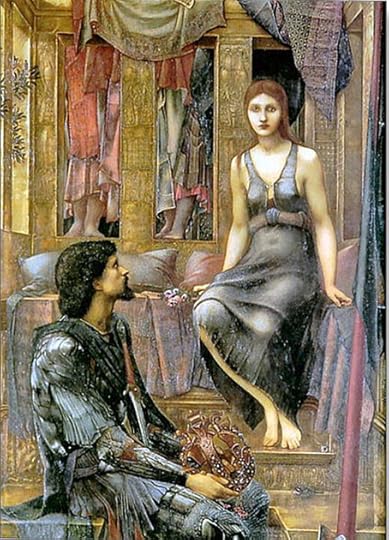
Trapnel and Pamela

["King Cophetua and the Beggar Maid" - a painting referenced in the novel]

In these sunless marshlands of existence, a dwindling reserve of pep-pills, a certain innate inventiveness, capacity for survival, above all the mystique of panache - in short, the Trapnel method - just about made it possible to hang on. That was the best you could say.
Profile Image for Darwin8u.
1,835 reviews9,035 followers
October 13, 2016
"Imagination must, of course, select and arrange reality, but it must be for imaginative ends: all too often the role of imagination in this sequence is to funny-up events and people whose only significance . . . is that Powell has experienced them."
- Philip Larkins, in a review of 'Books Do Furnish a Room'

description

Anthony Powell's 10th book in his 'Dance to the Music of Time' cycle starts with a discussion of Robert Burton's The Anatomy of Melancholy* and this book (and themes of melancholy and love) reappear frequently throughout the novel.

The central plot thrust of book 10, or the first book of the final season/October (if you will) centers on X. Trapnel a novelist loosely based on Julian McLaren-Ross a writer described by his biographer as "mediocre caretaker of his own immense talent". This novel is the first of the post WWII novels. It takes place in the years immediately after WWII when England is dealing with the social and economic turmoil of the Post war years. Powell describes these changes by describing how the sea and tides will roll certain things back, lose certain things, and propel new things onto shore. I'm obviously paraphrasing because it is late and I haven't the energy right now to find the damn quote. Anyway, it was an interesting brick in this series, not my favorite, but rewarding for some of its dialogue and plot twists.

* An amazingly rich work that I'm almost done with myself (I've got two hundred pages left in the last of the three partitions. I've spent about 3 years worth of Sundays intermittently reading while sitting through church. I'm not sure of my wife is thrilled with me reading Burton in Church, but Burton's explorations of Melancholy seem to almost need an altar or some sacred space to read it near.
Profile Image for Nigeyb.
1,475 reviews404 followers
September 24, 2024
Books Do Furnish a Room (1971) is the tenth of Anthony Powell's twelve-novel sequence A Dance to the Music of Time

Books Do Furnish a Room follows straight on from the trio of war volumes (The Valley of Bones (1964), The Soldier's Art (1966), and The Military Philosophers (1968)) and takes place in the immediate post-war period of 1946 and 1947. It is strange, and informative, to read an evocation of the atmosphere of post-war austerity in England, a period that doesn't appear to feature too often in literature (in contrast to the pre-War years and the war itself).

As the title suggests, Books Do Furnish a Room is about publishing, and specifically the publishers, Quiggins and Craggs, including their new literary magazine Fission which Nick Jenkins joins. Plenty of pre-war characters reappear, along with a younger bohemian crowd most notably the up-and-coming novelist X. Trapnel (famously based upon a literary hero of mine Julian Maclaren-Ross). From what I know of Julian Maclaren-Ross, X. Trapnel appears to be a fairly faithful rendition of his personality, and his strengths and foibles.

At the start of Books Do Furnish a Room we discover that narrator Nick Jenkins is writing a study of Robert Burton author of "The Anatomy of Melancholy", which was first published in 1621. I had never heard of Burton, or his book, but was inspired to find out more. The full title of The Anatomy of Melancholy is "The Anatomy of Melancholy, What it is: With all the Kinds, Causes, Symptomes, Prognostickes, and Several Cures of it. In Three Maine Partitions with their several Sections, Members, and Subsections. Philosophically, Medicinally, Historically, Opened and Cut Up" which I think gives a good indication of what the reader might expect. Nick Jenkins makes numerous small references to Burton throughout this volume which doubtless adds yet another layer of enjoyment for Robert Burton aficionados.

After the formality of the war years, Books Do Furnish a Room contains more humour and Anthony Powell seems to consciously add in more comedy including one of the funniest accounts of a funeral I have ever read.

Pamela Flitton, who we first encounter in The Military Philosophers, continues to live up to her billing as the ultimate femme fatale and, once again, wreaks havoc. She is a wonderful literary creation.

Meanwhile, our narrator, Nick Jenkins, now in middle age returns to both his university and his school in this volume which provokes reacquaintance with some old characters, and reflections on his younger self.

As with previous volumes, this book is funny, wise, compelling and addictive. Taken as a whole, A Dance to the Music of Time is really something special, one of the best things I've ever had the pleasure of reading, and now rereading.

4/5


'He is, as Proust was before him, the great literary chronicler of his culture in his time.' GUARDIAN

A Dance to the Music of Time is universally acknowledged as one of the great works of English literature. Reissued now in this definitive edition, it stands ready to delight and entrance a new generation of readers.

The ninth novel in Anthony Powell's brilliant twelve-novel sequence, A Dance to the Music of Time.

Profile Image for Diane Barnes.
1,613 reviews446 followers
October 15, 2016
The years immediately after the war are full of changes for the ones who survived, and a new generation is in the wings. England must have been a sad, gloomy place at that time, with little work to be had, and destruction all over London. This is #10 in the 12 volume series.
Profile Image for Ted.
515 reviews737 followers
November 9, 2016

In the new year, without further compromise, Dickensian winter set in. Snow fell, east winds blew, pipes froze, the water main (located next door in a house bombed out and long deserted) passed beyond insulation or control. the public supply of electricity broke down. Baths became a fabled luxury of the past.


or, if you prefer,


Takes place: winter 45-46 to late autumn ‘47.
Somewhere in here Nick Jenkins has probably entered his fifth decade.
Book published: 1971. Anthony Powell was 65 years old.

The main characters (by roughly the number of pages they are referenced on – with new characters in bold) – Widmerpool, X. (Francis Xavier) Trapnel, Pamela Flitton, Lindsay 'Books-do-furnish-a-room' Bagshaw, J.G. Quiggin, Viscount Erridge, ‘Sillers' Sillery, Gypsy Jones, Roddy Cutts, Leonard Short, Howard Craggs, Ada Leintwardine - and with a tip of the hat to Robert Burton, the 17th century writer of The Anatomy of Melancholy.

One thing I noted when making this list is that, whereas in the preceding books set during the War, a list mentioning characters who had fifteen or more pages in the novel circumscribed a cast of about ten. But in Books Do Furnish a Room that 15-page level of engagement would require a playbill mentioning almost twice as large a cast.

This larger cast, though not surprising given the situation of the war narrative in the prior volumes, does indicate the general truth that now, with the war over, Powell’s characters, Jenkins as well as the others, are beginning to reestablish the prewar variety of everyday human connections. In a similar way, many of the characters which would be shown on the lower half of such a playbill would again be members of the Toland family, Jenkins’ in-laws. During the war, there was the occasional set piece in which several Tolands were present – and of course Jenkins’ wife Isobel was never too far in the background. But with the war now over, these lesser familial connections again take a more prominent role in Jenkins’ affairs.

Moving into the post-war years, Powell shows us that Jenkins - and by implication society in general - has been freed from the necessarily more focused regimen of his life during the war. Not that everything has returned to “normal”, as so defined in pre-war days, but rather that there is an attempt, a yearning, to refocus on some routine, some way of life, which had been abrogated by reason of that regimen.


Widmerpool

Windmerpool, as in the previous two volumes, plays the leading role, and Pamela (as in her introductory role in the last book) is an extremely important character. How has this come to be? Is Powell saying something extremely important about Widmerpool as a type?

In searching for an answer, I thought of a regular feature that I remember from the old Readers Digest my parents received when I was young – something like “The Most Unforgettable Character I’ve Ever Met”.

I think many (most?) of us can bring up someone from our life’s passage, perhaps someone we may not have even been emotionally close to, who has remained lodged in our memories over the years. Someone not constantly in mind, but a person who, for reasons obvious or obscure, pops into our consciousness at random intervals – and someone who, once resurrected from the unconscious, floods us with a certain set of memories, pleasant or otherwise, that remains clearer and more detailed than there seems any reason to warrant.

This isn’t a perfect likeness. Widmerpool is much more (to Jenkins) than a mere set of memories revisited at odd times through his life. He is a character encountered again and again, and in the years of these later volumes, for extended periods of time, with frequent personal contact. Yet for all that imperfection, I see (for myself) Widmerpool best viewed as that Unforgettable Character (that I really do have in my own life) – not someone so knit into my experience as Widmerpool is to Jenkins, but someone who shares many of the colors with which Powell paints him. A person whom one can get along with, but unpleasant, not well-liked, full of himself – and one who has enough interaction with oneself and one’s friends, and enough force of action, to play a negative role in things.


Books Do Furnish a Room

There’s no mystery where this book’s title comes from. You must have seen the source in that list of characters above. Jenkins even tells us a couple legends of how Bagshaw’s sobriquet arose – one involving a large bookcase toppling on him, another involving the man advancing naked through the book-lined study of a drama critic, toward a paramour (being the critic’s wife) – in both stories Bagshaw having uttered the titular phrase. (Though Jenkins admits that the truth of the matter “was lost in the mists of the past”.)

But apart from Bagshaw’s appellation, his entire career serves as a signpost to the topic which the book’s narrative swirls around – that of books, books, books – the writing and the publishing world of the post-war years. Despite lingering paper shortages, almost all the significant characters in the novel are involved in one way or another in producing copy for the larger world to read.

The central enterprise which links most of these characters is Quiggin & Craggs, a left-leaning publishing house established after the war by Quiggin (Marxist) and Craggs (left wing pub.); and especially a Q&C house magazine, Fission. Widmerpool, now a Labour MP, is on the board, and uses Fission as an outlet for the promulgation of his political and economic views; X. Trapnel an up and coming author signed by Q&C, frequent contributor to the magazine; Bagshaw a longtime journalist, “deeply learned in left-wing lore”, and editor of Fission; Sillery, well-remembered don from Jenkin’s school days, reentering the narrative and signing a lucrative deal for his diaries with Q&C; Gypsy Jones, long time CP member, now married to Craggs and influential in unofficial capacity as promulgator of the party line; and Ada Leintwardine, Sillery’s secretary after the war, joining Q&C in similar capacity, but soon published herself as a novelist.

The publishing world in these years, for Jenkins, saturated with the fellow-traveler, Communist-impregnated fog of the pre-war years, the Fascism of the ultimate enemy now vanquished, once again the specter of Marx rising out of the ruins – Russia to be viewed as a valiant partner in the triumph, a beacon to a more just economic world? Or as a virulent foe, now that the preliminary bout won, standing in the way of a less-revolutionary progress?

Powell uses this world of writing to manufacture a magnificently satirical (and ridiculous) compendium of titles, mentioned as dating to, or recalled in, these years: from memoirs of the war by unnamed authors [one of these not mentioned by the author] (Moss off a Rolling Stone, Crying or Laughing Out Loud: When Did It Matter?, Purged Not in Lethe, Slow on the Feather, Stockbroker in Sandals); to titles casually mentioned [ditto] (Comrades at First Sight Yet Lovers in Arms: A Novel, A Hundred Disagreeable Sexual Experiences, Marx Without Tears, The Pistons of our Locomotives Sing the Songs of Our Workers); to books and articles written by the characters, forming structural elements in the narrative (Affirmative Action and Negative Values, Assumptions of Autarchy v. Dynamics of Adjustment, Bin Ends, Camel Ride to the Tomb, Profiles in String, Dogs Have No Uncles, Borage and Hellebore: a Study, Integral Foundations to a Fresh Approach to Art for the Masses, I Stopped at a Chemist, Mimosa, Miscellaneous Equities, Paper Wine, Secretions, Sad Majors, Sweetskin, Unburnt Boats); and finally a lecture delivered by Mark members, Kleist, Marx, Sarte, the Existentialist Equilibrium.


Borage and Hellebore: a Studyor, Time Marches On

As the book opens, we find Jenkins returning to university to engage in research for his only non-fiction book, named above. Rather inaptly named as far as sales go, a study of Robert Burton. (Well, the plants borage and hellebore are both mentioned by Burton, but who would know?)
Reverting to the University at forty, one immediately recaptured all the crushing melancholy of the undergraduate condition. As the train drew up to the platform, before the local climate had time to impair health, academic contacts disturb the spirit, a more imminent gloom was reestablished, its sinewy grip in a flash making one young again. Depressive symptoms, menacing in all haunts of youth, were in any case easily aroused at this period, to be accepted as delayed action of the last six years. The odd thing was how distant the recent past had become, the army now as stylized in the mind – to compare another triumphal frieze – as the legionaries of Trajan’s Column, exercising, sacrificing, sweating at their antique fatigue, silent files on eternal parade to soundless military music.



Jenkins and Burton – the melancholy brought on by advancing time. Into the war as a still-young (or at least youngish yearning) man, out of it as one entering, perhaps already arrived in, middle age - even though not directly involved in the most intimate aspects of facing the enemy. The abrupt shift in perspective having been brought about by the war years, which form a chasm across which that which came before, and the continuance of life coming after, seem somehow unbridgeable. Not only have things changed (bomb-damaged buildings, some still used though needing repair, others abandoned; liquor and wine supplies unrecovered to previous levels, forcing low quality, if not watered down, libations), but the view of those things has changed; and together, the different landscape, plus the changed perspective, produce this intense uneasiness which infects both Jenkins and the reader - particularly the reader advancing like Jenkins, or even leading him, into the first stage of the Winter of their years. The Indian Summer has been all but missed entirely, and the cold “Dickensian winter” is not too far off on the calendar.
Profile Image for Katie Lumsden.
Author 3 books3,767 followers
March 13, 2019
I really enjoyed this, especially the strong characterisation, the bookish themes and explorations of the late 1940s publishing industry.
Profile Image for Connie  G.
2,143 reviews709 followers
May 25, 2020
Post-war London is bleak with buildings reduced to rubble from the bombings, and people feeling the loss of good friends who died in the war. Nick Jenkins is returning to civilian work writing a book, and reviewing books for a left-wing magazine. He's working for a new publishing company where we are reacquainted with literary types from previous books, and introduced to the novelist X. Trapnel.

Kenneth Widmerpool, a MP, writes economic and political articles for the magazine. Femme fatale Pamela Widmerpool has a new victim fall for her.

There are lots of cultural references and humor in Anthony Powell's writing. He knows first-hand what it's like to be a writer and book reviewer, and uses satire in his depiction of the publishing industry. "Books Do Furnish a Room" is the tenth book in "A Dance to the Music of Time" series.
Profile Image for Bill Kupersmith.
Author 1 book245 followers
December 17, 2020
It was dogma when I was a graduate student that characters in literature can not exist outside the text. This heresy was ridiculed by a literary critic named L. C. Knights in an essay titled ‘How Many Children Had Lady Macbeth?’ Actually, writing a novel made me an apostate; I know exactly how many children my main character will have as well as who will be their father, though whether I’ll ever chronicle them for the world rests with the Fates. I’ve also become fascinated with the afterlives of real historical people in literature, especially the subjects of D. J. Taylor’s The Lost Girls: Love and Literature in Wartime. Currently I’m following Barbara Skelton, mistress of Peter Quennell and of King Farouk of Egypt amongst many others, and wife of Cyril Connolly and of George Weidenfeld. Her career in fiction led to Anthony Powell’s A Dance to the Music of Time, where she figures as the formidable Pamela Flitton. In Books Do Furnish a Room, another ‘lost girl’ joins her in the series, the highly efficient editorial assistant at Horizon, Sonia Brownell, who would marry the dying George Orwell and oversee the publication of his works. Here she is transformed to Ada Leintwardine, supervising the office of a new publishing house which is also sponsoring a magazine called Fission, where the narrator Nicolas Jenkins edits the book reviews.

Pamela is now married to the bumptious politician Widmerpool, but carrying on with X. Trapnel, a dissolute novelist, author of Camel Ride to the Tomb (Powell was utterly brilliant at inventing titles for non-existent books). Trapnel was based on a notorious denizen of Fitzrovia, Julian Maclaren-Ross. Widmerpool sits in Parliament for Labour and supports a new Communist government in the Balkans. We also have a reappearance by Odo Stephens, another of Pamela’s exes, who has written an embarrassing memoir of his undercover work with the partisans.

It makes one aware of how much has changed in the half-century since this novel was published that the plot turns on the destruction of a book manuscript—quite literally as Trapnel insists on writing his books by hand. Now, of course, he’d simply download a backup copy from ‘the cloud’. Actually, the story itself is slight, featuring the funeral of Nick’s aristocratic brother-in-law (where Pamela vomits into a huge Chinese vase), the brief life of a new publishing house, and the unpleasant marital history of Pamela and Kenneth Widmerpool.

In the latest issue of The Spectator, the ‘Low Life’ correspondent (a office that X. Trapnel could have discharged admirably) details how eager he was return to his reading of Hearing Secret Harmonies whilst visiting a French hospital for a cancer diagnosis. That’s the last novel in the series, which means I’ve two more to go (even though I started at the midpoint). Currently I am revisiting the authors who were in vogue in my youth—Angus Wilson may be next on the list. But should one find things too pressing, I may jump ahead to the next in the series, Temporary Kings. Like the officers in the First World War reading Thackeray and their counterparts in the Second with Trollope, I find the world of Anthony Powell a marvellous sedative for jangled nerves.
Profile Image for Steve.
1,147 reviews208 followers
February 17, 2024
Ten volumes in, and now, at long last, the end, or the conclusion, or, at very least, the final installment, appears in sight. There no doubt in my mind I'll eventually read the last two books, but I don't expect to immediately reach for the next one.

I can't say I was completely enamored with this installment, but it was very much in character, and I have no regrets having stuck with the enterprise. And, like comfort food or your favorite old sweater, it just feels familiar.

More importantly, it is been utterly fascinating to watch the evolution of the protagonist and his familiar, but constantly changing, circle. Powell's work - as historical fiction goes - offers a longitudinal window of sorts into a(n increasingly long) life, in 20th century England (primarily, but not exclusively, in the greater London area). And, yes, it's a writer's life, but much more.

No doubt, different readers look for different things in and take different things from Powell's books and the serial. But, for me, the high points are the kind of eye and pen that, in a different time and place and setting, harken back to what made so many readers fall in love with Jane Austen's jaundiced perception and portrayal of society and salon behavior.

Traveler's Easter Egg? An unexpected bonus came from me happening to read this volume at this particular time (and the random nature of it is, well, particularly notable given how slowly I've been working through the series ... indeed, I read the first in the series more than a decade ago). Less than a month ago, on a short trip to London, I stayed at hotel (that I booked at a very favorable rate) in a part of town where I'd never stayed or really spent time before, in the Maida Vale/Paddington neighborhood. Walking one afternoon, I came upon (and, unsurprisingly, was enamored by) Little Venice, which, frankly, until then, I'd been entirely unfamiliar with. So I was intrigued to find that the neighborhood, and particularly the canal, featured prominently in a couple of the more significant scenes in the book. What are the odds?
Profile Image for Hibou le Literature Supporter.
213 reviews13 followers
June 22, 2025
I have faith that reading this book about publishing (and novels! how could I not have loved it) will pay off in the last 2 books of this monumental 12-book series (no way can I give up on this now). Are competing authors, writing book reviews, selling manuscripts, and attending literary parties, just bad subplots? I struggled to get into this except for the last 50 pages when the infamous Pamela and frail (but armed) writer Trapnel clash heads. This is the first book in the series that seems just episodic and crazily, does not have enough Jenkins (whose mere eye, the camera of the novel, I rarely minded before).
Profile Image for Eleanor.
614 reviews57 followers
November 12, 2015
Great stuff once again. The Dance continues as peace returns following World War II. Many of the same players appear once again, and a few new ones are introduced to keep things lively. The formidable Pamela makes a number of appearances, and I treasured a wonderful phrase that summed her up, when Nick referred to "Pamela's gladiatorial sex life during the war."

Sadly, only two more books remain to be read, but they must wait for a couple of weeks.
Profile Image for Manny.
Author 48 books16.1k followers
March 7, 2012
As we get older, our stories increasingly become, not about us, but about other people. Here, in the first volume of Winter, Nick begins his transformation into Someone Who Knew X. Trapnel Personally. He hasn't yet seen that this is happening; the realization will dawn on him over the final two books. He doesn't really mind. He's amused by Trapnel, but can't take him very seriously.

Few authors have been able to paint such a subtle, nuanced, detached picture of what happens as life fades away.


Profile Image for Noel Ward.
169 reviews20 followers
October 16, 2024
An enjoyable read but still a bit of a letdown from the heights of the previous few books in the series.
Profile Image for Tom Ewing.
710 reviews80 followers
June 18, 2015
One of the most enjoyable and - after some initial feints - straightforward novels in Powell's sequence, Books Do Furnish A Room keeps a tight focus on the literary world of post-war London, its arc defined by the brief life of left-wing magazine Fission, which the narrator (no great sympathiser) works for as its reviews editor. Fission's most notable contributors are the ever-present Widmerpool, now an MP contributing unreadable articles on economics; and the talented but impecunious novelist X Trapnel. As the novel progresses, the two men's fates twine, with narrator Nick Jenkins present at most of the crucial points.

The individual novels of the Dance are at their best when they use a single character's story to frame the series' interplay of coincidence and reflection. Trapnel is a particularly well-drawn and interesting example, and so this is a particularly strong volume. It helps, too, that Pamela Widmerpool is a lot more entertaining in this book - still barely believable in her malice, but funnier, and as a force of nature and narrative she works. But, as ever, it's the side characterisations and vignettes that often truly resonate - particularly (since we're into the Winter trilogy) revisiting characters from the earliest novels and seeing what they made of themselves.

Less than expected, in some cases: the opening encounter with master networker Sillery is particularly well done - presented as a man of influence and substance in volume 2, he shows up in this book as the shabby, conceited and rather pitiable creature he always was. Other old characters - like the ambitious one-time firebrand Quiggin - find some kind of settlement too. Powell's (and the narrator's) amused Tory contempt for the left shows through a little, but he's too good a novelist to rely on being mean, and there's just as much affection in this tightly drawn, evocative portrait of a literary milieu.
Profile Image for Cooper Ackerly.
146 reviews21 followers
August 8, 2022
I’m only here for the hot literature takes Powell puts in the mouths of his drunk writers.
Profile Image for George.
3,258 reviews
December 10, 2019
Another good read in the 'A Dance to the Music of Time' series where narrator, Nick, writes about the book publishing business in London during 1946 - 1947. Nick is writing a biography and works for a small publishing business that publishes a magazine/newsletter called 'Fission'. We learn more about Kenneth Widmerpool, now a politician, and his beautiful and abrasive wife, Pamela Flitton. There is a funny scene where Pamela vomits into an expensive and rather large antique vase. There are a couple of amusing party scenes where we learn more about characters from previous books in the series. The novel introduces the author, Trapnel, who has a confrontation with Kenneth Widmerpool. Trapnel has had success as an author, having published a novel to good reviews. His work on a follow up novel creates issues for him. Even with a successful novel, Trapnel earns little money from writing book reviews and articles, whilst trying to complete his second novel. His love life and poor living conditions hamper his writing efforts.

Another very entertaining and enjoyable read.

Here is an example of Powell's smooth writing style:
'Trapnel wanted, among other things, to be a writer, a dandy, a lover, a comrade, an eccentric, a sage, a virtuoso, a good chap, a man of honour, a hard case, a spendthrift, an opportunist, a raisonneur; to be very rich, to be very poor, to possess a thousand mistresses, to win the heart of one love to whom he was ever faithful, to be on the best terms with all men, to avenge savagely the lightest affront, to live to a hundred full of years and honour, to die young and unknown but recognised the following day as the most neglected genius of the age.'
1,452 reviews42 followers
October 24, 2011
Sometimes I feel books should come with careful handling instructions. For example only read hemmingway after two shots of rum. The ideal way to read the books in A Dance to the Music of Time would be to retreat to a cottage, equip oneself with an ever replenishing cup of tea and some sort of exhaustive reference work which would have every character in the book and spend the next month reading every single one in series.

In the absence of such preparation I instead go through the same familiar stages of adaptation as I immerse myself in the Powell`s world. First complete confusion as I try and remember who on earth all the different characters are. Second the renewed realization that nothing that in a traditional novel would take center stage will happen at all, and if anything does it is best dismissed much like a rude visitor in one line. Finally the payoff comes as I am finally able to immerse myself in the acerbic worldview of Nick as he is begrudgingly dragged along by other more forceful characters in their entirely random machinations.

It is total genius but one that does not give up its joys easily. In this volume Pam Filton continues to deploy her impassivity to destroy at will and Nick orbits around a novelist this time.
Profile Image for Eadie Burke.
1,981 reviews16 followers
October 30, 2015
This was another good read from A Dance To The Music of Time. The tenth volume, Books Do Furnish a Room (1971), finds Nick Jenkins and his circle beginning to re-establish their lives and careers in the wake of the war. Nick dives into work on a study of Robert Burton; Widmerpool grapples with the increasingly difficult and cruel Pamela Flitton—now his wife; and we are introduced to the series’ next great character, the dissolute Bohemian novelist X. Trapnel, a man who exudes in equal measure mystery, talent, and an air of self-destruction.
Profile Image for Realini Ionescu.
4,031 reviews19 followers
September 20, 2025
Books Do Furnish a Room by Anthony Powell


The Second World War is over by the time we enter the world of this tenth novel of A Dance to the Music of Time. When you start a “series „which will go on for twelve installments you wonder if the author will keep up with the intrigue, the suspense or if the plot will lose intensity and you will eventually get bored. At least I did. And there have been some moments when I was reading novel number six, I guess, when it seemed that interest was not at the level of the first two marvelous novels in this extraordinary masterpiece.

Books Do Furnish a Room brought back, if ever lost, an acute sense of humor an extraordinary capacity to paint an immense fresco, of the size of the Monet late work in the Orangerie, I think.

It is at times beyond my power of concentration or memory size to remember the relationships and the exact place of some characters, which may sound natural, considering that we may be dealing with over one hundred roles in this gigantic play of human spirit, not unlike La Comedie Humaine.

We are even introduced to a new character, named X by his lover, the intriguing, attractive and strange Mrs. Widmerpool. Pamela is at the center of a scene taking place at a funeral…I will avoid naming the people who die, partly because I can’t recall them all, except for Stringham and Peter Templer and in part to avoid disclosing anything for a reader who might want to take the plunge. On second thoughts, the latter reason seems flimsy- I don’t see someone trying to read a review of the tenth volume and then embarking on the introduction, unless by mistake or design sprang from an unusual taste, which could then be matched by an odd presentation, like this.

Anthony Powell has an astonishing capacity to write with humor, incredible power of observation, a rigor which is even more remarkable given the size of the task- organizing and keeping track of a huge number of characters, over a large number of pages.

In the church, at the funeral service, Widmerpool shows up with a retinue which is as odd as the new MP himself- since we last met Kenneth, he has joined the British Parliament and at one later point, even the government. There is Gipsy, Pamela and a number of other companions, who turn what is supposed to be an opportunity to meditate, think of the departed into a scene.

On another note, Powell writes about Naturalism, Tolstoy, Anna Karenina in a very interesting way, with some different points of expressed in a dialogue between Nick and X.

In an unexpected turn of the story, we met Le Bas, the one and the same who was turned over to the police, about a thousand pages before. Le Bas is now eighty but his judgment seems to be unimpaired- he has a low opinion of the MP Widmerpool, which gives him a lot of credit and an advantage over many of the characters who are so easily fooled by the few positive qualities that Kenneth possesses and are blind to the pure evil that lies within and who has sent Stringham and others to meet their death.

A Dance to the Music of Time is a complex, beautiful and very rewarding book. I have only two novels left and I regret having to finish so soon such a great read.
Profile Image for Hester.
648 reviews
October 3, 2024
After the war years we are back on familiar Bohemian and Tolland family territory as Nick finds himself writing reviews for a left wing magazine . It's an optimistic start up and Books do Furnish a Room is the nickname of one of it's directors. Widmerpool makes a glorious entrance at a funeral and a singularly louche and wildly talented writer lurks around the outer reaches of Known London in places as outlandish as Camden Town or Notting Hill .

Pamela Widmerpool is as surly as and abrupt as ever and , it seems , as attractive . Clearly these men like to be bullied . Can't think why . Jenkins seems more and more detached from his own family , referring to his eldest as "A Son" at one point .

The final two novels promise some resolution of a few foreshadowed plot lines and I can't wait .
Profile Image for Greg.
396 reviews146 followers
July 31, 2020
Oh well, that was a bit slow. The tedious tales of Trapnel. Trapnel, Trapnel, Trapnel. What a bore. The rest of the novel stands up with the series though. Kenneth and Pamela, what a pair. Who'd have guessed?
Profile Image for Rob.
420 reviews25 followers
March 1, 2015
The title comes from a possibly apocryphal saying ascribed to a rather sodden career journalist who we haven't seen before this book (which is no. 10 of 12). In this not-quite roman a clef cycle, we can't be sure if it was a real-life quote or not. We are now in rationing-era London. Maida Vale is a dump; the pubs are draughty and often empty. The journalist is a red herring; the real new character followed here is the shambolic but talented writer X. Trapnel, based on Julian McLaren-Ross, whom Nick hires to write literary reviews. Alongside him is the voracious Pamela Widmerpool, nee Flitton, introduced in the last book, and her stilted marriage to our roly-poly go-getter.

If you've come this far, then you're in it to the end (as I'm sure I've been saying for a few instalments now) but I have to say I really have mixed feelings here. When Powell gets it right - the initial description of Trapnel, the walkout scene, the showdown in the hovel in Maida Vale - it's great. At other times there's a feeling of shoehorning as much lived experience as possible into this structure, which gets a bit stale. This entry is a bit more lively than the plodding spy fare of the last and Powell makes Trapnel work as a character, but his intuitions on Pamela are woefully two-dimensional, and the publishing adventure lacks a narrative arc. Again, Widmerpool, the character used as Powell's revenge on an old boss (he is based on Col. Denis Capel-Dunn), gives us a relentless force of nature, but the political barbs tossed by our supposed boho-Tory Jenkins are pretty anodyne. There is a tantalising glimpse of Sra Flores (as Jean Templer now is), and a great description of her some of her tics, but it goes nowhere. Not yet, at least.

So, one step up from the last instalment, but still not recapturing the spark of the earlier novels, although the structure and its comment on faded Empire are well in place. The cycle is a 20th century English literature staple, but it has its missteps too
Profile Image for Laura.
7,132 reviews606 followers
November 6, 2016

Pre-war characters reappear, and a younger generation spearheaded by Pamela Flitton take the lead in the narrative. Some of Nick's contemporaries are seen to have become middle-aged and staid, others more radical.

A change in the political tide is conveyed with some satirical fun at the expense of the more doctrinaire figures. The introduction of the bohemian Trapnel moves the centre of gravity towards literature, with a discussion of naturalism in the novel recurring.

4* A Question of Upbringing (A Dance to the Music of Time, #1)
4* A Buyer's Market (A Dance to the Music of Time #2)
4* The Acceptance World (A Dance to the Music of Time, #3)
4* At Lady Molly's (A Dance to the Music of Time, #4)
4* Casanova's Chinese Restaurant (A Dance to the Music of Time, #5)
4* The Kindly Ones (A Dance to the Music of Time, #6)
4* The Valley of Bones (A Dance to the Music of Time, #7)
4* The Soldier's Art (A Dance to the Music of Time, #8)
4* The Military Philosophers (A Dance to the Music of Time, #9)
4* Books Do Furnish a Room (A Dance to the Music of Time, #10)
TR Temporary Kings (A Dance to the Music of Time, #11)
TR Hearing Secret Harmonies (A Dance to the Music of Time, #12)
917 reviews10 followers
October 15, 2025
Book ten felt more focused than what had come before as it dealt largely with the formation, running and fall out of the Fission magazine and the characters involved in it. There were stretches in which Nick explained people's backstory and i don't remember that happening before.
The characters were still a joy to visit with a few surprising returns and much less heartbreaking departures than the war ravaged books. Pamela again was responsible for much of the drama and is a fascinating character. I think it's for the best that she's emerged late in the series as she tends to sweep almost everyone else to one side.
The Chinese Urn scenario was another to add to the long list of memorable scenes in the series and i felt real peril (for the first time during aD2tMoT?) when Widmerpool confronted the couple late in the book.
Again the home life of Nick only gets the most brief mention. It's only really by accident we find he's become a father once more.
Only a couple more books to go and then i feel it won't be long until i start all over again.
1,945 reviews15 followers
Read
December 10, 2025
So much happens in the greater Dance. Though the tempo of Nick’s life is leading towards lente, there is at the last an allegro con brio to sail through. 72nd reading. X Trapnel holds the novel together, even as he falls apart--from his emergence as a brilliant new voice in post-war fiction to his pathetic collapse in consequence of a most destructive love affair. Powell maintains structural patterns in development, without merely repeating himself, as Trapnel’s arc in this 10th volume of Dance is not radically different from that of Maclintick in Casanova’s Chinese Restaurant (volume 5) — a fact overtly mentioned by narrator Nick Jenkins. The “Dickensian winter” of 1947 symbolically parallels the coming of winter in the lives of all these characters. “Amour Piquant” and then some.
Profile Image for Ali.
1,241 reviews392 followers
October 16, 2014
Books Do Furnish a Room, is the first book in the last movement of Anthony Powell’s twelve novel sequence, the tenth book overall. As we enter the dance’s winter movement; Nick Jenkins is now a middle aged man. In this fabulously titled novel, Anthony Powell explores the literary world of the mid to late 1940’s.


Read full review: http://heavenali.wordpress.com/2014/1...
Profile Image for Kristel.
1,987 reviews49 followers
October 11, 2015
This book, volume 10, finds Jenkins at University doing research on Anatomy of Melancholy. He meets with Sillery and Short and learns that Quiggins and Cragg are starting a publishing company. There is a funeral for Effridge. This book spends a great deal of time on Pamela Flitton Widmerpool who has simply atrocious manners. X or Trapnel has a big part too. Trapnel is a man who drinks and does "pills". He borrows money and doesn't seem to make any.
Profile Image for Nicola.
538 reviews69 followers
January 19, 2016
Book #10, supposed to be read in October but, surprise surprise, I missed and ended up reading it at the end of November.

It was a relief to be through the war novels which I found increasingly tedious. Whether it was my perception due to the contrast with the previous few books or a deliberate attempt by Powell, I found this a much more light hearted read as well.
Displaying 1 - 30 of 130 reviews

Join the discussion

Can't find what you're looking for?

Get help and learn more about the design.