Jump to ratings and reviews
Rate this book

How to Commit a Postcolonial Murder

Rate this book
'Takes all the expected stories about growing up Indian American, slices them open with razor-sharp wit, and turns them inside out' CELESTE NG, author of OUR MISSING HEARTS

'Nina McConigley is a true original . . . Heart-mending and heart-breaking - as only the truth can be' TAYARI JONES, author of AN AMERICAN MARRIAGE

Georgie and Agatha Krishna killed their uncle, and they blame the British.

Summer, 1986. Tween sisters Georgie Ayyar and Agatha Krishna welcome their aunt, uncle and young cousin - newly arrived from India - into their house in rural Wyoming where they'll all live together. Because this is what families do. That is, until the sisters decide that it's time for their uncle to die.

To understand why, you need to hear Georgie's story. It's one of violence hiding in their house and history, of her once-unshakeable bond with her sister, of being an Indian-American girl in the heart of the West. Her account is cheeky, unflinching and infectiously inflected with the trappings of pen pal letters, how-to guides, games of MASH and teen-magazine-style quizzes. And the tale she weaves is

a) a vivid portrait of an extended family
b) a moving story of sisterhood
c) a playful ode to the 80s
d) a murder mystery (of sorts)
e) a ruthless meditation on history and language, trauma and healing, and the meaning of independence

Or maybe it's

f) all of the above.

'This thrilling bildungsroman is perfect for fans of Celeste Ng' PUBLISHERS WEEKLY (starred review)

'A fierce and marvelous book with an utterly unique, brightly burning lifeforce' MAGGIE SHPISTEAD, author of GREAT CIRCLE

'Tender, defiant, and formally daring . . . I couldn't stop reading' JESSAMINE CHAN, author of THE SCHOOL FOR GOOD MOTHERS

209 pages, Kindle Edition

Expected publication January 22, 2026

45 people are currently reading
17197 people want to read

About the author

Nina McConigley

3 books125 followers
NINA McCONIGLEY is the author of the story collection Cowboys and East Indians, which was the winner of the PEN/Open Book Award and the High Plains Book Award. She has received grants and fellowships from the NEA, the Radcliffe Institute, Bread Loaf, Vermont Studio Center, and the Sewanee Writers’ Conference. She was a recipient of the Wyoming Arts Council’s Frank Nelson Doubleday Memorial Writing Award and a finalist for a National Magazine Award for her columns in High Country News. Her work has also appeared in The New York Times, Orion, O: The Oprah Magazine, The Virginia Quarterly Review, Salon, among other outlets. Born in Singapore and raised in Wyoming, she now lives in Colorado and teaches at Colorado State University.

Ratings & Reviews

What do you think?
Rate this book

Friends & Following

Create a free account to discover what your friends think of this book!

Community Reviews

5 stars
54 (23%)
4 stars
102 (44%)
3 stars
46 (19%)
2 stars
20 (8%)
1 star
9 (3%)
Displaying 1 - 30 of 168 reviews
Profile Image for Thomas.
1,020 reviews270 followers
November 7, 2025
3.5 stars rounded down for a book about a difficult subject: child molestation by a trusted family member.
The blurb: " Summer, 1986. The Creel sisters, Georgie Ayyar and Agatha Krishna, welcome their aunt, uncle and young cousin—newly arrived from India—into their house in rural Wyoming where they’ll all live together. Because this is what families do. That is, until the sisters decide that it’s time for their uncle to die."
The book is an narrative by one of the two sisters addressed to the reader, explaining how they decided to kill Uncle Vinny, who has been molesting them.
Cons: While there is some humor in the book, I found it to be rather depressing.
Pros: There is a surprise ending. The narrative also shows a cultural understanding of the native Americans, using the native names for their tribes vs the the ones given to them by outsiders.
The book also gives the reader an understanding of the two sisters efforts to fit into a different society. The molestation is only briefly mentioned--no graphic descriptions.
Two quotes by the narrator:
"And if you are lost, if you have no idea what I'm talking about... If you're wondering what the big deal is... It's brownness. It's being the Other. It's what happens when people are split, when countries are split."
"But then Vinny Uncle came, and he started in on AK Akka first, and me later. He'd take one of us into the bathroom with him, and when we came back out, we'd be split, from each other, from ourselves."
#HowtoCommitaPostcolonialMurder #NetGalley
Thank You Knopf, Pantheon, Vintage and Anchor for sending me this eARC through NetGalley.

Pub Date Jan 20 2026
Profile Image for megs 🎀.
68 reviews21 followers
May 23, 2025
♡ DNF @ 50% ♡

1/5 ⭐️

thank you to Knopf, Pantheon, Vintage, and Anchor, and Nina McConigley for an ARC of this book via NetGalley

okay... i really wanted to read this. i really wanted to LOVE this.. but i just couldn't. i tried to power through but ended up DNF at 50%.

i thought the plot of this story was very confusing. there were many things that were seemingly unnecessary to the story and holes that didn't seem to fix themselves. mind you, of course i only made it to the half way mark... so maybe these resolve themselves later in the story.

one main point of confusion comes from the different names for the same character (ex: AK Akka and Agatha). if Ak Akka was her nickname, that's fine! but to go back and forth between both names was very confusing. same with Thomas.

i felt the quizzes were total left field and had nothing to do with the story. the first one i encountered, "how to know if a boy likes you", left me soo puzzled. i reread the chapter it was in and the chapter after to see if i had missed something. ultimately i felt all of the quizzes added nothing of value to the story and weren't on the same playing field as the plot.

this story (seems) to revolve around sexual abuse, which i felt was not disclosed in the blurb of this story. please be mindful of this trigger warning before reading!

Nina is a very descriptive writer and i could really see myself in the story, but the plot was not it for me.
Profile Image for Court Zierk.
373 reviews361 followers
May 7, 2025
⭐️ ⭐️ ⭐️ ⭐️

A surprising little gem, this book packs a lot into its 224-page frame. We get to explore the beauty and the ugliness of nuclear and extended family, the lasting impact of trauma and its clawing tendrils, the impact of being different in a homogeneous land, the lasting aftereffects of colonialism, and the 80s in all of its glory.

Being in Georgie’s head felt comfortable and familiar, even though we share little in common. Her narrative voice felt natural and she told a complex tale with relative ease.

The power of sisterhood was palpable, as was the muted terror that lives at the heart of the murder, which is really only a single strand of plot among many despite it being featured in the title.

Pick up this book for a quick, but rich look into the messiness of life.
Profile Image for Veronica.
26 reviews
May 22, 2025
This is a book about sisterhood, revenge, expectations, and how the world changes around you, no matter how much you think you understand it. This short book feels like several things rolled into one. It is a hyper-factual series of exploratory essays (but it's fiction). It is a brutally honest memoir (but it's fiction). Above all, it's a story of sisters and the many ways the world can dissect a girl's shape, race, actions, and potential to tear her and everything she knows apart. Nina McConigley doesn't cut her reader any slack (in a good way!), and her narrator is a witty speaker, unwilling to treat even her darkest moments as confession. This is a book that you have to be willing to immerse yourself in, and when you do, the ending will
haunt you for a long time. It is absolutely a book you could read and reread finding new layers to dissect every time.

Thank you to Pantheon and Nina McConigley for an ARC of this book via NetGalley
Profile Image for Zana.
890 reviews326 followers
January 6, 2026
3.75 stars.

"This is what being a girl is like. Holding yourself in a specific position, only moving when someone tells you to."

This is the type of novel that you either hate or love/like. It's lit fic with some experimental flourishes, which is definitely not for everybody. I'm not even sure who I can recommend this novel to.

Honestly, this wouldn't have been for me either if it wasn't for the overarching plot involving women's rage and getting revenge on a pedophile. This comes into play quite early on and ever since then, I was locked in. I managed to finish this short novel in a day because I was so engrossed.

The narrative reads like a young woman's diary about her current life, interspersed with fractured thoughts about girlhood and being brown in America. There are historical details and biographies of her family members. It's her attempt to understand the world around her and her place in it, however flawed her narrative and thought process may be. It's equal parts tragic and strangely beguiling in its bluntness.

Like I said, this isn't a novel for everyone. But somehow, it worked for me.

Thank you to Pantheon and NetGalley for this arc.
Profile Image for Becca (beccasnextchapter).
68 reviews70 followers
January 6, 2026
It’s 1986. Georgie is half Indian, half white. After her uncle and his family arrive from India and move into their house, Georgie and her sister Agatha decide their uncle must die.
That’s not a spoiler.

The topics in this book are heavy, but it doesn’t feel dark or heavy. The writer’s style of storytelling makes it feel like Georgie is telling you, the reader, how all this went down, and the fallout afterward. It’s not your typical plotline.

McConigley included several ‘80s pop culture references and moments in history, like the Challenger and Princess Diana’s wedding.

I consumed this book in nearly one sitting.

Thank you to Pantheon and Nina McConigley for an ARC of this book via NetGalley.
3 reviews
June 5, 2025
Thank you to NetGalley and Pantheon for the opportunity to read this book.

Unfortunately, this book was a disappointing read for me. The title was intriguing, the premise had me hooked, but the plot simply did not deliver. I was expecting a dark comedy, in the vein of My Sister, the Serial Killer or Bunny, but this fell short in both aspects. Firstly, I was not expecting the heavy emphasis on sexual abuse that occurred on what felt like every page. This should have been at least hinted at in the blurb. Also, while I loved Georgie's voice, it was hard to hear it under the rambling and vague plot. The author seemed to be trying to take on a wide range of topics, from racism to Indian history to sisterhood and beyond. The same points were repeated over and over, making it feel redundant and confusing. The lack of consistency in plot, time, or even space, along with the large cast of characters, made the novel incredibly hard to follow. The quizzes and little inserts were fun in a nostalgic sort of way, but mostly felt distracting.
Profile Image for Jen Ross Plude.
110 reviews4 followers
May 1, 2025
"But do you know what pioneers do? They colonize. They take things that aren't theirs." ... "We had to become pioneers if we were going to kill him. We had to do what was best for us, no matter how it might affect other people. That's what pioneers do. That's what colonizers do."

Reading this book felt like listening to a new friend tell a story. The writing was natural and conversational, which automatically endeared me to the book off the bat. Up front, the narrator promised to tell a story of a murder, but not in the way you would expect. Before the murder is discussed, Georgie, the narrator, unpacks bits and pieces of her life as a young Indian woman (emphasis on Indian, descended from India, not Indigenous American) growing up in Wyoming with an Indian mother and a white father.

The story is full of nostalgia, wit and humor, but equally chock full of pain, abuse, sisterhood, survival and the instability caused by growing up being labeled as "other" by your peers and neighbors. The book, like the narrator Georgie, can be described as being between two worlds.

This book, the format, and the authors voice, are all so unique and original. I couldn't put this book down. I was hooked from the start and I happily read it in two days. Bonus points because the book also contained a lot of lists (my personal fav), itemizations of feelings and fly fishing (cast/caste), some drawings (MASH forever, iykyk!), and teen magazine quiz intermissions between chapters.

One of my favorite lines in the book is about Sacagawea and Georgie says, "I wondered, if when Sacagawea got to Oregon, she'd felt relieved to have made it, or if she just worried about that these two men were going to make her do next." It's such a perfect line (and also.. so true?).

This book was absolutely wonderful and I highly recommend it for anyone who is looking for a fun but impactful read. Beautifully done.

Thank you, Pantheon and NetGalley for the eARC!
Profile Image for Mai H..
1,369 reviews815 followers
2026
September 30, 2025
ANHPI TBR

📱 Thank you to NetGalley and Pantheon
Profile Image for Nadine in NY Jones.
3,164 reviews278 followers
December 1, 2025
My thanks to NetGalley and the publisher for this early review copy.

This book is 1,001 tangents held together with baling wire, Elmer's glue and antifreeze. It meanders all over the place and never seems to know what it wants to be. Is it a light-hearted YA coming-of-age novel? Is it a dissertation on the difficulties of dealing with racism in small town America? Is it a dark tale of two sisters being sexually abused by their uncle until they are driven to murder him? It is all three of these, and they do not coexist comfortably on the page.

The blurb writers really dropped the ball by not making it clear that the girls kill their uncle because he is sexually abusing them. I was not expecting that. I feel like I should’ve been warned.

The book opens with a claim that either the British or Ronald Reagan are responsible for the murder of their uncle, but it never delivers on that claim. Their uncle sexually abused them because he was abuser, not because of racism or geopolitical boundaries drawn by British colonizers.


Along with the sin of meandering, this book commits the sin of horticultural incorrectness. That always drives me nuts, especially nowadays when you can easily fact check these things on Google.
… [Amma] planted hundreds of [daffodil] bulbs in our yard during our first fall at Cottonwood Cross, when I was a baby … Every spring thereafter they’d come up through the snow, and every spring thereafter, the deer would come down from the creek and eat them.


I guess the dry humor of that sentence just tickled the author’s funny bone. But go ahead, google it. “Do deer eat daffodils?” I’ll tell you the answer: no, no they do not. Because daffodils are toxic. They are one of the few spring bulbs immune from consumption by the local critters. Sure, they might get a few exploratory nibbles, but local wildlife figures out quickly to avoid daffodils. Maybe this will be corrected in the final copy.


TW: sexual abuse of children; and murder, obviously = that part is not a surprise.


words I looked up
Millers - a small white / gray moth common in western US (Colorado et al), adult form of the army cutworm
Akka - older sister in Tamil
Thangachi - younger sister in Tamil
gopi - Sanskrit for cowherd girl
Profile Image for Harrison.
230 reviews64 followers
August 12, 2025
4⭐
Oof... [complimentary]

This book is a masterclass in demonstrating the pervasiveness of colonialism and "othering" in America.

While the style of this was a little touch-and-go, I found the content of this to be extremely powerful and impacting. I'm not the biggest fan of all of the quizzes that run throughout the body, but I think that that just means I think the substance outweighs the style of this book. I'd be so bold as to say that this was probably up there with Ocean Vuong's "On Earth We Are Briefly Gorgeous": this book offers fantastic, gutting topics in a uniquely original format.

A huge thank you to NetGalley and Knopf, Pantheon, Vintage, and Anchor for an ARC of this work!
Profile Image for Ruth Walker.
30 reviews
May 25, 2025
I rate this book 2/10 or 1 ⭐️. I really wanted to like this book. The cover is so cool, the writing style is totally in my lane, and the title is intriguing. Unfortunately I made it 25% in and decided to stop. I could not continue. First off, there was no indicator that there would be sexual abuse (trigger warning). Secondly, it seems like she is repetitive to some degree. It just seems like she wants everyone to KNOW, for a fact, with no doubts, that white people are racist. It kind of got old the third time. A quarter of the way in, there was no hook, no action, just confusion. Like what happened? Where in the timeline am I? Where is the point in all the rambling? Again, she is a phenomenal author, well written.
Profile Image for Ann (Inky Labyrinth).
376 reviews205 followers
October 28, 2025
Georgie and Agatha just want to be normal teenage girls living in 1980s rural Wyoming, but they absolutely have to murder their creep of an uncle. But it's not actually their fault. Duh.

It's summer 1986 and while the sisters just want to watch the royal wedding and take quizzes from magazines to see "if your crush is really into you", they've made a pact that their uncle, newly arrived from India with his wife and son, needs to die. Meanwhile, the sisters contemplate life as Indian-Americans in a place where no one else is, and why the British are to blame for basically everything.

I think 80s babies will definitely get the most out of this fresh take on family drama, sisterhood, and colonialism. There's plenty of nostalgia (that sometimes went over my head as a 90s baby) as the background for this coming-of-age story that balances fun with hard-hitting topics like abuse. A really solid debut.

Thank you Pantheon for the early review copy!
Profile Image for mackenzie.
218 reviews
May 11, 2025
“But do you know what pioneers do? They colonize. They take things that aren’t theirs…..” “We had to become pioneers if we were going to kill him. We had to do what was best for us, no matter how it might affect other people. That’s what pioneers do. That’s what colonizers do.”

With a writing style reminiscent of “We Could Be Rats” and a story about sisterhood, growing up mixed, being split between two different realities, and how far two girls go when the big bad man shows up, this novel was stunning. When Georgie’s uncle, aunt and cousin move in from India, her and her sister, Agatha Krishna’s worlds are turned upside down. Georgie and Agatha Krishna are desperate to escape this pain and so they kill their uncle Vinny. But first, Georgie tells you a tale of her family, of foreign intelligent women coming to America and being demeaned as less, of growing up mixed in rural Wyoming, of the 80s, of sisterhood, of colonization and of how far she’s willing to go to be freed from her pain.

“It is an acknowledged truth that to be a girl, is to be extracted. Girls, we are taken. For once, we were the ones who were going to extract. We wanted to be the ones to take. To take Vinny Uncle right off the earth.”
Profile Image for jess.
198 reviews6 followers
May 26, 2025
Thanks to Pantheon for the ARC.

The synopsis of How to Commit a Postcolonial Murder is so intriguing, but the writing style unfortunately didn’t resonate with me. This book felt more like a loose collection of childhood moments than a cohesive narrative. The characters felt a little distant or one-dimensional to me—maybe a reflection of the narrator’s isolation. The chapters are interspersed with quizzes in the style of teen/tween magazines (does he like you back?) which I felt didn’t add much to the story. I appreciated that the author touched on important subjects like racism, colonialism, and abuse, but I would have liked to see a different approach.

Readers should be aware the book discusses child abuse and sexual abuse.
Profile Image for Becca ₊˚ʚ ᗢ₊˚✧ ゚..
95 reviews6 followers
June 16, 2025
it's okay. a short read that didn't take long. i did find it hard to understand some of the language used, and it felt repetitive. there wasn't a trigger for sexual abuse, which was a bit jarring. i overall liked the plot and found the writing style to be nice, but found a hard time connecting with the FMC as it felt like she was just saying "white people are racist" with every breath she had.

thank you to netgalley & penguin publishing for gifting me this ARC <3
Profile Image for Sarah.
717 reviews13 followers
July 15, 2025
This book took me by surprise. After reading the blurb I was curious as to how the story would be told and it was chaotic, messy, hard, and honest.

I will say there is heavy triggers esp SA of children. so please take care of yourself while reading.

When our two sisters decide that their uncle must die-we get the before and the after, with a mix of what was happening in the middle. It’s like a big stream of consciousness with lots of references to the 80’s and 90’s. I esp loved the reference to the game MASH. Man, I played that with my friends growing up, so that was fun.

Amongst all the horrendous things happening with our sisters, there are laugh out loud moments, but then a sharp turn into what their experience growing up Indian-American(which of course is riddled with racism, harmful stereotypes etc)

The longer I read the more I loved it.

Thank you NetGalley and Pantheon for the ARC!
Profile Image for Jim Holscher.
224 reviews
December 29, 2025
Thank you to NetGalley and the publisher of this one as well as the author for this digital ARC. I wanted to read this specifically because I remember this author from when she worked in the news business in Wyoming.

I loved the reminiscences of Wyoming, specifically Central Wyoming. I also loved her writing style. She was very descriptive and had a good talent for taking the reader places.

Unfortunately, for me at least, I have to quote a famous villain from American cinema, “I said I would take you places. I never said they’d be places you wanted to go.” The narrative circles around and around like a traveler searching for there destination and never finding it. I never really connected with any character. 2 1/2 rounded up.
Profile Image for Andrew.
352 reviews92 followers
June 25, 2025
Thank you very much to NetGalley and the publisher for providing me an advanced reader copy in exchange for an honest review.

I wish I could say this was "not what I expected in a good way" but I feel that the actual content of this book was so jarringly different than what it seemed to have promised, it was hard for me to look past it.

Georgie and her sister Agatha Krishna are mixed Indian/White children born and raised in the 80s in Marley, Wyoming. In some ways they have a typical suburban childhood life in a lower middle-class family, with their father frequently absent working in the oil fields, and their mother doing what she can to keep the family tight. In other ways, they are living the lives of many Indian immigrant families in America when part of their extended family, Georgie's Aunt, Uncle, and cousin, come to live with them for an extended period of time. Georgie's mother is expected to host and provide for them, even though they do what they can to integrate into the American life seamlessly. But this is when the troubles start, as Georgie and Agatha Krishna begin to be secretly sexually abused by their uncle, an experience that leads them to decide to kill him. Part harrowing family drama, part childhood reflection, part magazine quiz about relationships; this story paints a sobering portrait of the desperation of two young children caught between their trauma and identity, pushed to the edge.

If my description of this book seems to be at odds with the back of the book blurb, just know that I was just as surprised as you were about what this book ended up being. In fact, let's look at the blurb directly with some of my annotations:

At its heart, the tale she weaves is:
a) a vivid portrait of an extended family
-- This is true, if nothing else, it painted a family portrait, but only insofar as describing most of the family members as being present without fleshing them out.

b) a moving story of sisterhood
-- I don't know that I would describe this as "moving". There certainly were sisters with a complicated relationship, but it wasn't explored in any real depth.

c) a playful ode to the 80s
-- Had I not read that this was set in the 80s (and the handful of cultural references in the story), I would not have clocked this as an 80s book at all. I envisioned it with my 90s childhood lens and it fit perfectly fine. And let's be clear, nothing about this is playful.

d) a murder mystery (of sorts)
-- Nope, in no way is this a murder mystery.

e) an unexpected and unwaveringly powerful meditation on history and language, trauma and healing, and the meaning of independence.
-- Eh. I remain unconvinced. Again, there are things the story touches upon, but "powerful meditation" is being generous.

But most notably absent in this above list is that the entire crux of this book is based around Georgie and Agatha Krishna killing their uncle because he had been raping both of them in the bathroom for months, and they were so desperate for relief that they plotted to kill him. Don't get me wrong; I don't have a problem with this kind of content per se, but please be honest with me. We have a book called "How to Commit a Postcolonial Murder" with a playfully colorful cover, self described as a playful ode to the 80s and a "murder mystery of sorts". Do you expect this book to, perhaps, be a dark comedy about two sisters getting up to no good or a deeply harrowing story of rape, trauma, and how such severe abuse can crumble relationships between family members? My point being, this was so poorly pitched, it is bound to attract an audience that is not going to appreciate it for what it is rather than what it is promising to be.

But I digress, let's move on from expectations and talk about what the story actually delivered. Frankly, it was all over the place. It seemed to be doing so much that nothing was done well enough to reflect upon. We explore themes of racial inequality, financial insecurity, cultural exchange and differences, sisterhood, the intersection of culture and religion, ethnic identity, and of course, abuse. However "explore" is a generous word for some of the themes touched upon here. "Mentioned" may be more apt. I would have loved to see any of these explored in more depth than the were. The writing was also fairly strange. Our narrator Georgie shifts between the first and second person, talking about her childhood experiences, both the family dynamics and things like camp, school, and neighborhood friends, and then also talking directly to you, the reader, as she confesses to the acts that she's committed. But our dynamic with the narrator is not really fleshed out. This isn't epistolary. She's not writing letters. She's just talking to us, the undefined incorporeal reader. This is clearly a stylistic choice, but it interfered more with the storytelling by making me confused as to who I am supposed to be to Georgie.

This was not a bad book. I actually liked quite a bit of it. It was a quick read, and I wish it would have been longer so we could have sat with some of the themes more. But appropriately blurbing it would have done wonders for managing my own expectations for what this ended up being.
Profile Image for Sam  Hughes.
908 reviews88 followers
December 5, 2025
Woof, this was a tough one.

I am really thankful to PRH Audio, Knopf, and Nina McConigley for advanced audio access before this one hits shelves on January 20, 2026.

This coming-of-age, revenge-seeking narrative tells the story of two sisters who reclaim their autonomy by murdering their molesting, immigrant uncle. Being brown and children of migrant Indian parents they also try to assimilate with white-washed cultures to fit in with their peers, but what we get in return, are two too-mature (from a trauma standing) for their age, young women who are forced into adulthood at the toxic hand of their uncle.

I think there were pieces of this that were super empowering but at the cost of assault and molestation, it leaves a bitter taste.
Profile Image for Demetri Papadimitropoulos.
251 reviews7 followers
January 20, 2026
A Severe, Brilliant Novel About Girlhood, Power, and the Stories We’re Allowed to Tell


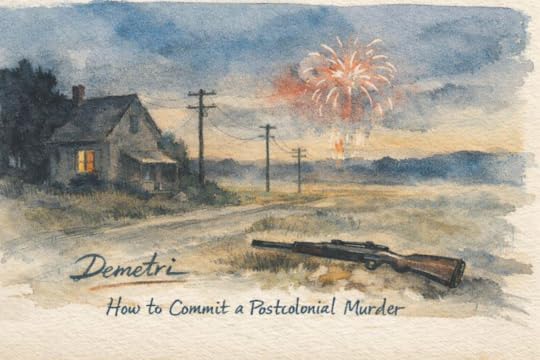
Watercolor Piece by Demetris Papadimitropoulos

Nina McConigley’s “How to Commit a Postcolonial Murder” is the sort of novel that arrives with a grin and leaves with a bruise. Its title performs a dare: a how-to manual, a satire, a provocation dressed as a joke. The book, meanwhile, does not so much explain itself as arrange the conditions under which explanation becomes suspect. It announces the crime early, declines the pleasures of detection, and turns instead to the more discomforting question: what kinds of violence are already licensed, routinized, taught – and which ones are declared unthinkable only when they disrupt the stories a nation prefers to tell about itself?

Set in 1986 Marley, Wyoming, McConigley’s novel moves through months like a calendar you can’t tear away from the wall. The structure is deceptively neat – January, February, March – and yet the effect is not tidiness but pressure. Months become moral weather. The book is keenly attuned to what time does to the body: how dread turns logistical, how a house becomes terrain, how childhood becomes a series of small competencies learned under duress. You feel the turning of seasons not as renewal but as exposure: winter’s concealments thaw into mud, spring’s rituals ask for cheerfulness, summer’s heat collapses privacy into proximity.

What distinguishes “How to Commit a Postcolonial Murder,” and what will make it divisive in the best way, is McConigley’s refusal to write the book most readers have been trained to demand. There is no courtroom crescendo, no climactic moral accounting, no therapeutic arc in which language saves what language could not stop. Instead, the novel keeps returning to systems – family, school, church, nation – and the way they distribute innocence and credibility like ration cards. The story’s central act is violent, but the surrounding world is saturated with quieter violences that everyone agrees not to call violence: the sanctioned gun curriculum of “safety,” the polite civic rituals of patriotism, the mythology of “independence” celebrated without acknowledging who gets liberated and who gets left behind.

McConigley’s greatest technical achievement is tonal: the book is funny in the way defense mechanisms are funny. It cracks wise to keep the airway open. It flirts with the reader, then refuses to reward the flirtation with intimacy. The prose frequently trades lyrical excess for procedural clarity, which gives the novel its peculiar chill. This is a text that understands how trauma often reads from the inside – not as one long scream but as lists, schedules, controlled breathing, counting. When emotion appears, it’s not performed for our benefit. When the book turns toward pain, it does so without the aesthetic indulgence that can make even serious fiction feel faintly complicit.

McConigley is not interested in building a monster. She is interested in showing how monsters are permitted to look ordinary, and how ordinariness itself can be weaponized. The most destabilizing scenes are not the ones in which harm occurs, but the ones in which the world continues. A May Day dance. A school lesson. A church blessing. A summer night where fireworks are meant to stand for freedom, while inside one home freedom remains a rumor. These are the moments in which the novel’s intelligence sharpens into something like accusation: the demand that children participate in rituals of innocence is not innocent. It is a form of social control. It trains the body to comply, and it trains the community to interpret compliance as proof that nothing is wrong.

The book’s formal play – its shifts into second person, its inserted quizzes, its epistolary fragments – is not ornamental. It is the novel’s ethical engine. The “you” sections are often described, reductively, as confrontational, but their more interesting function is diagnostic. They test the reader’s reflexes. Do you reach for judgment? Do you reach for justification? Do you reach for the comforting posture of the Good Reader, the one who knows the right words, the one who would have intervened, the one who is not like those other people? The novel treats those desires as a kind of appetite, and like any appetite, not automatically moral. Reading becomes a form of consumption, and McConigley wants us to notice what we’re hungry for when we say we want to “understand.”

This is where the book begins to feel startlingly contemporary. “How to Commit a Postcolonial Murder” is set decades ago, but it occupies the moral atmosphere of now – an era of disclosures that have not reliably produced protection, of viral testimonies that become content, of public outrage that can feel indistinguishable from entertainment. The novel understands that modernity has trained us to treat harm as something we can process at a safe distance, with the right vocabulary, the correct stance, the proper hashtags. It also understands how little that stance may matter when the structures that enable harm remain intact.

McConigley’s critique is not simply postcolonial, though colonial history is the novel’s bone structure. The book’s best insights are about continuity: how power reproduces itself through rituals, narratives, and education. The United States appears here as a nation expert at turning violence into curriculum, myth, and scenery. Hunter safety class is only the most literal example. The larger point is that the culture teaches procedural thinking, normalizes sanctioned killing, celebrates national rupture as liberation, and then insists that certain ruptures – the ones committed by the wrong people, in the wrong direction – are beyond comprehension. The book’s central act becomes, in this light, a kind of terrible inversion. The logic is learned from the world. The world is only outraged when that logic is applied inward.

One can feel McConigley writing in conversation with a lineage of “refusal” literature – books that withhold catharsis not as a coy trick but as an ethical stance. “Citizen,” by Claudia Rankine, comes to mind for its use of second person as moral mirror; Bhanu Kapil’s “Humanimal” for its attention to the body as a site where history is metabolized; Maggie Nelson’s “Bluets” for the way fragments can accrue into a philosophy of feeling rather than a plot. In the realm of morally chilly female narrators and the refusal of clean sympathy, one can also hear faint echoes of Ottessa Moshfegh’s “Eileen,” though McConigley’s project is less about individual pathology than about structural inheritance.

And yet the novel’s comparisons are also a trap. The book wants to be unhelpful in precisely the way the publishing world often demands helpfulness: the tidy elevator pitch, the digestible moral takeaway. McConigley keeps cutting the ribbon the reader tries to tie around the story. If you come looking for a redemptive narrative of survival, you will not find it. If you come looking for a clear political tract, you will be unsettled by the book’s intimacy and its unwillingness to legislate your response. If you come looking for a thriller, you will meet something closer to an anti-thriller: a narrative that treats suspense not as entertainment but as lived physiology.

Consider, for a moment, the novel’s fascination with quizzes – those bright, coercive artifacts of adolescent culture that promise clarity. The quiz is an American genre of reassurance: answer these questions, and you will know who you are, what you want, whether you’re “ready.” McConigley’s use of the form is wickedly precise. The quiz’s chirpy authority is grotesque when placed beside coercion. Its binaries – yes/no, A/B, mostly this/mostly that – become a parody of the way culture teaches girls to manage harm through self-surveillance. The quiz asks whether you are choosing, whether you feel pressured, whether you can say no. The reality that the novel is willing to say, without saying it loudly, is that coercion is often what makes those questions meaningless. The point is not to mock teen magazines. The point is to show how a culture can claim to educate while still failing to provide the language that would matter most.

This is McConigley’s special talent: the ability to reveal ideology in the smallest, most banal objects. A church ritual. A school lesson. A calendar page. A comet the children can’t really see, only watch simulated – wonder as projection, transcendence as staged event. The novel repeatedly offers the promise of rescue by “systems” – faith, family, institutions, history’s moral arc – and then shows the promise collapsing into ordinary neglect. Nothing arrives from the sky. No authority descends. The book’s central intelligence is that waiting, in certain lives, is not neutral. It is dangerous.

Still, this is not a novel that flatters its own despair. The most moving element of “How to Commit a Postcolonial Murder” is not outrage – it is the fierce, unsentimental bond between sisters. Their intimacy is not romanticized as pure. It is practical. It is tactical. It becomes a shared language and a shared discipline. McConigley writes their closeness as something forged under pressure, and that forging is at once heartbreaking and bracing: love here is not a feeling so much as a set of decisions.

It is also where the book’s ethical trouble begins – and where it earns its seriousness. The novel does not ask the reader to applaud. It does not ask the reader to forgive. It asks the reader to remain inside the contradiction: that an act can be comprehensible and still wrong, that it can feel inevitable and still carry consequence, that agency may arrive only as a last resort shaped by forces that preceded it. In a culture that is addicted to moral clarity, McConigley offers moral complexity without the usual alibis.

A lesser novelist might have turned this material into sermon or spectacle. McConigley does neither. Her style is too controlled for melodrama, too suspicious for uplift. The book’s coolness is sometimes a risk – a few middle stretches circle the same territory of refusal so insistently that readers may feel a certain emotional starvation, a sense of being held at arm’s length by design. But that arm’s length is also the book’s integrity. McConigley is not interested in making pain palatable. She is interested in showing how palatability itself can be a form of violence.

If “How to Commit a Postcolonial Murder” falters anywhere, it is where its brilliance becomes so self-protective that it occasionally threatens to withhold the very heat that makes literature feel necessary. There are moments when the book’s procedural restraint – so admirable ethically – can verge on affective flatness, and not every reader will want to do the work the novel demands without the usual narrative rewards. But perhaps that is the point. This is a critics’ book, a syllabus book, a book that will be argued with in margins and seminar rooms. It is also, quietly, a book that understands the current moment better than many novels that wear topicality like a badge. McConigley is writing about systems that outlast headlines.

Reading it, you may find yourself wanting to ask the old questions: Was it justified? Was it necessary? Who is to blame? The novel has no interest in handing you those answers, and that refusal is part of its courage. It is not a book about moral purity. It is a book about what happens when purity is not available.

One could imagine, if one wanted to mimic the book’s own forms, a small quiz for the reader:

How do you know if you’re ready to read this novel?
A. You prefer stories that resolve.
B. You can tolerate an ending that refuses to become a lesson.
C. You believe “awareness” is the same as protection.
D. You can sit with contradiction without turning it into a verdict.

If you chose mostly A or C, the book will frustrate you. If you chose mostly B or D, it may not comfort you, but it will reward you – with the sharp, enduring reward of a novel that refuses to lie.

For all its austerity, “How to Commit a Postcolonial Murder” is a work of rare precision. It is formally inventive without being precious, politically alert without being sloganized, emotionally controlled without being inhuman. It is a book that distrusts the easy uses we try to make of suffering – the way we turn it into inspiration, content, cautionary tale, moral proving ground. McConigley’s novel declines that entire economy. It offers, instead, attention: to the ways power hides, to the ways children learn the world too soon, to the ways history lives in the body, and to the ways narrative itself can become another border patrol.

That discipline, that refusal, that intelligence – combined with the book’s willingness to be genuinely uncomfortable – is why it earns a 91 out of 100.
Profile Image for Ashley (ashreadsitall).
230 reviews7 followers
May 31, 2025
This was a quick read, and not because it’s 224 pages, because I skimmed through a LOT of it.

The story revolves around two sisters who kill their uncle and the aftermath it brings. This, and the fact it was set in the 80s was super intriguing to me.

Unfortunately, there was too much randomness that didn’t contribute to the plot, including quizzes throughout the story which didn’t make sense to me.

This wasn’t for me. Thanks to Net Galley for the opportunity to read and review.
Profile Image for Katherine Bentsen.
191 reviews5 followers
May 29, 2025
Hot damn. This is some serious pack a punch style writing. Quick. Witty. Dark. Candid. Laugh out loud funny. Soul squeezing.

Topics / Themes / Tone
Acculturation. Navigating bicultural/biracial identity in a white community. Otherness. Adolescence. Sisterhood. Childhood trauma. The 80’s. Pop culture references. Dark humor. Rural life in Wyoming/Western America. British colonization of India. Privilege and Status.

Quick Thoughts
- A short but jam packed read.
- The narrative voice is perfect. It reflects the irreverent, bizarre, and blunt style of communication used by so many preteens. Added to the authenticity of the story.
- Loved the upfront addressing of stereotypes and related questions.
- Handled dark subject material sensitively and smartly.
- Enjoyed all the 80’s cultural references.
- Loaded with social commentary. Some subtle. Some in your face. All of it well done.

Thanks to NetGalley & Pantheon for the ARC!
Profile Image for Sue Goldberg.
237 reviews2 followers
May 7, 2025
A very different coming of age story told by a first generation Indian-American in a western state. Her mother has emigrated to the United States, is married to an American working on oil rigs, which keeps him away from his family for long stretches of time. Our narrator's uncle, aunt, and cousin come from India to live with them for awhile but all is not well and our narrator, Georgie, begins her story with a confession: she and her sister Agatha Krishna have murdered their uncle! This is a story of racism, abuse, immigrants, teenagers, and family. It is filled with magazine style quizzes, the kind teenagers love to take, which add some comic relief; but it is also filled with a lot of distrust and anger, common also in teens but here with an ominous twist. Nina McConigley makes the reader both a confidante and an antagonist. I found this debut novel very compelling.
Profile Image for Sacha.
1,963 reviews
September 22, 2025
4 stars

Prospective readers should be prepared to work; this simply will not fly as a passive reading experience. They should also be ready for a *literary* encounter that features structural elements they may not have anticipated or engaged with previously. For the right reader, this is a meaningful and powerful read.

Full disclosure: I jumped on this book for two reasons: the cover and the title. To me these are both giving "cozy." That is not at all reflective of what this book is, though. Do I still love the cover and title? Yes. Do I see them entirely differently after reading? Yes. If you, too, are anticipating some sort of cozy mystery or charming contemporary sisterly vibes, that's a mismatch with reality.

When I started this book, I felt like one of those cartoon characters who attempts to catch a moving train, does so with one hand, and then just sways to and fro for miles before finally hoisting themselves up to safety. In other words, it took me a minute to get into the groove of this narrative and to understand what was happening structurally, especially with the quizzes.

Once I got myself together, I also realized I (1) I should read this straight through and (2) I WANTED to do that. This short text encompasses so much, which is apt. After all, the events described here permanently change the lives of nearly every mentioned character.

Much of this novel centers on two sisters and how they decide to deal with a person who negatively impacts their lives. You can guess from the title what that decision might include. How the sisters get to that point - and more importantly, how that culminating event changes them and evolves into another story entirely - is truly stunning. These characters are so young when much of the plot takes place, and the inclusion of the quizzes - a constant staple in almost all girls' and women's magazines - reinforces their youth, their search for answers, and the gendered nature of what they experience. Like various other aspects of the novel ("Groty!"), these quizzes also heighten readers' attunement to the time. It's impossible to not feel mid-'80s if you had any personal experience there.

While I like to go into most reading experiences with as little information as possible, this is a book that is so specific and nuanced in particular ways that I think some fair warning is due. If you can hang, pay attention, find your footing, and commit to completing the read, you may come out of this feeling as wowed as I do right now. I suspect I'll be thinking about this one for a long time.

*Special thanks to NetGalley and Pantheon for this arc, which I received in exchange for an honest review. The opinions expressed here are my own.
Profile Image for A Person Called Name.
51 reviews8 followers
June 10, 2025
How to Commit a Postcolonial Murder by Nina McConigley is a fearless, searing portrayal of girlhood in the margins told through the eyes of Georgie, a teenage girl caught in the inescapable tension between her Indian heritage and her American upbringing. Set in the quiet ache of Middle America, the novel captures a young woman’s fractured identity: her love for her small town juxtaposed with a yearning for something bigger, safer, freer.

Georgie is both victim and hero who is wounded yet defiant. Her voice pulses with anger, confusion, and aching vulnerability as she tries to protect herself and her sister from the looming threat of familial violence. McConigley writes with startling originality, blending razor-sharp critiques of patriarchy, colonialism, and white fragility with the quiet tragedy of silence of choosing peace over safety, of sacrificing oneself to keep a family from falling apart.

What sets this novel apart is McConigley’s unflinching gaze and the fresh, electric rhythm of her prose. However, the narrative occasionally drifts into lengthy tangents detours into the lives of side characters or meditations on geology and fishing—that, while rich in texture, sometimes slow the urgent pace of Georgie’s story. These digressions add depth but occasionally left me skimming, eager to return to the raw immediacy of Georgie’s voice.

Still, this is a novel that lingers in a brutal, beautiful, and unforgettable way. McConigley has crafted a bold, necessary work that doesn’t flinch in the face of trauma but instead stares it down, daring us to do the same.
Profile Image for Suki J.
341 reviews16 followers
Review of advance copy received from Netgalley
December 30, 2025
Thank you to Fleet/ Little Brown Books UK and NetGalley for the ARC in exchange for an honest review.

This story is told from the point of view of Georgie, a tween Indian-American girl living in Wyoming with her sister Agatha Krishna. Into the house they share with their mother and father (who is often working away), their aunt, uncle and cousin from India come to live with them.
Life becomes very difficult for the girls and they make the decision to commit murder.

Firstly I'll say I really liked the decision to show the point of view of a half Indian, half Caucasian girl brought up in the west. In some small ways it mirrors my own background, although I was raised in the UK. The book highlights Georgie's experiences growing up in the US in the 1980s, and the effect that colonialism had on Indian immigrants.

I also found the narrative style quite unusual, as it's told as memories in a slightly haphazard way, rather than as straightforward storytelling, and to me this worked very well.

Some of the book was quite heavy, so I would definitely recommend checking out content warnings before diving in.

I enjoyed this quite a bit, and I'm glad I picked it up.
Profile Image for Megan F.
198 reviews4 followers
June 22, 2025
While I can understand some of the poor reviews for this book because of a lack of trigger warning for the s.a. described within, I cannot understand the numerous dings for the writing style. I quite enjoyed this book- if you stop and think that the majority was written by a preteen, the “disjointedness” makes complete sense. I thought this story was both beautiful and sad, and appreciated all of the different and difficult family dynamics. To add to that, this family was comprised of first generation Indians as well as immigrants, and they were living in the “Wild West.” To me, this novel is a young woman trying to parse through massive familial stressors, casual and outright racism, feeling split between two different countries, loving her sister yet feeling as if she is losing her through no fault of her own, and having all of this happen at a pivotal moment in her life- her entry into womanhood. I do understand the “quizzes” as plot devices, but will say that I wish there had been one or two less. Still, I found this novel to be well written and quite easy to read, and am grateful to both the publisher and netgalley for the opportunity to read this arc.s
Profile Image for Allison Meakem.
245 reviews11 followers
January 9, 2026
Conventional murder mysteries keep readers guessing until the end of the story. Not so in Nina McConigley’s debut novel, How to Commit a Postcolonial Murder, which begins with an admission of guilt by its narrator. In the summer of 1986, when Georgie Creel was 12, she and her sister killed their uncle. The novel unfurls as an extended mea culpa.

Georgie is the daughter of an American father and an Indian mother. She was born and raised in the fictional town of Marley, Wyoming, where her dad works on an oil rig. “It’s not the pretty Wyoming, the tourist Wyoming,” Georgie explains. In a state defined by cowboy culture, Georgie clarifies that she is “the other kind of Indian.” (Like her protagonist, McConigley grew up as a mixed-race Indian American in Wyoming.)

“Everything fell apart that year,” Georgie says of 1986. Amid an oil bust and the Chernobyl nuclear meltdown, she and her older sister decide to kill their uncle by poisoning his drinks with antifreeze. Vinny Uncle, as he is called, immigrated from India and moved in with the family a few years prior and... [[READ THE REST IN FP: https://foreignpolicy.com/2026/01/09/...]]
Displaying 1 - 30 of 168 reviews

Can't find what you're looking for?

Get help and learn more about the design.