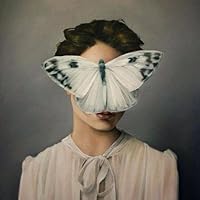
A British art critic offers a selection of quirky, insightful essays on art and artists, including such masters as Holbein, Vela+a7zquez, Rembrandt, Ce+a7zanne, van Gogh, Matisse, de Kooning, and Warhol and their diverse works. 10,000 first printing.
Cunningly packaged as a "paper museum," this book collects Andrew Graham-Dixon's responses to art exhibitions in the 1980s and 1990s. One might think that a book of short essays, taken from newspapers, might feel tedious or that responses to exhibitions from 20 years ago might feel stale, but Graham-Dixon is such a brilliant writer and critic that I easily forgot that these were reprints, that these wonderful, brief meditations on artists were written in response to exhibitions I'd never seen. Alain de Botton's recent Art as Therapy wants to make art seem psychologically useful to people but although the intentions are good, de Botton's book deals with art in reductive and condescending ways. The effect is deadening rather than enlivening.
Graham-Dixon's writing, on the other hand, is philosophical, insightful, intimate, and profound, and one never feels condescended to. He writes movingly about Gericault, Matisse, and Morandi, among others, and I couldn't help but think that if one wanted to help people engage more with art, Graham-Dixon would be an excellent example to follow. When I finished his extraordinary biography of Caravaggio, I concluded that I had never understood or appreciated a still life before -- in fact, I felt thrilled by the ones he touched upon -- and when I see a still life now I look at it with a new sense of eagerness. Here, too, his analyses seem exciting, fresh, and deeply worthwhile, exactly the sorts of writing you'd most hope to see next to paintings in brick-and-mortar museums. It's a trip to a fantasy museum and a delightful survey of art to boot.
Most of the essays in this book have only one or two black-and-white reproductions to accompany them, although Graham-Dixon typically writes in each essay about a handful of other paintings, too. I found I enjoyed this book most while at my computer, doing image searches to find the works he discussed. The black-and-white reproductions are quite attractive and lovely to have in the book, but even with those, there's nothing quite like being able to zoom in on the details, in full color, and to see, for example, the tiny castle hidden inside an orb in the Wilton Diptych or the cobbles in Vermeer's Street in Delft, which Graham-Dixon wonderfully describes as a vibrant "mass of painted wriggles."
A great book! Next to Robert Hughes, and John Berger, Andrew Graham-Dixon is one of my favorite critics. He helps with the transition the historical significance to the contemporary mind-set. It's dense while still being accessible. Graham-Dixon's work is heightened by what may be referred to as a poetic soul. He writes well about what beauty can be, and with his vivid prose, helps one put a higher-value on aesthetic worth (or what it can be). I think he might have some religious bones in him, (he's rocks a Jesus piece) which helps explain his sensitivity. In mushy things like art, it's comforting to see somebody else first, get gooey, so that we may follow suite, and feel comfortable, feel safe. For Graham-Dixon painting always has the potential for a transcendental sigh. Good art always has at least a few things to say, and changes its sayings through time. We go to books like this to teach us how to see better and how numerous the ways of perception are. Hughes' erudite crucible firmly plants (pins) art in the world and his explanations are measured in Orwellian precision, (Orwell's prose, not 1984 despotism ((though, I'm sure many could interlude a comparisons))), and Berger's dense didactic moralism can be intimidating for some and difficult for the tyro. Paper Museum's is a very valuable frolic through art history. It'll teach you some fun imagination. It's a important reminder why paintings are important.