This story begins in Ireland, in the bleak years of the mid-nineteenth century. The men of the Foley family have lost their home and suffered another loss which proves even more vital - beautiful Emer Foley, wife of Francis, mother to the four boys. With nothing to hold them they move on, setting out across Ireland to its Western shore, searching for the untenanted land that is to be their new Eden. But Francis Foley is a bitter man, and his harsh, proud soul can only bring destruction. Inevitably the five Foleys are scattered, each to his own road.Niall Williams leads the reader along on their great journeys, through the bittersweet heart of rural Ireland and far beyond its shores. He wrings beauty out of desolation and joy alike, guiding his characters through fire and water, earth and sky, magic and reality, loss and consolation, until finally they come to terms with their own freedom and dreams. Niall Williams was born in 1958 and lives in Kiltumper with his wife Christine and their two children. His previous novels, Four Letters of Love (1997) and As it is in Heaven (1999), were both published to critical acclaim and became international bestsellers.
Niall Williams studied English and French Literature at University College Dublin and graduated with a MA in Modern American Literature. He moved to New York in 1980 where he married Christine Breen. His first job in New York was opening boxes of books in Fox and Sutherland's Bookshop in Mount Kisco. He later worked as a copywriter for Avon Books in New York City before leaving America with Chris in 1985 to attempt to make a life as a writer in Ireland. They moved on April 1st to the cottage in west Clare that Chris's grandfather had left eighty years before to find his life in America.
His first four books were co-written with Chris and tell of their life together in Co Clare.
In 1991 Niall's first play THE MURPHY INITIATIVE was staged at The Abbey Theatre in Dublin. His second play, A LITTLE LIKE PARADISE was produced on the Peacock stage of The Abbey Theatre in 1995. His third play, THE WAY YOU LOOK TONIGHT, was produced by Galway's Druid Theatre Company in 1999.
Niall's first novel was FOUR LETTERS OF LOVE. Published in 1997, it went on to become an international bestseller and has been published in over twenty countries. His second novel, AS IT IS IN HEAVEN was published in 1999 and short-listed for the Irish Times Literature Prize. Further novels include THE FALL OF LIGHT, ONLY SAY THE WORD, BOY IN THE WORLD and its sequel, BOY AND MAN.
In 2008 Bloomsbury published Niall's fictional account of the last year in the life of the apostle, JOHN.
His new novel, HISTORY OF THE RAIN, will be published by Bloomsbury in the UK/Ireland and in the USA Spring 2014. (Spanish and Turkish rights have also been sold.)
Niall has recently written several screenplays. Two have been optioned by film companies.
“The day was improperly born. Blotches of wet fog obscured its shape, there were loose long sinews of mist that hung and made blind and confined the space. It was raining and not raining.” How can I do justice to perfection? The writing and the characters captured my heart from the start, and still held it tightly 435 pages later: bruised and uplifted.
It’s based on Williams’ great-great-grandfather, Teige Foley. Around 150 years ago, he is 12, the youngest of Francis and Emer’s sons. Tomás is the oldest at 19, with 16-year-old twins, Finbar and Finnan, in the middle.
The book follows them through wandering, separation, survival, famine, wilderness, rough seas, prison, death, and being reunited (resurrection?), all bound by endless love and frequent loss. The writing is poetic, but the plot is full of action (including gang, knife, and gun fights, horse races, and attacks by native Americans and a bear).
They are flawed but believable characters you root for. Second chances are seized, without it being a morality tale.
When they are in the gutter, the Foleys look at the stars (Wilde): Emer raised Teige with stories of the constellations (Pegasus is totemic to the budding horse-whisperer), and every night, Francis gazes longingly, through a stolen telescope. By day, the skies hold birds, whose presence, absence, colours, and formations foretell and echo the story. “Birds whirled on air that gleamed… Smaller birds briefly dallied in the polished light.”
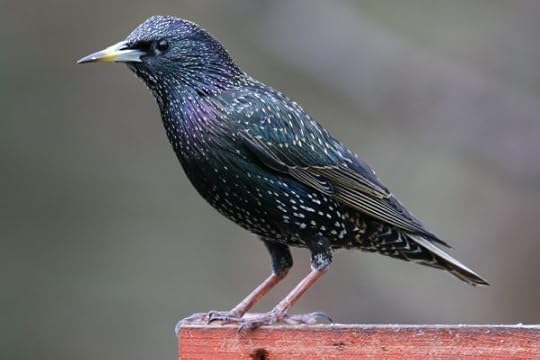
Image: A starling - a bird famous for formation flying, called “murmuration”. (Source)
The Foleys are also used to flight. And there may be a swan on the water or even a mermaid in it.
It is not a spoiler to say the book ends with Francis’ death and that the final words are: “Birds of morning sang.” - though perhaps there is a missing “u”.
If I had to find fault, it’s that we don’t really get Finnan’s story from his viewpoint, and the novel is a little rushed at the end. But even so, it’s an unquestioning 5* from me.
Home?
“Here was to be that home… for which he had set out so long ago and all but destroyed the family for whom he wished it.” All six have itinerant phases (and the threads with the gypsies border on magical-realism), yet all are seeking home. Family is bound by blood and place, but not limited to either.
For most of my life, I’ve lived within 40 miles of my birthplace, and yet, in many ways, I feel rootless. The Foleys endure varied and awful hardships, but I do envy their sense of belonging. My mother, brother, and I moved to the village where my mother still lives when I was barely six. I was discouraged from mixing with the children nearby and went to a different school. Aged 11, I went to boarding school, and never lived full-time at home thereafter. My adult kid knows the villagers better than I do, thanks to summer holidays and weekends spent there, by which time my mother had become involved in village life. I enjoyed boarding school, but didn’t fit in with the majority vibe, and my closest friends were similar. We’re still in regular touch.
I don’t claim to be a third culture kid (though I was, to some extent, raised in a culture other than that of my parents), but I do see a few parallels. Perhaps I should hit the road in a Winnebago, as my father sometimes thought of doing - but what would I do with my books? And therein is an answer: Home is where my books are, and the love of them is a gift from both my parents.
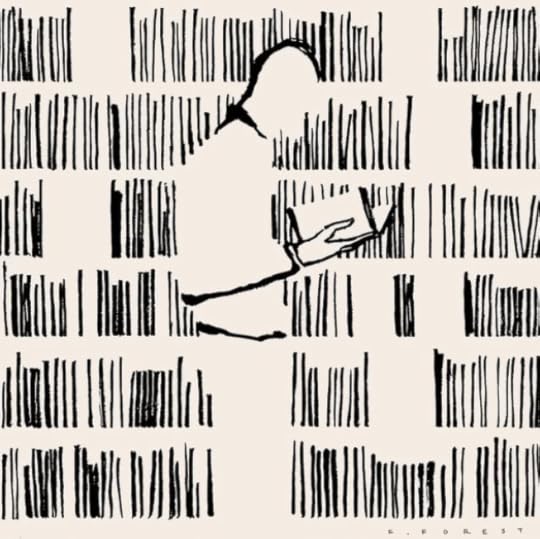
Image: Stylised line drawing of a figure opening a book, standing in front of a bookcase, by Frederic Forest (Source)
Quotes - from my uncorrected proof
• “They watched the dawn like a caress travelling the heavily misted veil of the river valley.”
• “The pale daylight fell out of the sky.”
• “In the deep silence of one dim room their marriage staggered under the impossible weight of dreams.”
• “This whole country [Ireland] is a jail, he thought. They have us prettying it up for their visits and they never even come.”
• “Only they [gypsies] knew that the telling of stories could rob the world of life and make Time vanish.”
• “Cattle stood in the timeless mesmerising drizzle.”
• “They travelled down the map of France like ink dribbling down a page.”
• “Trying each in their own way to imagine a future that might repair the past.”
• “The ghost of dead love harboured in his eyes.”
• “It rained a soft rain that was neither one weather nor the other, but a malady of season that lingered without remedy.”
• “He seemed to have passed beyond language and little by little it began to fade from him.”
• “He caught in his nostrils the bitter smells of the street that were the smells of envy and avarice.”
• “His heart grew large inside him and might have taken the form of white birds with wide wings for he felt then so light and full of hope.”
• “The myriad emigrant workers… who lived without hope a thing too empty to call a life.”
• “I have given up making plans… I plan to live until I die.”
• “The vastness of the land was like mesmerism upon him.”
• “Any number of children could be seen going about the island, chasing birds and hares, skipping in dance-step, hunting fairies, and gathering the assorted sundries that are the treasures of childhood.”
• “A buffeting wind like a busy housekeeper moved about and took down the first leaves of autumn.”
See also
There is a pantheon of poetic contemporary Irish authors who magically conjure immersion in the elements: how they describe light, water, weather, and landscape, and to link it to emotions, characters, dysfunctional relationships, and plot, while still being fresh and visceral: John Banville, Sebastian Barry, Claire Keegan, Billy O’Callaghan, Colm Toibin, William Trevor - and Niall Williams. (I’ve also enjoyed Maggie O’Farrell, though her writing doesn’t fit this mould, and of course older writers like Oscar Wilde and Iris Murdoch were also Irish.)
Four and a half years ago, I enjoyed Williams’ 2014 novel, History of the Rain (see my review HERE), but this, from 2001, is in a different league.
I also kept thinking of Cormac McCarthy’s The Road (see my review HERE), not so much for passages of father and son trudging, destitute, through a cruel landscape, as the descriptions of the weather. In particular, McCarthy’s unforgettable, "The snow fell nor did it cease to fall" compared with Williams’ words: “It was raining and not raining.”
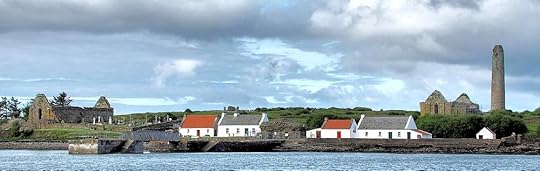
The novel is set in real places, including Scattery Island in the Shannon estuary, where Saint Senan founded a monastery, and where there is still a tall tower and stone homes built by 19th century river pilots.
Image: Scattery Island (St Senan’s) today (Source)
The Fall of Light by Niall Williams was probably my most……………let me think about this, okay amongst my three most enjoyable books I’ve read in 2020. This, a year when I have been introduced to the likes of Kent Haruf, Fannie Flagg, Wendell Berry and a couple of others. The writing in this book was really ‘next level’.
It’s a wonderful thing to be surprised like this, I just randomly picked up this book for a few dollars from our local book exchange – and it has blown me away. I had to wait 24 hours before writing this review, as one can suffer from the recency effect resulting in a review that can be too emotional and stained with tears of sadness and happiness. Well I’ve waited and done that anyway!
This story will stay with me.
At just over 380 pages it doesn’t sound like it qualifies as an epic – but it is. Williams packs so much into each page, each chapter, scene and character. It is a very rich piece of work. He certainly doesn’t rush to develop the characters and he paints each scene so evocatively.
The story starts in Ireland in the 1800s, it is set before, during and after the famine. It centres around the Foley family – husband and wife, Francis and Emer and their four strapping lads Thomas, twins Finbar and Finan and the horse whisperer Teige. The family are essentially nomadic, as were many poor people at the time, looking for work, food and a place to stay.
A major event in the first stages of this story causes the family to fracture, some end up in the Western-most part of Ireland, others end up in America, Canada, Europe and Africa. The family members encounter all sorts of situations including crime, violence, hunger, death, love, wives and children and these dramas are all snuggled into beautifully described landscapes. We experience and feel extreme heat, the wet, snow and the freezing cold. The author also touches on the lives of the very rich, but we spend most of our time amongst the wandering poor and hungry.
Francis’ desire to move is restlessness and Emer’s desire to settle was beautifully described by the author as they lay in their small room after another altercation:
……in the deep silence of the one dim room, their marriage staggered under the impossible weight of dreams
Some of the scenes, particularly in Ireland, were described so beautifully and were so vivid in my mind I could almost hear Enya. The scenes of abject famine were heartbreaking. There is a fair serving of bleak in this story, but also wonderful moments of humanity and love which make one’s heart swim.
I will forever remember people wandering around Ireland like the walking dead, babies suckling off empty breasts, the desperate hacking into the frozen carcasses of horses whilst potatoes turned into dust in the frozen ground. I knew the famines were significant, but I didn’t realise these people were battered year, after year, after year. No wonder the ‘lucky’ ones tried to escape to New York, Boston, Novia Scotia and other places – only to find these places were equally as violent, they were terribly exploited, and happiness was again such a scarce commodity.
This sounds like a miserable read, but it’s not. It’s also about hope, love and opportunity – like any great epic of this type, if you read this, you’ll get ample lashings of everything.
This is one of those books I find very difficult to review, a paltry 500 words to describe an experience like this is incongruous. Having said that, I can’t recommend this story enough and I will certainly read more of this author’s work.
An epic tale which centers on the Foley family in the years leading up to the Great Famine in Ireland, those years during it and the diaspora that followed, as many fled to other countries in the hopes to save what was left of their lives. Despite being under British rule, the suffering of the Irish was largely ignored, and Queen Victoria became known as the Famine Queen, but not because she devoted herself to offering aid. As a result, approximately one-quarter of the pre-famine population of Ireland was gone - over one million people in Ireland died because of the famine, and another million emigrated to other lands, half of that number to America, where they weren’t exactly welcomed. Despite the background of this story, there are lovely, and loving moments, with a story shared through some lovely prose.
This quintessentially Irish tale follows the family of Francis Foley, his wife Emer, formerly Emer O’Suilleabhain, and their four sons. As a tenant farmer of an estate owned but not inhabited by the owner, Francis not only has responsibility for tending to the land, but also has access to the estate. Inside the manor house, he has come to appreciate the view of the heavens offered by a telescope, and one night he leaves with the telescope. Knowing that it won’t be long until its absence is discovered, he knows he must escape quickly, leaving with his sons, and leaving without Emer as she has already left, angry with him at putting them in jeopardy.
Francis, accompanied by his twins Finbar and Finan, along with his other sons Tomas and Teige, runs off to escape the repercussions he knows will follow, and to find his wife. It isn’t long before the boys become separated from their father, believing that he has drowned, they eventually will end up separated from each other. Francis, however, is rescued by monks, although he has lost his telescope.
’”He is gone,” Tomas said. The breath of the horses misted and faded. They sat crouched forward like ones beneath a burden. The landscape thereabouts was a green and rumpled stillness. The silence grew heavy. Then Finbar said, “He is gone to America,” and laughed a small laugh that faded away. Finan looked at Tomas to see what he would say, but he said nothing at all. They watched the waters. “He is not,” Teige said at last, “he is become a swan.”
The stories of each are shared with a slowly mounting hope from both the characters and the reader that a reunion in some way will occur. Their sorrow of being apart is palpably present throughout, and the not knowing of where each is, if they’ve survived, if they will ever meet again is often on their minds, and their struggles to come to terms with the unlikeliness of a homecoming dwindling.
’And three years passed. ‘The stars rose and fell across the sky and told their timeless stories. But of Francis Foley and his sons in this time there is little recounted. They are like ones that have slipped inside a pause in the story. As if nothing good can be told and it is better for the silence to enfold them.’
An emotional, epic story of a country, people and time where the daily death toll is climbing, and yet so much of the focus is on love. Romantic love, familial love, love of country, love of life that is so beautifully shared that this is truly a love story.
I was very disappointed by this novel. I am a big fan of Niall Williams, having read ‘Four Letters of Love’ (1997), ‘History of the Rain’ (2014), and “This is Happiness’ (2019). Although I was only just OK with ‘John’ (2009).
Protagonists are Teige Foley who at the beginning of the novel was 12 years old, his father Francis, an older brother Finbar who had a twin (Finan) (both 16), and Tomas, the oldest brother who was 19 at the beginning of the novel.
Some novels are supposed to be believable and some are obviously not….you are usually alerted to that at the novel’s outset or when reading the synopsis of the novel in the book jacket, and can leave your reality beliefs at the door but still enjoy the novel. This novel was supposed to be believable — as believable as his other novels, and it was not. Also most of the protagonists were not all that likeable — I really didn’t care about what happened to them given their bad behaviors early on in the novel.
One good thing about the novel is that it gives you a feel for how hard life was for poor folks in Ireland during the potato famine (1845-1849). Some graphic descriptions but that was appropriate.
The writing was OK…maybe it was really good but I was so turned off by the unbelievable premise of things occurring in the novel I could not see the forest through the trees.
Wow. What can I say. I'm still in love with Niall Williams's writing. I know I should have read this book slowly, but I just couldn't! The Fall of Light has such a different sound than the other two books I've read by the author. This story of the traveling Foley family during the Irish Potato Famine plays with themes of loss, discovery, love (as is familiar in Williams's writing) and of course all of the beauty that I've come to love in the description, imagery and poetry. I'd put Four Letters of Love and As It Is In Heaven at the top of my list and this book a close third, but all three of Niall's books are in my "All Time Favorite" pile.
If you haven't read anything by this author, I implore you to do so. I am sure you will fall in love, too.
This book got better as it progressed, and I finally became invested around page 49, then halfway thru I could not stop reading. At Page 300, with 3 pages to go and I could not believe this story, it is so special, the way the family is broken by distance, yet clings to one another, or the memory of one another, right to the very end. Beautiful metaphors through out, a lot of life reflection, talented author to convey so much with words. A beautiful story that can evoke great emotion, (yep, I cried!) as you feel the character's loss, grief, and regrets, and feel the depth of love in this family on their life journey. This is life, and in this story it's all in "the stars".
Pg 304 "and in that fall of light from heaven to earth perhaps all our stories were told, all actions of the living and dead explained, and all time past present and future there revealed."
I have visited Ireland and vividly remember the shock I felt when standing before a sculpture in the streets of Dublin depicting a group of people and the suffering endured during the potato famine. The Great Famine was a period of mass starvation, disease and emigration in Ireland between 1845 and 1849. This novel which is my first by Niall details the tragedy that falls upon one family during this period of Irish history and told in the most luscious prose. Read it and weep. I certainly did but feel enriched by the experience.
A lush, epic drama set in 19th century Ireland (roughly during the potato famine). It follows the trials and tribulations of 4 brothers and their father as they leave their Tipperary home and set out to find a better life. They become separated, have some terrible, some amazing experience. It's almost mythic in quality- melodramatic- but very sensual. He uses language so beautifully, but you have to be patient and savor the story without rushing. It's like eating really expensive dark chocolate- just on the edge of being too bitter, eating more than a piece would leave you feeling oversated, but that one piece is so rich, so complex, so full of nuance that it's a pleasure to let it melt slowly in your mouth.
I really wanted to like this book. There are parts that are beautifully written and parts of the story that are compelling. But in the end I was just waiting to get through it so I could read something else. Not sure if this is a comment on the book or my own impatience but, it is what it is.
After reading 'History of the Rain' which I loved, I also wanted to love this. The writing is beautiful and sweeps you along with the story but sadly, by midway through, I got bored with the story and didn't much care what happened or had happened to any of the characters. That's always a cue to me to stop. A hard decision because Williams writes so well but it just wasn't for me in the end.
Williams's prose is lyrical, transports me utterly. His characters are vulnerable and your heart aches for them, plot is slow but engaging. What a beautiful read.
Although this novel was not set in Faha, I really enjoyed this earlier Niall Williams' foray, via fiction, into his great, great grandfather's life story.
The sons of the family become separated from their father and each other and proceed tp roam far and wide in Ireland and abroad.
Williams draws all these tales together most successfully to end the story in the perfect way.
I will continue to search out earlier titles from Niall Williams who is quickly becoming one of my favourite authors.
This was an advance reading copy that I picked up at a book sale, so the story may have been changed somewhat before publication.
By turns lyrical and brutal, this is the story of a family first torn apart, then reunited in a fashion many years later. It tells of Francis and Emer Foley who begin life together rather impetuously and with grand dreams. But the reality of their lives wears them down, and disaster follows. Through stubbornness and misunderstanding the family is separated; the author follows various family members through the years as they survive calamities. In ways almost magical they meet again, part again, sometimes come to good ends, sometimes to bad. They travel far from each other and yet manage to reunite at times, driven by their love for one another and their strong sense of family.
I did not like this book at first. It was too sad, desparate, almost despairing in tone. So I did something I rarely do - I skipped to the end chapters and skimmed through a few lines. What I read there encouraged me to continue, and then I was glad I did. Even though the story is sad in many places, there is still the strength of family, hope and love that comes through. Niall Williams' writing is almost poetic. His style is that of a story-teller passing along the family lore, so the skips in the story line seem natural and right, as do the mystical elements that he uses. All in all, a very satisfying book, and one very different from anything else I've read lately.
A sprawling epic family story, this is an ambitious microcosm of the experiences of the rural Irish and their diaspora in the mid nineteenth century. Parts of the book deal unflinchingly with the horrors and iniquities of the potato famine, but Williams is too much of a romantic to allow this to dominate.
Much of the story is more folk tale than plausible narrative, and to some extent this feels like an exploration into the evolution and exaggerations of family stories. As in all of Williams' work, much of the writing is lyrical and poetic, even if the story's many digressions can be exasperating and the characters seem to contribute much to their own misfortunes.
This book is not for everyone. If you don't like stories to evolve, ebb and flow like folklore, you won't like it. It's not action-packed, and it's unflinching, but it is a really beautiful book. Williams is renound for his stunning lyricism; the book sounds and feels like an ocean pulsing. The story is the folklore passed down of the Foley family and their struggles through the Irish potato-famine. The father, through obsession and passion for things he can't have, loses his wife and determinedly goes looking for her with his four boys. The boys, in the manner of their father, grow up restless and strong-willed, but also slavishly in love with romance. Their father wants nothing more than a complete family in one place; he finds an island. But the boys' loves and losses drive them further away from home, and, like the gypsies who wash ashore the island every summer, are forever doomed to be carrying on and searching for a sense of completeness. It is folklore, and as such moves quite slowly, and doesn't delve into the characters too much, but it really is a very beautiful read; Williams' narrative is poetic but precise, fierce but delicate. It's utterly spellbinding.
This entire review has been hidden because of spoilers.
In Ireland a family with four boys struggles to get by, and struggles all the more because they have a vision of something greater, inspired by stars and stories of the ancients, a vision of a land, maybe in on the West coast of Ireland, where a family could build something of their own. Those dreams wind up tearing the family apart, and set them on a lifetime of wandering, mostly alone or with new companions though sometimes reuniting. Through love and sickness and imprisonment and history, the family fights through to new generations.
The stories have a sheen of magic realism, in the way that family folklore from a few generations back might. And the stories are all third-person narrative, with little dialog as I recall. Lots of wandering across countryside, and then a break of a few years, and then the story picks up with more journeying. I sometimes had trouble maintaining interest.
A story of an Irish family, filled with folklore and magic. Has some beautiful passages, but not as polished as Williams' later works, like "The History of the Rain" or "This is Happiness", which I absolutely adored. It is also rather dark and dour, whereas his other books are permeated with the joy of life. I probably shouldn't give this just 2 stars, because William is a wonderful storyteller and writer, and I've certainly given higher ratings to less well-written books. However, I read for pleasure, and I just really didn't enjoy reading this and wouldn't recommend it to others - so 2 stars.
A lush and lyrically written saga set in 19th century Ireland, this book tells the story of a father and his four sons as they try to seek a better life. The sweep of this novel is epic, the language is gorgeous and the story is heart-warming. (Reviewed by Rina, West Windsor branch)
La familia Foley como muchas otras en Irlanda a mediados del siglo XIX, son las encargadas de mantener la tierra y cultivos de las personas más pudientes, teniendo como beneficio el poder alimentarse de esos cultivos y tener un lugar donde estar, pero la suma de incontables desmeritaciones, insultos y el carácter orgulloso de Francis, hace que un día roben un telescopio, incendien el lugar en el que vivían y dejen atrás a Emer debido a una fuerte discusión. Después de huir por muchas horas se encuentran con El Río Shannon, que es protagonista del inevitable declive de la familia Foley.
Niall Williams nos comparte la historia de la familia Foley (conformada por Francis que es el padre, Emer que es la madre, Tomas que es el hijo mayor, Finan y Finbar que son los gemelos y Teige que es el hijo menor), con un telón de fondo desgarrador que es La Gran Hambruna Irlandesa, ocasionada por La Plaga de la Patata que afectó a este cultivo por toda Europa y dejando así a millones de personas desahuciadas que dependían de ella para la supervivencia.
Esta Hambruna hizo cambios grandísimos en la demografía de la isla ya que ocasionó la disminución de casi 50% de la población Irlandesa haciendo énfasis en los muertos debidos a miles de enfermedades y la inmigración a diferentes países pero principalmente Estados Unidos.
Lo que más me gustó de esta historia fue la ambientación y los personajes, por un lado los verdes campos y por el otro playas costeras de Irlanda.A su vez a todo lo que tienen que someterse los integrantes de la familia, al amor, la traición, la incertidumbre, la angustia pero sobre todo la muerte que es totalmente ineludible.
This is my third Niall Williams novel, and like the other two, this one was a treasure. His writing is superb, poetic, lyrical…just great literary fiction. His books can be a little slow, but they are totally worth it just for the endings! His endings are always so soaring…they always remind me of the joy of reading. This particular book is a family saga set in Ireland during the potato famine, and takes several twists and turns. This family deals with so many challenges but the other shows the power of love and never giving up.
I don’t think I’ve come across a book with such beautiful writing and such an odd and wandering plot!
Be prepared for lyrical, beautiful prose but a disjointed plot-line often requiring a large dose of suspension of disbelief. It helps to read this book as the mythology of a family rather than actual history. Still, I’m not entirely sure what to make of it.
5 stars for writing plus 2.5 stars for plot = 4 stars? Sure! Let’s go with that!
A very readable novel abut the Foley family in the period before and during the Irish potato famine. Francis foley is a gardener of thwarted dreams. He loses control of himself on a particular evening, setting fire to his masters building and stealing his masters telescope. He goes home and has a huge argument with his wife who then leaves him. Francis with his four young sons, flees, ending up in a river where he is separated from all four sons. The story follows the lives of each of the sons who each live separate lives. Tomas, the eldest, has a weakness for women, falling in love with a prostitute. Finan travels the globe. Finbar, Finan’s twin, surrenders himself to other people’s magic. Tenge, the youngest, has a way with horses.
Each of the Foley’s travel beyond Ireland, to countries such as Europe, Africa and America. A satisfying reading experience with Interesting characters and very good plot momentum.
Beautiful writing. Reading this book is like crossing through a veil into a mystical fable. However, like many epic stories I've read, I wish I'd stopped reading 2/3 of the way through, while the world created hangs with anticipation and before the narrative starts rushing to an inevitably weak and preordained conclusion. Like sand running through your fingers.
A wonderful epic tale told in beautiful prose poetry so sumptuous that it slowed my reading considerably because I wanted to hear every word in my head.
I loved the books that Williams wrote with his wife, but this is pure poetry. The history of the Irish in America, the relationships lost and found, the urge for a new life. Ahh….
I wish I could say I enjoyed this book, but I honestly couldn't get into it, and finished it mostly out of a sense of obligation to get to the end. It did have its good points, but they were overshadowed by what I saw as weaknesses, leading to a very mediocre read. Despite this, it had a good flow, and was a fast read if I sat down to read it.
Niall Williams has a very poetic narrative voice, and his descriptions are vivid and summon clear mental images. He paints a stark picture of Ireland around the time of the potato famine, the lands traversed by gypsies, and even America, as two of the Foley boys find themselves across the Atlantic. His writing style gives some of the scenes a sort of mysticism, and that was the most convincing part of the novel for me. The descriptions are the backbone of this novel, and if you like reading for the mental pictures, you will probably enjoy this book. However, Williams relies too much on his descriptions to carry the story, and this leaves me feeling that the story lacked substance.
The storyline has a habit of jumping from person to person, following the four sons and the father through the years, sometimes in conjecture or dream sequences. Unfortunately, this novel is too short to develop all five of the Foleys, and the only character who seems to experience any change is the father, Francis Foley, who as an old man experiences regret. Despite all that every single character suffers, the father is the only one I felt any sympathy for. I didn't feel any connection to any of the four sons, who are all static characters and go from one adventure to the next without growing or learning. This was the biggest let down of the novel, and left me feeling unaffected by the suffering I was reading about.
If Francis Foley is the only character who experiences any sort of development, at least his sons have multiple aspects to them. All of the women characters are stock characters. They have one or two marked traits, and seem to exist simply to be love interests. Emer Foley, the wife and mother, had the potential to be developed, but this was not followed through with. She does play a bigger role than any other female character, but she's treated as something of a symbol, more than anything else. I would have liked to see more depth and development to all the main characters, but especially for the female characters.
If you're looking for a poetic read, or interested in novels set in Ireland, this book might be of interest. However, if you're looking for something a bit more engaging, this novel is not for you, and I highly recommend you look elsewhere.
It felt dragging at first but eventually picked up and quickly captivated me. I really enjoyed the Irish type folklore. It was a nice break from what I had been reading.
Niall Williams writes in a beautiful lyric style that, at times, catches in the throat of the reader. The story line is poignant and the characters rich and full. A great read. His story line has the epic saga quality of Ken Follett, but his poetic prose is far superior to that of Follett. The reader becomes absorbed by the fate of the Irish family, and Williams takes the reader all the way to the predictable/unpredictable ending so that the reader is left with a heavy sadness, yet, at the same time, a sense of "this is okay. It is as it should be". An immersion in Irish history and culture that is second to none. A story of irish reality with a mythical quality that smacks of Irish folklore which the author openly acknowledges.