Jump to ratings and reviews
Rate this book

Gelibolu

Rate this book
“Mustafa Kemal saldırının başından beri Anzak cephesinde, en şiddetli çarpışmaların ortasındadır. Komutası altındaki 19. Tümen, Yeni Zelanda ilerleyişinin ilk darbesini karşılamış, 7 Ağustos’ta Avustralya hafif süvarilerini yok etmiş, o andan bu yana da gece gündüz savaşa devam etmiştir. Kemal’in gözünde Türklerin durumu ‘son derecede hassastır’. Bu görüşlerini 8 Ağustos’ta Liman’ın kurmay başkanına telefonda iletir. Ona göre Conkbayırı’ndaki karışıklığı düzeltmek üzere hemen bir şeyler yapılmazsa, tüm vadiden çekilmek zorunda kalacaklardır. Bu nedenle bütün cephenin tek bir komuta altında toplanması gerekir. ‘Eldeki bütün birliklerin komutam altına girmesinden başka çare yoktur’ der.”

İtilaf Devletleri’nin Çanakkale harekâtının amacı Boğazlar’ı geçip başkent İstanbul’u ele geçirmek, böylece Osmanlı İmparatorluğu’nu savaş dışı bırakarak Almanya’yla savaşan Rus ordusuna destek sağlamaktı. Alan Moorehead, resmi kayıtlar, belgeler, özel mektuplar, günlükler ve hatıralardan faydalanarak iki tarafın savaş hazırlıklarını, Çanakkale deniz ve kara muharebelerini, siyasi ve askeri sonuçlarını aktarıyor.

272 pages, Paperback

First published September 1, 1956

182 people are currently reading
1791 people want to read

About the author

Alan Moorehead

98 books91 followers
Alan Moorehead was lionised as the literary man of action: the most celebrated war correspondent of World War II; author of award winning books; star travel writer of The New Yorker; pioneer publicist of wildlife conservation. At the height of his success, his writing suddenly stopped and when, 17 years later, his death was announced, he seemed a heroic figure from the past. His fame as a writer gave him the friendship of Ernest Hemingway, George Bernard Shaw and Field Marshall Montgomery and the courtship and marriage of his beautiful wife Lucy Milner.

After 1945, he turned to writing books, including Eclipse, Gallipoli (for which he won the Duff Cooper Prize), The White Nile, The Blue Nile, and finally, A Late Education. He was awarded an OBE in 1946, and died in 1983.


Ratings & Reviews

What do you think?
Rate this book

Friends & Following

Create a free account to discover what your friends think of this book!

Community Reviews

5 stars
431 (35%)
4 stars
525 (42%)
3 stars
218 (17%)
2 stars
37 (3%)
1 star
13 (1%)
Displaying 1 - 30 of 87 reviews
Profile Image for Dan.
1,249 reviews52 followers
June 30, 2024
It was the silence of the Gallipoli peninsula which most surprised and awed the survivors of the campaign who returned there after the war, the stillness of the cliffs and beaches where nothing much remained of the battle except the awful sight of the white bones of unburied soldiers and the rusting guns along the shore. Of the sunken battleships nothing was to be seen.

Gallipoli, by Australian Alan Moorehead, is an engaging narrative history about the famous WW1 naval and land campaign. It took place on that sliver of geography between the Mediterranean and the Black Sea. The disastrous campaign was dreamt up by Churchill in the early months of the war — ostensibly to protect British interests in the Middle East by seizing the straights which would also free up Russia to wage war in the Balkans and on the Eastern front. Eleven months later the British led forces fled Gallipoli utterly humiliated. It was the last victory of any importance for the doomed Ottoman empire.

Churchill, Lord Kitchener, the poet Rupert Brooke and the intriguing General Ian Hamilton are all found in the pages here. Enver Pasha, the enigmatic leader of the Young Turks, and Mustafa Kemal, who later became Kemal Atatürk the creator of modern Turkey, both figure prominently.

Supporting the British in Gallipoli were large Australian, French and New Zealand land forces. Of the 50,000 Australians who landed on the beaches at Anzac Cove and the other beachheads near Gallipoli nearly 10,000 soldiers and sailors died, a shockingly high casualty rate even by WW1 standards. Many infantry died right there in the trenches from sniper or artillery fire or from the occasionally ill-advised frontal assaults against the Turkish front lines. Many men also succumbed from dysentery and other related diseases.

Moorehead was just a young boy in Australia when the disaster in the Dardanelles unfolded. It is no surprise that the veterans who returned home from Gallipoli had a profound effect on him. Moorehead turned to writing and became a well known WW2 war correspondent and wrote this book some forty years later in 1956.

This book is written from a western perspective and while it makes note of the bravery of the Ottoman forces, the author’s sympathies clearly lie with the Allies. Secondly the maps in this book are inadequate so upon reading I regularly referenced Google maps to better understand the geography of western Turkey. It was a rewarding rabbit hole adventure in itself

5 stars. So this was book #75 in my WW1 project, and is easily one of my favorites. Focused solely on the 11 month campaign the narrative is full of depth and insights. The chapters on the terror and warfare waged by both the British submarines and the German u-boats were riveting.
Profile Image for Mike.
1,235 reviews175 followers
May 9, 2015
Written almost 60 years ago, this 4 Star account of Gallipoli is still fresh and informative. I was only minimally familiar with this campaign. Fixed that! Moorehead takes you through the inception, planning, execution and final withdrawal with precision and care for all participants. The Allied and the Turkish forces fought bravely, often in desperate battles for small gains in the historic lands near where Xerxes crossed the Hellespont, Achilles and Hector fought on the Trojan Plain, where you can swim between Asia and Europe in an hour. After Moorehead’s description I want to go stand on Sari Bair and look over the battlefields.

Gallipoli

Moorehead clearly explains the origins of the plan, Churchill is key but not the only one responsible. The naval campaign to force the Dardenelles was new to me, I thought the land campaign started at the same time but no, The RN and the French tried to break through to the Sea of Marmara first. The failure to force the passage translates to a “victory” for the Turks, bolstering some of the leadership. Later, we see the forces build up, not as strong as they should be. It was quite a collection of forces gathering in Egypt:

The initial landings by the British, ANZACs and the French are covered in all their confusion. One complaint is that the French land forces are almost ignored. The British landing at Cape Helles is “hellish”. The ANZAC landing is similarly difficult. The Turkish force response is better than expected. The future dictator of Turkey makes his mark on the day as he opposes the ANZAC force:

There is an air of inspired desperation about Kemal’s actions this day, and he even seems to have gone a little berserk at times. Instinctively he must have realized that his great chance had come, that he was either going to die here or make his name at last. He was constantly at the extreme front, helping to wheel guns into position, getting up on the skyline among the bullets, sending his men into attacks in which they had very little hope of survival. One of his orders was worded: ‘I don’t order you to attack, I order you to die. In the time which passes until we die other troops and commanders can take our places.’ The soldiers got up from the ground, and ran into the rifle and machine-gun fire; and presently the 57th Turkish Regiment was demolished.

Only 9 months will pass between first landing and last man out. So much sacrifice in between. Initially, the ANZACs thought of the Turks as monsters or animals but Moorehead relates the growing respect for the opponent as the battle rages. In a May 1915 battle, the Turks lose heavily trying to push the ANZAC forces back. In the truce that follows, you can see flashes of the famous Christmas truce in Europe. Each side gains the respect of the other.

The British landing at Sulva Bay is just heartbreaking to read. Victory was there for the taking. Moorehead was not as harsh as he needed to be on the generalship in this battle. Just so terrible to how good leadership could have won the day and saved so many lives. Conversely, the account of the withdrawal of forces from all three beachheads was inspiring. Very clever and almost no casualties incurred. I was very glad to have read this book and hope to find more books focused on individual parts of the campaign. This passage was very sad:

In the many books that were written about the campaign soon after the first world war, there is a constantly repeated belief that posterity would never forget what happened there. Such and such a regiment’s bayonet charge will ‘go down in history’; the deed is ‘immortal’ or ‘imperishable’, is enshrined forever in the records of the past. But who in this generation has heard of Lancashire Landing or Gully Ravine or the Third Battle of Krithia? Even as names they have almost vanished out of memory, and whether this hill was taken or that trench was lost seems hardly to matter any more.

As I write this on the 100th anniversary of the Second Battle of Krithia (and coincidentally the 70th anniversary of VE Day), let us not forget these brave men. Read this book and commemorate the action.
Profile Image for Eric Byrd.
624 reviews1,173 followers
October 14, 2012
Much of this was surprisingly dry, but Moorehead broke out the Leigh-Fermorish adventure and enchantment at frequent enough intervals to keep me reading. I will never forget his description of the exultant mood of the fleet before the landings. Rupert Brooke thrilled to the idea that he might fight on the wine-dark Homeric seas, as part of what was romantically called the "Constantinople Expedition," the young poet's dream of war, as Moorehead defines it, "the Grecian frieze, the man entirely heroic and entirely beautiful, the best in the prescence of death."

At the outset, at the embarkation, their hearts are light, as hearts always are if you have a large force on your side and nothing but space to oppose you. Their weapons are in their hands; the enemy is absent. Unless your spirit has been conquered in advance by the reputation of the enemy, you always feel yourself stronger than anybody who is not there. An absent man does not impose the yoke of necessity. To the spirits of those embarking no necessity yet presents itself; consequently they go off as though to a game, as though on holiday from the confinement of daily life.

(Simone Weil, "War and the Iliad")


And Moorehead recounts many instances of that stereotypically English courage: casual, sporting, nonchalant. The young Lt. Commander Freyberg, who had helped bury Brooke in an olive grove on Skyros days before, was tasked with fooling the Turks by lighting flares on a diversionary beach. Announcing that one swimmer could do with less risk what he had been given a platoon and a small boat to accomplish, Freyberg "had himself taken towards the land in a naval cutter, and when the boat was still two miles from the coast he slipped naked into the icy midnight sea" trailing a waterproof bag that contained the flares, a signalling light, a knife and a revolver. He lit the flares, investigated the Turkish defenses, and swam out again, to be pulled half-dead out of the sea by the crew of the cutter. And there was the British submariner who swam to the Marmara shore, planted and detonated explosives under a viaduct over which Turkish supply trains ran, then swam back to his lurking craft. Air Commodore Samson came upon a German U Boat in the Sea of Marmara. Though he had ready jettisoned every one his bombs in a previous attack, Samson swooped low and leaning out of the cockpit made a defiant gesture of emptying his rifle into the U Boat's hull. "In a world that has since grown used to the unearthly courage of young men with fantastic machines it is still difficult to credit some of the things that happened."

I'm off to Gallipoli in less than an hour!
Profile Image for Nadia.
91 reviews25 followers
June 6, 2020
Although one can deem the whole war unnecessary, Gallipoli was definitely one of the most unnecessary of its campaigns. It didn't accomplish much, if anything. Alan Moorehead writes that both sides suffered around 250 000 casualties and in retrospect many viewed the campaign as a mistake. Nevertheless, it is an interesting and important story of lives lost too early, of a battle on historic ground.

Alan Moorehead was an Australian journalist and writer and wrote this book in 1956. It is an excellent book on the Gallipoli campaign. Much like The Price of Glory: Verdun 1916 by Alistair Horne it is written and paced with the skill of a great writer and on many instances it will keep you turning the pages, eager to know more. While Moorehead clearly has a fascination with the Anzac forces, which is understandable as he was Australian, he gives an objective and quite multi-faceted account on this battle. There are definitely many interesting moments from this battle such as the nine hour armistice that was imposed, under which the Anzac forces and the Turks grew a mutual fondness and respect for one another; or the evacuation that ended the campaign that had to be conducted in utmost secrecy.

Something that I very much enjoyed is that Moorehead's writing on several instances captures the romanticism and myth around Gallipoli that was created by many of the soldiers, even before arrival. The hopefulness of the young Allied soldiers was showed through their poetry and diary entries and many regarded this as a moment that would forever change history. Rupert Brooke (who would die before arriving at Gallipoli) wrote:

If I should die, think only this of me:
That there's some corner of a foreign field
That is for ever England.


Moorehead portrays the unique culture that the soldiers developed after being stationed at a front so far away from home, cut off from the rest of the world. In addition to this, he makes it clear that this was very much a battle that displayed the weaknesses of the British army and its leadership, their inability to organize the campaign correctly was probably what jeopardized it and finally, caused it to collapse. Although it didn't succeed, the Gallipoli campaign and its combination of naval and military operations as well as use of airplanes, would be an indication of the development of modern warfare tactics. By studying what went wrong here and avoiding to make the same mistakes, the Allies were able to succeed in Normandie in 1944.
Profile Image for Steven Godin.
2,782 reviews3,397 followers
July 13, 2025

Australian-born Moorehead, a Seasoned war correspondent and one of the first to write about the Gallipoli campaign, does a great job of vividly depicting battle here without being too wordy, thus I found this book was very accessible and presented a good overview of what was a terrible time, both at sea and on land for the allies. I knew practically nothing about this WW1 campaign, so while it may not fully please those with prior knowledge, for me personally I really can't fault it – it did what I wanted it to do. One of the more successful situations being that of sending 2,000 troops up the side of a cliff in such an isolated spot, thus the Turks, not expecting this, had no defence whatsoever. A clever move by Commander Hamilton, which in the short run proved to be a masterstroke. Shame his bright ideas were in the few and not the many, as like Churchill, in regards the calamitous Dardanelles naval operation overall, through its rushed planning and tactical incompetence, I think the term 'Couldn't organise a piss-up in a brewery' comes to mind.
Profile Image for Christopher Saunders.
1,051 reviews960 followers
December 3, 2021
Alan Moorehead’s Gallipoli is the classic popular account of the disastrous Anglo-French campaign in Turkey during World War I. The Australian-born Moorehead was a prolific writer who served as war correspondent, travel writer and historian of Britain and Australia; unfortunately of his time in his racial and political attitudes, he was nonetheless a gifted prose stylist with a flare for conjuring exotic locales and far-off events. Unsurprisingly then, he depicts the Dardanelles Campaign both as high adventure and grand-scale tragedy: Moorehead emphasizes how close the Allies came to success in both their initial naval attacks on the Dardanelles and their early land assaults, only to bog down in stalemate thanks to muddled planning, poor coordination and tenacious resistance by the Turkish army (led, in part, by future President Mustafa Kemal). The book sketches the fumbled Allied planning, with Winston Churchill among others implicated in a desperate plan to end the war with a quick victory away from the Western Front, along with the hyper-nationalism of Turkey’s CUP, comparing Enver Pasha and friends to gangsters and fascists (which a lengthy discussion of the Armenian genocide does nothing to dissuade). Moorehead’s book certainly feels romanticized when he devotes reams of pages to the flower of English and Aussie youth, excited for war and bursting with male camaraderie, their only to have their dreams dashed in a miserable campaign that repeated the mistakes made in Flanders and France. Generals waste men in charge after fruitless charge; more soldiers are funneled in by commanders unwilling to admit a mistake; daily existence in trenches and beaches are a misery of sniping, shellfire and boring drudgery; the campaign finally ends after nine endless months with an ignominious (if well-executed) evacuation, leaving over 500,000 dead or maimed on both sides to little purpose. Moorehead, no doubt because of his Aussie heritage, finds nobility in the sacrifice of the ANZACs who endured Turkish guns and distrust from their British commanders; later writers (from Peter Hart to Peter Fitzsimons) have done plenty to question or disparage this National Myth. One should approach Moorehead’s Gallipoli with caution; but viewed as a sort of Capote-ian “nonfiction novel” it brilliantly dramatizes the lives, deaths and dreams of young soldiers whose lives were so profligately wasted.
Profile Image for Olethros.
2,724 reviews534 followers
July 10, 2013
-Brevedad exitosa para situar al lector, narración detallista para contar los hechos.-

Género. Historia.

Lo que nos cuenta. Relato de la realidad sociopolítica y militar pertinente en Turquía antes de la Gran Guerra y durante sus primeros meses, de la situación general y los intereses de los diferentes países protagonistas de contienda, con especial y comprensible protagonismo para el Reino Unido, y de los eventos que llevaron a la concepción y planificación del desembarco anfibio en la península de Gallipoli en los Dardanelos, el desarrollo de la propia operación y sus consecuencias a muchos niveles.

¿Quiere saber más de este libro, sin spoilers? Visite:

http://librosdeolethros.blogspot.com/...
Profile Image for Alex Hope.
82 reviews6 followers
February 28, 2022
Alan Moorehead was a sensational Australian writer of the XX century. His works are usually considered to be generalized history for the masses, as he writes them more like a writer, not a historian. As Thornton McCarmish puts it, "for most professional historians, Moorehead was a mere popularizer. Nevertheless, there was a sly art to these narratives and a distinctive aesthetic to which ordinary readers responded in huge numbers." Alan Moorehead had always wanted to be, primarily, a writer, not a historian. To that, he had always shared his passions regarding journalism with his wife, as he became one of the most widely recognized ones in Europe.
Gallipoli is one of the most outstanding works by Moorehead, which made the author be put in a special literary category by Sunday Times. Furthermore, it was critically acclaimed both by critics and the campaign participants. Moreover, the book significantly increased the author's reputation at the time. At the end of 1954, he had visited Gallipoli and found out for himself that the Gallipoli campaign of 1915-1916 could be turned into a great book, filled with action and human sacrifice, which he was very good at delivering .
In the book, Alan Moorehead describes the Gallipoli campaign, which was carried out by the Allied troops against the Ottoman and the German Empires from February 19th, 1915, to January 9th, 1916. It describes the moves which both sides took and provides a good chronology, yet the book's focus is not as much to provide the reader with the information about the events, but rather to provide the reader with the feeling of what the soldiers on the battlefield lived through. Throughout the book's entirety, the reader might notice how Moorehead describes almost every single stone on the battlefield. One might even forget that he is reading a historical book, as Moorehead dives in into "Tolstoy-like" descriptions of the war: "grass vanished from the ground, and in place of green crops there were now wide areas covered with the fading purple flowers of the wild thyme, the dried-up sticks of asphodel, an occasional dusty pink oleander, a green fig or a pomegranate with its little flame-coloured blossom on the fruit." The author's graph mania can also be seen in how he overcomplicates some of the descriptions, making them long and beautiful rather than short and on point. For example, when Alan Moorehead describes the fleeing of the allied soldiers from the ship Swiftsure, he establishes that they "did not wait to pack their belongings; baggage, bedding, tinned preserves and an assortment of wines were dumped in a trawler and ferried across in a matter of minutes." Such a passage could have easily been shortened by stating that the soldiers did not pack their belongings without making the reader endure through unnecessary prose.
One of the author's central theses is that the Gallipoli campaign was forgotten. Throughout the book, he is trying to show that despite the Gallipoli mission being a battle destined to be lost by the allies, the act of bravery carried out by the allies shall always be remembered . With such theses, he reveals to the reader direct thinking behind the campaign, covering not only Winston Churchill, whom he considers to be the main person to take the blame for the disaster of Gallipoli , but the entirety of the Allied commanding, which did not do much to support the success of Gallipoli. Moorehead also shows that the landings were a horrifying mess, as Turks were defending their position bravely, while the Allied forces seemed to be lost entirely and inexperienced, as the commanders most certainly were relying on morale . Furthermore, he also touches on the fleet's role during the campaign, as he shows that even one submarine could have done significant damage. For instance, because of the dangers of a submarine attack, HMS Queen Elizabeth, the most powerful ship on the allied side during the campaign, was taken away .
A significant focus of Moorehead's book, as it was already stated, is on the life of soldiers. He provides insights into their lives using soldiers' diaries, memoirs, and even poetry, through which the struggles could be better understood. The author also describes the horrors of everyday lives, as the disease, flies, hunger, and dehydration were endangering people's lives. For example, some people were forced to drink seawater . The shortage of military supplies also came with such horrors, which resulted in some attacks being almost suicidal bayonet charges . Nonetheless, one might notice that some of the descriptions might seem fabricated. For instance, when he describes the problem of flies that the soldiers experienced, he states that "no tin of food could be opened without it being covered instantly with a thick layer of writhing insects." Although it is understandable that such a description was provided to make the reader feel the number of flies, it is unnecessary to overestimate the actual situation. One more overcomplication could be found in the author's description of the diseases that men experienced during the campaign, most notably dysentery. In his book, Moorehead states that "every man was infected by it." This information can be doubted by other researchers, such as Peter Hart, who suggested that dysentery caused a "heavy toll on the Allied soldiers." To that, Alan Moorehead sometimes falsifies the facts by assuming that some of the historical personalities he mentions seemed to predict the future. For example, when he mentions the Russian Emperor Nikolai II, he states that he knew "the revolution and his own death were not far off." Nevertheless, in reality, the emperor could have had no idea about the revolution in 1915, as the Russian Empire was doing well militarily. His death, especially, could have been seen in no way because the liberal-bourgeoise revolution was leading among the people's beliefs. When it finally occurred in 1917, it was not until the Civil War broke out when the emperor and his family were killed in inevitable circumstances, so there is hardly any chance he understood that his revolution and death were close. Thus, in the book, Alan Moorehead tries to perfect his writing by partially providing false facts, which may lead some people reading to confusion.
Another confusing moment in the book is that the French letters, seen in some chapters, do not have a translation . Considering this book was published in 1956, this might have led some people to misinterpretation or anxiety, as it takes time to use the dictionary, especially when translating entire paragraphs.
One more consideration that might be taken from the book is the sources Alan Moorehead used. Firstly, it is necessary to understand that despite the book being critically acclaimed, with Winston Churchill himself praising it, the book can be considered outdated now. The bibliography Moorehead provides consists primarily of ANZAC sources, which can be understood due to the author being Australian. Furthermore, nearly all these sources are first-person narratives of what was happening, as there was barely any scholarly research during that time, which might lead to confusing and unofficial information getting into the book. Moorehead himself describes the reliability of the sources as "confirmed by other people," which is a vague justification.
The conclusion that Alan Moorehead provides at the end of the study states that the operation in Gallipoli was a mistake from the beginning. He traces throughout the book that soldiers on the Allied side were providing their offense while being inexperienced, while the Turks clearly understood their territory, which helped them in defense. Furthermore, in Moorehead's opinion, the Dardanelles fleet attack was a wrong decision . Another argument that Moorehead gives to support his position is that the fighting was throwing one group against another until the other side was exhausted . Finally, in Moorehead's opinion, the motivation was high on both sides, as the Allied soldiers deemed adventure, while the Turks wanted their first major victory . Nevertheless, Gallipoli was almost forgotten by the allies; as Moorehead notices, they have concentrated more on the Western Front, which partially led to the loss of Gallipoli.
To conclude, Alan Moorehead's book is an interesting research that compels both the elements of fiction and non-fiction. The materials he uses in the research are valid for the time, yet they are unhelpful for scholars today. Thus, the main reading contingent shall be considered people who want to understand history in a general way: Moorehead provides a detailed and interesting description of events without requiring the knowledge of any other material. The statement he makes, in conclusion, is that the heroes of Gallipoli shall always be remembered, as despite the operation being a mistake, they have endured and fought bravely. Furthermore, the book primarily focuses on the ANZAC troops, yet it remains unbiased until the very end, as Moorehead treats both sides with the same respect. Nonetheless, Moorehead's book has many discussions that do not relate to the topic, as well as it has many descriptions which only complicate the narrative. Thus, the book might serve greatly to a regular reader if he is interested in either history or English, as the author not only details the historical events but also uses good machinations with the English language to describe them. Lastly, the book reads very easily, except for the part with no translation of French, which might lead one towards a better understanding of the Gallipoli campaign, World War I itself, and the horrors and successes that people endure at wars.
Profile Image for Lyndon.
119 reviews23 followers
April 30, 2010
This was my ANZAC octave reading. Moorehead narrates the impossibilities and hopes of the Gallipoli landings with clarity, humor and generosity towards the Allies and their foes. Missing is the usual mythologizing and sentimentality that reduces the Gallipoli campaign to a faded image of its ancient precursor poetically captured by Homer. Comfortable in the heady debates of admirals as with life in the trenches, Moorehead covers the social and political ground as best an anyone i know.
I discovered in the pages of this book the ANZAC's who are worth remembering but not idolizing; a campaign that richly construed was poorly completed; and a fresh appreciation for the horror of war and the humanity that periodically surfaces in the courage and wisdom of minor and great actors in this deadly drama. I will read this book again, next year.
Profile Image for Steven Kent.
Author 36 books242 followers
July 10, 2009
Has World War I become the forgotten war? It was the "war to end all wars," but then it became overshadowed by the next world war.

One of the darkest chapters of the war was Gallipoli, an ill-planned, badly executed attempt to break the stalemate by striking into the heart of Germany through Turkey.

The naval bombardment did not go right. The landing forces got trapped on beaches. The Turks turned out to have a lot more fight than the British ever expected. The British assigned Australian and New Zealand forces untenable landing areas while reserving far better ones for themselves. The winters were pestillential and freezing.

In the end, the battle at Gallipoli proved even more of a stalemate than the fronts in Western Europe.

One thing to note, the Turkish proved to be gentlemen soldiers. ANZAC soldiers and Turks developed a great respect for each other.
Profile Image for Stephen.
1,951 reviews140 followers
July 15, 2016
As the Great War ensnared powers beyond Middle Europe, it became in truth a world war, providing the spark to reignite old tensions in places like the middle east. In late 1914, the nations of the Black Sea became party to the conflict, and Turk railed against Russian and Bulgar as in conflicts of yore. After months of bloody stagnation in Europe, certain persons in Britain had an idea for altering the dynamics of the war; invade Turkey, the sick man of Europe, and encourage the Balkan Powers to rise against it. Not only would that force Turkey to release its pressure on Russia – allowing the tsar to concentrate fully on Germany and Austria – but it would put a handful of allied powers right behind in Austria’s backyard if the Balkans joined in. The Central Powers would be well and truly surrounded. The invasion would be so easy – use modern ships to blast a way through the narrow channel leading to Constantinople, using landings to help secure the forts if need be, and stand by and smile as the Turks fled before the might of modern military prowess. By awful luck, problems in command, and the feistiness of the Turks, however, Gallipoli became a year-long tragedy, a distraction from the west that never realized its promise.

Alan Moorehead’s Gallipoli covers the campaign from its planning through its execution to the end, when the greatest victory of the episode was realized in a bloodless retreat. Addressing both the naval campaign and the months of trench warfare, and considering both the Turkish and Allied sizes, Gallipoli impresses with its thoroughness and easy reading despite the grim nature of the work. He covers the larger maneuvers in full, but during the months of gruesome gridlock breaks way to address the political ramifications of Gallipoli’s floundering, both on the Turkish and Allied sides. The book contains some of the best maps I've seen in a text of this kind, including three-dimensional renderings of the hills that deliver the difficulty of fighting in this terrain much more than a simple topographical map could have. Gallipoli seems nothing if the difficulties of WW1 warfare concentrated into the narrow stretch of the Hellespont. In some areas of the ANZAC front, the opposing trenches were scarcely ten yards apart from one another, or within a grenade's -- or a tin of jam's - throw. In such confined quarters, the two sides could not help but realize one another's essential humanity, and this is often a tale of well-meaning men making awful mistakes against one another. Moorehead's Gallipoli is what Churchill's campaign was not: most effective.
Profile Image for Brayden Raymond.
564 reviews13 followers
February 2, 2017
This book was incredible. Now I am sure the many other books written on the subject are great as well however this was surely an eye opener and satisfied my curiosity of the famed disastrous campaign. Moorehead does more than just gloss over the events that occurred. He shows the frustrations and feelings of the commanders in charge of the battle. Specifically General Hamilton. Moorehead also focused on the more political aspects of the campaign and was able to show expertly why the campaign failed without having to outwardly state "this is why it failed". Finishing Gallipoli leaves me with much to think about, for example my original understanding was that the whole thing was Winston Churchills blunder however he was removed so early in the campaign that the end result can hardly be considered his fault. All in All this book serves as a reminder of what happen on that famed penisula already over a hundred years ago and how it should not be forgotten.
Profile Image for Andrea.
84 reviews95 followers
December 21, 2007
Not as smooth a read as 1776, but much more satisfying. While this book is written in a clinical, "historical record" type of style, it doesn't lose its humanity. The author tells the story of the war by writing about the struggles and conflicts and heartbreaks of the people involved. As a result, I came away with real knowledge of the events of the Gallipoli Campagin of WWI and real empathy for the men on both sides of the razor wire.
Profile Image for Kurt Lutter.
20 reviews2 followers
June 3, 2012
While it is easy to armchair something so thoroughly picked apart by critics, one still comes away utterly incredulous at the stupidity of the British High Command during WWI. Moorehead's version of the telling is a classic and doesn't disappoint. A solid read on the history of this tragic battle.
920 reviews11 followers
May 23, 2025
This book has been languishing on my tbr pile for decades. Quite why I left it so long I’m not sure but I’m glad now I picked it up. The author was clearly well versed in his subject. It is lucidly written and mercifully free of the alphanumeric soup of formation designations which tends to bedevil works of military history. This one focuses more on the personalities central to the story of Turkey’s involvement in the Great War - the Young Turks, Mustafa Kemal, Lord Kitchener, Winston Churchill, and the various commanders – as well as the details of the many military engagements which marked the Dardanelles enterprise.

The idea out of which the landings on Gallipoli arose came from Lt-Col Hankey, Secretary of the War Council, as an attempt to evade the impasse on the Western Front, where the Allies were neither advancing nor killing more Germans than British soldiers were being killed, by a flanking move through Turkey and the Balkans. Moorehead outlines the political manœvrings between Kitchener and Churchill (First Lord of the Admiralty) on the for side and Lord Fisher (First Sea Lord) with various others against. The issue would lead in the end to the break-up of Churchill and Fisher’s hitherto close friendship.

The aim of the operations was first, using obsolete battleships (whose loss could be borne) to force a passage of The Narrows, a pinch point between the Dardanelles and the Sea of Marmara, and then, on to Constantinople in the hope of prising Turkey out of the war. The initial solely naval effort to do so having foundered on an undetected minefield, plans were made for an amphibious landing (actually two) to take the Gallipoli peninsula and protect the flank of a further naval expedition though the Narrows. This amphibious landing was the biggest in history up to that point. It was planned in three weeks. (Compare Operation Overlord in 1944, which took nearly two years to prepare.)

Turkey had recently suffered a series of military humiliations in the Balkan wars of the early Twentieth Century, leading to the Young Turks seizing control of the government. Their hold was precarious though, and another defeat might have brought their downfall. The withdrawal of the Royal Navy, seen as all-powerful, and its French counterpart after their initial setbacks led to an upsurge in Turkish confidence and, Moorehead goes on to say, acted as a trigger for Turkish resentment to find for itself a target in its minority (and Christian) Armenian population upon whom the government thereupon instituted a policy of genocide – murder, rape (Moorehead uses the words “molest women” the first time he deals with this but the more accurate term later) and forced migration amounting to a death march. The strong implication is that without the Allied ships’ withdrawal the persecution of the Armenians would not have occurred.

The Great War in general was a catalogue of lost opportunities or doomed attempts to follow up early success. Moorehead says that over Gallipoli in particular hung a peculiar lethargy, a miasma of indecision. The one exception to this was Mustafa Kemal, who twice, in the hills above Anzac during the first landings and again near Suvla Bay for the later one, managed to be by happenstance in the correct spot to appreciate the danger for the Turks inherent in the situation and to forestall Allied progress. (Some idea of his desperation and borderline fanaticism is that one of his orders at Anzac read, in part, “I don’t order you to attack. I order you to die.”) None of this excuses the failure of General Stopford, commander at Suvla, (with his insistence, the weariness of his men notwithstanding, that no advance could take place without artillery support) to understand there were no Turkish entrenchments there which required such an insurance, nor of overall Commander Ian Hamilton to impress upon Stopford the necessity of quick movement into the hills when briefing him in the first place.

Moorehead is good on the conditions endured by the troops - not least the depredations ensured by the infestations of flies as summer approached, landing on food as soon as it was uncovered so that no mouthful was without its insect accompaniment - and their diverions when no fighting was taking place. With dead bodies and excrement also prevalent it is no surprise that dysentery was soon rampant among the soldiers – even the headquarters staff. British soldiers’ rations were almost entirely of bully beef, whose fat melted in the can, supplemented by plum and apple jam, with no vegetables to vary the diet. By contrast any army officer invited aboard one of the ships - away from the flies, the lice and the smell of death and decay - marvelled at clean linen, glasses, plates, meat, fruit and wine. (Of course, on land there was a decent prospect of surviving a battle; but if a ship went down you most likely drowned.)

As a precursor to Turkey’s entry into the war, and without their say so, the Germans had mined the Dardanelles (obstruction of which was an act of war) so blocking the vast majority of Russia’s exports. Russia’s grain and other exports piled up in the Golden Horn before their ships had to sail back to Russia. When the time was ripe once more to reopen trade the Revolution in that country had removed (the now Soviet) interest in the trade. According to Moorehead (at time of writing in 1956) that pre-war trade through the Dardanelles had never revived in the forty years since.

One of the aspects of the Gallipoli battles I had not realised before was the extent of submarine operations. Several British submarines penetrated into the Sea of Marmara and devastated Turkish shipping there. One submariner even swam ashore to blow up an important railway line. German submarines - easily able to access the Mediterranean through the Straits of Gibraltar as no technology then existed to detect or prevent them - managed to torpedo some Allied warships.

The campaign saw military innovation on a large scale: as well as the experimental use of submarines and aircraft, radio, aerial bombs, land mines and other new devices, it trialled the firing of modern naval guns against shore artillery and the landing of soldiers by small boats on an enemy coast. But the story is mainly of opportunities missed and chances spurned.

Nevertheless it may have continued for much longer (and Moorehead suggests even succeeded in its aims) had not the Australian journalist Keith Murdoch arrived and witnessed the danger and squalor in the dugouts, the sickness, the monotonous food, the general depression. Despite being only a few hours at the front, in collaboration with the only British journalist Kitchener had allowed on the expedition, Ellis Ashmead-Bartlett, he planned to bypass the usual channels and break the agreement not to send reports without submitting them first to the censor at headquarters. His private letter to the Australian Prime Minister reached the eyes of Lloyd George (by now UK Prime Minister) who himself bypassed official channels by circulating it directly to the Dardanelles Committee without first asking Hamilton for his comments. The man sent out to take over from Hmailton and assess the situation for himself, Lt-Gen Charles Monro, already firmly believed that the war could only be won on the Western Front by killing Germans, Turks did not count.

Thus was set in train the process, sanctioned in the end by a visit from Kitchener himself, which led to the withdrawal of troops, at first only from Anzac and Suvla. That this was accomplished without the Turks getting wind of it - at Anzac the opposing lines were in places no more than ten yards apart - and with no loss, with the help of the famous improvised device of the self-firing rifle using dripping water from a can to fill another attached to the trigger or fuses and candles to burn through string and release a weight, in retrospect still seems astonishing.

That left only the beachhead at Cape Helles, upon which the German commander of the Turks, Liman von Sanders, unleashed a delayed attack accompanied by the heaviest artillery bombardment of the campaign on the now depleted British force the day before the final 17,000 troops were to be taken off. The British fire in response, perhaps inspired by desperation, was so devastating that the follow-up Turkish infantry refused to charge - something rarely seen before on the peninsula. This repulse convinced von Sanders that there would be no further British evacuation, but of course there was. Yet again the withdrawal was completed in the utmost secrecy and highly successful. Despite widescale destruction of supplies as the withdrawal took place the booty of food, weapons and ammunition retrieved from Cape Helles by the Turks took two years to clear up.

The hopes of those who advocated withdrawal never came to fruition, none of the troops from Gallipoli (save the Anzacs) were ever sent to the Western Front. Many more than had landed on Gallipoli were posted instead to the Salonika front or drawn into the long desert campaign against Turkey in Sinai and Palestine. Towards the end of 1918 plans were even well advanced to try again to force the Narrows by ship but were pre-empted by the Armistice.

While never neglecting the other side of the argument Moorehead’s position on the Gallipoli campaign is clear throughout the book; that its objective was worthwhile, and achievable, that its success would have shortened the war, given succour to Russia and even prevented the Revolution there and so given history a different direction.

A cruel comment on the whole business is that no special medal was awarded to those who took part.
Profile Image for Dave Clarke.
223 reviews1 follower
June 5, 2025
I’m glad I read John Laffin’s Damn The Dardanelles before this book on the Gallipoli campaign, as otherwise one might not realise half a million men lost their lives in this theatre of the First World War. Moorehead is excellent at building up the picture of events that led to the campaign being launched, and follows the bigger picture of the assaults, entrenchments, failed objectives and eventual withdrawal. He intimates the subterfuge driving the senior commanders and politicians back in London and he is able to therefore give the reader a good overall grasp of events, but by making light of the appalling leadership from Hamilton and De Roebeck and many of the brigade, Corps and divisional commanders and their staff … this startling omission whilst not sinking the book, certainly left it listing like a holed allied warship beached at the mouth of the Dardanelles all those years ago
Profile Image for JW.
127 reviews4 followers
January 9, 2020
History, by it's nature, has no surprise ending, we all know how Gallipoli ends and the tragedies that ensued during the campaign but having someone like Moorehead to walk you through the day-to-day life of those involved in such a compelling way is illuminating. He understands the human element; the smells, pains, exasperations and psychology of those in the trenches.
This is second book by Alan Mooehead that I've read (The White Nile being the first) and I know I'll read more of his. He relates history on a personal level, little academics or minutiae, and it's like listening to a friend tell a fascinating tale.
If all you know of Gallipoli is the Mel Gibson movie then dive in to Moorehead's volume. Highly recommended.
219 reviews6 followers
January 19, 2023
Good account of the disastrous Gallipoli campaign of World War 1. The author discusses events prior to Gallipoli that sparked British interest in a campaign. He also discusses the politics in Turkey at the time. He then discusses first the naval attempt to breach the Narrows, followed by an accounting of the 8 month land campaign. He finishes with an assessment, including the Turkish assessment that the British campaign was close to victory several times, thus validating the original basis for the campaign.
Profile Image for WaldenOgre.
734 reviews93 followers
October 12, 2024
本书微观描写细致生动,宏观分析却略显单薄。即便如此,作者 Alan Moorehead 的文笔和叙事能力还是值得称道的。

回顾这么一场历经数次功败垂成的战役时,有些问题难免会萦绕心头:如果协约国打赢了,奥斯曼帝国会立刻崩溃吗?如果奥斯曼帝国崩溃了,西线的均势会就此被打破吗?或者退一步讲,如果打通了达达尼尔海峡至黑海的生命线,俄国还会崩溃吗?十月革命还有可能发生吗?然后,作为一个中国读者自然会接着问下去:如果十月革命不曾发生,中国的近代史又会如何书写呢?

历史是没有如果的,但浮想联翩也几乎是一种情不自禁的历史本能。

最感慨的是,作者在全书的“结语”一章的开头,引用了汉密尔顿将军当年对加里波利参战士兵的演说:“……直到地球沉入无边的黑暗,你们也不会消逝。因为你们已经成了自赫克托尔和阿喀琉斯开始的达达尼尔海峡的伟大传统的一部分。再过几千年,这两个故事会整合成一个……”随后,在同一章的最末,他笔锋一转,写道:“到了20世纪50年代时……(协约国士兵在加里波利半岛上的坟墓)几乎没人来参观。除了偶尔组织起来的旅行之外,一年到头来的游客还不到六个人……蜥蜴在阳光照耀下墓碑上奔跑,时间在无尽的梦中流逝。”

最终,无论是历史还是神话,都无法否认这样一个冷酷的事实:任何时代、任何形式的战争都是巨大的浪费和愚行。
Profile Image for Colin Mitchell.
1,244 reviews17 followers
May 31, 2022
One of the great "botched jobs" of the first world war. Thousands of Australian, New Zealand, British and French troops were killed and injured with nothing achieved. All this while incompetent Generals and politicians dither about. Alan Moorehead was a respected journalist and author who produced this account of the campaign. Well written, easily read if very harrowing as the suffering and privation of the troops are well covered, even the rotting corpses in no-mans land as the guns kept firing while the navy was prevented from forcing the wat to the Sea of Marmara and Constantinople.

My respect for the men in these campaigns increases with the more I read. 4 stars.
Profile Image for Timothy.
61 reviews1 follower
September 2, 2020
An old book that stands the test of time. Moorehead is a balanced and informative writer with a knack of getting across the big picture and the small details. This is a thoroughly enjoyable account of a less well understood episode of British military history.
Profile Image for Linda.
620 reviews34 followers
May 26, 2015
According to one of the other books I've read on Gallipoli, Moorehead's is supposed to the the best at that time. I've heard since that he missed some things, got a few just a little off but that this is still the "go to" book for an overview of the battle(s).

The invasion of Gallipoli was based on the success that the British Navy had in advancing to Constantinople. Although they lost several ships and discovered mines that made them turn back, the Government, especially Winston Churchill, thought that an assault on the pennisula would allow the navy to advance and capture the city. However, no one really looked at what they were getting into.

First of all, the pennisula is mostly mountains or rocky cliffs, especially close to the beaches. Therefore, any landing sites would be small stretches of sand that stood a good chance of being bombarded by the Turks as they landed. (The experience here, however, gave enough information about such assaults that the Normandy invasion, using it, was successful.) Second, one assault team was made up entirely of volunteer Australians who had never fought before so were an unknown quantity. Third, no one could determine the true status of the Turkish army. And lastly, most of the commanders were dunces - some were pulled out of retirement and never visited their troops to see the conditions they were fighting under.

Moorehead gives a lot of detail which I wasn't interested in - such as the type, size and number of sailors on specific ships - but the book kept me interested. I had to read it in stages, however, to be able to digest all the implications and information.

Two parts especially stand out. A British submariner managed to get through the nets, mines and strange water conditions (hard to explain) and actually cruise around the waters near Constantinople and sink many ships. He put the fear of the British into the Turks. His success enabled the British to send more subs into that area.

Also it's obvious that Moorehead loved the Australians. Volunteers who had never seen the violence of war turned out to be the best soldiers. When fighting was sparse or at a standstill, they calmly remained in camp and waited for orders. As Moorehead says

"No stranger visiting the Anzac bridgehead ever failed to be moved and stimulated by it. It was a thing so wildly out of life, so dangerous, so high-spirited, such a grotesque and theatrical setting and yet reduced to such a calm and almost matter-of-fact routine. The heart missed a beat when one approached the ramshackle jetty on the beach for the Turkish shells were constantly falling there, and it hardly seemed that anyone could survive. Yet once ashore a curious sense of heightened living supervened. No matter how hideous the noise, the men moved about apparently oblivious of it all, and with a trained and steady air as though they had lived there all their lives...."

The Aussie, more so that their British counterparts, came to know the Turks on a personal basis. A bit like the Christmas armistice in the West, the Aussies and the Turks frequently stopped fighting and during the quiet would throw food items or coffe or other "necessities" to each other since their trenches were just a few yards apart. Once a note came over from the Turks: "Bully beef no coffe yes." During times of truce for burial of the dead, they worked together with no animosity or thought of breaking the truce.

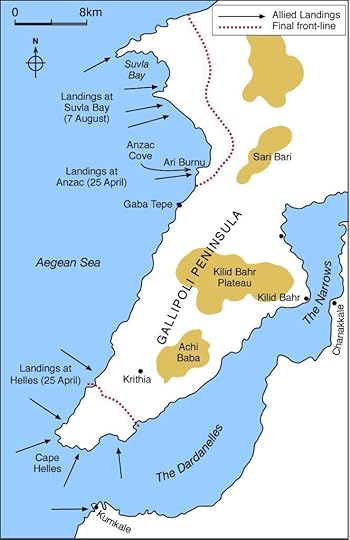
Moorehead includes maps to help the reader locate the pennisula and the landing sites and battles. All in all, it is a good introduction, and a great reference, for anyone interested in the battle.
757 reviews14 followers
July 4, 2015
Gallipoli is a little known battle in a poorly understood war and yet it holds a fascination for historians and students of the Great War, for it was on these beaches that Australia is said to have earned its nationhood and against its rocks that Winston Churchill’s career almost floundered.

“Gallipoli”, is a reprint of Alan Morehead’s 1956 classic that brings order and perspective to its subject for the novice and World War I student alike. The battle of Gallipoli was the 1915 Allied attack on the Dardanelles and Gallipoli peninsula of Turkey intended to seize Constantinople and force the Ottoman Empire from the war. Often characterized as Churchill’s first adventure in the “soft underbelly” of Britain’s German dominated opponents, it is here shown as having a deeper purpose and greater potential than the sad disaster that is commonly depicted. Aimed to draw Turkish troops from the Russian Caucasus front and open the Dardanelles to the export of Russian grain and the inflow of Western aid, it was the largest amphibious attack up to its time.

The initial phase of the offensive was an attempt by old ships of the Royal Navy to force the Dardanelles. When that failed the task was assigned to armies as the British landed at Suvla Bay and Cape Helles, the ANZACS, Australian New Zealand Army Corps, at what has since been known as Anzac Cove and French troops across the water at Kum Kale on the Asia side of the Continental divide. Failure resulted from a combination of dogged defense, lapses in coordination and execution, lost opportunities and, even to the end, indecision as to the commitment to the project: how much, how long, whether to withdraw. At the conclusion the shortcomings of the invasion were left behind as a flawless, virtually bloodless evacuation withdrew virtually the whole force with negligible casualties, except of course lo the unlucky few to be personally involved.

I am very glad that I read this book. I know relatively little about World War I and my familiarity with British military figures is sparse. During some early chapters I felt that I was missing something while trying to follow the generals mentioned. As I progressed and the campaign took shape I developed an appreciation for the battle not dependent on identities of individual actors. At its end I had a much greater understanding of how the story played out. I enjoyed the glimpses of humanity amidst death and destruction as the Australian and Turkish troops traded courtesies and gifts, reminiscent of the Christmas Truce on the Western Front a few months before. I am left with a sense of loss, of lives spent for no gain, and all the what might have beens. With more resources, which were available, perhaps the invasion would have reached its goals, the separate German-Russian peace unnecessary and, a revolution avoided and the history of the balance of the Twentieth Century immeasurably altered. We will never know but “Gallipoli” challenges us to appreciate, to analyze and to read more. For this it is a excellent tome.

I did receive a free copy of this book in the hopes, but without the obligation, to write a review.
30 reviews3 followers
November 10, 2007
Moorehead reminds us that things aren't terrible because they just happen to be, they're terrible because we made them that way. And nothing happens in a vacuum. It's pretty depressing, I know, but he also writes pretty well. And there's pictures.
Profile Image for Daniel Hubbell.
116 reviews
October 23, 2022
Thumbing through the shelves of a secondhand bookstore (Unicorn Books outside Cambridge, MD), I found a battered copy of Alan Moorehead's Gallipoli in the stacks and bought it for a dollar. I'd say that's about right for it.
Gallipoli is a narrative account of the ill-fated Gallipoli campaign, one that resulted in over 250,000 casualties for the Entente and the Ottoman Empire in a brutal deadlock that lasted for nine months in 1915. Like a lot of WWI's conflicts, the standout moments of the campaign were its start and its end, with a lot of the middle reiterating on a central theme of push/counterpush from one trenchline to another. The start marked a dramatic naval attempt to force passage of the Dardanelles straits in order to, essentially, bombard the Ottoman Capital into submission. And in the end, the Entente safely evacuated the peninsula and committed to other pushes through Greece (deposing the Greek monarch to make space for this) and the Arabian peninsula. The campaign made the reputation of Mustafa Kemal, and submerged that of Winston Churchill and half a dozen other proponents of the campaign. That's the cliffs notes version anyways, and Moorehead mostly picks up each element in turn with an eye for writerly flourish in his accounts.
Yet published in 1956, it's very difficult to separate Moorehead's work from the time of writing. To give one example there, Winston Churchill was not only still alive but actively praised the book and awarded Moorehead a cash prize for the book. Second, this was Moorehead writing within a decade of WWII, where he himself served as a war correspondent throughout the campaign. Third, as an Aussie himself, Moorehead's sourcing and primary interest for the Gallipoli campaign is in portraying the battles there as a nation building trial by fire for the Australia New Zealand Army Corps (ANZAC).
Take all three together, and an otherwise very good summing up of the campaign with a solid writerly foundation becomes much more annoying to read. While at turns Moorehead acknowledges the campaign to be an utter waste of lives, he can't help but think what might have been accomplished if the Navy had forced their way through in those early days. If the army's first landing had been more aggressive. If the generals in charge were less conservative or better coordinated. If a later landing on Suvla Bay hadn't been done with raw recruits but instead with experienced ones. If If If.
In those ifs, Moorehead carries water for Winston Churchill especially, a proponent not just of the naval landing but especially of the subsequent land campaign past any reason or hope of success. Neither man can quit the view that "just one more" push would've done, even as Moorehead describes the ANZAC troops suffering to a man from dysentery and plagued by a whole civilization's worth of flies and Churchill burned every professional bridge in his political life. The result is a weird glorification of profound suffering, one that Moorehead breezes through almost entirely without quoting primary sources (something he does liberally when the generals are engaged in their umpteenth bout of infighting). Soldiers are described in Homeric terms, above such petty desires as sex or alcohol (but again, no quoting, and only really in reference to the ANZAC troops). Two journalist's attempts to expose the horrific conditions on the peninsula are also treated as a near scandal, with Moorehead calling one journalist "gloomy" and suggesting the other should have simply conveyed his concerns in a private letter...which is exactly what was attempted and foiled by the British Army itself.
Even at the end of the book, with soldiers dying of exposure and frostbite in their thousands, Moorehead devotes most of a chapter to one final twist where the British "almost" sent yet another full six divisions to turn the tide with a kind of palpable longing.
Perhaps that's understandable. As he notes in his conclusion, the alternative was the Western Front, a place of almost nihilistic carnage and grim attrition. Moorehead paints a rosy portrait of a world redeemed by a successful Gallipoli, one where the Russian Revolution never happened (what?) and half a dozen other sweeping events of the war are undone at the stroke of a pen. Perhaps.
But the difference between dreaming and living are vast, as Moorehead himself inadvertently illustrates in the book. The poet Rupert Brooke is given a loving shoutout, described in (again) almost Homerically attractive terms as he gleefully writes in his diary about looting Constantinople and raping the Sultan's wives, a kind of orientalist fever dream from the colonial era that explains so much of the British Museum's contents. Instead of the glorious campaign promised, Brooke died of sepsis on the island of Lemnos before the landings even started. In the end all his dreams of conquest were undone but a total unfamiliarity with what the task itself entailed. The same could be said of Moorehead's whole whistful view in my opinion. One can always dream that a battle could've turned out differently, but forty years later it might at last be time to wake up.
Profile Image for Gregory Thompson.
231 reviews2 followers
September 30, 2025
Learning more about this ill-fated battle has long been on my to-do list. As an Australian kid growing up many years ago, we did not learn much about our own history - a situation that I hope has been rectified today. ANZAC Day was always a day of national remembrance but I never fully appreciated the details of the battle and the mistakes and amateurish conduct of the campaign by the British command. It is also important to my family as one of my forebears, Harold Denston, died on April 25 on Gallipoli's shores. April 25 is arguably the most important date in Australia's emergence as a sovereign nation - more important than January 26, which commemorates the landing of the First Fleet and the settling of the country by the Brits.

From my perspective as a long time ex-pat, I take pride in the notion that our "coming out" as a nation was, in fact, not a great military victory but rather an ill-advised military campaign that led to the death of about 8,700 young Australian volunteers who died on the beaches and 60,000 who died in the overall conflict; and helped forge our identity as a nation. It should be borne in mind that our population at the time was only about 4.9 million.

This book is perhaps the defining text on the disastrous Gallipoli campaign, written in 1956 by Alan Moorehead, a renowned Australian war correspondent who lived in the U.K. His description in Chapter 9 of the battle between the so-called Colonials and the Turks and the mutual admiration they developed that encapsulated the ANZAC spirit was worth the price of admission alone! War is hell - but in this situation, it brought out the best of the men involved - on both sides.

Moorehead provides the details behind many of the headlines I've had heard about the campaign, such as the incompetence of the English military leaders, the damage to Churchill's reputation, the role of Keith Murdoch, the camaraderie that developed between the soldiers in the trenches - both between soldiers on the same side as well as between the Turks and the Allies as they whiled away the hours and days in unbearable conditions. Notwithstanding the mistakes that were made throughout the campaign, it appears that the evacuation was well-planned and executed. Getting thousand of soldiers off the beaches was no mean feat!

A total of 259 days elapsed between the first landings and the last evacuations - from April 1915 till January 2016. About half a million men were sent to Gallipoli of which approximately half became casualties, ironically about the same number of casualties as the Turkish losses. Today I understand it is a tranquil site, but it is the place where a country's self-image was borne. One day I hope to make a pilgrimage there and pay my respects.
Profile Image for David Cain.
492 reviews16 followers
March 24, 2018
I've been interested in Gallipoli, one of the better-known battles of WWI, since my visit to New Zealand in 2015 and 2016. While in Auckland, my wife and I visited Te Papa, New Zealand's national museum. We experienced perhaps the most impactful exhibit I've ever been to (on the 100th anniversary of the battle, no less), and learned all about Gallipoli and its importance to Australia and New Zealand in the development of their national identity and international reputation.

Moorehead's analysis of this battle covers the Turkish military and political situation, the reasons why Great Britain (and France) decided to invade the Gallipoli Peninsula to secure the Dardanelles, what went well (and disastrously wrong) during the campaign, and why the Allied forces (including the 'ANZAC' corps from Australia and New Zealand) ultimately decided to retreat. Gallipoli could have been a pivotal moment in the War, but of the one million combatants on both sides, half were casualties and no military objectives were ultimately achieved by the Allies.

The writing style in this book is fine but not exceptional, and I do not consider this to be among the more riveting works of scholarship on WWI. The style and format of this work are dated (it was first published 62 years ago, after all). There are a number of photographs that do nothing to illustrate the events described in the book (generals, admirals, etc. posing for portraits in their dress uniforms), and poorly-drawn maps that do nothing to explain the sequence or position of military maneuvers. The author chose to focus on the "Great Man" concept of historical analysis and spends the majority of the book describing the decisions, disagreements, triumphs, and failures of a variety of important British (and a few Turkish) officers. Although he does mention what life was like for the men in the trenches, it's primarily through descriptions of anonymous soldiers rather than specific men (many of whom wrote journals, I'm sure, so there probably are a variety of available primary sources). The primary focus is on the British Army and Navy, with considerably less attention devoted to the Turkish perspective and virtually no mention of the German and French involvement in the conflict.

My understanding is that this is considered the primary mid-century secondary source for information and analysis about the Gallipoli campaign, so despite its shortcomings, this is a solid overview of an important moment in world history. Even though it took me a while to read this work, it's not especially challenging, so it's a solid choice for anyone interested in learning more about this campaign.
Profile Image for Brian Manville.
193 reviews1 follower
November 7, 2022
World War I had already sunk into trench warfare by the time the Gallipoli offensive started. Conceived as a second front and as an attempt to knock Turkey out of the war, it's execution was similar and achieved the same results. Alan Moorehead tries his hand at explaining the campaign.

The Gallipoli campaign was envisaged by many young Englishmen as some sort of quest. Seen as a battle in a far off land, the romanticism of many were off the charts. However, the same kind of bumbling, ineffectual leadership was seen in the Dardenelles as in eastern France. After nearly 280 days, the campaign ended in a series of mass escapes that were pulled off in an impressive fashion.

The problem with Moorehead's version of events is that the same romanticism many young English men had is prevalent in his writing. His special adoration for the Australians can be forgiven as it has always been a source of national pride in their performance in their first campaign. The fact that Moorehead is himself Australian tends to give his stories an air of bias. Indeed, other than the notables on the Turkish side (Mehmet Talaat, Enver Pasha, Kemal Pasha), the Turkish forces have no role to play other than the heavies in this real life silent movie.

A second problem comes from his source material. While written in 1956, most of his sources for the book are from people who served in the conflict and whose works were created in the decade following the campaign. Forty years on from the campaign should have seen primary research that Moorehead could've tapped into. It gives the appearance to me of someone not looking for something he didn't want to find as it would detract from his story. Sadly, it need not have been this way. No one who studies or reads about Gallipoli has nothing but respect and admiration for Anzac forces who were on the peninsula.

In the end, Moorehead's "Gallipoli" suffers from the lack of outside scholarship, a slight hint of bias, and overt romanticism. This campaign has been discussed in a more abject way and as such Moorehead's tale ranks slightly above granddad's stories about his time in the war.

BOTTOM LINE: Mid-century tale that reads more like historical fiction than history.
Profile Image for Deb.
656 reviews4 followers
Read
October 2, 2022
I ought to crack open a bottle to celebrate finishing this...
Not that it wasn't a fascinating read, I was just not able to stick with it because of family events this past Spring.
Mr. Moorehead's book on the World War I battle(s) of Gallipoli (seige is more apt), where the allied armies battled Germany and Turkey for control of the Dardenelles straits leading to Constantinople, is well-researched and beautifully written. That said, it is old-fashioned in the sense of hewing to the stories of the political and military leaders, with lesser attention to the foot soldiers and sailors who lived and died on the cliffs and beaches.
I began this because of the current Russian invasion of Ukraine, since in some ways, we're still waging war over this long-contested part of the world. The hash made of the two major assaults on the heights above the Dardenelles (both fell short due to miscommunications or poor leadership on the field), contrasted against the astonishing success of the evacuation (no lives lost), is jaw-dropping for this modern reader. Like certain accounts of the U.S. Civil War, this is a tale of personalities and power plays as much as a study of military strategy or maneuvers. Winston Churchill fell from power because of his promotion of this expedition, and the legendary General Kitchener also was pushed out of British war planning as a result of his involvement.
I gleaned some interesting tidbits from my reading: Churchill served in the trenches after he was booted from the War Cabinet. Poet Rupert Brooke was among those who joined the Expedition (he died of infection following sunstroke and was buried on the island of Skyros hours before his regiment was to sail for Gallipoli; I thought Brooke died in France). And a contributor to the decision to evacuate was an Australian journalist named Keith Murdoch--father of Rupert Murdoch, the now much reviled owner of Fox News and the larger Murdoch Media holdings. Huh.
Those who learn nothing from history are doomed to repeat it, as they say.
Profile Image for Jerome Otte.
1,916 reviews
April 11, 2024
A vivid, comprehensive and very readable history of the campaign.

The book is compelling and coherent, and most of Moorehead’s focus is on the ANZACs, but he does cover the other allied forces and the Turkish side as well, to the extent possible at the time. He describes the muddled thinking behind the decisions made, the awful conditions endured by the troops, and the determination and courage of the troops in spite of it all. He covers the difficulties in keeping the forces supplied and the communications problems they suffered, and argues that the venture was doomed from the start. He also gives some good insight into Hamilton’s mind.

The narrative is clear, balanced and thorough, but Moorehead does assume some general knowledge of the campaign’s context and even some material on the tactical level. He also assumes that the reader knows French. The maps are a bit sketchy and sometimes hard to connect to the narrative (there’s also no map index) Moorehead also includes a lot of firsthand accounts, but these can seem excessive at times, and sometimes feel like crutches.

At one point Moorehead mistakes Wangenheim as the “Minister progenitor of the wartime alliance” between the Germans and Turks. Elsewhere Moorehead refers to the German army as the “Wehrmacht.” He also writes that the Germans took it upon themselves to close the Straits in 1914, even though Enver Pasha had ordered this to be done. He also mentions “priests” among the Turkish soldiers.

Still, an engaging, illuminating and well-written work.
Displaying 1 - 30 of 87 reviews

Can't find what you're looking for?

Get help and learn more about the design.