

What do you think?
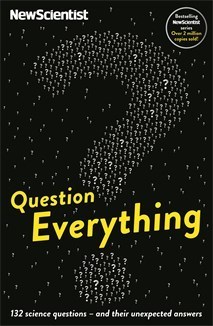
Question Everything: 132 science questions - and their unexpected answers
The dazzling new collection of scientific questions and answers from New Scientist magazine
The latest in the bestselling New Scientist Last Word series
All science begins with questions... - Why is the night sky black, even though it's full of stars? - How do pebbles skim on water? - Why doesn't your own snoring wake you up? - And why is the Large Hadron Collider so ... er ... large?
And as these intriguing, imaginative and occasionally bonkers questions and answers drawn from New Scientist magazine's archives show: question everything and you might find your way to amazing, unexpected insights into our minds, bodies and the universe, and the science behind the scenes that keeps them ticking. As you would expect from New Scientist, this is top-flight science at its most accessible, unpredictable and entertaining. This latest mind-bending addition to the No. 1 bestselling series will fascinate 'Last Word' fans and new readers alike.
The latest in the bestselling New Scientist Last Word series
All science begins with questions... - Why is the night sky black, even though it's full of stars? - How do pebbles skim on water? - Why doesn't your own snoring wake you up? - And why is the Large Hadron Collider so ... er ... large?
And as these intriguing, imaginative and occasionally bonkers questions and answers drawn from New Scientist magazine's archives show: question everything and you might find your way to amazing, unexpected insights into our minds, bodies and the universe, and the science behind the scenes that keeps them ticking. As you would expect from New Scientist, this is top-flight science at its most accessible, unpredictable and entertaining. This latest mind-bending addition to the No. 1 bestselling series will fascinate 'Last Word' fans and new readers alike.
- GenresScienceNonfictionTrivia
288 pages, Paperback
First published November 6, 2014
Ratings & Reviews
Friends & Following
Create a free account to discover what your friends think of this book!
Community Reviews
Displaying 1 - 30 of 30 reviews

August 28, 2026
Still Water:
"Is it possible for two ingredients to weigh more mixed, than they do separately? If so, what and why?
The simple answer is no. One of the fundamental laws of physics is the conservation of mass and energy. Normal chemical processes do nothing to alter matter, they just rearrange atoms in different ways. Nuclear reactions can convert matter to energy, but as long as this energy is not lost from the system, the system will still weight the same.
There is certainly no way for a system to gain mass unless there is a flow of energy or matter into it from outside. For instance, a rusting nail weights more than the original because it has reacted with oxygen from the air.
Simon Iveson
Theoretically, because E = mc^2, the mass would increase very slightly if there is an increase in energy. But usually, mixing two substances decreases the energy, otherwise they wouldn't mix - as oil and water do not.
There is one explanation for an apparent increase in the weight, though When you weight something you are actually measuring its true weight minus the buoyancy due tot eh volume of air it displaces. And weight is different from mass,. So if mixing two ingredients results in a smaller volume, then there will be less buoyancy and it will seem heavier. For instance, mixing soda and water will show this effect, but it's a very small one.
Eric Kvaalen
It is possible for two substances to weigh more after they are mixed than they did separately. Alcohol and water love to mix and form hydrogen bonds. A 50:50 mixture of ethanol and water takes up about 96% of the volume of the separate liquids. Thus a litre of alcohol mixed with a litre of water contracts by about 80 ml and thereby displaces 80 millilitres and thereby displaces 80 ml less air than the separate liquids do. And 80 ml of air weighs about 0.1 grams. So the mixed liquids are heavier by 0.1 grams because less displaced air means less buoyancy from the weight of displaced air."
"The speed of light in air is about 0.997 of the speed of light in a vacuum. This means that light probably interacts with air molecules many millions of times, even over a short distance, and photons are scattered following collisions. Why then can we see images crisply and sharply? What kind of interactions lows light down and yet does not change its path?
Leo Sarasua
The slowing of light is an illusion, at least on a microscopic scale. Its speed between atoms is the same as its speed in a vacuum.
Light waves carry an alternating electric field that makes electrons move up and down in the same way that waves in water make boats bob up and down. in order to oscillate, each electron borrows some energy from the passing light beam. However, by virtue of their everchanging speed and direction, these electrons are accelerating. This means they emit electromagnetic radiation. And, in fact, they emit exactly the same light they absorbed a moment earlier; it is just slightly delayed. This is why light appears to be slowed when not ravelling in a vacuum.
Light can also be visualised as tiny particles of energy called photons. If a photon carries exactly the correct transition energy to promote an electron to a higher energy level, it will be absorbed and the medium will be perceived as opaque to it .This is why there is so much concern about ozone depletion and the increased skin cancer risk. photons of visible light pass through the ozone layer, which is why we can't see it
However, the closer a photon's energy is to an electron's transition energy, the longer it is delayed by each electron. This explains why the apparent slowing of light is frequency dependent, why we get dispersion of light, and also why blue light is slowed down more than red in glass."
"So it seems that evolution has led to increasing intelligence simply because it has led to increasing body size. Vertebrates can be bigger than insects and nematodes because, among other adaptations, they have internal skeletons and oxygen-carrying blood. Greater intelligence is a by-product. Yet, in spite of these considerations, it is clear that humans have a bigger brain than would be expected for a mammal of our size.
The traditional explanation is that our greatly increased intelligence gave us a survival advantage, but there's little evidence for that. If extra intelligence helped our ancestors survive, then we would expect evidence in the form of increasingly sophisticated tools. That doesn't seem to have happened. Homo Habilis's tools stayed exactly the same for a million years, then Homo Erectus's tools stayed the same for another million years.
One theory stays that unusually high intelligence aids our survival as much as a big tail aids a peacock's survival. It costs a lot to maintain and so reduced our ancestors' life expectancy. But, like a peacock's tail, it made us sexier, and the sexiest is, of course, the most likely to reproduce. We chat each other up. We write sonnets. We tell jokes.
Sexual selection is arbitrary: the object of desire can have bright scales, large horns or a big brain. And the positive feedback of sexual selection leads to fast evolution and great exaggeration of the chosen characteristic...
Although many animals have evolved quite a high level of intelligence, it is by no means a desirable feature for all species to possess.
Animals have a limited supply of energy, so they have to choose how it is allocated. Two major uses of energy are brain power and reproduction. Humans and many other intelligent species have only a few offspring and look after them very carefully, which is partly thanks to intelligence. In contrast, insects, for example, tend to produce millions of eggs in the hope that a few will survive. This is very costly in terms of energy and any evolutionary trend towards having a larger brain would mean they would have to reduce the number of eggs they produce."
Best Quote of the Book Award 🏅
"In a study looking at what makes people seem more attractive to the opposite sex, people were shown two images of the same face. When pictures of the faces were doctored to look slightly more symmetrical, people found them more attractive than the original photographs. When animals inbreed, the chance their offspring is in some way defective, or asymmetrical, is higher. This means that the asymmetrical offspring appear less attractive than their interbred counterparts, and are less likely to find a mate and repeat the habits of their parents or siblings.
In another study, participants were shown pictures of people of the opposite sex who resembled them. In general, the greater the similarity, the weaker the attraction people felt. The likeness that carries through families seems to inhibit incest. IF a sibling looks like you, you are less attracted to him or her. So, in theory, even if society were impartial to incestuous relationships, we are genetically hardwired not to find members of our families attractive."
"Is it true that goldfish grow in proportion to the tank in which they live?
...
There's no reason goldfish should become stunted in ponds if water quality is good and food supply rich and varied. But because garden ponds are often filtered (to remove fish waste) and almost always receive few water changes, which would dilute the end products of biological decay and filtration, water quality in ponds may not be as good as the pond keeper thinks. This, more tan anything, explains why goldfish in ponds are smaller than expected.
That we so often see stunted goldfish in ponds, aquaria and bowls say less about their ability to grow to the size of the container and more about their ability to hold onto life where other fish would simply die"
"Contrary to what you might suppose, spiders are not immune from being trapped in their own webs. They avoid getting stuck by leaving some strands of silk untreated with glue, which allows them to deftly pick their way around without becoming entangled.
Blundering into a strange web, the intruder spider in the question didn't know which strands were untreated."
"Why does my nose run in cold weather?
This is caused by condensation and evaporation. In cold air there is not much water vapour but warm exhaled air is almost completely saturated with water vapour from its passage over the warm surfaces of the lungs and airways.
When the exhaled warm and moisturised air passes over the surface of the nasal mucosa that has been cooled by the cold air on its way into the lungs, it condenses, just as it does if you blow exhaled air towards the colder surface of a window pane or a mirror. As the nasal mucosa cannot take up all the moisture that condenses on it, the nose runs to get rid of the excess. The water running out of the nose is clear and clean condensed water, and is not a sign of an infection.
In the Arctic this constant running nose is a nuisance until you learn either to avoid breathing through the nose or to breathe in through the nose and out through the mouth. In fact, the original Arctic mitten has a piece of soft fur on the back to wipe up the surplus water running out of the nose. After the water has frozen, the ice crystals can easily be shaken off.
"Is it possible for two ingredients to weigh more mixed, than they do separately? If so, what and why?
The simple answer is no. One of the fundamental laws of physics is the conservation of mass and energy. Normal chemical processes do nothing to alter matter, they just rearrange atoms in different ways. Nuclear reactions can convert matter to energy, but as long as this energy is not lost from the system, the system will still weight the same.
There is certainly no way for a system to gain mass unless there is a flow of energy or matter into it from outside. For instance, a rusting nail weights more than the original because it has reacted with oxygen from the air.
Simon Iveson
Theoretically, because E = mc^2, the mass would increase very slightly if there is an increase in energy. But usually, mixing two substances decreases the energy, otherwise they wouldn't mix - as oil and water do not.
There is one explanation for an apparent increase in the weight, though When you weight something you are actually measuring its true weight minus the buoyancy due tot eh volume of air it displaces. And weight is different from mass,. So if mixing two ingredients results in a smaller volume, then there will be less buoyancy and it will seem heavier. For instance, mixing soda and water will show this effect, but it's a very small one.
Eric Kvaalen
It is possible for two substances to weigh more after they are mixed than they did separately. Alcohol and water love to mix and form hydrogen bonds. A 50:50 mixture of ethanol and water takes up about 96% of the volume of the separate liquids. Thus a litre of alcohol mixed with a litre of water contracts by about 80 ml and thereby displaces 80 millilitres and thereby displaces 80 ml less air than the separate liquids do. And 80 ml of air weighs about 0.1 grams. So the mixed liquids are heavier by 0.1 grams because less displaced air means less buoyancy from the weight of displaced air."
"The speed of light in air is about 0.997 of the speed of light in a vacuum. This means that light probably interacts with air molecules many millions of times, even over a short distance, and photons are scattered following collisions. Why then can we see images crisply and sharply? What kind of interactions lows light down and yet does not change its path?
Leo Sarasua
The slowing of light is an illusion, at least on a microscopic scale. Its speed between atoms is the same as its speed in a vacuum.
Light waves carry an alternating electric field that makes electrons move up and down in the same way that waves in water make boats bob up and down. in order to oscillate, each electron borrows some energy from the passing light beam. However, by virtue of their everchanging speed and direction, these electrons are accelerating. This means they emit electromagnetic radiation. And, in fact, they emit exactly the same light they absorbed a moment earlier; it is just slightly delayed. This is why light appears to be slowed when not ravelling in a vacuum.
Light can also be visualised as tiny particles of energy called photons. If a photon carries exactly the correct transition energy to promote an electron to a higher energy level, it will be absorbed and the medium will be perceived as opaque to it .This is why there is so much concern about ozone depletion and the increased skin cancer risk. photons of visible light pass through the ozone layer, which is why we can't see it
However, the closer a photon's energy is to an electron's transition energy, the longer it is delayed by each electron. This explains why the apparent slowing of light is frequency dependent, why we get dispersion of light, and also why blue light is slowed down more than red in glass."
"So it seems that evolution has led to increasing intelligence simply because it has led to increasing body size. Vertebrates can be bigger than insects and nematodes because, among other adaptations, they have internal skeletons and oxygen-carrying blood. Greater intelligence is a by-product. Yet, in spite of these considerations, it is clear that humans have a bigger brain than would be expected for a mammal of our size.
The traditional explanation is that our greatly increased intelligence gave us a survival advantage, but there's little evidence for that. If extra intelligence helped our ancestors survive, then we would expect evidence in the form of increasingly sophisticated tools. That doesn't seem to have happened. Homo Habilis's tools stayed exactly the same for a million years, then Homo Erectus's tools stayed the same for another million years.
One theory stays that unusually high intelligence aids our survival as much as a big tail aids a peacock's survival. It costs a lot to maintain and so reduced our ancestors' life expectancy. But, like a peacock's tail, it made us sexier, and the sexiest is, of course, the most likely to reproduce. We chat each other up. We write sonnets. We tell jokes.
Sexual selection is arbitrary: the object of desire can have bright scales, large horns or a big brain. And the positive feedback of sexual selection leads to fast evolution and great exaggeration of the chosen characteristic...
Although many animals have evolved quite a high level of intelligence, it is by no means a desirable feature for all species to possess.
Animals have a limited supply of energy, so they have to choose how it is allocated. Two major uses of energy are brain power and reproduction. Humans and many other intelligent species have only a few offspring and look after them very carefully, which is partly thanks to intelligence. In contrast, insects, for example, tend to produce millions of eggs in the hope that a few will survive. This is very costly in terms of energy and any evolutionary trend towards having a larger brain would mean they would have to reduce the number of eggs they produce."
Best Quote of the Book Award 🏅
"In a study looking at what makes people seem more attractive to the opposite sex, people were shown two images of the same face. When pictures of the faces were doctored to look slightly more symmetrical, people found them more attractive than the original photographs. When animals inbreed, the chance their offspring is in some way defective, or asymmetrical, is higher. This means that the asymmetrical offspring appear less attractive than their interbred counterparts, and are less likely to find a mate and repeat the habits of their parents or siblings.
In another study, participants were shown pictures of people of the opposite sex who resembled them. In general, the greater the similarity, the weaker the attraction people felt. The likeness that carries through families seems to inhibit incest. IF a sibling looks like you, you are less attracted to him or her. So, in theory, even if society were impartial to incestuous relationships, we are genetically hardwired not to find members of our families attractive."
"Is it true that goldfish grow in proportion to the tank in which they live?
...
There's no reason goldfish should become stunted in ponds if water quality is good and food supply rich and varied. But because garden ponds are often filtered (to remove fish waste) and almost always receive few water changes, which would dilute the end products of biological decay and filtration, water quality in ponds may not be as good as the pond keeper thinks. This, more tan anything, explains why goldfish in ponds are smaller than expected.
That we so often see stunted goldfish in ponds, aquaria and bowls say less about their ability to grow to the size of the container and more about their ability to hold onto life where other fish would simply die"
"Contrary to what you might suppose, spiders are not immune from being trapped in their own webs. They avoid getting stuck by leaving some strands of silk untreated with glue, which allows them to deftly pick their way around without becoming entangled.
Blundering into a strange web, the intruder spider in the question didn't know which strands were untreated."
"Why does my nose run in cold weather?
This is caused by condensation and evaporation. In cold air there is not much water vapour but warm exhaled air is almost completely saturated with water vapour from its passage over the warm surfaces of the lungs and airways.
When the exhaled warm and moisturised air passes over the surface of the nasal mucosa that has been cooled by the cold air on its way into the lungs, it condenses, just as it does if you blow exhaled air towards the colder surface of a window pane or a mirror. As the nasal mucosa cannot take up all the moisture that condenses on it, the nose runs to get rid of the excess. The water running out of the nose is clear and clean condensed water, and is not a sign of an infection.
In the Arctic this constant running nose is a nuisance until you learn either to avoid breathing through the nose or to breathe in through the nose and out through the mouth. In fact, the original Arctic mitten has a piece of soft fur on the back to wipe up the surplus water running out of the nose. After the water has frozen, the ice crystals can easily be shaken off.

October 25, 2014
I am very fond of these New Scientist books that bring together question and answer sessions from the weekly magazine's Last Word column. The idea is simple - readers send in questions, other readers provide answers (which I assume are only used if they are reasonably correct (or funny)). The series has been very popular, but inevitably some books in the series stand out, and for me this wasn't one of the better ones.
It's not that there isn't good material. I enjoyed, for instance, entries on the spinning of cricket balls (and I hate sport), the long life of fruit cakes, skimming stones and the reason animals don't need toilet paper. But there were just too many questions and answers that didn't really give me anything new and exciting. Perhaps all the really mind boggling questions have already been dealt with.
The final question also illustrated the limitations of this approach. Someone asked how the UK TV audience figures are calculated. They clearly don't ask every viewer what they watched - so how do we know that 9 million people watched programme X? The answer about a sample of viewers whose viewing is recorded was fine, but the problem is that in a 'real' popular science book, the writer would be likely to think through what more would people want to discover? A writer would develop the question. But this 'crowd sourced' approach means there isn't that opportunity to dive in. So here, for instance, the really interesting question is how do they deal with the fact that many us now hardly watch any TV at the time of broadcast, but instead watch a mix of programmes time shifted with a PVR, catch-up TV and streamed shows? That's where the questioning should have gone, but the format doesn't allow for it unless someone happens to write in with the follow-up question.
So, overall, definitely still an interesting book to dip into and makes a great gift (the timing of the publication before Christmas is hardly coincidental) - but it wasn't one of my favourites in the series.
It's not that there isn't good material. I enjoyed, for instance, entries on the spinning of cricket balls (and I hate sport), the long life of fruit cakes, skimming stones and the reason animals don't need toilet paper. But there were just too many questions and answers that didn't really give me anything new and exciting. Perhaps all the really mind boggling questions have already been dealt with.
The final question also illustrated the limitations of this approach. Someone asked how the UK TV audience figures are calculated. They clearly don't ask every viewer what they watched - so how do we know that 9 million people watched programme X? The answer about a sample of viewers whose viewing is recorded was fine, but the problem is that in a 'real' popular science book, the writer would be likely to think through what more would people want to discover? A writer would develop the question. But this 'crowd sourced' approach means there isn't that opportunity to dive in. So here, for instance, the really interesting question is how do they deal with the fact that many us now hardly watch any TV at the time of broadcast, but instead watch a mix of programmes time shifted with a PVR, catch-up TV and streamed shows? That's where the questioning should have gone, but the format doesn't allow for it unless someone happens to write in with the follow-up question.
So, overall, definitely still an interesting book to dip into and makes a great gift (the timing of the publication before Christmas is hardly coincidental) - but it wasn't one of my favourites in the series.
July 24, 2015
This book has made me realise the importance of diagrams, graphs and statistics. If you are trying to cut down on the esoteric jargon, please... pretty please... include a visual or two!
August 15, 2017
This was a little hard for me to get into at first because the questions were very physics-heavy but once it became less physics-focused, I got pretty into it.

October 22, 2014
While I was looking for new non-fiction books to read, I stumbled upon this one: Question Everything. It contains Q&A's from the various readers of New Scientist, the scientific magazine. I know the magazine, but have never read a copy. The questions and answers were taken from the printed magazine and online at www.newscientist.com/topic/lastword/, which is regularly updated.
Also, it seems that they (New Scientist) regularly publish such a book, compiled of Q&A's and ordered by theme. Selecting appropriate questions and answers that fit best to those questions.
In this new book, 132 questions and several more answers (as there were sometimes more answers per question, from various readers, including experts in those specific fields) offer a very informative and interesting way on many aspects of life. Themes range from Earth, Space, Physics, Health, Meteorology, Cognition, Biology, and more, to Biology, Evolution, Transport, and Various / The Rest.
The index at the back is a helpful means to find an answer to a specific item.
You don't have to read the book from start to finish. Just select a theme and question whenever you like. While the book is made to be accessible for a large audience, some technical jargon will be part of the answers as well, obviously. Sometimes a certain answer, depending on your preferences, will not provide enough information or reasoning.
Regardless of this small issue, I can recommend Question Everything, as you can pick it up any time you want to and read something from it now and then, and at the same time refresh or expand your knowledge on many things that happen / exist in life.
Also, it seems that they (New Scientist) regularly publish such a book, compiled of Q&A's and ordered by theme. Selecting appropriate questions and answers that fit best to those questions.
In this new book, 132 questions and several more answers (as there were sometimes more answers per question, from various readers, including experts in those specific fields) offer a very informative and interesting way on many aspects of life. Themes range from Earth, Space, Physics, Health, Meteorology, Cognition, Biology, and more, to Biology, Evolution, Transport, and Various / The Rest.
The index at the back is a helpful means to find an answer to a specific item.
You don't have to read the book from start to finish. Just select a theme and question whenever you like. While the book is made to be accessible for a large audience, some technical jargon will be part of the answers as well, obviously. Sometimes a certain answer, depending on your preferences, will not provide enough information or reasoning.
Regardless of this small issue, I can recommend Question Everything, as you can pick it up any time you want to and read something from it now and then, and at the same time refresh or expand your knowledge on many things that happen / exist in life.

September 7, 2020
This book really intrigued me and I really did find a lot of the answers very unexpected. A lot of them were like eureka moments where it asks a question, and when you’ve read the answer, you’re like, ‘Oh yeah, that’s actually really obvious!’ An example is, ‘How do freckles come?’ And that was because your body has more melanin and therefore also tans quicker!
Anyway, I also really liked this book because, firstly, there were some of these everyday questions that seem so simple that nobody ever really thinks about it, but actually, there’s loads of scorende behind it! Furthermore, when there were questions, there were always multiple people who answered it which helped me to see the answer from different viewpoints. However, I thought it was quite strange though when there was a question, three answers, and all three answers said something completely opposite!! That just shows how even scientist aren’t always certain of answers!
Anyway, I also really liked this book because, firstly, there were some of these everyday questions that seem so simple that nobody ever really thinks about it, but actually, there’s loads of scorende behind it! Furthermore, when there were questions, there were always multiple people who answered it which helped me to see the answer from different viewpoints. However, I thought it was quite strange though when there was a question, three answers, and all three answers said something completely opposite!! That just shows how even scientist aren’t always certain of answers!
July 20, 2020
You all at this point I’m sure know that along with Meryl Streep, and toast, I very much love science. LOVE IT. Alas I did not love this book, which was extra disappointing as I thought it might be amazing. Really what isn't to love, 132 supposedly interesting questions alongside scientific answers for each. But the questions weren’t really all that interesting, for instance why do thunderstorms and fireworks set off car alarms?, why exactly would I care, also its a fairly obvious reason, but they jargon the life out of the answer so it stumbles right over that little hurdle too. The answers annoyed me quite a bit, they are given by readers of New Scientist, making for some very poor writing, some muddled explanations and tone that ranges from patronising to pandering. This book is why people don’t like science. Science has the capacity to explain marvels, to shock and awe, science (and the Queen of science, my beloved Mathematics) is literally the root of all that is good and all that is evil and all that is everywhere in between, meaning there is huge scope for the parts that are captivating, here this book shone a light on the parts that are just sort of boring. And by shone a light I mean a really dim light that rendered you with strained eyes trying to see what it supposedly illuminated.
November 7, 2018
Overall not a bad book. I wouldn't say it is something extraordinary. I liked the fact that the questions were organized in groups of different subjects. However I have to say that some questions missed the mark for me (either the answer was very obvious or the question itself was completely irrelevant). As for the answers, most of them were accurate and explained quite clearly. That said in some cases there were several answers with almost the exact same explanations just using different words - I found that completely unnecessary. The first three chapters contained the "hardest" scientific questions in my opinion - from there on the level quickly dropped and I was a bit disappointed with the nature of the questions as I think scientific branches as for example biology and evolution pose may more interesting mysteries. I think the writer had a nice idea, but I believe this book lacked depth and execution.

February 4, 2019
I read roughly about 3/4 of the book as the information is presented to you in question and answer format with each question having 2,3 sometimes 4 answers. The later answers, after reading a few, didn't serve to enlighten or even interest the reader in many ways.
As I was going through them I noticed how frequently some of the questions related to personal thoughts I'd have about phenomena that goes on so it was cool to have some of those mysteries spoken about and elucidated. Part of the responses are pretty comical too so I think the New Scientist did a good job, if a little bit infrequently, in lightening the material and making it engaging.
No question was explained in any great detail and I didn't have any serious mind blowing moments. Just a pleasing exploration.
As I was going through them I noticed how frequently some of the questions related to personal thoughts I'd have about phenomena that goes on so it was cool to have some of those mysteries spoken about and elucidated. Part of the responses are pretty comical too so I think the New Scientist did a good job, if a little bit infrequently, in lightening the material and making it engaging.
No question was explained in any great detail and I didn't have any serious mind blowing moments. Just a pleasing exploration.

July 28, 2018
132 lovely earthings of sky-high theory. Not much new, but good as refresher course and mind candy.
The tacit connections between the answers are the real thing – for instance, I guessed (wrongly) that synchrotron radiation and Cherenkov radiation were based on the same mechanism, and feel very happy that a quick and public disconfirmation was available. Here
The tacit connections between the answers are the real thing – for instance, I guessed (wrongly) that synchrotron radiation and Cherenkov radiation were based on the same mechanism, and feel very happy that a quick and public disconfirmation was available. Here

November 28, 2018
It was really interesting and I learnt lots of new things. I found that it was really good to just pick up and read a small part of it at a time, just read one question and the answers.
It covers a wide range of topics, which I really enjoyed, and may pick up a book similar to this in the future.
It covers a wide range of topics, which I really enjoyed, and may pick up a book similar to this in the future.

October 22, 2018
Questions and answers from the New Scientist.

April 29, 2020
Not my style of book but was on the shelf for years. Couldn’t motivate myself to read certain sections (eg chemistry & space) but certain parts were interesting and I definitely learned a lot!

March 3, 2021
Really good to dip in an out of for answers to all of those little weird and wonderful things you've considered about the world and beyond!

October 6, 2024
Some questions were interesting, most weren’t
March 29, 2026
Not bad.

March 14, 2015
Early in my so-called career, I had a senior colleague who subscribed to New Scientist magazine, and, during rainy lunch breaks, I might borrow his mag, find a few articles interesting and attempt to engage him in some controversial discussion, at which he might brush me off by saying, "don't believe everything in print". I learnt something from his healthy scepticism: question everything.
However, the phrase here used for the title is turned about, inviting their readers to submit a question on anything they felt like, providing it could be answered scientifically, and other readers could then answer it, the best answers, hopefully the most correct ones, were subsequently published. Here is a collection of 132 questions and 132+ answers (there are more answers than questions in some cases).
It's taken a long time to get to the end of this book not because it's hard to understand but because it covers such a wide range of subjects duly separated into relevant chapters. In all, though I haven't counted them, there are 132 reader's questions. It's a book that can be savoured slowly, especially if too great a dose of scientific explanation is overwhelming.
The questions, and subjects, are broad in range, from intellectual to naive, complex to facile, obvious to why on earth didn't I think to ask that? I made some highlights, I found the chapter on Evolution the most fascinating. Other gems include; if the Earth was hollow below the crust, could a man literally run and jump off from it (and into orbit)?, what would you experience if you travelled to the centre of the Earth?, how much longer will the Earth keep turning for?, why do pebbles skim?, why does a hand have five fingers and a foot five toes?, is there a limit to the size of a brain?, what is fire really made of?, what makes all that black dust in the London tube?, does the other lane really move faster in slow traffic?, how can sailing boats actually move faster than the wind?
And it only cost me 99p on the Kindle store at the time. I would have paid more but I'm not complaining. An interesting miscellany of curious scientific enquiry.
However, the phrase here used for the title is turned about, inviting their readers to submit a question on anything they felt like, providing it could be answered scientifically, and other readers could then answer it, the best answers, hopefully the most correct ones, were subsequently published. Here is a collection of 132 questions and 132+ answers (there are more answers than questions in some cases).
It's taken a long time to get to the end of this book not because it's hard to understand but because it covers such a wide range of subjects duly separated into relevant chapters. In all, though I haven't counted them, there are 132 reader's questions. It's a book that can be savoured slowly, especially if too great a dose of scientific explanation is overwhelming.
The questions, and subjects, are broad in range, from intellectual to naive, complex to facile, obvious to why on earth didn't I think to ask that? I made some highlights, I found the chapter on Evolution the most fascinating. Other gems include; if the Earth was hollow below the crust, could a man literally run and jump off from it (and into orbit)?, what would you experience if you travelled to the centre of the Earth?, how much longer will the Earth keep turning for?, why do pebbles skim?, why does a hand have five fingers and a foot five toes?, is there a limit to the size of a brain?, what is fire really made of?, what makes all that black dust in the London tube?, does the other lane really move faster in slow traffic?, how can sailing boats actually move faster than the wind?
And it only cost me 99p on the Kindle store at the time. I would have paid more but I'm not complaining. An interesting miscellany of curious scientific enquiry.

January 3, 2015
The real reason that I have this book is because a good friend of mine, a hip-hop artist called Antix, has an album of the same name. That tenuous link was enough for me to buy it when I had a chance to, and it turned out to be a pretty interesting read, and one that Antix would enjoy, too.
There’s no complex idea behind it, but it can get complex at times – simply put, it’s a series of questions and answers that have appeared in New Scientist over the years, sorted by subject (Earth, Space, Physics, Meteorology, Chemistry, Evolution, Biology, Health, Cognition, Alcohol, Eating, Transport and The Rest).
Some of the questions are deep, like ‘why is the night sky black, even though it’s full of stars?’, and some are trivial, like ‘why doesn’t your own snoring wake you up?’, but all of them somehow seem to fit into the category of questions that you’ve wondered about absent-mindedly at least once in your life. It’s kind of cool to get answers to questions that you didn’t realise that you’d asked, if nothing else.
It can also be a little depressing at times – it turns out that the answer to a lot of the ‘what would happen if?’ questions is that we would all die. If the earth was hollow, for instance, we would be screwed – bet you’ve always wanted to know how long it would take to circumnavigate the globe if you jumped straight through a hole in the planet, though. Get ready to have that question, and plenty more, answered comprehensively.
There’s no complex idea behind it, but it can get complex at times – simply put, it’s a series of questions and answers that have appeared in New Scientist over the years, sorted by subject (Earth, Space, Physics, Meteorology, Chemistry, Evolution, Biology, Health, Cognition, Alcohol, Eating, Transport and The Rest).
Some of the questions are deep, like ‘why is the night sky black, even though it’s full of stars?’, and some are trivial, like ‘why doesn’t your own snoring wake you up?’, but all of them somehow seem to fit into the category of questions that you’ve wondered about absent-mindedly at least once in your life. It’s kind of cool to get answers to questions that you didn’t realise that you’d asked, if nothing else.
It can also be a little depressing at times – it turns out that the answer to a lot of the ‘what would happen if?’ questions is that we would all die. If the earth was hollow, for instance, we would be screwed – bet you’ve always wanted to know how long it would take to circumnavigate the globe if you jumped straight through a hole in the planet, though. Get ready to have that question, and plenty more, answered comprehensively.

March 9, 2015
While this book contains some very good and detailed answers to lots of questions, I found myself already knowing the answers to many of them, causing me to flick through it quite quickly. A very interesting read to learn a little more about the things around us, however I personally believe that some of the questions were far too simplistic. However, that's just my opinion, and I'm sure that many others will have enjoyed it!
December 23, 2014
This is a great book for people who want to read a little a bit of information on a lot of subjects. I like that for each question there are multiple answers, it meant that if you don't understand one answer or you want more detail you can get it from another source.

April 3, 2024
This was a nice little non fiction book that even managed to get the attention of my bf, which is very rare for books 😂
I enjoyed the different variety of facts that are in this and I actually learned a few things so I definitely recommend!
I enjoyed the different variety of facts that are in this and I actually learned a few things so I definitely recommend!

November 28, 2014
It's a fun book for facts and a goo little chat with mates about facts over a drink I enjoyed this book

May 17, 2015
Explanations can be very technical and not friendly, and many subjects are irrelevant to me. Still, a few gems of new knowledge here and there. Only for hardcore science enthusiasts.

December 15, 2015
One of those books to pass the time. Had some great explanations to questions I've always pondered. Picked this one up from my local library :)

January 18, 2016
I think this is the perfect selection of random sciencey question and answers that I love the way it's presented very good 11/10

May 9, 2016
i think it's not irrelevant to me
Read
September 28, 2016Thought provoking and challenges widely conceived fallacies.

October 18, 2016
An average book. There were a few interesting questions, however, overall it did not seem too intriguing

April 19, 2015
I know how to cook mushrooms properly now.
March 11, 2016
A fun book to read. Interesting questions and answers compilation. Quick and a light read.
Displaying 1 - 30 of 30 reviews