

What do you think?
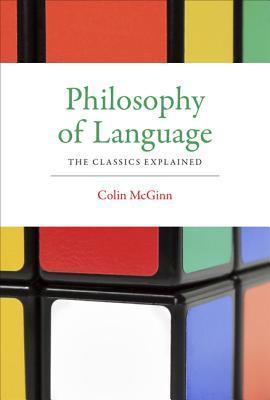
Philosophy of Language: The Classics Explained
Many beginning students in philosophy of language find themselves grappling with dense and difficult texts not easily understood by someone new to the field. This book offers an introduction to philosophy of language by explaining ten classic, often anthologized, texts. Accessible and thorough, written with a unique combination of informality and careful formulation, the book addresses sense and reference, proper names, definite descriptions, indexicals, the definition of truth, truth and meaning, and the nature of speaker meaning, as addressed by Frege, Kripke, Russell, Donnellan, Kaplan, Evans, Putnam, Tarski, Davidson, and Grice. The explanations aim to be as simple as possible without sacrificing accuracy; critical assessments are included with the exposition in order to stimulate further thought and discussion. Philosophy of Language will be an essential resource for undergraduates in a typical philosophy of language course or for graduate students with no background in the field. It can be used in conjunction with an anthology of classic texts, sparing the instructor much arduous exegesis. Contents Frege on Sense and ReferenceKripke on NamesRussell on Definite DescriptionsDonnellan's DistinctionKaplan on DemonstrativesEvans on Understanding DemonstrativesPutnam on Semantic ExternalismTarski's Theory of TruthDavidson's Semantics for Natural LanguageGrice's Theory of Speaker Meaning
225 pages, Hardcover
First published January 16, 2015
About the author
Colin McGinn
42 books77 followersColin McGinn is a British philosopher currently working at the University of Miami. McGinn has also held major teaching positions at Oxford University and Rutgers University. He is best known for his work in the philosophy of mind, though he has written on topics across the breadth of modern philosophy. Chief among his works intended for a general audience is the intellectual memoir The Making of a Philosopher: My Journey Through Twentieth-Century Philosophy (2002).
Colin McGinn was born in Blackpool, England in 1950. He enrolled in Manchester University to study psychology. However, by the time he received his degree in psychology from Manchester in 1971 (by writing a thesis focusing on the ideas of Noam Chomsky), he wanted to study philosophy as a postgraduate. By 1972, McGinn was admitted into Oxford University's B.Litt postgraduate programme, in hopes of eventually gaining entrance into Oxford's postgraduate B.Phil. programme.
McGinn quickly made the transition from psychology to philosophy during his first term at Oxford. After working zealously to make the transition, he was soon admitted into the B.Phil programme under the recommendation of his advisor, Michael R. Ayers. Shortly after entering the philosophy programme, he won the John Locke Prize in 1972. By 1974, McGinn received the B.Phil degree from Oxford, writing a thesis under the supervision of P.F. Strawson, which focused on the semantics of Donald Davidson.
In 1974, McGinn took his first philosophy position at University College London. In January 1980, he spent two semesters at University of California, Los Angeles (UCLA) as a visiting professor. Then, shortly after declining a job at University of Southern California, he succeeded Gareth Evans as Wilde Reader at Oxford University. In 1988, shortly after a visiting term at City University of New York (CUNY), McGinn received a job offer from Rutgers University. He accepted the offer from Rutgers, joining ranks with, among others, Jerry Fodor in the philosophy department. McGinn stayed at Rutgers until 2006, when he accepted a job offer from University of Miami as full time professor.
Although McGinn has written dozens of articles in philosophical logic, metaphysics, and the philosophy of language, he is best known for his work in the philosophy of mind. In his 1989 article "Can We Solve the Mind-Body Problem?", McGinn speculates that the human mind is innately incapable of comprehending itself entirely, and that this incapacity spawns the puzzles of consciousness that have preoccupied Western philosophy since Descartes. Thus, McGinn's answer to the hard problem of consciousness is that humans cannot find the answer. This position has been nicknamed the "New Mysterianism". The Mysterious Flame: Conscious Minds in a Material World (2000) is a non-technical exposition of McGinn's theory.
Outside of philosophy, McGinn has written a novel entitled The Space Trap (1992). He was also featured prominently as an interviewee in Jonathon Miller's Brief History of Disbelief, a documentary miniseries about atheism's history. He discussed the philosophy of belief as well as his own beliefs as an atheist.
Colin McGinn was born in Blackpool, England in 1950. He enrolled in Manchester University to study psychology. However, by the time he received his degree in psychology from Manchester in 1971 (by writing a thesis focusing on the ideas of Noam Chomsky), he wanted to study philosophy as a postgraduate. By 1972, McGinn was admitted into Oxford University's B.Litt postgraduate programme, in hopes of eventually gaining entrance into Oxford's postgraduate B.Phil. programme.
McGinn quickly made the transition from psychology to philosophy during his first term at Oxford. After working zealously to make the transition, he was soon admitted into the B.Phil programme under the recommendation of his advisor, Michael R. Ayers. Shortly after entering the philosophy programme, he won the John Locke Prize in 1972. By 1974, McGinn received the B.Phil degree from Oxford, writing a thesis under the supervision of P.F. Strawson, which focused on the semantics of Donald Davidson.
In 1974, McGinn took his first philosophy position at University College London. In January 1980, he spent two semesters at University of California, Los Angeles (UCLA) as a visiting professor. Then, shortly after declining a job at University of Southern California, he succeeded Gareth Evans as Wilde Reader at Oxford University. In 1988, shortly after a visiting term at City University of New York (CUNY), McGinn received a job offer from Rutgers University. He accepted the offer from Rutgers, joining ranks with, among others, Jerry Fodor in the philosophy department. McGinn stayed at Rutgers until 2006, when he accepted a job offer from University of Miami as full time professor.
Although McGinn has written dozens of articles in philosophical logic, metaphysics, and the philosophy of language, he is best known for his work in the philosophy of mind. In his 1989 article "Can We Solve the Mind-Body Problem?", McGinn speculates that the human mind is innately incapable of comprehending itself entirely, and that this incapacity spawns the puzzles of consciousness that have preoccupied Western philosophy since Descartes. Thus, McGinn's answer to the hard problem of consciousness is that humans cannot find the answer. This position has been nicknamed the "New Mysterianism". The Mysterious Flame: Conscious Minds in a Material World (2000) is a non-technical exposition of McGinn's theory.
Outside of philosophy, McGinn has written a novel entitled The Space Trap (1992). He was also featured prominently as an interviewee in Jonathon Miller's Brief History of Disbelief, a documentary miniseries about atheism's history. He discussed the philosophy of belief as well as his own beliefs as an atheist.
Ratings & Reviews
Friends & Following
Create a free account to discover what your friends think of this book!
Community Reviews
Displaying 1 - 8 of 8 reviews

August 8, 2020
I decided to try to learn a bit about philosophy of language because stuff I was reading about philosophy of mind kept referring to it. This book was very helpful; I love the format and really appreciate its clarity. I read the original paper after reading each chapter, and generally felt McGinn had already told me most of what was worth knowing about it.
I still don't really see the appeal of philosophy of language, though. What's the point? What are the consequences of favoring one theory over another? Those questions remain unclear in my mind.
I still don't really see the appeal of philosophy of language, though. What's the point? What are the consequences of favoring one theory over another? Those questions remain unclear in my mind.

July 15, 2016
McGinn's book is less an introduction and more a commentary. It will be useful sat next to Martinich's reader.
As a commentary, McGinn does a good job of explaining difficult passages of text by Frege, Kripke, Russell, Donnellen, Kaplan, Evans, Putnam, Tarski, Davidson, and Grice.
As a commentary, McGinn does a good job of explaining difficult passages of text by Frege, Kripke, Russell, Donnellen, Kaplan, Evans, Putnam, Tarski, Davidson, and Grice.

Read
May 24, 2026It can be difficult to find one’s way into analytic philosophy of language. The ideas are expressed in highly technical jargon and are scattered throughout journal articles that the uninitiated may not know about let alone have access to. This book by Colin McGinn really fulfills a need, then. McGinn introduces some of the major concepts and controversies in analytic philosophy of language through a discussion of some of the major texts in this tradition. One gets a sense of the flow of a conversation about how words connect to reality that begins with Frege and continues to the present day. There are some omissions, which I suspect were made because they contributed to different conversations in the philosophy of language. A complete history of analytic philosophy of language would surely have to discuss ordinary language philosophy as practiced by Ludwig Wittgenstein, J. L. Austin, and Gilbert Ryle. Also missing is anything on the analytic-synthetic distinction by Rudolph Carnap and W. V. O. Quine, as well as the later work of Donald Davidson. Still, as an account of issues related to reference stemming from Frege’s work, McGinn’s book is quite useful.
There is one oddity worth mentioning: McGinn anachronistically discusses Kripke before Russell. I am not sure why McGinn does this, and it seems to me it would have been better had the discussion of Frege led into the discussion of Russell and then into the discussion of Kripke, who is after all criticizing Frege as well as Russell. This is not a major issue, but it is a bad choice on McGinn’s part.
Beyond reading the essays discussed by McGinn and some of the notable omissions (Wittgenstein’s Philosophical Investigations, Austin’s How to Do Things with Words and Philosophical Papers, Carnap’s “Empiricism, Semantics, and Ontology,” Quine’s “Two Dogmas of Empiricism,” Davidson’s “A Nice Derangement of Epitaphs”), someone looking for a fuller picture of analytic philosophy of language might also consult the essays in Richard Rorty’s The Linguistic Turn: Essays in Philosophical Method and J. O. Urmson’s Philosophical Analysis: Its Development Between the Two World Wars.
There is one oddity worth mentioning: McGinn anachronistically discusses Kripke before Russell. I am not sure why McGinn does this, and it seems to me it would have been better had the discussion of Frege led into the discussion of Russell and then into the discussion of Kripke, who is after all criticizing Frege as well as Russell. This is not a major issue, but it is a bad choice on McGinn’s part.
Beyond reading the essays discussed by McGinn and some of the notable omissions (Wittgenstein’s Philosophical Investigations, Austin’s How to Do Things with Words and Philosophical Papers, Carnap’s “Empiricism, Semantics, and Ontology,” Quine’s “Two Dogmas of Empiricism,” Davidson’s “A Nice Derangement of Epitaphs”), someone looking for a fuller picture of analytic philosophy of language might also consult the essays in Richard Rorty’s The Linguistic Turn: Essays in Philosophical Method and J. O. Urmson’s Philosophical Analysis: Its Development Between the Two World Wars.

March 16, 2019
McGinn's clarity and concision, without much loss of content, is impressive. This book is based on transcriptions from McGinn's lectures, and it retains a conversational, elucidating quality. Each chapter focuses on a major paper by one key contributor to the debates in philosophy of language; McGinn walks the reader through the ideas presented in the paper, criticisms of these ideas, and its implications on major problems in the field.
The chapters proceed in an order that allows the reader to witness how responses to the same problems develop (and, possibly, make actual progress) over time. It also allows the reader to see potentially conventional assumptions or biases of the founders of these problems, biases which might have plagued the entire tradition and fated it to progress in the way it did.
This book holds, by far, the clearest explanations I've read so far of theories by Gareth Evans, Alfred Tarski, and Donald Davidson (among other philosophers; I was especially delighted by these chapters due to the general deficit of clear explanations of their ideas). I would highly recommend this book to anyone who has little or no background in philosophy of language, and who wants a straightforward, effective introduction to the major thinkers of this tradition and the core problems that drive their debates.
The chapters proceed in an order that allows the reader to witness how responses to the same problems develop (and, possibly, make actual progress) over time. It also allows the reader to see potentially conventional assumptions or biases of the founders of these problems, biases which might have plagued the entire tradition and fated it to progress in the way it did.
This book holds, by far, the clearest explanations I've read so far of theories by Gareth Evans, Alfred Tarski, and Donald Davidson (among other philosophers; I was especially delighted by these chapters due to the general deficit of clear explanations of their ideas). I would highly recommend this book to anyone who has little or no background in philosophy of language, and who wants a straightforward, effective introduction to the major thinkers of this tradition and the core problems that drive their debates.

January 29, 2026
More than anything, this book has taught me how almost mind-numbingly dull the philosophy of language is. Many of the problems seem completely uninteresting and their "solutions" even more so. What really did it for me in the end was a longer chapter attempting to spell out why "'Snow is white' means snow is white" is a seminal contribution to the field. Having said all that, this is a well written book and explains the various concepts, as pointless as they seem, very clearly. For anyone interested in the philosophy of language, this is probably a good place to start to figure out what the field is about and as such, I was able to discover that it is not the field for me.
June 26, 2020
Excellent and concise introduction to the study of language. True, it is missing some figures like Chomsky, but McGinn must've had good reason for it.
It contains perfect treatment of Tarski's T-sentence truth semantics.
One thing I didn't like were the sudden non-chrological jumps, for example, he jumps from Frege to Kripke's casual theory of names, and only then he treats Russell's descriptivism. Since Kripke attacks both Russell and Frege, this would be better done the other way around in my view.
But that is a minor thing, not enough to take away full 5 stars from it.
It contains perfect treatment of Tarski's T-sentence truth semantics.
One thing I didn't like were the sudden non-chrological jumps, for example, he jumps from Frege to Kripke's casual theory of names, and only then he treats Russell's descriptivism. Since Kripke attacks both Russell and Frege, this would be better done the other way around in my view.
But that is a minor thing, not enough to take away full 5 stars from it.

May 14, 2020
It's quite fun to read if you really enjoy philosophy of language. This book reminded me the time when I was learning philosophy in my undergrad. I'm not majoring in philosophy, but always feel fun and helpful to learn it.

Want to Read
February 10, 2020Language
Displaying 1 - 8 of 8 reviews