

What do you think?

Bernie for Burlington: The Rise of the People's Politician
The early days and inexorable rise of the young Bernie Sanders, the one-of-a-kind visionary who changed American politics forever, told by a son of the People’s Republic of Burlington, Vermont
In this symphonic origin story of an era-defining politician, Dan Chiasson, a Burlington native who had a ringside seat to Bernie Sanders’s development, reconstructs the rise of an American icon. With in-depth reporting and remarkable remembered scenes, Chiasson tracks a faint political signal that traveled from the Vermont communes, hardluck neighborhoods, traditional businesses, and county fairs to the town meetings and ballot boxes of his home state, and finally to Washington, D.C., to transform our national political landscape.
Sanders, insisting on a socialist platform that hasn’t changed to this day, defied a corrupt Democratic machine to find his coalition among Burlington’s often feuding the conservative French-Canadian Catholics whose grandparents and great-grandparents—including Chiasson’s own—had worked in the mills; the puppeteers, hippies, and NYC transplants who’d moved to Vermont to find land and authenticity; the anti-nukers, activist nuns, baseball fans, developers, cops, and small businessmen like Ben and Jerry, who became Ben & Jerry’s right there in town. Bernie captivated them all, running on the slogan “Burlington Is Not for Sale” to become the modern era’s first socialist mayor, one who got the streets plowed but also boasted a foreign policy and a bullhorn to speak directly to Ronald Reagan.
In the tradition of J. Anthony Lukas’s Common Ground, this people’s epic shows us an American city transformed one diner coffee and one neighborhood door-knock at a time, even as the analog era wanes and a new digital politics appears on the horizon. Full of Sanders himself, reflecting and raging, hitting his themes, Bernie for Burlington is a mesmerizing portrait of a politician, a place, and a movement that would change America.
* This audiobook edition includes a downloadable PDF of selected images from the book.
In this symphonic origin story of an era-defining politician, Dan Chiasson, a Burlington native who had a ringside seat to Bernie Sanders’s development, reconstructs the rise of an American icon. With in-depth reporting and remarkable remembered scenes, Chiasson tracks a faint political signal that traveled from the Vermont communes, hardluck neighborhoods, traditional businesses, and county fairs to the town meetings and ballot boxes of his home state, and finally to Washington, D.C., to transform our national political landscape.
Sanders, insisting on a socialist platform that hasn’t changed to this day, defied a corrupt Democratic machine to find his coalition among Burlington’s often feuding the conservative French-Canadian Catholics whose grandparents and great-grandparents—including Chiasson’s own—had worked in the mills; the puppeteers, hippies, and NYC transplants who’d moved to Vermont to find land and authenticity; the anti-nukers, activist nuns, baseball fans, developers, cops, and small businessmen like Ben and Jerry, who became Ben & Jerry’s right there in town. Bernie captivated them all, running on the slogan “Burlington Is Not for Sale” to become the modern era’s first socialist mayor, one who got the streets plowed but also boasted a foreign policy and a bullhorn to speak directly to Ronald Reagan.
In the tradition of J. Anthony Lukas’s Common Ground, this people’s epic shows us an American city transformed one diner coffee and one neighborhood door-knock at a time, even as the analog era wanes and a new digital politics appears on the horizon. Full of Sanders himself, reflecting and raging, hitting his themes, Bernie for Burlington is a mesmerizing portrait of a politician, a place, and a movement that would change America.
* This audiobook edition includes a downloadable PDF of selected images from the book.
Audible Audio
Published February 3, 2026
Ratings & Reviews
Friends & Following
Create a free account to discover what your friends think of this book!
Community Reviews
Displaying 1 - 30 of 41 reviews

February 3, 2026
I devoured this magnificent book: part exploration of a transformational moment in one city's history, part memoir of the boy who grew up there. My wife and I moved to Vermont when we in our early 20s', drawn here first by an article in the New York Times travel section about "the People's Republic of Burlington, VT," and it was love at first sight. Dan Chiasson's remarkable book captures a world in transition, Burlington and Vermont in the 1970s and 1980s: a GE plant making gatling guns while two hippies were making ice cream a few blocks away, for instance. Chiasson was here, even if his frontal lobe was still that of a skateboarding teen, which is what makes this book so charming and (often) deeply moving. And, yes, the U.S. Senator with (my opinion) a deeply accurate moral compass is at the center, but this is also a tale about a kid who'd become one of our great poets and a city that has become one of the most fascinating in the nation. There are some wild photos in this book, too, including one that -- speaking for all the readers here on Goodreads -- is bonkers. On page 82, there’s a 1979 photo of Goddard writers, including Tobias Wolff, Jane Shore, Raymond Carver, Geoffrey Wolff, Donald Hall, Louise Gluck, and Stephen Dobyns. "Bernie for Burlington" is an absolute gem.

October 14, 2025
What a fantastic and thorough look at Bernie Sanders in his younger years when he began to rise as someone who would fight for the people. It was so fascinating to learn about the early days of a man I have always admired. His rise in popularity and up the chains of politics is so impressive and reading this reminded me of why I came to love Bernie to begin with. This is probably one of the greatest biographies I have ever read that kept my attention the entire way through. I felt like I was right there next to Bernie myself watching him over the decades. I received an advance review copy for free, and I am leaving this review voluntarily.

February 3, 2026
What Dan Chiasson’s “Bernie for Burlington” Taught Me About Power Without Spectacle – and Why the Most Important Politics Still Happens in Rooms That Smell Like Old Carpet
By Demetris Papadimitropoulos | February 3rd, 2026
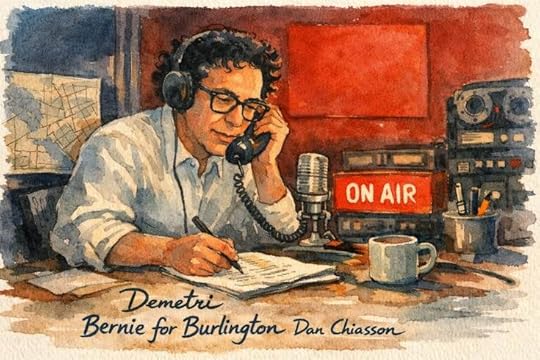
Watercolor Piece by Demetris Papadimitropoulos
In midtown Manhattan in the early 1950s, you could step off the avenue and into Vermont. Dan Chiasson opens “Bernie for Burlington” with that implausible premise and makes it tactile: a storefront at 1268 Avenue of the Americas, a diorama of “virtues” offered to a city that wanted to believe in snow and quiet. The move is more than ornament. It announces Chiasson’s method: begin with the way a place is dreamed of, then follow the dream as it hardens into budgets, zoning fights, and the stubborn realities of who gets to belong.
To call this book timely is also to say that it refuses to behave like a topical book. Chiasson does not chase the day’s headlines. He does not build his narrative around the high-gloss milestones of the modern political imagination. Instead he commits a quiet heresy: he stays local, and he stays long. He is interested in meetings, not rallies; budgets, not slogans; the long middle of civic life, not the climactic montage. The result is a portrait of Bernie Sanders before he became a national shorthand, and of Burlington before it became an emblem, and of the strange chemistry that occurs when a political temperament finds a city small enough to be shaped and stubborn enough to resist shaping.
Chiasson flags his posture early, with a candor that feels both ethical and stylistic. He did not speak with Bernie or Jane Sanders, and he makes no pretense of omniscience. What he offers is a book of stories constructed from friends, allies, antagonists; from disorganized archives and local newspapers; from ephemera that still smells faintly of old staplers and town bulletin boards. The intelligence of the choice is that it makes the book less about a single consciousness and more about a civic ecosystem: a biography told through the chorus of a place.
The opening chapters move through Brooklyn family history and the moral pressure of scarcity, then toward the political education of a young man trying to convert anger into usefulness. Vermont arrives as both destination and projection: a “fantasy,” Sanders’s brother Larry suggests, but an important one. Chiasson is alert to the way Vermont is sold, desired, consumed. He can’t resist the comedy of it – the notion of two lanky Midwood boys poring over glossy photographs of farms – but the humor doesn’t weaken the point. Myth is a kind of infrastructure. People build their lives inside it. They vote inside it too.
When the book shifts into the late 1970s and early 1980s, Burlington comes into view as the kind of small city where everything is visible and nothing is simple. If the national story of our time has been a story of abstraction – politics turned into entertainment, ideology turned into identity, citizens turned into audiences – Burlington insists on the opposite. Here, fights are concrete. They are about rent, zoning, public access to the waterfront, and the nagging question of whether a city belongs to its residents or to developers, institutions, and the soft coercion of “inevitability.”
Watercolor Piece by Demetris Papadimitropoulos
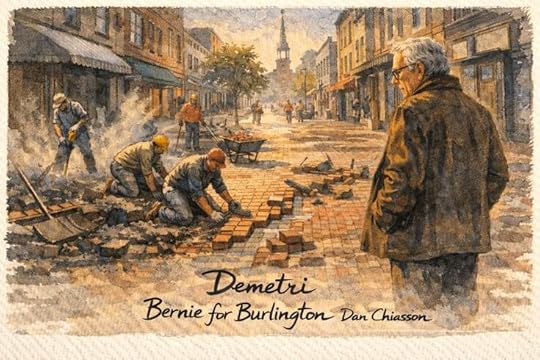
One of Chiasson’s greatest strengths is his ability to render public goods as both physical and moral. A park is not merely a park; it is a wager on shared life. A sidewalk is not merely a sidewalk; it is a social contract in poured concrete. The book returns again and again to the “public thing” – not as an abstraction, but as an object you can stand beside. When Sanders fights for access to the waterfront, or for policies that keep Burlington from behaving like a private club, Chiasson does not frame the conflict as ideological theater. He frames it as an argument about dignity, and dignity is always spatial. Who gets to stay? Who gets to be near work, near water, near safety, near beauty?
The writing has the controlled warmth of a poet who understands that lyricism in politics can either anesthetize or clarify. Chiasson chooses clarity, and he does so by refusing grandiosity. His sentences are attentive to the minor signals of power: who has time to remain after the meeting adjourns, whose irritation is indulged, whose inconvenience is treated as an emergency, whose suffering is treated as background noise. He lingers in rooms where the air itself seems bureaucratic, then makes you feel how those rooms decide lives.
Chiasson is also, crucially, a writer of cultural detours. In a chapter that begins with Burlington’s made-for-TV cameo and drifts through the design fantasy of the pedestrian mall, he sets the city’s self-invention against the particular swagger of its mayors and the voices of its citizens. Elsewhere, MTV arrives as not merely a channel but an argument about access, youth, and the negotiation between pragmatic socialism and consumer desire. These digressions are not decorative. They are part of Chiasson’s argument that politics is never only policy; it is also taste, media, spectacle, boredom, and the everyday scripts people inherit about what a city is allowed to be.
Chiasson has a particular gift for casting light on the unglamorous middle space between legend and paperwork. His Sanders is not a saint. The book preserves, with almost mischievous honesty, the testimony of people who found him difficult: brusque, impatient, sometimes so single-minded that charisma is replaced by abrasion. It is a relief to see a political figure rendered with this kind of texture. The irritations are not merely personality quirks; they are part of a governing style that treats time as a moral resource. In Chiasson’s portrait, Sanders can look like a man whose seriousness can look like contempt, but whose contempt is often for the frivolity that keeps problems unsolved.
The cast of characters around him is one of the book’s pleasures. Chiasson is attentive to the way local politics is made not only by elected officials but by organizers, professors, reporters, campaign managers, longtime callers, and skeptics who become, reluctantly, collaborators. He writes about diners and coffee shops the way some biographers write about palaces: as sites where alliances are formed, resentments hardened, plans revised. A particular meeting over coffee can carry as much narrative charge as an election night, because in Burlington the distance between private conviction and public decision is short.
Watercolor Piece by Demetris Papadimitropoulos
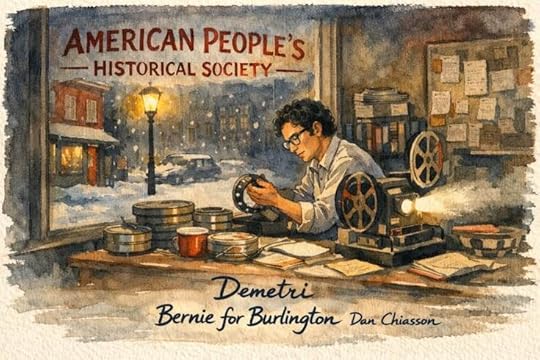
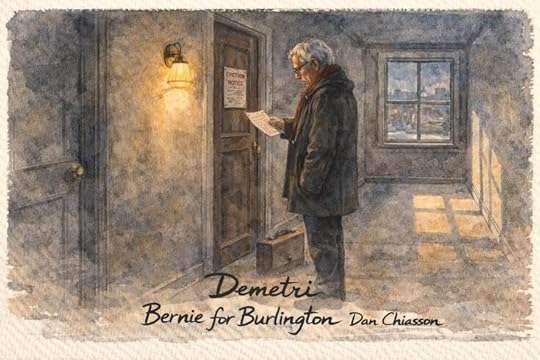
Chiasson’s archival imagination is most vivid when he follows Sanders into the odd entrepreneurial corners of a precarious life. The chapter on “The American People’s Historical Society” treats Sanders’s brief career as a small businessman not as a footnote but as a clue: a man inventing institutions because existing ones won’t accept his arguments, selling history as a way of rehearsing civic pedagogy. Then the book pivots into the more brutal economics of renting, when an eviction notice arrives like a slap: the vulnerability of making a living, the sudden fragility of housing, the way ideology becomes personal when the door may no longer open.
If the book sometimes feels like an essay collection braided into biography, that is because Chiasson trusts association as a form of explanation. Vermont’s mythos – Frost, maples, “virtues” offered for sale – is never simply background. It is an instrument, and a temptation. The book is subtle about the danger: a place that markets itself as pure can become complacent about exclusion, and a state that thinks of itself as morally exceptional can overlook the ways power reproduces itself even in small rooms. Chiasson’s Burlington is affectionate, but it is not sugarcoated.
This attentiveness makes his handling of race and belonging especially bracing in a story set in one of the whitest states in the country. Chiasson does not pretend that Burlington’s progressivism automatically resolves its tensions; he traces how ideals encounter institutions, how good intentions fray under pressure, how “community” can mean protection for some and scrutiny for others. At times you wish he pushed even harder, widening the lens beyond the circles closest to Sanders. But the book’s refusal to let local virtue become self-congratulation feels, in itself, like a political act.
There is also, throughout, a delicate comedy about American self-invention. Chiasson has an ear for the way political language can inflate and deflate in the same breath, the way earnestness can tip into performance, the way slogans become both necessary and absurd. The book’s Burlington is filled with people who believe in causes and also in lunch specials, who can argue about imperialism and then worry about potholes. That doubleness is the point. Democracy is not an abstract seminar. It is a lived style, complete with irritations, jokes, fatigue, and the stubborn desire to keep showing up.
The book’s most moving scenes are often the least cinematic. A municipal meeting stretches on and on; the miracle is not that a leader delivers a soaring speech, but that citizens remain in the room long enough to decide something together. A call-in radio show becomes an artery of democratic speech, letting people speak in their own voices rather than through the ventriloquism of press releases. Sanders’s style emerges as almost aggressively unglamorous. He is repetitive, blunt, impatient with niceties, and therefore, in Chiasson’s framing, strangely persuasive. The book does not treat this as a brand. It treats it as temperament.
Watercolor Piece by Demetris Papadimitropoulos
The campaign that carries the book into its heart is framed with a phrase that feels like both slogan and warning: “Burlington Is Not For Sale.” It is hard to read those pages without thinking of the current decade’s fever dream of real estate – the way cities now feel auctioned off to the highest bidder, the way “investment” language colonizes the vocabulary of home. Chiasson follows Sanders’s path as an outsider trying to become an incumbent without losing the outsider’s moral advantage. He shows the subtle work of coalition, the strategic necessity of being legible to people who fear socialism, and the personal awkwardness of a man not naturally gregarious needing, suddenly, to knock on doors.
Once Sanders is in City Hall, the book becomes a study in the romance and the drudgery of municipal power. Chiasson writes beautifully about the administrative world – the way idealism gets translated into forms, how the room itself reshapes those who enter it, how compromise can be either betrayal or technique. He is also attentive to the city’s internal divisions, including racial tensions and the uneasy work of turning rhetoric into actual policy. Burlington’s progressivism is not portrayed as automatic virtue; it is portrayed as labor.
The later chapters widen into a kind of municipal epic. There is the pragmatism of dealing with utilities and media, the desire to control the forces that shape daily life, the constant negotiation between what a city can do and what it wishes it could do. And then Chiasson turns outward, as Burlington does: to foreign policy by way of a sister-city relationship and a journey to Nicaragua, where solidarity, symbolism, and local politics collide. The effect is to remind the reader that “local” does not mean small-minded. It means grounded. It means you feel the consequences in your own streets, and therefore you cannot pretend consequences are theoretical.
The comps that come to mind are less about ideology than about method. Like “The Death and Life of Great American Cities,” it treats street life as civic intelligence and planning as moral philosophy. Like “Evicted,” it understands housing as a pressure that reorganizes everything else. And like “The Power Broker,” it reminds you that decisions about space – waterfronts, downtowns, “renewal” – decide who gets to belong.
If “Bernie for Burlington” has a flaw, it is the one that often accompanies principled restraint. Because Chiasson is so committed to the ground-level view, he can occasionally feel withholding. Readers who want the clean architecture of a comprehensive biography – exhaustive chronology, constant forward propulsion, a tighter bridge to the later national persona – may find the book’s essayistic interludes too patient, its pleasures too dependent on mood. Yet the patience is also the point. In a moment when politics is increasingly mediated by screens – algorithmic outrage, viral clips, perpetual emergency – Chiasson insists on the opposite tempo. He insists that democracy is something you do slowly, with other people, in rooms that smell like old carpet.
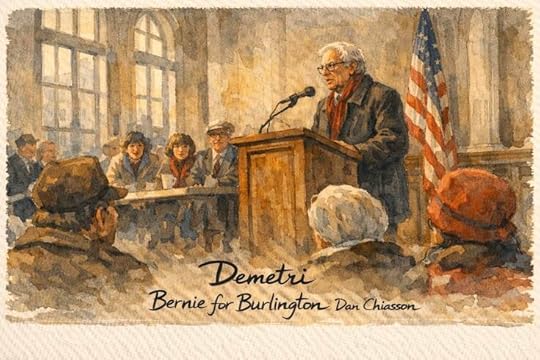
Watercolor Piece by Demetris Papadimitropoulos
The afterword, set in the summer of 2024 at a family picnic in rural Vermont, makes this insistence quietly devastating. Chiasson writes about the new millennium’s atmosphere – the internet’s reshaping of consciousness, the acceleration of political feeling, the way a persona can become a technological vessel – without turning the book into a sermon about the present. He does something more literary. He sketches a “structure of feeling,” the emotional weather of an era, and suggests that Sanders’s wearied warrior persona did not simply survive into our time but became newly legible inside it.
When you finish “Bernie for Burlington,” you are less dazzled by politics than recalibrated by it. You have been taught to see benches and budgets as moral objects, to understand that “public” is not a synonym for “government” but a synonym for “shared,” and to recognize that the most consequential politics may be the politics you can still walk to. For its literary intelligence, its fidelity to civic texture, and its refusal of spectacle in an age addicted to it, I would rate the book 91 out of 100.
By Demetris Papadimitropoulos | February 3rd, 2026
Watercolor Piece by Demetris Papadimitropoulos
In midtown Manhattan in the early 1950s, you could step off the avenue and into Vermont. Dan Chiasson opens “Bernie for Burlington” with that implausible premise and makes it tactile: a storefront at 1268 Avenue of the Americas, a diorama of “virtues” offered to a city that wanted to believe in snow and quiet. The move is more than ornament. It announces Chiasson’s method: begin with the way a place is dreamed of, then follow the dream as it hardens into budgets, zoning fights, and the stubborn realities of who gets to belong.
To call this book timely is also to say that it refuses to behave like a topical book. Chiasson does not chase the day’s headlines. He does not build his narrative around the high-gloss milestones of the modern political imagination. Instead he commits a quiet heresy: he stays local, and he stays long. He is interested in meetings, not rallies; budgets, not slogans; the long middle of civic life, not the climactic montage. The result is a portrait of Bernie Sanders before he became a national shorthand, and of Burlington before it became an emblem, and of the strange chemistry that occurs when a political temperament finds a city small enough to be shaped and stubborn enough to resist shaping.
Chiasson flags his posture early, with a candor that feels both ethical and stylistic. He did not speak with Bernie or Jane Sanders, and he makes no pretense of omniscience. What he offers is a book of stories constructed from friends, allies, antagonists; from disorganized archives and local newspapers; from ephemera that still smells faintly of old staplers and town bulletin boards. The intelligence of the choice is that it makes the book less about a single consciousness and more about a civic ecosystem: a biography told through the chorus of a place.
The opening chapters move through Brooklyn family history and the moral pressure of scarcity, then toward the political education of a young man trying to convert anger into usefulness. Vermont arrives as both destination and projection: a “fantasy,” Sanders’s brother Larry suggests, but an important one. Chiasson is alert to the way Vermont is sold, desired, consumed. He can’t resist the comedy of it – the notion of two lanky Midwood boys poring over glossy photographs of farms – but the humor doesn’t weaken the point. Myth is a kind of infrastructure. People build their lives inside it. They vote inside it too.
When the book shifts into the late 1970s and early 1980s, Burlington comes into view as the kind of small city where everything is visible and nothing is simple. If the national story of our time has been a story of abstraction – politics turned into entertainment, ideology turned into identity, citizens turned into audiences – Burlington insists on the opposite. Here, fights are concrete. They are about rent, zoning, public access to the waterfront, and the nagging question of whether a city belongs to its residents or to developers, institutions, and the soft coercion of “inevitability.”
Watercolor Piece by Demetris Papadimitropoulos
One of Chiasson’s greatest strengths is his ability to render public goods as both physical and moral. A park is not merely a park; it is a wager on shared life. A sidewalk is not merely a sidewalk; it is a social contract in poured concrete. The book returns again and again to the “public thing” – not as an abstraction, but as an object you can stand beside. When Sanders fights for access to the waterfront, or for policies that keep Burlington from behaving like a private club, Chiasson does not frame the conflict as ideological theater. He frames it as an argument about dignity, and dignity is always spatial. Who gets to stay? Who gets to be near work, near water, near safety, near beauty?
The writing has the controlled warmth of a poet who understands that lyricism in politics can either anesthetize or clarify. Chiasson chooses clarity, and he does so by refusing grandiosity. His sentences are attentive to the minor signals of power: who has time to remain after the meeting adjourns, whose irritation is indulged, whose inconvenience is treated as an emergency, whose suffering is treated as background noise. He lingers in rooms where the air itself seems bureaucratic, then makes you feel how those rooms decide lives.
Chiasson is also, crucially, a writer of cultural detours. In a chapter that begins with Burlington’s made-for-TV cameo and drifts through the design fantasy of the pedestrian mall, he sets the city’s self-invention against the particular swagger of its mayors and the voices of its citizens. Elsewhere, MTV arrives as not merely a channel but an argument about access, youth, and the negotiation between pragmatic socialism and consumer desire. These digressions are not decorative. They are part of Chiasson’s argument that politics is never only policy; it is also taste, media, spectacle, boredom, and the everyday scripts people inherit about what a city is allowed to be.
Chiasson has a particular gift for casting light on the unglamorous middle space between legend and paperwork. His Sanders is not a saint. The book preserves, with almost mischievous honesty, the testimony of people who found him difficult: brusque, impatient, sometimes so single-minded that charisma is replaced by abrasion. It is a relief to see a political figure rendered with this kind of texture. The irritations are not merely personality quirks; they are part of a governing style that treats time as a moral resource. In Chiasson’s portrait, Sanders can look like a man whose seriousness can look like contempt, but whose contempt is often for the frivolity that keeps problems unsolved.
The cast of characters around him is one of the book’s pleasures. Chiasson is attentive to the way local politics is made not only by elected officials but by organizers, professors, reporters, campaign managers, longtime callers, and skeptics who become, reluctantly, collaborators. He writes about diners and coffee shops the way some biographers write about palaces: as sites where alliances are formed, resentments hardened, plans revised. A particular meeting over coffee can carry as much narrative charge as an election night, because in Burlington the distance between private conviction and public decision is short.
Watercolor Piece by Demetris Papadimitropoulos
Chiasson’s archival imagination is most vivid when he follows Sanders into the odd entrepreneurial corners of a precarious life. The chapter on “The American People’s Historical Society” treats Sanders’s brief career as a small businessman not as a footnote but as a clue: a man inventing institutions because existing ones won’t accept his arguments, selling history as a way of rehearsing civic pedagogy. Then the book pivots into the more brutal economics of renting, when an eviction notice arrives like a slap: the vulnerability of making a living, the sudden fragility of housing, the way ideology becomes personal when the door may no longer open.
If the book sometimes feels like an essay collection braided into biography, that is because Chiasson trusts association as a form of explanation. Vermont’s mythos – Frost, maples, “virtues” offered for sale – is never simply background. It is an instrument, and a temptation. The book is subtle about the danger: a place that markets itself as pure can become complacent about exclusion, and a state that thinks of itself as morally exceptional can overlook the ways power reproduces itself even in small rooms. Chiasson’s Burlington is affectionate, but it is not sugarcoated.
This attentiveness makes his handling of race and belonging especially bracing in a story set in one of the whitest states in the country. Chiasson does not pretend that Burlington’s progressivism automatically resolves its tensions; he traces how ideals encounter institutions, how good intentions fray under pressure, how “community” can mean protection for some and scrutiny for others. At times you wish he pushed even harder, widening the lens beyond the circles closest to Sanders. But the book’s refusal to let local virtue become self-congratulation feels, in itself, like a political act.
There is also, throughout, a delicate comedy about American self-invention. Chiasson has an ear for the way political language can inflate and deflate in the same breath, the way earnestness can tip into performance, the way slogans become both necessary and absurd. The book’s Burlington is filled with people who believe in causes and also in lunch specials, who can argue about imperialism and then worry about potholes. That doubleness is the point. Democracy is not an abstract seminar. It is a lived style, complete with irritations, jokes, fatigue, and the stubborn desire to keep showing up.
The book’s most moving scenes are often the least cinematic. A municipal meeting stretches on and on; the miracle is not that a leader delivers a soaring speech, but that citizens remain in the room long enough to decide something together. A call-in radio show becomes an artery of democratic speech, letting people speak in their own voices rather than through the ventriloquism of press releases. Sanders’s style emerges as almost aggressively unglamorous. He is repetitive, blunt, impatient with niceties, and therefore, in Chiasson’s framing, strangely persuasive. The book does not treat this as a brand. It treats it as temperament.
Watercolor Piece by Demetris Papadimitropoulos
The campaign that carries the book into its heart is framed with a phrase that feels like both slogan and warning: “Burlington Is Not For Sale.” It is hard to read those pages without thinking of the current decade’s fever dream of real estate – the way cities now feel auctioned off to the highest bidder, the way “investment” language colonizes the vocabulary of home. Chiasson follows Sanders’s path as an outsider trying to become an incumbent without losing the outsider’s moral advantage. He shows the subtle work of coalition, the strategic necessity of being legible to people who fear socialism, and the personal awkwardness of a man not naturally gregarious needing, suddenly, to knock on doors.
Once Sanders is in City Hall, the book becomes a study in the romance and the drudgery of municipal power. Chiasson writes beautifully about the administrative world – the way idealism gets translated into forms, how the room itself reshapes those who enter it, how compromise can be either betrayal or technique. He is also attentive to the city’s internal divisions, including racial tensions and the uneasy work of turning rhetoric into actual policy. Burlington’s progressivism is not portrayed as automatic virtue; it is portrayed as labor.
The later chapters widen into a kind of municipal epic. There is the pragmatism of dealing with utilities and media, the desire to control the forces that shape daily life, the constant negotiation between what a city can do and what it wishes it could do. And then Chiasson turns outward, as Burlington does: to foreign policy by way of a sister-city relationship and a journey to Nicaragua, where solidarity, symbolism, and local politics collide. The effect is to remind the reader that “local” does not mean small-minded. It means grounded. It means you feel the consequences in your own streets, and therefore you cannot pretend consequences are theoretical.
The comps that come to mind are less about ideology than about method. Like “The Death and Life of Great American Cities,” it treats street life as civic intelligence and planning as moral philosophy. Like “Evicted,” it understands housing as a pressure that reorganizes everything else. And like “The Power Broker,” it reminds you that decisions about space – waterfronts, downtowns, “renewal” – decide who gets to belong.
If “Bernie for Burlington” has a flaw, it is the one that often accompanies principled restraint. Because Chiasson is so committed to the ground-level view, he can occasionally feel withholding. Readers who want the clean architecture of a comprehensive biography – exhaustive chronology, constant forward propulsion, a tighter bridge to the later national persona – may find the book’s essayistic interludes too patient, its pleasures too dependent on mood. Yet the patience is also the point. In a moment when politics is increasingly mediated by screens – algorithmic outrage, viral clips, perpetual emergency – Chiasson insists on the opposite tempo. He insists that democracy is something you do slowly, with other people, in rooms that smell like old carpet.
Watercolor Piece by Demetris Papadimitropoulos
The afterword, set in the summer of 2024 at a family picnic in rural Vermont, makes this insistence quietly devastating. Chiasson writes about the new millennium’s atmosphere – the internet’s reshaping of consciousness, the acceleration of political feeling, the way a persona can become a technological vessel – without turning the book into a sermon about the present. He does something more literary. He sketches a “structure of feeling,” the emotional weather of an era, and suggests that Sanders’s wearied warrior persona did not simply survive into our time but became newly legible inside it.
When you finish “Bernie for Burlington,” you are less dazzled by politics than recalibrated by it. You have been taught to see benches and budgets as moral objects, to understand that “public” is not a synonym for “government” but a synonym for “shared,” and to recognize that the most consequential politics may be the politics you can still walk to. For its literary intelligence, its fidelity to civic texture, and its refusal of spectacle in an age addicted to it, I would rate the book 91 out of 100.

May 20, 2026
Bernie for Burlington has three themes. It is a memoir for Dan Chiasson, who grew up in Burlington, Vt.; a partial biography of Bernie Sanders, and a cultural history of the back-to-the-land, left-wing political movement that gave Sanders his start in the Green Mountain State.
Chiasson, born in 1971, is far too young to have participated in said movement. At any rate, he comes from a conservative Catholic French-Canadian family who wanted as little to do with the counterculture or the left as possible. The autobiographical parts of this book must have been the most difficult to write. How much do you reveal? What do you leave out?
There is a pertinent reason for including his own life in the story of Bernie Sanders: he was 10 years old when Sanders was elected mayor and he was 18 when the independent candidate beat out a Republican to become the first socialist U.S. Representative. In addition, Chiasson is likely as liberal as he seems to be largely because of the cultural soup in which he grew up.
By Chiasson's account, Burlington was a corrupt and broken-down city for many years, a victim of a hidebound, self-dealing Democratic machine. Most of Vermont is a Republican stronghold, but the cities tended to be Democratic because of the unions in the mills and prevalence of newer immigrants there. But the countercultural immigrants who flooded into Vermont in the 1960s at first settled in the hilltowns where land was cheap and regulations were few. They founded intentional communities of various stripes or took over failing farms and learned as they went by talking to their Yankee neighbors and ordering from the Whole Earth Catalog.
Bernie Sanders was never really culturally a part of this movement. He benefited from its left-wing slant but he was and is further to the left. While most of the old hippies began life as middle-class suburbanites and aged into liberal Democrats, Sanders grew up poor in Brooklyn and got involved in radical politics during his stint at the University of Chicago. He moved to Vermont in the mid '60s to live in the Northeast Kingdom town of Stannard and became an advocacy journalist in the fledging leftwing newspapers of the time, but he was always a meat and potatoes guy who preferred hanging around with the farmers and the mill workers to grooving with the hippies.
Chiasson's portrayal of Vermont's countercultural scene is affectionate but of course incomplete. He is at pains to describe its odd relationship with the existing Yankee culture. The two cultures met along a shared belief in the value of individual freedom and decision-making; they agreed that people should be allowed to live their lives the way they want to, as long as it is not to the detriment of their neighbors.
The tricky part was and still is "what is the role of government in this kind of ideology." Chiasson does not really explore the philosophical territory where liberalism, libertarianism, and socialism meet with any kind of academic rigor. Apparently, he wants his book to remain a personal account and he doesn't want to get bogged down in a lot of language that would come out of a political philosophy lecture. It works, generally speaking, and he does explain, however obliquely, the existence of the so-called "Bernie bros." More importantly, he makes understandable why Sanders got fairly consistent support from Vermont Republicans.
Sanders emerges from this book as an admirable person without being made into an icon. He is an irascible man who can be difficult to get along with or even to be around. And yet there is something undeniably heroic about him. He is not Don Quixote; the guy knows the difference between a real opponent and a windmill. When his own instincts fail him, he has loyal and wise friends around him who set him straight and to whom he mostly listens, albeit after some pitched and prolonged arguments.
What Chiasson and most people seem to like about Sanders is his honesty and integrity. Even people who disagree with him end up liking him, if they admire a principled stand. The villains in this book are mostly Democrats who do nothing but act to preserve their own hegemony. Without openly stating it, Chiasson shows us through the story of the microcosm of Vermont why both the major political parties have become ideologically bankrupt and have lost the respect of the electorate.
Perhaps what makes Chiasson's account of this three-part history most credible is that he does not share Sanders' hell-for-leather political zeal. During the 2020 election, when it became apparent that the Sanders campaign had been suffocated, he put a Hillary sticker on his car "like most normal people." And his 18-year-old participation in Sanders' 1990 congressional campaign was limited to licking envelopes while listening to his Discman.
He picks his parties among the counterculture too. As a poet and academic, he shows much more respect for Peter Schumann, the founder of Bread & Puppet Theatre than he does for the Liberty Union politicians or any of the communes. These people moved into Burlington after their rural enterprises came to naught and they changed the culture of the city, helping to put Sanders into office in 1981 and acting as a small but potent contigent that transformed Burlington into a thriving, experiment in activist government.
I am 11 years older than Chiasson and visted Burlington several times between 1979 and 1981, so I saw the immediate pre-Bernie city. It was already a thriving place for the well-to-do college students and anyone who could make a buck off them. Having grown up surrounded by urban and rural poor people myself, I took the pockets of poverty in Burlington for granted as part of "life under capitalism." Bernie did not. And it was his focused outrage that transformed the economic and social life of one small American city.
Years later I moved to the Ithaca area. This city, about the same size as Burlington and also gifted with the double-edged sword of being a college town, elected a socialist mayor in 1989 (the year Sanders left office). Ben Nichols was, however, neither as charismatic nor as ambitious as Bernie Sanders, and Ithaca is more isolated geographically than Burlington. And yet both men managed to galvanize their respective municipalities by taking on ambitious projects and showing the populus that government could do good things for people.
Americans fear socialism when it is named because they have been brainwashed into thinking it is the same as communism, but during his rise Sanders avoided using the word when possible and just went ahead and did what he thought needed to be done to help the poor and the disadvantaged get their fair share of the wealth in the wealthiest country in the history of the world. Chiasson does a good job of showing how ironic it is that the individualism that liberals prize so much is extremely important to the success of a socialist government in a capitalist economy. The fact that he does not elaborately fault liberals for being part of the problem is what makes this book readable and enjoyable. That would be a whole other story.
Chiasson, born in 1971, is far too young to have participated in said movement. At any rate, he comes from a conservative Catholic French-Canadian family who wanted as little to do with the counterculture or the left as possible. The autobiographical parts of this book must have been the most difficult to write. How much do you reveal? What do you leave out?
There is a pertinent reason for including his own life in the story of Bernie Sanders: he was 10 years old when Sanders was elected mayor and he was 18 when the independent candidate beat out a Republican to become the first socialist U.S. Representative. In addition, Chiasson is likely as liberal as he seems to be largely because of the cultural soup in which he grew up.
By Chiasson's account, Burlington was a corrupt and broken-down city for many years, a victim of a hidebound, self-dealing Democratic machine. Most of Vermont is a Republican stronghold, but the cities tended to be Democratic because of the unions in the mills and prevalence of newer immigrants there. But the countercultural immigrants who flooded into Vermont in the 1960s at first settled in the hilltowns where land was cheap and regulations were few. They founded intentional communities of various stripes or took over failing farms and learned as they went by talking to their Yankee neighbors and ordering from the Whole Earth Catalog.
Bernie Sanders was never really culturally a part of this movement. He benefited from its left-wing slant but he was and is further to the left. While most of the old hippies began life as middle-class suburbanites and aged into liberal Democrats, Sanders grew up poor in Brooklyn and got involved in radical politics during his stint at the University of Chicago. He moved to Vermont in the mid '60s to live in the Northeast Kingdom town of Stannard and became an advocacy journalist in the fledging leftwing newspapers of the time, but he was always a meat and potatoes guy who preferred hanging around with the farmers and the mill workers to grooving with the hippies.
Chiasson's portrayal of Vermont's countercultural scene is affectionate but of course incomplete. He is at pains to describe its odd relationship with the existing Yankee culture. The two cultures met along a shared belief in the value of individual freedom and decision-making; they agreed that people should be allowed to live their lives the way they want to, as long as it is not to the detriment of their neighbors.
The tricky part was and still is "what is the role of government in this kind of ideology." Chiasson does not really explore the philosophical territory where liberalism, libertarianism, and socialism meet with any kind of academic rigor. Apparently, he wants his book to remain a personal account and he doesn't want to get bogged down in a lot of language that would come out of a political philosophy lecture. It works, generally speaking, and he does explain, however obliquely, the existence of the so-called "Bernie bros." More importantly, he makes understandable why Sanders got fairly consistent support from Vermont Republicans.
Sanders emerges from this book as an admirable person without being made into an icon. He is an irascible man who can be difficult to get along with or even to be around. And yet there is something undeniably heroic about him. He is not Don Quixote; the guy knows the difference between a real opponent and a windmill. When his own instincts fail him, he has loyal and wise friends around him who set him straight and to whom he mostly listens, albeit after some pitched and prolonged arguments.
What Chiasson and most people seem to like about Sanders is his honesty and integrity. Even people who disagree with him end up liking him, if they admire a principled stand. The villains in this book are mostly Democrats who do nothing but act to preserve their own hegemony. Without openly stating it, Chiasson shows us through the story of the microcosm of Vermont why both the major political parties have become ideologically bankrupt and have lost the respect of the electorate.
Perhaps what makes Chiasson's account of this three-part history most credible is that he does not share Sanders' hell-for-leather political zeal. During the 2020 election, when it became apparent that the Sanders campaign had been suffocated, he put a Hillary sticker on his car "like most normal people." And his 18-year-old participation in Sanders' 1990 congressional campaign was limited to licking envelopes while listening to his Discman.
He picks his parties among the counterculture too. As a poet and academic, he shows much more respect for Peter Schumann, the founder of Bread & Puppet Theatre than he does for the Liberty Union politicians or any of the communes. These people moved into Burlington after their rural enterprises came to naught and they changed the culture of the city, helping to put Sanders into office in 1981 and acting as a small but potent contigent that transformed Burlington into a thriving, experiment in activist government.
I am 11 years older than Chiasson and visted Burlington several times between 1979 and 1981, so I saw the immediate pre-Bernie city. It was already a thriving place for the well-to-do college students and anyone who could make a buck off them. Having grown up surrounded by urban and rural poor people myself, I took the pockets of poverty in Burlington for granted as part of "life under capitalism." Bernie did not. And it was his focused outrage that transformed the economic and social life of one small American city.
Years later I moved to the Ithaca area. This city, about the same size as Burlington and also gifted with the double-edged sword of being a college town, elected a socialist mayor in 1989 (the year Sanders left office). Ben Nichols was, however, neither as charismatic nor as ambitious as Bernie Sanders, and Ithaca is more isolated geographically than Burlington. And yet both men managed to galvanize their respective municipalities by taking on ambitious projects and showing the populus that government could do good things for people.
Americans fear socialism when it is named because they have been brainwashed into thinking it is the same as communism, but during his rise Sanders avoided using the word when possible and just went ahead and did what he thought needed to be done to help the poor and the disadvantaged get their fair share of the wealth in the wealthiest country in the history of the world. Chiasson does a good job of showing how ironic it is that the individualism that liberals prize so much is extremely important to the success of a socialist government in a capitalist economy. The fact that he does not elaborately fault liberals for being part of the problem is what makes this book readable and enjoyable. That would be a whole other story.

November 30, 2025
I picked up Bernie for Burlington by Dan Chiasson the moment I saw it, and I’m so glad I did. When I think of socialism in the U.S., Bernie Sanders is pretty much my point of reference — but I realized I knew almost nothing about his early political life or what he actually did as mayor of Burlington.
This book ended up being an excellent crash course. It’s a clear, thorough, and surprisingly engaging look at “Bernie before he was Bernie,” showing how his ideas, leadership style, and political instincts were shaped long before he became a national figure. Chiasson does a great job laying out both the context and the real impact Bernie had locally.
If you’re curious about Sanders’ background or want a deeper understanding of how his political identity formed, this is a great starting point. Very readable, very informative, and absolutely worth picking up.
Thank you to NetGalley for this eARC.
This book ended up being an excellent crash course. It’s a clear, thorough, and surprisingly engaging look at “Bernie before he was Bernie,” showing how his ideas, leadership style, and political instincts were shaped long before he became a national figure. Chiasson does a great job laying out both the context and the real impact Bernie had locally.
If you’re curious about Sanders’ background or want a deeper understanding of how his political identity formed, this is a great starting point. Very readable, very informative, and absolutely worth picking up.
Thank you to NetGalley for this eARC.

May 3, 2026
Thank you Knopf, Pantheon, Vintage, and Anchor | Knopf for allowing me to read and review Bernie for Burlington The Rise of the People's Politician by Dan Chiasson on NetGalley.
Published: 02/03/26
Stars: 4
Note: I am not a fact checker. With that clearly marked I am happy to add I enjoyed Bernie for Burlington. I didn't know much about him and picked the book up because the title and cover reminded me of the picture of Bernie and his gloves. This was a 500+ page gamble that paid off.
Chiasson did a great job of holding my interest. His writing was not dry or burdened with statistics. He gives enough personal information informing without being invasive or embarrassingly awkward.
Why 500+ pages? Bernie has lived and continues to make every second count.
Highly recommend.
Published: 02/03/26
Stars: 4
Note: I am not a fact checker. With that clearly marked I am happy to add I enjoyed Bernie for Burlington. I didn't know much about him and picked the book up because the title and cover reminded me of the picture of Bernie and his gloves. This was a 500+ page gamble that paid off.
Chiasson did a great job of holding my interest. His writing was not dry or burdened with statistics. He gives enough personal information informing without being invasive or embarrassingly awkward.
Why 500+ pages? Bernie has lived and continues to make every second count.
Highly recommend.

July 25, 2026
I love him forever

May 29, 2026
I think this is the best political biography that I have ever read. Chiasson weaves his own personal story, stories of his neighbors, and of other Vermonters seamlessly into the story of Mayor Bernie Sanders.
As someone whose political awakening was due to Bernie, this book explained his beliefs and idiosyncrasies through his experience as a young man in Burlington.
Beautifully written and hard to put down, Chiasson had me enthralled to read about the intricacies of local electoral politics of a mid-sized New England city over 40 years ago.
As someone whose political awakening was due to Bernie, this book explained his beliefs and idiosyncrasies through his experience as a young man in Burlington.
Beautifully written and hard to put down, Chiasson had me enthralled to read about the intricacies of local electoral politics of a mid-sized New England city over 40 years ago.

February 20, 2026
Rating: a scant 4* of five
The Publisher Says: The story of Bernie Sanders's quixotic but inexorable rise is told by a son of Burlington on a broad and vivid canvas, depicting the shaping of a people's politics, as he tracks a political signal that traveled from the hard-luck neighborhoods, general stores, traditional businesses, and county fairs to the Town Meetings and the ballot boxes of the last century, predicting much of what has happened to our nation writ large since then.
This utterly captivating symphonic story of city, a visionary, and the way our politics changed forever is told through the very specific people of Burlington, beginning with Dan Chiasson's own mall-punk friends of the 1980 in a video that would go viral decades later in 2020, they engaged with the itinerant carpenter turned socialist mayoral candidate, and there in that food court, the seeds of everything that was Bernie were sown. Dan, uniquely placed to bring a deep insider's perspective, knew all the the conservative French-Canadian Catholics whose great grandparents had worked in the mills (his own); the puppeteers and hippies and NYC transplants looking for land and "authenticity" in Vermont; the developers involved in the era's Robert Moses urban-renewal schemes; the corrupt old-school Dems at their table in the local dive; and even Ben and Jerry who became Ben and Jerry's right there in town. They all made up the mosh pit of the Burlington that Bernie captivated, running on the slogan "Burlington is not for sale," to become the modern era’s first socialist mayor, intimate with his constituents across workers, cops, lefties, and the little old ladies who organized their streets; he also boasted a foreign policy, a sudden national profile, and a bullhorn to speak to Ronald Reagan.
In the tradition of J. Anthony Lukas's Common Ground and the documentary films of Frederick Wiseman, this epic of American city life delves into the gossip—and the exhilaration—around Bernie's unlikely rise, as we watch an American place transformed one diner coffee, one neighborhood door-knock at a time.
Full of Sanders himself, reflecting and raging, hitting his themes, forging alliances with all comers, this is a mesmerizing portrait of a politician, a place, and a movement that would change America.
I RECEIVED A DRC FROM THE PUBLISHER VIA NETGALLEY. THANK YOU.
My Review: Poet and academic Chiasson came of age under Mayor Bernie Sanders' Socialist administration in Burlington, Vermont. It's no surprise that he decided to write Senator Sanders' political biography.
The Bernie Bros were never a thing. The likeliest explanation for the chimera was state-sponsored misinformation campaigns led by an authoritarian polity that supports the current administration taking socially divisive cyberaction to help the 2016 campaign waged by the current president succeed. As is the norm in the US, the main supporters of progressivism are young women and people of color. It's a relief in one way...those trolls were obnoxious...and very sad in another, because so much hate and rage has been sown in young white men so successfully for so long it's hard to see a path back from the ugliness for them.
This story is about one of the few remaining Sixties radicals who stayed true to his vision and who made it a point to live out those principles loudly and publicly. A terrific opposition leader, in other words...but not a person of Presidential timber any more than the current occupant of the White House is. (Albeit I'd take Bernie in that office every damn day over felonious yam.)
I wasn't raised in Burlington, saw none of Bernie's achievements, and was not engaged by the nostalgic-bordering-on-elegiac tone of the read. I'm glad to have a blunt, mouthy, principled person in the Senate, and wish Bernie a long, useful life. I don't think anything in this book altered my overall positive opinion of him, I don't find the book a must-read, but am very glad it's out there. Someday we'll need a reminder there *were* idealists in US politics. As it is now, this feels more like a finger wagged in my face for not getting on board with Bernie. Offered the choice between voting for Harris or Sanders, I'd still vote for Harris.
The Publisher Says: The story of Bernie Sanders's quixotic but inexorable rise is told by a son of Burlington on a broad and vivid canvas, depicting the shaping of a people's politics, as he tracks a political signal that traveled from the hard-luck neighborhoods, general stores, traditional businesses, and county fairs to the Town Meetings and the ballot boxes of the last century, predicting much of what has happened to our nation writ large since then.
This utterly captivating symphonic story of city, a visionary, and the way our politics changed forever is told through the very specific people of Burlington, beginning with Dan Chiasson's own mall-punk friends of the 1980 in a video that would go viral decades later in 2020, they engaged with the itinerant carpenter turned socialist mayoral candidate, and there in that food court, the seeds of everything that was Bernie were sown. Dan, uniquely placed to bring a deep insider's perspective, knew all the the conservative French-Canadian Catholics whose great grandparents had worked in the mills (his own); the puppeteers and hippies and NYC transplants looking for land and "authenticity" in Vermont; the developers involved in the era's Robert Moses urban-renewal schemes; the corrupt old-school Dems at their table in the local dive; and even Ben and Jerry who became Ben and Jerry's right there in town. They all made up the mosh pit of the Burlington that Bernie captivated, running on the slogan "Burlington is not for sale," to become the modern era’s first socialist mayor, intimate with his constituents across workers, cops, lefties, and the little old ladies who organized their streets; he also boasted a foreign policy, a sudden national profile, and a bullhorn to speak to Ronald Reagan.
In the tradition of J. Anthony Lukas's Common Ground and the documentary films of Frederick Wiseman, this epic of American city life delves into the gossip—and the exhilaration—around Bernie's unlikely rise, as we watch an American place transformed one diner coffee, one neighborhood door-knock at a time.
Full of Sanders himself, reflecting and raging, hitting his themes, forging alliances with all comers, this is a mesmerizing portrait of a politician, a place, and a movement that would change America.
I RECEIVED A DRC FROM THE PUBLISHER VIA NETGALLEY. THANK YOU.
My Review: Poet and academic Chiasson came of age under Mayor Bernie Sanders' Socialist administration in Burlington, Vermont. It's no surprise that he decided to write Senator Sanders' political biography.
The Bernie Bros were never a thing. The likeliest explanation for the chimera was state-sponsored misinformation campaigns led by an authoritarian polity that supports the current administration taking socially divisive cyberaction to help the 2016 campaign waged by the current president succeed. As is the norm in the US, the main supporters of progressivism are young women and people of color. It's a relief in one way...those trolls were obnoxious...and very sad in another, because so much hate and rage has been sown in young white men so successfully for so long it's hard to see a path back from the ugliness for them.
This story is about one of the few remaining Sixties radicals who stayed true to his vision and who made it a point to live out those principles loudly and publicly. A terrific opposition leader, in other words...but not a person of Presidential timber any more than the current occupant of the White House is. (Albeit I'd take Bernie in that office every damn day over felonious yam.)
I wasn't raised in Burlington, saw none of Bernie's achievements, and was not engaged by the nostalgic-bordering-on-elegiac tone of the read. I'm glad to have a blunt, mouthy, principled person in the Senate, and wish Bernie a long, useful life. I don't think anything in this book altered my overall positive opinion of him, I don't find the book a must-read, but am very glad it's out there. Someday we'll need a reminder there *were* idealists in US politics. As it is now, this feels more like a finger wagged in my face for not getting on board with Bernie. Offered the choice between voting for Harris or Sanders, I'd still vote for Harris.

March 22, 2026
Full review at: https://readingourshelves.wordpress.c...
This behemoth (over 500 pages) was a lot to get through, but I liked it. It tells a few different stories, woven together in chronological order.
The first, naturally, is of Bernie Sanders. We start there, learning of his childhood in New York, and about his family, his interests, his schooling. Eventually he goes to Chicago for college. He is active in the Civil Rights movement there, but does not head South to participate. After school, he heads back to the Northeast.
This next part starts weaving in the history of Vermont, and its unique little enclaves and characters, as Bernie moves around the state and finds his people there. This part was interesting to me, as it was the sixties and seventies, and there were a lot of hippies! And communes, and maybe even cults? But it does hit on one point that will continue to resonate: the progressive movements then, and sometimes still, were predominantly white. Can that be made accessible to everyone?
It’s also funny because, in our time now, we think of Bernie as very curmudgeonly – and he was always kind of considered to be that way, where politics was concerned – but he was also hanging with hippies and reading philosophy and psychology texts from the 1930s-1950s and, well, into free sex and stuff like that. (Look, some of our grandparents inevitably were, or we wouldn’t be here!)
Eventually Sanders settles into Burlington, and then we get some history of that particular place. It’s not the capital, but it is the biggest city. It has a lake, and mountains nearby. Around the same time, it is the birthplace of Ben & Jerry’s. So much potential.
But also, it has some deep divides. There’s a university that makes a lot of noise and uses some of the city utilities, but doesn’t pay taxes. There are old folks being pushed into crappy apartments because their old homes were bought up for new urban projects. The lake is literally a dump, full of human waste. The eighties were a time of upheaval, and the city elected Sanders to a few terms as mayor during this era.
The first thing that struck me was that, when Sanders took the helm, there were only two other city officials elected that shared his platform. The old guard in city hall tried to block him from even appointing his own staff, as they were terrified of change. During his first term, he was forced to appeal to the public for everything he wanted to do – and even forged deep ties to local businesses to fund projects, instead of going through the city. If you’ve ever wondered how someone can be IN the government for as long as he has, but still not inherently trust the government – I really think this is your answer.
Another interesting factor is that Sanders won by collecting different factions to his views – but sometimes, those factions clashed with each other. For example, he was always very pro-worker, and even pro-union, earning the endorsement of the local police force and other unionized groups. But when a protest started about a local weapons manufacturer, on anti-war grounds – would Bernie side with the hippies or the workers?
These constant battles are the meat of the book, really. Eventually Sanders decides to not run for re-election, surprising everyone. He made one attempt at running for governor, but did not succeed. His next attempt was for Vermont’s solo seat in the House, and he did succeed there. And this is where this story ends.
If you are interested in politics, this might be a solid read for you. If not, it would probably be a little “too much.”
This behemoth (over 500 pages) was a lot to get through, but I liked it. It tells a few different stories, woven together in chronological order.
The first, naturally, is of Bernie Sanders. We start there, learning of his childhood in New York, and about his family, his interests, his schooling. Eventually he goes to Chicago for college. He is active in the Civil Rights movement there, but does not head South to participate. After school, he heads back to the Northeast.
This next part starts weaving in the history of Vermont, and its unique little enclaves and characters, as Bernie moves around the state and finds his people there. This part was interesting to me, as it was the sixties and seventies, and there were a lot of hippies! And communes, and maybe even cults? But it does hit on one point that will continue to resonate: the progressive movements then, and sometimes still, were predominantly white. Can that be made accessible to everyone?
It’s also funny because, in our time now, we think of Bernie as very curmudgeonly – and he was always kind of considered to be that way, where politics was concerned – but he was also hanging with hippies and reading philosophy and psychology texts from the 1930s-1950s and, well, into free sex and stuff like that. (Look, some of our grandparents inevitably were, or we wouldn’t be here!)
Eventually Sanders settles into Burlington, and then we get some history of that particular place. It’s not the capital, but it is the biggest city. It has a lake, and mountains nearby. Around the same time, it is the birthplace of Ben & Jerry’s. So much potential.
But also, it has some deep divides. There’s a university that makes a lot of noise and uses some of the city utilities, but doesn’t pay taxes. There are old folks being pushed into crappy apartments because their old homes were bought up for new urban projects. The lake is literally a dump, full of human waste. The eighties were a time of upheaval, and the city elected Sanders to a few terms as mayor during this era.
The first thing that struck me was that, when Sanders took the helm, there were only two other city officials elected that shared his platform. The old guard in city hall tried to block him from even appointing his own staff, as they were terrified of change. During his first term, he was forced to appeal to the public for everything he wanted to do – and even forged deep ties to local businesses to fund projects, instead of going through the city. If you’ve ever wondered how someone can be IN the government for as long as he has, but still not inherently trust the government – I really think this is your answer.
Another interesting factor is that Sanders won by collecting different factions to his views – but sometimes, those factions clashed with each other. For example, he was always very pro-worker, and even pro-union, earning the endorsement of the local police force and other unionized groups. But when a protest started about a local weapons manufacturer, on anti-war grounds – would Bernie side with the hippies or the workers?
These constant battles are the meat of the book, really. Eventually Sanders decides to not run for re-election, surprising everyone. He made one attempt at running for governor, but did not succeed. His next attempt was for Vermont’s solo seat in the House, and he did succeed there. And this is where this story ends.
If you are interested in politics, this might be a solid read for you. If not, it would probably be a little “too much.”

March 9, 2026
It's interesting to me, given Bernie's political ascendancy over the past decade, that this is the first book to truly dive into his tenure as Burlington's mayor. In fact, aside from some scant Wikipedia articles and the occasional mention during his two presidential campaigns, Bernie's experience and actions as mayor are barely a part of the public record. What I know of it comes from being a Vermonter. But even those stories are so intertwined with family that it's hard to assess just how much I know about Bernie the Mayor; for the vast majority of my life he's been in Washington, D.C.
Bernie for Burlington thus served, for me, as an education on my home state's history, as much as a detailing of Bernie's political rise. In fact the sections that engrossed me the most were accountings of the city's horrifying issues: racism, homophobia, poverty. I never heard stories about the Vermont State Hospital, which was run by a man who espoused eugenics and forced sterilization, or that "Waterbury" became part of local parlance to insinuate someone was mentally ill. And so to learn these things was, in a way, to relearn Burlington. Sometimes in sad ways, like when Chiasson details Lou Hines Jr., who brutally murdered a woman on Church Street in 1980 and then became "the very image of urban violence and danger" due to the local media's leveraging of racist stereotypes and tropes. Sometimes in a positive way, like Chiasson's detailing of how the Waterfront came to be, turned from a unwelcoming and industrial location to a beautiful gathering spot.
And in some spots, it was interesting to see how history was repeating itself. In 1981, after his stunning victory over Gordon Paquette, Bernie said, "We have a city that is trying to help a developer build $200,000 luxury waterfront condominiums with pools and health clubs and boutiques and all sorts of upper-middle-class junk five blocks from an area where people are literally not eating in order to pay their rent and fuel bills." And until just recently, the middle of downtown Burlington was pocked by the eye sore known as "The Pit", which Mayor Weinberger created in an effort to transform the dying downtown mall into luxury apartments. Once erected, those of us with blue enough blood can spend anywhere from $1,950 to $6,800 a month to live there. This in a city that has been begging local government since I was a kid for affordable housing.
All this to say, I appreciated Chiasson's book both as a biography of Bernie's early political races and his tenure as mayor, and as a reckoning with the city I grew up in and still love, even when it saddened me to learn awful new historical facts or to recognize the ways in which the city has taken steps backward.
Bernie for Burlington thus served, for me, as an education on my home state's history, as much as a detailing of Bernie's political rise. In fact the sections that engrossed me the most were accountings of the city's horrifying issues: racism, homophobia, poverty. I never heard stories about the Vermont State Hospital, which was run by a man who espoused eugenics and forced sterilization, or that "Waterbury" became part of local parlance to insinuate someone was mentally ill. And so to learn these things was, in a way, to relearn Burlington. Sometimes in sad ways, like when Chiasson details Lou Hines Jr., who brutally murdered a woman on Church Street in 1980 and then became "the very image of urban violence and danger" due to the local media's leveraging of racist stereotypes and tropes. Sometimes in a positive way, like Chiasson's detailing of how the Waterfront came to be, turned from a unwelcoming and industrial location to a beautiful gathering spot.
And in some spots, it was interesting to see how history was repeating itself. In 1981, after his stunning victory over Gordon Paquette, Bernie said, "We have a city that is trying to help a developer build $200,000 luxury waterfront condominiums with pools and health clubs and boutiques and all sorts of upper-middle-class junk five blocks from an area where people are literally not eating in order to pay their rent and fuel bills." And until just recently, the middle of downtown Burlington was pocked by the eye sore known as "The Pit", which Mayor Weinberger created in an effort to transform the dying downtown mall into luxury apartments. Once erected, those of us with blue enough blood can spend anywhere from $1,950 to $6,800 a month to live there. This in a city that has been begging local government since I was a kid for affordable housing.
All this to say, I appreciated Chiasson's book both as a biography of Bernie's early political races and his tenure as mayor, and as a reckoning with the city I grew up in and still love, even when it saddened me to learn awful new historical facts or to recognize the ways in which the city has taken steps backward.
April 5, 2026
This is a special book. Confounding at times for the memory-challenged with its cast of hundreds, it ultimately rewards. Tracking Sanders' in-no-way preordained ascent in Vermont politics from many contemporaneous persepectives, including the author's, who came into contact with Mayor Sanders regularly in 1980s Burlington, a moving portrait of Bernie Sanders bubbles up before us. A New York Times reviewer gave Chiasson a hard time, painting the book as the fan-nonfiction of a "Bernie Bro." I couldn't disagree more. I expected the book to mythologize Sanders and found that instead it humanized him, presenting him as a man of contradictions, an actual, imperfect human with one bedrock and hardwon belief: extreme wealth disparity isn't fair. I enjoyed the macro-tale of the stewardship and marketing of Vermont itself interspersed with stories of the coalitions that Bernie aggregated and dissolved. Why is this book important now? Because in a time when the common wisdom is that our politics is broken, here is a blueprint on how to build consensus, one issue at a time. Here we see politics redeemed: a time when the messy business of politics yielded tangible results, enhancing the lives of actual people. Having read the entire book, I'm challenged to come up with a single laudatory adjective for Bernie. He doesn't come across as particularly likable or exceptionally brilliant. But what I'd settle on, which I don't think the author actually used, is dogged. Armed with that single core belief in economic justice, Sanders just kept at it, through public indifference, ridicule, and some brutal electoral loses. He simply talked to and at his constituents, over and over. The coalitions he built - with gun enthusiasts, union tradespeople at defense contractors, the local business elites -- not always or even usually the leftists you'd expect -- ensured that programs and projects got completed in Burlington and its citizens (rich, poor, academic and working class alike) reaped the benefits. If the book only looked back to tell its story it would hold limited appeal, but as a guide for community organizers interested in moving our politics and society toward a more perfect and egalitarian union, Bernie for Burlington is an inspiring read.

March 20, 2026
Bernie for Burlington: The Rise of the People's Politician by Dan Chiasson, is a compelling read that traces the early political life of Bernie Sanders during his time as mayor of Burlington, Vermont. Chiasson is a Burlington native who had a front row seat to the growth and development of Sander. Rather than focusing on his later national prominence, the book focuses on a formative period that reveals how his political identity and governing style were shaped at the local level. This focus gives the book a refreshing perspective on leadership, public service, and grassroots politics. I was expecting a more traditional biography but this is a political biography and it's important to know that going in. The author brings alive the political climate of Burlington in the early 1980s, a time of economic struggle, shifting demographics, and tension between development and community preservation. Sanders as a relatively unknown figure who challenges entrenched power structures. It becomes clear that his campaign was not just about winning an election, but about redefining what local government could prioritize. Sanders focused on issues such as affordable housing, public space, and economic fairness and they are presented not as abstract policy concerns, but as real and immediate challenges facing residents. This helps the reader understand why his message resonated so strongly with the people. It is also a balanced portrayal as Sanders is not presented as universally accepted or without opposition. Overall, the book is engaging and informative. It succeeds in showing that the roots of larger political movements are often found in small, local efforts.

October 22, 2025
I absolutely loved Bernie for Burlington by Dan Chiasson. This audiobook paints a vivid, heartfelt portrait of Bernie Sanders in his formative years, long before he became a national name. Chiasson’s storytelling made me feel like I was walking alongside Bernie as he knocked on doors, argued for justice, and built his grassroots movement from scratch.
The level of research and detail in this biography is phenomenal. Chiasson explores the complex mix of people and politics that shaped Burlington—blue-collar workers, hippies, activists, and old-school politicians—and shows how Bernie managed to bring them together under a shared cause. His rise wasn’t easy, but every setback and success helped define the uncompromising passion that we still see in him today.
As someone who has admired Bernie for years, this book reminded me why. He is relentless in his dedication to the people, to fairness, and to progress. The fact that he’s still out there, even after the 2024 election, fighting for ordinary Americans, speaks volumes about his character.
This is one of the best political biographies I’ve ever read—thorough, emotional, and truly inspiring. It’s a must-read for anyone who believes in community, equality, and the power of persistence.
The level of research and detail in this biography is phenomenal. Chiasson explores the complex mix of people and politics that shaped Burlington—blue-collar workers, hippies, activists, and old-school politicians—and shows how Bernie managed to bring them together under a shared cause. His rise wasn’t easy, but every setback and success helped define the uncompromising passion that we still see in him today.
As someone who has admired Bernie for years, this book reminded me why. He is relentless in his dedication to the people, to fairness, and to progress. The fact that he’s still out there, even after the 2024 election, fighting for ordinary Americans, speaks volumes about his character.
This is one of the best political biographies I’ve ever read—thorough, emotional, and truly inspiring. It’s a must-read for anyone who believes in community, equality, and the power of persistence.
February 17, 2026
Before picking up this book, everything I knew about Bernie revolved around his multiple failed attempts to secure the Democratic nomination for President of the United States in 2016 and 2020. I pre-ordered this book on a whim, and wasn't sure to expect, especially because the author, Dan Chiasson, is foremost a poet. What's an English professor with multiple published volumes of poetry doing writing a political biography of America's most famous socialist? Well, Chiasson came of age in Bernie's Burlington, in the 1980's, and in re-telling the story of Bernie's political journey, Chiasson weaves in the history of Burlington, Vermont.
At times, the stylistic choice of the book turns the reading into what it feels like to pour over another family's scrapbook: some anecdotes and photographs lack context, or are more significant to the author than they are for us the reader. But the overall narrative is a generous, detailed portrait of the relationship between the iconic character, Bernie Sanders, and the quintessential 20th-century American town, Burlington. The town evolved and changed, Bernie on the other hand has stayed consistently blunt, honest, and cranky since the 1960's.
At times, the stylistic choice of the book turns the reading into what it feels like to pour over another family's scrapbook: some anecdotes and photographs lack context, or are more significant to the author than they are for us the reader. But the overall narrative is a generous, detailed portrait of the relationship between the iconic character, Bernie Sanders, and the quintessential 20th-century American town, Burlington. The town evolved and changed, Bernie on the other hand has stayed consistently blunt, honest, and cranky since the 1960's.

April 11, 2026
I give this book 3.5 stars. I received a free ebook in exchange for a fair and unbiased review. I have liked Bernie Sanders for a long time ( but never voted for him). I have seen him in person once. I was really excited to read this book.
I had a hard time reading this book. I put it down for a while. I did pick it back up and finish it. The book is very long. The chapters are long. There are sub chapters. It is very dense reading.
The book feels like an academic book. The book is filled with facts and information. The book has so names in it ( of people I hadn't heard of before).
Yet, I learned a lot from this book. I knew so little about Bernie ( or Vermont) from the 60s -90s. It is interesting remembering something from back in the day or a lot of learning that I had no idea happened back then.
The book has a lot of politicians in the book. There are local politicians that were new to me in this book. Ninety percent of what is in the book I didn't know.
I do wish the book was shorter. I wish it focused only or mainly on Bernie. It is just a lot of information in this book.
I am thankful to Netgalley and the author for the opportunity to read this book. I have gained a lot of knowledge because of this book.
I had a hard time reading this book. I put it down for a while. I did pick it back up and finish it. The book is very long. The chapters are long. There are sub chapters. It is very dense reading.
The book feels like an academic book. The book is filled with facts and information. The book has so names in it ( of people I hadn't heard of before).
Yet, I learned a lot from this book. I knew so little about Bernie ( or Vermont) from the 60s -90s. It is interesting remembering something from back in the day or a lot of learning that I had no idea happened back then.
The book has a lot of politicians in the book. There are local politicians that were new to me in this book. Ninety percent of what is in the book I didn't know.
I do wish the book was shorter. I wish it focused only or mainly on Bernie. It is just a lot of information in this book.
I am thankful to Netgalley and the author for the opportunity to read this book. I have gained a lot of knowledge because of this book.

February 20, 2026
Bernie Sanders is unique in American politics, and the fact that he became so well-known is a feat considering many of his political ideas are still to this day seen as a bit on the fringe. And this book explores where it all started: Burlington, Vermont.
For anyone that's ever supported Bernie Sanders in any of his presidential bids, I bet many would not know anything about his politics in the 1960s, 70s, and 80s. However, this book puts it all down and gives it an added layer of familiarity by being written by someone who grew up watching Sanders' rise in politics, from local elections to senator. I enjoyed learning about his political career and getting a better understanding of where he comes from and the experiences he had that shaped his political beliefs.
*Book provided by NetGalley
For anyone that's ever supported Bernie Sanders in any of his presidential bids, I bet many would not know anything about his politics in the 1960s, 70s, and 80s. However, this book puts it all down and gives it an added layer of familiarity by being written by someone who grew up watching Sanders' rise in politics, from local elections to senator. I enjoyed learning about his political career and getting a better understanding of where he comes from and the experiences he had that shaped his political beliefs.
*Book provided by NetGalley

February 27, 2026
I hate giving a Bernie book a bad rating. I’m in the minority here, but I picked this up thinking it would be a biography about Bernie. I think the author couldn’t decide if it should be about the history of Bernie, the history of Burlington, VT, or a history of himself. It really dragged in some places, and was a little short in others. You won’t really read any of his ventures past 1990, and not much detail of his youth. Sometimes I couldn’t tell if the author was a Bernie fan or not, and I don’t think it was to remain unbiased. I felt the locations of the photos didn’t alway fit with the content of the text. Otherwise, I enjoyed learning about Bernie’s earlier victories. A good bio to read to when you feel like contemplating what we could have had.

September 15, 2026
This was a great book on the 20th century political history of Burlington and Bernie's rise to mayor. Its amazing to see how he went from perennial fringe candidate to mayor and beyond. Particularly interesting to think about how he won his first mayoral race by a total of 10 votes - lots of stars had to line up in order to kindle his rise and history could have been a lot different if 10 voters didn't show up. The author also emphasized Bernie's focus on working class people and issues, even when it doesn't align with other progressive causes (e.g., saving jobs vs. environmentalism) which I hadn't fully appreciated before. Fun to learn more about Burlington's general history as well - the development of the waterfront and lakeshore bike path, church street pedestrian mall, etc.

February 10, 2026
Bernie Bros rejoice!
Of course we Bernie Bros are going to enjoy this overview of the early life and political career that made the man we know and love today. That said, the book was too long for my taste and really could have been shortened quite a bit. For instance, while the Wilhelm Reich stuff kinda threw me for a loop (but, sure, kind of makes sense given Bernie's background and character) and sometimes pops up now and then, it didn't feel essential for inclusion, and a bunch of other threads as well mainly on the inevitable internecine circular-firing-squad politics that always accompany left wing politics.
Of course we Bernie Bros are going to enjoy this overview of the early life and political career that made the man we know and love today. That said, the book was too long for my taste and really could have been shortened quite a bit. For instance, while the Wilhelm Reich stuff kinda threw me for a loop (but, sure, kind of makes sense given Bernie's background and character) and sometimes pops up now and then, it didn't feel essential for inclusion, and a bunch of other threads as well mainly on the inevitable internecine circular-firing-squad politics that always accompany left wing politics.

April 1, 2026
I had high hopes for this read, but I am going to have to DNF it. I’m 110 pages in and get the feeling that this is more a history of Burlington, memories from the author (who is from there) and Bernie’s influence and impact on the city and the movements that arose around the culture of the state.
It is full of local lore and local figures that crossed paths with Bernie Sanders on his path to discovery to become the “People’s Politician” that he rose to prominence as during his 2016 Presidential campaign, however, it doesn’t give a clear cut view of the man himself and I am left a bit wanting.
It is full of local lore and local figures that crossed paths with Bernie Sanders on his path to discovery to become the “People’s Politician” that he rose to prominence as during his 2016 Presidential campaign, however, it doesn’t give a clear cut view of the man himself and I am left a bit wanting.

June 5, 2026
This is part local history, part memoir, and part biography. It makes sense that a book that flows this way would be written by a poet, though to be clear, it is not poetry.
Bernie Sanders comes across here as a real person, flaws fully on display, but it’s more about Burlington, Vermont, particularly during the years of the author’s adolescence. You’d think that perhaps this would be a recipe for self-indulgence, but that boots-on-the-ground lived experience is helpful and colours a story that ends up very vibrant. Heck, it made me want to visit Burlington, so that’s worth something.
4.5/5.
Bernie Sanders comes across here as a real person, flaws fully on display, but it’s more about Burlington, Vermont, particularly during the years of the author’s adolescence. You’d think that perhaps this would be a recipe for self-indulgence, but that boots-on-the-ground lived experience is helpful and colours a story that ends up very vibrant. Heck, it made me want to visit Burlington, so that’s worth something.
4.5/5.

July 4, 2026
I loved it. Dan’s description of Burlington’s journey before and during Bernie’s time as mayor and after was well written and enjoyable. Even though I lived there then and went to UVM during the late 60’s -70’s, I learned much about the background to the changes I experienced. This was also a personal story of Dan’s experiences growing up in Burlington then and that made it a much more engaging story. It made it more real. I knew or knew many of the people in Burlington political scene so I might have enjoyed it more. It was a long book and much time was given to helping us understand the unique process of Bernie’s success. This was a well researched book and I enjoyed it.
April 30, 2026
As someone going into this as a big Bernie supporter I left it liking him even more. To read about his story essentially coming out of obscurity and becoming a national icon was at times riveting. Understanding the number of times he failed to succeed and yet never changing who he was an iota was inspiring. Of the great Senators, Sanders in my opinion is one of best. Whether you’re a fan of Sanders or not, I recommend you read this story, as it gives hope that we the people not the rich and well off have a say in our future.

March 8, 2026
I loved this book! Partly because I learned a lot about Bernie. I wish he was president now. I suppose he would have made his own mess. But it couldn't be as bad as the one we're in now. I also enjoyed learning a lot about Burlington. I now live just a few blocks from where the author grew up. I know many of the places he described. Kampus Kitchen. Centennial Field. Church Street. Our beautiful waterfront (thanks Bernie).

August 18, 2026
This is a remarkable book, particularly for a reader who grew up in Eighties Vermont. It’s as much a social and cultural history — in our lifetimes — of the Green Mountain State as it is the biography of a man. The author was at Boys State (in Northfield) with me in 1986. I recognize his observations as those of a neighbor and peer. “[Norwich University] sits among green hills in a paradise." I called that paradise (Northfield) home for five years. In many ways, I still do.
February 26, 2026
How Larry Sander's little brother, BERnard, became the mayor of Burlington and then BERNIE. Told by a fellow burlingtonian, this story feels genuine and honest. Chiasson doesn't sugarcoat Bernie's shortcomings nor does he downgrade his positives. A really good background on Bernie and Vermont culture.

February 27, 2026
Bernie for Burlington: The Rise of the People’s Politician by Dan Chiasson offers a thoughtful look at Bernie Sanders before the national spotlight, centering on grassroots politics in 1970-80s Vermont and the campaign that reshaped Burlington. I appreciated the detailed portrait of how local activism and persistence can spark something much bigger. At times it felt too long (592 pages) but it’s still an informative read for anyone curious about the early roots of a political movement and the people behind it.
Thank you to the author, Knopf, and NetGalley for an advanced reader copy. All opinions are my own.
Thank you to the author, Knopf, and NetGalley for an advanced reader copy. All opinions are my own.

May 6, 2026
I respect that this book could only be written this way by this author, given how he weaves in his own history with Burlington and how Sanders’ mayoralty shaped his life.
But I needed more on what Sanders actually did as mayor. There was lots on vibes and the people around him, but I felt like the waterfront battle and his place in it was rushed. I think we needed to spend more time unpacking his relationship with the developer and the business community at large and how he reconciled that with his political identity (even if just in the eyes of critics at the time).
But I needed more on what Sanders actually did as mayor. There was lots on vibes and the people around him, but I felt like the waterfront battle and his place in it was rushed. I think we needed to spend more time unpacking his relationship with the developer and the business community at large and how he reconciled that with his political identity (even if just in the eyes of critics at the time).

Read
May 11, 2026This read took me FOREVER, which is rare for me and not a great sign. It’s honestly more of a love letter to the state of Vermont with Bernie as a sometimes-likeable-sometimes-not side character. It was interesting, for sure, but now I feel like I need to read an actual Bernie book to get my fix. *cries in what could have been*
Displaying 1 - 30 of 41 reviews