A Statue of Liberty made of Jell-O. Where do you start eating it? The head? The torch?
It’s a new Thomas Pynchon adventure so, no matter where you start, you are guaranteed to become discombobulated , just like private detective Hicks McTaggart of Unamalgamated Ops detective agency in Milwaukee, the year 1932.
I’ve been around the block a couple of times already in a vehicle driven by Mr. Pynchon, so I knew that, once I have secured my seat belt, I was in for a wild ride of conspiracy theories, with a large cast of colourful and untrustworthy characters and a maximalist, truly immersive approach to world building. The world in this case being the next door neighbour to Al Capone’s Chicago, at least for the first part of the novel:
... there’s your wholesome Cream City, kid, mental hygiene paradise but underneath running off of a heartbeat crazy as hell, that’s if it had a heart which it don’t ...
Hicksie tries to keep a low profile and to stay out of trouble, but this is a difficult proposition when you’re built like an armoire and rolling bombs are launched at truck drivers like Stuffy Keegan, a local underworld figure. His boss at the agency has a proposition for McTaggart, a former strikebreaking gorilla better known for his fists than for his brains. According to the Gumshoe Manual, such a job is called a ticket:
“And the job would be ...”
“To locate Miss Airmont wherever she’s off to, smooth-talk her out of her involvement with this clarinet player, bring her back. Simple pickup and delivery.”
Daphne Airmont, the Milwaukee Cheese Heiress, has run away from home to follow clarinetist Hop Wingdale, a member of The Klezmopolitans, a popular swing band reformatted by electric xylorimba virtuoso Curly Capstock. Daphne left her fiancee G. Rodney Flaunch of the Glencoe Flaunches in tears over the million and a half dollars dowry that slipped through his fingers.
“Around Baraboo, even the sweetest of girls, the most carefully brought up you can imagine, could still, one day, all at once, just ... well, run away with the circus.”
Hicksie, who had a previous encounter slash one-night-stand with the missing hot tomato, seems like the right man for the job, despite his reluctance to handle affairs of the heart or to venture anywhere outside of his home town.
Private eyes of the 1930’s are emerging from an era of labor unrest and entering one of spousal infidelity, encouraged if not enabled by Prohibition
Clear so far? Don’t worry, things are about to get a lot more interesting in various explosive and/or subversive ways. You see, Miss Airmont is the daughter of the infamous Bruno Airmont, also known as the Al Capone of Cheese, which is pretty big in the milk saturated state of Wisconsin. Bruno is also missing, having absconded with a very large sum of money embezzled from the Cheese Syndicate. He is presumed to be hiding on a tropical island, surrounded by hula girls and sipping daiquiris. A lot of unpleasant personages are looking for Bruno – one more reason for Hicks to refuse the ticket.
This is about as far as I can get with trying to make sense of what happens next.
I made a list of the recurring characters, hoping it would help me navigate the detours our gumshoe is forced to take on his way to find the missing heiress. I ended up laughing out loud as I scratched my head at the inventiveness of the author while suspecting some of these names are based on real underworld characters from the period.
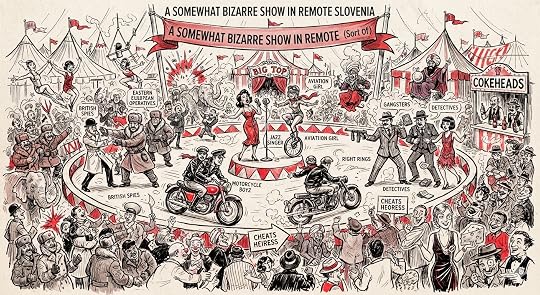
Zbig Dubinsky: a junior hire at the U-Ops agency, Skeet: a small though energetic urchin with a pocketful of rubber balloons and a supply of pins, Don Peppino Infernacci, Vito Guardalabene, Hoagie Hivnak, Giancarlo Foditto aka Dippy Chazz, Francesco “Finger of Death” Sfuzzino: locally year after year coming in at the top of everybody’s most-frightened-of list, Miss Fancy Vivid, Greasy Thumb Guzik, Ooly Schaufl, Vito Cubanelli, Dr. Swampscott Vobe, Pancho Caramba: percussionist, early influencer Glow Tripworth del Vasco and her alleged husband/ jealous boyfriend Porfirio del Vasto: high society thief and aircraft dealer, Royal Navy Commander Alf Quarrender, retired and his wife Philippa who are probably secret agents from MI7b or some service like that, Dr. Zoltan von Kiss: apportist, Zdenek, who claims to be an authentic Czechoslovakian golem, child movie star Squeezita Thickly, a spinthomaniac (don’t ask) named Phoebe, Egon Praediger: a cocaine addicted European commissar, Ace Lomax: bike dare-devil, Vassily Midoff: Russian contrabandist. There are literally hundreds more names to keep track of.
The novel comes with its own cabaret and vaudeville soundtrack, courtesy of the several femmes fatale that cross paths with Hicks, starting with his main squeeze and dance partner April Randazzo, a chanteuse who is also wooed by one of the ’Ndragheta capi, the seductive Glow, a fiery Hungarian biker named Terike, eventually Daphne if/when she comes out from the shadows. McTaggart may be a little slow in the brain department, but he is a real smooth operator on the dance floor, one could even say a professional at the Lindy-hop, the Mazize, the North Shore Zombie two-step(?) and other syncopated as sin rhythms of the original hipster era.
The ladies interest in Hicks comes with the complementary dirty looks from their husbands, parents or mobster sponsors. When a couple of elves bearing gifts accost our gumshoe on the street it is probably time for him to do his own vanishing act. Hicks would rather not go farther than a stone throw from his home town, but his boss, the newly arrived G-men in town and a spiked drink will make sure he wakes aboard the ocean liner Stupendica , bound for Europe and as clueless as the reader about what the heck is going on.
>>><<<>>><<<
So, Mr. Pynchon, where do you get your ideas from?
Apparently, he watches a lot of old Looney Tunes cartoons, because this is the main vibe I got from this novel:
A familiar mental prowl car now begins to drive back and forth across Hick’s brain, gonging high-low-high-low, signalling trouble for somebody, which Hicks would prefer to be anybody but him.
I can understand why it takes more than ten years for the author to publish something new: underneath the wacky actions and the burlesque actors lies a very solid foundation of research. The atmosphere feels authentic because one never knows for sure what is invented and what is actual trivia from 1932, what is relevant to the plot and what is just a detour. Most of all, the story is immersive for the intensive use of slang and of cultural references, in particular when we arrive in the Central Europe / Balkans part of the novel, at least for me as a native of the region.
Many are the rabbit holes waiting to trip the serious reader who wants to fact-check the author, and many are the rewards for those who can put aside the book in order to learn more about such things as the Maxfield Parrish nude pictures, an actress named Toby Wing, the Sombrero of Uneasiness, IMOPIO (Infernal Machines of Presumed Italian Origin), a hi-jacked Hungarian submarine from WWI currently hiding in Lake Michigan, Ojibwe spirit quests, pre-owned autogyros in tip-top condition barely flown, Sticky Toffee Pudding, Jack Rose cocktails the size of birdbaths, belinographs, 500 cmc Moto Guzzi racing motorcycles, contraband Ankhesenamun cigarettes, flying watermelons, theremin vacuum tubes, pareidolia, dedicated cruciverbalists, a lamp so stupefyingly tasteless it makes nonsense of the tasteless-lamp category itself, slivovitz effects on clarinet reeds, Blavatskian narkomats or the role of teuthologists in Valdivia Expedition of 1898-99.
Some of these are red herrings, some are actual clues to closing the Airmont ticket . So we’ll put on a zoot suit in midnight aubergine and electric kumquat , grab a big bowl of giant exploded kernels of corn fiery with eros paprika, drenched in goose grease, and try to solve the McTaggart ticket ourselves, as we move from Midnight in Milwaukee, with or without ukulele accompaniment, to mornings at the Crossword Suicide Cafe in Budapest, from Vlad the Impaler comedy skits around a Transylvanian campfire to a masked ball in Fiume/Rijeka (the Milwaukee of the Adriatic). It will go probably like this, and I’m quoting the novel for the next lines:
“Wait, now you’re talking about – vampires?”
“Talk to Lew Basnight. Get him to teach you the Curly Bill Spin. Something every gunslinger should know.”
“Egon. Wait. C’mon ... counterfeit cheese?”
“I say – Republicans and gangsters? How can such things be?”
“And while he was down there he bit my ankle. Rather like human existence, wouldn’t you say.”
“Y – well, no. Sure. Um – “
“Leave the deep thinking to others and get on with the action, that about cover it?”
“Action, well, I try to avoid that too, when I can.”
“Oh, dear.”
“Don’t worry, it doesn’t always avoid me.”
“Oh and this is Erzsebet, we’re eating her for Christmas.”
“Meanwhile, if I knew you were this cold I’d’ve asked you to keep a bottle of beer for me close to your heart.”
>>><<<>>><<<
Jumping catfish , give me a break, I will eventually get to the point, probably faster than Mr. Pynchon, with fewer detours and with less radioactive cheese (which is apparently the main source of the Bruno Airmont wealth and the reason InChSyn, the mad dog of Cheese Enforcement, are hunting him).
“Does cheese, considered as a living entity, also possess consciousness?”
As if the story wasn’t already convoluted enough, beyond the scope of the most bright cruciverbalist, some supernatural elements put in an appearance: sapient cheese, Zdenek the golem, various apportists, vampires, card sharps and mentalists like Thessaly, the U-Ops agency secretary(she knows all about men). Here’s another rabbit hole I need to escape from ... but not before two examples of the inclusion of real historical references in this crazy carnival ride, like :
... the recently famous Mrs. Myrtle Bennett of Kansas City, who in the course of an otherwise friendly bridge game shot her husband dead for coming up two tricks short on a contract.
(According to wikipedia, the famous Ely Culbertson wrote about the killing and trial in his new magazine, The Bridge World. In lectures, Culbertson suggested that if only the Bennetts had been playing the Culbertson System of bidding, then 36-year-old John Bennett might still have been alive.)
or, One of the many interesting facts about Milwaukee is that along with the Harley-Davidson motorcycle and the QWERTY typewriter keyboard layout, it’s also the birthplace of the shoe-store X-ray machine.
>>><<<>>><<<
I have so many more ideas I want to include in this review, like the importance of the Oriental Attitude TM in sleuthing, or the various tips to be gleaned from the Gumshoe Manual TM, some lessons in Romanian insults and folk tales, lyrics in cabaret singing or sketches about night owls, freeloaders, accidental walk-ins, practitioners of esoteric arts, fearers of the dark, compulsive socializers, secret police, jewel thieves, firefly girls, drug dealers, cigarette-factory workers, tobacco smugglers and all the other walk-in actors here.
You probably already deduced that I am a fan of this exuberant and twisted style of story construction, of the journey being often more interesting than the destination. But I also know there is always a backbone, a solid core to the whimsical and the subversive Pynchon narrative. It takes a lot of digging to get at the gold, but that is probably one of the keys to his enduring popularity.
Prohibition Era Milwaukee was not chosen at random: the ethnic mix of the population, the criminality, the political conspiracies, all that laughter, dancing, music, drugs and chaotic loving are projected against the background of the coming storm:
We’re in the last minutes of a break that will seem so wonderful and peaceable and carefree. If anybody’s around to remember. Still trying to keep on with it before it gets too dark. Until finally we turn to look back the way we came, and there’s that last light bulb, once so bright, now feebly flickering, about to burn out, and it’s well past time to be saying, Florsheims, let’s ambulate.
You might say I am reading contemporary things into the cheese magnate that are not there, but what else can I do when I come across such comments:
how insulting to me personally, to, to be mentioned in the same breath with this feeble impersonation of a crime boss? To waste my talent not on an evil genius but on an evil moron, dangerous not for his intellect, what there may be of it, but for the power that his ill-deserved wealth allows him to exert, which his admirers pretend is will, though it never amounts to more than the stuborness of a child ...”
The title mentions shadows and tickets. One interpretation is that all these people are dancing their way to apocalypse.
“Some of us, if conscience had toenails, would be hanging on by just that margin. Yet conscience must find ways to go on operating inside history.”
We are still operating today inside history, and the times they are a-changing!
As our Hicks McTaggart might exclaim in the final hour of his ticket:
Abyssinia, hepcats and hot tomatos! I’m truckin’ off to Timbuktu!