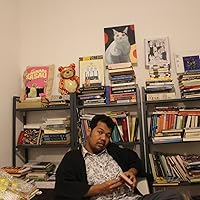
In his greatly anticipated new full-length book of poetry, the first since The Dead Emcee Scrolls in 2006, “the poet laureate of hip-hop” (CNN) Saul Williams presents his ideas, observations, realizations, dreams, and questions about the state of America, the American psyche, and what it means to be American.
After four years abroad, Williams returned to the United States and found his head twirling with thoughts on race, class, gender, finance, freedom, guns, cooking shows, dog shows, superheroes, not-so-super politicians—everything that makes up our country. US(a.) is a collection of poems that embodies the spirit of a culture that questions sentiments and realities, embracing a cross-section of pop culture, hip-hop, and the greater world politic of the moment. Williams explores what social media may only hint at—times and realities have changed; there is a connect and a disconnect. We are wirelessly connected to a past and path to which we are chained. Saul Williams stops and frisks the moment, makes it empty its pockets, and chronicles what’s inside. Here is an extraordinary book that will find its place in the hands and minds of a new generation.
Saul Williams is an acclaimed American poet, musician, actor, and filmmaker whose work fuses raw political insight, lyrical intensity, and a bold disregard for genre boundaries. Widely recognized for his dynamic presence in both spoken word and alternative hip hop, Williams emerged in the mid-1990s as a vital voice in contemporary poetry before expanding into music, theater, film, and literature. Born in Newburgh, New York, Williams studied acting and philosophy at Morehouse College and later earned an MFA from NYU’s Tisch School of the Arts. It was in New York's vibrant poetry scene that he honed his distinctive voice—fusing personal narrative, political urgency, and rhythmic precision. His breakout came in 1996 when he was named Grand Slam Champion at the Nuyorican Poets Café. He soon co-wrote and starred in the film Slam (1998), a bold meditation on incarceration, art, and resistance. The film won the Grand Jury Prize at Sundance and the Camera d’Or at Cannes, launching Williams into international prominence. Williams has published several collections of poetry, including The Seventh Octave, Said the Shotgun to the Head, and The Dead Emcee Scrolls, which reflect his ability to merge the cadence of hip hop with spiritual and philosophical inquiry. His writing is known for its fierce social critique and experimental form, often pushing beyond traditional poetic boundaries to embrace typography, performance, and digital culture. As a musician, Williams has created a genre-defying body of work that blends hip hop, punk, rock, electronic, and spoken word. His debut album Amethyst Rock Star (2001), produced by Rick Rubin, was followed by the critically acclaimed self-titled Saul Williams (2004). He collaborated with Nine Inch Nails’ Trent Reznor on The Inevitable Rise and Liberation of NiggyTardust! (2007), a provocative, pay-what-you-want release that challenged music industry norms and addressed race, identity, and digital freedom. Later albums such as Volcanic Sunlight, MartyrLoserKing, and Encrypted & Vulnerable further showcased his global perspective and political urgency, incorporating influences from African rhythms, industrial noise, and cyberpunk aesthetics. In theater, Williams originated the lead role in Holler If Ya Hear Me, the Broadway musical inspired by the lyrics of Tupac Shakur. As an actor, he has appeared in films like Today, Akilla’s Escape, and Neptune Frost—the latter of which he co-directed with Anisia Uzeyman. Neptune Frost premiered at the Cannes Film Festival and exemplifies Williams’ vision of “sonic fiction,” combining sci-fi, Afrofuturism, and social commentary in a deeply poetic cinematic language. Williams is also known for his global activism, his commitment to nonconformity, and his exploration of identity. He describes himself as queer and has consistently used his platform to advocate for justice, equality, and creative freedom. His life and work reflect a boundary-crossing ethos, uniting the spiritual and the political, the poetic and the revolutionary. Across all mediums, Saul Williams defies categorization. Whether through verse, film, or song, he invites audiences to question, to imagine, and to awaken. His artistry continues to inspire new generations of poets, musicians, and thinkers worldwide.
I've always been a big fan of Saul Williams's music, and I love the one poetry book I have of his, The Dead Emcee Scrolls, so I was really excited for this. It's a commissioned collection of poetry loosely about America, being American, race in America and so on, and there are some really stunning pieces in here. He's got a great sense of rhythm and beauty and transcendence and plays around with words just enough that it's satisfying without being tiresome. I was surprised by the inclusion of a large chunk of unfinished film script for a biopic Williams had been working on about the life of Miles Davis and his relationship with Juliette Greco in Paris. I'm barely knowledgeable about jazz or any of that scene, so I didn't know what to expect; I've never been too receptive to reading scripts as-is, but this had some great moments. Much more moving though was the lengthy introduction and prologue to the collection, where Williams tracks his relationship with his own American-ness (and blackness) through his childhood.
As a collection of poems it's really pretty good. I even found myself bookmarking a few, which doesn't happen to me much. And after finishing it I find myself even more excited for his new album.
Been a fan of Mr. Williams and when I was a younger poet, this book was dope. Now, I can’t remember why I was so riled up about. Nonetheless, shit’s great. A few mad lines and fave pomes. Check out all these pieces:
Rammellzee at the Battle of the Republic When the Ocean was the Internet, U were New to Me Beneath the Ruins are Older Ruins Unanimoua Goldmine The Disappearance of the O Dead beat Glorybox Manhattan Beach Oceanium As If Thighs were Parentheses Freedom Virus Found in Monkeys Undressed Horn of the Clock Bike Minimizing, Denying, and Blaming Love and the Mountaineer Stephen Torton Kicks Off His Shoes Song Keeper
I really wanted to/ expected to enjoy this book more than I did. I loved the first 3/4ths of it, the core poetry of the volume. But there is a funky play-poem that takes up the last quarter of the book, which I didn't find as appealing. But overall the rhythms, images, and themes of Williams poems here--like his latest album Martyr Loser King, are powerful and moving. As always, Williams draws wonderful connections across various themes, places, figures forcing one to reflect and regroup.
I'd really to be able to discuss this with someone. I enjoyed the stories in the beginning and the story that was weaved throughout the book in quasi verse. The section on Miles Davis, the fictional account with his French lover, skipped ... I had zero interest in that section. I get why it's added and the point; but as this junction (for strictly personal reasons) no interest in "jaZZ."
By far, his best work to date! And that's coming from a very, very avid fan. Hell, I even wrote one of my own books with inspiration from his impeccable formatting that creates a better context for the words. I highly recommend this book to everyone and anyone that can appreciate one of the most prolific artist/poet/philosopher that our generation has seen to date!
You can see some evolution in Williams's writing after having been abroad, and in the ten years since his last collection of original works. I have to admit, the poems themselves didn't strike me as interesting--a lot of them being grouped in ways that seemed like stanzas in three columns on a page, but each group was often a single line, and that meant the enjambments didn't grab as much, in my opinion. As always, rhythm is a huge factor of the poems here and that never ceases to be the highlight of his work--the way you can hear these, feel the beats.
However, surprisingly I found the kind of "screenplay"s that he put in the second part and especially the final section re-imagining Miles Davis and Juliette Greco's romance in Paris to be the best parts of this collection. I think actually he would do great writing for the stage or film. I went and looked and found he wrote and directed a film that was released two years ago, and will definitely watch that now. Having now read all of Williams' poetry books, I think I would say , said the shotgun to the head is the best, but s/he and this one might be tied for next best, with Dead Emcee Scrolls coming in last only because the final section of journals isn't as strong as the rest. Glad I have read all of this, and seen this side of him to think about as I bop to the tunes he releases.
US(a.) is my first exposure to Saul Williams as a poet and a writer, although I have loved him as a musical artist since diving into his body of work a few years ago. I was not disappointed. This lives up to my expectations of a creative who defies restrictions and expectations. I mean, I wasn't at all thrown off by the book's having a Foreward, Introduction, and Prologue in succession. The stories amidst the poems were unexpected, though. The one in the second section was good, so good that I was disappointed it didn't continue into the next. Instead we get a story about Miles Davis and his lover that failed to hold my interest any fair fraction as well as the convergence story about Ah, Aria, and Aura.
4.5 stars. Really enjoyed this. Williams hits his stride, for me, in the “(b.) Glorybox” section. Reading Ah and Aria’s saga with the dreams was incredibly thought provoking.
Williams forces me to interrogate concepts like ancestral memory, my place within American and world society, and what art means as a vehicle both for change and emotional release. He challenges me to see hidden futures within historical pasts. He encourages me to continue a search for truth within this life. Excellent writing.
I'm not usually one for poetry, especially written poetry. I'm of the mind that poetry is meant to be heard. But Williams might have changed my mind about this; at least to some extent. Part poetry, part script, part visual art, this book has a little bit of everything. It uses the page to express themes in the poems. One poem about division is literally split down the middle. When the words are scattered across the page, it feels like you are really looking into someone's stream of consciousness. Williams makes the poems interactive in a way I don't usually see and it was so refreshing.
**I received a copy of this book in exchange for an honest review.**
Disclosure: I received this book of poetry from a giveaway. I actually received this about a year or possibly more ago. Quite frankly, I was not on my priority list to read in the midst of hectic school years. This summer I finally sat down to take it all in. The poetry has a very interesting tone to it, especially since most of the ones I have read were in class (the very upsetting ones). It was rather easy to read and understand, but the poetry simply didn't click with me. A well done work that just wasn't my cup of tea.
Definitely a talented author, and some of the pieces in this book are amazing, but I find that the overall product sometimes fail to meet its own standards. By which I mean that this book is long, and perhaps too long for its own good. It contain a lot of individual poems, some of which were way less good than others, and in my opinion unnecessary. A condensed version of this book could have made a masterpiece, but as it is now it has quite a way to go. Still an enjoyable read though.
Tupac said, ”I never had a [criminal] record until I said that I did on record.” John Keats said, ”Poets are midwives of reality.”
p.110
Vaikea arvioida kokonaisuutena, koska niin vaihtelevainen sisältö. Näytelmäkäsikirjoituspätkien tunnelmiin en ihan päässyt kokonaan mukaan, muuten pidin.
I would have liked this better if I had read it when it in 2015. When US(a.) was published social media was in full swing, horrific news stories fueled the Black Lives Matter movement and Wall Street was facing Occupation. A few years later, Saul Williams' still topical collection encompasses a rhythm all his own. Still, it felt super rant-y. Maybe just not my favorite of his work.
What a wild and wondrous trip. My imagination hasn't been teased this way in quite some time. I felt myself absorbed into these dreamworlds and not wanting to leave.
Paint a dreamworld solid enough to hold us. ❤ Unanimous Goldmine in US(a.)
Williams is one of the artist who turned me on to poetry so I read this new collection with care. It's an awesome collaboration between his hip hop style and the stories that he weaves through dialogue and prose. One of the powerful voices of our day.
I may have to revisit this down the line but a lot of it fell flat, which I never thought I'd say about anything Saul Williams related. There are moments of brilliance, naturally, but it lacked something that made me go "Whoa!" when I finished it.
I didn't read the "introductions." Went straight to the poems. Saul doesn't disappoint and is as edgy as ever. A true words man. I found my self unconsciously reading out loud.