

What do you think?

The Distance of a Shout: Selected Poems
An astonishing, one-of-a-kind collection showcasing fifty years of poetry by one of our most celebrated and cherished authors
The poetry of Michael Ondaatje begins in distant landscapes, myths from childhood, fleeting interactions with loved ones, and characters from history itself. In poems that are spare as often as they are fable-like—as tender as they are heart-wrenching—the poet navigates the past, looks toward the future, and unearths inevitable truths about the world.
Assembling Michael Ondaatje’s finest poems in one brilliant volume, The Distance of a Shout chronicles the poet’s journey—moving book to book, moment to moment, border to border—and leads the reader through the threshold of discovery itself. The Distance of a Shout is a profound and gorgeous collection by an indispensable poet of our time, and proof of why miraculous poetry endures.
The poetry of Michael Ondaatje begins in distant landscapes, myths from childhood, fleeting interactions with loved ones, and characters from history itself. In poems that are spare as often as they are fable-like—as tender as they are heart-wrenching—the poet navigates the past, looks toward the future, and unearths inevitable truths about the world.
Assembling Michael Ondaatje’s finest poems in one brilliant volume, The Distance of a Shout chronicles the poet’s journey—moving book to book, moment to moment, border to border—and leads the reader through the threshold of discovery itself. The Distance of a Shout is a profound and gorgeous collection by an indispensable poet of our time, and proof of why miraculous poetry endures.
- GenresPoetry
240 pages, Hardcover
Published February 24, 2026
About the author
Michael Ondaatje
103 books4,403 followersPhilip Michael Ondaatje is a Sri Lankan-born Canadian poet, fiction writer, and essayist, renowned for his contributions to both poetry and prose. He was born in Colombo in 1943, to a family of Tamil and Burgher descent. Ondaatje emigrated to Canada in 1962, where he pursued his education, obtaining a Bachelor of Arts degree from the University of Toronto and a Master of Arts from Queen's University.
Ondaatje’s literary career began in 1967 with his poetry collection The Dainty Monsters, followed by his celebrated The Collected Works of Billy the Kid in 1970. His poetry earned him numerous accolades, including the Governor General’s Award for his collection There's a Trick with a Knife I'm Learning to Do: Poems 1973–1978 in 1979. He published 13 books of poetry, exploring diverse themes and poetic forms.
In 1992, Ondaatje gained international fame with the publication of his novel The English Patient, which won the Booker Prize and was later adapted into an Academy Award-winning film. His other notable works include In the Skin of a Lion (1987), Anil’s Ghost (2000), and Divisadero (2007), which won the Governor General’s Award. Ondaatje’s novel Warlight (2018) was longlisted for the Booker Prize.
Aside from his writing, Ondaatje has been influential in fostering Canadian literature. He served as an editor at Coach House Books, contributing to the promotion of new Canadian voices. He also co-edited Brick, A Literary Journal, and worked as a founding trustee of the Griffin Trust for Excellence in Poetry.
Ondaatje’s work spans various forms, including plays, documentaries, and essays. His 2002 book The Conversations: Walter Murch and the Art of Editing Film earned him critical acclaim and won several awards. His plays have been adapted from his novels, including The Collected Works of Billy the Kid and Coming Through Slaughter.
Over his career, Ondaatje has been honored with several prestigious awards. He was named an Officer of the Order of Canada in 1988, upgraded to Companion in 2016, and received the Sri Lanka Ratna in 2005. In 2016, a new species of spider, Brignolia ondaatjei, was named in his honor.
Ondaatje’s personal life is also intertwined with his literary pursuits. He has been married to novelist Linda Spalding, and the couple co-edits Brick. He has two children from his first marriage and is the brother of philanthropist Sir Christopher Ondaatje. He was also involved in a public stand against the PEN American Center's decision to honor Charlie Hebdo in 2015, citing concerns about the publication's anti-Islamic content.
Ondaatje’s enduring influence on literature and his ability to blend personal history with universal themes in his writing continue to shape Canadian and world literature.
Ondaatje’s literary career began in 1967 with his poetry collection The Dainty Monsters, followed by his celebrated The Collected Works of Billy the Kid in 1970. His poetry earned him numerous accolades, including the Governor General’s Award for his collection There's a Trick with a Knife I'm Learning to Do: Poems 1973–1978 in 1979. He published 13 books of poetry, exploring diverse themes and poetic forms.
In 1992, Ondaatje gained international fame with the publication of his novel The English Patient, which won the Booker Prize and was later adapted into an Academy Award-winning film. His other notable works include In the Skin of a Lion (1987), Anil’s Ghost (2000), and Divisadero (2007), which won the Governor General’s Award. Ondaatje’s novel Warlight (2018) was longlisted for the Booker Prize.
Aside from his writing, Ondaatje has been influential in fostering Canadian literature. He served as an editor at Coach House Books, contributing to the promotion of new Canadian voices. He also co-edited Brick, A Literary Journal, and worked as a founding trustee of the Griffin Trust for Excellence in Poetry.
Ondaatje’s work spans various forms, including plays, documentaries, and essays. His 2002 book The Conversations: Walter Murch and the Art of Editing Film earned him critical acclaim and won several awards. His plays have been adapted from his novels, including The Collected Works of Billy the Kid and Coming Through Slaughter.
Over his career, Ondaatje has been honored with several prestigious awards. He was named an Officer of the Order of Canada in 1988, upgraded to Companion in 2016, and received the Sri Lanka Ratna in 2005. In 2016, a new species of spider, Brignolia ondaatjei, was named in his honor.
Ondaatje’s personal life is also intertwined with his literary pursuits. He has been married to novelist Linda Spalding, and the couple co-edits Brick. He has two children from his first marriage and is the brother of philanthropist Sir Christopher Ondaatje. He was also involved in a public stand against the PEN American Center's decision to honor Charlie Hebdo in 2015, citing concerns about the publication's anti-Islamic content.
Ondaatje’s enduring influence on literature and his ability to blend personal history with universal themes in his writing continue to shape Canadian and world literature.
Ratings & Reviews
Friends & Following
Create a free account to discover what your friends think of this book!
Community Reviews
Displaying 1 - 18 of 18 reviews

May 18, 2026
Book 2 Read for Asian American (AANHPI Heritage Month) 2026.
"My life always stops for a new book by him"- Jhumpa Lahiri.
"Do you want to be happy and write?" from Tim Roof (75).
Like Jhumpa Lahiri, my life does stop whenever something by Michael Ondaatje is published. He is one of my literary heroes- perhaps my male literary hero because he and Toni Morrison are often neck and neck when it comes to how much I love their work.
This is a beautiful, ethereal collection of poems selected from an oeuvre spanning over 40 years of poetry- many of these poems written in between some of his iconic novels.
Since I have read everything by Michael Ondaatje, rereading poems from past collections such as "Handwriting", "The Collected Works of Billy the Kid" and "A Year of Last Things" felt like revisiting the home of an old friend- like somehow life stopped and I managed to reflect what life was then and now.
According to a poem "A Story"- Mr. Ondaatje states, "I know a story about maps, for you" (15).
This collection is indeed a map: the poems map out how the boundaries of life and death, of sex and erotic feelings, of desire, of loneliness as maps of stories that are all familiar and beautiful.
Mr. Ondaatje writes about how our own mortality and lives are linked by exile and assimilating into worlds that we may or not know, and how to adapt is to survive. He writes of poetry about the immigrant experience, of displacement, of finding a home and of a footing in the world.
He writes from his poem "Tin Roof", "listen, solitude, someone said, is not an absolute, just a resting place" (86). Ondaatje is simply a hopeless romantic who says that children need to be taught "as romantics" (87).
In "Last Ink" he writes that to live is "the way someone in your life will talk out love and grief then leave your company laughing" (175). And the melancholy does not stop, it's always good to be a little sad when reading a bittersweet line such as "nothing else lasted, as if these might only be memory of ourselves when we are gone" (189).
When one enters the world of Michael Ondaatje- whether it’s his prose, or his poetry, you must be prepared to allow his language to take and seduce you.
Feelings must come out, your heart in your sleeve, always ready to cry, celebrate and reflect. It's always an adventure of loss, and of grief, and love when reading this master author's work. I cherish every word that he writes.
"My life always stops for a new book by him"- Jhumpa Lahiri.
"Do you want to be happy and write?" from Tim Roof (75).
Like Jhumpa Lahiri, my life does stop whenever something by Michael Ondaatje is published. He is one of my literary heroes- perhaps my male literary hero because he and Toni Morrison are often neck and neck when it comes to how much I love their work.
This is a beautiful, ethereal collection of poems selected from an oeuvre spanning over 40 years of poetry- many of these poems written in between some of his iconic novels.
Since I have read everything by Michael Ondaatje, rereading poems from past collections such as "Handwriting", "The Collected Works of Billy the Kid" and "A Year of Last Things" felt like revisiting the home of an old friend- like somehow life stopped and I managed to reflect what life was then and now.
According to a poem "A Story"- Mr. Ondaatje states, "I know a story about maps, for you" (15).
This collection is indeed a map: the poems map out how the boundaries of life and death, of sex and erotic feelings, of desire, of loneliness as maps of stories that are all familiar and beautiful.
Mr. Ondaatje writes about how our own mortality and lives are linked by exile and assimilating into worlds that we may or not know, and how to adapt is to survive. He writes of poetry about the immigrant experience, of displacement, of finding a home and of a footing in the world.
He writes from his poem "Tin Roof", "listen, solitude, someone said, is not an absolute, just a resting place" (86). Ondaatje is simply a hopeless romantic who says that children need to be taught "as romantics" (87).
In "Last Ink" he writes that to live is "the way someone in your life will talk out love and grief then leave your company laughing" (175). And the melancholy does not stop, it's always good to be a little sad when reading a bittersweet line such as "nothing else lasted, as if these might only be memory of ourselves when we are gone" (189).
When one enters the world of Michael Ondaatje- whether it’s his prose, or his poetry, you must be prepared to allow his language to take and seduce you.
Feelings must come out, your heart in your sleeve, always ready to cry, celebrate and reflect. It's always an adventure of loss, and of grief, and love when reading this master author's work. I cherish every word that he writes.
Review of advance copy received from Publisher
I was a fan of Ondaatje's prose, and now I'm a fan of his poetry as well.
Distance of a Shout is like Ondaatje's memoir weaved into poetry, and is so evocative and beautiful. The verses capture his life in Sri Lanka and Canada and have the themes of routine, memories, and serve as tume capsules as we walk through these verses and take a glimpse of his life.
Some poems are quite intimate, and then are others that talk about mundane stuff. I cannot pick a particular favourite poem since I loved most of them.
When I first read The English patient, I had a thought that this author would write tremendous poetry, since the prose in The English Patient was so lyrical that it felt like verses embedded into shells of prose. And, I was correct.
Distance of a Shout is like Ondaatje's memoir weaved into poetry, and is so evocative and beautiful. The verses capture his life in Sri Lanka and Canada and have the themes of routine, memories, and serve as tume capsules as we walk through these verses and take a glimpse of his life.
Some poems are quite intimate, and then are others that talk about mundane stuff. I cannot pick a particular favourite poem since I loved most of them.
When I first read The English patient, I had a thought that this author would write tremendous poetry, since the prose in The English Patient was so lyrical that it felt like verses embedded into shells of prose. And, I was correct.

April 14, 2026
Favorite poem herein is “Late Movies with Skyler” - evokes the chill atmosphere of snacking and watching late movies with your friends
Fave stanzas:
This is the hour
When dead men sit
And write each other
- from “Claude Glass”
A man buying wine
Rainier beer at the store
Would he be satisfied with this?
Cold showers, electric skillet,
Red River on TV
Oh, he could be
(do you want
to be happy and write?)
He happens to love the starkness
Of this place, the refusal
To move
- from “Tin Roof”
Fave stanzas:
This is the hour
When dead men sit
And write each other
- from “Claude Glass”
A man buying wine
Rainier beer at the store
Would he be satisfied with this?
Cold showers, electric skillet,
Red River on TV
Oh, he could be
(do you want
to be happy and write?)
He happens to love the starkness
Of this place, the refusal
To move
- from “Tin Roof”

September 25, 2026
When I read Michael Ondaatje, I always feel like I’m floating in a dream. In The Distance of a Shout, images, voices, landscapes, and fragments of memory accumulate into something intimate, haunting, and difficult to shake.

Review of advance copy received from Publisher
A Lifetime in Fragments and Light: On Reading Michael Ondaatje’s “The Distance of a Shout” as a Literary Self-Portrait
By Demetris Papadimitropoulos | February 22nd, 2026
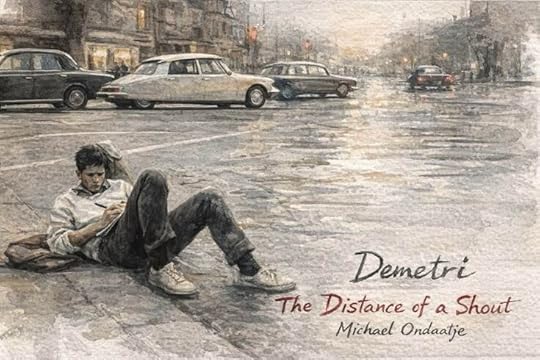
Watercolor Piece by Demetris Papadimitropoulos
Michael Ondaatje’s “The Distance of a Shout” arrives less as a new collection than as a weather system of returning images. A river moves through it. So does dusk. So do ink, rooms, fragments of family speech, old books, border-crossings, and those small objects that outlive the hand that held them. To call it a “selected poems” volume is accurate but insufficient. What Ondaatje has assembled here feels more like a self-portrait made from echoes – a lifetime of poems arranged so that earlier voices can be heard inside later silences.
This is the rare retrospective that does not read like a monument to itself. It does not announce legacy, does not swell toward valedictory statements, does not ask to be admired for having lasted. Instead it proceeds by recurrence and pressure. A phrase in one decade is answered by an image several sections later. The younger poet’s velocity and cinematic fracture give way, over time, to a spare, late style in which a chair, a hut, a dawn hour, a river edge carry the force of argument. The result is a book of unusual internal weather – all those tonal gradients, all that held breath.
Ondaatje has always written as if history and intimacy occupy adjoining rooms. In “The Distance of a Shout,” that adjacency becomes the organizing principle. The collection carries poems from early autobiographical and family-centered work into the mythic and hybrid territory of “The Collected Works of Billy the Kid,” through the sensual and diasporic mid-career poems, into “Handwriting” and finally the pared, meditative sequence from “A Year of Last Things.” The architecture matters. The table of contents itself tells a story of returns, not simply periods. The poems are grouped less by chronology than by emotional gravity, and the effect is closer to memory than to literary history.
This is one reason the book feels so contemporary. We live in an age that experiences time in shards – tabs open, feeds refreshing, family archives half-digitized, one language spoken at home and another at work, yesterday’s outrage arriving beside a century-old catastrophe. Ondaatje’s retrospective sequencing turns that fragmentation into form. Ancient history and domestic detail, migration and motel-room stillness, linguistic inheritance and the fading of a day all coexist here without needing to be harmonized into thesis. He trusts juxtaposition. He trusts the reader’s ear.
The title is the book’s best clue. A shout is immediate at its source but altered by distance. It carries, distorts, thins, becomes more atmosphere than statement. That is exactly how these poems are arranged to be read. The early work feels like the original call – muscular, risk-taking, full of movement and montage. The later poems are not weaker versions of that voice but its transformed resonance, what remains audible after years of living, leaving, remembering, forgetting, and writing. If many retrospectives promise the “whole career,” this one stages something harder to achieve: the distance itself.
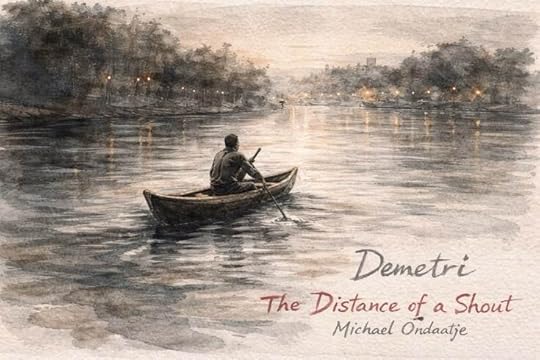
Watercolor Piece by Demetris Papadimitropoulos
That distance is geographic, certainly. Ondaatje’s long preoccupation with Sri Lanka, migration, and diasporic belonging gives the book one of its deepest currents. But geography here is never only mapwork. Places function as memory chambers. A river is history, and then a body, and then language, and then time. A landscape is not scenery but a way of keeping faith with what has been lost. The poems in and around “Handwriting” remain among the most searching in the collection because they understand that cultural inheritance is not an abstraction. It is tactile – ink on a page, names half-remembered, words disappearing from the mouth. The recurrent anxiety of these poems is not simply exile. It is erasure.
That concern with language loss gives “The Distance of a Shout” an acute relevance now, in a moment when so much of human memory is being outsourced, summarized, flattened, and accelerated. Ondaatje’s poems return obsessively to what can be inscribed, translated, misheard, preserved. “Handwriting,” “Last Ink,” “Translations of My Postcards,” “An Old Book on the Poisons of Madness” – even their titles imply a poetics of salvage. In a culture increasingly organized by the disposable and the instantly retrievable, these poems insist on the opposite: that memory is fragile, partial, and embodied, and that writing is not data storage but an endangered form of attention.
Attention may be the book’s real subject. Not narrative. Not even memory, finally. Attention. Ondaatje’s late poems in particular seem less interested in “saying” than in noticing. A sound in the woods. The quality of light at 5 a.m. A room, an object, a pause in speech. Their scale shrinks but their pressure increases. This is the compression of a mature artist who has no need to perform intensity because he can place it. The poems often end without rhetorical closure. They leave silence in the margins. That silence is not vagueness. It is structure.
The tonal evolution across the collection is one of its great pleasures. The younger Ondaatje can be explosive – cinematic in the old sense, all cuts and desert glare, the body moving through a frame. The “Billy the Kid” pieces are crucial here. Included in many retrospectives they might function as historical exhibit, proof of youthful experimentation. In “The Distance of a Shout,” they do something more interesting. They interrupt the lyric and remind us that Ondaatje’s imagination has always moved toward hybrid form, toward documentary texture, toward fractured narrative. They also sharpen the contrast with the late work. The outlaw myth, all distance and projection, is set against the old poet’s inward room. The two modes illuminate each other. Myth turns out to be another kind of memory, and memory another kind of myth.
If the “Billy the Kid” material provides the collection’s angular energy, the middle run – beginning with “Skin Boat” and moving through poems like “The Cinnamon Peeler,” “To a Sad Daughter,” “Red Accordion – an immigrant song,” “Birch Bark,” and “Escarpment” – is the emotional center of gravity. These are the poems in which Ondaatje’s written identity is most legible: the body as vessel, desire as geography, music as migration, inheritance as touch. “Skin Boat” is especially revelatory as a hinge poem in this gathering. The image is at once literal and archetypal: a fragile craft stretched tight, built to carry and survive. It becomes an emblem for the self in transit, and by extension for the book itself – a vessel made of vulnerable materials asked to cross a long distance.
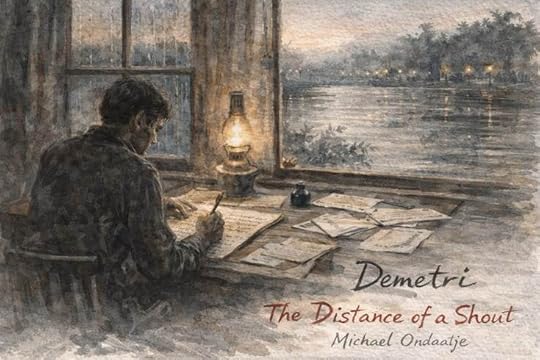
Watercolor Piece by Demetris Papadimitropoulos
One of Ondaatje’s gifts, visible throughout but most alive in this mid-career core, is his ability to let objects hold emotional voltage without overexplaining them. A postcard, a piece of bark, an accordion, a bed, a fox outside a motel room – these are not symbols in the classroom sense. They are residues. They arrive with an atmosphere already attached. This is where Ondaatje resembles no one and many poets at once. The sensual precision and diasporic layering can call to mind Derek Walcott at his most intimate, while the late, lucid minimalism carries a little of W.S. Merwin’s hush. There are moments when the meditative poise of a Louise Glück late collection hovers nearby, and moments when the archival pressure feels closer to Czesław Miłosz. But Ondaatje’s cadence – alert to image, suspicious of thesis, willing to move by leap – remains unmistakable.
What makes “The Distance of a Shout” more than a beautifully curated retrospect is the way it resists self-mythologizing. Many poets, arranging a lifetime, would foreground the “major” pieces and let the sequence read as a chain of achievements. Ondaatje does include the iconic work, but he keeps placing it beside quieter poems, transitional poems, poems that matter less as standalone performances than as tonal bridges. This is a deeply intelligent editorial choice. It asks us to read the career not as a staircase of masterpieces but as a continuum of sensibility. The recurring motifs – water, ink, evening light, interior rooms, sound – become more important than any single poem’s reputation. We begin to hear the whole as a field of echoes.
That field is especially moving in the final stretch, where “A Year of Last Things” and the closing poems enact a remarkable softening of scale. Titles like “Mask,” “Lock,” “Definition,” “November,” “Evening,” and “Talking in a River” suggest not argument but condition. The poems do not dramatize death so much as they practice reduction. This distinction matters. A lesser late style often mistakes thinness for wisdom. Ondaatje’s late style feels earned because it is not thin. It is compressed. The language has lost ornament, not nerve. The poems keep asking what remains – not in a tragic register, but in a patient one. What remains of a language. What remains of a room after someone leaves it. What remains of a life in the light it paid attention to.
The ending is a triumph of restraint. There is no grand concluding statement, no retrospective summation, no final turning of the key. Instead there are sounds, evening, river-talk. The book closes in continuity rather than closure. It is one of the most beautiful things about “The Distance of a Shout” that it understands how to stop without ending. The title’s metaphor of sound traveling through distance is completed here – not by silence, but by fading into a larger acoustic field. The poems do not conclude. They become less locatable.
Readers coming to Ondaatje primarily through “The English Patient” or “Running in the Family” may be startled, happily, by how much of that prose writer’s intelligence is already present in the poems – the historical doubleness, the fascination with broken archives, the instinct for montage, the erotic life of surfaces, the moral seriousness hidden inside restraint. But this book also reverses the usual hierarchy. It is not the poems that illuminate the novels as juvenilia or side work. It is the poems that look like the originating medium – the place where Ondaatje learned to think in shards, to move across time by image, to trust the pressure of omission.
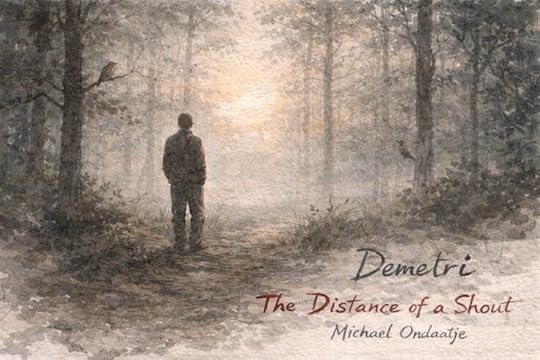
Watercolor Piece by Demetris Papadimitropoulos
There is, inevitably, some unevenness. A book spanning so many decades and modes cannot sustain identical voltage throughout, and not every poem hits with immediate force. Some read more as connective tissue than as standalone revelation. At times the retrospective method – echo answering echo, quiet reinforcing quiet – can produce a kind of tonal mist in which one wishes for a little more abrasion. The very discipline that gives the collection its poise can also keep it at a slight remove. This is the trade-off of mature restraint. The poems are less interested in seizing the reader than in staying with the reader, and now and then that means admiration arrives before urgency.
Still, the book’s cumulative power is hard to dispute. It is the power of sediment, not storm. The emotional force arrives by accrual – image laid beside image, one decade listening to another. By the time one reaches the final pages, the recurring symbols have become a kind of private lexicon. Water is no longer just water. Ink is no longer just ink. A room at dawn contains all the earlier rooms. A river carries all the previous crossings. This is the retrospective’s quiet miracle: not that it preserves a career, but that it creates a new book from the pressure among old poems.
For a reader in 2026, “The Distance of a Shout” also registers as a subtle rebuttal to contemporary speed. It is not nostalgic for a vanished literary world. It does not sermonize about distraction. But it stages another way of being in language – slower, more tactile, less performative, more faithful to the fragment as fragment. In a moment when memory is everywhere and depth is scarce, Ondaatje’s poems remind us that remembering is not the same as recording, and that preservation without attention is just storage. The book’s recurring concern with handwriting, old texts, and lost words feels uncannily apt in the age of auto-generated fluency and algorithmic abundance. These poems protect the human grain of language – the part that falters, repeats, leaves things unsaid.
If one wanted a compact way to place “The Distance of a Shout” among its peers, one might say it stands with the great late selected volumes – “New Selected Poems” by Heaney, the reflective reaches of Merwin, the transnational memory-work of Walcott – while remaining entirely Ondaatje in its compositional instincts. But the comparison only goes so far. What is most distinctive here is the book’s refusal to turn its own importance into rhetoric. It is a major retrospective that moves quietly. It is a legacy volume that distrusts legacy language.
I would rate it 92 out of 100 – a major, quietly radiant book, more echo than thunder, but all the more lasting for the way it teaches us to listen across distance. In the end, what “The Distance of a Shout” offers is not a monument but a practice: how to attend, how to carry, how to let a life in language remain audible after the voice has moved on.
By Demetris Papadimitropoulos | February 22nd, 2026
Watercolor Piece by Demetris Papadimitropoulos
Michael Ondaatje’s “The Distance of a Shout” arrives less as a new collection than as a weather system of returning images. A river moves through it. So does dusk. So do ink, rooms, fragments of family speech, old books, border-crossings, and those small objects that outlive the hand that held them. To call it a “selected poems” volume is accurate but insufficient. What Ondaatje has assembled here feels more like a self-portrait made from echoes – a lifetime of poems arranged so that earlier voices can be heard inside later silences.
This is the rare retrospective that does not read like a monument to itself. It does not announce legacy, does not swell toward valedictory statements, does not ask to be admired for having lasted. Instead it proceeds by recurrence and pressure. A phrase in one decade is answered by an image several sections later. The younger poet’s velocity and cinematic fracture give way, over time, to a spare, late style in which a chair, a hut, a dawn hour, a river edge carry the force of argument. The result is a book of unusual internal weather – all those tonal gradients, all that held breath.
Ondaatje has always written as if history and intimacy occupy adjoining rooms. In “The Distance of a Shout,” that adjacency becomes the organizing principle. The collection carries poems from early autobiographical and family-centered work into the mythic and hybrid territory of “The Collected Works of Billy the Kid,” through the sensual and diasporic mid-career poems, into “Handwriting” and finally the pared, meditative sequence from “A Year of Last Things.” The architecture matters. The table of contents itself tells a story of returns, not simply periods. The poems are grouped less by chronology than by emotional gravity, and the effect is closer to memory than to literary history.
This is one reason the book feels so contemporary. We live in an age that experiences time in shards – tabs open, feeds refreshing, family archives half-digitized, one language spoken at home and another at work, yesterday’s outrage arriving beside a century-old catastrophe. Ondaatje’s retrospective sequencing turns that fragmentation into form. Ancient history and domestic detail, migration and motel-room stillness, linguistic inheritance and the fading of a day all coexist here without needing to be harmonized into thesis. He trusts juxtaposition. He trusts the reader’s ear.
The title is the book’s best clue. A shout is immediate at its source but altered by distance. It carries, distorts, thins, becomes more atmosphere than statement. That is exactly how these poems are arranged to be read. The early work feels like the original call – muscular, risk-taking, full of movement and montage. The later poems are not weaker versions of that voice but its transformed resonance, what remains audible after years of living, leaving, remembering, forgetting, and writing. If many retrospectives promise the “whole career,” this one stages something harder to achieve: the distance itself.
Watercolor Piece by Demetris Papadimitropoulos
That distance is geographic, certainly. Ondaatje’s long preoccupation with Sri Lanka, migration, and diasporic belonging gives the book one of its deepest currents. But geography here is never only mapwork. Places function as memory chambers. A river is history, and then a body, and then language, and then time. A landscape is not scenery but a way of keeping faith with what has been lost. The poems in and around “Handwriting” remain among the most searching in the collection because they understand that cultural inheritance is not an abstraction. It is tactile – ink on a page, names half-remembered, words disappearing from the mouth. The recurrent anxiety of these poems is not simply exile. It is erasure.
That concern with language loss gives “The Distance of a Shout” an acute relevance now, in a moment when so much of human memory is being outsourced, summarized, flattened, and accelerated. Ondaatje’s poems return obsessively to what can be inscribed, translated, misheard, preserved. “Handwriting,” “Last Ink,” “Translations of My Postcards,” “An Old Book on the Poisons of Madness” – even their titles imply a poetics of salvage. In a culture increasingly organized by the disposable and the instantly retrievable, these poems insist on the opposite: that memory is fragile, partial, and embodied, and that writing is not data storage but an endangered form of attention.
Attention may be the book’s real subject. Not narrative. Not even memory, finally. Attention. Ondaatje’s late poems in particular seem less interested in “saying” than in noticing. A sound in the woods. The quality of light at 5 a.m. A room, an object, a pause in speech. Their scale shrinks but their pressure increases. This is the compression of a mature artist who has no need to perform intensity because he can place it. The poems often end without rhetorical closure. They leave silence in the margins. That silence is not vagueness. It is structure.
The tonal evolution across the collection is one of its great pleasures. The younger Ondaatje can be explosive – cinematic in the old sense, all cuts and desert glare, the body moving through a frame. The “Billy the Kid” pieces are crucial here. Included in many retrospectives they might function as historical exhibit, proof of youthful experimentation. In “The Distance of a Shout,” they do something more interesting. They interrupt the lyric and remind us that Ondaatje’s imagination has always moved toward hybrid form, toward documentary texture, toward fractured narrative. They also sharpen the contrast with the late work. The outlaw myth, all distance and projection, is set against the old poet’s inward room. The two modes illuminate each other. Myth turns out to be another kind of memory, and memory another kind of myth.
If the “Billy the Kid” material provides the collection’s angular energy, the middle run – beginning with “Skin Boat” and moving through poems like “The Cinnamon Peeler,” “To a Sad Daughter,” “Red Accordion – an immigrant song,” “Birch Bark,” and “Escarpment” – is the emotional center of gravity. These are the poems in which Ondaatje’s written identity is most legible: the body as vessel, desire as geography, music as migration, inheritance as touch. “Skin Boat” is especially revelatory as a hinge poem in this gathering. The image is at once literal and archetypal: a fragile craft stretched tight, built to carry and survive. It becomes an emblem for the self in transit, and by extension for the book itself – a vessel made of vulnerable materials asked to cross a long distance.
Watercolor Piece by Demetris Papadimitropoulos
One of Ondaatje’s gifts, visible throughout but most alive in this mid-career core, is his ability to let objects hold emotional voltage without overexplaining them. A postcard, a piece of bark, an accordion, a bed, a fox outside a motel room – these are not symbols in the classroom sense. They are residues. They arrive with an atmosphere already attached. This is where Ondaatje resembles no one and many poets at once. The sensual precision and diasporic layering can call to mind Derek Walcott at his most intimate, while the late, lucid minimalism carries a little of W.S. Merwin’s hush. There are moments when the meditative poise of a Louise Glück late collection hovers nearby, and moments when the archival pressure feels closer to Czesław Miłosz. But Ondaatje’s cadence – alert to image, suspicious of thesis, willing to move by leap – remains unmistakable.
What makes “The Distance of a Shout” more than a beautifully curated retrospect is the way it resists self-mythologizing. Many poets, arranging a lifetime, would foreground the “major” pieces and let the sequence read as a chain of achievements. Ondaatje does include the iconic work, but he keeps placing it beside quieter poems, transitional poems, poems that matter less as standalone performances than as tonal bridges. This is a deeply intelligent editorial choice. It asks us to read the career not as a staircase of masterpieces but as a continuum of sensibility. The recurring motifs – water, ink, evening light, interior rooms, sound – become more important than any single poem’s reputation. We begin to hear the whole as a field of echoes.
That field is especially moving in the final stretch, where “A Year of Last Things” and the closing poems enact a remarkable softening of scale. Titles like “Mask,” “Lock,” “Definition,” “November,” “Evening,” and “Talking in a River” suggest not argument but condition. The poems do not dramatize death so much as they practice reduction. This distinction matters. A lesser late style often mistakes thinness for wisdom. Ondaatje’s late style feels earned because it is not thin. It is compressed. The language has lost ornament, not nerve. The poems keep asking what remains – not in a tragic register, but in a patient one. What remains of a language. What remains of a room after someone leaves it. What remains of a life in the light it paid attention to.
The ending is a triumph of restraint. There is no grand concluding statement, no retrospective summation, no final turning of the key. Instead there are sounds, evening, river-talk. The book closes in continuity rather than closure. It is one of the most beautiful things about “The Distance of a Shout” that it understands how to stop without ending. The title’s metaphor of sound traveling through distance is completed here – not by silence, but by fading into a larger acoustic field. The poems do not conclude. They become less locatable.
Readers coming to Ondaatje primarily through “The English Patient” or “Running in the Family” may be startled, happily, by how much of that prose writer’s intelligence is already present in the poems – the historical doubleness, the fascination with broken archives, the instinct for montage, the erotic life of surfaces, the moral seriousness hidden inside restraint. But this book also reverses the usual hierarchy. It is not the poems that illuminate the novels as juvenilia or side work. It is the poems that look like the originating medium – the place where Ondaatje learned to think in shards, to move across time by image, to trust the pressure of omission.
Watercolor Piece by Demetris Papadimitropoulos
There is, inevitably, some unevenness. A book spanning so many decades and modes cannot sustain identical voltage throughout, and not every poem hits with immediate force. Some read more as connective tissue than as standalone revelation. At times the retrospective method – echo answering echo, quiet reinforcing quiet – can produce a kind of tonal mist in which one wishes for a little more abrasion. The very discipline that gives the collection its poise can also keep it at a slight remove. This is the trade-off of mature restraint. The poems are less interested in seizing the reader than in staying with the reader, and now and then that means admiration arrives before urgency.
Still, the book’s cumulative power is hard to dispute. It is the power of sediment, not storm. The emotional force arrives by accrual – image laid beside image, one decade listening to another. By the time one reaches the final pages, the recurring symbols have become a kind of private lexicon. Water is no longer just water. Ink is no longer just ink. A room at dawn contains all the earlier rooms. A river carries all the previous crossings. This is the retrospective’s quiet miracle: not that it preserves a career, but that it creates a new book from the pressure among old poems.
For a reader in 2026, “The Distance of a Shout” also registers as a subtle rebuttal to contemporary speed. It is not nostalgic for a vanished literary world. It does not sermonize about distraction. But it stages another way of being in language – slower, more tactile, less performative, more faithful to the fragment as fragment. In a moment when memory is everywhere and depth is scarce, Ondaatje’s poems remind us that remembering is not the same as recording, and that preservation without attention is just storage. The book’s recurring concern with handwriting, old texts, and lost words feels uncannily apt in the age of auto-generated fluency and algorithmic abundance. These poems protect the human grain of language – the part that falters, repeats, leaves things unsaid.
If one wanted a compact way to place “The Distance of a Shout” among its peers, one might say it stands with the great late selected volumes – “New Selected Poems” by Heaney, the reflective reaches of Merwin, the transnational memory-work of Walcott – while remaining entirely Ondaatje in its compositional instincts. But the comparison only goes so far. What is most distinctive here is the book’s refusal to turn its own importance into rhetoric. It is a major retrospective that moves quietly. It is a legacy volume that distrusts legacy language.
I would rate it 92 out of 100 – a major, quietly radiant book, more echo than thunder, but all the more lasting for the way it teaches us to listen across distance. In the end, what “The Distance of a Shout” offers is not a monument but a practice: how to attend, how to carry, how to let a life in language remain audible after the voice has moved on.

Review of advance copy received from Publisher
I was captured from the first poem which describes looking at old family photographs on slides and the memories of the people captured in them. “These are the fragments I have of them,” Ondaatje writes. “These are their fragments, all I remember, wanting more knowledge of them.” Loving old photographs myself, what he captures in these lines gave me chills.
There is a poem remembering the moving of an outhouse, another about an auction. He writes about jazz and lovers, family members and friends. Memories of his childhood in Sri Lanka, his time in Ontario. These poems alone are richly rewarding. But several others hit me personally.
In the long poem Tin Roof, written in Hawaii, he addresses Rilke and his Duino Elegies, then referencing the Letters to a Young Poet he notes that for him “this solitude brings no wisdom.” He ends, “I wanted poetry to be walnuts/in their green cases/but now it is the sea/and we let it drown us,/and we fly to it released/by giant catapults/of pain loneliness deceit and vanity.”
Later, I am stunned to recognize a poem referential to one of my favorite poems, The Exile’s Letter by Rihaku, translated by Ezra Pound. I felt something spark while reading The River Neighbor, but Pacific Letter was obvious from the first line, “Now I remember….” and continues at “All this comes to an end.”
I miss your company.
Things we clung to
remain on the horizon
so be become the loon
on his journey
to confused depth and privacy.
At such times–no talking
no concludsions in the heart.
I buy postage
seal this
and send it a thousand miles, thinking.
from Pacific Letter by Michael Ondaatje
I love this.
These are poems to return to over and over, richer with every reading.
Thanks to the publisher for a free book.
There is a poem remembering the moving of an outhouse, another about an auction. He writes about jazz and lovers, family members and friends. Memories of his childhood in Sri Lanka, his time in Ontario. These poems alone are richly rewarding. But several others hit me personally.
In the long poem Tin Roof, written in Hawaii, he addresses Rilke and his Duino Elegies, then referencing the Letters to a Young Poet he notes that for him “this solitude brings no wisdom.” He ends, “I wanted poetry to be walnuts/in their green cases/but now it is the sea/and we let it drown us,/and we fly to it released/by giant catapults/of pain loneliness deceit and vanity.”
Later, I am stunned to recognize a poem referential to one of my favorite poems, The Exile’s Letter by Rihaku, translated by Ezra Pound. I felt something spark while reading The River Neighbor, but Pacific Letter was obvious from the first line, “Now I remember….” and continues at “All this comes to an end.”
I miss your company.
Things we clung to
remain on the horizon
so be become the loon
on his journey
to confused depth and privacy.
At such times–no talking
no concludsions in the heart.
I buy postage
seal this
and send it a thousand miles, thinking.
from Pacific Letter by Michael Ondaatje
I love this.
These are poems to return to over and over, richer with every reading.
Thanks to the publisher for a free book.

August 4, 2026
There's a lot in these 214 pages of poems, and a multiplicity of styles. I could tell that the book affected me more deeply than I had thought, when I got to the end and felt sad to putit down.
Many entries are love poems, or ruminations on past loves ("a love so narcotic / I possessed unimpaired splendour"), but you can also encounter poems about long-term friendships, nature ("the silence of rock"; "the muscle within the river"), jazz, his cultural inheritance from Sri Lanka, and beloved pets. There's even—some hutzpah!—a poem about an outhouse.
Ondaatje describes his own writing process: "My mind is pouring chaos / in nets onto a page" and "The beautifully formed things caught at the wrong moment." He spins beautiful phrases out of complicated family relationships ("My father's body was a globe of fear / His body was a town we never knew")
The long poems are magnificent and cycle subtly through their multifold themes—a very difficult achievement.
Many entries are love poems, or ruminations on past loves ("a love so narcotic / I possessed unimpaired splendour"), but you can also encounter poems about long-term friendships, nature ("the silence of rock"; "the muscle within the river"), jazz, his cultural inheritance from Sri Lanka, and beloved pets. There's even—some hutzpah!—a poem about an outhouse.
Ondaatje describes his own writing process: "My mind is pouring chaos / in nets onto a page" and "The beautifully formed things caught at the wrong moment." He spins beautiful phrases out of complicated family relationships ("My father's body was a globe of fear / His body was a town we never knew")
The long poems are magnificent and cycle subtly through their multifold themes—a very difficult achievement.
July 26, 2026
Autobiographical - like a diary. And I think he stole the title from a book published in English in 2001 by a Pakistani Urdu feminist and poet.
Here's my own poem about this book:
I do not understand poetry.
How to write it. How to read it. Although I like some of it.
Once upon a time...
It was all rhyming.
Then - or perhaps before - there was something about
rhythm.
There's a lovely odd word: rhythm.
Let's digress:
Is it onomatopoeic?
Does it sound like what it represents?
Or is it just an echo?
Did we lose the rhythm? I don't see the pattern.
Does it matter?
Some say I don't need one. A pattern.
But how can we create something universally elegant
If we can't find the rhythm?
Here's my own poem about this book:
I do not understand poetry.
How to write it. How to read it. Although I like some of it.
Once upon a time...
It was all rhyming.
Then - or perhaps before - there was something about
rhythm.
There's a lovely odd word: rhythm.
Let's digress:
Is it onomatopoeic?
Does it sound like what it represents?
Or is it just an echo?
Did we lose the rhythm? I don't see the pattern.
Does it matter?
Some say I don't need one. A pattern.
But how can we create something universally elegant
If we can't find the rhythm?

Read
June 26, 2026A sublime collection of selected poems; a sort of poetic memoir spanning 50 years, featuring continents, friendships (many with fellow poets), love and life.
My favourite remains "The Cinnamon Peeler" - ever thus since I once heard him read it to almost orgasmic pleasure. But I also discovered other jewels: "Light", "Walking to Bellrock", "Bessie Smith at Roy Thomson Hall" (so inventive), "Breeze" and "The Geography of Sixth" among many.
I will be dipping into this time and again, savouring, warming myself.
Thank you, Michael for sharing your prodigious gifts.
My favourite remains "The Cinnamon Peeler" - ever thus since I once heard him read it to almost orgasmic pleasure. But I also discovered other jewels: "Light", "Walking to Bellrock", "Bessie Smith at Roy Thomson Hall" (so inventive), "Breeze" and "The Geography of Sixth" among many.
I will be dipping into this time and again, savouring, warming myself.
Thank you, Michael for sharing your prodigious gifts.

Review of advance copy received from Publisher
This was my first foray into the world of poetry in years. While some parts resonated with me, for the most part, this one was a miss. It wasn't bad, it just didn't evoke the emotion that I expect when I read poetry. Luckily, poetry is very subjective and I am sure that this will be a hit for those with more life experience than myself.

March 25, 2026
Having not yet read the author's novels, I was incredibly impressed by this collection. The poetry felt personal and intimate, and his voice is incredibly unique. I felt like I was sitting on a porch with someone who showed me their old photographs, letters, and vivid paintings of their childhood and youth, as the sun set lazily in the background and the crickets chirped in the tall grass.

July 18, 2026
I feel like it's rare for me to rate a poetry or short story collection higher than 3 stars, just because they're always a mix of hits and misses. For this one in particular, Ondaatje has never written a better poem than Cinnamon Peeler's Wife (included in this collection), but I always read his new works on the off chance that he might.
September 21, 2026
Where to start! A wonderful collection of poems written across 60 years. It is hard to single out any favorites they are all so engaging and thought provoking. I did not know until I read the notes about the author that he also wrote “The English Patient”!

April 28, 2026
A bit difficult to understand as I was not familiar with the references in the poems. The language was beautiful.
May 27, 2026
Yeah I guess I just don’t get poetry

June 19, 2026
I really enjoyed this book of poetry. Some pieces more tgan others. It definitely strikes up a chord in me to read other poetry books from Ondaaje.
July 8, 2026
Some lovely language but overall the poems failed to draw me in - or they simply eluded me.
September 17, 2026
amazing!!!!!
Displaying 1 - 18 of 18 reviews