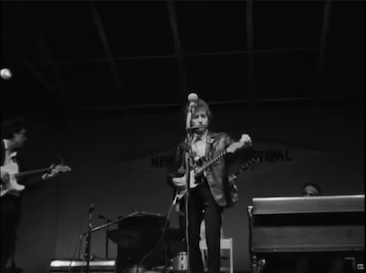
Wald's focus is the night Dylan took the stage at the 1965 Newport Jazz/Folk festival, backed by most of the Paul Butterfield Blues band, and "electrified one half his audience and electrocuted the other." Newport principally had been acoustic (and, if not, featured only electrified ethnic folk music, e.g., Cajun). But Dylan cranked the volume up to "11". It is true, as described in Alex Ross's book on 20th Century music, and the surviving film (turned into a brilliant documentary by Scorsese) that Pete Seeger charged up to the mixing board demanding the noise be reduced--but was told there were enough other Newport Festival Board members to overrule him.
More interesting is the tale of the axe--that Pete Seeger wanted to take down the power to the electric instruments. Seeger himself admitted, in an autobiography, saying, "Damn, if I had an axe I'd cut the cable right now." But this may be a post-hoc invention: Wald closely listens to the film soundtrack, and hears "Leave that one alone, Pete [Seeger]," at almost the same time Peter Yarrow says, referring to Dylan, not Seeger, and using a jazz musician's metaphor for guitar, "He's gonna get his axe."
There's no question that some, maybe as much as half, of the Newport audience booed the Dylan/Butterfield electric set. But why? Two reasons: the impromptu group played badly, having rehearsed only once (the night before); and the sound mix was awful--those in front could hear only the amplified instruments, not Dylan's voice: you had to be in the back half of the lawn to know Dylan existed at all. So at least some of those booing may have been frustrated about missing their idol entirely (at least until he was persuaded to return for two solo acoustic numbers).
Still, Newport '65 became a time to take sides:
"[T]he audience had to make a clear-cut choice and they made it…They were choosing suffocation over invention and adventure, backwards over forwards, a dead hand over a live one."
Theodore Bikel put it in a nutshell:
"'You don't whistle in church--you don't play rock and roll at a folk festival.' For that analogy to hold, Newport has to be the church: the quiet, respectable place where people knew how to act. Pete Seeger was the parson. The troubled fans were the decent, upstanding members of the community. And Dylan was the rebellious young man who whistled."
"Or, to personify that era, it was not Dylan who was transformed; it was Seeger. [The audience] could chose the past or the future, and they chose Seeger. It was not news that Dylan was the future; the news was that Seeger was the past."
On the other side, a young audience member -- clearly unfamiliar with Seeger's persistent Communist connections (Seeger apologized for Stalin only in the 1990s) -- said:
"All the martyrdom blather about blacklisting and guitars killing fascists and trailing Woody Guthrie around like a puppy faded to zero for me when Seeger took the stage to try to enforce his hootenanny, Sing Out version of what music should be."
Or, to simplify it still further, it must have driven Seeger mad that although "[i]t was not impossible to sing along with a rock band, but it was irrelevant."
So, Wald concludes -- anticipating, wrongly I think with respect to the break between New and Old Left, Altimont by a few years -- "the confrontation at Newport marked the end of the folk boom and the arrival of rock as a mature art form, the break of the New Left from the old, and the triumph of the counterculture."
Dylan made it clear he didn't care: "You go your way/I'll go mine." Seeger seems to have simultaneously admired and despised that attitude.