

What do you think?

The Interpreter
The time is the distant future. The place is Earth - a minor planet in a universe enslaved by an alien race.
A charge of corruption in their tyrannical regime leads to a threat of human rebellion. For Gary Towler, chief interpreter to the aliens, the situation is desperate. After eons of servitude, he has one chance to free earth.
A charge of corruption in their tyrannical regime leads to a threat of human rebellion. For Gary Towler, chief interpreter to the aliens, the situation is desperate. After eons of servitude, he has one chance to free earth.
126 pages, Mass Market Paperback
First published January 1, 1960
About the author
Brian W. Aldiss
836 books693 followersPseudonyms: Jael Cracken, Peter Pica, John Runciman, C.C. Shackleton, Arch Mendicant, & "Doc" Peristyle.
Brian Wilson Aldiss was one of the most important voices in science fiction writing today. He wrote his first novel while working as a bookseller in Oxford. Shortly afterwards he wrote his first work of science fiction and soon gained international recognition. Adored for his innovative literary techniques, evocative plots and irresistible characters, he became a Grand Master of Science Fiction in 1999.
Brian Aldiss died on August 19, 2017, just after celebrating his 92nd birthday with his family and closest friends.
Brian W. Aldiss Group on Good Reads
Brian Wilson Aldiss was one of the most important voices in science fiction writing today. He wrote his first novel while working as a bookseller in Oxford. Shortly afterwards he wrote his first work of science fiction and soon gained international recognition. Adored for his innovative literary techniques, evocative plots and irresistible characters, he became a Grand Master of Science Fiction in 1999.
Brian Aldiss died on August 19, 2017, just after celebrating his 92nd birthday with his family and closest friends.
Brian W. Aldiss Group on Good Reads
Ratings & Reviews
Friends & Following
Create a free account to discover what your friends think of this book!
Community Reviews
Displaying 1 - 30 of 36 reviews

November 28, 2008
Interesting book which describes a world in which humankind has become an inferior client species to a powerful alien race. Aldiss was very interested in Africa, and you get a distinct feeling that he is really talking about how Africans view Westerners. There is a memorable scene in which the (human) hero gets trapped in a high-tech alien porno theatre, and is forced to experience the performance in full 3-D with smell and touch. Nice way of making that point...
___________________
I found a used copy of this book, which I hadn't seen since the 70s, at Page & Turner, and couldn't resist. I think I liked it more than when I read it as a teen, but now it felt like a missed opportunity; the idea was appealing, but not fully realised, and the ending seemed illogical. On the other hand, it was only Aldiss's second science-fiction novel.
___________________
I found a used copy of this book, which I hadn't seen since the 70s, at Page & Turner, and couldn't resist. I think I liked it more than when I read it as a teen, but now it felt like a missed opportunity; the idea was appealing, but not fully realised, and the ending seemed illogical. On the other hand, it was only Aldiss's second science-fiction novel.

October 17, 2017
About a guy who works as an interpreter for the ruling aliens. I bought this because of the great cover art. (5/10)

March 28, 2023
Far future SF, with Earth under oppressive Galactic rule: an examination of colonialism, stronger in its opening chapters of scene-setting, satire and allegory, wobbling considerably in the middle, with much toing-and-froing and dead-end plotting, and then—perhaps betraying its serialised origins—coming together in a largely unbelievable and rather pat ending.

February 26, 2026
Earth is a vassal planet in an ancient and vast galactic empire, and mainly resigned to the fact. Only a handful of folk want out from beneath the alien yoke, and only one of those has any real idea of how to properly go about it... and his main impetus is to impress an attractive woman in the interpreter pool he manages.
An early novel by Aldiss, and not one of his best (the aliens only look the part, but in every other way may as well be human; passionate scenes are eye-rolling; the plot is littered with unlikely coincidences). That said, there is a retro nostalgic value to proceedings, and the writing is quite readable and the page count small - so if that's the kind of kick you're after, there's much worse out there.
Gorgeous Bruce Pennington cover, though.
An early novel by Aldiss, and not one of his best (the aliens only look the part, but in every other way may as well be human; passionate scenes are eye-rolling; the plot is littered with unlikely coincidences). That said, there is a retro nostalgic value to proceedings, and the writing is quite readable and the page count small - so if that's the kind of kick you're after, there's much worse out there.
Gorgeous Bruce Pennington cover, though.
February 25, 2025
A wonderful science fiction novel that is partly a meditation on colonialism long before post-colonial theory became fashionable. Not surprised to learn that Aldiss influenced many other sci fi writers including China Mieville.
August 20, 2026
Why is it that every 60’s scifi author seems like such a horn dawg

July 10, 2015
This review appeared at https://darrengoossens.wordpress.com/2015/07/10/bow-down-to-nul-slightly-unconvincingly-a-review-of-the-interpreter-by-brian-w-aldiss/.
The Interpreter by Brian W. Aldiss, NEL, 1973, 126 pages.
Brian Aldiss is one of the most significant figures in post-war science fiction. In particular his breadth makes him SF's true 'man of letters'. As an author he stands at the highest level, a Grand Master of the genre who has written traditional SF (in his early work like the book I'm talking about here) and some of the most experimental work, like Barefoot in the Head and Report on Probability A. His much more recent Walcot was written in second person. Yet while being a highly productive and intensely thoughtful author, he is one of relatively few really major, central figure who has spent a great deal of time thinking and writing about the field and about the work of others. Delany also comes to mind. His is importance to SF history and criticism. Couple that with significant achievements in 'mainstream' fiction, like the Squire Quartet and the Horatio Stubbs saga, and add in stage shows, poetry and editing work, and we see that his career has a both a breadth and depth of achievement rarely seen.
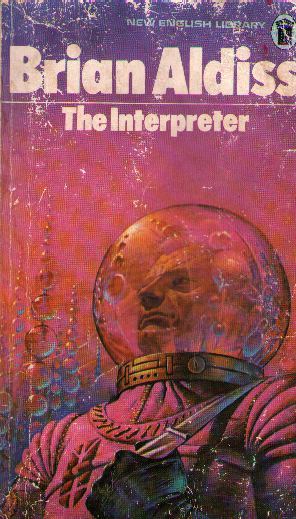 Front cover of The Interpreter by Brian Aldiss.
This book is a relatively minor early work. It is Aldiss still learning his trade. First published in New Worlds way back in 1960, it lies closer to the SF of the US and the 1940s, the so-called 'golden age' of the genre, that most of his work. It also lies closer to the American tradition than much of his work, ending as it does in... well, suffice to say that the plot is perhaps more pulpy and more 'traditionally' resolved than in many of his later works. Though it shows the inward focus that is so typical of him compared to other space operas of the time. It contains some nicely inhuman aliens, the nuls, but feels rather schematic, and the plot turns on some characters making decisions that the author feels the reader might not believe without considerable convincing. There is lots of treachery and trickery and many double-crosses. The dialogue often rings untrue, especially when characters are trying to explain each others' motivations to each other (really to the reader) --"...Something in your subconscious wanted me as a witness of what you took for Rivars's mistake." -- or implicitly telling the reader that the author knows these words would never be spoken by a real person ("Ah, now you're rationalizing.")
So, not a great book, but by a great author who intermittently produces great books.
The Interpreter by Brian W. Aldiss, NEL, 1973, 126 pages.
Brian Aldiss is one of the most significant figures in post-war science fiction. In particular his breadth makes him SF's true 'man of letters'. As an author he stands at the highest level, a Grand Master of the genre who has written traditional SF (in his early work like the book I'm talking about here) and some of the most experimental work, like Barefoot in the Head and Report on Probability A. His much more recent Walcot was written in second person. Yet while being a highly productive and intensely thoughtful author, he is one of relatively few really major, central figure who has spent a great deal of time thinking and writing about the field and about the work of others. Delany also comes to mind. His is importance to SF history and criticism. Couple that with significant achievements in 'mainstream' fiction, like the Squire Quartet and the Horatio Stubbs saga, and add in stage shows, poetry and editing work, and we see that his career has a both a breadth and depth of achievement rarely seen.
 Front cover of The Interpreter by Brian Aldiss.
This book is a relatively minor early work. It is Aldiss still learning his trade. First published in New Worlds way back in 1960, it lies closer to the SF of the US and the 1940s, the so-called 'golden age' of the genre, that most of his work. It also lies closer to the American tradition than much of his work, ending as it does in... well, suffice to say that the plot is perhaps more pulpy and more 'traditionally' resolved than in many of his later works. Though it shows the inward focus that is so typical of him compared to other space operas of the time. It contains some nicely inhuman aliens, the nuls, but feels rather schematic, and the plot turns on some characters making decisions that the author feels the reader might not believe without considerable convincing. There is lots of treachery and trickery and many double-crosses. The dialogue often rings untrue, especially when characters are trying to explain each others' motivations to each other (really to the reader) --"...Something in your subconscious wanted me as a witness of what you took for Rivars's mistake." -- or implicitly telling the reader that the author knows these words would never be spoken by a real person ("Ah, now you're rationalizing.")
So, not a great book, but by a great author who intermittently produces great books.
January 25, 2020
2/5 (Bad)
Ok, I admit, I bought this book because of the gorgeous red/helium-breathing alien/humans toting spears cover… Sadly, there’s very little behind the cover besides a standard uninventive pulp-ish romp. Aldiss expends little effort [..]
Full review: https://sciencefictionruminations.com...
Ok, I admit, I bought this book because of the gorgeous red/helium-breathing alien/humans toting spears cover… Sadly, there’s very little behind the cover besides a standard uninventive pulp-ish romp. Aldiss expends little effort [..]
Full review: https://sciencefictionruminations.com...

June 11, 2013
Not quite up there with Hot House or Report on Probablity A, but a decent enough SF political thriller

January 2, 2026
This good early Aldiss sees Earth as a subject colony in a 4 million planet strong empire ruled by the tripedal, bureaucratic race known as nuls. Towler is appointed as interpreter to a visiting nul inspector, investigating charges of corruption and exploitation by Par-Chavorlem, Earth’s colonial administrator, who attempts (successfully) to cover up his misdeeds, portraying his regime as lenient and enlightened in the face of the violent human population, who are engaged in a (faked) civil war (with imported Starjjans, whose importation is a crime). Aldiss had experience of British colonialism and draws his characters well - Par-Chavorlem schemes to no end, and has a habit of terrifying humans to satisfy his detached sadistic tendencies; Rivars plays the naïve revolutionary, eventually turning on Towler as his simple scheme to convince the inspector fails (believing he need only provide proof of Starjjan presence on Earth to the inspector, using a severed Starjjan foot, overlooking the fact that the inspector is unaware of the appearance of Starjjans despite having administered Starjj); the inspector, Synvoret, is the best character - convinced of his own superior intellect and morality, he nevertheless views humans with disgust and finds himself duped by the facade he is presented with, eventually aiding the human cause by providing evidence of Chav’s excessive lenience for allowing an attempt on his life to be made in an ironic, humorous ending that works well in underlining the inefficiency of the decaying empire. The book’s message is clear: diplomatic attempts to resist imperialism are futile - the administrators don’t care, they have no connection to the culture and no understanding of the people, so only violence will prevail. The world-building is adequate, with a couple of nice touches, such as the wronged gambler Wattol Forlie who blags some change off Synvoret to win his sip fare home, and the weird 4D ‘Jarmboree’ sex film Towler is forced to experience and which foils the attempt on his life. The prose is solid and the narrative whips along, although it does get a bit formulaic and a tad aimless around the middle.

September 20, 2020
A rather strange look into our future.
Brian Aldiss' The Interpreter is set in the far future, where Earth has been under the rule of a galactic ruling triped species known as the nuls for a thousand years. When word of corruption on Earth reaches the nul capital of Partussy, an official investigation is started. What follows is a game of subterfuge and deception, with a lowly human interpreter stuck in the middle.
This was a short and simple read, nothing challenging while still being interesting. It was very much a mixed genre, combining elements of classic sci-fi with a comedy of errors. Each character had their own motivations for doing things, and the lengths some would go to in order to have their side win was quite amusing. The nul species made for fearsome and very alien adversaries.
The pacing was a little funny at times, given to the short length of the book, and some of the characters felt a little hollow. Aside from this the book was otherwise enjoyable.
If you're interested in a small slice of classic science fiction, then I'd recommend giving The Interpreter a shot.
Brian Aldiss' The Interpreter is set in the far future, where Earth has been under the rule of a galactic ruling triped species known as the nuls for a thousand years. When word of corruption on Earth reaches the nul capital of Partussy, an official investigation is started. What follows is a game of subterfuge and deception, with a lowly human interpreter stuck in the middle.
This was a short and simple read, nothing challenging while still being interesting. It was very much a mixed genre, combining elements of classic sci-fi with a comedy of errors. Each character had their own motivations for doing things, and the lengths some would go to in order to have their side win was quite amusing. The nul species made for fearsome and very alien adversaries.
The pacing was a little funny at times, given to the short length of the book, and some of the characters felt a little hollow. Aside from this the book was otherwise enjoyable.
If you're interested in a small slice of classic science fiction, then I'd recommend giving The Interpreter a shot.

October 1, 2018
Brian Aldiss brengt niet altijd boeken die aangenaam lezen, door het onderwerp is het soms moeilijk om verder te lezen - je wil gewoon niet weten wat er gebeurt of hoe het verder loopt. De Tolk is zo een boek waar ik me moest doorheen worstelen, al heeft dat weinig met het schrijftalent van de auteur en alles met zijn figuren die niet doen wat ik wil dat ze doen.
Het boek is een kijk op een Aarde in slavernij door de bril van iemand uit de hoogste kaste van de bezetters - die een rijk van miljoenen planeten overheersen.
Op de keper beschouwd is het eigenlijk erg aards: een dictatuur door degenen die zich ver boven het onderdrukte verheven voelen, een vok dat wel slavenarbeid moet verrichten om de dictators in weelde te laten leven. Superieure technologie zorgt dat de verhoudingen blijven wat ze zijn. Bureacratie, geheime politie, collaboratie, verraad... eigenlijk niets dat ons vreemd is. Maar dan wel uitvergroot tot een kosmische dimensie, tot zelfs iemand die vanuit zijn machtspositie het systeem van binnenuit wil veranderen.
Het boek is een kijk op een Aarde in slavernij door de bril van iemand uit de hoogste kaste van de bezetters - die een rijk van miljoenen planeten overheersen.
Op de keper beschouwd is het eigenlijk erg aards: een dictatuur door degenen die zich ver boven het onderdrukte verheven voelen, een vok dat wel slavenarbeid moet verrichten om de dictators in weelde te laten leven. Superieure technologie zorgt dat de verhoudingen blijven wat ze zijn. Bureacratie, geheime politie, collaboratie, verraad... eigenlijk niets dat ons vreemd is. Maar dan wel uitvergroot tot een kosmische dimensie, tot zelfs iemand die vanuit zijn machtspositie het systeem van binnenuit wil veranderen.

May 31, 2023
Aus älteren Aufzeichnungen um 1990 (teilweise ergänzt):
"Den Roman überflog ich förmlich, hoffe, ich kann ihn zumindest passagenweise noch einmal lesen. Er sehr spannend.
Aldiss versteht es, einem alten Muster eine originelle Variante abzugewinnen. Der Herrschaft der Nal erinnert sehr oft an allzuirdische Methoden, besonders im Kolonialismus. Hat er aber das britische Empire im Visier gehabt, oder zumindest stand es ihm als Vorbild vor Augen, dann muss ich aber meine oben vermutete Intention des romans teilweise revidieren, und sagen, dass sich Aldiss auch gegen die Unterdrückung und Überheblichkeit wendet. Die SF zeigt sich wieder einmal als Spielfeld zur Erkundung der Wirklichkeit.
Im übrigen geht der "frühe" Aldiss recht unbekümmert mit Zahlen und den Naturwissenschaften um, schon in "Non-Stop" zeigte sich das."
Ich hoffe, ich kann in den nächsten Wochen meine schon wirklich lang andauernd Aldiss-Lektüre wieder aufnehmen. Das warten noch ein paar richtig interessante Romane und Erzählungen auf mich.
"Den Roman überflog ich förmlich, hoffe, ich kann ihn zumindest passagenweise noch einmal lesen. Er sehr spannend.
Aldiss versteht es, einem alten Muster eine originelle Variante abzugewinnen. Der Herrschaft der Nal erinnert sehr oft an allzuirdische Methoden, besonders im Kolonialismus. Hat er aber das britische Empire im Visier gehabt, oder zumindest stand es ihm als Vorbild vor Augen, dann muss ich aber meine oben vermutete Intention des romans teilweise revidieren, und sagen, dass sich Aldiss auch gegen die Unterdrückung und Überheblichkeit wendet. Die SF zeigt sich wieder einmal als Spielfeld zur Erkundung der Wirklichkeit.
Im übrigen geht der "frühe" Aldiss recht unbekümmert mit Zahlen und den Naturwissenschaften um, schon in "Non-Stop" zeigte sich das."
Ich hoffe, ich kann in den nächsten Wochen meine schon wirklich lang andauernd Aldiss-Lektüre wieder aufnehmen. Das warten noch ein paar richtig interessante Romane und Erzählungen auf mich.

August 12, 2026
Concerning colonial empires, but the bulk of the page count is devoted to the poker-face-laden political schemings of a configuration of characters graced with unbalanced powers. The exploration of humankind in the clutches of alien domination is less viscerally explored by Aldiss than some of his contemporaries. Brisk and readable, but somewhat underwhelming, the novel fails to deepen its antagonists beyond some basic suggestions. Three genders? Merely mentioned. Much is treated the same. The human characters are all archetypal at best, but the focus and narrative structure may have benefited from, if not demanded, portraiture more nuanced. Teeters on the threshold between the Golden Age and the New Wave, it possesses the greater qualities of neither. But when it comes to quick, snappy, and accesible genre fiction, you could certainly do much worse.

November 26, 2020
First published in book form in 1967, after having been published in 'New Worlds' in 1960, 'The Interpreter' is a short sf novel set against the background of a huge galactic empire in which an investigator has set forth from the ruling world to investigate claims of corruption. These claims relate to the governing of the planet Earth which has been under the control of non-human alien overlords for a long time. All of which is standard space opera fodder, but given a little extra polish by the superb Brian Aldiss. An enjoyable, if brief read.

August 9, 2022
A decent enough early attempt to examine colonialism by describing the oppression and exploitation of Earth by an alien galactic civilisation. The story focuses on the resistance, but cannot really do justice to the material. The tense first part is betrayed by an all took, and all to easy ending. Students of anti-colonial struggles who like SF might find some reflections of strategic debates - armed resistance, versus reform, but Aldiss isn't able to draw these out.

August 19, 2019
Better than run-of-the-mill science fiction, with leanings to being a psychological thriller. Inventive in the worlds that are described, and the beings that inhabit them - and in the plot. I kept wondering how this story was going to turn out, and was pleasantly surprised by the way in which it did.
May 17, 2023
Pomysł intrygujący. Niestety jego realizacja słaba. Widać wyraźnie, że ze strony na stronę jest co raz gorzej. A końcówka wg mnie po prostu fatalna. Tak jakby autor chciał jak najszybciej skończyć swoją opowieść.
March 23, 2024
The ending is so memorable I really enjoyed the comedic satirist take on empire. Very entertaining ans a hilarious read. Do wish we got to saw more of the aftermath. The themes of solidarity and unity were let down by the low page count but it was very fun!!! Good read I really.enjohed this.
January 23, 2018
Szału nie ma. Dość konwencjonalna, drugorzędna literatura sci-fi. Trąca myszką, zwłaszcza w warstwie dialogowej. Spokojnie można sobie podarować.

August 7, 2021
A fairly riveting book which drives to the end with a good amount of momentum. The characters are fascinating, and show the resilience that lies within mankind.
January 20, 2026
It's an interesting read, but the style is somewhat dated.
September 17, 2026
matige vertaling

May 30, 2013
An early effort from Aldiss, this book is a fun read, pursuing the classic sci fi theme of colonialism. Much of Aldiss' work is in this vein, probably informed by his years in the UK military.
In this one, a human is the interpreter between the mighty Nul conquerors and the subject humans. The Nul have engaged in a Roman style empire overreach; the humans are engaged in an underground rebellion. The biggest problem I have is the ending seems muddy. One human has the idea to wait out the Nul and let the empire die of overreach; but then suddenly he's attempting an unsuccessful assassination. Then cut forward and everyone is alive and have seized a city from which they are successfully driving the Nul away. I must admit I finished this three days ago and I've already forgotten the ending; all I recall is a feeling of disapointment. I enjoyed Equator, Hothouse, Greybeard, and Nonstop much more. There is some darkness in here, I'm finding Aldiss to be much darker than I first intimated from his Pringle works. There are some things to like here but could be skipped in favor of his other books. Pretty good which means two stars for me.
In this one, a human is the interpreter between the mighty Nul conquerors and the subject humans. The Nul have engaged in a Roman style empire overreach; the humans are engaged in an underground rebellion. The biggest problem I have is the ending seems muddy. One human has the idea to wait out the Nul and let the empire die of overreach; but then suddenly he's attempting an unsuccessful assassination. Then cut forward and everyone is alive and have seized a city from which they are successfully driving the Nul away. I must admit I finished this three days ago and I've already forgotten the ending; all I recall is a feeling of disapointment. I enjoyed Equator, Hothouse, Greybeard, and Nonstop much more. There is some darkness in here, I'm finding Aldiss to be much darker than I first intimated from his Pringle works. There are some things to like here but could be skipped in favor of his other books. Pretty good which means two stars for me.

May 18, 2009
Earth is a mere colony in a vast and sprawling galactic empire of an alien race. So vast and sprawling that takes years to traverse and control of individual planets devolves to governers, many of whom are corrupt and exploit the indiginous populations for all they are worth. The governer of earth is just such a creature but he is forced to pretend otherwise when an anti-corruption charge is investigated by a commisioner from their home planet. Can Gary Towler, the human interpreter for the aliens, ensure that this charade fails?
The setting for this story touches upon the kinds of problems any large sprawling empire, such as the British, might face, particularly in it's twilight days.
It's an exciting read that keeps you gripped until the finish. The ending, whilst feeling a little rushed, is quite unexpected.
The setting for this story touches upon the kinds of problems any large sprawling empire, such as the British, might face, particularly in it's twilight days.
It's an exciting read that keeps you gripped until the finish. The ending, whilst feeling a little rushed, is quite unexpected.

June 22, 2009
I thought this was lousy until I came to the afterword, where Aldiss talks about seeing India while it was under occupation. Then I hated the smarmy sonuvabitch for being so sympathetic to the earthmen under "nul" "rule" while setting the entire novel in England and committing the classic sin of forgetting that the rest of the world existed. Bastard.

May 23, 2010
I bought this for its wonderful cover - not the one used by its Goodreads entry sadly, and its authour is sort of in my B team of favorite science fiction writers.
It was an agreeable romp and its plot did indeed feel like a much better, more thoughtful, richer, version of Hubbard's awful Battlefield Earth (and its publication precedes Battlefield Earth by 22 years...)
It was an agreeable romp and its plot did indeed feel like a much better, more thoughtful, richer, version of Hubbard's awful Battlefield Earth (and its publication precedes Battlefield Earth by 22 years...)

May 24, 2024
Despite its clever concept (a translator trapped between humanity’s alien overlords and human rebels) this early work from the brilliant Aldiss slowly dissolves into obtuse mental gamesmanship and a convenient afterthought of an ending. The stilted dialogue may be the book’s worst aspect.
The Jack Gaughan cover on this edition is alien chewed gum and his work is growing on me.
The Jack Gaughan cover on this edition is alien chewed gum and his work is growing on me.
April 8, 2009
I'm embarrassed to say that this book sat on my shelf for about nine years before I got around to reading it. It reminded me a lot of the Tripod Trilogy but with more thought put into it and less Young Adult.

January 23, 2015
Aldiss examines the corruption of Empire via science fiction. A bit too brief for its thesis, sadly, with a slightly forced upbeat ending with an assortment of plot points neatly dealt with off-page. Mind you, the alien nul are interesting.
Displaying 1 - 30 of 36 reviews