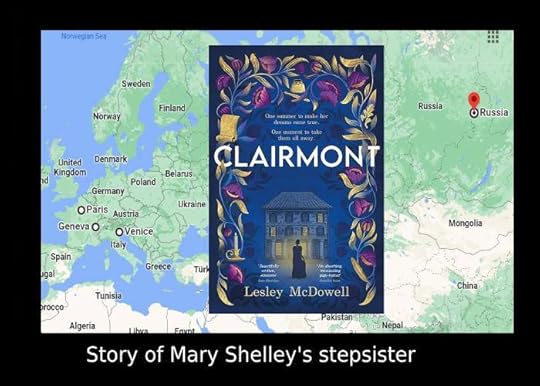
**The spellbinding, bold new retelling of the story of Lord Byron and the Shelleys, from the perspective of Claire Clairmont, the incredible woman that history tried to forget.**
'Beautifully written, Clairmont tells the sensuous hidden story of an influential historic woman.' Sara Sheridan, author of The Fair Botanists Waterstones Scottish Book of the Year
'An absorbing, intoxicating page-turner about a woman who deserves to be remembered.' Jennifer Saint, author of Ariadne and Atalanta
'Riveting - a clever portrait of a fascinating, flawed heroine.' The Times
'An intimate and enlightening tale of one of Romanticism's forsaken muses - an artfully told story that lingers in the mind far beyond the last page' Susan Stokes-Chapman, author of Pandora
1816. A massive volcanic eruption has caused the worst storms that Europe has seen in decades, yet Percy and Mary Shelley have chosen to visit the infamous Lord Byron at his villa on Lake Geneva. It wasn't their Mary's eighteen year old step-sister, Claire Clairmont, insisted.
But the reason for Claire's visit is more pressing than a summer escape with the most famous writers in the world. She's pregnant with Byron's child - a child Byron doesn't want, and scarcely believes is his own.
Claire has the world in her grasp. This trip should have given her everything she ever dreamed of. But within days, her life will be in ruins.
History has all but forgotten her story - but she will not be silenced.
Lesley McDowell is an author and critic living in Scotland. She earned a PhD for work on James Joyce and feminist theory before turning to literary journalism. Her first novel "The Picnic" was published in 2007 and she is the recipient of a Scottish Arts Council award for a second novel, based on the life of a childhood friend of Mary Shelley. She reviews regularly for the Herald, the Scotsman and the Independent on Sunday.
A beautifully written and emotional read, Leslie McDowell’s Clairmont explores the life of a complex and fascinating woman that history has, for the most part, all but forgotten.
As the stepsister of Mary Shelley (and sometime lover to Lord Byron), Claire Clairmont was at the centre of The Romantic poetry scene (she actually introduced Percy Bysshe Shelley to Byron!) And yet her story, condensed mostly to footnotes (as background character and witness to literary genius) is far more compelling than history has led us to believe.
Spanning three timelines and emotional stages of Claire’s life (including the infamous night that birthed Frankenstein.) Mcdowell’s fictionalised version of the flawed muse finally gives her a voice, shedding light on her (fascinating yet tragic) story of love, loss, motherhood and betrayal— alongside her path to the enlightened, independent woman she had always strived to be.
I loved Claire, as impulsive and rebellious as she was, and really enjoyed her rather candid narrative voice. McDowell does a brilliant job in portraying both the emotional, vulnerable and more nuanced side of Claire’s personality with her bolder, risk taking demeanour she uses to impress and shock Byron.
But it’s the depth and emotion, particularly surrounding her fraught, abusive relationship with Byron, the manipulative whims of the Shelleys (and later surrounding the loss of her daughter) really kept me engaged and rooting for her to find some semblance of happiness.
It’s by no means a lighthearted or easy read given the tragedy she experiences throughout her life, but still utterly unputdownable nonetheless. Just make sure you have some tissues handy as you may (if you’re anything like me) find yourself teary eyed during several of the more emotionally intense scenes.
The biggest surprise for me was just how dislikeable many of the people in her life were. I had expected Byron’s awfulness given his “mad, bad and dangerous to know” reputation (as well as Percy’s whose abandonment of his first wife is pretty well known), but Mary was a bit of a shock.
Despite her literary darling status and reverence from Shelley, Byron and even Polidori, she comes across as a rather jealous woman who needed constant adoration to feel validated. I’m not familiar enough with Mary Shelley to know whether McDowell’s version is accurate to the real Mary —but the fictional version’s hypocrisy and lack of empathy when it came to Claire (and women in general) was more than a little rage inducing!
Overall, a well researched, incredibly evocative and memorable read that historical fiction lovers are bound to find utterly captivating—but do be sure to check the TW/CWs first.
Also, a huge thank you to Headline/ Wildfire for the proof.
Really wanted to like this book, but the clumsy, frenetic writing style took away from the story and made it very difficult to determine who was who and what was going on. Thanks to NetGalley and the publisher for the ARC
This was an amazing novel! Lesley McDowell brings the story of Claire Clairmont, a woman history tends to forget, to the contemporary with this beautiful, well-research and compelling novel that reminds me of Hilary Mattel. The stepsister of Mary Shelley, Claire Clairmont was overshadowed for much of her life, but McDowell does not let that happen in Clairmont; Claire is vibrant, she is sassy, and she is a deep thinker. Through the ups and downs in her life, I saw a survivor, a fighter who refuses to back down from living her life. I fell in love with her strength and her weaknesses because it made her feel so much more than a reimagination in a novel, McDowell brought her back to life and let her voice be heard.
If you adore Historical fiction and want to hear from a woman who battles the silent wars and continues to fight for herself, then Lesley McDowell's Clairmont is your next read.
Thank you, NetGalley and Headline for sending me an ARC in exchange for my honest review.
I have read several novels about the Romantic poets and their social circle, including Jude Morgan’s Passion and Guinevere Glasfurd’s The Year Without Summer, but Claire Clairmont has always seemed a shadowy character, who hasn’t come to life as strongly as other women such as Mary Shelley or Lady Caroline Lamb. This new novel by Lesley McDowell changes that by giving Claire a voice and placing her at the forefront of her own story.
Clairmont follows Claire throughout three different periods of her life, beginning in 1816 when she accompanies her stepsister Mary Godwin (later Mary Shelley) to Geneva. Claire, Mary and Mary’s married lover, Percy Bysshe Shelley, with whom she already has a baby son, are renting a house by the lake, while Shelley’s friend Lord Byron is staying at the nearby Villa Diodati with his doctor, John Polidori. Claire is pregnant with Byron’s child, but it’s becoming clear that he now views her as an inconvenience and would prefer it if the child was never born.
The Geneva episode taking place in 1816, the ‘year without a summer’ which followed a volcanic eruption in Indonesia, is the part of Claire’s life most people will be familiar with (if they’re familiar with her at all). It was during their stay at the Villa Diodati that Mary began to write her famous novel Frankenstein, and it’s through her own relationships with Byron and the Shelleys that Claire has gained historical significance. In addition, this novel also follows Claire during her time working as a governess in Russia in 1825 and later when she settles in Paris in the 1840s, and we gradually begin to see how those events of 1816 have impacted the rest of her life.
There were things that I liked about this book and things that I didn’t (more of the latter than the former, unfortunately). To start with a positive, I appreciated having the opportunity to learn more about Claire Clairmont, having previously known very little about her beyond her involvement with the Romantic poets. I had no idea what she did or where she went later in life, so I found that interesting. The story is not told in chronological order, but moves back and forth in time, with a Russia chapter followed by a Paris one then back to Geneva again, which I thought was quite confusing, particularly as the gaps between the timelines aren’t adequately filled in and no backstory is given for the characters prior to 1816. It felt as though half of the story was missing and it made it difficult to become fully immersed.
The writing is beautiful and dreamlike and at times reminded me of Maggie O’Farrell’s Hamnet (especially since, like the O’Farrell novel where Shakespeare is never referred to by name, here Byron is always referred to by his nickname, Albe, and never Byron). However, sometimes beautiful writing isn’t enough and I didn’t get on very well with Hamnet so maybe it’s not surprising that I didn’t get on with this book either. The constant jumping around in time and the vagueness of the plot made it hard for me to really get to know Claire and understand her actions. Although I had a lot of sympathy for her because of the terrible way Byron treated her during and after her pregnancy (which has been well documented, including in his own letters), I had no idea what attracted her to him in the first place or how their relationship had reached this point, because none of that is explained or touched upon. Throughout the book, we are continually being dropped into situations that don’t make much sense without being given the full context.
Don’t let me put you off this book if you want to try it – there are plenty of other books I didn’t care for that other people have loved! This will probably be a good read for the right reader; it just wasn’t for me.
Clairmont is the fascinating story of Claire Clairmont, a women who was step-sister to Mary Shelley, sister-in-law to poet Percy Bysshe Shelley and lover to Lord Byron. Her story is lost in time, a women whose life was influenced by these famous writers, but now she tells her story. In three different periods of her life, beginning in 1816, we are witness to how that summer in Geneva marked the rest of Claire’s life.
Over the years, both in fiction and non-fiction, Claire Clairmont is a figure I have come across, so I was excited when Wildfire Books kindly sent me a copy of Clairmont to review. Reading this book I felt that Claire was a pawn in a game where she was the ultimate loser. Shelley used her to gain access to Byron, she wrote flirty letters to ingratiate herself to him so she could introduce the poets. This relationship had shocking consequences for Claire, pregnant with a child that Byron didn’t want, then convinced by Shelley that it would be better to give her child to Byron to raise. This decision mars the rest if her life, and we see the result of this when we catch up with her in 1825, working as a governess in Russia, and becoming very attatched to the young daughter she looks after. We also see her 1843 when she is living in Paris, having an affair with a younger man. Her realationship with Mary is still important, still wanting to please her, but found lacking. Of all the characters it is Byron who comes across the worst, he is vindictive, manipulate and plain cruel to Claire, she was just used for sex, something to be thrown away when he bored of her.
I love that Lesley McDowell has brought Claire Clarment to life as her story is intriguing and incredible in it’s own right. From the bibliography at the end of the book you can see how much research Lesley has done before writing this book. I thought the inclusion of quotes from letters, mainly between Claire and Mary gave authenticity to the book and gave great insight into their lives and relationship. The idea of freedom for women is discussed between the characters, giving historical insight into the role of women in this period, how they were perceived and treated, by both male and female, by their contemporaries. The disriptive writing captures the beauty of the three main lcations of Geneva, the lake and the awe inspiring mountains, Russia’s contrast of the heat of the summer, then the swim change to the cold and the snow, and the bonhomie of Paris, the different political factions and the more liberal lifestyle. There are some difficult scenes in this book but they refelect the reality of life of that period in history.
I thoroughly enjoyed readong Clairmont, it was a compelling and intriguing read about a remarkable woman. I liked how this book celebrated the life of Claire Clarmont, putting her as the voice in her won story where her famous relatives and lover took a back seat. Her life was remarkable, she was forever haunted by the events of 1816, but still she set out on her own to live the life she wanted, not living with Mary and Shelley who would have smothered her. Fascinating, enlighten and engaging, this is a brilliant read.
Thank you to NetGalley and to the publisher Headline/Wildfire for the digital ARC, it has not affected my honest review.
TW: child death, unhealthy relationships, explicit sexual content
“Clairmont” tells the story of a massively forgotten, but just as important historical figure, Claire Clairmont. The step-sister of Mary Shelley, beloved sister-in-law and muse of Percy Bysshe Shelley and the mother of Lord Byron’s daughter Allegra, she has long been shoved to the side in favour of those who made literary history. The book starts in 1816, not long after Claire Clairmont introduces the Shelleys to Lord Byron after an affair when she was only 18. It then moves through the “Year Without A Summer” in Geneva during which Mary Shelley wrote the earliest version of Frankenstein and John Polidori’s “The Vampyre”, a precursor to “Dracula”- but Claire has discovered she is pregnant from her affair with Byron. It flashes forward to Claire’s experiences in 1825 as a governess in Russia after the deaths of both her daughter Allegra, aged 5 (in part because of Byron’s neglect) and Percy Shelley’s drowning before moving on to 1843, when Claire finally settled in France. In between this are her feelings after the death of Byron, her experiences as a notorious woman and the complicated square between Claire, Byron, Mary and Percy that has been the subject of a lot of speculation and study. The relationship between Claire and Mary is complex and full of irritation, love and despair as the two sisters navigate a society that will always work better for men while also experiencing the need to express themselves through creation. Claire’s vibrant, passionate but ultimately destructive affair with Byron- while short- defines so much of her life. This is shown through the non-linear narrative as she still expresses her anger at him well into her eighties in Florence, even as she is the only surviving member of their legendary group.
This is a powerful piece of historical fiction, giving a voice to someone many either don’t know existed or haven’t wanted to hear from. The author has made Claire into a character of a thousand contradictions- caring but impulsive and intense- while retaining so much of the important history that she lived through and influenced. There’s no attempt to romanticise the kind of relationship that Claire had with Byron and the Shelleys or how difficult and turbulent her experiences as a mother were once she gave up access to her daughter to Byron. Her story is not well known but it should be, and this novel shows the powerful reality that life with creatives, in the middle of an extended Grand Tour, could be turbulent and unsettled. It’s also a deeply uncomfortable book, with Claire alternating between worshipping the days gone by and detesting everyone she associated with and the impact they had on each others’ lives and legacies. I'm going to be thinking about Claire Clairmont for a long time, especially when I read the works of the people she knew
Enormous thanks to the team at Netgalley and at Wildfire for the chance to read and review for free as an advance reader!
There be none of Beauty’s daughters with a magic like thee...
So begins one of Byron's lesser known works, and the one that McDowell here gifts to Claire. This become something of a motif throughout the first few chapters before more or less being forgotten for the rest of the novel. I want to preface this by saying that I was always going to enjoy Clairmont. Frankenstein is one of my favourite books, and I have always found the strange quintet that came together in Geneva and produced two of the most recognisable monsters of the modern age to be fascinating no matter what. And I did enjoy it. Although I found the start to be quite weak, and it did a poor job of setting Claire up - she comes across as both shallow and painfully stupid, which was probably supposed to read as youthful naivity - once it settles into itself, it's eminently readable. I disagreed with a lot of the characterisations, and especially the way that Mary Shelley is presented, but I also understood that as a novel from the perspective of her younger stepsister, Clairmont was not necessarily going to be sympathetic towards Mary. But, to be honest, Mary is why we're reading. If it weren't for the fame of her stepsister, Claire would be at best a footnote in biographies of Lord Byron.
Claire Clairmont, historically has always been seen as scandalous in her affair with Byron. In this novel we delve into the true character of Claire - a brave, complex heroine, defying stereotypes and breaking rules. Initially set in the summer of 1816 when Claire persuades the Shelley’s to travel to Lake Geneva to stay with Lord Byron, Mary Shelley is the step sister to the 18 year old Claire She needs to see Byron as she is pregnant with his child and is totally obsessed with him, but the feeling isn’t mutual It’s told over three timelines and moves from 1816 to the 1820s when see her life as a governess in Russia and finally her later life living the high life in Paris. A very emotional read with lots of cruel moments, particularly by Byron - it so annoyed me that Byron was seemingly forgiven his bad behaviour and Claire was forced to make impossible choices. The book assumes you’ve already have a lot of knowledge regarding Byron and Shelley, which I didn’t so found it a bit confusing at times. “History has all but forgotten her story - but she will not be silenced” - so glad that with this book Claire hasn’t been written out of history. Thanks @lesleywrites @headlinebooks & @netgalley for the insightful read
Clairmont tells the story of Claire Clairmont, the muse to both Lord Byron & Shelley.
Following Mary Shelley, her poet husband and Byron, we get a glimpse into 19th century radicals and thier strange and intriguing friendship.
Claire tells her story in 3 parts, the weeks in Geneva when the friends were together, when she is a governess in Russia and later in Paris when she is in her 40s. These chapters intermingle throughout the book but after the first 3 chapters, you quickly get into the rhythm and flow of the story.
I found it fascinating and read what is a substantial read, very quickly. I wouldn't say I liked the protagonist nor the other lead characters. They all had traits which were either shocking or plain awful. However, you do still find yourself rooting for Claire in a society that is dominated by men.
Overall, a great read that throws you into this strange, bohemian society.
Thanks to NetGalley, Lesley McDowell and the Publishers for this eARC in lieu of my honest opinion.
The writing style was very in keeping with the time period & I did find the start of the story a bit disjointed. However, from the point Clare & Shelley try to agree terms for her daughter I got really invested in the people. I found it interesting how the birth of Frankenstein almost was a footnote in this story which is polar opposite to the reality that Clare Clairmont was often seen as a footnote to Marys story. The story does give you an insight into some rather complex historical characters, and the loss of so many young children makes it a very emotive storytelling, Clare was robbed of the time with her daughter & it ultimately shapes who she becomes. Overall, if you are interested in this time period & historical characters then there is much to learn from reading this book.
This entire review has been hidden because of spoilers.
Historical fiction based on seeds of reality is my favourite kind, especially when the lead character is as tantalising as this one. Clare Clairmont was a real person - the stepsister of Mary Shelley and this is the fictional account of her POV. Clairmont has a darker tone than I was expecting and explores the life and relationships of Clare over three time periods in different geographical landscapes.
I thought Clairmont was so well written and researched, I was immersed in Claire's story, a great historical read.
This was really disappointing. Claire Clairmont is an interesting historical figure and this book does not do her any justice. A number of the characters were simply written as caricatures, a fact made more unbearable by the audiobook narrator. Although in truth, I went into this book expecting it to be one thing and it turned out to be something else - not in a good way.
“I would willingly think that my memory may not be lost in oblivion as my life has been”.
Absolutely great story! As I am currently writing my thesis on lord Byron, this book brought me back to reality as I sometimes feel like a Byromaniac myself. Terribly interesting tale on Claire that made me look up her actual diaries to further understand her relation with Mary, Percy and Byron.
I was fascinated by this one - learning the history of Shelley, Mary Shelley and Byron. Well researched, this story is a mix of fact and fiction and tells the tale of a string woman manipulated and used by the men in her life she is unable to move on from.
Clairmont tells a wonderful story that will appeal to literature history lovers as it has such charm and delves in to both Byron and The Shelleys lives. What makes this book quite hard to read is the writing style as it distracts from fantastic story being told.
This is quite a difficult book to review for me - in retrospect I think I enjoyed it more than I did during the actual reading. I found it very slow to get started and I had to really persevere to get to the end but I'm glad I did.
The story revolves around Claire Clairmont, stepsister of Mary Shelley, and concentrates on three intervals of her life - 1816, where she visits Lord Byron at Lake Geneva with Percy and Mary Shelley during the stormy summer that followed a volcanic eruption, a later period working as a governess in Russia in 1825 and later again in Paris in 1843 where she has settled. The impact of her affair with Byron in 1816, the child that followed, her complicated relationship with her sister and Percy Shelley are the heart of the story.
So far, so good, this is an interesting story and the author has researched it well. However, I had real problems with some of it. The story jumps around a lot between the time frames and this takes a while to get used to - as the book goes on it became less of an issue but I found it made the start quite hard to follow and it made it difficult to get fully invested in the story.
The bigger problem though was how unlikeable all the characters are. Each of them seems entirely self absorbed, quite sure of how special they are and showing little or no empathy to each other. The character of Claire seems highly unusual for the time and this does seem to have some historical accuracy but I never had any idea of why she was like that and what made her tick. A little further reading into the background of her and Mary Shelley makes more sense of it but it was never clear in the novel. Nobody in the novel comes out well and it's hard to care about people you just don't like.
Sticking with it did pay off, though, and once I got into the style of writing of the author, it became much easier to follow and I was interested enough to want to know what happened. It's not an easy read but it's an interesting subject and unusual, and ultimately worth the effort.
Thanks to NetGalley and the publisher for a copy in return for an honest review.
The story follows Claire Clairmont from the summer of 1816 at Lake Geneva, where she visits Lord Byron alongside her stepsister Mary Shelley and brother-in-law Percy Shelley. From that moment, the events of that fateful summer set the course of her life, and we follow her journey through the 19th century as she navigates its consequences. This is the story of a forgotten woman, overshadowed by the literary geniuses around her, those whose brilliance ultimately cost her a chance at happiness.
I felt secure in the belief that this book would be well written, especially in the parallel between the introduction, first chapter, and final pages. This is an author who clearly thinks ahead.
The narrative voice is strong, and I appreciate her writing style. Even the sexual scenes are brief and subtle, delivering exactly what’s needed. Several themes are explored in this novel, but the most poignant to me are those surrounding motherhood, the dynamics between men and women, sisterhood, and the profound impact of literature on the story.
Starting with motherhood, there is Mary, whose loss of her mother shadows her. How different would she be if her mother had lived? Would she have made different choices, like running off with Shelley? Would she have been a “better” woman, the kind Wollstonecraft envisioned in her academic texts? Does she feel she’s letting her mother down? This haunting of Wollstonecraft even seeps into Mary's work, with the idea of Frankenstein’s Monster being created just to be destroyed by Frankenstein is chilling. It's his child, his creation, yet he despises it, hating what it represents. In the context of the 1800s and 1900s, bearing a child could destroy a woman's reputation. For women, sex isn’t just a physical act; it can be the end of everything. So, in a way, does Mary (even as she loves her child) want to figuratively kill them, destroy what society has forced upon her? The monster becomes the embodiment of her "sin."
The novel’s portrayal of motherhood is compelling. Even the male characters try to strip women of this power, wanting everything—even what’s impossible. They’re selfish and destructive.
Then there is the relationship between Claire (our protagonist) and her step-sister Mary. One of my favourite aspects of this book (and a personal guilty pleasure in most novels) is not romantic relationships, but the bonds between siblings. In Clairmont, the dynamic between Claire and Mary is one of the most compelling parts of the story. The depth and complexity of their journey together highlight the complex nature of sisterhood, which can sometimes outweigh even romantic love.
‘One woman, split into two.’
Their bond (though not one of blood but of circumstance) endures betrayal and disappointment in ways that chosen loves often cannot. Yet, their relationship is deeply frayed by the men in their lives, a painfully real dynamic that still resonates today and deserves closer examination. The sisters' relationship is frayed because of their relationship with men and I HATE IT. The way men poison women’s relationships with each other, making them believe men over their own kind, is pure misogyny. Despite being sisters, in this generation, they’re women first—built in opposition because of men.
The biggest influence and force behind the story is of course the men in Claire's life. Such as Percy Shelley, who used Claire to get closer to Lord Byron, masking his true intentions with the pretense of caring about her love life.
The men are horrible, and I couldn’t stand them in this novel. Still, I struggled to like the women either, as they too played a role in breaking up marriages and being cast as the "villains" in the wives' stories. Of course, the men hold the power and always win, but we can’t forget Harriet Westbrooke, who took her own life because of Percy Shelley’s abandonment for Mary. Harriet's reputation was tarnished by Mary and her father, William Godwin, who spread rumours about her infidelity. This need for male validation and and selfishness from led to Harriet's suicide. So, none of these characters are “good,” but they share a common experience, being manipulated by the men in their lives.
The novel also made me question, why are women so drawn to broken men, to “fix” them? Men, on the other hand, barely want to be there for a“whole” women, yet we see broken men as worth saving, even when those men would never return such a favour.
I loathe the disgust these men “allow” themselves to feel for women they’ve “defiled,” as if they aren’t the real monsters. They feel sick, but somehow find a way to blame it on them. The author does a brilliant job of conveying this without forcing it on us, she captures the period’s attitudes perfectly.
I enjoyed the parallel between when Mary loves Byron she wants her child to be a boy, and then when she hates him, she wants it to be a girl, highlighting the stereotype of women being a disappointment. "I still have her. In here. Your child."
These men are so vile, and McDowell does such a good job of showing it. They have the nerve to feel sorry for themselves when their wives deny them access to children they abandoned. Taking the children away was the best thing the women could have done. And of course, it hurts them more when it’s a boy.
And of course, I cannot ignore the impact that these literary greats had on the making of this novel that McDowell had to consider.
The idea that artists must hide parts of themselves from others, sometimes even from fellow artists, is compelling. Suggesting that being an artist is a lonely path, a commitment to not being fully understood.
The use of storms and thunder to convey meaning is powerful, especially in the context of the 1816 volcano and how it transitions into the later parts of the novel, following Claire into her older years.
Not everything in the book is literal.
These characters are poets, writers, dreamers, and everything they experience holds deeper significance than what we read it as. For example, there's a scene where Byron (Albe) cuts Claire's dress open during a makeshift 'play' in his dining room, but McDowell's writing suggests something far more sinister. Did he want to cut open her dress—or her body as well? Was he trying to kill her? It’s a chilling moment. Byron might be using the play as a way to relieve himself of his darkest fantasies. Speaking of Byron, in this novel, he is quite literally a poison, infecting everyone he comes into contact with. He’s like a drug you’re drawn to, but once the high fades, you realise it’s more akin to an infection. This is a fitting description, as he's not just a figurative poison, but a literal one, drugging his friends during their visits for his own pleasure.
This is an immensely complex and thoughtful novel which kept me engaged throughout. It is based on a real person, and largely on what is known about her, providing real insights into why she made the choices she did, especially in the light of her well known companions. Her presence at Lord Byron’s famous house party at Lake Geneva in the face of the extreme weather conditions of 1816 is documented; what is less well understood is why and what she experienced there, especially in the light of her later life. This novel takes those events as a starting point for the life of an eighteen-year-old who will also be seen in Russia in 1825 and in Paris 1845. The format of the novel is complicated in that it is divided into five sections, and each section is further divided into three sections as Claire’s story progresses in each place and stage in her life. It is a very clever way of presenting a story of a woman who must meet challenges at each stage. It is not just done for effect as it is an engaging way of showing the depth of the characters. At the heart of this book is Claire’s relationship with various people, especially her stepsister Mary Godwin and her husband, the poet Shelly. Byron, who is called Albe throughout the novel, is typically at the centre of the passages set in 1816, but his later actions have effects on Claire and others for many years. He is seen as a mesmerising, fearsome and passionate character who Claire has many strong feelings about from the beginning of the novel. Her relationship with Mary is also complex; there is jealousy, overwhelming love, exasperation, despair, and anger. Mary is often seen as the genius – the golden-haired writer, mother and magnetic woman. Claire wants to be a new type of woman who does not need marriage and the typical family structure, who can make her own way and maintain a form of independence for herself and a special child. Her vulnerability is obvious and at variance with her sometimes fierce thoughts and passions. She can be loving, even adoring, but also seeks her own role, to protect her own identity, to care for the children she feels so deeply about. Her treatment by Byron suggests that he fears her, fears her passion, and yet is physically attracted by her, nonetheless. Shelley has his own burdens, his own deep loves, and yet remains sympathetic to her. There are secrets and lies within the foursome which are mutually destructive, as if they all feel too deeply. The second situation which begins from the start of the novel is typified by Claire’s frustration at the treatment of children in a country house community, her confused feelings for a suitor, and the effects of another woman who tries to manipulate her. The rural setting is beautifully described, a meaningful background for the action among the people of the house. Mary is in the background, wanting Claire to return to England, desperate for attention. In the Paris narratives Mary is very present even when physically absent as demanding money, attention and even a version of love. The city setting is in great contrast to the other situations in the book, with the heat of a small apartment contributing to the pressure of emotions. This is not a cheerful book in many ways, but I feel that it succeeds in conveying something of the passions and emotions felt by most of the characters, especially Claire who is at the centre of most of the action. It is beautifully written in terms of the settings, appearance of even the clothes of the characters. I found the structure impressively devised and handled, and in some senses this book is three novellas in one cover, all dealing with the central character who is always searching for answers, for love and an almost contradictory independence. It has much to say about motherhood in various forms. I was pleased to have the opportunity to read and review this book and recommend it as an impressive fictional appreciation of a woman often written out of history.
I've always been intrigued by the story of how 'Frankenstein' came into existence - the stormy summer of 1816 on the shores of Lake Geneva where Mary Shelley, Percy Bysshe Shelley, Lord Byron and John Polidori gathered to share their storytelling and pass the time. The rest, as they say, is history...
Except that Claire Clairmont, Mary Shelley's step-sister, was also there that summer and is often forgotten in the light of the bigger, badder and much more infamous characters around her. I only really knew about her from reading Jeanette Winterson's 'Frankissstein', a reimagining of that crazy summer and a whole lot more (sexbots!) I'm always here for stories about women whose voices have been lost to history, so I approached this book with enthusiasm.
The story shifts between timelines as we see a young Claire in 1816 (obsessed with Byron and carrying his child), then as a governess in Russia, then as an independent woman embarking on an ill-advised affair in Paris, before a poignant farewell as she leaves the UK for good. All of this covers about 40 years in Claire's life and it is clearly well-researched - there are lots of factual details that pop up within the narrative and its authenticity is discussed by the writer (along with a reading list) in notes at the end of the novel. I'll admit that I found the shifting between timelines a little tricky to follow until I got used to the characters within each timeline.
I really wanted Claire Clairmont to be an intelligent, independent woman forging her own way despite the many setbacks in her life - and I now think this was an unrealistic expectation given the time period. The Georgian era wasn't known for its liberal approach to unwed mothers, so Claire was on the back foot from the start. Add in her seemingly insatiable desires for Byron and many others, the lack of contraceptive options, plus the horrific infant mortality rates of the period, and we're left with a woman who lived freely but paid the price. I found myself feeling that Claire Clairmont was a tragic figure, but one that also really didn't make good choices along the way.
Still, I did like the historical details and the insights into the Shelleys and Byron - even if they were all pretty terrible people in this telling. In the notes at the back of the novel, there is a snippet of a memoir that Claire Clairmont wrote in which she describes Shelley and Byron as 'monsters of lying, meanness, cruelty and treachery' and I'd agree wholeheartedly with this - although McDowell uses the word 'astonishingly' to describe this which I guess means we don't see them quite the same! Byron, in particular, was awful and I'm not sure the unravelling of the whole story showed him in any better light. Similarly, I didn't warm to either of the Shelleys, even though I wanted to love Mary for her literary genius against the odds.
This is an engaging and well-researched historical novel, although one that didn't quite do what I wanted it to do. I think this is my fault for having unrealistic expectations about a figure on whom there is a reasonable amount of historical information - I'm not sure McDowell could have changed her character without deviating from her truth. Instead, we are shown the often sad life of a woman who was badly treated by some of the men around her, yet still managed to outlive them all and forge some independence within tight Georgian/Victorian parameters.
Clairmont es una novela que explora la vida de Claire Clairmont, hermanastra de Mary Shelley, y su turbulenta relación con figuras icónicas como Lord Byron y su propia hermana. Por si no lo sabéis (yo no lo sabía) Claire fue la madre de una de las hijas de Byron.
La autora nos sumerge en un universo de relaciones tóxicas, marcadas por la excentricidad, la obsesión y, en ocasiones, la locura. La novela explora con crudeza y sensibilidad dichas relaciones que marcaron su existencia, especialmente la que mantuvo con Lord Byron, una figura que la fascinó y atormentó durante toda su vida.
Uno de los grandes aciertos del libro es cómo retrata la influencia devastadora de Byron en la vida de Claire. Su obsesión por él la persigue durante toda su existencia, condicionando sus decisiones y su visión del mundo y convirtiéndose en una condena que la acompañará de por vida. Pero no es solo Byron el coprotagonista de esta historia. La relación entre Claire, su hermana y Percy Shelley el marido de esta última, es un torbellino emocional, está cargada de excentricidad, dependencia emocional y una intensidad que roza la locura donde la admiración y el deseo se mezclan con el rechazo y la autodestrucción.
Aunque la estructura narrativa es ambiciosa, con tres líneas temporales que se entrelazan, lo que aporta riqueza y profundidad a la historia. Personalmente, he disfrutado mucho más de los capítulos ambientados en Rusia y París, donde Claire busca su lugar en el mundo lejos de la sombra de Byron e incluso de las de su hermana. Estas partes resultan más evocadoras y permiten conocer mejor la evolución del personaje. En cambio, los capítulos en los que aparece Byron me han resultado densos y menos atractivos, en parte porque su figura me ha parecido detestable y difícil de soportar.
A pesar de la originalidad de la propuesta, no he logrado conectar del todo con el libro. La narración me ha parecido a veces inconexa, con escenas que no terminan de encajar o que parecen carecer de sentido dentro del conjunto. Esto ha dificultado mi implicación emocional con la historia y sus personajes.
Ahora que os he adelantado un poco sobre las relaciones entre los personajes dejadme que os cuente un poco más: • Claire Clairmont: Protagonista de la novela. Inteligente, apasionada y profundamente marcada por su relación con Byron. Su vida está atravesada por la búsqueda de identidad y redención. • Mary Shelley: Autora de Frankenstein y hermanastra de Claire. Figura más distante en la novela, pero clave en el entorno emocional y literario de Claire. Confieso que tampoco me ha caído bien. • Lord Byron: Poeta célebre, carismático y destructivo. Su relación con Claire es el eje de su tormento emocional. Un personaje que encarna el narcisismo y la crueldad emocional. • Percy Shelley: Poeta romántico y esposo de Mary. Aunque menos central, su presencia influye en la dinámica del grupo y en la vida de Claire.
En definitiva, Clairmont es una novela que ofrece una mirada intensa y oscura sobre una figura histórica muchas veces olvidada. Aunque no he logrado conectar del todo con su estilo narrativo, reconozco el valor de rescatar la voz de Claire y su lucha por existir más allá de los hombres que la eclipsaron. Una novela interesante para quienes disfrutan de los relatos sobre figuras literarias y relaciones complejas.
Well, I finally read it and I won't rate it yet, BUT it's beautifully written, BUT this is not my version of Claire, Mary, and Shelley or even Byron. I do believe it's because I have spent more time studying these people through various and very different lens than this author, and I could never write a book on Percy Shelley like this book. I lean more toward Holmes and his feelings on Claire. The author (who knows her own work well enough and is a wonderful scholar) and I (who also has as many hours in Psychology as Lit and History) see these people, for the most part, very differently.
She and I both know that Mary Shelley was a very depressive personality and was indeed a lot like her biological parents. Mary Godwin Shelley is definitely Godwin's child. The two girls were both very young when they went off, with dreams in their pockets and those dreams never came true. That said, I wonder what their lives would have been without PB Shelley, stuck in Godwin's bookshop without a penny to their name and a good education. No one would have married either one of them (Godwin, a former Radical, was deep in debt until the day he died and that alone was a deterrent) and neither would have wanted or looked for a normal life. They did not know normal. They were educated and exposed to ideas and to literary celebrities of their times. So Shelley took them, like always with young women, to save. them from patriarchy. Because believe me, he didn't care who they slept with. Let me tell you, Mary Shelley desperately wanted out of the bookshop. So Shelley it was to be. The author does not like him. I love him, even though he was very self absorbed.
But Percy was a polymath, a genius, a prodigy and he was neurodivergent and couldn't even write a poem while in the room with other people. He literaly walked the walk and talked the talk. And dragged these two women with him everywhere he went. There is no doubt in my mind that he adored both of them and thought about them a lot. I have never read a decent book about these people. I have never seen a decent film about these people and everybody seems to get hung up on the 1816 summer and Frankenstein when Mary lived to 1851 and Claire lived to 1879. Smiling. That said, Claire Clairmont is not a footnote in literary history. She just didn't write a great piece of work like Shelley, Mary, or Byron. But she knew them well. Claire's relationship with Mary, from the beginning, was fraught. But she was not to blame. Did she make bad choices. Yes. But so did all of them.
Again, this book is beautifully written. I get what she was trying to do. It was brave. It was work well done. She should be proud of it and know that I liked it well enough even though I didn't agree with much of it. I need to really think about it and reread it again before I rate it. Wonderful and very brave author. I want to say one last thing. Byron was an asshole! To everybody, even his own best friend and he certainly doesn't deserve this much attention.
Esta obra resulta un retrato de lo más revelador sobre la figura de Claire Clairmont (totalmente desconocida para mí hasta el momento), una figura que la historia relegó injustamente al papel secundario de ser “la hermana de Mary Shelley o la musa de Lord Byron”. Esta historia busca rescatar su voz y su lucha por una identidad propia, mostrándola como una mujer que desafió los límites morales de su tiempo en busca de libertad, reconocimiento y amor.
El personaje de Claire se nos presenta con todas sus contradicciones: apasionada, ingenua, a veces vanidosa y caprichosa, pero también vulnerable y auténticamente humana. Su relación con Lord Byron, figura cruel, narcisista y egoísta, constituye el eje principal de esta trama.
Y es que totalmente enamorada, Claire se somete a un amor destructivo, convencida de que la maternidad podría ser su salvación y la llave para retener a un Lord Byron que solo disfruta denigrándola de todas las formas posibles, públicamente y en la intimidad. Sin embargo, ese bebé no será más que otra herramienta en manos de Byron para humillarla y reafirmar su poder.
También se nos revela la compleja relación entre Claire y Mary (así como con Percy Shelley), hermanas que compartieron mucho más que un hogar. Claire vivía constantemente a la sombra del talento de Mary, sintiéndose arrastrada y en constante comparación por la perfección de su hermana. A través de esta historia, además, descubrimos facetas menos conocidas de la vida de Mary Shelley, célebre autora de Frankenstein.
La novela cuenta con una narrativa densa y una estructura narrativa algo enrevesada, con saltos temporales que me han llegado a despistar aunque sí creo que logra su propósito más valioso: dar voz a una mujer olvidada y ello sin pretender idealizarla ni justificar sus errores; más bien se nos presenta con sus luces y sombras, como una figura compleja atrapada entre el deseo de ser libre y la necesidad de ser amada.
El punto más fuerte del relato radica precisamente en mostrar a Claire no como un personaje secundario de la vida de otros, sino como una protagonista con una historia propia, marcada por sus decisiones y su contexto aunque debo decir que pese a todo, no he conseguido llegar a conectar del todo con Claire, si en lo referente a la maternidad y sus ansías de protección pero no con determinadas acciones que me han resultado algo chirriantes, extravagantes e incluso caprichosas.
En resumen, esta historia logra devolverle a nuestra protagonista el lugar que merece, mostrando su vida más allá de los grandes nombres que la rodearon. A través de sus aciertos y errores, conocemos a una mujer adelantada a su tiempo, deseosa de ser amada y contradictoria, que solo buscaba ser recordada por sí misma. Una lectura que, sin idealizarla, nos invita a mirar con nuevos ojos a quienes la historia dejó en silencio.
With thanks to the publishers and NetGalley for an advance review copy.
I won’t pretend I knew a great deal about Claire Clairmont’s life when I started this book, but I was aware of her existence as Mary Shelley’s half sister and the mother of a child by Byron. However I don't think it would matter much if you knew nothing about her, as I think this works very well as a work of fiction in its own right.
The narrative is split across three time periods, placing Claire squarely at the centre of each key period in her long life. The first takes place in Geneva, summer of 1816, when Claire is 18. Having thrown herself at Lord Byron, she is now pregnant and has persuaded Mary and Percy Shelley that they should all travel to Lake Geneva to be near Byron. Claire is struggling to accept that far from her pregnancy winning Byron’s heart it has made him despise her. The second strand of the narrative takes us to Russia in 1825, when a childless 27-year-old Claire is employed as a governess with a wealthy Russian family, fending off the gentle and devoted attention of the family tutor and becoming ever more attached to the little girl who fills the void left, as we learn, by her own daughter’s death. The third time period covers Claire’s time in Paris in 1845 - Shelley is long since dead, Byron too, and Claire feels cheated of the chance to exact revenge on the man who cruelly separated her from her daughter whom he left to die in a convent, alone.
Throughout the novel, Claire remains true to her desire to be an independent woman, as inspired by her stepmother Mary Wollstonecraft. She lives alone, works and takes lovers. But her entire life is coloured by the loss of her daughter at such a young age, and her cruel treatment at Byron's hands.
I enjoyed this book, but my overall impression, having finished it, is not as good as it was around a third through. I didn't have a problem with the split timeline, but I just thought it went on a bit too long. Claire learns to temper her impetuosity a bit, but I didn't really get a sense of her gaining a huge amount of maturity or developing a great deal as a character. The misogyny inherent in Victorian society, even within quite radical and freethinking circles Claire moves in, is well conveyed, but I was left feeling that the whole was somehow less than the sum of its parts.
Como en otras ocasiones, muy agradecida a Babelio por haberme elegido en una de sus últimas ediciones de Masa Crítica.
Clairmont narra la —desdichada— vida de Claire Clairmont, hermanastra poco conocida de la autora Mary Shelley (sí, la de Frankenstein). El libro nos lleva a través de tres etapas de la vida de Claire: Suiza, Rusia y París, donde vivió durante algunos periodos clave de su vida.
La idea del libro es espectacular, y tras revisar un poco la bibliografía que trae al final, debo decir que me parece bastante brillante que la autora haya hilado tan finamente la historia. Incluso tomándose unas licencias puntuales como admite en una nota, son deducciones que tienen bastante sentido a la hora de rellenar los huecos de la vida de Claire. Por supuesto, no creo que nunca lleguemos a saber hasta dónde ha acertado McDowell.
Pero esto no ha servido de mucho, porque la pluma tan inconexa y sinsentido me ha hecho muy difícil lo de poner conectar yo misma los momentos de la trama. A veces era imposible discernir quién decía qué en plena conversación, y dentro de cada línea temporal había a veces flashbacks que no estaban claramente diferenciados de la escena previa.
Por la parte de los personajes, creo que están todos hechos para ser odiosos. Los hombres: crueles e infieles; las mujeres en una espiral de constante rivalidad, celos y ganas de hacerse daño entre ellas. Lord Byron debe de ser de los seres más abominables con los que me he topado en los últimos tiempos. El libro refleja bastante bien lo destructivo que resulta oara Claire y cómo únicamente busca formas de humillarla.
Pero Shelley y Mary no se quedan atrás tampoco, haciendo de menos los deseos de Claire. Las vidas de todos están marcadas por la tragedia y la pérdida, lo que también convierte a Claire en una persona increíblemente egoísta.
Ha habido algunos puntos interesantes y de los que encogen el corazón, eso es verdad, pero no han sido suficiente para terminar de sumergirme del todo en este libro.
¿𝗤𝗨𝗘́ 𝗣𝗨𝗘𝗗𝗘𝗦 𝗘𝗡𝗖𝗢𝗡𝗧𝗥𝗔𝗥?
✒️ Ficción histórica pero basada en hechos muy reales. ✒️ Mujer olvidada por la historia. ✒️ TW: muerte infantil. ✒️ Tres líneas temporales.
Aquí nos habla de la vida de Claire dividida en tres fases. El pasado, otro entre medias y el presente. Tengo que decir que al principio me he liado un poco. La forma de narrar de la autora a saltos durante las escenas ha impedido que me meta en la trama en la primera cuadra del libro. Hay muchos personajes,otros que no cuadran sus nombres hasta que a medida que ibas leyendo ibas atando cabos.
Es una historia dura y con salseo.
Corre el año 1816 y Claire junto a su hermanastra viven con Shelley un hombre casado con el que su hermana Mary se fugo y de la que han tenido un hijo.
He alucinado con la cantidad de amantes y de juergas que hacían por aquel entonces.
Claire se desvive por Albe (Byron) pero él solo quiere saber de ella en la intimidad y la trata fatal hasta la humillación.
A consecuencia de ello Claire se queda embarazada y por aquellos tiempos está mal visto tenerlo sola así que llega a un acuerdo con Albe gracias a Shelley que le hará que pase hasta los dos años de vida de la pequeña con ella. Luego sin ninguna razón no la dejan verla.
Claire está desesperada. Ha descubierto que la niña la ha metido en un convento y poco después por culpa de unas fiebres como la niña pierde la vida.
Luego irás descubriendo poco a poco como ha ido su vida después de ese revés junto a su hermana Mary (la creadora de Frankenstein) que también toma un papel importante del libro y verás como va evolucionando la vida de ambas hermanas y sus amoríos.
Secretos, traiciones y amoríos podrás ver a lo largo del libro que no deja de ser un hecho real ya que Claire Clairmont ha existido de verdad.
Frases✨ ✨No es raro que que una persona de sentimientos vivos crea ver lo que en realidad nunca existió. "Voltaire" ✨Algún día alguien entenderá todo de ti y no tendrás que ocultarlo. Pero incluso entonces puede que quieras hacerlo. Solo para ti. ✨A veces me detesto a mí mismo incluso más de lo que te detesto a tí.
Claire Clairmont, the woman who gives her name to this novel is a woman plucked from history and given her own voice. She was the step sister of Mary Shelley who wrote Frankenstein but is largely forgotten due to her stepsisters prominence. What’s very interesting is that she had an affair with Lord Byron and they had a child which he subsequently abandoned. Disaster strikes however and the story takes a turn for the worst.
The locations in the novel were excellent as they ranged from Geneva to Italy back to England as we visited real life locations of where Byron and the Shelley family lived. I had no idea about Mary Shelley’s step sister and find it fascinating that this story has finally been told!
Claire tells her story well. Geneva where all the characters were together were particularly insightful. There’s also Russia and Paris not to mention Italy. There’s a journey in more ways than one and I was there for the ride. Utterly compelling and hard to put down.
Lord Byron comes across very badly indeed – what a cad! I had no idea he was like this. His behaviour towards Claire is shocking and he is very abusive. That actually reflects larger society at the time and honestly, the way women were treated by men in general in this book is very hard to read at times. Tell you what, it might explain where Mary Shelley got the idea for Frankenstein from! (Have to say she doesn’t come off too well in all of this either but that’s another story)
I loved this. A very meaty story with spice and very emotionally challenging. What a story though!
I read an eARC of this so thank you to Net Galley, the author and the publisher.
If you’re a big fan of Lord Byron then be aware he’s quite monstrous in this. His behaviour towards Claire is sickening. Rude, abusive, he is deeply unpleasant. In fact, I’m struggling to think of any of the adult characters who aren’t unpleasant in this. Claire is better than most but still can be manipulative.
I have quite mixed feelings on this book. I found it really well-written, evocative, compelling. The novel jumps between three separate times in Claire’s life, each one defined by a love affair with an unsuitable man. I found the time jumps confusing for the first three chapters but after that I had the shape of the narrative and it was fine.
Throughout the novel we are uncovering the story of what happened to Claire’s child. This defines her entire life. It is also deeply unfair. The behaviour of men towards women in this is horrifying. Women and their children seen as the property of men and the extreme cruelty shown. This is a historical novel so it’s reflective of the time period, but it’s still deeply uncomfortable to read.
I had some prior knowledge of Byron and Mary Shelley but I knew very little of Claire Clairmont so much of what happened was a surprise to me. No-one comes off well in this book. Mary Shelley who I’d always thought of a positive figure is frequently portrayed as selfish and manipulative.
I did think this was very well written and I was fully engaged with this story. My mixed feelings come from how bleak it felt. I struggled to find any points of hope or brightness. It was tragedy after tragedy, littered with cruelty and injustice. While most likely very accurate it did make it a hard read emotionally.
I would recommend this for being a well-crafted, interesting and engaging story. It’s not for when you want a light hearted read, but if you’re in the mood for something darker, emotionally challenging and unnerving then this is worth a read.
Lesley McDowell uses three timelines to tell Claire Clairmont’s story but it’s the first that informs them all. In a cottage on the shores of Lake Geneva, eighteen-year-old Claire is staying with her slightly older stepsister Mary and her lover Percy; you’ll know them better as the Shelleys. They’re there because Lord Byron, whom they call Albe, is staying up the hill at Villa Diodati. We’re thrown straight into the chaos of the Shelley household and Byron’s stranglehold on it. He calls the shots and makes what rules there are. We’re treated to a fly-on-the-wall view of the tangle of relationships. Also staying at the villa is doctor-poet John Polidori. He adores Mary but she’s devoted to Percy (Shelley). He is turn is in cahoots with Claire to attract Albe’s interest. McDowell paints even this younger version of Claire as complex and conflicted. She may be beguiled by Byron but she’s somewhat clear-headed too. But even with her self-awareness, Claire finds herself in thrall to this cruel man. This isn’t casual, thoughtless cruelty, though: Byron is manipulative and vindictive. Mad, bad and dangerous to know indeed. Both he and Shelley are expert gaslighters; Mary has her moments too. The other parts of the book are equally interesting. A twentysomething Claire is a governess in Russia, her dreams haunted by her earlier loss. Twenty years later, she is living in Paris and still making decisions she’ll come to regret. Claire feels forever in the shadow of Mary’s light; people want to know her because she has known these geniuses rather than for herself. But she’s more than interesting enough to hold the centre of this gripping novel. I received a free proof copy of this book via NetGalley in return for an honest review.