Jump to ratings and reviews
Rate this book

Born in Paradise

Rate this book
One of the favorite books of old Hawaii, Born in Paradise is the first volume of the autobiography of Maui native Armine von Tempski. Throughout her youth, hers was a world of green pastures and roving herds, of hoofs and spurs and laughter. With great zest and charm, von Tempski vividly depicts the lavish and wild pattern of island life in the early years of the twentieth century. It is this breathtaking world which leaps into dazzling reality in the magic pages of her own life story.

342 pages, Paperback

First published June 1, 1985

11 people are currently reading
118 people want to read

About the author

Armine Von Tempski

27 books4 followers

Ratings & Reviews

What do you think?
Rate this book

Friends & Following

Create a free account to discover what your friends think of this book!

Community Reviews

5 stars
42 (45%)
4 stars
38 (40%)
3 stars
9 (9%)
2 stars
3 (3%)
1 star
1 (1%)
Displaying 1 - 17 of 17 reviews
Profile Image for Sheila .
2,006 reviews
August 20, 2016
I started this book on a vacation to Maui earlier in the year, but since I wasn't able to finish it on the trip it ended up getting set aside. I have just now dug it back out of my pile and finished it, and was transported back to Maui, to the land that author Armine Von Tempski calls paradise.

This is an autobiography set in the early 1900's when Armine's father was the manager of Haleakala Ranch, a ranch still in existence on Maui. The Von Temski family lived on the ranch for many years, and Armine was able to experience and write about the life and history of not only Maui but of other Hawaiian islands that they visited. A beautiful glimpse of an era gone by.
Profile Image for Shawn.
258 reviews27 followers
August 28, 2022
Perhaps the writing of a memoir is the most important writing that we can do because it delivers history directly from the perspective of the one who lived it. Just imagine how much more accurate our knowledge of history would be if everyone that had lived had written a memoir. At the very least it would relieve readers from the bias inflicted by the narrow perspective of a single history writer. Certainly, it would help us to understand one another much better.

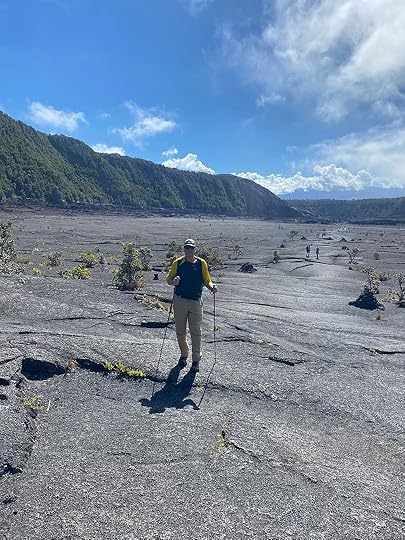
Reading a memoir such as this underscores for us how ephemeral our life actually is, that we are mere organisms flourishing for a short time amidst an ecosystem that continues on and on beyond us. The Maui that I saw during my visit there is drastically different from the one painted by this narrator and the current Maui is similarly destined for inexorable and unceasing change. My experience hiking in the volcanic craters was much different than that of the narrator. She describes the mystic isolation of the place while I find myself part of a seemingly endless line of tourists streaming through the crater single file, like a path of ants across the ground.

description
Me hiking across desolate Hawaiian crater

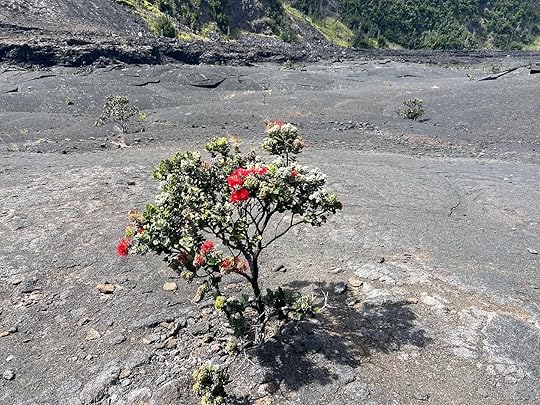
Interestingly though, one of the ants was my guide, an environmentalist specializing in invasive species, who kept pointing out the plants that were indigenous versus those that were invasive. As we descended into the vast crater, I quickly grew tired of this guide’s denigration of certain plant species, as many of them appeared very beautiful to me and certainly not eyesores on the landscape.

description
Beautiful and tough shrub arising despite the largely impervious lava

At one point I drew the guide into a discussion concerning the origination of the Hawaiian Islands and the fact that each island arose from the sea floor and was initially barren when it first emerged above the sea. The guide agreed that the very first of flora and fauna made it to the islands by way of eggs or seeds attached to the legs of seabirds or via substances floating amidst seaweed or debris. I posed to the guide that technically then all biological life on the islands had to have been “invasive” at some point in time. He pondered this with a smile and quickly agreed.

For those that want to constantly condemn and denigrate so called “invasive species”, I would suggest pondering the idea that without such intrusions the Hawaiian Islands would be totally barren, rocky, outcrops, much of which persists even today. Such thinking incorporates a failure to embrace the change that is inevitable in all of our lives. In this memoir, the authors mentor, Makalii, remarks about this as follows:

“To be happy, a person must adjust to things as they change. Yesterday is finished, tomorrow hasn’t come, only today is actually yours.”


With such explanations, this author underscores the swiftly changing face of life and its tendency to tear precious things from us and, in the next instant, give us something new and beautiful to fill the aching void.

The current fad among liberals to chastise modern European descendants for colonizing these Islands (or all of North America for that matter) is no different. The struggle among life forms to adapt is a constant fact. Another fact is that those who fail to adapt become extinct or altered. We can see it all around us. Energy is temporarily encapsulated and stored in life forms and such life forms constantly steal that energy from one another. We do it when we consume plants as food, employ the labor of another person, or extract fossil fuels. It is a natural progression, and the idea that the absence of European colonization would somehow have left the world in a blissful utopia of naturalization is contrary to everything we observe in life.

In the absence of European conquest, there would have been others, or even a natural evolution within the indigenous populations, that would have eventually accomplished the same sort of conquest. The depletion of indigenous peoples had far more to do with their natural resistance to change than most people are willing to recognize. History shows that the species which adapts best always has the upper hand. If we ignore adverse, oncoming change that unmistakably affects our wellbeing, we will likely suffer. Such modern changes, like climate, pollution, and overpopulation are today being ignored and the species that first adapts to such conditions will best succeed.

Observing and contemplating Hawaii, one can’t help but relate it to a microcosm of the early formation of the earth, with its earthquakes, cataclysms, and writhing surface heat. One sees dead trees that were severed by the lava flow now rotting on the hardened surface that is largely impervious to root penetration. Certainly, the entire earth must have been fluid-like in this manner in its early stages of formation, and we have to understand that it is slowly cooling. In comparison, other planets around us have already cooled and their stage for exhibiting organic life has already passed. These other planets slowly froze over as the internal heat from their formation eventually dissipated. Today, we walk the surface of solidified lava like bugs crawling over cooled candle wax, most of us unconscious of the impending peril awaiting our species.

Just as one might release thousands of drones to reconnaissance a landscape, so billions of humans survey this planet, cataloguing it with their descriptions, piling up innumerable photographs and details within electronic clouds. They do so almost instinctively, many never even taking time to look at their photos again. What will become of this information? Is it being examined from afar? While competitive with one another, all existing life forms still appear to be acting and interacting instinctively in an evolutionary sequence leading toward something mysterious and ineffable.

Everything is in the process of becoming something else. Viruses capable of changing our genetic makeup appear out of nowhere and go about their work methodologically. One can only wonder what we’re becoming. What sort of divergent life forms are we growing? Our choices are to either facilitate the dictates and parameters of this unconscious and mysterious design or to otherwise annihilate into dissolved substances, from which more conducive life forms may arise to give the dance of existence a whirl.

Such a perspective is certainly more prevalent for people who have lived their whole lives in such a barren landscape as Hawaii, as has this author. The author speaks of her father as follows:

“Daddy, forgot all about time, happy in the knowledge that someday, after he was gone, atoms of him persisting in the cells of my body would live on to enjoy the green ways of the earth.”


It is too easy for those in lusher environments, such as rich populations of people in the occidental realms, to fail in appreciating the need to adapt, and to wallow in the sort of obesity, inactivity, and substance abuse that leads to the formation of unhealthy viruses that threaten humanity. Certainly, we see among our own species that strength emanates from those in environments that are most challenging. One thinks of the power of the Vikings, the physical prowess of Alaskans, etc. The Hawaiians depicted in Born In Paradise were similarly challenged and powerful, as opposed to the fat and lazy characterizations of native Hawaiians popularly depicted. The sort of Hawaiian body type that is popularly depicted, such as in the Disney animation Moana, is overly exaggerated. In contrast, this author gives a good account of what the later Hawaiian pioneers were like, many of them of mixed ancestry. And the most important thing about them, more important than their physical prowess, was their ability to recognize their presence as a part and portion of an infinitely broader universe. The author speaks of her oncoming awareness as follows:

“Then, mysteriously, from being just a small girl, I was transformed into an atom of the wide splendid life about me.”


Gaining the humility that comes with this sort of awareness eludes many today, but those who harbor it gain immense respect for their environment and become more careful in how they interact with it. This author speaks of this as follows:

“…most people use only a tenth of their brains. The world of such people is as limited as they are themselves. If a thing is outside their personal experience, they immediately discredit it, or brush it aside. - The average person is like a blind man tapping his way forward with a cane, believing only in what he touches at the moment - which alone exists for him.”


Recently, while mowing grass, I was suddenly shocked by all the life forms I was running over. Beneath me, as I sat on the mower, were countless life forms, flipping about in terror, as the powerful mower came to interrupt their solitude. Grasshoppers, flies, ants, bees, worms, butterflies, small mice, even snakes, all scurried forth from this vicious machine that was annihilating the tall grass where they lived. Even a rabbit scampered quickly out of my way.

Suddenly, I was encompassed by the sounds of reality. I could hear the trees rearranging their leaves and the foliage giving off little secret rustles, as if reaching out to me. I stopped the mower just to look at the hopping, flying, and slithering lifeforms, scooting about in every direction. I suddenly wondered: why was I mowing all this area in the first place? It wasn’t like I really needed such a vast amount of open space. A clean wind suddenly rustled my hair like an adult does to encourage a growing child. My perspective changed and I suddenly decided to allow certain segments of the vast lawn to return to natural undergrowth. Minimizing my intrusion to only the areas that I require will allow for the proliferation of innumerable life forms and save me time, money, and energy.

At some point, human beings must take stock of the things they are doing to the earth for merely egotistical reasons or for reasons that have little to do with survival and much to do with adversely impacting the environment. For me, it was as if the incessant vibrations of the vicious mowing machine were suddenly overwhelmed by the tingling of secret messages running up from the ground, through my legs, across my torso, and registering firmly in my head. The dazzling diversity of the ground life and the countless array of growing green things suddenly seemed crowned with a beauty far beyond that of any manicured lawn. If we learn to listen, the earth can whisper to us through the grass, dewdrops, flowers, stars, shadows, clouds, aromas, trees, rocks, and wind. The author writes of this sort of oncoming awareness as follows:

“The deep mystery of it had cried itself into my blood. Beyond the objects about me were other worlds, other forces, half-tones of which overlapped into everyday life and wound through it. Tiny happenings assumed immense proportions and the unknown seemed to blink at me like a sly cat. Shadowy forms crept along the edges of my sleep or sat in the middle of bright afternoons staring at me.”


As the author says, we must begin thinking of ourselves in relation to life, instead of thinking of life in relation to ourselves. We must be aware of not only the people who lived before us but, even more so, the people who will come after us. Even though one may exist their whole life in the same out of the way place, perhaps on a small, isolated island in the middle of the Pacific, in the Arctic regions, or in some other distant place, there is nevertheless before them a dramatic display of ever-changing beauty that is casting itself like a captivating movie, and we are all playing an integral role. All we have to do is open our eyes to see it.

-End-

Vocab

Polyglot - knowing or using several languages
Solicitude - care or concern for someone or something
Dissolute - lax in morals, licentious
Profile Image for alleycats.
152 reviews8 followers
January 16, 2026
Maui, Hawaii / early 1900s

It's hard for me to resist most anything from Hawaiian authors. I was pleased with the way she evoked the feeling of this place, as much as what it was like to grow up here when she did.

Armine creates a vivid, energetic portrait of a childhood shaped by a dramatic place. The story feels like lived memory — full of incident, risk, and physical immediacy.

She blends frontier ruggedness with poetic Victorian enthusiasm. It’s earnest, wide-eyed, and emotionally direct.

"The deep mystery of it cried itself into my blood. Beyond the objects about me were other worlds, other forces, half-times of which overlapped into everyday life wound through it. Tiny happenings assumed immense proportions and the unknown seemed to bonk at me like a sky cat. Shadowy forms crept along the edges of my sleep or sat on the middle of bright afternoons starting at me."

"Daddy, forgot all about time, happy in the knowledge that someday after he was gone, atoms of him persisting in the cells of my body would live on to enjoy the green ways of the earth."

"Then, mysteriously, from being just a small girl, I was transformed into an atom of the wide splendid life about me."

"The show honey of complete happiness poured through me as I relaxed against the faded blue shirt holding the old man I loved.”
Profile Image for Deirdre.
296 reviews8 followers
February 9, 2018
I still love this book since first reading it in the eighties at the behest of a writer-producer I was working with who had just returned from Maui with a copy. We were unable to get the rights for him to adapt the script and get it produced. The last living matriarch of the family was stringently against the book being submitted to film. What a shame! This is a heartfelt story of Armine Von Tempski's growing up on a ranch in Hawaii, being the lucky child of a most loving father and friendly natives. It's sadly a piece and place in history that no longer exists, but once even tempted Jack London with its charm and beauty. Ah, yes, Armine had a bit to play in that temptation, but Paradise was finely lost to Jack.
Profile Image for Michelle Nakagawa.
1,356 reviews11 followers
August 4, 2021
I have been told repeatedly that I should read this book, so I gave in and finally borrowed it from the library.

After getting over my initial irritation that it was written by a woman whose family came over from the mainland, I truly enjoyed the descriptions of old Maui and the people who lived here way back when. Her words really did well at putting the beauty of this island in my mind, as it used to be, and even brought back memories of when I was a kid growing up here, though of course, it was already so different.

Overall, the author's love (as well as the love of her family) for Hawaii and its many races of people shown through and I enjoyed the story immensely.
Profile Image for Marcia Murphey.
23 reviews
April 18, 2024
Reading has taken a backseat for me this month, but I just finished this wonderful old book “Born in Paradise” by Armine von Tempski. The author grew up on #Haleakala ranch in the early 1900’s, and it tells of her life there on the vast cattle ranch. Her love for the land and the people of Hawaii is evident throughout. To anyone who loves Hawaii and its history, you’ll want to get a copy of this book.
Profile Image for Lyvia.
13 reviews7 followers
June 10, 2023
“The slow honey of complete happiness poured through me as I relaxed against the faded blue shirt holding the old man I loved”. A sweet memoir depicting life and death in Hawaii perfect for a stay on Maui.
Profile Image for Matt  Wang.
19 reviews3 followers
January 20, 2023
Incredible first account of a time gone by. Hawaii before statehood, a true paradise lost. Highly recommended read for anyone interested in the multi-cultural history of Hawaii.
Profile Image for Elizabeth R.
767 reviews
July 22, 2012
I love a good autobiography, especially one about days of yore, and this was among the best I've read of.both. It is set in the early 1900s in Maui, and describes an amazing lifestyle. I learned a lot from reading this, just about other ways of life, and that alone merits four stars. The writing is deliciously old-fashioned yet irreverent, my favorite kind. For a book describing a certain era in a certain culture, it was interesting to note how other races were referred and related to. It was hard to tell how much of subordinates or inferiors the Hawaiians, Japanese, Chinese, and other people were regarded as, truly, by the white characters, but it is obvious that their employees and friends were very much valued regardless of race. I want to think that very little "superior" thinking and acting occurred in re: race, though there was some in the employer:employee that one might find anywhere, between any two. The author's father seemed to figure somewhat prominently in the history if Hawaii, and as a father he is a huge, beloved figure in the.book. There is a lot of love in this book, in spite of tragic events, and that is always a beautiful thing to read.
Profile Image for Aubrey.
28 reviews
July 23, 2012
It literally took me 8 months to get through this book~ my grandma and aunts are such fans of it that I forced myself to keep reading and in the end I am glad that I did. It starts out slow and with no real plot you don't have the cliffhangers to keep you wanting more from chapter to chapter. I should have gone into it thinking it was a history book about the island of Maui- which it is. It is a fascinating life that this girl lived and half the time I can't imagine it all being true.
Profile Image for Gini.
29 reviews
April 22, 2013
It has taken me a year to get through this book, and to be honest, I think it will take me another year to finish it, so I am calling it done. Love the subject but the author overwrites so much that it becomes a slog. Too many details with no real arc to the structure so every chapter should be viewed as a short story.
43 reviews
August 11, 2016
A perfect book. For me anyway. Descriptive, wise, entertaining, lush - and very educational. Living on Maui while reading it makes if all the more interesting. And since we've had an unprecedented year of shark bites I found the information about Makena very enlightening. Turns out we should not be surprised as sharks have been working off that shore forever!
12 reviews
January 28, 2014
I often enjoy non-fiction and historical fiction about Hawaii because of the rich diversity on the islands and the descriptions of beautiful landscapes and interesting cultures. This book paints a beautiful portrait of a point in time and place in Maui that I haven't seen described in other books about Hawaii. I am looking forward to reading more of her books.
Profile Image for Melissa.
35 reviews1 follower
June 26, 2012
A rich story that is inspiring for it's ability to bring reverence and adventure as viable goals in ones life.
Plus, the details of the Islands are a historically beautiful painting that I won't but help try to see remnants of the next time I visit the islands.

Which I hope will be soon! :)
Profile Image for Marilyn.
1,513 reviews
August 25, 2016
50 States and at least 50 Authors 2016 Reading Challenge. HAWAII.

An interesting look at Hawaii, more specifically Maui, in the early 1900's. A mix of ethnicities and cultures. A bit of history, some of the language, and a bit about ranching on Maui.
Profile Image for Julie.
140 reviews
January 28, 2017
What this book lacks in a critical perspective it gains in the author's love of Maui and her life growing up during the cattle ranching hey days.
Displaying 1 - 17 of 17 reviews

Can't find what you're looking for?

Get help and learn more about the design.