

What do you think?

Hunger: ‘An instant cult classic’ HARPER’S BAZAAR
If Parasite were a record-breaking dark romance with over half a million copies sold across 10 languages
I could go to the police and confess. I could visit the priest and confess.
I ate a person. Is that a sin?
On an ordinary afternoon, a woman finds her soulmate dead in the street. She cradles the body to her chest and carries it home, where she disinfects every inch before beginning her macabre task.
As the man witnesses his own interment from beyond, their two voices – living and dead – tell of a country where the rich feast and the poor starve. But this woman is no longer willing to bow before law, money, or God.
A decade in the making, Hunger is a psychologically and philosophically thrilling cult phenomenon about love, capitalism, and the things they do to us.
I could go to the police and confess. I could visit the priest and confess.
I ate a person. Is that a sin?
On an ordinary afternoon, a woman finds her soulmate dead in the street. She cradles the body to her chest and carries it home, where she disinfects every inch before beginning her macabre task.
As the man witnesses his own interment from beyond, their two voices – living and dead – tell of a country where the rich feast and the poor starve. But this woman is no longer willing to bow before law, money, or God.
A decade in the making, Hunger is a psychologically and philosophically thrilling cult phenomenon about love, capitalism, and the things they do to us.
208 pages, Hardcover
First published March 30, 2015
About the author
Choi Jin-young
21 books80 followersChoi Jin-young began writing twenty years ago. She is now one of Korea’s foremost novelists, having amassed several prestigious prizes, including the Yi Sang Literary Award, Hankyoreh Literary Award and Shin Dong-yup Literary Prize.
Her record-breaking novella, Hunger, has sold half a million copies and been translated into 10 languages.
Her record-breaking novella, Hunger, has sold half a million copies and been translated into 10 languages.
Ratings & Reviews
Friends & Following
Create a free account to discover what your friends think of this book!
Community Reviews
Displaying 1 - 30 of 1,733 reviews

October 13, 2025
I picked up this book because I was drawn in by its haunting title, evocative cover, and the provocative premise of a lover, Dam, consuming the body of her deceased partner, Gu. As a self-proclaimed sucker for love stories, no matter how unsettling it was—I got curious to see how such a taboo act could be used to explore grief and devotion. Unfortunately, what promised to be a profound meditation on love and loss left me deeply disappointed.
On the surface, I understand the novel's ambitious goals. It is not truly about cannibalism, but rather a metaphor for consuming memory and the ways we process grief. The book aims to delve into the psychology of its characters, showing how Gu's absence evokes pain, guilt, and cold indifference in those he left behind. The core message seems to be about the continuity and distortion of memory after death, and the necessity of accepting loss as a part of life. In theory, the disturbing premise is just a tool to challenge the reader to explore difficult, important themes.
However, the execution failed miserably for me. One of the primary issues being the confusing and disjointed narrative structure. The perspective shifts between Dam and Gu without clear distinction, making it easy to get lost in whose memory was being recounted. I only realized after reading another review that the white and black bullets were supposed to distinguish between the two. Consequently, I spent an unexpected amount of time feeling muddled and distanced from the characters. Not to say, the central romance itself was bland and unremarkable, filled with corny, unimaginative dialogue that undermined the intended profundity.
Hunger attempts to walk the line between metaphor and shock, and I acknowledge that literature often uses disturbing content to provoke thought. But Hunger felt like it leaned more on provocation than purpose. Where novels like Lolita and Tampa frame their discomfort through commentary and psychological insight, Hunger seems to present its grotesque premise without enough justification. If this is meant to be symbolic of love, loss, or identity; it gets lost in the topsy-turvy narrative. I found myself unable to emotionally connect with Dam’s act of eating Gu, even if the intention was to portray it as an act of love rather than horror. For me, it was mostly just disturbing... or maybe the theme of cannibalism is not just for me.
That said, I understand how this book could touch certain readers. There are moments that evoke sadness and longing, even catharsis, particularly in the closing reflections on memory and death as a transition rather than an end. In that sense, it attempts to do what literature does best: force us to confront the uncomfortable. And yet, despite recognizing its themes and ambition, I could not enjoy it. The story failed to grip me, the prose felt flat, and the metaphor (if it existed), never came through clearly enough to justify the discomfort it asked me to endure.
In my attempt to understand the book better, I also found out the original Korean title was 'Proof of Gu', which might have made more sense thematically. Hunger, as a title, seems like an attempt to rebrand it as a cult classic or a piece of transgressive literature, but the substance does not quite support the hype. It left me in a reading slump, and between that and my hyperfixation on Zhou Anxin, it took me over a month to get through what should have been a brief read.
In the end, Hunger had potential. It could have been a haunting, philosophical reflection on loss and memory. Instead, it felt like literary confusion rather than a literary depth. Maybe I missed something, or again, simply the theme of cannibalism is not for me, but if this is what counts as a 'cult classic,' I would argue we need to reexamine what kind of stories we elevate in that category. This book is a stark example of a powerful metaphor being lost in poor execution.
On the surface, I understand the novel's ambitious goals. It is not truly about cannibalism, but rather a metaphor for consuming memory and the ways we process grief. The book aims to delve into the psychology of its characters, showing how Gu's absence evokes pain, guilt, and cold indifference in those he left behind. The core message seems to be about the continuity and distortion of memory after death, and the necessity of accepting loss as a part of life. In theory, the disturbing premise is just a tool to challenge the reader to explore difficult, important themes.
However, the execution failed miserably for me. One of the primary issues being the confusing and disjointed narrative structure. The perspective shifts between Dam and Gu without clear distinction, making it easy to get lost in whose memory was being recounted. I only realized after reading another review that the white and black bullets were supposed to distinguish between the two. Consequently, I spent an unexpected amount of time feeling muddled and distanced from the characters. Not to say, the central romance itself was bland and unremarkable, filled with corny, unimaginative dialogue that undermined the intended profundity.
Hunger attempts to walk the line between metaphor and shock, and I acknowledge that literature often uses disturbing content to provoke thought. But Hunger felt like it leaned more on provocation than purpose. Where novels like Lolita and Tampa frame their discomfort through commentary and psychological insight, Hunger seems to present its grotesque premise without enough justification. If this is meant to be symbolic of love, loss, or identity; it gets lost in the topsy-turvy narrative. I found myself unable to emotionally connect with Dam’s act of eating Gu, even if the intention was to portray it as an act of love rather than horror. For me, it was mostly just disturbing... or maybe the theme of cannibalism is not just for me.
That said, I understand how this book could touch certain readers. There are moments that evoke sadness and longing, even catharsis, particularly in the closing reflections on memory and death as a transition rather than an end. In that sense, it attempts to do what literature does best: force us to confront the uncomfortable. And yet, despite recognizing its themes and ambition, I could not enjoy it. The story failed to grip me, the prose felt flat, and the metaphor (if it existed), never came through clearly enough to justify the discomfort it asked me to endure.
In my attempt to understand the book better, I also found out the original Korean title was 'Proof of Gu', which might have made more sense thematically. Hunger, as a title, seems like an attempt to rebrand it as a cult classic or a piece of transgressive literature, but the substance does not quite support the hype. It left me in a reading slump, and between that and my hyperfixation on Zhou Anxin, it took me over a month to get through what should have been a brief read.
In the end, Hunger had potential. It could have been a haunting, philosophical reflection on loss and memory. Instead, it felt like literary confusion rather than a literary depth. Maybe I missed something, or again, simply the theme of cannibalism is not for me, but if this is what counts as a 'cult classic,' I would argue we need to reexamine what kind of stories we elevate in that category. This book is a stark example of a powerful metaphor being lost in poor execution.

August 13, 2025
may this type of love (obsession) never find me.

June 24, 2025
An unsettling tale of star-crossed lovers, Gu and Dam, struggling to retain their bond even though one of them is now dead. Choi Jin-young’s short novel is structured as a series of parallel monologues, Gu and Dam take turns to tell their story, to outline the contours of their relationship – each of Gu’s sections headed with a black circle, Dam’s with a white. After Gu’s brutally murdered, Dam takes his body back to their dilapidated room and slowly begins to consume his corpse, refusing to be separated even by death. It's a ritualistic act of mourning, an expression of grief and love that for Dam seems akin to a sacrament. As she carefully absorbs Gu’s flesh into her own, Dam reflects on how they met, the circumstances that led up to these moments. From beyond death, Gu too thinks about their past and the life he was forced to live.
But, despite the cannibalism, this isn’t a horror novel in any strict sense. Instead, Choi Jin-young’s intent on exposing the horrors of contemporary Korean society: the destructiveness of rampant capitalism, class inequalities, and the slow violence of necropolitics, those who’re valued and those deemed disposable. Working-class Gu and Dam soon realised they had no hope of a bright future; the possibilities open to the children of the wealthy the stuff of science fiction. So, they’ve supported themselves in dead-end jobs, barely scraping by. Their fate was sealed when Gu’s parents disappeared, leaving behind an enormous debt that then became Gu’s responsibility. But the money came from one of Korea’s many underground loan sharks so the amount continued to grow, and grow, and grow. When Gu’s attempts to evade the loan shark’s reach failed, he was killed, left on the street as a blood-soaked warning for anyone else thinking about escape. Ultimately, this is a fairly moving, gripping piece but it’s also quite uneven: inventive, arresting scenes jostle with the more stock; raw, haunting episodes interrupted by flashes of sentimentality. Translated by Soje.
Thanks to Netgalley and publisher Brazen for an ARC
But, despite the cannibalism, this isn’t a horror novel in any strict sense. Instead, Choi Jin-young’s intent on exposing the horrors of contemporary Korean society: the destructiveness of rampant capitalism, class inequalities, and the slow violence of necropolitics, those who’re valued and those deemed disposable. Working-class Gu and Dam soon realised they had no hope of a bright future; the possibilities open to the children of the wealthy the stuff of science fiction. So, they’ve supported themselves in dead-end jobs, barely scraping by. Their fate was sealed when Gu’s parents disappeared, leaving behind an enormous debt that then became Gu’s responsibility. But the money came from one of Korea’s many underground loan sharks so the amount continued to grow, and grow, and grow. When Gu’s attempts to evade the loan shark’s reach failed, he was killed, left on the street as a blood-soaked warning for anyone else thinking about escape. Ultimately, this is a fairly moving, gripping piece but it’s also quite uneven: inventive, arresting scenes jostle with the more stock; raw, haunting episodes interrupted by flashes of sentimentality. Translated by Soje.
Thanks to Netgalley and publisher Brazen for an ARC

August 26, 2025
... wow. obsessive, tender, gross, heartwrenching, beautiful, toxic, loving, so so loving... just excellent. those last pages broke me so hard that my heart hurts, and the only thing on my mind right now is how to stop the tears that keep running down my face

July 26, 2025
”What should I do once this story is told? Where should I go? I could go to the police and confess. I could visit a priest and confess. I ate a person. Is that a sin?”
✍🏼ask boyfriend whether he would eat me when i die ✍🏼
found the cannibalism part very emotional, didn’t care about the backstory tbh
✍🏼ask boyfriend whether he would eat me when i die ✍🏼
found the cannibalism part very emotional, didn’t care about the backstory tbh

September 4, 2025
⭐️⭐️⭐️⭐️ (4 stars)
Okay, I’ll confess again: I am weirdly, obsessively hooked on cannibalism in literature. It’s that taboo cocktail of horror and intimacy—that primal "I need you so much I could eat you" fantasy—that turns my brain to butter. Hunger by Choi Jin-young didn’t just scratch that itch—it devoured it.
This novella—or should I say fever-dream—starts at the end, with Dam discovering her boyfriend Gu’s body in the street, murdered by loan sharks. Rather than calling the police, she cradles him, takes him home, bathes and embalms him, then begins the slow, ritualized act of cannibalism. It’s as impossible and heartbreaking as it sounds:
Told in alternating monologues—Dam marked by a white circle (○), Gu by a black circle (●)—their voices intertwine across life and afterlife. Gu is already dead by the time the book begins, narrating from beyond, while Dam absorbs every piece of him:
This act of cannibalism isn’t gory for gore’s sake—it’s grief, love, and survival in visceral form. Dam won’t let death separate them, literally consuming Gu so he can live inside her. It's devotion turned into flesh and bone.
Their history is woven with quiet intimacy: they met as children, bullied for holding hands, bonded over petty thefts of sugar or ice cream, and grew into each other despite poverty and trauma. One poignant memory:
The crushing weight of debt is constant—loan sharks stalk Gu even after his death, chasing the body for parts. Choi Jin-young uses that to skew the real horror: a society that treats human lives as disposable commodities. Dam’s cannibalism becomes an act of rebellion and refusal to relinquish Gu—even in death—as society tries to turn his corpse into capital.
There’s a poetic brutality here that evokes The Vegetarian—a love that transcends time, death, and rational boundaries, all in a whisper-thin novella. It’s formally spare, emotionally dense, grotesque yet hauntingly tender.
Why I’m giving it 4 stars (and not 5):
It’s raw, quirky, and visceral enough to satisfy my cannibal-obsessed soul. But its uncanny tone and emotional intensity may leave other readers as unsettled as they are mesmerized. Still, I loved being swallowed whole by this bizarre love story.
Final Bite:
If you’re like me—a little twisted, a little tender, and can’t resist a love story where devotion becomes literal consumption—Hunger is for you. Dam didn’t just eat Gu—she made him immortal, piece by piece, in the deepest possible way.
Okay, I’ll confess again: I am weirdly, obsessively hooked on cannibalism in literature. It’s that taboo cocktail of horror and intimacy—that primal "I need you so much I could eat you" fantasy—that turns my brain to butter. Hunger by Choi Jin-young didn’t just scratch that itch—it devoured it.
This novella—or should I say fever-dream—starts at the end, with Dam discovering her boyfriend Gu’s body in the street, murdered by loan sharks. Rather than calling the police, she cradles him, takes him home, bathes and embalms him, then begins the slow, ritualized act of cannibalism. It’s as impossible and heartbreaking as it sounds:
Told in alternating monologues—Dam marked by a white circle (○), Gu by a black circle (●)—their voices intertwine across life and afterlife. Gu is already dead by the time the book begins, narrating from beyond, while Dam absorbs every piece of him:
This act of cannibalism isn’t gory for gore’s sake—it’s grief, love, and survival in visceral form. Dam won’t let death separate them, literally consuming Gu so he can live inside her. It's devotion turned into flesh and bone.
Their history is woven with quiet intimacy: they met as children, bullied for holding hands, bonded over petty thefts of sugar or ice cream, and grew into each other despite poverty and trauma. One poignant memory:
The crushing weight of debt is constant—loan sharks stalk Gu even after his death, chasing the body for parts. Choi Jin-young uses that to skew the real horror: a society that treats human lives as disposable commodities. Dam’s cannibalism becomes an act of rebellion and refusal to relinquish Gu—even in death—as society tries to turn his corpse into capital.
There’s a poetic brutality here that evokes The Vegetarian—a love that transcends time, death, and rational boundaries, all in a whisper-thin novella. It’s formally spare, emotionally dense, grotesque yet hauntingly tender.
Why I’m giving it 4 stars (and not 5):
It’s raw, quirky, and visceral enough to satisfy my cannibal-obsessed soul. But its uncanny tone and emotional intensity may leave other readers as unsettled as they are mesmerized. Still, I loved being swallowed whole by this bizarre love story.
Final Bite:
If you’re like me—a little twisted, a little tender, and can’t resist a love story where devotion becomes literal consumption—Hunger is for you. Dam didn’t just eat Gu—she made him immortal, piece by piece, in the deepest possible way.

June 24, 2026
I just don’t think I really understood this? Like, I was able to follow along and everything, I just struggled to really find my footing in the story. I kept thinking like, “Okay… and maybe now I’ll get into it? Maybe now? Now???” Idk it just didn’t work for me I guess.

May 15, 2025
you ever read a book and feel like you’re stuck in a fever dream where nothing makes sense but everything is vaguely poetic so you keep going?? yeah. that was me with hunger.
i picked this up ‘cause the premise was wild—woman finds her dead man, carries his corpse home, and proceeds to… eat him??? romantic cannibalism but make it metaphorical?? sounded like my kind of weird. but then i actually read it and. yeah. confusion ate me up instead.
⸻
the good (aka the only reason it’s not a 0 star):
• the prose lowkey slapped. some lines were stunning.
• short read. that’s it. that’s the compliment.
⸻
the bad (deep breath):
• whose pov was it??? like genuinely. gu? dam? the aunt? a ghost? i had no clue. the shifts were random and messy. one second we’re in one head, the next i’m like “wait, didn’t he die???”
• the formatting??? atrocious. might’ve been an arc issue but it made my head hurt. full-on chaos.
• plot? character arcs? a timeline??? couldn’t find ‘em. the book just flits through random moments and expects you to stitch them together like a patchwork quilt in the dark.
• the cannibalism moment that should’ve been the mic drop? weirdly boring. like girl if you’re gonna eat your lover, make it iconic, not confusing.
⸻
final thoughts:
the concept had potential. but the execution? confusing, disjointed, and not deep enough to justify how lost i felt. it’s giving ✨literary confusion for confusion’s sake✨.
1 star.
*thank you netgalley, the author, and the publishing team for the arc in exchange for an honest review.
i picked this up ‘cause the premise was wild—woman finds her dead man, carries his corpse home, and proceeds to… eat him??? romantic cannibalism but make it metaphorical?? sounded like my kind of weird. but then i actually read it and. yeah. confusion ate me up instead.
⸻
the good (aka the only reason it’s not a 0 star):
• the prose lowkey slapped. some lines were stunning.
• short read. that’s it. that’s the compliment.
⸻
the bad (deep breath):
• whose pov was it??? like genuinely. gu? dam? the aunt? a ghost? i had no clue. the shifts were random and messy. one second we’re in one head, the next i’m like “wait, didn’t he die???”
• the formatting??? atrocious. might’ve been an arc issue but it made my head hurt. full-on chaos.
• plot? character arcs? a timeline??? couldn’t find ‘em. the book just flits through random moments and expects you to stitch them together like a patchwork quilt in the dark.
• the cannibalism moment that should’ve been the mic drop? weirdly boring. like girl if you’re gonna eat your lover, make it iconic, not confusing.
⸻
final thoughts:
the concept had potential. but the execution? confusing, disjointed, and not deep enough to justify how lost i felt. it’s giving ✨literary confusion for confusion’s sake✨.
1 star.
*thank you netgalley, the author, and the publishing team for the arc in exchange for an honest review.

November 30, 2025
“If only it were a billion years in the future, I’d leave Earth with your body on my back and we’d be a pair of happy boats. Doesn’t that sound nicer than cannibalism?”
A Korean novel, novella to be precise about two lovers, Dam and Gu. They meet at elementary school and their novel charts their lives and relationship. It is told from both points of view. It is a romance, albeit a rather macabre one. At the beginning of the novel Gu dies. He is killed on the street as a result of the debt he inherited from his parents. Gu cannot bear to be parted from him. She takes him home, washes him down and over a period of time eats him. It really doesn’t pay to think of the practicalities of this, that clearly isn’t the point. The novel flashes back to the couple’s history. They live at the lower levels of society and life is difficult.
The novel covers a lot of ground, but because of its brevity nothing is covered in any real depth. It emphasises the lack of choices for the working class in Korea. These aren’t Shakespeare’s star-crossed lovers, there’s more struggle and desperation. It can’t really be called horror despite the cannibalism.
“But what do I know, really? Turns out we're as clueless in death as in life. The only difference is the dead don't agonise over the unknown. They know to leave some things alone.”
I think the trick is to focus on metaphor, but it didn’t really grab me, although it was interesting.
A Korean novel, novella to be precise about two lovers, Dam and Gu. They meet at elementary school and their novel charts their lives and relationship. It is told from both points of view. It is a romance, albeit a rather macabre one. At the beginning of the novel Gu dies. He is killed on the street as a result of the debt he inherited from his parents. Gu cannot bear to be parted from him. She takes him home, washes him down and over a period of time eats him. It really doesn’t pay to think of the practicalities of this, that clearly isn’t the point. The novel flashes back to the couple’s history. They live at the lower levels of society and life is difficult.
The novel covers a lot of ground, but because of its brevity nothing is covered in any real depth. It emphasises the lack of choices for the working class in Korea. These aren’t Shakespeare’s star-crossed lovers, there’s more struggle and desperation. It can’t really be called horror despite the cannibalism.
“But what do I know, really? Turns out we're as clueless in death as in life. The only difference is the dead don't agonise over the unknown. They know to leave some things alone.”
I think the trick is to focus on metaphor, but it didn’t really grab me, although it was interesting.

November 26, 2025
‘I will outlive those who treated us as less than human. Even as they grow old, fall ill, die–until they are long forgotten and their bodies disintegrate into nothingness–I will live. I will carry your remains with me to the very end of time. You will die only when I die. I won’t follow you into death; I will have you follow me. I won’t watch you disappear. I will live. I will live to remember you.’
Ultimately, I think this is a brilliant piece of writing. I think I would’ve loved it more without the ‘romance’ (essentially/arguably the subplot or either the carrier of the better lines/ideas in the book, but somehow — it didn’t move me much — in the same way that Sally Rooney’s ‘romantic bits’ doesn’t do anything for me (maybe I’m just not into the whole ‘friends to lovers’ kink? Whatever it is it just wasn’t to my taste is all)). Or perhaps I would’ve loved it more if the romantic layers/plot-lines were done differently (or perhaps just made more brief/replaced with something with more substance? Personally (and/but sharing the sentiments of other readers) I don't think (whatever that 'romantic' subplot is) it adds anything to the narrative; if anything, it is almost definitely 'counter-effective' (in adding/arousing any sort of emotional effect/impact).
The characters weren’t particularly impressive or interesting either (and style of writing weren’t really to my taste either—additionally, the structure and ‘switch’ of POVs were done in such a way that felt a bit distracting since it was more often that not rather confusing), but I thought the execution overall (and how Choi was able to put so much into so little space/lines) was almost — well it sort of felt like a kind of poetic/aesthetic fuckfest (complimentary) — and chunks of/from the text taken out of context/plot made me surprisingly emotional — fucked me up a bit so speak — and I think that’s beautiful — made me feel unapologetically human (for the lack of a better phrase). Might add more thoughts to this at a later date, but in any case, I will share some excerpts that held my attention a little more/longer than the rest.
‘—And if that’s not doable, then let this lifetime fly by.
— But that means you’ll die sooner. I can’t let that happen.
— Then let me be nothing again, nothing and everything.
— That’s dying.
— It’s not. It’s courage.’
‘All you’ve got is your body. A body—not a person, not a human. Human as meat, human as object, human as tool. A person’s value is proportional to their bank balance. Our society seems to think it’s okay to look down on the poor. And when you’re constantly broke and beaten down, you start to think money’s the only thing that matters. The more you’re knocked down, the more you cling to money, hoping it can put you back together. It’s messed up, yeah, but that’s how it is.’
‘Some are born into war zones, knowing nothing but conflict from their first breath to their last. Some children die starved and diseased. Some die in regions ravaged by epidemics. Some are swept up in wars started by their ancestors, spending their lives as refugees. I believe money can be just as brutal. The debt became a parasite clinging to Gu’s life, eating away at his humanity and sucking him dry. It’s all the same in the end. The debt was simply the world he inherited, and he had to find a way to survive it. What should we have done? What could we have done?’
‘— Like if I end up an alcoholic because of you, you should pour me another drink. It’s you and me, together. No matter what.
— That’s not love.
— I don’t care what it is.
I started packing my bags—.’
‘— I’d choose dying by your hand over illness or a freak accident.
And there we lay, gazing into each other’s eyes and holding every part of each other with every part of our being.’
‘Human beings are up for sale. They kill and eat anything. They lie and cheat. They have the power to ruin or save a life. They believe in God. And they use that God to their advantage. They undergo surgeries and take pills to stave off death. They cook with fire. And before they figured out how to tame the fire, they ate the flora and fauna raw. In prehistoric times, humans would have turned to cannibalism whether starving or sated. They would have hungered for her hand, his foot, their face, genitals. They would have eaten it all out of reverence, out of love. Is that primitive? Are we any better? We put a price on human life and erect hierarchies. Is money power? Is wealth nothing more than the survival of the fittest?’
‘Are we any more civilised than animals? An animal’s power is hereditary. The strong devour the weak with jaws and claws. Money is also hereditary. The heirs prey on the poor. Without money, those who deserve to live, die. With money, those who deserve to die, thrive.’
‘Why did Noma die? Why did Auntie? Why Gu? Are car accidents, illness or poverty valid reasons for death? Do the enlightened accept the fact of death with composure? If they do, let me never reach enlightenment. I can come to terms with my own death, but I cannot come to terms with the death of a loved one. I’m still here, living through the pain of losing someone I love. The pain of getting left behind is seared into my soul. Let me be the one to leave—His dying will, his body, his spirit. I wanted to claw into my skull and yank my brain out, anything to make it stop—Do I want to be human?’
‘—I see trees, trees that have stood here forever—Back then, your tears used to piss me off—I wanted the real you, not the perfunctory greetings you gave everyone else—You cried, and I got lost. I ended up angry at the butterflies in my stomach for hurting you. They hurt you throughout our relationship. Even now, they’re still hurting you. Is that what love is? Is it like that for other people? There’s so much I don’t know—you fool. You’ve done everything you can. Wrap up the funeral and start living. You have to live for a long, long time—You fool.’
‘If you must die, I hope it’s a thousand years from now—Being dead, I can wait for you. For millennia.’
And then this finally, I found interesting too :
‘Even though I’m the author, it doesn’t feel like I wrote this story. I reviewed the proofs with this strange feeling—So what am I doing? I don’t know, but loving and writing are the best things for me right now. Maybe I’ll find something better as I go on, but for now, I want to live without knowing anything better for as long as I can—’ (Author's Notes, March 2015, Sitting in a chair for one, Choi Jin-young)
And I was reading/finishing Choi’s book alongside Ken Liu’s latest one All That We See or Seem, and somehow I found this line(s) in a way (or more) complementary to the vibes of Choi’s text : ‘I’m not going to pretend I know how you feel. I wish the world were better than it is. I just want you to know that I’m really glad you’re here.’
Ultimately, I think this is a brilliant piece of writing. I think I would’ve loved it more without the ‘romance’ (essentially/arguably the subplot or either the carrier of the better lines/ideas in the book, but somehow — it didn’t move me much — in the same way that Sally Rooney’s ‘romantic bits’ doesn’t do anything for me (maybe I’m just not into the whole ‘friends to lovers’ kink? Whatever it is it just wasn’t to my taste is all)). Or perhaps I would’ve loved it more if the romantic layers/plot-lines were done differently (or perhaps just made more brief/replaced with something with more substance? Personally (and/but sharing the sentiments of other readers) I don't think (whatever that 'romantic' subplot is) it adds anything to the narrative; if anything, it is almost definitely 'counter-effective' (in adding/arousing any sort of emotional effect/impact).
The characters weren’t particularly impressive or interesting either (and style of writing weren’t really to my taste either—additionally, the structure and ‘switch’ of POVs were done in such a way that felt a bit distracting since it was more often that not rather confusing), but I thought the execution overall (and how Choi was able to put so much into so little space/lines) was almost — well it sort of felt like a kind of poetic/aesthetic fuckfest (complimentary) — and chunks of/from the text taken out of context/plot made me surprisingly emotional — fucked me up a bit so speak — and I think that’s beautiful — made me feel unapologetically human (for the lack of a better phrase). Might add more thoughts to this at a later date, but in any case, I will share some excerpts that held my attention a little more/longer than the rest.
‘—And if that’s not doable, then let this lifetime fly by.
— But that means you’ll die sooner. I can’t let that happen.
— Then let me be nothing again, nothing and everything.
— That’s dying.
— It’s not. It’s courage.’
‘All you’ve got is your body. A body—not a person, not a human. Human as meat, human as object, human as tool. A person’s value is proportional to their bank balance. Our society seems to think it’s okay to look down on the poor. And when you’re constantly broke and beaten down, you start to think money’s the only thing that matters. The more you’re knocked down, the more you cling to money, hoping it can put you back together. It’s messed up, yeah, but that’s how it is.’
‘Some are born into war zones, knowing nothing but conflict from their first breath to their last. Some children die starved and diseased. Some die in regions ravaged by epidemics. Some are swept up in wars started by their ancestors, spending their lives as refugees. I believe money can be just as brutal. The debt became a parasite clinging to Gu’s life, eating away at his humanity and sucking him dry. It’s all the same in the end. The debt was simply the world he inherited, and he had to find a way to survive it. What should we have done? What could we have done?’
‘— Like if I end up an alcoholic because of you, you should pour me another drink. It’s you and me, together. No matter what.
— That’s not love.
— I don’t care what it is.
I started packing my bags—.’
‘— I’d choose dying by your hand over illness or a freak accident.
And there we lay, gazing into each other’s eyes and holding every part of each other with every part of our being.’
‘Human beings are up for sale. They kill and eat anything. They lie and cheat. They have the power to ruin or save a life. They believe in God. And they use that God to their advantage. They undergo surgeries and take pills to stave off death. They cook with fire. And before they figured out how to tame the fire, they ate the flora and fauna raw. In prehistoric times, humans would have turned to cannibalism whether starving or sated. They would have hungered for her hand, his foot, their face, genitals. They would have eaten it all out of reverence, out of love. Is that primitive? Are we any better? We put a price on human life and erect hierarchies. Is money power? Is wealth nothing more than the survival of the fittest?’
‘Are we any more civilised than animals? An animal’s power is hereditary. The strong devour the weak with jaws and claws. Money is also hereditary. The heirs prey on the poor. Without money, those who deserve to live, die. With money, those who deserve to die, thrive.’
‘Why did Noma die? Why did Auntie? Why Gu? Are car accidents, illness or poverty valid reasons for death? Do the enlightened accept the fact of death with composure? If they do, let me never reach enlightenment. I can come to terms with my own death, but I cannot come to terms with the death of a loved one. I’m still here, living through the pain of losing someone I love. The pain of getting left behind is seared into my soul. Let me be the one to leave—His dying will, his body, his spirit. I wanted to claw into my skull and yank my brain out, anything to make it stop—Do I want to be human?’
‘—I see trees, trees that have stood here forever—Back then, your tears used to piss me off—I wanted the real you, not the perfunctory greetings you gave everyone else—You cried, and I got lost. I ended up angry at the butterflies in my stomach for hurting you. They hurt you throughout our relationship. Even now, they’re still hurting you. Is that what love is? Is it like that for other people? There’s so much I don’t know—you fool. You’ve done everything you can. Wrap up the funeral and start living. You have to live for a long, long time—You fool.’
‘If you must die, I hope it’s a thousand years from now—Being dead, I can wait for you. For millennia.’
And then this finally, I found interesting too :
‘Even though I’m the author, it doesn’t feel like I wrote this story. I reviewed the proofs with this strange feeling—So what am I doing? I don’t know, but loving and writing are the best things for me right now. Maybe I’ll find something better as I go on, but for now, I want to live without knowing anything better for as long as I can—’ (Author's Notes, March 2015, Sitting in a chair for one, Choi Jin-young)
And I was reading/finishing Choi’s book alongside Ken Liu’s latest one All That We See or Seem, and somehow I found this line(s) in a way (or more) complementary to the vibes of Choi’s text : ‘I’m not going to pretend I know how you feel. I wish the world were better than it is. I just want you to know that I’m really glad you’re here.’

May 15, 2026
Turn Romeo and Juliet into a YA romance with a sprinkling of body horror you'll get the book Hunger.
Shocked that escaping loan sharks is a major plot point here that drove the story ala Squid Game. Is this a common occurrence in South Korean culture?
Overall, the love and romantic relationship tackled in this book feels like the lived-in experience of people without a fused frontal lobe. 2 stars x
Shocked that escaping loan sharks is a major plot point here that drove the story ala Squid Game. Is this a common occurrence in South Korean culture?
Overall, the love and romantic relationship tackled in this book feels like the lived-in experience of people without a fused frontal lobe. 2 stars x

May 12, 2026
I liked the general concept of this. You can easily read it in one day, if you’re like me and don’t have much going on.
The switches back and forth in POV are a bit confusing. I couldn’t always tell right away who was speaking, and sometimes it took a couple of pages for me to figure it out. In addition to this, there are also switches between past and present.
The writing can be both mildly off putting and oddly romantic at times. (The idea of consuming someone so that they will be with you forever IS a wild but intriguing concept.) However, despite its short length the story does wear thin about halfway through. I got tired of listening to these two wax poetic about how much they loved and missed each other when there was really no reason why they couldn’t just be together.
The cannibalism was a much smaller part of the narrative than I was expecting. Maybe I’m a sicko, but I was hoping for more. I can see why this book was a hit, but I didn't personally find it overly satisfying. (Especially the ending.)
Also, I liked Dam but Gu was kind of a jerk. I bet he tasted awful.
Thank you to NetGalley and to the Publisher for this early copy in exchange for an honest review. All opinions are my own.
TW: Cannibalism, Bullying, Harm to children
The switches back and forth in POV are a bit confusing. I couldn’t always tell right away who was speaking, and sometimes it took a couple of pages for me to figure it out. In addition to this, there are also switches between past and present.
The writing can be both mildly off putting and oddly romantic at times. (The idea of consuming someone so that they will be with you forever IS a wild but intriguing concept.) However, despite its short length the story does wear thin about halfway through. I got tired of listening to these two wax poetic about how much they loved and missed each other when there was really no reason why they couldn’t just be together.
The cannibalism was a much smaller part of the narrative than I was expecting. Maybe I’m a sicko, but I was hoping for more. I can see why this book was a hit, but I didn't personally find it overly satisfying. (Especially the ending.)
Also, I liked Dam but Gu was kind of a jerk. I bet he tasted awful.
Thank you to NetGalley and to the Publisher for this early copy in exchange for an honest review. All opinions are my own.
TW: Cannibalism, Bullying, Harm to children

March 23, 2026
Açlık, toplumdan kopmuş, travmalarla şekillenmiş bir kadının hem fiziksel hem de duygusal anlamda bir “açlık” halini anlatıyor.
Dam ve Gu arasındaki ilişki ise yaralı iki insanın birbirine tutunması gibi; sevgiyle birlikte gelen bağımlılık ve ihtiyaç, en çok da eksiklikten doğan bir yakınlık. Bir anlamda değerli çünkü gerçek, çıplak ve filtresiz. Ama aynı zamanda yıkıcı, dengesiz ve tam anlamıyla iyileştirici olmayan bir bağ.
Okurken içimi burkan ama bir yandan da gerçekliğiyle çarpan bir deneyimdi. Bazı yerlerde zorlandım, hatta yer yer içim acıdı ama tam da bu yüzden etkisini uzun süre üzerimde taşıyacağımı hissediyorum.
Dam ve Gu arasındaki ilişki ise yaralı iki insanın birbirine tutunması gibi; sevgiyle birlikte gelen bağımlılık ve ihtiyaç, en çok da eksiklikten doğan bir yakınlık. Bir anlamda değerli çünkü gerçek, çıplak ve filtresiz. Ama aynı zamanda yıkıcı, dengesiz ve tam anlamıyla iyileştirici olmayan bir bağ.
Okurken içimi burkan ama bir yandan da gerçekliğiyle çarpan bir deneyimdi. Bazı yerlerde zorlandım, hatta yer yer içim acıdı ama tam da bu yüzden etkisini uzun süre üzerimde taşıyacağımı hissediyorum.

July 15, 2025
This book hooked me from page 1.
It's a mix of a love story, grieving the loss of a loved one, and the reality of living an unwanted life.
If Dam ate Gu, he would be with her forever...
It's short, intense, original, and so brilliantly written that it's captivating.
One of the weirdest stories I've read so far, but it has definitely left a mark on me. Simply brilliant.
It's a mix of a love story, grieving the loss of a loved one, and the reality of living an unwanted life.
If Dam ate Gu, he would be with her forever...
It's short, intense, original, and so brilliantly written that it's captivating.
One of the weirdest stories I've read so far, but it has definitely left a mark on me. Simply brilliant.
Review of advance copy received from Netgalley
Thank you to NetGalley and the publisher for an ARC
I went into Hunger thinking "okay, weird literary horror, I’ve got this."
Wrong.
This book doesn’t ease you in. It immediately sets your brain on fire and then just… continues along calmly? Like everything happening is perfectly reasonable and you’re the weird one for being unsettled?
The premise is out there: Dam brings home the corpse of her murdered lover… and eats him. Which sounds like shock-value chaos, except the novel actively refuses to behave like horror. Instead, it becomes this deeply melancholic, psychologically sharp meditation on grief, loneliness, and love.
You start off horrified (normal reaction), then gradually find yourself drifting into sympathy, then discomfort, then full existential unease. Because the book keeps peeling back layers of their lives: poverty, exhaustion, emotional dependency, the quiet brutality of simply trying to survive.
Normally, I’m not a fan of short chapters. And these are short. Between a quarter page and two pages. But it works here. It adds to the unhinged, tense, on-the-cusp-of-mental-breakdown feeling. The pacing feels fractured in exactly the right way, like your thoughts when you’re spiraling at 3am. It’s jittery and breathless. There's an instability to the writing.
The writing itself is sharp and stripped down which makes every disturbing moment land harder. Its cold, precise prose describes deeply uncomfortable emotional states.
There's so much going on in such a short book.
Why is cannibalism not even the most unsettling thing happening???
Underneath the shock factor, this story is really about isolation. About how loneliness distorts love. About how connection, when filtered through trauma and desperation, can become something consuming in every possible sense. There’s also that very specific Korean literary bleakness where life itself feels systemically exhausting: Survival is relentless, love becomes less romance and more survival instinct with emotional teeth.
By the end, I wasn’t thinking: “wow that was disturbing.”
I was thinking:
“wow existence is horrifying.”
“wow love is terrifying.”
I went into Hunger thinking "okay, weird literary horror, I’ve got this."
Wrong.
This book doesn’t ease you in. It immediately sets your brain on fire and then just… continues along calmly? Like everything happening is perfectly reasonable and you’re the weird one for being unsettled?
The premise is out there: Dam brings home the corpse of her murdered lover… and eats him. Which sounds like shock-value chaos, except the novel actively refuses to behave like horror. Instead, it becomes this deeply melancholic, psychologically sharp meditation on grief, loneliness, and love.
You start off horrified (normal reaction), then gradually find yourself drifting into sympathy, then discomfort, then full existential unease. Because the book keeps peeling back layers of their lives: poverty, exhaustion, emotional dependency, the quiet brutality of simply trying to survive.
Normally, I’m not a fan of short chapters. And these are short. Between a quarter page and two pages. But it works here. It adds to the unhinged, tense, on-the-cusp-of-mental-breakdown feeling. The pacing feels fractured in exactly the right way, like your thoughts when you’re spiraling at 3am. It’s jittery and breathless. There's an instability to the writing.
The writing itself is sharp and stripped down which makes every disturbing moment land harder. Its cold, precise prose describes deeply uncomfortable emotional states.
There's so much going on in such a short book.
Why is cannibalism not even the most unsettling thing happening???
Underneath the shock factor, this story is really about isolation. About how loneliness distorts love. About how connection, when filtered through trauma and desperation, can become something consuming in every possible sense. There’s also that very specific Korean literary bleakness where life itself feels systemically exhausting: Survival is relentless, love becomes less romance and more survival instinct with emotional teeth.
By the end, I wasn’t thinking: “wow that was disturbing.”
I was thinking:
“wow existence is horrifying.”
“wow love is terrifying.”

July 28, 2025
I didn't like this 😕 I thought the premise was so interesting, and we begin at the most interesting part, where a woman tries to decide what to do with her lover's body. I thought the beginning was so thrilling, it made me so excited for the rest of the book but we flash back to their story together and it's an absolute chore to read. These characters are painted as soulmates from when they were children and it gives them no interesting personalities or traits or chemistry - just zooms through the facts of their lives, switching perspective back and forth about how much these two love each other, miss each other, are destined for each other etc. They feel barely like characters, no strong memories or personalities, things just happen to them and keep happening to them until the end.

June 29, 2026
“𝘐𝘧 𝘰𝘯𝘭𝘺 𝘪𝘵 𝘸𝘦𝘳𝘦 𝘢 𝘣𝘪𝘭𝘭𝘪𝘰𝘯 𝘺𝘦𝘢𝘳𝘴 𝘪𝘯 𝘵𝘩𝘦 𝘧𝘶𝘵𝘶𝘳𝘦, 𝘐’𝘥 𝘭𝘦𝘢𝘷𝘦 𝘌𝘢𝘳𝘵𝘩 𝘸𝘪𝘵𝘩 𝘺𝘰𝘶𝘳 𝘣𝘰𝘥𝘺 𝘰𝘯 𝘮𝘺 𝘣𝘢𝘤𝘬 𝘢𝘯𝘥 𝘸𝘦;𝘥 𝘣𝘦 𝘢 𝘱𝘢𝘪𝘳 𝘰𝘧 𝘩𝘢𝘱𝘱𝘺 𝘣𝘰𝘢𝘵𝘴. 𝘋𝘰𝘦𝘴𝘯’𝘵 𝘵𝘩𝘢𝘵 𝘴𝘰𝘶𝘯𝘥 𝘯𝘪𝘤𝘦𝘳 𝘵𝘩𝘢𝘯 𝘤𝘢𝘯𝘯𝘪𝘣𝘢𝘭𝘪𝘴𝘮? 𝘐 𝘰𝘱𝘦𝘯 𝘵𝘩𝘦 𝘧𝘳𝘰𝘯𝘵 𝘥𝘰𝘰𝘳 𝘢𝘯𝘥 𝘰𝘣𝘴𝘦𝘳𝘷𝘦 𝘵𝘩𝘦 𝘤𝘰𝘶𝘯𝘵𝘭𝘦𝘴𝘴 𝘴𝘵𝘢𝘳𝘴, 𝘭𝘪𝘬𝘦 𝘱𝘢𝘭𝘭𝘪𝘥 𝘤𝘢𝘳𝘤𝘢𝘴𝘴𝘦𝘴 𝘧𝘳𝘰𝘻𝘦𝘯 𝘪𝘯 𝘭𝘪𝘨𝘩𝘵. 𝘞𝘪𝘭𝘭 𝘸𝘦 𝘦𝘹𝘪𝘴𝘵 𝘪𝘯 𝘢 𝘣𝘪𝘭𝘭𝘪𝘰𝘯 𝘺𝘦𝘢𝘳𝘴, 𝘪𝘯 𝘵𝘩𝘢𝘵 𝘧𝘢𝘳𝘢𝘸𝘢𝘺 𝘱𝘭𝘢𝘤𝘦 𝘸𝘪𝘵𝘩𝘰𝘶𝘵 𝘢𝘪𝘳, 𝘭𝘪𝘨𝘩𝘵 𝘰𝘳 𝘴𝘰𝘶𝘯𝘥?”
Pithy in all the right ways. Derives itself from the very ennui of the twentysomething. Fully contained in its spirit. Breathtaking.
Pithy in all the right ways. Derives itself from the very ennui of the twentysomething. Fully contained in its spirit. Breathtaking.

September 9, 2026
داستان کوتاه و wired girl جالبی بود.

Review of advance copy
Need to sit with my thoughts for a bit as I’m not sure what to rate it 🤔

September 17, 2025
The blurb is more interesting than the book itself.

August 7, 2025
The really unsettling love story between Gu and Dam goes straight in the WTF drawer of my mind. I still have to understand if all contemporary Korean narrative is completely bonkers or if it's just the one that I get to read, but I'll keep exploring. 3.5 rounded down.
-------
La storia d'amore davvero inquietante tra Gu e Dam finisce dritta nel cassetto della mia mente dedicato ai "WTF". Devo ancora capire se tutta la narrativa coreana contemporanea è completamente folle o se è solo quella che leggo io, ma continuerò a esplorare. 3,5 arrotondato per difetto.
-------
La storia d'amore davvero inquietante tra Gu e Dam finisce dritta nel cassetto della mia mente dedicato ai "WTF". Devo ancora capire se tutta la narrativa coreana contemporanea è completamente folle o se è solo quella che leggo io, ma continuerò a esplorare. 3,5 arrotondato per difetto.

July 20, 2026
Un libro que me duró dos días. Un romance macabro. Una sociedad enferma. Una idea retorcida. Muerte duras y muy dolorosas . Esta novela encierra el dolor, la soledad, la desesperación, el vínculo y la muerte de formas poéticas y magistralmente terroríficas. Para mis mejores lecturas del año.
Aquí les dejo mi opinión más amplia de esta obra:
https://youtu.be/HQaOMpnxn8c?si=T3bqp...
Aquí les dejo mi opinión más amplia de esta obra:
https://youtu.be/HQaOMpnxn8c?si=T3bqp...

September 4, 2026
Yazılanlardan çok, bıraktığı duygu etkiledi beni.
Aşk üzerine çok yoğun, çok fiziksel ve biraz da ürkütücü bir roman. Birlikteyken bile özlenen aşk, ayrılmadan önce bile kavuşmayı bekleyen türden bir aşk. Sevdiğin insan yanındayken bile o anın biteceğini bilmek, daha yaşarken kaybetmeye başlamak…
Kitabın son sözünü de çok sevdim. Choi Jin-young, romanı yazarken dinlediği 9 and the Numbers – Genesis şarkısından, onu dinlerken hatırladığı anlardan ve o sırada içinde bulunduğu ruh halinden bahsediyor. Kitabı bitirdikten sonra bunu öğrenmek, romanın duygusunu benim için daha da yerine oturttu.
Belki her yazılanı aynı ölçüde sevmedim. Açıkçası okurken beni çok zorlayan tasvirler de vardı. Ama kitabın duygusu ve özellikle sonu bende kaldı. Bu kitabı düşündüğümde, sanırım hikâyeden çok o yoğun hissi hatırlayacağım.
Son olarak kitabın çevirmeni Tayfun Kartav'a, bu güzel çeviri ve duru Türkçesi için teşekkür etmek istiyorum.
Uyarı: hassas okuyucu için uygun değildir.
Aşk üzerine çok yoğun, çok fiziksel ve biraz da ürkütücü bir roman. Birlikteyken bile özlenen aşk, ayrılmadan önce bile kavuşmayı bekleyen türden bir aşk. Sevdiğin insan yanındayken bile o anın biteceğini bilmek, daha yaşarken kaybetmeye başlamak…
Kitabın son sözünü de çok sevdim. Choi Jin-young, romanı yazarken dinlediği 9 and the Numbers – Genesis şarkısından, onu dinlerken hatırladığı anlardan ve o sırada içinde bulunduğu ruh halinden bahsediyor. Kitabı bitirdikten sonra bunu öğrenmek, romanın duygusunu benim için daha da yerine oturttu.
Belki her yazılanı aynı ölçüde sevmedim. Açıkçası okurken beni çok zorlayan tasvirler de vardı. Ama kitabın duygusu ve özellikle sonu bende kaldı. Bu kitabı düşündüğümde, sanırım hikâyeden çok o yoğun hissi hatırlayacağım.
Son olarak kitabın çevirmeni Tayfun Kartav'a, bu güzel çeviri ve duru Türkçesi için teşekkür etmek istiyorum.
Uyarı: hassas okuyucu için uygun değildir.
March 12, 2026
4.5
bueno, que me lo empezase ayer y ya lo haya acabado dice bastante. empecemos, que tengo muchas cosas que decir.
he visto a mucha gente quejarse de que la narración y el tiempo son confusos, y a eso lanzo dos observaciones:
1. that’s the fucking point
2. skill issue
queda todo bastante claro si pillas bien los hilos narrativos, cosa que no es necesariamente difícil. entiendo que pueda chirriar el estilo de narración coreano, que es básicamente mucho cambio de focalización y una acción con un tiempo interno muy corto atravesada por reminiscencias del pasado, vaya, acciones más largas y contemplativas. pero claro, si venimos de leer el gran misterio de la cafetería de bangtan sonyeondan pues quizás esta no es una lectura que encaje bien.
a mí me ha encantado: el ritmo es bastante ameno y el libro te atrapa desde el principio. la premisa es perfecta, o a mí al menos me encanta, y la ejecución es aún mejor cuando queda claro que el canibalismo no va a entrar en gorerías y se va a quedar en una metáfora, otra vez del amor, pero esta vez del amor desesperado. cuando una persona no es más que su cuerpo y el rendimiento que este puede producir, cuando solo se refleja la potencialidad del dinero y no la del alma… ahí es cuando dejamos de ser humanos. el mensaje queda más que claro: es más humano, más compasivo, mucho más, la decisión de dam que la del sistema capitalista que ha despojado de oportunidades a gu.
lectura totalmente recomendada, una joyita de la narrativa surcoreana que demuestra su realidad. imaginad que park chanwook dirigiese bones and all, pues así. qué vivan las precarias y las tóxicas
bueno, que me lo empezase ayer y ya lo haya acabado dice bastante. empecemos, que tengo muchas cosas que decir.
he visto a mucha gente quejarse de que la narración y el tiempo son confusos, y a eso lanzo dos observaciones:
1. that’s the fucking point
2. skill issue
queda todo bastante claro si pillas bien los hilos narrativos, cosa que no es necesariamente difícil. entiendo que pueda chirriar el estilo de narración coreano, que es básicamente mucho cambio de focalización y una acción con un tiempo interno muy corto atravesada por reminiscencias del pasado, vaya, acciones más largas y contemplativas. pero claro, si venimos de leer el gran misterio de la cafetería de bangtan sonyeondan pues quizás esta no es una lectura que encaje bien.
a mí me ha encantado: el ritmo es bastante ameno y el libro te atrapa desde el principio. la premisa es perfecta, o a mí al menos me encanta, y la ejecución es aún mejor cuando queda claro que el canibalismo no va a entrar en gorerías y se va a quedar en una metáfora, otra vez del amor, pero esta vez del amor desesperado. cuando una persona no es más que su cuerpo y el rendimiento que este puede producir, cuando solo se refleja la potencialidad del dinero y no la del alma… ahí es cuando dejamos de ser humanos. el mensaje queda más que claro: es más humano, más compasivo, mucho más, la decisión de dam que la del sistema capitalista que ha despojado de oportunidades a gu.
lectura totalmente recomendada, una joyita de la narrativa surcoreana que demuestra su realidad. imaginad que park chanwook dirigiese bones and all, pues así. qué vivan las precarias y las tóxicas

May 3, 2025
*thanks to netgalley, the publishers and author for this ARC in exchange for an honest review*
i absolutely loved this book and consumed it in one sitting.
themes include obsessive love, oppressive debts, and grief/loss.
the romance aspect actually kept reminding me of a modern korean wuthering heights (in a very good way).
the cannibalism aspect is actually not as central as i expected, which i actually enjoyed. i imagined there would be more horror-like scenes of dam eating gu, but apart from the early chapters (my stomach turned at eating hair and nails) this wasn't the case, and much more space was dedicated to exploring the interesting ideas that dam and gu have about life. a good balance.
overall this novella was dark but poignant and certainly gripping, the writing is excellent and the pacing/unfolding of the plot is great. dam and gu are fascinating characters and i enjoyed being in their heads.
due to the non-linear chronology, there aren't really any "twists" or things that you don't see coming, but this worked well for a short book.
i can easily see why this was so popular in korea and i'm looking forward to its release in the UK so that i can recommend it!!
5 stars
i absolutely loved this book and consumed it in one sitting.
themes include obsessive love, oppressive debts, and grief/loss.
the romance aspect actually kept reminding me of a modern korean wuthering heights (in a very good way).
the cannibalism aspect is actually not as central as i expected, which i actually enjoyed. i imagined there would be more horror-like scenes of dam eating gu, but apart from the early chapters (my stomach turned at eating hair and nails) this wasn't the case, and much more space was dedicated to exploring the interesting ideas that dam and gu have about life. a good balance.
overall this novella was dark but poignant and certainly gripping, the writing is excellent and the pacing/unfolding of the plot is great. dam and gu are fascinating characters and i enjoyed being in their heads.
due to the non-linear chronology, there aren't really any "twists" or things that you don't see coming, but this worked well for a short book.
i can easily see why this was so popular in korea and i'm looking forward to its release in the UK so that i can recommend it!!
5 stars

September 8, 2025
3.5*
Children humanise objects, and adults objectify humans.
Children humanise objects, and adults objectify humans.
September 8, 2026
‘Honger’ is een intrigerend verhaal over liefde, een alles verslindende liefde. Over het zoveel van iemand houden dat het alles overheerst en diegene - voor altijd- zo dicht bij je moet zijn. Over een zwaar leven en de dood. Dat verpakt in een duister en luguber jasje. Ik vond het mooi geschreven, de wanhoop pakte me wel en ik heb sowieso een voorkeur voor melancholie en duisternis. In die zin heb ik ervan ‘genoten’ maar ik sloeg het boek ook met een zwaarte dicht.

August 13, 2026
I’ve never read anything quite like this. Hunger is an incredibly physical book—I can’t even properly explain what I mean by that. It seems to ooze loneliness and despair, creating this strange, oppressive atmosphere that I could almost feel while reading.
The entire time, I had the sensation of listening to a monotonous voice-over against a background of white noise-
it has Silent Hill vibes
The entire time, I had the sensation of listening to a monotonous voice-over against a background of white noise-
it has Silent Hill vibes

May 10, 2025
만약 네가 먼저 죽는다면
나는 너를 먹을 거야.
그래야 너 없이도 죽지 않고 살 수 있어.
If you die before me, I will eat you.
That's the only way I can live without you.
Hunger is Soje's translation of 구의 증명 by 최진영 (Choi Jin-Young), the second book in English I'm aware of from the pair after To the Warm Horizon.
(as an aside the Goodreads entries for the author have got a bit tangled, with two potential English renditions - this and the more Western-style Jin-Young Choi, the Korean name, and it seems potentially two different Korean authors with the same name)
The novel is told by two first person voices, 담 Dam, a young woman in her twenties, whose passages are marked with a white circle ○, and 구 Gu, a young man of the same age, denoted by a black circle ●.
The novel opens with Dam's voice:
What should I do once this story is told? What could I possibly do? Where should I go? I could go to the police and confess. I could visit a priest and confess. I ate a person. A human being. Is that a sin? They'll do with me as they see fit. I could say whatever they tell me to say, go wherever they tell me to go.
To tell this story, and to live on:
that is all I want.
Gu has died (his sections narrated from some form of afterlife), Dam finding his body in the street after he called her for help, but rather than call the authorities she calls a taxi, pretending he has passed out drunk, takes him home, and, as the quote above suggests, starts to eat his body, this based on a suggestion he made - see the opening quote to my review - on what he would do if she died, so that he would always have her with him. Gu seems to have something of a fascination with cannibalism, telling Dam the story of Sawney Bean, Gu and Dam most fascinated by the 3rd generation of children, born of incesteous relationships, and who would have grown up thinking what the family did was normal.
But this rather disturbing approach to bereavement, while the novel's most stand-out feature, is not really at it's heart, which is more a tale of an intense relationship.
Dam and Gu were classmate for two years from the age of 8, although don't remember each other from their first year together, and Gu bullied Dam in their second, before they became very close friends age 10. They then grew up together, evolving from friends to lovers, although going their separate ways at times, Gu to the army and Dam to studies, sometimes not seeing each other for over a year, but immediately picking up as if they'd met yesterday, and eventually moving around the country to escape the loan sharks pursuing Gu for his parent's debts.
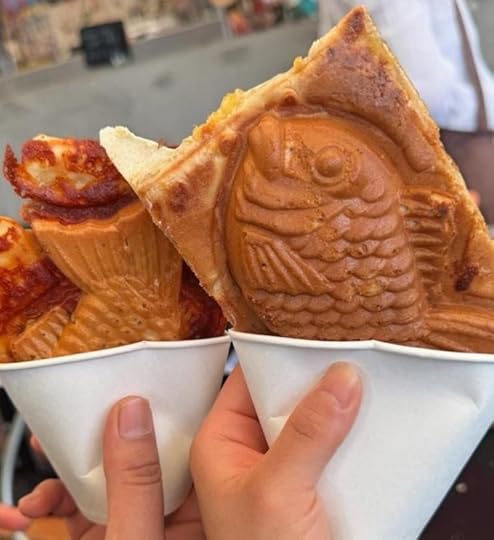
One of many formative incidents was when Gu worked in a factory, Dam often meeting him at the start/end of the day, and the two of them befriended a young boy, Noma, son of one of the other workers, only for him to die before their eyes in a traffic accident just after the three of them have bought some leftover 붕어빵 (bungeoppang) from a vendor:
Our walks had a quiet warmth to them. Noma between us made me feel safe and soothed my nerves, as if an angel were watching over us. Or as if we were looking out for each other, wrapped in the arms of the night. They plucked the thorns out of my heart. They made me a better person. We licked ice cream in the summer and munched bungeoppang in the winter, losing ourselves in the beauty of the spring flowers and autumn leaves. At the end of the night, I'd wait for Noma to lock his door and kiss Dam goodbye. Then it was a shower and four to five hours of sleep before doing it all again, but there was a warm ball of rice in my heart that exhaustion and the future could never spoil.
In many respects a conventional coming-of-age tale, but the unconventional form and the intensity elevate it. 3.5 stars rounded to 4.
Thanks to the publisher via Netgalley for the ARC.
나는 너를 먹을 거야.
그래야 너 없이도 죽지 않고 살 수 있어.
If you die before me, I will eat you.
That's the only way I can live without you.
Hunger is Soje's translation of 구의 증명 by 최진영 (Choi Jin-Young), the second book in English I'm aware of from the pair after To the Warm Horizon.
(as an aside the Goodreads entries for the author have got a bit tangled, with two potential English renditions - this and the more Western-style Jin-Young Choi, the Korean name, and it seems potentially two different Korean authors with the same name)
The novel is told by two first person voices, 담 Dam, a young woman in her twenties, whose passages are marked with a white circle ○, and 구 Gu, a young man of the same age, denoted by a black circle ●.
The novel opens with Dam's voice:
What should I do once this story is told? What could I possibly do? Where should I go? I could go to the police and confess. I could visit a priest and confess. I ate a person. A human being. Is that a sin? They'll do with me as they see fit. I could say whatever they tell me to say, go wherever they tell me to go.
To tell this story, and to live on:
that is all I want.
Gu has died (his sections narrated from some form of afterlife), Dam finding his body in the street after he called her for help, but rather than call the authorities she calls a taxi, pretending he has passed out drunk, takes him home, and, as the quote above suggests, starts to eat his body, this based on a suggestion he made - see the opening quote to my review - on what he would do if she died, so that he would always have her with him. Gu seems to have something of a fascination with cannibalism, telling Dam the story of Sawney Bean, Gu and Dam most fascinated by the 3rd generation of children, born of incesteous relationships, and who would have grown up thinking what the family did was normal.
But this rather disturbing approach to bereavement, while the novel's most stand-out feature, is not really at it's heart, which is more a tale of an intense relationship.
Dam and Gu were classmate for two years from the age of 8, although don't remember each other from their first year together, and Gu bullied Dam in their second, before they became very close friends age 10. They then grew up together, evolving from friends to lovers, although going their separate ways at times, Gu to the army and Dam to studies, sometimes not seeing each other for over a year, but immediately picking up as if they'd met yesterday, and eventually moving around the country to escape the loan sharks pursuing Gu for his parent's debts.
One of many formative incidents was when Gu worked in a factory, Dam often meeting him at the start/end of the day, and the two of them befriended a young boy, Noma, son of one of the other workers, only for him to die before their eyes in a traffic accident just after the three of them have bought some leftover 붕어빵 (bungeoppang) from a vendor:
Our walks had a quiet warmth to them. Noma between us made me feel safe and soothed my nerves, as if an angel were watching over us. Or as if we were looking out for each other, wrapped in the arms of the night. They plucked the thorns out of my heart. They made me a better person. We licked ice cream in the summer and munched bungeoppang in the winter, losing ourselves in the beauty of the spring flowers and autumn leaves. At the end of the night, I'd wait for Noma to lock his door and kiss Dam goodbye. Then it was a shower and four to five hours of sleep before doing it all again, but there was a warm ball of rice in my heart that exhaustion and the future could never spoil.
In many respects a conventional coming-of-age tale, but the unconventional form and the intensity elevate it. 3.5 stars rounded to 4.
Thanks to the publisher via Netgalley for the ARC.

August 5, 2025
Hunger does in a hundred odd pages what big books often fail to do. It pulls you in, wraps its words around you and takes you to the depths of despair and love, an act that will eventually leave you feeling devastated. Written by Choi Jin-Young in Korean and later translated into English by Soje, this novella introduces us to the world of two lovers, Dam and Gu. From a very young age, I’ve always been fascinated by the idea of twin flames, two souls finding their way back to each other no matter where life takes them. The protagonists in this book are two such people who against all odds seek each other out again and again. But this isn’t just a love story. It’s about what money or the lack of it does to families and how loss/death has consequences on the ones who are left behind.
The novella opens with a rather bold statement, instantly giving us a glimpse of the body horror facet of the story. When Dam finds Gu murdered on the streets of Korea, she decides right away that she is going to eat him. And so she carries him home, lovingly cleans him up and begins the act of eating her lover. She wants all of him, every piece and inch that made her fall in love with him and while she chews and bites on his flesh, we are taken back to the day when the two first met. The chapters are narrated by Gu and Dam alternatively, making it easier to understand the world from both of their perspectives. As they age during the changing seasons, the intensity of their love morphs into something profound, something that stretches past the boundaries of time and even death.
Contrary to the size of the book, this is in no way an easy read. To some, it may seem rather unsettling, this story of love, grief and flesh. But to others it might truly be the most beautiful yet strangest love story ever written.
The novella opens with a rather bold statement, instantly giving us a glimpse of the body horror facet of the story. When Dam finds Gu murdered on the streets of Korea, she decides right away that she is going to eat him. And so she carries him home, lovingly cleans him up and begins the act of eating her lover. She wants all of him, every piece and inch that made her fall in love with him and while she chews and bites on his flesh, we are taken back to the day when the two first met. The chapters are narrated by Gu and Dam alternatively, making it easier to understand the world from both of their perspectives. As they age during the changing seasons, the intensity of their love morphs into something profound, something that stretches past the boundaries of time and even death.
Contrary to the size of the book, this is in no way an easy read. To some, it may seem rather unsettling, this story of love, grief and flesh. But to others it might truly be the most beautiful yet strangest love story ever written.
Displaying 1 - 30 of 1,733 reviews