A group of septuagenarians revive schoolboy conflicts in the election of the President of the Old Boys Association. Jaraby expects to get the job, but he reckons without the bitterness of Nox, who still remembers the humiliations of his school years. And when Jaraby's son gets into trouble with the law, Nox has the perfect stick with which to beat him.
Their powers may be failing but the old boys possess a fierce understanding of the things in life that matter - power, revenge, hatred, love, and the failure of love.
William Trevor, KBE grew up in various provincial towns and attended a number of schools, graduating from Trinity College, in Dublin, with a degree in history. He first exercised his artistry as a sculptor, working as a teacher in Northern Ireland and then emigrated to England in search of work when the school went bankrupt. He could have returned to Ireland once he became a successful writer, he said, "but by then I had become a wanderer, and one way and another, I just stayed in England ... I hated leaving Ireland. I was very bitter at the time. But, had it not happened, I think I might never have written at all."
In 1958 Trevor published his first novel, A Standard of Behaviour, to little critical success. Two years later, he abandoned sculpting completely, feeling his work had become too abstract, and found a job writing copy for a London advertising agency. 'This was absurd,' he said. 'They would give me four lines or so to write and four or five days to write it in. It was so boring. But they had given me this typewriter to work on, so I just started writing stories. I sometimes think all the people who were missing in my sculpture gushed out into the stories.' He published several short stories, then his second and third novels, which both won the Hawthornden Prize (established in 1919 by Alice Warrender and named after William Drummond of Hawthornden, the Hawthornden Prize is one of the UK's oldest literary awards). A number of other prizes followed, and Trevor began working full-time as a writer in 1965.
Since then, Trevor has published nearly 40 novels, short story collections, plays, and collections of nonfiction. He has won three Whitbread Awards, a PEN/Macmillan Silver Pen Award, and was shortlisted for the Booker Prize. In 1977 Trevor was appointed an honorary (he holds Irish, not British, citizenship) Commander of the Most Excellent Order of the British Empire (CBE) for his services to literature and in 2002 he was elevated to honorary Knight Commander of the Most Excellent Order of the British Empire (KBE). Since he began writing, William Trevor regularly spends half the year in Italy or Switzerland, often visiting Ireland in the other half. He lived in Devon, in South West England, on an old mill surrounded by 40 acres of land.
As the title implies, one focus of the story is on a group of elderly men, all graduates of the same boys’ school, who meet to pass the time, plan reunions and talk about donating piddling amounts to the school. As they reminisce about their trials and tribulations at the school, we are reminded that the British boys school system seems design to maximize bullying and intimidation and to terrify the smaller, timid, bookish, weaker boys.
The system seems to have worked well for the main character since he still admires an older boy (now dead) who abused and bullied him. He sent his son to the same school and it didn’t work out: “It ruined him.” One good line: “The world is the School gone mad.” But his wife gets the last word when she asks, more or less, why do MEN make such a fuss about their old school antics decades ago? A lot of women went to girls’ schools and they don’t constantly relive that past. Maybe for the men it serves this purpose: “Come now, how shall we prove we are not dead?” Or this: “He would have liked to have written his memoirs, but he knew there was nothing to write. ‘The tragedy, he sighed, of those who come into their own too late.’ ”
A second theme is the onset of the problems of old age. The main character wants to be the next president of this Alzheimer-tending group. While their babbling and occasional confusion is served up with humor and we laugh, sometimes it gets serious, as when the group convinces one of the men that he is engaged to a woman and he panics, thinking it must be true.
Perhaps the main theme is that of a marriage of mutual animosity and constant bickering of husband and wife. They never have a civil word with each other. They argue about how he wastes his time fooling with the old school; his vicious cat, and the relative merits of things like canned Australian fruit. Mostly they argue about bringing their estranged son home to live with them. The son is barely surviving on his own; hitting people up for money in the parks. His mother wants to bring him back to their home, but the father won’t allow it.
As in other Trevor novels, beneath the humor there’s a secret vicious crime that will settle the argument about where the son goes.
Two more lines I liked:
“Everything happens in middle age. One is old and young at the same time.”
“You start with one worry, you settle it in your mind; and then there’s another.”
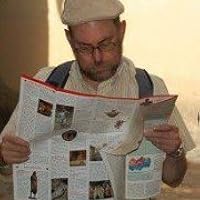
This is Trevor’s first novel that he was proud of, published in 1964 when he was 36. I say this because he wrote ‘A Standard of Behavior’ 6 years earlier but later disowned it and refused to have it reprinted. I tried to find a photo of Trevor in his younger years – no luck – this is the earliest one I could find.
William Trevor is one of my favorite authors and I have read about 15 of his novels and collections of short stories. Below are links to reviews of some others of my favorite novels of his:
One of the best. This is Trevor in High Comedy Mode. It would be unjust to knock off a star for making me laugh so much at a time when laughter was painful.
This is my first William Trevor novel and, having finished it, I have mixed feelings. The novel revolves around the upcoming election for President of the Old Boys Association of a public school, which remains unnamed throughout the novel. We do know that Mr Jaraby, now in his Seventies (as are most of the characters in this book) has been proposed as the new President and, unless he is opposed, he should automatically replace the previous Old Boy.
Jaraby is a man whose successes are all built around his school days, where he revered his housemaster, H.L.Dowse. Of course, people see things differently and, another Old Boy, Nox, certainly has a different vision of his schooldays – when he recalled being bullied by both Dowse and Jaraby. Jaraby’s now adult son, Basil, also had a miserable time at the school his father loved and is something of a disappointment to his father.
This is a novel of memory and subterfuge. The embattled Jaraby is attempting to steer his way to the President role at the Association – something that he desires more than anything else. Meanwhile, there are a number of other encounters with fellow Old Boys; Mr Turtle, Mr Sole, Mr Cridley and others, which are often amusing and sometimes sobering. As Nox does his best to discredit Jaraby and stop him gaining the post he wishes, Jaraby is also under assault at home, where his wife is pressuring him to accept Basil back in the house.
Evelyn Waugh, one of my very favourite authors, apparently loved this novel. I can see how the dark humour and bizarre situations would have amused him. However, this novel is not nearly as sly, or dark, as Waugh. This is an early work and I would not like to judge William Trevor on one novel, but I found this an interesting concept, rather than an entertaining read.
It seems I have been hearing about this author for years, probably because he was shortlisted several times for the Booker Prize. The Old Boys was his second novel. He immediately won prizes and went on to write novels, short stories, and even plays. Whatever he wrote, he kept winning prizes, awards and at last a KBE: Knight Commander of the Most Excellent Order of the British Empire. Though he was born, raised and educated in Ireland, he emigrated to England and stayed there.
I was therefore expecting a great deal as I finally came to William Trevor on the 1964 list of My Big Fat Reading Project. The first unsettling surprise was that the "old boys" are quite old, in their 70s. Why would an author starting out in his 30s write about such old guys?
The plot concerns a coming election for the next president of the Old Boys Association which is connected with the boarding school (called public school in England) these old guys attended. Anyone who has read British literature knows about the cruel and unusual goings on in those places, often leaving people scarred for life. I was not excited about reading another one of those stories.
My boredom with these old boys continued to the end but since the story was contemporary with the early 1960s in Great Britain, I found a little to interest me. This is the time and environment that gave us all those great bands from Britain: the Beatles, the Stones, etc. This was when the rebellion was born.
Though no one in the book starts a band, the story of these guys dredging up all their old friendships and hostilities as they dodder through meetings, had a quaint historical feeling, showing me what the lads of the 60s might have been wanting to shake up.
In fact, many British writers in the 50s and 60s did write about the hidebound, stuffy but crumbling and defeated British class system and mores of the Postwar era: Muriel Spark, A S Byatt, Doris Lessing, Iris Murdoch and more. They eventually moved into more modern stories.
I am sure William Trevor did so as well. Since his writing style is already quite good in The Old Boys, I will keep reading his novels as I move through my reading project, hoping to enjoy them more than I did this one.
Have you read this author? If so, which books did you enjoy the most?
Don’t you just love picking up a book off your shelf at random, reading the first few pages, and then you can’t put it down? AND then, it perfectly fills a prompt in one of those annual challenges you keep doing every year!
This short little novel was a total delight, all 165 pages. A story about eight septuagenarians, all graduates of the same hoity-toity boarding school, who still meet monthly and attend the annual “Old Boys” day at the school every year. They’re all cranky, have their various aches and pains; most are widowers, but Jaraby is still married and the worst, most miserable husband I’ve come across in all my reading history. The story is mostly told through conversations and it had me chuckling nearly every page. Highly recommend.
The 52 Book Club Reading Challenge - 2022 Prompt #13 - Includes a club
The septuagenarian alumni association of a boys' English boarding school gathers to vote for a new president. Mr. Jaraby is thought to have it in the bag, except that Mr. Nox remembers all the cruelties Jaraby visited upon him when he was his fag in 1907. We get comical glimpses into the lives of these old men, mostly widowers or never married, with the largest focus on Mr. Jaraby's sadistic domesticity with his wife.
Both New York Times reviews of 1964 compared Trevor's dialogue to the "stylized dialogue" of Ivy Compton-Burnett. I didn't find that to be true, since the the dialogue here was amusing, whereas the little of Compton-Burnett's I've read, I found almost unreadable.
A bookish side project of mine is noting instances of the term nigger in literary fiction before it became taboo. It's more common than you might think in English novels. Here, Mr. Jaraby explains to his wife that in voting for him, "The committee would be unanimous but for Nox. I'm sure of it." Mrs. Jaraby replies, "Yes, yes. Nox is the nigger in the woodpile." The phrase originated in the 1840s-50s U.S. and refers to "some fact of considerable importance that is not disclosed—something suspicious or wrong," according to Wikipedia.
The Old Boys is a sharply observed ensemble piece featuring a cast of rather idiosyncratic characters – this time, the members of an Old Boys Association for an English public school. In short, the novel explores the longstanding beliefs and rivalries that resurface amongst the men (all in their seventies) when the committee comes to elect a new President. It is a marvellous novel, shot through with a particularly savage streak of humour and some poignancy too.
'Ενα χιουμοριστικό-κωμικό μυθιστόρημα που διαθέτει τη 'φρεσκάδα' και τη νοσταλγικότητα του 'Νέου Κύματος' των '60ς (1964), το οποίο θα μπορούσε να μας 'αγγίξει' μέχρι σήμερα. Ο Τρέβορ χρησιμοποιεί το βρετανικό φλεγματικό χιούμορ δημιουργικά, και χτίζει μια 'γέφυρα' μεταξύ της ανεμελιάς των σχολικών χρόνων και του ανταγωνισμού των ηλικιωμένων, πλέον, 'μαθητών' για τη θέση του Προέδρου του Συλλόγου Αποφοίτων ενός δημόσιου σχολείου.
William Trevor is a new author for me, and his short fiction is considered excellent.
This compact novel is layered and nuanced, and although there are satirical elements it stops short of outright satire. The feeling is one of the ironies of life, which can be true and farcical at the same time.
Ultimately, this novel explores the programming drilled into boys at public schools and how that affects the "old boys" for the rest of their lives.
However, I was confused by the discussions between Mr. and Mrs Jacaby — they both had the same voice, and often the text lacked "he said/she said" and I would lose track of the speaker. Perhaps I’m just too easily confused.
I started to read William Trevor’s books in the late 1990s and consider him as one of my favorite authors. His fiction and short stories are equally good. I joined GoodReads about 2 months ago and wanted to start to build up my library/books read here, since I do enjoy reading.
This is so depressing! Only 232 people on this website have read this book (as of 11.16.2019).
This was Trevor's first book....it won the Hawthornden Prize in 1965. Here's what is in his short bio on dust jacket, inner sleeve: He now lives and works in London, where he interrupted a career in public relations to write this first novel, after no more of a tryout than a few short stories.
If ever you wanted proof that authors, great authors, need, like great bordeauxs, time to develop and mature then you need look no further than William Trevor. In 1958 he published his first novel 'A Standard of Behavior' a charming but utterly forgettable work. Six years later he produced this, a truly magnificent novel and the accolades and prizes bestowed on it convinced Trevor to become a full time writer (oh for those lost days when the success of literary work could launch a career). It is one of Trevor's finest novels and he is one of the glories of 20th century Irish literature. He is also, in a small way, of forerunner of how Ireland would change, mutate and mature, he never was, and would have violently rejected any suggestion that he was an 'Anglo-Irish' writer because the need for that distinction had vanished.
This novel is dazzling on so many levels, Jaraby the main protagonist (all the men in the novel are refered to by surname to do otherwise would be an insolence), is a comic creation of genius, though he is also a monster of destructive self centered concerns. The other 'old boys', Sole, Cridley, Nox, Turtle, Swabey-bones, Sanctuary and Ponders are imagined with as deft, but minimum, prose as Muriel Spark manages in 'Memento Mori' and I can't think of a better novel then 'Memento Mori' to compare 'THe Old Boys' to and as a way of praising William Trevors marshalling of such a realised ensemble of brilliantly concieved elderly characters.
I don't know if Mr. Trvor intended the novel to such a wonderful evisceration of 'public schools' and all they had ever stood for, but he does by situating the worm in the bud of those institutions baleful influence in their arrogance and self centered belief that they reflected the world and the the world would be like them. For a horrifying time between the late 19th century and post WWII they did, or at least the UK, and the way it was run, reflected their twisted ideals.
The horror of the public schools was the way it used older boys to discipline and control younger boys and the damage that did lasted a lifetime and is seen in virulence with which one old man, Nox, persues vengance against another, Jaraby, who as a boy exercised almost unbelievable power over him as head of house. It is also reflected in the lonely tragedy of Jaraby's son, one of the boys who couldn't adapt to the 'public school' way and was destroyed.
As both social satire and commentary it is brilliant because Trevor presents these 'old boys' as, in many ways, turning into the 'boys' they never could be when they were young. Trevor is also devastatingly acute in his portrayal of the loneliness and despair of getting old and realising that you have wasted your life.
A great novel from a great writer.
My original review is below:
I don't know when I last read this book, maybe thirty years ago. That was my second or third reading, the first was probably the very early 1980s, maybe the late 70s. It was a novel of such power and in language so beautiful it has stayed with me. William Trevor is one of my favorite writers and while it has been too long since I read this novel to write the review it deserves I have no hesitation in recommending it, and the author, to anyone. This novel is superb and my copy is now off the shelf and on pile of books I am determined to read, soon.
Typical early Trevor, which means it's very very different from his mature and late work (which is probably better known and better-loved). It's full of the contrived, stagey and unrealistic dialogue, in a Beckettian or Pinterian vein, that you also see in some of the early stories (e.g. in The Day We Got Drunk on Cake). It's entertaining, and it does work well in some of those short stories, but it can't hold my interest for an entire novel.
It was interesting to read this immediately after a failed attempt to read Compton-Burnett's A Father and his Fate, because there's some of the same contrivance in the dialogue: people blatantly saying out loud things one normally doesn't say out loud to one another.
I read now that this was his debut, that it immediately won an award which "encouraged Trevor to become a full-time writer", so that was all for the good anyway – whatever the intrinsic merits of the book itself. And it is interesting, and sometimes very funny. No doubt about that.
I'm still having a bit of a William Trevor binge - both his novels and his short stories. And this, his second novel (his first he disowned and wouldn't have republished) is definitely his weakest of those I've read. All the characters are dislikeable, although that didn't worry me, but they often read like caricatures written for jokes which went on a bit too long. It wasn't a chore to get to the end, but I wouldn't recommend it.
Got this in a omnibus of 3 early novels of Trevor. Never read him before, and to be honest, never heard of him before.
Loved this book! Wow, very funny, great dialogue. Pretty basic plotting, but this is his first novel, and all reports seem to indicate ideas and plotting get more complicated and complex as his career goes on.
Characters here are funny and as well fleshed out as an ensemble cast can be in 165 pages.
Highly recommended to people who like English authors with a decided Pickwickian feel.
I like William Trevor and it is odd to give a book of his only two stars. I found the book outdated and boring. He had focused on something I have read or picked up elsewhere. There were moments when I saw promise, like one of characters hiring a detective to watch another, but it fizzled out in the end. The idea of watching tv without sound was well developed but was irrelevant to the plot. What was the plot anyway?
Will probably get into this a bit tonight, though I'm still reading "Ready Player One." This I gladly do in honor of the death of Mr. Trevor(last fall), one of the late 20th and early 21st centuries finest writers. I've read quite a few of his books and have never been disappointed. This little hardbound looks to be an original from 1964. Doesn't look like it's ever been checked out from the Bowdoin Library - an interlibrary loan from the library I was just(using a public computer) in earlier this afternoon! I don't have a card there anymore ... "Presented to Bowdoin College by Benjamin Sonnenberg" - inside the front cover.
Finally got started on this last night and I'm very much enjoying it. This book is early Trevor and his style is a bit word-busier. Still, the trademarks are there: irony, suffering, human on human abuse, institutional abuse in the form of the 500-year old public(private) school the old boys attended. English upper-class adolescent bullying, sadism etc. carried into adulthood in the gent who seems to be the villain of the piece. A familiar target of course, but in Trevor's hands given his own special sorrowful AND humorous sheen. I love William Trevor! Too bad he's gone ...
Moved past halfway last night in this slight novel. Mr. Trevor did not write long fiction. No doorstops ... Anyway, this continues to amuse and dismay as we shift from villain to the (sort-of) righteous. This book is about old age, the challenges that the coping-challenged find living in this world. Sometimes you're the windshield and sometimes you're the bug. Mr. Trevor never shied away from telling the buggy side of life. This book has connections to "Reading Turgenev," "Felicia's Journey," and "Death in Summer" as the hapless Basil fits well with the hapless protagonists of those tales.
- As one G'reads. reviewer has put it, the dialogue has a sort of surreal vaudeville quality to it. Perhaps Mr. T. had Samuel Beckett in mind?
- The hapless and prematurely old Mr. Turtle and the scary Mrs. Strap:
"This comparison did not occur to Mr. Turtle; he was not, in such matters, a observant man. Mrs. Strap(his housekeeper) was more of a blur to him; a useful fury, an ill-tempered necessity. When she snapped, her eyes lit up with anger, matching her tongue. They blinked and glowed with elaborate spectacles; spectacles that were a confection of bric-a-brac built up to a pair of tapering points: specks of coloured glass that were not for seeing through, with gold, or something, in triangular blobs at either hinge."
Almost done last night, but I had to get to bed. Meanwhile, things do get kind of weird as the surreal atmosphere continues. Be ready for cat murder - I'm just sayin' ... Mr. Trevor lays it on pretty thick and others beside the cat are biting the dust. Poor old Jaraby, the ostensible villain, seems due for a bit of sympathy as he jousts relentlessly with his implacable wife(the vaudeville/absurdist dialogue) and bird-brained(literally) son. A weird book for sure. Perhaps a bit like Henry Green, in fact!
- gotta love those names: Mr. Turtle, Lord Ponder, Bludgeon, Mr Sole, Miss Burdock, Swabey-Boyns, Monmouth(the bird-killing, one-eyed kitty - don't ask how he lost the eye), Mrs. Strap and General Sanctuary, Haw minor ...
Finished last night as Nox has his revenge. There is a bit of a sour taste to the whole thing, as if Trevor himself were exacting a bit of Irish revenge against English middle-class culture. Doesn't paint a pretty picture of the aging of the "old boys" and the title is likely a double entendre. Still, there's no way I'm giving William Trevor less than a 4* rating. This one makes it by rounding up from 3.75*.
This was one of a group of classics that I picked up in a car boot sale and although I opened it with some trepidation, being used to more modern fare, I was utterly lost in the delightfully precise writing. It appears at first a simple story about a group of elderly ex public schoolboys who sit on a committee to support the activities of their old school but it soon plunges beneath the surface to explore motives of hatred and revenge that have lingered on since those long lost schooldays as well as examining the tensions and difficulties of the various members' personal lives. There is everything conducive to good fiction here: sadness and poignancy, conflict and rage, shock and a humour that is almost sadistic at times. Written in 1964 it details the cruelties and inhumanities of public school life of the period which (hopefully) no longer exist. Floggings, fagging and an acceptance of an horrific pecking order from which the only escape is to ascend over others until you yourself can mete out the same punishments to other boys is a major theme of the book, but more important is the underlying theme that childhood experiences are never really forgotten and continue to influence behaviour throughout adult life. Although the book is dated and details a society which now seems like another planet, the dilemmas the characters face are classic and the prose is as fresh as a daisy. Trevor's use of humour is refreshing and at times startling. In Chapter 17 one of the 'old boys' has passed away in the audience of a school theatrical performance. Another character reflects, 'No one could wish to die during a performance of The Mikado.' How's that for a one-liner? I thoroughly enjoyed this book and will be on the look out for more of Trevor's work.
I enjoyed this book while I was reading it, but now that the dust has settled, I remember it as grim and grotesque. It's a very black comedy indeed, and it seems rather excessive that those of the characters who weren't warped and destroyed by the brutality and hypocrisy of the public school system should have been damaged by the process of aging. The principals are Jaraby and Nox. Once upon a time Nox was Jaraby's fag. Aided and abetted by Headmaster Dowse, your stereotypical old pervert, Jaraby victimized Nox to the extent that decades later, Nox is prepared to employ a seedy private detective to try and find incriminating evidence about Jaraby, who is about to be elected president of the Old Boys' Association. Nox genuinely believes that Jaraby frequents brothels, but in the end, what comes to light is that Jaraby's son Basil, also a victim both of the school system and of his father's cruelty, is a pedophile and has molested a little girl. The private detective diddles both Nox and Jaraby into believing he can help them achieve their goals. Jaraby loses the election, but not through any intervention of the swindler called, rather too obviously, Swingler. The hateful Jaraby is locked in another intractable conflict with his wife, who kills his beloved cat to enable their grown-up son, a bird fancier, to move back in with them, a step Basil only takes in order to hide from the police. Trevor is not the only British writer to write in this vein about the hopeless battles of embittered elderly people, but somehow the mix of ferocity and farce in this book left an unpleasant taste in my mouth.
Trevor's debut novel from the sixties. Social satire about a group of slightly demented "old boys"--ancient (70!) alumni from a British prep school. Mostly from the perspective of callow youth, however. Mostly nothing happens of course as the old boys are involved in inconsequential business. Too bad Trevor didn't do a reprise once he had reached that certain age himself--might have been better book. Fortunately Trevor gets a lot better
The misanthropic streak of Trevor’s early fiction works to his advantage here. Waugh might have been proud of this sharp, blackly comic send-up of elderly public school boys.
Funny in places. Found it hard to read in places. Laughed when Turtle died in The Mikado escaping a fate worse than death. Will give some of his other books a read.
This entire review has been hidden because of spoilers.
"The middle-aged are most susceptible, are easily hurt and most in need of reassurance. They are strait-laced in their different ways, serious and intent. They have lost what they have always been taught to value : youth and a vigour for living. They suspect their health, scared to lose it too. The prime of life is a euphemism."
Oh my dear William Trevor is there anything you can't do?
This book is an exploration of the inner life of a public school, the impact it has on various pupils and the inability to escape it in old age. Men obsessed with the past, relationships falling apart, the elderly questioning their place in the world. William Trevor was a true observer.
From the GoodReads blurb I expected this book to be about bitterness that happened between men on a committee to elect a new president for their Old Boys group. I was looking for rancorous interchanges among the old men, bringing up old grievances perpetrated on each other at public school. Instead, these interchanges were eclipsed by the very entertaining interchanges between the Jarabys, husband, wife, and errant son. Great dialogue, and stilted writing, in the manner of old English novels. Enjoyable.
William Trevor’s first novel and like a lot of his work, full of surprises, unexpected cruelty and just revenge. Some ultimately very sad characters particularly Basil Jaraby with his desire to regain the power he once had. The arguments with his wife are a highlight of the novel and fabulously funny.
Ένα βιβλίο που αφορά γέρους, γραμμένο από έναν νέο σε ηλικία συγγραφέα (τότε που το έγραψε ήταν νέος, τώρα είναι και αυτός ραμολί). Και είναι ίσως από τα πιο αστεία βιβλία που έχω διαβάσει, όσο να'ναι τα γερόντια με τις διάφορες παραξενιές τους και με τις συζητήσεις τους, καμιά φορά, προκαλούν γέλιο. Ειδικά όταν τσακώνεται ο ηλικιωμένος άντρας με την ηλικιωμένη γυναίκα του. Καταπληκτικοί διάλογοι.
Οι συμπαθητικοί γέροντες που πρωταγωνιστούν στο βιβλίο, είναι απόφοιτοι ενός σχολείου το οποίο έχει τεράστια ιστορία και σίγουρα είναι υπερήφανοι που φοίτησαν σ'αυτό. Στην ιστορία μας, είναι σε εξέλιξη η εκλογή ενός νέου προέδρου του συλλόγου αποφοίτων και βλέπουμε τις ζωές μερικών γέρων που αναπολούν τα σχολικά τους χρόνια, όπως και πως τα περνάνε καθημερινά, αλλά βλέπουμε επίσης και τον γάμο μεταξύ του υποψήφιου νέου προέδρου (που όμως θα βρει ισχυρή αντίσταση από έναν γέρο που του το κρατάει μανιάτικο για τα καψόνια που υπέστη στο σχολείο...) και της γυναίκας του, που έχει κρατήσει πάρα πολλά χρόνια, παρά το γεγονός ότι τσακώνονται σχεδόν καθημερινά, ειδικά για το θέμα του άσωτου υιού, που ούτε να τον βλέπει δεν θέλει ο πατέρας του, αλλά και για μια γάτα την οποία μισεί η γριά γυναίκα (και για κάτι λαχανικά, μεταξύ άλλων).
Σε μερικές στιγμές υπάρχει και αρκετά μαύρο χιούμορ και μια κάποια κακία. Εννοείται πως οι χαρακτήρες είναι εξαιρετικοί, αν γινόταν ταινία, τον ρόλο του υποψηφίου νέου προέδρου θα τον είχε καπαρωμένο ο Γουόλτερ Ματάου (και μόνο που το σκέφτομαι, ξεκαρδίζομαι). Η όλη ατμόσφαιρα εξαιρετική. Και η γραφή φυσικά καταπληκτική. Το προτείνω το βιβλίο σαν κάτι ανάλαφρο, διαβάζεται πάρα πολύ γρήγορα και ευχάριστα.
55 years after its publication, it took the recent death of Irish author William Trevor to motivate me to finally read his debut, which is as well written, witty, and insightful as one might expect. The description of the book, as one dealing with "never forgotten old school days" is a bit misleading - truthfully if that were the point of the book it would have required double the length. Ultimately the book is about the fading glory and mental state of a single man, and the struggles to keep his dignity late in life. A rare instance of a likable book with mostly unlikable characters, the book meanders a bit until the punch of the final 30 or so pages, but the payoff is more than worth the short journey. An interesting book and more than admirable debut for a legendary writer.
Once again, I'm surprised by how different an early Trevor novel (this was his first) is from his later works like The Story of Lucy Gault and Felicia's Journey. The later books are usually single-perspective narratives, often of sad, isolated women. But The Old Boys (like The Boarding House, which I also enjoyed) covers a broad range of characters and is often very funny, perhaps in the vein of Wodehouse (whom I haven't read) or Kingsley Amis. Eight old men, graduates of the same boarding school and desperate to find meaning at the end of their lives, can do little more than complain, scheme and re-fight the battles of sixty years earlier. A witty and rollicking good read.
If it had been longer and delved deeper, this might have scored 4 stars. As it stands it's a darkly amusing and comically disturbing look at the way that a group of former public school pupils have carried their childhood notions and relationships (especially resentments) into old age, and how they increasingly turn their thoughts back to their school days as the shadow of death edges near. The plot skews towards the faintly surreal, the dialogue is pleasantly mannered and sometimes almost Vancean, and the overall effect is one of a kind.
When I heard the hubbub when William Trevor died as "one of the best modern Irish writer" I became curious; I'd never heard of him before. The Old Boys is considered his first major work and I enjoyed it thoroughly. It is about old boys from an English public school living out their grudges some 60 years after leaving that school. While that may sound odd, the book is very witty. I plan to read more Trevor in the future.