

What do you think?

The War for Korea #1
The War for Korea, 1945-1950: A House Burning
When the major powers sent troops to the Korean peninsula in June of 1950, it supposedly marked the start of one of the last century's bloodiest conflicts. Allan Millett, however, reveals that the Korean War actually began with partisan clashes two years earlier and had roots in the political history of Korea under Japanese rule, 1910-1945.
The first in a new two-volume history of the Korean War, Millett's study offers the most comprehensive account of its causes and early military operations. Millett traces the war's origins to the post-liberation conflict between two revolutionary movements, the Marxist-Leninists and the Nationalist-capitalists. With the U.S.-Soviet partition of Korea following World War II, each movement, now with foreign patrons, asserted its right to govern the peninsula, leading directly to the guerrilla warfare and terrorism in which more than 30,000 Koreans died. Millett argues that this civil strife, fought mostly in the South, was not so much the cause of the Korean War as its actual beginning.
Millett describes two revolutions locked in irreconcilable conflict, offering an even-handed treatment of both Communists and capitalists-nationalists. Neither movement was a model of democracy. He includes Korean, Chinese, and Russian perspectives on this era, provides the most complete account of the formation of the South Korean army, and offers new interpretations of the U.S. occupation of Korea, 1945-1948.
Millett's history redefines the initial phase of the war in Asian terms. His book shows how both internal forces and international pressures converged to create the Korean War, a conflict that still shapes the politics of Asia.
The first in a new two-volume history of the Korean War, Millett's study offers the most comprehensive account of its causes and early military operations. Millett traces the war's origins to the post-liberation conflict between two revolutionary movements, the Marxist-Leninists and the Nationalist-capitalists. With the U.S.-Soviet partition of Korea following World War II, each movement, now with foreign patrons, asserted its right to govern the peninsula, leading directly to the guerrilla warfare and terrorism in which more than 30,000 Koreans died. Millett argues that this civil strife, fought mostly in the South, was not so much the cause of the Korean War as its actual beginning.
Millett describes two revolutions locked in irreconcilable conflict, offering an even-handed treatment of both Communists and capitalists-nationalists. Neither movement was a model of democracy. He includes Korean, Chinese, and Russian perspectives on this era, provides the most complete account of the formation of the South Korean army, and offers new interpretations of the U.S. occupation of Korea, 1945-1948.
Millett's history redefines the initial phase of the war in Asian terms. His book shows how both internal forces and international pressures converged to create the Korean War, a conflict that still shapes the politics of Asia.
- GenresHistoryWarNonfiction
366 pages, Hardcover
First published October 3, 2005
About the author
Allan Reed Millett
47 books21 followersA specialist in the history of American military policy and twentieth century wars and military institutions, Allan R. Millett is professor emeritus at The Ohio State University, where he taught from 1969 until his retirement in 2005.
Ratings & Reviews
Friends & Following
Create a free account to discover what your friends think of this book!
Community Reviews
Displaying 1 - 7 of 7 reviews

May 7, 2026
The Korean War, as Alan Millett notes in his introduction to this book, is often overlooked in American remembrance. Sandwiched as it is between the monumental Second World War and the much longer and more visually pervasive Vietnam War, most Americans have only a hazy grasp of the conflict and the events surrounding it. Even for those who lived through it, the war erupted suddenly on June 25, 1950, with North Korea’s invasion of its southern neighbor, an attack that triggered an intervention by a coalition of U.S.-led U.N. forces and resulted in an uneasy armistice that remains in place today.
The events leading up to that invasion are the subject of Millett’s book. These he recounts in a detailed and painstaking narrative that begins during the years of colonial occupation. During these years nationalists aspired to regain Korea’s independence yet struggled to establish themselves amidst Japan’s overwhelming control of the country. When Korea was freed from Japanese rule in 1945, it was not through the labors of a successful resistance movement but because of Japan’s defeat at the hands of the Allied powers. Receiving independence at such low cost, Millett argues, was a major factor in the fractiousness of the peninsula’s politics in the years that followed, as they deprived the Koreans of leaders who earned credibility through struggling from within their homeland rather than scheming safely abroad.
In the wake of Japan’s surrender these expatriate politicians rushed back to Japan. Yet their efforts to assert their claim to leadership were defined not by the wishes of the Korean people, but the whims of the American and Soviet occupying powers. Millett spends considerable effort unpacking the factionalism of this period, which often defied neat political categorization and was shaped as much by personal ambition as anything else. This scramble for influence proved particularly frustrating for American officials in the south, who worked vainly to establish an American-style liberal democracy against local interests and Soviet intransigence. Simply creating a functioning administration that governed the southern half proved difficult, as U.S. Army officers and State Department officials coped with both the legacy of Japanese rule and the efforts of expatriate politicians to install their cronies in key positions.
While wartime agreements had envisioned the Korean divide as only a temporary measure, by 1947 the United States had given up on any hope of creating a united government for the country before ending their occupation. Neither of the new Korean governments that were established by the occupying powers in their respective regions saw the separation of the other side as permanent, however, which made war all but inevitable. In Millett’s estimation, this war began even before the American occupation ended, with attacks by Communist-led partisans on Cheju-do on April 3, 1948, which were followed in subsequent months by guerrilla warfare on the peninsula. This proved just one of the many problems facing the new country, as South Korea needed American economic as well as military aid, especially as the withdrawal of U.S. soldiers had removed an important source of local spending. South Korea remained a low priority for American policymakers, though, especially as some worried that meeting President Syngman Rhee’s demands for tanks, bombers, and other forces would only encourage them to assault their counterparts in the north. Seeking to avoid an expanded conflict, military aid was limited to what was necessary for dealing with the insurgency and the “Parallel War” with North Korean border forces.
By contrast, Kim Il-sung faced no such constraints from his patron, as Joseph Stalin gave him the equipment necessary to build the combined arms force necessary for a successful invasion. Millett does a good job of exploiting the limited Russian and Chinese records to understand to the extent possible the factors that informed both Kim’s decision to invade the south and why he received the support he did. Despite this and Millett’s extensive time spent in South Korea, however, his narrative rests mainly on a thorough exploitation of the U.S. and British archives. This contributes to the American-centric tone of his book. Though Millett devotes considerable space to recounting Korean politics, his analysis views them mainly from the perspective of the officers who comprised the U.S. Army’s occupation forces and the post-occupation Korean Military Advisory Group (KMAG). While informative, it has the effect in his account of diminishing the agency of the Koreans themselves.
This is particularly unfortunate given Millett’s clear intent to provide a Korean-centric history of the conflict. To that end, his efforts to describe the indigenous political are laudable, but often feel as though he approached it more as an obligation to get through rather than a challenge he relished. The narrative improves once he gets to recounting the operations of the anti-guerrilla campaign and the Parallel War, as they allow him to play to his strengths as a military historian. In this sense it compliments rather than supersedes Bruce Cumings’s groundbreaking two-volume history of the period, The Origins of the Korean War, Volume I: Liberation and the Emergence of Separate Regimes, 1945-1947 and The Origins of the Korean War, Volume II: The Roaring of the Cataract, 1947-1950, while offering the promise in the two volumes to come a highly valuable narrative of the war itself.
The events leading up to that invasion are the subject of Millett’s book. These he recounts in a detailed and painstaking narrative that begins during the years of colonial occupation. During these years nationalists aspired to regain Korea’s independence yet struggled to establish themselves amidst Japan’s overwhelming control of the country. When Korea was freed from Japanese rule in 1945, it was not through the labors of a successful resistance movement but because of Japan’s defeat at the hands of the Allied powers. Receiving independence at such low cost, Millett argues, was a major factor in the fractiousness of the peninsula’s politics in the years that followed, as they deprived the Koreans of leaders who earned credibility through struggling from within their homeland rather than scheming safely abroad.
In the wake of Japan’s surrender these expatriate politicians rushed back to Japan. Yet their efforts to assert their claim to leadership were defined not by the wishes of the Korean people, but the whims of the American and Soviet occupying powers. Millett spends considerable effort unpacking the factionalism of this period, which often defied neat political categorization and was shaped as much by personal ambition as anything else. This scramble for influence proved particularly frustrating for American officials in the south, who worked vainly to establish an American-style liberal democracy against local interests and Soviet intransigence. Simply creating a functioning administration that governed the southern half proved difficult, as U.S. Army officers and State Department officials coped with both the legacy of Japanese rule and the efforts of expatriate politicians to install their cronies in key positions.
While wartime agreements had envisioned the Korean divide as only a temporary measure, by 1947 the United States had given up on any hope of creating a united government for the country before ending their occupation. Neither of the new Korean governments that were established by the occupying powers in their respective regions saw the separation of the other side as permanent, however, which made war all but inevitable. In Millett’s estimation, this war began even before the American occupation ended, with attacks by Communist-led partisans on Cheju-do on April 3, 1948, which were followed in subsequent months by guerrilla warfare on the peninsula. This proved just one of the many problems facing the new country, as South Korea needed American economic as well as military aid, especially as the withdrawal of U.S. soldiers had removed an important source of local spending. South Korea remained a low priority for American policymakers, though, especially as some worried that meeting President Syngman Rhee’s demands for tanks, bombers, and other forces would only encourage them to assault their counterparts in the north. Seeking to avoid an expanded conflict, military aid was limited to what was necessary for dealing with the insurgency and the “Parallel War” with North Korean border forces.
By contrast, Kim Il-sung faced no such constraints from his patron, as Joseph Stalin gave him the equipment necessary to build the combined arms force necessary for a successful invasion. Millett does a good job of exploiting the limited Russian and Chinese records to understand to the extent possible the factors that informed both Kim’s decision to invade the south and why he received the support he did. Despite this and Millett’s extensive time spent in South Korea, however, his narrative rests mainly on a thorough exploitation of the U.S. and British archives. This contributes to the American-centric tone of his book. Though Millett devotes considerable space to recounting Korean politics, his analysis views them mainly from the perspective of the officers who comprised the U.S. Army’s occupation forces and the post-occupation Korean Military Advisory Group (KMAG). While informative, it has the effect in his account of diminishing the agency of the Koreans themselves.
This is particularly unfortunate given Millett’s clear intent to provide a Korean-centric history of the conflict. To that end, his efforts to describe the indigenous political are laudable, but often feel as though he approached it more as an obligation to get through rather than a challenge he relished. The narrative improves once he gets to recounting the operations of the anti-guerrilla campaign and the Parallel War, as they allow him to play to his strengths as a military historian. In this sense it compliments rather than supersedes Bruce Cumings’s groundbreaking two-volume history of the period, The Origins of the Korean War, Volume I: Liberation and the Emergence of Separate Regimes, 1945-1947 and The Origins of the Korean War, Volume II: The Roaring of the Cataract, 1947-1950, while offering the promise in the two volumes to come a highly valuable narrative of the war itself.

November 28, 2024
Millett's The War for Korea was a brutally honest and well researched introduction to the Korean War.
Showing the brutality of communism and the Soviet Union, the quick and effectiveness an authoritarian leader or dictatorship is compared to democracy. And how communism fails long term to a cohesive democracy and how strong liberalism is when unified.
Unfortunately this look into the past is also a look into the mirror considering America has failed the democracy test again, electing another isolationist and criminal in Trump. Finishing this book was a rough introspection how Great America can be and how worse off the rest of the World is when America is failing and falling.
I'm excited to start the 2nd book of Milletts' in this duology, probably sometime around the end of 2025.
Showing the brutality of communism and the Soviet Union, the quick and effectiveness an authoritarian leader or dictatorship is compared to democracy. And how communism fails long term to a cohesive democracy and how strong liberalism is when unified.
Unfortunately this look into the past is also a look into the mirror considering America has failed the democracy test again, electing another isolationist and criminal in Trump. Finishing this book was a rough introspection how Great America can be and how worse off the rest of the World is when America is failing and falling.
I'm excited to start the 2nd book of Milletts' in this duology, probably sometime around the end of 2025.

January 3, 2024
Col. Millett's first volume on the history of the Korean war. The book was well researched. It could only be improved if all of the Russian and Chinese documents were open to historians. What documents they did release provided insights into time's thinking and assumptions of the communists. (The thoroughness of research is told in a fascinating chapter on the bibliography itself.)
The book is a fine tale on the difficulties of post-war nation building. The implications of the Korea experience are pertinent to America's ventures in Iraq and Afghanistan.
The book is a fine tale on the difficulties of post-war nation building. The implications of the Korea experience are pertinent to America's ventures in Iraq and Afghanistan.

June 24, 2012
A history of Korea from the end of WWII until the invasion of the South by the communist North in June 1950. Millet contends that the "Korean War" actually began in this period by way of Northern infiltration and terrorism aimed at civil society in the South. A very good survey of modern Korea, the book is highly useful for those - like me - who studied the war but were unaware of the historical background or the development of modern Korea itself. Dr. Millet is a fine writer as well as a towering scholar in the study of war.

July 12, 2015
In depth coverage of the 5 years leading up to the North Korean invasion of the South. The book makes a convincing case that the war really started no later than 1948. Fascinating stuff

September 17, 2016
quite helpful

Read
November 22, 2017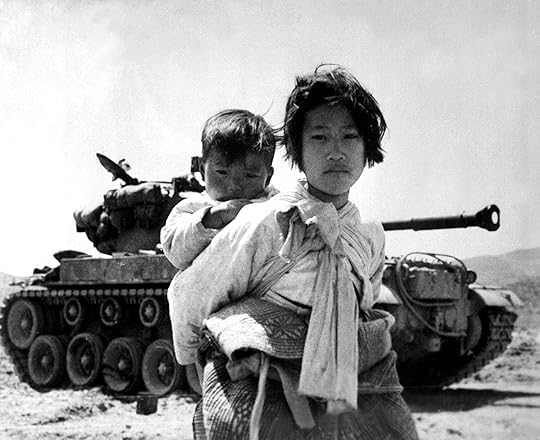
Korean War refugees, June 9, 1951
But war is a stern teacher; in depriving them of the power of easily satisfying their daily wants, it brings most people's minds down to the level of their actual circumstances.
So revolutions broke out in city after city, and in places where the revolutions occurred late the knowledge of what had happened previously in other places caused still new extravagances of revolutionary zeal, expressed by an elaboration in the methods of seizing power and by unheard-of atrocities in revenge. To fit in with the change of events, words, too, had to change their usual meanings. What used to be described as a thoughtless act of aggression was now regarded as the courage one would expect to find in a party membership; to think of the future and wait was merely another way of saying one was a coward; any idea of moderation was just an attempt to disguise one's unmanly character; ability to understand a question from all sides meant that one was totally unfitted for action. Fanatical enthusiasm was the mark of a real man, and to plot against an enemy behind his back was perfectly legitimate self-defence. Anyone who held violent opinions could always be trusted, and anyone who objected to them became a suspect.
- Thucydides
Warning: Some of what is to come below is not for those with weak stomachs.
At a time when "Rocketman" and "the dotard" are exchanging insults and placing their miniscule members on the table for comparison by those whose eyesight is necessarily more acute than my own, I have turned to the history of the Korean conflict for some perspective. And immediately, on the first page of Bruce Cuming's The Korean War: A History (2010) I find without surprise the following:
Forgotten, never known, abandoned: Americans sought to grab hold of this war and win it, only to see victory slip from their hands and the war sink into oblivion. A primary reason is that they never knew their enemy - and they still don't.
The Heavens wept!
As emphasized by both Cumings and Allan R. Millett in his yet unfinished massive trilogy on the Korean War - The War for Korea, 1945-1950: A House Burning (2005) and The War for Korea, 1950-1951: They Came from the North (2010) have appeared so far - the Korean conflict was primarily a civil war, and, as is unmercifully normal in civil wars, the Koreans were particularly murderous with each other. After decades of either denying or suppressing the truth, the South Koreans followed the example of the South Africans and set up a nonpunitive commission to investigate the crimes committed during the war. Nearly a decade later, it estimated that between 100,000 and 200,000 civilians, children included, were massacred - without trial - on the suspicion of Communist sympathies by South Korean police and military. The North Koreans and their sympathizers in the South were apparently slightly less profligate in their random murders of the populace, but not much less.(*) Needless to say, North Korea has had no Truth Commission to date.
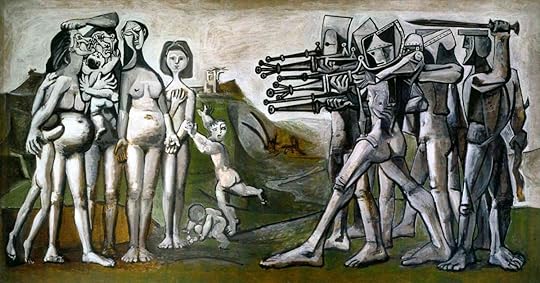
Pablo Picasso - Massacre in Korea (1951)
This was no artistic fantasy any more than the Guernica was, or, for that matter, Goya's The Third of May, 1808.
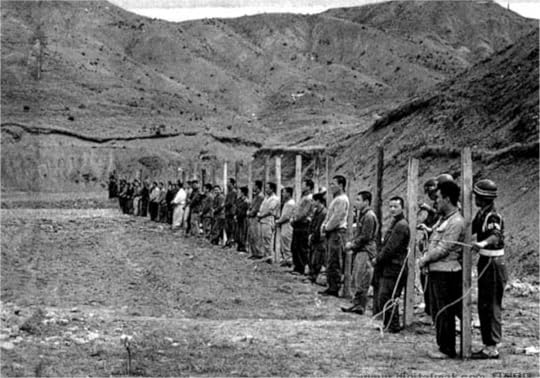
Some of the 3,400 civilians suspected of Communist sympathies executed without trial by the Republic of Korea in Pusan alone.
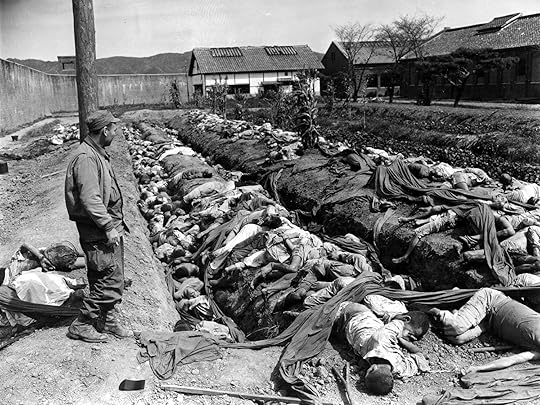
More Korean civilians bound and slain for political reasons, Taejeon, 1950 (**)
The roots of the Korean War go far deeper than the window-dressing ideological trimmings of Communism and anti-Communism. The aristocratic class in Korea had held the people in a stranglehold for centuries; at certain points in history over half of the Korean populace were, literally, slaves and the rest weren't much better off. Then the Japanese arrived and soon made Korea into a colony (from 1910 till 1945), ruthlessly capitalizing upon Korean resources and labor to set up and maintain their Asian empire. Their suppression of Korean resistance and later the very culture and language of the Korean people was equally ruthless. The Koreans came to loathe the Japanese with a passion. As usual there was a certain number of Koreans who collaborated; these people also came to be despised by their countrymen.
What I didn't know before is that most of the North Korean leadership came from the anti-Japanese armed resistance forces who fought the Japanese in China and Manchuria and much of the South Korean leadership (with the exception of Syngman Rhee himself - his name was actually Yi Sung-man) were notorious collaborators. Small wonder then that when the collaborators had themselves voted into power in the South in an election that many Koreans boycotted, a Korean had no need to caress Communist sympathies in order to find the government of the new Republic of Korea to be objectionable. But, of course, when the murdering commenced, all were painted with the same brush.
There was no simple story in Korea after its liberation from the Japanese in 1945; released from the Japanese death grip, many ideas for a new Korea were rampant in the populace. Unfortunately, those willing to commit violence for their ideas rose to power both in the northern portion, occupied by the Soviet Union, and in the southern, occupied by the USA, with the more or less active collaboration of the occupying powers. Both Cumings and Millett provide insight into the many political forces at play in Korea in the mid 1940's; really, anything I write here is necessarily an oversimplification.
Cumings takes a long view, from the late 19th century to the late 20th, and he does so with a deliberate polemical intent that is stirring but which left me with questions since some of his more important assertions were not backed up by Millett's more narrowly focused but much more intensely detailed tomes. Though not averse to directing criticism at all the parties in this conflict, Millett's yet incomplete work(***) provides a detailed look at the political and military aspects of the war without polemics.
Both the South and North Korean leadership were raring to go at each other's throats but were held back by their Russian and American masters through various kinds of threats. But then serious misapprehensions came into play. The North Korean leadership thought they didn't need the Russians (except for arms, munitions and training) - their longtime comrades-at-arms, the Chinese, would have their backs - and that the Americans wouldn't risk a nuclear war to prop up the South. The South Korean leadership thought that the Russians and Chinese wouldn't risk nuclear war and that it could handle the North Koreans easily with American help. The Americans thought the North Koreans and Chinese couldn't fight their way out of a paper bag (and that the Russians wouldn't risk nuclear war). The Chinese thought that the Americans would not be willing to sacrifice much of anything for this obscure Asian appendage. All were wrong, and millions and millions had to pay for their mistakes.
Shall we guess the misapprehensions now current among the Korean, American and Chinese leadership?
The mindset during the Peloponnesian War described so well by Thucydides in the epigraph has manifested itself repeatedly throughout Humankind's lamentable history, including in the Koreas during the late '40s. Its humors rose again in my homeland in 2001 and need but one overt act to overflow once more. The approval ratings of the glowing orange toad croaking in the White House actually edged up when he began his bluster about Korea. Nothing assures re-election like a war against a mannequin tarred and feathered by propaganda, particularly when that mannequin's own bluster has overreached into the absurd. And in Asia, face is everything. It's difficult to be sanguine about this...
(*) A particularly poignant story told by Millett: When a Communist infiltrated regiment of the South Korean Constabulary (precursor to its army) revolted and massacred hundreds of police, officials, rightists and ordinary citizens in Yosu and Sunchon in 1948, they also killed two sons of a Korean pastor for being Christians. When the governmental troops regained control of the area, the pastor pleaded for the life of the young man who had betrayed his sons to their death, promising to raise him as his son and a Christian. In 1950 when the North Korean army came through the area, the pastor and his newly adopted son were executed by the Communists for being a propaganda embarrassment to them.
(**) This massacre was initially attributed by the South Korean government to the North (and is still so attributed on some internet sites), but, no, see here:
http://www.nbcnews.com/id/24695113/ns...
(Nonetheless, there were many such massacres by the North Koreans.) The corrupt and brutal South Korean police and their helpers generated such blazing resentment in the general populace that when a mob rioted in Taegu in late 1946 dozens of policemen were massacred with boundless brutality (but not before they killed hundreds of rioters); I quote from The War For Korea: "Policemen, youth auxiliaries and officials were found impaled through the rectum, mutilated, burned, castrated, disemboweled and buried alive."
(***) Volume two of Millett's history ends with the preparations for the Kaesong "Peace Talks"; two more years of shooting war remained at this point before it was ended temporarily with an armistice, not a peace treaty.
Displaying 1 - 7 of 7 reviews