Jeden ze zásadních grafických románů historie poprvé v českém překladu.
Kultovní, geniální, průkopnický. Všechny tyto přívlastky si vysloužil grafický román Tady, jehož příběh se odehrává na ploše miliard let. Veškerý děj sledujeme z koutu jednoho obyčejného obýváku v jednom obyčejném domě a výsostně komiksovými prostředky se pohybujeme časem. Stěžejní jsou bezejmenní obyvatelé domu, jejich malé osudy a rodinné momentky. V roce 1907 začíná stavba domu, v roce 1609 svádí muž z kmene původních obyvatel svou partnerku, v roce 1986 by se archeolog rád podíval na dvorek, v roce 1870 si malíř s doprovodem užívá romantický piknik, v roce 1998 vlétne do pokoje pták a způsobí zmatek…
Komiks propojuje lidské osudy s faunou a flórou – před osídlením území sledujeme bizona na pastvině, objevují se motivy divoké přírody a pradávného oceánu. Nechybí ani vize vzdálené budoucnosti. Tady je malou historií jedné rodiny a velkým časosběrem celé planety.
Vítěz hlavní ceny z Mezinárodního komiksového festivalu v Angoulęme.
Pro geniální a revoluční komiks Tady se i termín grafický román zdá příliš úzký. McGuire vnesl na plochu stránky třetí rozměr a dokázal vytvořit díry v časoprostoru. Tady je komiksovým ekvivalentem vědeckého objevu. Zároveň je to půvabná evokace místa a rodinné drama na pozadí věčnosti. — The New York Times
Taková kniha se objeví jednou za deset let, ne-li za století… Zaručuji vám, že si přesně zapamatujete, kde jste byli, když jste ji četli poprvé. — Chris Ware, autor komiksu Jimmy Corrigan: Nejchytřejší kluk na světě
Richard McGuire is a regular contributor to the New Yorker magazine. He has written and illustrated both children's books and experimental comics. His work has appeared in The New York Times, McSweeney's, Le Monde and Libération. He has written and directed two omnibus feature films, designed and manufactured his own line of toys, and is also the founder and bass player of the post-punk band Liquid Liquid.
Richard McGuire's Here is a stunning visual experience that takes a single spot in time and examines it over the course of human history. From a prehistoric forest, the hunting grounds of Native Americans, colonial days, contemporary family living and then on into the future, McGuire allows the reader to see this space seemingly unchained from the flow of time and instead as if it is all occurring at once. In this manner, McGuire shows how we are not just merely an inconsequential speck in the cosmos, but an integral part of the story of history. Despite our differences across the span of time, we all share the same fate of mortality, experience the same emotions. We all love, we all laugh, we all lose and we all die, yet time marches on. Began in 1989 as a 6-page black-and-white comic, McGuire has in 2014 released an expanded, 300pg examination of human life in vivid color and gorgeous graphic design. While the individual narratives don't amount to much, the overall mosaic reveals a striking portrait of humanity and the parallels that run in all our lives. The whole range of human emotion, from love and joy, to loss, anger and embarrassment dance across the pages. There is much humor to be found within the book, especially the frequent allusions to Benjamin Franklin (who makes an appearance in 1775 as the site is the former home to his son). Many of the parallels are subtle, like the water that drips from the ceiling or the flood that breaks the window generations later to the toxic swamp of the future. Man can try and harness nature and time, but all must inevitably be overrun someday. While the slight narratives leave the reader feeling much more could have been accomplished—though too much more would ruin the fragile and breathless beauty— there is still much to enjoy and marvel at in this book. It takes only a few minutes to 'read', but it is one you will find yourself frequently returning to as there are many small joys nestled in the many narratives. Families come, age, die, as the earth keeps on turning far into a fascinating future, yet all our lives aren't quite as different as they may seem at first glance. 'Life has a flair for rhyming events,' Benjamin Franklin tells his grandson—McGuire's visual extravaganza is the perfect portrait of that statement. 3.5/5
Here is the all time greatest example of why it’s difficult to recommend graphic novels to your average reader who doesn’t really take them seriously. It’s such a fast read, or view, really, there are so few words, that most people are going to think they didn’t get much for their money, and these things are never ever cheap. You can get through this in 30 minutes. But the story – there is no story – moves from 3 billion BCE to 2313. Mostly it ricochets over the 20th & early 21st century and what you get are the dozens of fragments of narratives/incidents/emptinesses that happened in one corner of one large room in one house in the USA. Each page is a palimpsest, the room written over and over with human and animal lives. Sometimes a little story emerges but you won’t get to see the beginning or end of it as they happened somewhere else in the house. Here is much more like looking at several paintings than reading a book. Really, it’s an art object. I’m a sucker for people pushing the graphic envelope& this definitely does that.
***
Well, since it’s kind of hard to discuss this one and you’d be better off finding it in a shop & taking a look, I thought I’d take this opportunity to list my favourite graphic novels so far. (Out of about 50 so far.)
The Essential Dykes to Watch Out For by Alison Bechdel
Here by Richard McGuire
Summer Blonde by Adrian Tomine
The Arrival by Shaun Tan
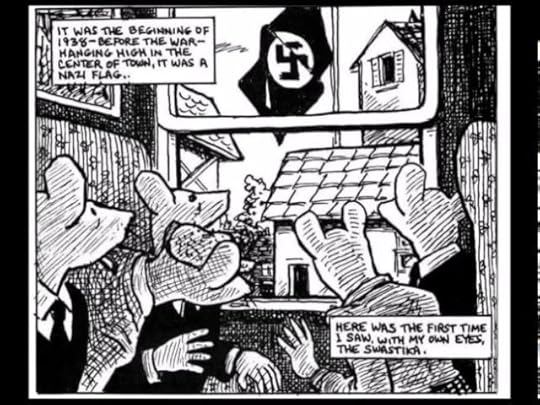
Maus I and II by Art Spiegelman
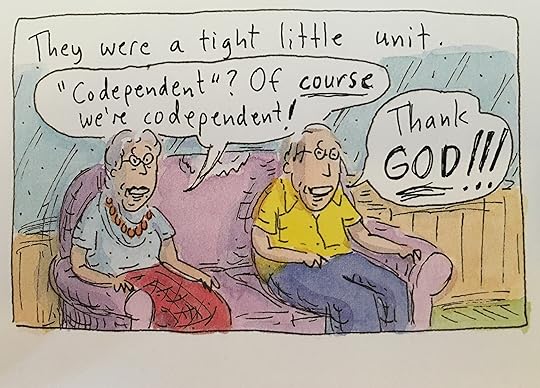
Can’t we Talk about something more Pleasant? By Roz Chast
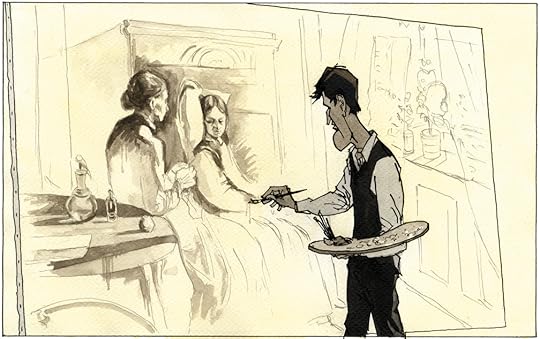
Munch by Steffen Kverneland
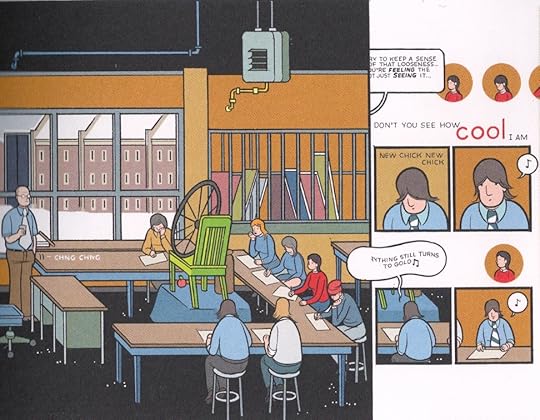
Acme Novelty Library # 20 by Chris Ware
My Friend Dahmer by Derf Backderf
Jerusalem by Guy Delisle
Hostage by Guy Delisle
Fluffy by Simone Lia
American Splendor by Harvey pekar
Sabrina by Nick Drnaso
The Poor Bastard by Joe Matt
Spent by Joe Matt
The carter Family : Don’t Forget this Song by Frank M Young
Update, eleven years later, 1/21/26!: Reread in conjunction with Spring Graphic Novels course, the early focus of which is wordless graphic novels, where we are forced to read images, not words, in order to make sense of the text. And to be challenged to consider the possibility that theses images may not conform to expected narrative-sense-making conventions at all. I have not yet seen the 2024 film adaptation , but am now intrigued. I see that the film is also non-linear, and invites you to consider that this tract of land has been occupied by many different kinds of objects, people, buildings, and so on. I guess many of us tend to think of many buildings, even the houses we live in, as somehow permanent--that store down the street, that park I have always gone to--but we see from this book that change is always happening, impermanence is always happening, we can't count on things always being here. There's an environmental message here, of course.
Original review 1/20/15: I read this a a couple months ago and was convinced it was a great work but couldn't exactly say why, which is a particularly lame reviewing comment, worthy of stopping yr reading right there, maybe. I have now read it 3 times and will read it again, but thought I would pause to say I read it one of these times in a classroom with maybe 15 really smart senior undergrads and grad students, all English majors, only one with any art background, some of whom had just wrestled with Ware's also formally challenging Building Stories. And we (the class) still can't exactly figure all of it out but I think we all all into it. On one level, it is clear that it is a meditation on time and space, as it explores one specific location on the planet over human history and the future. There are almost no words, except those incidental to a scene, so it is mainly silent, and none of the words reveal anything approaching a story. So it's essentially non-narrative--except that space/time aspect--a pastiche or collage of visuals, sometimes whole pages devoted to one scene, sometimes many pictures on a page, some all in the present, some extending over multiple years. Each picture is dated, so with some work you can begin to construct mini-narratives or anecdotes about various aspects of the book. Some sense of history.
This book began with a 6 page comic in RAW in 1987 and now, more than a quarter of a century later, we get this fully realized gorgeous volume that extends some of the principles that most comics artists at the time and thereafter recognized as revolutionary. I am a narrative guy, like most people, so initially couldn't see the big deal, but I think in part this is because I don't have enough comics or art background, and because the point of this representation is that it is NOT fundamentally a story. It uses the comics medium to explore a series of interrelated concepts. It's a conceptual or abstract comic; it's also a meta-comic, about what it is the comics medium can do to represent the space-time continuum in ways other arts cannot. And McGuire is also a filmmaker, so he knows that difference. And a musician, with Liquid Liquid. And an illustrator, and maker of picture books for all ages.
So in my class we decided to each take one aspect of the book that interested us--color, animals, children, narrative, whatever--to see if we could assemble a kind of collective interpretation of the book. And patterns form. But I think I really like this work in part because I don't quite fully understand it, because it bears rereading and mining for meaning. It's not obvious in the least what it is about. Like the best art, not easily reducible to written comprehension.
Chris Ware, no stranger to conceptual and meta-comics himself, wrote a review of it in The Guardian that acclaimed it as the greatest comics accomplishment of the new century. He may just be right. It is not particularly emotionally engaging, not being grounded in the personal lives of persons, but on the level of ideas it is definitely engaging.
Let me start with this: I'm prepared to admit that I might be wrong. This might be a really good book. A lot of people I respect, people whose opinions I respect, really dig this. I don't want to convince anyone they're wrong, and I don't want to change anyone's mind. I disliked the book, and I feel compelled to say why, maybe only to explain it to myself.
With that out of the way...I don't think I really understand this book. Or understand its appeal.
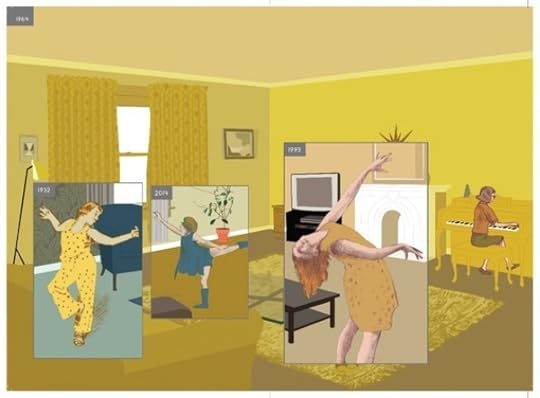
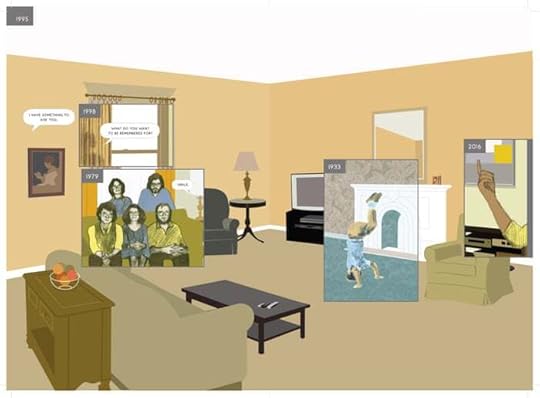
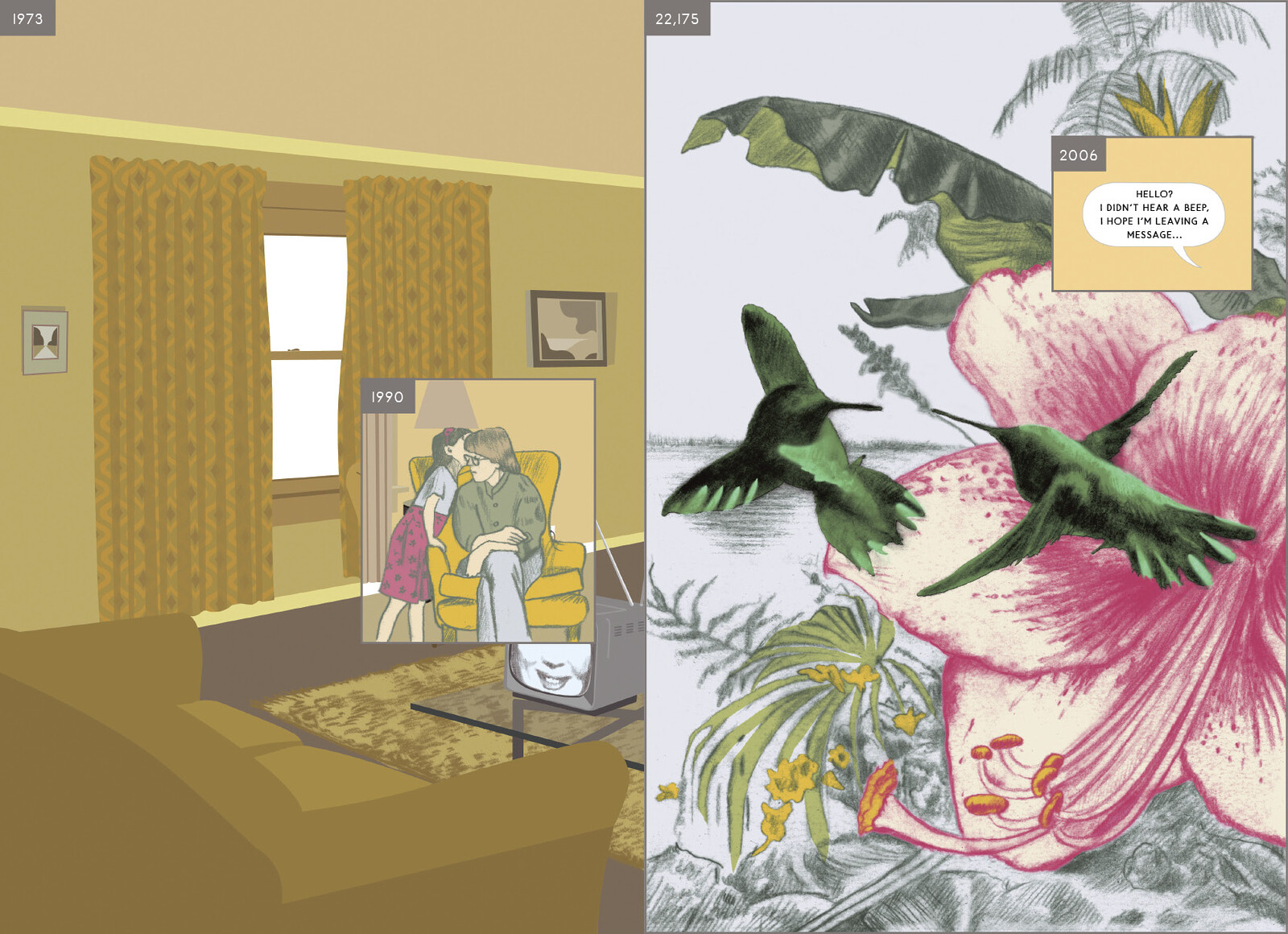
The premise is this: Take a framed scene, in this case a living room, and then imagine what happened in that space throughout the history of the planet. Swamp days, natives hanging out, the 60's, the 70's. What the book does is to show this same space, and through the use of frames, show what happened there throughout time. Sometimes the bulk of the image is the house in 1971, while a small frame in the middle shows a bird flying through, which happened in that space in 1654. The basic idea.
And I think my problem is, I didn't see a lot going beyond that premise. It's an interesting premise, but I didn't feel like it was 300+ pages interesting. Also, it's total fiction.
For me, a fiction is only as strong as its combination of voice and story. An imbalance in those two can be made up for by one or the other. A boring story told really well can still be pretty compelling. Think David Sedaris. A great, great story told in a mundane way can still work. I read a memoir by a guy who contracted HIV, and although the prose wasn't super, he was really open and honest about how his life works now, and that meant that the book worked.
In this book, there is essentially no voice. The reader is an omniscient observer floating in the corner of this space. There is very little written dialogue. The art is pretty, but I would say it's more accurate than anything. Accuracy isn't a crime, but I think accurate, architectural art feels less voice-y than something more stylized. Again, not a criticism of the art, but an expression of the fact that I didn't feel the art style could stand in for a narrative voice.
So what about the story?
I didn't feel like there was a lot of story either. Stuff happened. But it was minor stuff. Which I suspect is the point here, that a million minor things all happened in this one area, and that means there's a story. But the stories within are things like "A man hangs a deer head on the wall, which his partner does not care for." "An old man falls out of a chair." "Benjamin Franklin(?) argues about the monarchy."
Here's the thing: I think this book definitely relies on the reader to do the heavy lifting. Which I am somewhat able to do. But I also think this book, the appeal is about the reader doing the heavy lifting outside the story. Imagining all the things that happened in her office, all the stuff that happened on that spot throughout history. Imagining all the things that happened where a guy plays pool. If you read this book, it can help in that it gives you a very zen experience the next time you're in line at the post office and it sucks. You can just think about how this spot probably used to be a literal smelly hellpit bog instead of a metaphorical one.
My writing teacher has a saying that he likes to break out when a writer is concerned that his or her work is too mundane. Too navel-gazing. He says, "You can tell a boring story about an exciting person, or you can tell an exciting story about a boring person, but you can't tell a boring story about a boring person." That's how I felt about this book. The story didn't excite me, and the way it was told was very static.
I recognize that the very things I disliked about it are at the very core of the story and the way it was told. That my reasons for disliking it are kind of the purpose of the entire thing.
Oh, wait. I have one more thing about this.
I'm sorry, I know it's a fictional story, but it all felt so damned convenient. All this stuff happened in this one spot. Natives had sex on this very spot where Ben Franklin argued with some redcoat jagoff!
It feels like genealogy to me. I have never in my life heard from someone who is interested in genealogy who discovers that he is related to absolutely no one of interest. That his family is very basic, never did anything exciting, and never made history. But let's be honest. 99% of humans on this Earth will not do anything on a level of interest that warrants keeping track of. Most people are born, they write some bad book reviews, and then they die. Most of us will be branches on the family tree that are used only as footholds in an attempt to climb up to the point of a person of interest. After I die, some distant relative will step on my proverbial branch-y face to reach up to the next branch in hopes of climbing to the point of being related to Abraham Lincoln or something.
As most people are uninteresting, I think most of the square footage on this planet is also probably VERY uninteresting. Yes, I'd totally watch a time-lapse of my apartment from the dawn of time until now. But would I ever re-watch it? I have seen all of 'Black Mirror' so maybe, but it's pretty unlikely.
So while it's fun to think about, it's less fun if you're a pessimist like myself who kind of feels like things are way less interesting that most people think.
Oh, I have another, last thing to say.
This book fits into a sort of This American Life idea, which is the idea that every person has a story, and every story is interesting. Which I think is false. Someone much smarter than me pointed out that This American Life isn't just a great idea. It's not just a matter of walking up to someone on the street and pointing a microphone in their face and saying, "Tell me your best story." It's a well-produced show that's very thoughtful, and the stories they tell are ALMOST NEVER mundane, boring stories. They represent, perhaps, boring sectors of our lives, but the stories themselves are almost always remarkable or take a remarkable twist on the ordinary. A father taking his baby for a walk is very unremarkable, but if that father was totally blind and taking on fatherhood, now that walk is interesting.
Or take Found Magazine. It's composed entirely of found notes. Let me tell you, pick up every note you see, and almost all of them are unexciting or uninteresting. You get some gems, and it's worth it because, what the hell, I'm not above bending down to snoop in the life of a stranger. But as someone who has done this for years, who feels a tremendous guilt and thinks about it all day when he bypasses a folded note, I'm here to tell you that MOST times you pick up a note, it's a bust.
I'm somewhat against the idea that everything is extraordinary. The idea is a little...well, I don't understand why people who work very hard to create great works want to promote that idea, why they want people to think that they aren't working hard. In my own work, I don't screw from the rooftops how great something is, but if someone asks whether or not it's a lot of work, I'm never shy about saying, "Yes, writing and polishing that 1,500 words was a lot of work. It took a lot of time and effort." If someone asks whether podcasting is hard, I have no problem saying, "The recording is the easiest part. You have to master the file, get it online, and you have to get a feed that takes it all into iTunes, and there are about 1 million ways to screw this up. Yes, setting up that framework is a lot of work."
I guess I should wrap this up. And I'll just say my piece in a much briefer format.
1. I think this book lacks a voice.
2. I think the stories contained in here are not very meaningful (the exception being the joking old man at the end, who I enjoyed).
3. I think this book continues this idea that interesting things JUST HAPPEN if you dig beneath the surface. That fascinating material is just there waiting as opposed to created and honed through lots of hard work.
Okay, this is the third time, but this is REALLY the final thing.
Picture a room in your home. Do you know what that same room looked like 10 years ago? 20 years ago? Can you imagine what that space looked like 100 years ago? 1,000 years ago? What will it look like in the future?
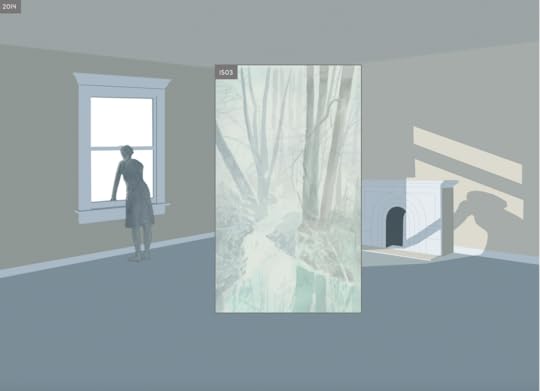
Richard McGuire tried to answer those questions in this graphic novel. The book opens to a nearly empty room in 2014; we see a sofa, a window and a fireplace. Each turn of the page brings another drawing from the same perspective, with the year in the upper corner. Sometimes there is a family in the room, sometimes the house hasn't even been built yet and we see the woods, a stream, animals.
Truly, this graphic novel left me speechless. It is an extraordinary collection of drawings of the same space over time. Besides 2014, other pictures are from 1998, 1943, 1907, 1870, 1775, and all the way back to 3,000,500,000 BCE. We also glimpse the future: 2051, 2313, and year 22,175.
I loved McGuire's imagination of the space, especially of what the future may hold. I was so entranced with this book that when my husband asked me what I was reading, I hesitated because I was't sure how to describe it. Finally I muttered, "A graphic novel."
This book is thoughtful and stunningly beautiful. I highly recommend it.
جمعهی پیش خونهی مادربزرگم دور هم جمع شدیم. خونهی مامانی عزیزم که حالا پنج ساله نیست و البته من فکر میکردم دو سالی بیشتر نگذشته
دم در که زنگ رو زدم پرت شدم به سالها پیش که خیلی کوچیک بودم. خونهی ما دو تا خونه با این خونه فاصله داشت و با دختردایی و پسرداییهام اونجا ناهارمون رو خوردیم و رفتیم شب رو پیش مامانی بمونیم. تا رسیدیم اونجا برق رفت و همه جا تاریک تاریک شد. سرش رو از بالکن آورد بیرون و برامون کلید انداخت. گفت کلید قرمزه مال در پایینه و ما چون تاریک بود کلید قرمز رو نمیدیدیم. زدیم زیر خنده و انقدر خندیدیم که عصبانیش کردیم. میگفت تخم جنها چرا میخندید؟ آخر چادر سر کرد و اومد در رو باز کرد
انگار یک تصویر روی این تصویر پرت میشه و میرم به سال ۹۱ که از دانشگاه اومدم و چون میخوام از خونه فرار کنم خودم رو رسوندم اینجا که کنارش چایی بخورم و اخبار ببینم، بعد خودم رو توی اتاق حبس کنم. صداش از آیفون رنگ خوشحالی داره
تصویر بعدی با دختر خالههام ایستادیم پشت در و همدیگه رو بغل کردیم و زار میزنیم. داییم دیشب فوت کرده. دایی عزیزم. بالا همه چیز سیاهه، همه سیاهن. برای اینکه بتونیم نفس بکشیم اومدیم پایین
همونجا با مامانی وایسادم و شاید ده سالمه. رفتیم از حسنآقا شیر کیسهای و بستنی عروسکی گرفتیم و اومدیم. داره دنبال کلیدش میگرده
از مدرسه دارم برمیگردم و میرم جلوی مینیبوس به آقای عبداللی میگم که امروز میرم خونه مامانیم. جلوی در پیادهم میکنه و همینجوری که با چادر عربیم دو تا پله رو میپرم پایین پشتم میگه برو زورو. مامانی از بالکن داره نگاهم میکنه
خرداد نود و هشته. پشت در منتظرم که در رو باز کنن. دل اینجا اومدن ندارم. نمیتونم بیهوش دیدنش روی تخت رو تحمل کنم. ولی از دو روز پیش بدجوری بیقرارم. دیروز به مامان گفتم من فردا کلاس ندارم و میام اونجا. پرستار در رو باز میکنه. این پا و اون پا میکنم. این همون روزیه که بالا سرش وایمیستم تا آروم آروم نفسهای آخرش رو بکشه
اینجا جلوی این در میتونم تموم این لحظهها رو در یک لحظه زندگی کنم. انگار هزاران نسخه از من اینجا ایستاده. بارها جایی رفتم و فکر کردم جای من کی ایستاده بوده؟ چه میکرده؟ روی این نقطه از زمین چه گذشته؟ و این کتاب همونه. تصویرهایی از یک مکان در طول زمان. از گذر زندگی. از تلخیها، خوشیها و بیشتر از همه معمولیها. کتاب با تصویر یک کنج از اتاق نشیمن شروع میشه و ما جریان زندگی رو در این نقطه تماشا میکنیم. به خودم اومدم و دیدم که مسحور این سادگی شدم و بغض گلوم رو گرفته. «اینجا» داستان زیبایی و ناپایداری زندگیه
Who was here 20,50,160, 2000 years ago? Who (or what) will be here 10, 80, 180, 3000 years from now?? That's the simple idea, ingeniously illustrated in this graphic novel. A visual essay on the memory of the Past and the envisioning of the Future. More an aesthetic experience than an actual narration, there is indeed a plot in Here, or rather a suggestion of a plot, the details of which are to be filled in by the readers themselves. To be savoured in as few sittings as possible for the full effect of the experience.
A beautifully designed graphic novel paired with a genius idea that's incredibly well thought out. It tells the story of a corner of a room throughout the billions of years of its existence. The art is gorgeous, giving off a Richard Hamilton vibe that I adored. You can read it in a half hour, but you'll be thinking about it for quite a while after. And I'm sure to return to it multiple times and learn something new each pass. Definitely recommend this one.
Back in 1989, Richard McGuire's 6-page story "Here" appeared in Art Spiegelman's seminal Raw anthology. It depicted a random North American location at vastly different points in time, hinting in very vague and abstract terms at its history over a period of billions of years. Primarily, though, the story experimented with the formal properties of comics. Its panels were not organized in conventional ways, and the result was a tapestry of a narrative that heavily relied on reader participation.
Over the years, this formal experiment has influenced many adventurous cartoonists, ranging from the Bros Hernandez in the 1990's to Chris Ware (who famously described the experience of reading "Here" as "life-changing") in the 2000's to Ray Fawkes in the 2010's. Eventually, McGuire himself decided to revisit his own 6-pager, spinning out of it this whopping 300-page graphic novel of the same title. So does the expanded version have anything new to offer? As you can tell from my rating, I think it does.
Designed to expose the limitations of conventional perspectives on the potential of comics as well as on our role in the grand scheme of things, the original 6-pager was a kick in the head - the comic-book equivalent to a really good two-minute punk rock song. It shook things up by hinting at the existence of long-forgotten but fundamental truths, at a bigger picture that tends to remain hidden in contemporary everyday life. However, there simply was not enough space to explore this bigger picture.
To be sure, the expanded version still does not spell everything out for us; its language is every bit as loose and cryptic as the original’s. Yet by providing a much wider range of moments in time, it allows the reader to gain a more profound sense of the themes the original version merely insinuated: the evolution of life, the rise of the human species, the ways in which we have redefined ourselves and our environment over the centuries, and the significant consequences of these developments for all life forms.
If the original 6-pager had the punch of an in-your-face punk rock song, then the experience of reading this expanded version brings to mind the 1982 movie Koyaanisqatsi and its trippy, quietly unsettling meditation on the changing relationships between humans, nature, and technology. Highly recommended!
I don't read graphic novels at all. Just not my thing. But after reading a review of this here on GR, I was interested enough to request a copy from my library. The premise is simple. One corner of a room is portrayed over the course of millions of years in the past and the future. From the primeval ooze to the high tech reality of many years from now, we see a small window of events. The artwork is amazing. Quite an accomplishment.
this one is kind of hard to explain: but in a nutshell it's about this one room in an old house and how the space is used over time... before it was even a room, after it was a room, during it's use as a room.
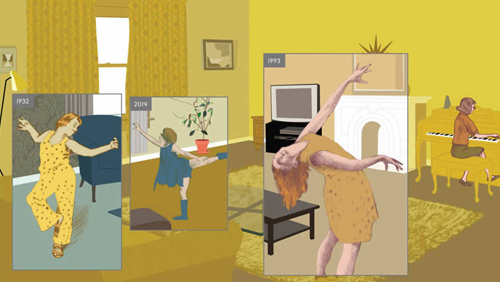
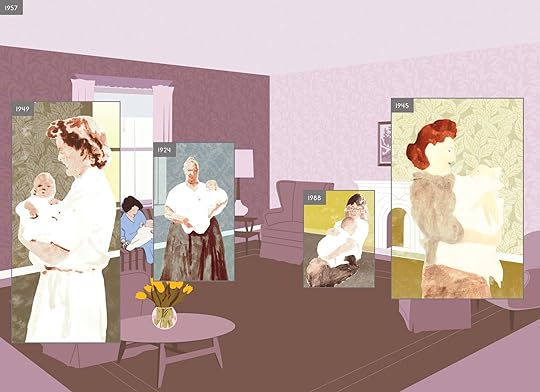
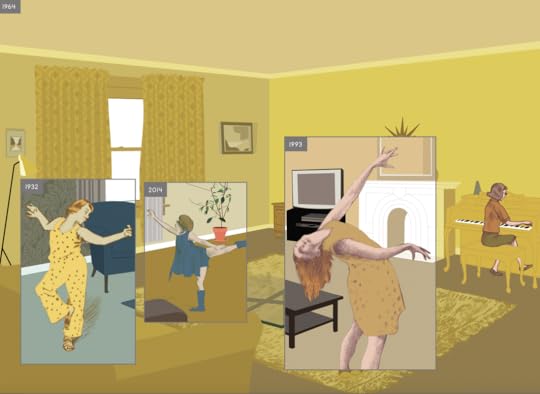
and the visuals are laid over each other so the room itself could be the room from 1960 but with people from 1950 and 2020 and 1900 inside. the narrative itself is all over the place, honestly i wouldn't even call it a narrative. but most of the pages and scenes have something central tying them together. so like misunderstanding, or aging or whatever.
i didn't love the art style in this, it was a little bleak to me and the colors were not something that really grabbed me. likewise the execution was a little bit confusing given that so much was going on at one time.
but i was left feeling things and i think that was the point. puts into perspective how short the human lifespan is, how we all experience similar things in this life, etc. i probably don't stop thinking about this one for a long time.
i wouldn't necessarily purchase this for myself, but i'm really glad i picked it up from my library.
The six-page comic "Here", which appeared in 1989 in "Raw" magazine, volume 2, number 1, was immediately recognized as a transformative work that could expand the possibilities of the comics medium. Its influence continues to be felt twenty-five years after its publication--back dust jacket flap.
This book has enchanted me.
Each spread is a collection of vignettes depicting what happened at a particular moment in time right here, in this space, the space on the pages. I feel it may be a place in Pennsylvania but I've never been to Pennsylvania so I have no basis of reference. It could just as easily be upstate New York. It's certainly someplace that was part of Colonial America.
Usually, the space is inside a house built in 1907 but destroyed in 2111. While the house is there, the window and fireplace, mantle and all, are permanent. Everything else changes. But nothing can stay the same forever and even those permanent pieces vanish, are undone as if they were never there to begin with.
There are patterns throughout the times, repetition and replication, from wallpaper and furniture-placement to activities that include moments of violence, of love, of sleep, of Benjamin Franklin, and sites of archaeological interest. Family, life, death, holidays, disappointments. Nature vs man, man vs man, technology vs nature. There are also little stories. You can find them by matching up the years throughout the pages and then putting the years in order.
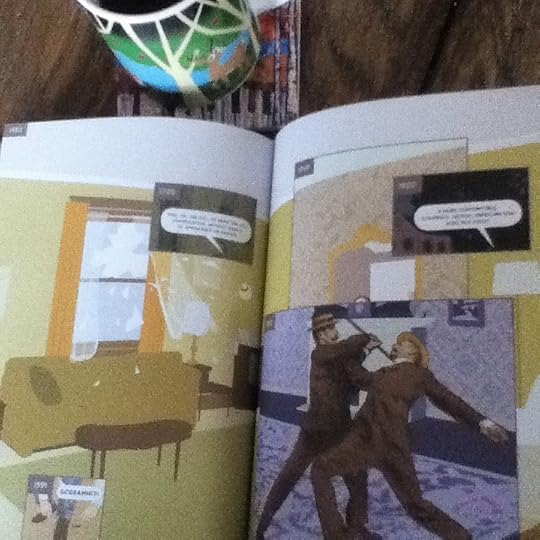
(the pictures are not that yellow. That's just my camera. The colors are soft, but not all greenyyellowy)
When a new family moves into the house, I was a little sad that the other family, who seems to have been part of this space for many years, was gone. But the new family seems to like their new home. In 2213, though, it's a historical site where a hologuide informs tourists that records indicate there was a house standing on this spot in the 20th and 21st century. 100 years later, it's not even that anymore but is, instead, an archaeological site. Again. Then nature reclaims it, as nature will, bringing it back to what it was like in 500,000 BCE. Cyclical, but so much happened while it was coming back around.
The entire history of this space takes place in the few moments it takes a housewife in 1957 to remember why she walked into the room.
This appeals to me, personally, because it makes visible one of my favorite past times - imagining all the lives, the memories, the moments that have happened or will happen in one space throughout time. We're all so involved in our own moments, which is not a bad thing, that it is sometimes surprising to remember there were other people there before doing their own things that were important to them. Will there be more people in the future or will another race of creatures be digging in the dirt where my living room was and will they find evidence of our humanity? What will that be like for them? Will we know we're being remembered? I love playing that game and it is just as satisfying to see it drawn out in the pages of Here.
I absolutely adore this book, this story of temporary and eternal permanence; this space will be here forever (unless a black hole gets it) and it will never go anywhere, though everything in and around the space will change forever. I imagine it's the type that you can look at over and over and find something new, understand something more. Also, I would like a print of the cover. I like that cover a lot.
From the publisher: Richard McGuire's Here is the story of a corner of a room and the events that happened in that space while moving forward and backward in time. The book experiments with formal properties of comics, using multiple panels to convey the different moments in time. Hundreds of thousands of years become interwoven. A dinosaur from 100,000,000 BCE lumbers by, while a child is playing with a plastic toy that resembles the same dinosaur in the year 1999. Conversations appear to be happening between two people who are centuries apart. Someone asking, "Anyone seen my car keys?" can be "answered" by someone at a future archeology dig. Cycles of glaciers transform into marshes, then into forests, then into farmland. A city develops and grows into a suburban sprawl. Future climate changes cause the land to submerge, if only temporarily, for the long view reveals the transient nature of all things. Meanwhile, the attention is focused on the most ordinary moments and appreciating them as the most transcendent.
Wat schrijf je over een boek als dit, zonder ook maar iets van het gaandeweg groeiende, verwondering-wekkende effect te spoilen?
Dat 'Here' nooit twee keer dezelfde plek kan zijn, zoals je volgens Heraclites nooit twee keer in dezelfde rivier kan stappen. Panta Rei in graphic novel-vorm, zeg maar.
Een boek waarin je leert terugbladeren. Dat je ook geheid zal herlezen en dat dan al niet meer hetzelfde kan zijn (wat trouwens van toepassing is op alle boeken die je herleest, vermoed ik).
Windows voor gevorderden? Voor tijdreizigers? Want naast het originele uitgangspunt zijn vooral de welgeplaatste tijdframes vindingrijk en dus fascinerend.
Vormgeving is nog zo'n troef van Richard McGuire. Na de aanvankelijk wat saai ogende digitale kamerhoeken, duiken steeds meer verschillende stijlen, kleuren en technieken op. Prikkelend!
'Here' behoeft wat mij betreft geen verfilming door Robert-Forest Gump-Zemeckis met Tom Hanks en Robin Wright. Het kunstwerk heeft voldoende aan zijn eigen innerlijke, beeldende zeggingskracht.
Ik laat het boek voorlopig nog een tijdje Hier liggen, op mijn vaste leestafel naast mijn vaste leesplek met mijn immer wisselende leesuitzicht. Om te grasduinen hoef je namelijk niet altijd naar zee.
"اینجا" کتابی هست که باید «تجربه» بشه. خوندنی نیست؛ یا حتی تماشا کردنی.
مکگوایر از یه ایده بکر (که همون سال ۱۹۸۹ هم الهامبخشِ یه رهیافت جدید به پلتفرم کامیک بود) استفاده کرده تا مُراقبهای داشته باشه در عنصر زمان. به این ترتیب که در اینجا، «اینجا» یه اتاق نیست، یه «مکان» هست و مکان هم یه کلاژ هست از زمان. در Here نه تنها زمان خطی (linear) نیست، بلکه مکان هم ایستا نیست و تنیده در غیرخطیبودنِ زمان (Nonlinearity of time).
جایی ندیدم که مکگوایر به الهام گرفتن از کتاب "بوطیقای فضا" ( The Poetics of Space by Gaston Bachelard) اشاره کنه ولی این دو اثر بی اندازه به هم شبیه هستن و ا��بته هر چقدر فلسفه بَشِلار برام غیرقابل قبول و دور از منطق بود، در Here فلسفه در هنر ادغام شده و از مخاطب «درک منطقی» طلب نمیکنه و در پی خلق حس هست و این اون چیزیه که در هنر دنبالش میگردم; همون کاری که شاعر [در شعر مدرن غربی] هدف خودش می دونه اینجا در فرمت کمیک داره بروز پیدا میکنه.
نگاه مکگوایر به زندگی، پوچگرایانه اما خوشبینانه ست. این ممکنه پارادوکسیکال به نظر بیاد اما باید دقت کرد که مکگوایر با اینکه زندگیِ فرد رُ محتوم به مرگ میبینه اما «زندگی»، خودش به عنوان یه پدیده، همواره در جریان و پایان نیافتنیه.
در کل Here هم از نظر فرم، هم از نظر روایت و هم ایدهای که می خواد اتنقال بده شگفت انگیز و پرملاته و به تک تک شما پیشنهاد میکنم یک ساعت وقت بذارید و تجربهش کنید لطفاً.
Richard McGuire’s Here looks at a corner in a living room through the ages. Using the same angle throughout, McGuire shows us what the corner looked like from millions of years ago to thousands of years in the future with everything in between.
So one page will show the corner of the living room in 1957 where a child sits playing with a toy, then in the corner of the page will be a cat walking through in 1999 and the framing might be from 1821 where it wasn’t a house yet and was simply a field.
There’s no narrative and it’s all about this concept of focusing on a single simple part of a room in a house, using it as a window through history with glimpses of the lives lived in this part of the world. The babies who became children who became adults who had babies who became children, and so on and so forth.
I’d never heard of McGuire’s original 6 page strip that appear in Art Spiegelman’s Raw magazine in 1989 but you can easily find this online and read it for yourself. Apparently it was “ground breaking” and showed the enormous potential of comics though I don’t really see its importance in those 6 pages. Comics, like many forms of storytelling, have always used time jumps to tell some stories - putting them together on a page as part of a collage doesn’t really strike me as all that brilliant. In fact I’m pretty sure I’ve seen it done before in other art.
This expanded 300 page book utilises the same idea without building upon it. It’s the same approach on every page that repeats itself over and over and then just ends. I’m not sure what the effect he’s going for in this extended version of Here. We’re all mortal? Nothing lasts forever? Does he really think these thoughts haven’t already been thought a zillion times already?
In fact, if you arranged it so that the various images lined up linearly from oldest to present to future, the comic would have the same effect. It’s completely all about style over substance.
Sure it’s not black and white like the original 6 pages, it’s in colour and looks great, and there is a hint of a narrative dropped in there, but I feel like McGuire achieved the same thing in 6 pages more than 25 years ago that he did today in 300 pages. Here is a fine arty comic though it isn’t nearly as impressive as some would have you think.
I've known the basis for this book since my mother gave me her copy of Raw Volume 2 Number 1: Open Wounds from the Cutting Edge of Commix that included the seed for this, which blew my mind as I read it on my parents' downstairs toilet while home for Xmas in 1991 to be exact. At grad school I presented a Xerox of the Raw pages in Edward Carey's seminar on the use of images in fiction after hearing Chris Ware talk about McGuire's piece in Raw #2 as the temporal inspiration for his work, how it blew open the regular conventional comic book frames and presentation of time. Although I loved this, it felt like an extrapolation that came a little too late, the innovator's attempt to match the work of those he later influenced? That is, it's difficult to read this now without thinking about Chris Ware, as though Ware influenced it in a backwards Borgesian sense. It's a totally lovely way to spend an hour, though. Highly recommended to anyone interested in graphic novels or the telling of time in storytelling of any sort.
How much does the space and time we occupy resonate into the past and the future? This graphic novel reminds me of several episodes of The Twilight Zone when dimensions intersect and collide.
Sin ninguna duda ¿leer? Aquí será para cualquiera una experiencia, parece que gratificante para la mayoría, algo desconcertante para mí. No he sido capaz de ver eso que tiene de especial, lo que la convierte en inolvidable, incluso en obra maestra.
El punto de partida me parece atrayente y como experimento despertó mi interés al principio: el espacio permanece inmóvil, un punto fijo, siendo la mayor parte del tiempo el rincón de una habitación, aunque también vemos la época anterior a la construcción del edificio y un futuro en el que ya no existe, y es el tiempo el que se desplaza, miles y miles de años pasan por delante de nuestros ojos, sin ningún orden.
El presente, el pasado y el futuro se mezclan en la mayoría de las páginas, mediante imágenes superpuestas, utilizando para cada época un estilo de dibujo diferente, como si todo ocurriese a la vez, como si el tiempo no hubiese transcurrido, porque al final todo se reduce a la misma historia insignificante: risas, muerte, juegos, fiestas, mudanzas... Todo cambia sin cambiar en absoluto, y como dice un hombre en 1775, la vida tiene el don de rimar momentos. Y plasmar esto a través de imágenes, prácticamente sin diálogos, es todo un logro, pero yo no he conseguido disfrutar de esta historia sin historia, no hemos conectado, y frente a eso no hay nada que hacer.
This is not even a graphic novel; it's a work of art.
Over the course of 300 pages, Richard McGuire's comic strip collection Here displays the events and inhabitants of a corner in a single room throughout history, spanning the timeline of Earth itself—from a time when dinosaurs were roaming around the planet, over a time when Native Americans built a burial ground on the site and colonialists took over, up to the life of a married couple who spend their life in the house during the 20th century, and way into a future where remnants of our civilization are looked at from a similar perspective as the way we look at life hundreds of years ago today.
It's a unique concept brought to life with staggering images of visual art. The production design here is impeccable, with this single room changing shape and design so seamlessly and rapidly that it makes you wonder about how your own room, the place where you're currently reading this, has changed over the course of history, how it will change throughout the future.
Time never stands still. What looks like the room we know today looked totally different one hundred years ago. Two hundred years ago, it was even more different. A thousand years ago, you might not recognize a single bit. How will it look like one hundred years from now?
My initial reaction to the trailer for Here was what in the CGI nightmare factory is THIS?!?!?!?! My second reaction was to go see if it originated as a book . . . obviously. Of course my fantastic library system had a copy so I checked it out right away. What a fantastic premise this graphic novel is. With mainly imagery and little dialogue this is the story of what happened “here” in a particular location from 500,957,406,073 BC to 2313 AD. A great addition for collectors.
quando si dice finestra di dialogo. la differenza fondamentale tra me e richard mcguire sta nel fatto che, guardando la prima interfaccia grafica di windows, a lui venne l'idea di quest'opera geniale. io rimasi soltanto istupidita davanti allo schermo. mi limito a una chiosa in parallelo tra il primo delizioso libro di mcguire, the orange book, e questo. là le immagini essenziali raccontavano una storia centrifuga: il destino di 14 arance (non so perché quel numero, ma mi piace) raccolte dallo stesso albero e finite ciascuna in un posto diverso. qui è invece uno storytelling centripeto fin dal titolo. zoom sull'angolo di un salotto, e uno accanto all'altro (sopra, sotto, laterali, sovrapposti) riquadri con i flash di quello che è successo in quello stesso posto decine di migliaia di anni prima e dopo di noi. scott fitzgerald sbagliava: la vita non si osserva meglio da una finestra sola.
Graphics can tell such a story! This entire book takes place in one corner of one room and tells the history of that spot, from millions of years BCE to 2300 AD. It's remarkably done. It makes one think of tim; all the forgotten, everyday history, the present and the coming history of each spot in our world. Each spot has a continuing story to tell, even the corner of a room.
I have been waiting for 4 years to read this graphic novel. It would cost me 3 times to get this book delivered to my country - so, it never worked out! 😞 Recently I've found that this book is available in my current institution's library. However, somebody checked it out before I could avail and now the book is due in the Feb of 2022. 🙄 It felt like a joke! So, in the end I got a copy for myself. 🤗
Richard McGuire's "Here" is the past, present, and future of a single space 🙂 That afternoon while unlocking the door of my apartment, I looked through the window in the corridor, saw the bright sunshine out there, I was thinking on "Topic A" and it suddenly occurred to me, "Did other people, who lived here before me, ponder over something while unlocking the door and looking out through the corridore window?"
Kundera said that gestures are limited - so the same gesture would be repeated again & again by many people- either rediscovered, adopted, picked, or improvised. So, I hope this same gesture was carried out by others who stayed in this place before me.
Some days I lie on the floor and think - what events might have taken place "Here" and what events I would add during my stay "Here". I thought I wouldn't leave any sign/ spot/ dent in this space but that's easier said than done. I've already left two of my signs "Here" despite being very careful throughout and those couldn't be reversed. Then it occurred to me maybe some dents couldn't be mended and should be left as it is.
This book is like that, snapshots of different people who captured the same space of a house at different time periods. Last November I visited the house where we used to live 19-20 years ago. I was comparing my mental images of the room from 2001-2 with that of the 2020 for the people who were currently living there... This book is just like that ~
So many breaths, stories, memories, dreams, laughter, joy, pain, sorrow, tears, growth, and decay of so many different people - captured "Here" in this space!!! 🙂
A very original concept, a sort of time scape of the corner of the living room in different eras, from the prehistoric times through later periods when there was a swamp, then forest with the Native American settlers, and then several generations of inhabitants after the house was built (1907) to the far distant speculative future. Since I live in a house that is over 130 years old, often exploring its past and filling the gaps by imagining those who lived here before me, I was most drawn to the visual panorama of different generations inhabiting the house, each era sparsely but effectively marked with staple furniture, color, jargon, parlor games...
Moving in with anticipation or moving out with nostalgia?
Thanks to a GR friend Violeta whose wonderful review opened a window, as on the book's cover page, into this fascinating graphic journey.














![Profile Image for s.penkevich [hiatus-will return-miss you all].](https://i.gr-assets.com/images/S/compressed.photo.goodreads.com/users/1735525095i/6431467._UX200_CR0,11,200,200_.jpg)