

What do you think?

Lost: Amelia Earhart's Three Mysterious Deaths and One Extraordinary Life
Unravel one of history's greatest mysteries in this spellbinding narrative exploring three leading theories of Amelia Earhart’s tragic disappearance.
When Amelia Earhart’s plane disappeared in 1937, the clues poured in, attracting wild conspiracies about her tragic fate.
In Lost, former National Geographic reporter Rachel Hartigan delves into Earhart’s disappearance, introducing a host of eccentric characters who have become obsessed with finding the truth. Did the great aviator crash land near the Marshall Islands, only to be captured by Japanese soldiers? Did she manage to land on Nikumaroro Island but die of injury or starvation? Or did she run out of fuel and crash into the ocean?
Interspersed with the search for Earhart is the story of her extraordinary her unstable childhood, her itinerant early career, and how a PR-savvy publisher transformed her into an aviation icon and became her husband in an unconventional marriage.
In the spirit of nonfiction blockbusters like The Lost City of Z, Hartigan draws us into the world of Earhart's devotees and unspools a beguiling tale. The theories lead Hartigan from the pilot's birthplace of Atchison, Kansas to an expedition on a remote Pacific Island, where forensic dogs attempt to recover a potential sample of Earhart’s DNA.
As tantilizing new evidence mounts, Hartigan and her fellow investigators descend deeper into a world of conspiracy and obsession. Through its irresistible characters and prodigious research, Lost reveals not just why we remember Amelia Earhart as a trailblazer and adventurer, but why unsolved mysteries keep us forever searching for answers.
When Amelia Earhart’s plane disappeared in 1937, the clues poured in, attracting wild conspiracies about her tragic fate.
In Lost, former National Geographic reporter Rachel Hartigan delves into Earhart’s disappearance, introducing a host of eccentric characters who have become obsessed with finding the truth. Did the great aviator crash land near the Marshall Islands, only to be captured by Japanese soldiers? Did she manage to land on Nikumaroro Island but die of injury or starvation? Or did she run out of fuel and crash into the ocean?
Interspersed with the search for Earhart is the story of her extraordinary her unstable childhood, her itinerant early career, and how a PR-savvy publisher transformed her into an aviation icon and became her husband in an unconventional marriage.
In the spirit of nonfiction blockbusters like The Lost City of Z, Hartigan draws us into the world of Earhart's devotees and unspools a beguiling tale. The theories lead Hartigan from the pilot's birthplace of Atchison, Kansas to an expedition on a remote Pacific Island, where forensic dogs attempt to recover a potential sample of Earhart’s DNA.
As tantilizing new evidence mounts, Hartigan and her fellow investigators descend deeper into a world of conspiracy and obsession. Through its irresistible characters and prodigious research, Lost reveals not just why we remember Amelia Earhart as a trailblazer and adventurer, but why unsolved mysteries keep us forever searching for answers.
320 pages, Hardcover
Published March 3, 2026
Ratings & Reviews
Friends & Following
Create a free account to discover what your friends think of this book!
Community Reviews
Displaying 1 - 30 of 210 reviews

June 8, 2026
“If the Electra is ever found at the bottom of the Pacific or if bones are discovered on Nikumaroro or anywhere else, what will that tell us? That [Fred] Noonan and [Amelia] Earhart suffered fear and pain in their last moments, that they knew irrevocably that they would never reach home, that their flight had come to an end. The mystery of their deaths may be resolved, but the deaths themselves won’t. Sudden deaths never are, as survivors know to their sorrow…”
- Rachel Hartigan, Lost: Amelia Earhart’s Three Mysterious Deaths and One Extraordinary Life
If feels more than a little reductive to fixate upon the death of Amelia Earhart during her attempted circumnavigation of the globe. After all, her years on earth amounted to far more than her final moments. Before losing contact with the world on July 2, 1937, she had gained worldwide fame as a pioneering female aviator. Though not the best pilot of her day, she was the best known, and used that notoriety to advance women’s rights. This is no small thing, given that for much of human history, roughly half the population has lived a subordinate existence, with individual freedoms arbitrarily curtailed on the basis of sex.
Reductive or not, the rather spectacular circumstances of Earhart’s death explain the reason her loss has overshadowed her existence. It would have been one thing if Earhart and Fred Noonan, her navigator, had crashed on takeoff, smashed-up during a landing, or fell like a meteor onto solid ground. In those instances, their deaths would have been ascribed to the inherent dangers of flying. The causes could have been easily explained.
But Earhart and Noonan did not do any of these things. Instead, they vanished.
In Lost, Rachel Hartigan provides a brisk survey of the three prevailing theories regarding Earhart’s fate, while intercutting her disappearance with episodes of her fully-lived life.
***
Lost proceeds along two different timelines.
Much of the book is an exploration of the three main theories – alas, no alien abductions here – as to the final resting place of Earhart and her Electra airplane. The exploration of these theories involves elements of historical research, noting how each was developed and supported over time. There is also a bit of travelogue and memoir mixed into the proceedings. Hartigan is a journalist for National Geographic. As a result, she has interviewed many of the individuals devoted to solving the Earhart riddle. Hartigan also accompanied several different expeditions to the Pacific Ocean, as various hypotheses were tested out.
Hartigan intercuts the search for Amelia Earhart with a slimmed-down biography that charts her journey toward immortality. The biographical sections are essentially structured as flashbacks, though they occur in chronological order in date-stamped chapters to avoid confusion.
As a fan of overlarge, multivolume biographies, I was a bit skeptical about getting anything from this extremely concise overview. The entirety of Lost is less than three-hundred pages, while the chapters devoted to Earhart’s pre-crash journey comprise only ten of twenty-two chapters. This is not a lot of space to provide a detailed look at anyone, especially not a person like Earhart. Somewhat to my surprise, I found Hartigan’s just-the-highlights approach to be effective. It describes the big events, gives context to Earhart’s famous final act, and adds a human dimension to what otherwise might have been a solely clinical work of detection.
***
Though the backstory chapters are good, Lost’s central concern is on Earhart’s afterlife. In particular, Hartigan dives into the world of Earhart searchers who have devoted significant portions of their own turn at the mortal wheel looking for evidence of her crash site.
There have been many proposed scenarios over the years, some wilder than others. Hartigan narrows her scope to three in particular.
The first – and least likely – is that Earhart and Noonan crashed, were captured by the Japanese, and were later executed. There is precious little support for this notion, and a lot of logistical reasons it could not have happened. Furthermore, as Hartigan explains, the birth of this tale involves an extremely dubious eyewitness whose story grew more fabulous in the telling.
Next, there is speculation that even though Earhart and Noonan missed Howland Island, they managed to make a sea-landing near a different patch of land, thereupon becoming castaways. More specifically, tantalizing clues have suggested that pilot and navigator made it safely to Nikumaroro, where they lingered for a time before passing away. Unfortunately, even Robert D. Ballard – celebrated finder of the Titanic – could not pinpoint the airplane in the offshore waters.
The final – and simplest – explanation is that the Electra ran out of gas while trying to find Howland, and thereafter crashed somewhere in the wide blue sea. This feels very likely to me, though it is not an attractive proposition, for it is rather quick and unpleasant. Regardless, despite extensive efforts to survey some of the most likely parts of the ocean floor, the remains of the plane have not been located.
***
This material is handled crisply and professionally. The writing is clear and unobtrusive, with occasional stabs at deeper evocation. The pacing is quite good, and the nonlinear narrative works very well. Instead of being showy and superfluous, the framework meaningfully adds to the book’s impact.
Perhaps the only thing missing is true passion for the subject matter. Lost did not grip me as firmly as I had hoped, and I think this has something to do with the fact that Hartigan’s interest does not come close to matching the obsession of the people she is profiling. In short, it felt like Hartigan was on assignment, rather than chasing down a ghost that truly haunted her.
***
The text of Lost is all about finding the remnants of a pilot, her plane, and her navigator. The subtext is something deeper. There is no objectively important reason for this ongoing search. It occurred almost ninety years ago. Earhart and Noonan are dead and have been mourned. There is no lesson to be learned from their fate.
What we are really talking about here is the fascinating ways that people organize the principles of their lives. Life does not give you meaning; you give meaning to life. The folks in these pages have found that meaning in the hunt for Amelia Earhart’s resting place. This might feel foolish, macabre, even wasteful. Then you remember that most of us spend out brief span working jobs we hate to create wealth for the powerful, and you realize that they might have discovered something after all. Perhaps they never solve the enigma of Earhart’s last flight, but they seem to have unlocked the secret of a fulfilled life.
- Rachel Hartigan, Lost: Amelia Earhart’s Three Mysterious Deaths and One Extraordinary Life
If feels more than a little reductive to fixate upon the death of Amelia Earhart during her attempted circumnavigation of the globe. After all, her years on earth amounted to far more than her final moments. Before losing contact with the world on July 2, 1937, she had gained worldwide fame as a pioneering female aviator. Though not the best pilot of her day, she was the best known, and used that notoriety to advance women’s rights. This is no small thing, given that for much of human history, roughly half the population has lived a subordinate existence, with individual freedoms arbitrarily curtailed on the basis of sex.
Reductive or not, the rather spectacular circumstances of Earhart’s death explain the reason her loss has overshadowed her existence. It would have been one thing if Earhart and Fred Noonan, her navigator, had crashed on takeoff, smashed-up during a landing, or fell like a meteor onto solid ground. In those instances, their deaths would have been ascribed to the inherent dangers of flying. The causes could have been easily explained.
But Earhart and Noonan did not do any of these things. Instead, they vanished.
In Lost, Rachel Hartigan provides a brisk survey of the three prevailing theories regarding Earhart’s fate, while intercutting her disappearance with episodes of her fully-lived life.
***
Lost proceeds along two different timelines.
Much of the book is an exploration of the three main theories – alas, no alien abductions here – as to the final resting place of Earhart and her Electra airplane. The exploration of these theories involves elements of historical research, noting how each was developed and supported over time. There is also a bit of travelogue and memoir mixed into the proceedings. Hartigan is a journalist for National Geographic. As a result, she has interviewed many of the individuals devoted to solving the Earhart riddle. Hartigan also accompanied several different expeditions to the Pacific Ocean, as various hypotheses were tested out.
Hartigan intercuts the search for Amelia Earhart with a slimmed-down biography that charts her journey toward immortality. The biographical sections are essentially structured as flashbacks, though they occur in chronological order in date-stamped chapters to avoid confusion.
As a fan of overlarge, multivolume biographies, I was a bit skeptical about getting anything from this extremely concise overview. The entirety of Lost is less than three-hundred pages, while the chapters devoted to Earhart’s pre-crash journey comprise only ten of twenty-two chapters. This is not a lot of space to provide a detailed look at anyone, especially not a person like Earhart. Somewhat to my surprise, I found Hartigan’s just-the-highlights approach to be effective. It describes the big events, gives context to Earhart’s famous final act, and adds a human dimension to what otherwise might have been a solely clinical work of detection.
***
Though the backstory chapters are good, Lost’s central concern is on Earhart’s afterlife. In particular, Hartigan dives into the world of Earhart searchers who have devoted significant portions of their own turn at the mortal wheel looking for evidence of her crash site.
There have been many proposed scenarios over the years, some wilder than others. Hartigan narrows her scope to three in particular.
The first – and least likely – is that Earhart and Noonan crashed, were captured by the Japanese, and were later executed. There is precious little support for this notion, and a lot of logistical reasons it could not have happened. Furthermore, as Hartigan explains, the birth of this tale involves an extremely dubious eyewitness whose story grew more fabulous in the telling.
Next, there is speculation that even though Earhart and Noonan missed Howland Island, they managed to make a sea-landing near a different patch of land, thereupon becoming castaways. More specifically, tantalizing clues have suggested that pilot and navigator made it safely to Nikumaroro, where they lingered for a time before passing away. Unfortunately, even Robert D. Ballard – celebrated finder of the Titanic – could not pinpoint the airplane in the offshore waters.
The final – and simplest – explanation is that the Electra ran out of gas while trying to find Howland, and thereafter crashed somewhere in the wide blue sea. This feels very likely to me, though it is not an attractive proposition, for it is rather quick and unpleasant. Regardless, despite extensive efforts to survey some of the most likely parts of the ocean floor, the remains of the plane have not been located.
***
This material is handled crisply and professionally. The writing is clear and unobtrusive, with occasional stabs at deeper evocation. The pacing is quite good, and the nonlinear narrative works very well. Instead of being showy and superfluous, the framework meaningfully adds to the book’s impact.
Perhaps the only thing missing is true passion for the subject matter. Lost did not grip me as firmly as I had hoped, and I think this has something to do with the fact that Hartigan’s interest does not come close to matching the obsession of the people she is profiling. In short, it felt like Hartigan was on assignment, rather than chasing down a ghost that truly haunted her.
***
The text of Lost is all about finding the remnants of a pilot, her plane, and her navigator. The subtext is something deeper. There is no objectively important reason for this ongoing search. It occurred almost ninety years ago. Earhart and Noonan are dead and have been mourned. There is no lesson to be learned from their fate.
What we are really talking about here is the fascinating ways that people organize the principles of their lives. Life does not give you meaning; you give meaning to life. The folks in these pages have found that meaning in the hunt for Amelia Earhart’s resting place. This might feel foolish, macabre, even wasteful. Then you remember that most of us spend out brief span working jobs we hate to create wealth for the powerful, and you realize that they might have discovered something after all. Perhaps they never solve the enigma of Earhart’s last flight, but they seem to have unlocked the secret of a fulfilled life.

Read
January 4, 2026I have read other books about Amelia Earhart. This is a really great book and the best I have read about Earhart. A very informative and interesting book. There will always be a mystery of what really happened. A very intriguing book. Highly recommend.

March 8, 2026
A brilliant book about the endlessly fascinating mystery of Amelia Earhart and the incredibly interesting woman it revolved around.
Rachel Hartigan deftly balances a biography of Earhart's life with the mystery that has consumed the world since her disappearance in 1937. The book alternates chapters between meticulously curated details about Earhart's childhood, early life, and her trajectory into aviation, and all the hypotheses about the actual disappearance of the flight and the self-motivated people who tried to find it even decades later. There are several theories about where Earhart's Electra ended up, each with a microscopic amount of evidence, and it is fascinating to learn how the mystery is still being decoded.
I didn't know much about Earhart other than the fact that she was one of the pioneers of aviation in its early days, a feminist icon, and disappeared in a tragic, unexplained incident as she flew over the ocean. This book was perfect for someone even slightly curious about Earhart, like me, and managed to be both informative and truly entertaining, which is rare for a non-fiction book. It reads both like a biography and a compelling mystery drama: highly recommended!
Thank you, Netgalley and National Geographic, for a copy of the ARC in exchange for an honest review!
Rachel Hartigan deftly balances a biography of Earhart's life with the mystery that has consumed the world since her disappearance in 1937. The book alternates chapters between meticulously curated details about Earhart's childhood, early life, and her trajectory into aviation, and all the hypotheses about the actual disappearance of the flight and the self-motivated people who tried to find it even decades later. There are several theories about where Earhart's Electra ended up, each with a microscopic amount of evidence, and it is fascinating to learn how the mystery is still being decoded.
I didn't know much about Earhart other than the fact that she was one of the pioneers of aviation in its early days, a feminist icon, and disappeared in a tragic, unexplained incident as she flew over the ocean. This book was perfect for someone even slightly curious about Earhart, like me, and managed to be both informative and truly entertaining, which is rare for a non-fiction book. It reads both like a biography and a compelling mystery drama: highly recommended!
Thank you, Netgalley and National Geographic, for a copy of the ARC in exchange for an honest review!

Read
March 2, 20263.5 ⭐
What is it about Amelia Earhart and her missing plane that fascinates us all?
Author Rachel Hartigan shares how hopes were escalated in 2019 when an underwater vehicle discovered an object at 4800m below sea level just off the coast of the “island of Nikumaroro, an uninhabited coral atoll just shy of the equator” where Earhart and Noonan’s Lockheed Electra 10e was said to have likely disappeared in 1937.
She shares about the limitations of the sonar imaging used to locate the wreck, checking the dimensions of the object to see if they match those of the Electra, that researchers still claim the wreck is roughly on Earhart’s flight route and will send equipment down to the site again, and that there are claims the two may have been captured and killed in Saipan, Japan, by a firing squad. Each theory is discussed and questions are raised. I didn’t feel like anything was too technical and I felt that the information was reliable. I’ll admit to being as frustrated looking for answers when I finished the book as before I started.
Part biography, part a search for answers, this book will appeal to those who've been curious about the disappearance and those who recall hearing about a possible discovery.
Hartigan asks a thought-provoking question:
“Amelia’s closest relatives endured the unresolved nature of her death and their grief for the rest of their days. Why can’t we?”
I was gifted this copy and was under no obligation to provide a review.
What is it about Amelia Earhart and her missing plane that fascinates us all?
Author Rachel Hartigan shares how hopes were escalated in 2019 when an underwater vehicle discovered an object at 4800m below sea level just off the coast of the “island of Nikumaroro, an uninhabited coral atoll just shy of the equator” where Earhart and Noonan’s Lockheed Electra 10e was said to have likely disappeared in 1937.
She shares about the limitations of the sonar imaging used to locate the wreck, checking the dimensions of the object to see if they match those of the Electra, that researchers still claim the wreck is roughly on Earhart’s flight route and will send equipment down to the site again, and that there are claims the two may have been captured and killed in Saipan, Japan, by a firing squad. Each theory is discussed and questions are raised. I didn’t feel like anything was too technical and I felt that the information was reliable. I’ll admit to being as frustrated looking for answers when I finished the book as before I started.
Part biography, part a search for answers, this book will appeal to those who've been curious about the disappearance and those who recall hearing about a possible discovery.
Hartigan asks a thought-provoking question:
“Amelia’s closest relatives endured the unresolved nature of her death and their grief for the rest of their days. Why can’t we?”
I was gifted this copy and was under no obligation to provide a review.

February 19, 2026
ADVANCE REVIEW COPY – RELEASE DATE: MARCH 3, 2026
When you think Amelia Earhart, what do you think? You should think about her accomplishments in aviation, her dedication to social justice, and her role in the early women’s rights movements. But chances are, the first thing you conjure is, of course, her mysterious disappearance. Or maybe Amy Adams’ over-the-top portrayal of her in the “Night at the Museum” movies. Hey, I’m guilty of it, too.

But if you’re as curious as I was about the woman behind the puzzle, this is your book.
Hartigan uses a simple but effective method: she alternates chapters. One will discuss an aspect of her disappearance, the next will cover her biography. Usually, I prefer the more linear method, but this structure just worked perfectly. It’s almost as if she wanted to convey that Earhart’s interesting and impactful life was just as important as her disappearance.
Hartigan lays out all the theories and investigations from 1937 until today, with some still ongoing. The term from the title, “Three Mysterious Deaths,” indicates the three main theories of what happened to Earhart and Noonan (her navigator):
1. They ran out of fuel and crashed in the ocean
2. They landed somewhere, somehow, and died as castaways on a deserted island
3. They were captured by the Japanese (and either executed or recruited as spies)
Thus, this part is quasi-linear. It gets a little jargon-y, so I went into “scan mode”: I just kind of got the gist of it and looked for the conclusions. But you’ll have to read it with – spoiler alert – the fact that none of the investigations have been successful. (So far.) Hartigan presents them with National Geographic-like curiosity and precision, not frenzied sensationalism.
However, what I appreciated most about this was the rich and meaningful description of an American heroine. The tragedy of her death seems to overshadow the triumph of her life, and Hartigan changed my focus. Earhart did things women just didn’t do at that time in history, and flying was just one part of it. From growing up playing sports and exploring nature, to making speeches to rapt audiences, to teaching aviation and business at the university level, to working for the betterment of her community in settlement houses, her life was one of service and discovery.
What’s more, she had her share of challenges, and not just battling sexism. She wasn’t dirt poor, but she also didn’t have unlimited resources. Society also expected her to settle down in the traditional American family style, but that just wasn’t her. She’s the kind of person I’d like to have met, and it’d be easy to call her a role model in any generation. Hartigan doesn’t canonize her, but opens our eyes to what’s been overlooked: a tremendous life that should overshadow her death.
It’s my hope this biography hits the big time, since it’s a subject worth noting and is written in a precise but emotional style. Go get it!
Thanks to NetGalley and none other than National Geographic for an advance copy in exchange for an honest review. Lost: Amelia Earhart's Three Mysterious Deaths and One Extraordinary Life will be released March 3, 2026.
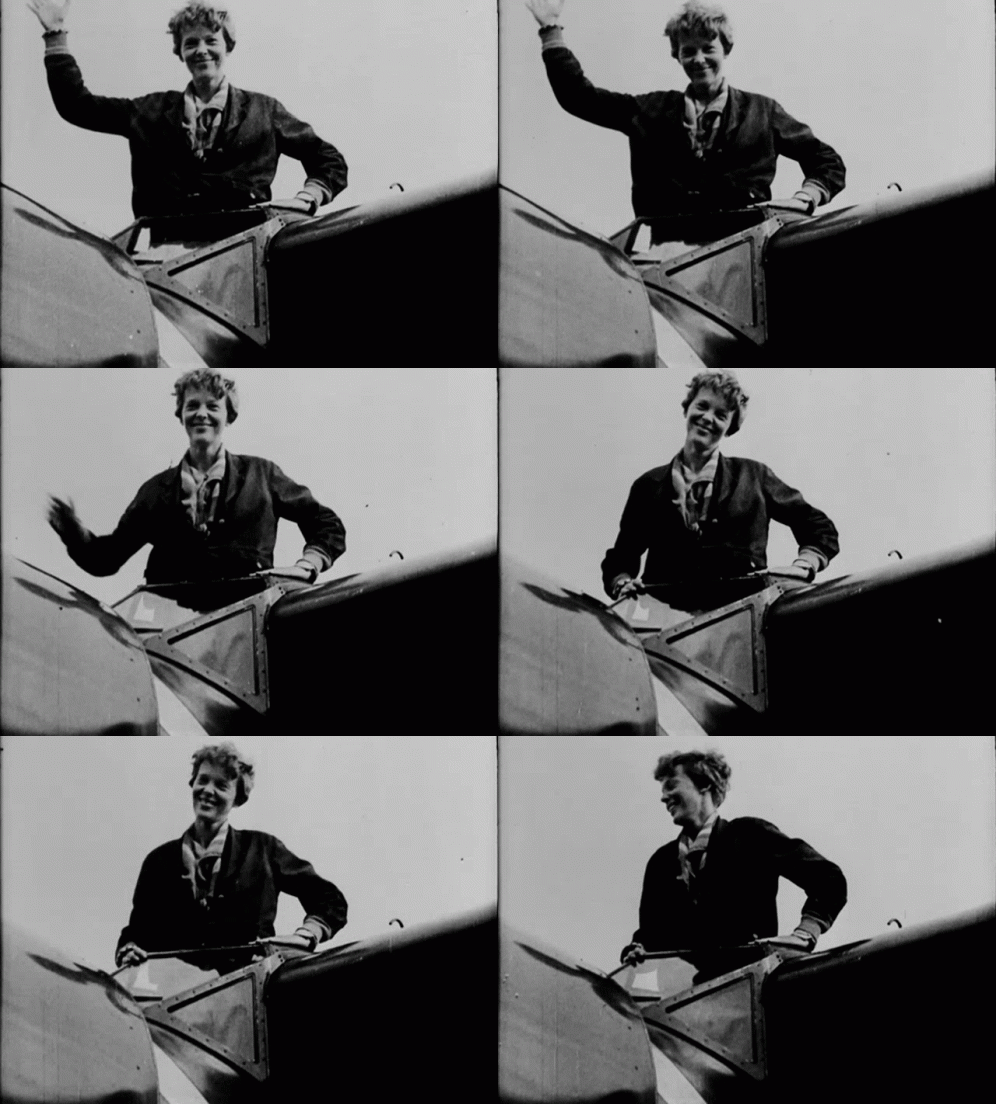
When you think Amelia Earhart, what do you think? You should think about her accomplishments in aviation, her dedication to social justice, and her role in the early women’s rights movements. But chances are, the first thing you conjure is, of course, her mysterious disappearance. Or maybe Amy Adams’ over-the-top portrayal of her in the “Night at the Museum” movies. Hey, I’m guilty of it, too.
But if you’re as curious as I was about the woman behind the puzzle, this is your book.
Hartigan uses a simple but effective method: she alternates chapters. One will discuss an aspect of her disappearance, the next will cover her biography. Usually, I prefer the more linear method, but this structure just worked perfectly. It’s almost as if she wanted to convey that Earhart’s interesting and impactful life was just as important as her disappearance.
Hartigan lays out all the theories and investigations from 1937 until today, with some still ongoing. The term from the title, “Three Mysterious Deaths,” indicates the three main theories of what happened to Earhart and Noonan (her navigator):
1. They ran out of fuel and crashed in the ocean
2. They landed somewhere, somehow, and died as castaways on a deserted island
3. They were captured by the Japanese (and either executed or recruited as spies)
Thus, this part is quasi-linear. It gets a little jargon-y, so I went into “scan mode”: I just kind of got the gist of it and looked for the conclusions. But you’ll have to read it with – spoiler alert – the fact that none of the investigations have been successful. (So far.) Hartigan presents them with National Geographic-like curiosity and precision, not frenzied sensationalism.
However, what I appreciated most about this was the rich and meaningful description of an American heroine. The tragedy of her death seems to overshadow the triumph of her life, and Hartigan changed my focus. Earhart did things women just didn’t do at that time in history, and flying was just one part of it. From growing up playing sports and exploring nature, to making speeches to rapt audiences, to teaching aviation and business at the university level, to working for the betterment of her community in settlement houses, her life was one of service and discovery.
What’s more, she had her share of challenges, and not just battling sexism. She wasn’t dirt poor, but she also didn’t have unlimited resources. Society also expected her to settle down in the traditional American family style, but that just wasn’t her. She’s the kind of person I’d like to have met, and it’d be easy to call her a role model in any generation. Hartigan doesn’t canonize her, but opens our eyes to what’s been overlooked: a tremendous life that should overshadow her death.
It’s my hope this biography hits the big time, since it’s a subject worth noting and is written in a precise but emotional style. Go get it!
Thanks to NetGalley and none other than National Geographic for an advance copy in exchange for an honest review. Lost: Amelia Earhart's Three Mysterious Deaths and One Extraordinary Life will be released March 3, 2026.

June 12, 2026
⭐⭐ A Frustrating Timeline That Turns an Icon into a Mere Plot Point
Growing up in Kansas, I have always been familiar with Amelia Earhart, as her legacy is a major point of pride in the region. When I saw Lost: Amelia Earhart's Three Mysterious Deaths and One Extraordinary Life by Rachel Hartigan was published this March, I was eager to dive in, hoping for fresh information and a lively look at the various conspiracy theories. I am a dedicated reader who refuses to ever abandon a book, so I committed to giving this text a completely fair shake. The book contains a wealth of detailed information and a solid photograph section, but the overall reading experience was unfortunately a horrendous slog.
The biggest failure of this book lies in its messy dual-timeline structure. The narrative constantly jumps back and forth between Earhart's life and modern-day search expeditions, which completely destroys the momentum. This layout creates an information overload of competing arguments, random names, and isolated Pacific islands that ultimately blend together into a confusing mush. The book leaves out maps entirely, which forced me to constantly close the book to look up locations on Google Maps just to follow along. It feels like there should have been two completely separate books here. If the author had focused purely on a sequential biography, it could have been thoroughly captivating. Instead, the actual travel experiences of her world flight, including fascinating stops through places like Puerto Rico, Suriname, and across Africa, were barely explored. By the time the book shifts into the search eras, Amelia ceases to feel like a real person and is treated more like a minor plot point for modern theories.
The book is also undermined by a glaring lack of objectivity. Hartigan focuses almost exclusively on the expeditions funded by her own employer, National Geographic, and the organization TIGHAR. This heavy favoritism causes her to dismiss alternative disappearance theories rather than offering a balanced, broad discussion. My trust in the editing was further shaken early on by a massive geographical blunder regarding my home state, where the author erroneously places Kansas State University in the city of Lawrence and claims it has a law school. Other well-crafted biographies and documentaries likely handle this lively subject with much better care, and I cannot recommend this disorganized account.
Growing up in Kansas, I have always been familiar with Amelia Earhart, as her legacy is a major point of pride in the region. When I saw Lost: Amelia Earhart's Three Mysterious Deaths and One Extraordinary Life by Rachel Hartigan was published this March, I was eager to dive in, hoping for fresh information and a lively look at the various conspiracy theories. I am a dedicated reader who refuses to ever abandon a book, so I committed to giving this text a completely fair shake. The book contains a wealth of detailed information and a solid photograph section, but the overall reading experience was unfortunately a horrendous slog.
The biggest failure of this book lies in its messy dual-timeline structure. The narrative constantly jumps back and forth between Earhart's life and modern-day search expeditions, which completely destroys the momentum. This layout creates an information overload of competing arguments, random names, and isolated Pacific islands that ultimately blend together into a confusing mush. The book leaves out maps entirely, which forced me to constantly close the book to look up locations on Google Maps just to follow along. It feels like there should have been two completely separate books here. If the author had focused purely on a sequential biography, it could have been thoroughly captivating. Instead, the actual travel experiences of her world flight, including fascinating stops through places like Puerto Rico, Suriname, and across Africa, were barely explored. By the time the book shifts into the search eras, Amelia ceases to feel like a real person and is treated more like a minor plot point for modern theories.
The book is also undermined by a glaring lack of objectivity. Hartigan focuses almost exclusively on the expeditions funded by her own employer, National Geographic, and the organization TIGHAR. This heavy favoritism causes her to dismiss alternative disappearance theories rather than offering a balanced, broad discussion. My trust in the editing was further shaken early on by a massive geographical blunder regarding my home state, where the author erroneously places Kansas State University in the city of Lawrence and claims it has a law school. Other well-crafted biographies and documentaries likely handle this lively subject with much better care, and I cannot recommend this disorganized account.

September 8, 2025
Thanks to NetGalley and National Geographic [the publisher] for an eARC of Lost: Amelia Earhart’s Three Mysterious Deaths and One Extraordinary Life by Rachel Hartigan, with an expected publication date in March of 2026, in return for an honest review.
I have never been obsessed with the mystery of Earhart’s disappearance, but have been intrigued over the years at the periodic articles about the latest theory/discovery concerning her disappearance. She has become a figure of adulation and the center of a number of conspiracy theories. Was she a spy for the US in the years leading up to the war against Japan in WWII. Was she a Japanese spy, whose disappearance allowed her to go to Japan and become Tokyo Rose during the war? These are just two of the conspiracies covered in Hartigan’s fascinating book. While not a predominant theme, the author explores the role of conspiracy thought in American history.
The author was a journalist working for National Geographic, and participated in a couple expeditions to the Pacific in attempts to locate the remains of Earhart’s plane or even her remains. The book alternates between Earhart’s biography and an exploration of what went wrong on her last flight. Hartigan does a good job of laying out the various theories behind many of the attempts to locate her. [Some my find too much detail, but the detail is necessary to explain why the explorers searched where they did.] Despite her own role in the search, the author remains in the background, giving the reader enough to understand her experience and interest in the topic. I have not read any other biographies of Earhart, but Lost provides an excellent exposition of her life.
Reading Lost you get a sense of the adulation that continues around Earhart, in part as a feminist icon. Last time that I looked, Goodreads lists almost 1,000 entries with her as a subject, many of them for children. I recommend this book, especially for those interested in biographies, history [the history of the early days of aviation], or an exploration of conspiracy thinking.
I have never been obsessed with the mystery of Earhart’s disappearance, but have been intrigued over the years at the periodic articles about the latest theory/discovery concerning her disappearance. She has become a figure of adulation and the center of a number of conspiracy theories. Was she a spy for the US in the years leading up to the war against Japan in WWII. Was she a Japanese spy, whose disappearance allowed her to go to Japan and become Tokyo Rose during the war? These are just two of the conspiracies covered in Hartigan’s fascinating book. While not a predominant theme, the author explores the role of conspiracy thought in American history.
The author was a journalist working for National Geographic, and participated in a couple expeditions to the Pacific in attempts to locate the remains of Earhart’s plane or even her remains. The book alternates between Earhart’s biography and an exploration of what went wrong on her last flight. Hartigan does a good job of laying out the various theories behind many of the attempts to locate her. [Some my find too much detail, but the detail is necessary to explain why the explorers searched where they did.] Despite her own role in the search, the author remains in the background, giving the reader enough to understand her experience and interest in the topic. I have not read any other biographies of Earhart, but Lost provides an excellent exposition of her life.
Reading Lost you get a sense of the adulation that continues around Earhart, in part as a feminist icon. Last time that I looked, Goodreads lists almost 1,000 entries with her as a subject, many of them for children. I recommend this book, especially for those interested in biographies, history [the history of the early days of aviation], or an exploration of conspiracy thinking.

November 20, 2025
The story of Amelia Earhart has been told by countless authors. It is a well-researched subject. But this book does something few others do - it describes in detail Amelia’s life before her disappearance. In Lost, Rachel Hartigan dives deep, detailing this biographical information with suspenseful narration. She speaks about Amelia’s home life and the influences her mother and father had on her childhood. It speaks about her adoring sister, and the influence the World Fair had on her – cultivating a love for aviation that eventually led her to become a pilot. And, about Fred Noonan, to whom she leaned on for aviation advice and guidance.
Interwoven with the biographical information is the story of her last flight and theories of her disappearance. And, while many believe to know what happened to Amelia, spending tens of millions of dollars to search islands and seas, Rachel highlights an important point – we may never discover what became of the famed pilot. The sea is wide and deep, and resources are limited. But nearly 90 years later, interest continues to rise. With luck, we may stumble upon the wreck one day and be able to close this chapter of history.
Overall, Rachel’s writing was enjoyable. The story flowed well, navigating well the distribution of information with a dialogue-like narrative. I would recommend this to anyone interested in Amelia Earhart, aviation mysteries, or strange or mysterious stories.
Many thanks to NetGalley, National Geographic, and Rachel Hartigan for this book in advance of an honest review.
Interwoven with the biographical information is the story of her last flight and theories of her disappearance. And, while many believe to know what happened to Amelia, spending tens of millions of dollars to search islands and seas, Rachel highlights an important point – we may never discover what became of the famed pilot. The sea is wide and deep, and resources are limited. But nearly 90 years later, interest continues to rise. With luck, we may stumble upon the wreck one day and be able to close this chapter of history.
Overall, Rachel’s writing was enjoyable. The story flowed well, navigating well the distribution of information with a dialogue-like narrative. I would recommend this to anyone interested in Amelia Earhart, aviation mysteries, or strange or mysterious stories.
Many thanks to NetGalley, National Geographic, and Rachel Hartigan for this book in advance of an honest review.

September 9, 2026
Many of us grew up in the earlier period of space travel when astronauts were pioneers. This created an exciting taste for adventure and reaching beyond what was then possible. Amelia Earhart was one of those who bravely went where no woman had gone before; a pioneer not unlike modern space travelers. She dared to push boundaries that would help usher in the age of international airline travel.
Of note is that, although this was a civilian undertaking, the government played several roles. It provided a Coast Guard ship to support navigation and communication for her planned stop at Howland Island before the final two legs to Hawaii then on to Oakland, CA. When she didn’t arrive at Howland, the Navy launched a massive search and rescue operation.
Hartigan does a good job portraying three possible outcomes of Earhart’s final flight. The chapters alternate between these three scenarios and an enlightening biography of Earhart’s life. This is a fascinating account of Earhart’s life and what might have happened to her, which lets the reader imagine which outcome is the most likely.
Thank you to National Geographic and NetGalley for providing this e-galley.
Of note is that, although this was a civilian undertaking, the government played several roles. It provided a Coast Guard ship to support navigation and communication for her planned stop at Howland Island before the final two legs to Hawaii then on to Oakland, CA. When she didn’t arrive at Howland, the Navy launched a massive search and rescue operation.
Hartigan does a good job portraying three possible outcomes of Earhart’s final flight. The chapters alternate between these three scenarios and an enlightening biography of Earhart’s life. This is a fascinating account of Earhart’s life and what might have happened to her, which lets the reader imagine which outcome is the most likely.
Thank you to National Geographic and NetGalley for providing this e-galley.

April 3, 2026
Amelia Earhart is such an intriguing historical figure. Her disappearance has fascinated us all for generations. What really happened to her on that fateful journey across the globe? LOST is a wonderful exploration of Earhart’s life, giving us a taste of her daredevil spirit that led her to be one of the pioneers of female aviation. What I found most interesting is her life leading up to her disappearance. Amelia seemed like one of those take no shit from anyone types of pioneer spirit I admire.
Rachel Hartigan, a journalist from National Geographic, gives us an in-depth look at Earhart and the adventures that led up to her final journey, leading her to disappear in the South Pacific. Was she captured by the Japanese? Did she die a lonely death on a deserted island? The world may never know. Truth be told, she pushed the limitations of technological advancement, dodging the inevitable many times, until she couldn’t dodge it anymore. Explorers like Earhart roll the dice. Eventually, you number comes up. A fascinating read which I recommend to anyone interested in learning about her life or early air exploration.
4 Deserted Islands out of 5
Rachel Hartigan, a journalist from National Geographic, gives us an in-depth look at Earhart and the adventures that led up to her final journey, leading her to disappear in the South Pacific. Was she captured by the Japanese? Did she die a lonely death on a deserted island? The world may never know. Truth be told, she pushed the limitations of technological advancement, dodging the inevitable many times, until she couldn’t dodge it anymore. Explorers like Earhart roll the dice. Eventually, you number comes up. A fascinating read which I recommend to anyone interested in learning about her life or early air exploration.
4 Deserted Islands out of 5

March 15, 2026
A concise collection of every endeavor to recover Amelia Earhart and her navigator-- from the moment she disappeared to present day-- mixed with everything we know about Earhart's life. While occasionally I would get confused because of the timeline jumping around, I found myself completely convinced each time a new theory of the famed pilot's disappearance was introduced. Probably not much new information for someone well versed in Earhart's life and mystery, but for someone whose knowledge of her was limited, this was a really good summary.
Thank you to NetGalley for providing me access to the advanced copy
Thank you to NetGalley for providing me access to the advanced copy

May 28, 2026
The title refers to the three most plausible theories of the disappearance of the famous aviator and her navigator, Fred Noonan. Those and many other less plausible theories are laid out in detail here, interspersed with the story of Earhart’s life. The author did a great job of walking us through that final flight, along with the ways that it might have gone wrong. Where the book really shines, though, is in describing Earhart as a fully realized human being, with great strengths and a few flaws. We walk away with an appreciation for how she lived, rather than getting lost in the details of her untimely death.

February 26, 2026
Thank you Net Galley, Rachel Hartigan and National Geographic for allowing me to read this book in advance.
I have always been curious and interested to know what really happened to Amelia Earhart so when I saw this book offered I knew I had to read it.
I will keep my review brief and spoiler free as I don’t plan to ruin the book for anyone who aims to read it.
There is more to Amelia than most people realize. She has been involved in clothing lines, women’s movements and rights.
I myself being a huge fan of aircraft and female are probably why her life and story has always interested me over the decades.
Thank you for this very interesting story and all the hard work and efforts to try and decipher what really happened to Amelia.
I have always been curious and interested to know what really happened to Amelia Earhart so when I saw this book offered I knew I had to read it.
I will keep my review brief and spoiler free as I don’t plan to ruin the book for anyone who aims to read it.
There is more to Amelia than most people realize. She has been involved in clothing lines, women’s movements and rights.
I myself being a huge fan of aircraft and female are probably why her life and story has always interested me over the decades.
Thank you for this very interesting story and all the hard work and efforts to try and decipher what really happened to Amelia.

August 11, 2025
read if you like:
📖 non-fiction
✈️ Amelia Earhart
🤷🏻♀️ missing people
summary:
I’ve always been fascinated by Amelia Earhart since I was little. I mean really — how does someone just disappear? This combined with my love of female heroines made this the perfect book to preview. This story follows National Geographic reporter Rachel Hartigan on her search around the world for the true story behind Amelia Earhart, as she explores three of the most common theories of her disappearance. Alternating between the story of her life and the details behind these theories, the reader learns more about who Amelia was, what led her to her record-breaking trip, and the mystique behind her legacy.
As someone who hasn’t read a lot about these theories, Hartigan does an excellent job of digging into the details behind them. It’s hard to believe how far fetched some of them were and still are, but she investigates each of them, along with the evidence and research that followed to refute them. The depth of her investigation is impressive, and sadly proves that many of these theories are honestly, unprovable. While the author might go into a little too much detail for the average reader, it would be perfect for any Amelia Earhart fan who wants the complete story.
Thanks to National Geographic and NetGalley for the advanced copy. If you too are fascinated by this mystery, check this out book out when it releases on March 3, 2026.
📖 non-fiction
✈️ Amelia Earhart
🤷🏻♀️ missing people
summary:
I’ve always been fascinated by Amelia Earhart since I was little. I mean really — how does someone just disappear? This combined with my love of female heroines made this the perfect book to preview. This story follows National Geographic reporter Rachel Hartigan on her search around the world for the true story behind Amelia Earhart, as she explores three of the most common theories of her disappearance. Alternating between the story of her life and the details behind these theories, the reader learns more about who Amelia was, what led her to her record-breaking trip, and the mystique behind her legacy.
As someone who hasn’t read a lot about these theories, Hartigan does an excellent job of digging into the details behind them. It’s hard to believe how far fetched some of them were and still are, but she investigates each of them, along with the evidence and research that followed to refute them. The depth of her investigation is impressive, and sadly proves that many of these theories are honestly, unprovable. While the author might go into a little too much detail for the average reader, it would be perfect for any Amelia Earhart fan who wants the complete story.
Thanks to National Geographic and NetGalley for the advanced copy. If you too are fascinated by this mystery, check this out book out when it releases on March 3, 2026.

March 6, 2026
Thank you to Netgalley for the ARC of this book!
If you're aggressively into the life and disappearance of Amelia Earhart, this is the book for you. As a more casual reader who just finds disappearances interesting, this was a slow and sometimes overly compllicated read. The chapters alternate between telling about Amelia's life and then talking about theories regarding her disappearance. For me, I would have much rather a more chronological path, with a section just on her biography and then sections on each of the main theories about her disappearance. I found myself skimming a lot of her background in order to get to what I was really there for, which is not ideal. The book definitely gave me a newfound appreciation and understanding of her life, but I'm not sure I'll remember any of it a year from now.

April 2, 2026
The book would have worked better as a straight forward biography of Amelia Earhart. The biographical sections are riveting and inspiring. She was so much more than her mysterious disappearance. The book suffers from the rotating chapters on the efforts to solve the disappearance. These sections are interesting for a brief period but get more annoying and intrusive as the book goes on.

Read
March 20, 2026In 2017, Rachel Hartigan found herself on the island of Nikumaroro, an uninhabited coral atoll in the western Pacific Ocean. She was there on an assignment for National Geographic Magazine, trailing The International Group for Historic Aircraft Recovery (TIGHAR).
Their mission: to find Amelia Earhart.
The first woman to fly across the Atlantic. The aviator who vanished in 1937 somewhere in the Pacific during an around-the-world adventure. The superstar whose disappearance (along with that of her plane and her navigator, Fred Noonan) has befuddled and beguiled researchers for nearly 90 years.
Other so-called “Earhart hounds” have different theories. That she was captured by the Japanese, or drowned or even survived and moved back to the US under a different name.
Hartigan tries to make sense of them all in her new book “Lost: Amelia Earhart’s Three Mysterious Deaths and One Extraordinary Life” (National Geographic).
As the author unspools each of the main theories, “Lost” uncovers an obsessive subculture of amateur sleuths and conspiracy theorists — as well as legit scientists and historians — who have dedicated their lives to solving the mystery.
“I think people are drawn into theories around Earhart because they want an ending to the story,” Hartigan told The Post. “She was a super famous person. How could such a super famous person disappear? And how can we not know the ending? We need to know the ending to the story.”
Read the rest of my piece for the NY Post here: https://nypost.com/2026/03/08/world-n...
Their mission: to find Amelia Earhart.
The first woman to fly across the Atlantic. The aviator who vanished in 1937 somewhere in the Pacific during an around-the-world adventure. The superstar whose disappearance (along with that of her plane and her navigator, Fred Noonan) has befuddled and beguiled researchers for nearly 90 years.
Other so-called “Earhart hounds” have different theories. That she was captured by the Japanese, or drowned or even survived and moved back to the US under a different name.
Hartigan tries to make sense of them all in her new book “Lost: Amelia Earhart’s Three Mysterious Deaths and One Extraordinary Life” (National Geographic).
As the author unspools each of the main theories, “Lost” uncovers an obsessive subculture of amateur sleuths and conspiracy theorists — as well as legit scientists and historians — who have dedicated their lives to solving the mystery.
“I think people are drawn into theories around Earhart because they want an ending to the story,” Hartigan told The Post. “She was a super famous person. How could such a super famous person disappear? And how can we not know the ending? We need to know the ending to the story.”
Read the rest of my piece for the NY Post here: https://nypost.com/2026/03/08/world-n...

March 5, 2026
This book offers an interesting look not only at the story of Amelia Earhart, but also at the many attempts to locate her and her airplane in the Pacific Ocean. I especially liked the way the chapters alternated between Earhart’s life and background and the details of the various search expeditions. That structure helped the story flow well and kept the narrative engaging.
It’s clear that the book is thoroughly researched, and I appreciated that the author had firsthand experience with some of the search efforts. That perspective added an extra layer of credibility and interest to the story. I did find myself wishing there had been a bit more discussion about the aftermath of Earhart’s disappearance and its longer-term impact, but overall this was an intriguing and informative nonfiction look at the enduring mystery surrounding Amelia Earhart.
Thank you to NetGalley and the publisher for providing an advance copy in exchange for an honest review.
It’s clear that the book is thoroughly researched, and I appreciated that the author had firsthand experience with some of the search efforts. That perspective added an extra layer of credibility and interest to the story. I did find myself wishing there had been a bit more discussion about the aftermath of Earhart’s disappearance and its longer-term impact, but overall this was an intriguing and informative nonfiction look at the enduring mystery surrounding Amelia Earhart.
Thank you to NetGalley and the publisher for providing an advance copy in exchange for an honest review.
March 20, 2026
Thank you to NetGalley and National Geographic for an ARC of this book in exchange for an honest review.
Overall this was a combination biography and story of theories and searches for what happened to Amelia.
The style the author used flowed very well, mixing stories about searches along with biography. I found it overall interesting although parts seemed longer than necessary to establish the point.
For someone interested in the topic, they would probably find this interesting but for the diehards I’m not sure it would add much more than. Wasn’t previously known. Being neither, I still found the book overall enjoyable.
Overall this was a combination biography and story of theories and searches for what happened to Amelia.
The style the author used flowed very well, mixing stories about searches along with biography. I found it overall interesting although parts seemed longer than necessary to establish the point.
For someone interested in the topic, they would probably find this interesting but for the diehards I’m not sure it would add much more than. Wasn’t previously known. Being neither, I still found the book overall enjoyable.

March 13, 2026
Spoiler alert: this is a book about the events leading up to Amelia's disapperance AND simultaneously different rescue and recovery projects (most recent was 2025). This is NOT the story about finding Earhart, but about the long long efforts and questions people have asked and wondered about her life and disapperance.
Overall I loved how well research this was- but I also felt the story jumped around TOO many times for me to really keep track. I wished it was organized a little bit differently. Overall, highly recommend!
A special thank you to NetGalley and to National Geographic (SQUEAL!?!?!) for alloting me an ebook copy of this book.
Overall I loved how well research this was- but I also felt the story jumped around TOO many times for me to really keep track. I wished it was organized a little bit differently. Overall, highly recommend!
A special thank you to NetGalley and to National Geographic (SQUEAL!?!?!) for alloting me an ebook copy of this book.

June 1, 2026
Hartigan writes with clear prose and rigorously examines the evidence, a valued quality in a crowded field full of speculation. I didn’t know much beyond the basics about the details of Amelia Earhart’s final journey or the search to find her, so I can’t vouch for how much would be new to Earhart enthusiasts. It was all new to me, and much of it devastating.
I especially appreciated the last chapter. I’m curious about what happened to Earhart and Noonan, too, but like the author says, that knowledge won’t bring them back, won’t tell their surviving descendants anything they don’t already know.
Anyway, I’m off to watch the Amelia episode of Bob’s Burgers, once again.
I especially appreciated the last chapter. I’m curious about what happened to Earhart and Noonan, too, but like the author says, that knowledge won’t bring them back, won’t tell their surviving descendants anything they don’t already know.
Anyway, I’m off to watch the Amelia episode of Bob’s Burgers, once again.

June 14, 2026
I give this one 3 stars because I've always been a sucker for an Amelia Earhardt story. This one looks into 3 possible "deaths" (Saipan, Howland Island, and Nakimoruru). All have many plausible and enticing details, but, ultimately, there is no resolute evidence. Researchers are still actively searching the Pacific, and just in March, 2026 a new image of what might be her Lockheed Electra has emerged. This book also told the stories of several die hard Earhardt investigators, which is interesting on its own merit. I could not help but feeling that Ameila wasn't "present" in this book and she seems to be fairly absent from all parts of her story...the tragedy of her disappearance did not liberate her.

June 27, 2026
My first book on Amelia Earhart. I think this is perfect for beginners, as it’s short and covers quite a bit: an overview of her life, her flights, her disappearance, and expeditions held over the years.
The author alternates chapters between theories/expeditions and going back in time to tell us about Amelia. I liked this format a lot. I also liked how well researched this seemed without being too “textbook”.
Amelia was a fascinating woman and well ahead of her time in so many ways. I’ll definitely be reading more about her in the future.
The author alternates chapters between theories/expeditions and going back in time to tell us about Amelia. I liked this format a lot. I also liked how well researched this seemed without being too “textbook”.
Amelia was a fascinating woman and well ahead of her time in so many ways. I’ll definitely be reading more about her in the future.

April 4, 2026
I rounded up from 3.5. I got sucked into the mystery as the different theories unfolded while also being astounded by level of dedication so many people have put into trying to solve this mystery. I knew very little about Amelia’s story and enjoyed learning more about her but there were plenty of terms and details that flew (pun intended) right over my head.

June 14, 2026
I enjoyed this book about Amelia Earhart. It was part autobiography and part detailing the search for what happened on that fateful last flight. There was a lot of interesting information that I had not heard before and now I know more about the woman behind the legend.

May 4, 2026
An easy, quick read about a continuing mystery.

July 14, 2026
4.25 stars

March 5, 2026
Sure, I would love to know what really happened to Earhart, but this earnest and thorough overview of all main theories and their lives by an involved investigator is the next best thing. Most intriguing to me was the chase after bones
The chase to locate those bones reads like a drama movie.
What is real is Amelia the person that comes through here, and I really don't like to think of her dying slowly without stimulation....
When she was with society we learn there was a feminist push to clear the way for women in aviation and that was a driving impulse for Earhart.
In all this, it seems she was sloppy in not learning More code sufficiently, or some of her (then) modern equipment. This and multiple small errors are a constellation of those most convincing arguments of a rather banal final end.
Also an exciting part here is the large effort to re-create the conditions and see what may have happened.
King hypothesized that after Earhart died, the crabs consumed her flesh and dragged her bones into their burrows— except, of course, the 13 bones Gallagher’s team discovered.
The chase to locate those bones reads like a drama movie.
What is real is Amelia the person that comes through here, and I really don't like to think of her dying slowly without stimulation....
“Oh, if only we can get away soon. It is hard indeed to remains sans books, sans contact with one’s interests and withal on a terrific strain,” Amelia observed.
When she was with society we learn there was a feminist push to clear the way for women in aviation and that was a driving impulse for Earhart.
Amelia had nearly finalized a deal to be the aviation editor for McCall’s magazine, where she’d have a platform from which to extoll on her favorite subject— the wonders, convenience, and practicality of flying as well as the sheer opportunities it offered to women. She was thrilled, though apprehensive, at this new role. But McCall’s wouldn’t permit any member of its staff— especially a high-profile one— to be sullied by a whiff of cigarette smoke. After all, this magazine went into good, middle-class homes across the country. The offer was rescinded before she could begin.
...
For Amelia, talk of opportunities and a satisfying life naturally segued into talk of aviation. “There is need for every kind of talent to advance the business of flying,” a business that would only increase, even with the troubled economy, she argued. “What opportunities lie here for clear thinking, energy, and vision!” But those opportunities must include women, whose progress she said was being blocked by two capital T’s: “One is Training— or lack of it. The other, Tradition. It is a fact that women, because they are women, are denied certain types of training in a number of institutions of learning.” She pointed out that New York University, then the largest university in the country, prevented women from taking aeronautical engineering courses.
...
Amelia had been pushing for women’s rights in other arenas. She refused to give money to Denison House unless she could be certain her donation would be used “for girls in some way.” She’d begun researching how menstruation affected women’s abilities in other physically taxing fields. Men seemed to feel it was exceedingly dangerous for all women to fly during menses. Women themselves knew better: A few women were truly laid low by menstruation, but most women weren’t.
In all this, it seems she was sloppy in not learning More code sufficiently, or some of her (then) modern equipment. This and multiple small errors are a constellation of those most convincing arguments of a rather banal final end.
It took the Longs more than 25 years to publish their conclusion: After a cascade of errors, the Lockheed Electra 10-E ran out of fuel and crashed into the ocean near Howland. In their accounting, nearly everyone involved in the flight made mistakes or had the wrong information. None of these errors were insurmountable individually. Compounded, the Longs argued, they almost inevitably doomed Amelia Earhart and Fred Noonan. Earhart and Noonan never knew about their first mistake. Indeed, it wasn’t a mistake, just a matter of bad timing. When Earhart radioed the Itasca at 7: 42 a.m. on July 2, 1937, to say, “We must be on you but cannot see you,” she was going by what their charts and Noonan’s dead reckoning was telling her. And she was right to rely on Noonan, who had pioneered Pan American’s commercial routes across the Pacific; few navigators were more experienced than he was in that region of the world. Yet the island wasn’t where he thought it would be. The Itasca had been traveling down to the Line Islands— Howland, Baker 42 miles south, and Jarvis more than 1,000 miles to the east— since 1935, as part of the bid to establish them as U.S. territories. On one trip south from Hawaii, the ship’s navigator surveyed the islands and discovered existing maps put Howland nearly six miles east of where it actually was. (The island had last been charted by the U.S.S. Narragansett in 1872.) The Itasca sent the updated coordinates to Coast Guard headquarters, but an updated chart wasn’t published until June 1937— too late for Noonan to be apprised of the island’s real location. Compounding the error, Noonan made what Long considered a baffling mistake: He assumed his compass presented the actual magnetic heading, without any deviation. Long examined the charts Noonan sent home, which included his calculations. “Whenever it came to deviation, he wrote zero,” said Long. But most compasses on most planes deviate, reacting magnetically to metal objects and electrical currents on board. “There’s no such thing in my navigational experience (and I’ve had a lifetime of it) in those days as a perfect compass,” he explained. He estimated Noonan’s compass was actually off the mark by nearly four degrees— not a big deal for short flights (the Federal Aviation Administration now allows for deviations of up to 10 degrees) but potentially catastrophic in a long flight like theirs. This error may have put the Electra short by another six miles. Add that to the six miles from the incorrect map and Earhart’s “must be on you” was actually 12 miles west of Howland. Meanwhile, a wind blowing at exactly the wrong speed put them even farther off course: The Itasca had reported an easterly wind at four to eight miles an hour. Too weak to create whitecaps on the waves, thought Long, such a breeze would have been invisible to Earhart and Noonan. Noonan would have had no other way to measure wind speed as he had left his drift bomb behind in Lae. This light little wind pushed the Electra another six or so miles west. Now they were some 18 miles west of Howland, beyond visual range in the early morning sunlight. But all wasn’t lost. Unpredictable conditions are a predictable element of any long journey, and Earhart had prepared for them. She knew finding Howland would be one of the trickiest parts of the world flight, and that the smallest error could put them off their course to the island. That’s why she’d established a radio communication plan with the Coast Guard— through their cutter, the Itasca— so they could talk her in if need be. That’s why she’d had a cutting-edge radio direction finder installed on her plane, and why the Itasca was waiting at Howland with its own pair of radio direction finders: a powerful low-frequency model on the ship and a portable high-frequency counterpart on the island. With these backup systems in place, she and Noonan would be able to make a slight course correction and within minutes see the rough runways on Howland Island. Unfortunately, according to the Longs, every one of those backup systems failed. The trouble began early on. Earhart had informed the Itasca she would transmit 15 minutes before and after the hour and listen for their messages on the hour and half hour. The radiomen misunderstood; they were used to keeping to schedules, which to them meant making an appointment with another radio operator to be on the same frequency at a set time. They thought that’s what Earhart would be doing, and assumed they’d be able to communicate back and forth. But Earhart meant what she said. She’d flip on her transmitter to transmit messages at set times and turn on her receiver to listen for messages at others. She didn’t have time to hang out on a frequency waiting to chat. The Itasca had four radio operators whose sole responsibility was managing communications for the ship. The Electra only had Earhart. The discrepancy didn’t register with O’Hare, Bellarts, and their colleagues. When O’Hare demanded why she didn’t keep monitoring her receiver, Long responded with uncharacteristic heat: “She’s flying an airplane. She’s got to keep track of her fuel. She’s marking the engines. She’s navigating. She’s watching her autopilot. She’s doing everything.” “Has she got the cans on her ears?” asked O’Hare. The headphones, he meant. “For 20 hours?” Long replied, his voice rising. “Her ears would fall off, for Christ’s sake.” To Long, who’d flown solo around the world, it was clear: Earhart had to keep to the schedule she described so she could take care of everything else. And there was another big problem with the communication plan— one the Longs called “the simplest of booby traps”: the time zones. Earhart was operating on Greenwich Mean Time (now Coordinated Universal Time or UTC) while the Itasca crew was on Greenwich time plus 11: 30 (one hour behind Hawaiian Standard Time). In other words, the Longs wrote, “Earhart’s ‘on the hour’ was their ‘on the half hour.’” They weren’t transmitting when she was listening for them, and they were when she wasn’t. She never heard them, except once right toward the end. “The half-hour difference? Never gave it a thought,” said O’Hare. In Long’s recording of their interview, the former radio operator’s breath sounds short, as if the wind had been knocked out of him. The one time Earhart did hear them, the Itasca was sending a message on 7,500 kilocycles in Morse code. And therein lies another big error, according to Long: Neither Noonan nor Earhart knew code, but the radiomen on board the ship assumed they did. In their world, everyone who operated a radio knew code. But because she didn’t, she would have turned the switch to off on her receiver for CW— continuous wave Morse code signals. When they transmitted code, all she would have heard was an undecipherable whoosh. But despite the misunderstandings between the Electra and the Itasca, Earhart and Noonan might have landed safely on Howland Island if the cutting-edge technology they were all relying on as the ultimate backup had worked. And in this case, according to the Longs, the failure was not that of the Coast Guard crew— at least not completely— but of Earhart herself. Earhart had originally planned on having a dedicated radio operator on board for the first few legs. But Henry Manning, a ship’s captain as well as an accomplished pilot, navigator, and radio operator who knew Morse code, backed out after Earhart crashed on her first attempt around the world. When the radio direction finder was installed on the plane, Manning had been the one to learn how it worked. When Manning returned to his ship, Earhart received a brief tutorial. But she was too busy to practice using the device, which was so new that it didn’t even come with a manual. Not realizing that low frequencies were crucial to direction finding, she removed the trailing wire that would have made receiving them possible. She never figured out why she couldn’t get the direction finder to work throughout the world flight. The problems with direction finding didn’t end there. If the Electra couldn’t receive signals on 500 kilocycles, it also couldn’t transmit them. The Itasca direction finder was powerful, but only worked at low frequencies; it would not be able to guide the plane in. There was still the high-frequency direction finder loaned to the Itasca for this mission. None of the crew members knew how to operate it. A young radio operator was temporarily transferred from another ship. But he didn’t know how to operate it either. Later, he would claim the batteries had run out, and that’s why he never homed in on Earhart. But when he finally returned to the ship with the direction finder, the wires were “twisted up like a bunch of rats’ tails,” as if the loop had been turned too hard. It was inoperable. And there was one last miscalculation, according to the Longs— one that didn’t prevent Earhart and Noonan from finding the island, but did stop them from searching a little longer. The Electra had less fuel than Earhart realized. The tanks had been filled the day before they left Lae; tropical heat had affected the fuel’s density, effectively reducing the gallons on board from 1,100 to 1,092. “She was in the middle of her last radio message when they went in,” said Long. “I can tie that down pretty good.” Long also thought he had a pretty good idea where the plane went down. Or at least where it didn’t. He calculated that the Electra couldn’t have crashed anywhere within visual range of Howland Island— so nowhere within 20 nautical miles to the north, south, or east. To the west, the visual range shrank to 15 nautical miles because the aviators were flying toward the sun’s glare, which reduced visibility. Knowing what Noonan didn’t know about the charts, his compass, and the wind, and making the standard assumption that dead reckoning is 90 percent accurate, Long calculated that at 8: 43 in the morning on July 2, the plane crashed somewhere within a rectangle 62 miles north and south of Howland, 29 miles to the east, and 41 miles to the west. “If this approximately 2,000-square-nautical-mile area is searched, there is a 90 percent probability that the Electra will be found within it,” he wrote.
...
Why did she opt to use 7,500 as the frequency in the first place? “It’s just not optimal for doing that kind of work,” says Vinson. “You’re supposed to be down around 500 to 1,500 kHz.” He wonders if she misread instructions from her former radio operator Harry Manning, whose handwriting used a Europeanized “1” that could easily be mistaken for a 7.
....
it was a relatively short hop to Darwin, on the northern edge of Australia. When they arrived, a communications officer named Stanley Rose asked why Amelia hadn’t contacted the Darwin direction finding unit, as was mandatory in the country. She admitted she hadn’t been able to use the direction finder since leaving the United States— and apparently hadn’t missed it. Rose got it to work by replacing a fuse. But Amelia’s familiarity with the device she’d be relying on to cross the Pacific hadn’t improved since her brief training with Joe Gurr more than a month earlier in California.
Also an exciting part here is the large effort to re-create the conditions and see what may have happened.
...the vessel would play the role of the Itasca, the Coast Guard cutter that awaited Amelia Earhart and Fred Noonan at Howland Island. Some 30 miles to the north at Accomack County Airport, a restored Beechcraft Model 18 plane was being prepared for takeoff in a few hours. It would serve as a stand-in for Earhart’s Lockheed Electra 10-E.

May 22, 2026
Soooooo good

April 3, 2026
Not a character study of AE but an insightful overview of her life and accomplishments, as well as several high profile attempts to explain her disappearance and locate remains. It’s amazing that we’re still captivated by her story nearly 100 years later.
Displaying 1 - 30 of 210 reviews