

What do you think?

Gunk
A Cosmopolitan book to look out for in 2025
'An immersive story about love and the softening borders around what family can be' Sheena Patel
'An intimate and tender exploration of love's possibilities' Sophie Mackintosh
Jules has been divorced from her ex-husband Leon for five years, but she still works alongside him at Gunk, the grotty student nightclub he owns in central Brighton. She spends her nights serving shots and watching, from behind the bar, as Leon flirts with students on the dancefloor. In the early hours of the morning, she paces home to sleep.
But then Leon hires nineteen-year-old Nim to work the bar with Jules – Nim, with her shaved head and steady pour, her disarming sweetness and sudden distance – and Jules finds herself jolted awake. When Nim discovers she's pregnant, Jules agrees to help. As the months pass, and the relationship between the two women grows increasingly intimate and perplexing, it emerges that Nim has her own unexpected gifts to give.
Now, alone in her small flat, Jules is holding a baby, just twenty-four-hours old, who still smells of Nim. But no one knows where Nim is, or if she's coming back. What could the future – for Jules, Nim, and this unnamed baby – possibly look like?
Raw, exhilarating, tender and wise, Gunk is an electrifying debut novel exploring love and desire, safety and destruction, chaos and control – and family in all its forms.
Praise for Saba Sams
'Sams is the real deal' LUCY KIRKWOOD, GUARDIAN
'A bold new talent' STYLIST
'I can't wait to see what she writes next' PANDORA SYKES
'An immersive story about love and the softening borders around what family can be' Sheena Patel
'An intimate and tender exploration of love's possibilities' Sophie Mackintosh
Jules has been divorced from her ex-husband Leon for five years, but she still works alongside him at Gunk, the grotty student nightclub he owns in central Brighton. She spends her nights serving shots and watching, from behind the bar, as Leon flirts with students on the dancefloor. In the early hours of the morning, she paces home to sleep.
But then Leon hires nineteen-year-old Nim to work the bar with Jules – Nim, with her shaved head and steady pour, her disarming sweetness and sudden distance – and Jules finds herself jolted awake. When Nim discovers she's pregnant, Jules agrees to help. As the months pass, and the relationship between the two women grows increasingly intimate and perplexing, it emerges that Nim has her own unexpected gifts to give.
Now, alone in her small flat, Jules is holding a baby, just twenty-four-hours old, who still smells of Nim. But no one knows where Nim is, or if she's coming back. What could the future – for Jules, Nim, and this unnamed baby – possibly look like?
Raw, exhilarating, tender and wise, Gunk is an electrifying debut novel exploring love and desire, safety and destruction, chaos and control – and family in all its forms.
Praise for Saba Sams
'Sams is the real deal' LUCY KIRKWOOD, GUARDIAN
'A bold new talent' STYLIST
'I can't wait to see what she writes next' PANDORA SYKES
240 pages, Hardcover
First published May 8, 2025
About the author
Saba Sams
7 books210 followersSaba Sams is a fiction writer based in London. Her stories have appeared in The Stinging Fly and The Tangerine. She was shortlisted for The White Review Short Story Prize in 2019. Her debut collection of short stories Send Nudes was published by Bloomsbury in 2022.
Ratings & Reviews
Friends & Following
Create a free account to discover what your friends think of this book!
Community Reviews
Displaying 1 - 30 of 960 reviews

June 16, 2025
Acclaimed writer Saba Sams’s debut novel grew from her desire to read a convincing birth scene; it was while crafting that episode Sams came up with her narrator Jules who serves as witness to this birth. The rest of Sam’s book flowed from these images, a slice-of-life, short story that just kept going. Sams sets out to interrogate dominant concepts of motherhood, intent on questioning the narrowness of notions of what does or doesn’t make a family. For Jules family is synonymous with convention. She grew up in a suburb close to Brighton, experiencing her parents’ careful attention as close to smothering. Jules dreamt instead of having her own child, establishing a relationship where she’s the one in control. As an adult, Jules moves to central Brighton where she ends up working at a shabby nightclub Gunk. A dilapidated space that appeals to rich students intent on rebelling against their bourgeois origins. Gunk’s owner is an older man Leon who possesses a kind of sleazy charisma, Jules eventually marries then later divorces him but takes on running his club. It’s there Jules becomes entangled with the much younger Nim whose unexpected pregnancy will bind them together in entirely unanticipated ways.
Sams is drawing on aspects of her own life here, she had the first of her three children while still a student, and her family circle is opened up to friends and relatives, rather than locked down in nuclear family mode. A form that clearly no longer works for women, if it ever did. Sams is interested in mothering as a practice: who mothers, who’s mothered and how. She also wants to chronicle the essential messiness of everyday life: Nim’s feelings for Jules; Jules’s complicated emotions for ex Leon and so on. Sams’s novel unfolds at a languid pace, the claustrophobic world within worlds represented by Gunk underlined by the claustrophobic atmosphere that pervades her story. Sams’s accomplished prose is often direct and visceral, but it can also be lyrical and tender echoing elements of the tentative bonds being formed between Nim, Jules and the unnamed child – although sometimes that tenderness threatens to tip over into sentimentality.
Sams touches on external, social issues around mothering – such as the surveillance culture mothers are routinely subjected to – but I wanted her to dig deeper, to say more about the political and economic aspects of contemporary parenting. Instead, the primary focus here is on Jules and her evolving state of mind. And I just didn’t find Jules entirely convincing. I couldn’t fully comprehend what was driving her desperation to have and raise a child. It seemed so vastly removed from any consideration of the child itself and its potential needs. It felt, to me at least, as if Jules’s impulse was closer to yearning for some unobtainable object or commodity – an extension of consumerism. However, it transpired that this type of transactionality was very much part of what Sams was seeking to explore and undermine, it’s just that this aspect of her narrative came a little too late, and was a little too rushed, to satisfy. For all that this was a well-observed, absorbing read, likely to appeal to fans of authors like Gwendoline Riley.
Thanks to Netgalley and to publisher Bloomsbury Circus for an ARC
Sams is drawing on aspects of her own life here, she had the first of her three children while still a student, and her family circle is opened up to friends and relatives, rather than locked down in nuclear family mode. A form that clearly no longer works for women, if it ever did. Sams is interested in mothering as a practice: who mothers, who’s mothered and how. She also wants to chronicle the essential messiness of everyday life: Nim’s feelings for Jules; Jules’s complicated emotions for ex Leon and so on. Sams’s novel unfolds at a languid pace, the claustrophobic world within worlds represented by Gunk underlined by the claustrophobic atmosphere that pervades her story. Sams’s accomplished prose is often direct and visceral, but it can also be lyrical and tender echoing elements of the tentative bonds being formed between Nim, Jules and the unnamed child – although sometimes that tenderness threatens to tip over into sentimentality.
Sams touches on external, social issues around mothering – such as the surveillance culture mothers are routinely subjected to – but I wanted her to dig deeper, to say more about the political and economic aspects of contemporary parenting. Instead, the primary focus here is on Jules and her evolving state of mind. And I just didn’t find Jules entirely convincing. I couldn’t fully comprehend what was driving her desperation to have and raise a child. It seemed so vastly removed from any consideration of the child itself and its potential needs. It felt, to me at least, as if Jules’s impulse was closer to yearning for some unobtainable object or commodity – an extension of consumerism. However, it transpired that this type of transactionality was very much part of what Sams was seeking to explore and undermine, it’s just that this aspect of her narrative came a little too late, and was a little too rushed, to satisfy. For all that this was a well-observed, absorbing read, likely to appeal to fans of authors like Gwendoline Riley.
Thanks to Netgalley and to publisher Bloomsbury Circus for an ARC
February 24, 2026
This seeped into my brain and sat there like… well… gunk.
This is not the book I thought I was signing up for. I went in expecting something vaguely tragic and romantic and instead got hit with motherhood, weird power dynamics, bodily fluids, emotional codependency, and a constant low-level sense of “wtf is even happening???”
But somehow… I couldn’t look away.
There’s a grimy, gunk-y feeling to this book. It’s everywhere. The sort where you can basically feel the soles of your shoes sticking to the floor, squeaking with every step. And that feeling extends to everything in this book. I feel like I need a long, hot shower to get all the ick off me.
The writing's deceptively simple. It feels like nothing is happening and everything is happening all at once. Then you’re 150 pages deep and feeling hollow. It's direct and minimal, but it also occasionally slips into something fragile and tender, almost easing into something sentimental until the book yanks you back and goes, "no ❤️ you suffer now."
I did not expect SO MUCH BABY. Like. So much. Baby everywhere.
The birth scene destroyed me. I don’t want kids, but if there was even a microscopic, hypothetical part of me that was vaguely open to the concept, it is gone. My ovaries shrivelled reading the pregnancy and birth scenes.
The way it’s written is so visceral and convincing that I felt like I needed to leave my body or meditate, do something, to relieve the trauma. It’s not beautiful. It's not romantic. It's just raw and painful.
Deeply, deeply uncomfortable.
And it doesn’t stop there.
If you’re not prepared for the full sensory assault of parenting and the body horror-adjacent reality of being needed constantly, this will hit you like a truck like it did me. You feel the ceaseless demands, the sleepless nights, the loneliness, the all-consuming presence of a tiny human who doesn’t give a shit about your boundaries. You can feel your sense of self dissolving into this small, screaming creature who's always damp and hungry and tired and cranky.
Motherhood isn't romanticised. It’s claustrophobic and exhausting.
The baby isn’t background noise. The baby isn't a side character you can ignore. It's this all-consuming force. I seriously feel like I’ve raised a child after reading this. 0/10 experience.
And then layered on top of all that is the messy, destabilising relationship (situationship from hell? emotional spiral?) between Jules and Nim.
Whatever they have going on is so off-balance that I spent the whole book bouncing from “this is kind of tender??” to “wait no this is unhealthy” to “no wait I’m lowkey obsessed with them actually” to “someone call a therapist and the police, oh, and maybe an exorcist, just in case.”
It’s not soft or safe. Their relationship's tense, intimate, needy, awkward, weird, tender, and uncomfortable all at once. It refuses to settle into anything vaguely recognisable.
Desire is there, but it's tangled up in a power imbalance and proximity and timing and circumstance that the book never fully resolves. Which is the point, but also… I don’t know if I should be rooting for them or reporting them?
And Jules… oh my god Jules. Desperate to be a mother from a young age, but unable to, she's painfully real in a familiar, slightly pathetic, yearning, self-aware-but-not-enough kind of way. I wanted to hug her and block her number at the same time. Watching her make the worst decisions in slow motion is both excruciating and magnetic. And the thing is, Jules knows she's making literally the worst decisions ever, but she does it anyway.
Sometimes it feels like a short story that got stretched into a novel and no one bothered to stop it. The pacing's weird in some places and some emotional beats lean a bit too tell rather than show, but regardless, it's intense.
The book touches on the societal pressure on mothers, like the constant judgement and expectations, but I wanted the author to go deeper into the political and economic realities of parenting (apparently, I didn't feel like I'd been punished enough). Instead, the focus stays tightly locked on Jules’s internal spiral.
I also wanted more on her desperation for a child. Because at times, her desire for a child felt more like an acquisition. Like she's looking for something to complete herself. Like she's given up on romantic love and is trying to replace it with another form of love. But we don't really see why. It's almost consumerist in its logic. And while the book does eventually engage with that idea of transaction, it gets there a bit too late and feels slightly rushed when it does.
This book makes you feel tired. That exhausted, wobbling, brain-fried tiredness you get when you’ve been partying too many days in a row and now have to get up at 6am after crawling into bed at 4. The tiredness seeps into your bones from the pages, but also keeps you reading anyway because somehow you need it. Whatever it is.
I don’t even know if I enjoyed it in a traditional sense. It’s not satisfying. It doesn’t wrap up neatly with a nice little bow on top. Motherhood is suffocating and the romance is destabilising. It's dirty and bleak and it leaves you with this heavy, melancholy feeling.
But my brain chemistry has been irreversibly changed and I can’t stop thinking about it.
This is not the book I thought I was signing up for. I went in expecting something vaguely tragic and romantic and instead got hit with motherhood, weird power dynamics, bodily fluids, emotional codependency, and a constant low-level sense of “wtf is even happening???”
But somehow… I couldn’t look away.
There’s a grimy, gunk-y feeling to this book. It’s everywhere. The sort where you can basically feel the soles of your shoes sticking to the floor, squeaking with every step. And that feeling extends to everything in this book. I feel like I need a long, hot shower to get all the ick off me.
The writing's deceptively simple. It feels like nothing is happening and everything is happening all at once. Then you’re 150 pages deep and feeling hollow. It's direct and minimal, but it also occasionally slips into something fragile and tender, almost easing into something sentimental until the book yanks you back and goes, "no ❤️ you suffer now."
I did not expect SO MUCH BABY. Like. So much. Baby everywhere.
The birth scene destroyed me. I don’t want kids, but if there was even a microscopic, hypothetical part of me that was vaguely open to the concept, it is gone. My ovaries shrivelled reading the pregnancy and birth scenes.
The way it’s written is so visceral and convincing that I felt like I needed to leave my body or meditate, do something, to relieve the trauma. It’s not beautiful. It's not romantic. It's just raw and painful.
Deeply, deeply uncomfortable.
And it doesn’t stop there.
If you’re not prepared for the full sensory assault of parenting and the body horror-adjacent reality of being needed constantly, this will hit you like a truck like it did me. You feel the ceaseless demands, the sleepless nights, the loneliness, the all-consuming presence of a tiny human who doesn’t give a shit about your boundaries. You can feel your sense of self dissolving into this small, screaming creature who's always damp and hungry and tired and cranky.
“I’m not the baby’s mother, and this is why he cries. He has no language to tell me that I’m not right for him, and yet he tells me with his body, with his eyes…”
Motherhood isn't romanticised. It’s claustrophobic and exhausting.
The baby isn’t background noise. The baby isn't a side character you can ignore. It's this all-consuming force. I seriously feel like I’ve raised a child after reading this. 0/10 experience.
And then layered on top of all that is the messy, destabilising relationship (situationship from hell? emotional spiral?) between Jules and Nim.
Whatever they have going on is so off-balance that I spent the whole book bouncing from “this is kind of tender??” to “wait no this is unhealthy” to “no wait I’m lowkey obsessed with them actually” to “someone call a therapist and the police, oh, and maybe an exorcist, just in case.”
It’s not soft or safe. Their relationship's tense, intimate, needy, awkward, weird, tender, and uncomfortable all at once. It refuses to settle into anything vaguely recognisable.
“It occurs to me that perhaps this has been the problem, for Nim and me. We’ve been caught up in trying to define what we have. I tried to limit her to employee, to housemate, to surrogate. In turn, her approach was expansion; she reached up for romantic love. I see that we’ve been trapped by language, by legitimacy.”
Desire is there, but it's tangled up in a power imbalance and proximity and timing and circumstance that the book never fully resolves. Which is the point, but also… I don’t know if I should be rooting for them or reporting them?
And Jules… oh my god Jules. Desperate to be a mother from a young age, but unable to, she's painfully real in a familiar, slightly pathetic, yearning, self-aware-but-not-enough kind of way. I wanted to hug her and block her number at the same time. Watching her make the worst decisions in slow motion is both excruciating and magnetic. And the thing is, Jules knows she's making literally the worst decisions ever, but she does it anyway.
Sometimes it feels like a short story that got stretched into a novel and no one bothered to stop it. The pacing's weird in some places and some emotional beats lean a bit too tell rather than show, but regardless, it's intense.
The book touches on the societal pressure on mothers, like the constant judgement and expectations, but I wanted the author to go deeper into the political and economic realities of parenting (apparently, I didn't feel like I'd been punished enough). Instead, the focus stays tightly locked on Jules’s internal spiral.
I also wanted more on her desperation for a child. Because at times, her desire for a child felt more like an acquisition. Like she's looking for something to complete herself. Like she's given up on romantic love and is trying to replace it with another form of love. But we don't really see why. It's almost consumerist in its logic. And while the book does eventually engage with that idea of transaction, it gets there a bit too late and feels slightly rushed when it does.
This book makes you feel tired. That exhausted, wobbling, brain-fried tiredness you get when you’ve been partying too many days in a row and now have to get up at 6am after crawling into bed at 4. The tiredness seeps into your bones from the pages, but also keeps you reading anyway because somehow you need it. Whatever it is.
I don’t even know if I enjoyed it in a traditional sense. It’s not satisfying. It doesn’t wrap up neatly with a nice little bow on top. Motherhood is suffocating and the romance is destabilising. It's dirty and bleak and it leaves you with this heavy, melancholy feeling.
But my brain chemistry has been irreversibly changed and I can’t stop thinking about it.
May 20, 2025
Loved this so much! The characters are frustrating in a Sally Rooney kinda way but I loved the exploration into relationships, this was right up my street

April 12, 2026
Birth is gunk and death is gunk. Gunky is the circle of life, what we run from chases us just the same. It is the comfortable patterns we fall into as we flail around and stumble upon any semblance of life. It is that lack of a roadmap or a guidebook that leads us down roads we find ourselves on, and the crumbs we latch onto, so close, conceived from a fervent abandonment and an incessant urge to hold on. It is the conventions that we’re raised upon, how they mould us and sear us into who we end up becoming. Gunk is all that controls us and all that we want to control, of the independence we wish to exert and the codependency that slithers its way into our world. It is motherhood and families and love, of course love is in the midst of all that dirt and grime and the filth that we surrender to is the love so warm and funky it doesn’t even matter if it is messy.
And gunk is the usual daftness of girlhood; do I want her or do I want to be her.
So what is this story really? It’s about this girl who really wants to be her own person and also she really wants to be a mother but really what she wants is some sense of superiority and control, all of this spurred by her idyllic childhood. So she marries a dipshit and mothers him, hoping to have his baby so she’d mother it. But no luck. Then enters a massively younger girl bearing baggage and a solid spirit, who ends up with dipshit’s baby and feelings for aforementioned girliepop, and finally offers the baby to aforementioned girliepop all while aforementioned girliepop drowns in the gunk of her own worldview, clueless to what’s actually taking place.
And gunk is the usual daftness of girlhood; do I want her or do I want to be her.
So what is this story really? It’s about this girl who really wants to be her own person and also she really wants to be a mother but really what she wants is some sense of superiority and control, all of this spurred by her idyllic childhood. So she marries a dipshit and mothers him, hoping to have his baby so she’d mother it. But no luck. Then enters a massively younger girl bearing baggage and a solid spirit, who ends up with dipshit’s baby and feelings for aforementioned girliepop, and finally offers the baby to aforementioned girliepop all while aforementioned girliepop drowns in the gunk of her own worldview, clueless to what’s actually taking place.
January 23, 2026
An absolutely electric, completely perfect novel.

December 21, 2024
Longlisted for the International Dylan Thomas Prize 2026
For Nim and me, there is no word either, no neat category. We’re more than friends, less than lovers. We’re intimate but not sexual. I’m old enough to be her young mother, young enough to be her older girlfriend. We’ve slept with the same man, worked the same job. We lived as housemates but we shared a bed. Now, she’s had a baby but the baby is mine. It occurs to me that perhaps this has been the problem, for Nim and me. We’ve been caught up in trying to define what we have. I tried to limit her to employee, to housemate, to surrogate. In turn, her approach was expansion; she reached up for romantic love. I see that we’ve been trapped by language, by legitimacy.
Saba Sams story Blue 4eva won the 2022 BBC National Short Story Award, the judges citing its "transportive atmosphere, its masterful telling of complex family dynamics and the sense of building tension", and the collection in which it was included, Send Nudes, won the 2022 Edge Hill Prize.
But it was on the strength of this, at that time forthcoming, novel, Gunk that, in 2023, she was included on Granta’s decennial Best of Young British Novelists.
Gunk is a well-crafted story of another unconventional set-up. The novel opens with our narrator Jules, in her flat, caring for a 1-day old baby, but which is not hers:
I’m not the baby’s mother, and this is why he cries. He has no language to tell me that I’m not right for him, and yet he tells me with his body, with his eyes. I was naïve to think that, if I scooped him straight from the womb and held him immediately to my bare chest, so in his first breaths he would inhale only my smell, he would mistake me as his. I was wrong to think that, if I brought him home, all of time would be erased. In reality, the flat was just as we’d left it: the bath full with cool, blue water; Nim’s clothes a twisted loop on the floor; the ice cube tray upside down in the sink.
Much of the novel then explains how this came about - I will include in spoiler tags given this is an ARC, although the blurb gives much of it away, and the plot is less the point than the relationships between Jules and the other characters.
Nim, the baby's mother, neatly skewers Jules's perceive self-sufficiency as well as what perhaps attracts her to others with perceived needs:
You worry about me, you worry about Leon. You don’t think anyone can stand on their own two feet, except yourself. Imagine if I dared to worry about you, Jules. You’d be so offended you’d never speak to me again.
[...]
Nim swam for fifteen minutes, maybe more. I sifted pebbles through my hands and thought about how she was right: I was determined to think of myself as above other people. Was this why I wanted a baby? Was this why other people kept on having babies? Despite the strain of pregnancy, the agony of birth, despite the terror of unknowable love, we wanted so badly to see ourselves in somebody else, and we wanted to have control over that person. We wanted a chance to build a destiny, from day one.
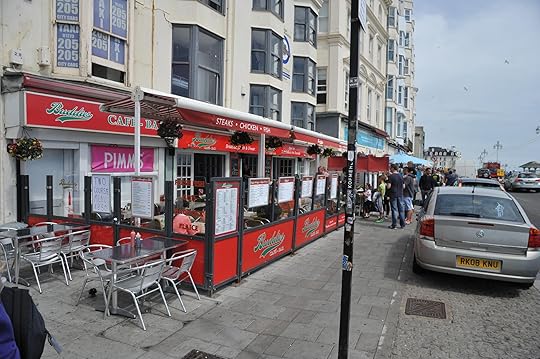
Buddies, the 24/7 cafe on Brighton seafront, now closed, which, alongside the ficticious Gunk, plays a key role in the novel
A quick and immersive read, although perhaps a little conventional for my taste and expectations after the Granta listing, and lacking the tension of Blue4Eva - I wonder if the short-form is the author's strong suit.
Thanks to the publisher via Netgalley for the ARC.
For Nim and me, there is no word either, no neat category. We’re more than friends, less than lovers. We’re intimate but not sexual. I’m old enough to be her young mother, young enough to be her older girlfriend. We’ve slept with the same man, worked the same job. We lived as housemates but we shared a bed. Now, she’s had a baby but the baby is mine. It occurs to me that perhaps this has been the problem, for Nim and me. We’ve been caught up in trying to define what we have. I tried to limit her to employee, to housemate, to surrogate. In turn, her approach was expansion; she reached up for romantic love. I see that we’ve been trapped by language, by legitimacy.
Saba Sams story Blue 4eva won the 2022 BBC National Short Story Award, the judges citing its "transportive atmosphere, its masterful telling of complex family dynamics and the sense of building tension", and the collection in which it was included, Send Nudes, won the 2022 Edge Hill Prize.
But it was on the strength of this, at that time forthcoming, novel, Gunk that, in 2023, she was included on Granta’s decennial Best of Young British Novelists.
Gunk is a well-crafted story of another unconventional set-up. The novel opens with our narrator Jules, in her flat, caring for a 1-day old baby, but which is not hers:
I’m not the baby’s mother, and this is why he cries. He has no language to tell me that I’m not right for him, and yet he tells me with his body, with his eyes. I was naïve to think that, if I scooped him straight from the womb and held him immediately to my bare chest, so in his first breaths he would inhale only my smell, he would mistake me as his. I was wrong to think that, if I brought him home, all of time would be erased. In reality, the flat was just as we’d left it: the bath full with cool, blue water; Nim’s clothes a twisted loop on the floor; the ice cube tray upside down in the sink.
Much of the novel then explains how this came about - I will include in spoiler tags given this is an ARC, although the blurb gives much of it away, and the plot is less the point than the relationships between Jules and the other characters.
Nim, the baby's mother, neatly skewers Jules's perceive self-sufficiency as well as what perhaps attracts her to others with perceived needs:
You worry about me, you worry about Leon. You don’t think anyone can stand on their own two feet, except yourself. Imagine if I dared to worry about you, Jules. You’d be so offended you’d never speak to me again.
[...]
Nim swam for fifteen minutes, maybe more. I sifted pebbles through my hands and thought about how she was right: I was determined to think of myself as above other people. Was this why I wanted a baby? Was this why other people kept on having babies? Despite the strain of pregnancy, the agony of birth, despite the terror of unknowable love, we wanted so badly to see ourselves in somebody else, and we wanted to have control over that person. We wanted a chance to build a destiny, from day one.
Buddies, the 24/7 cafe on Brighton seafront, now closed, which, alongside the ficticious Gunk, plays a key role in the novel
A quick and immersive read, although perhaps a little conventional for my taste and expectations after the Granta listing, and lacking the tension of Blue4Eva - I wonder if the short-form is the author's strong suit.
Thanks to the publisher via Netgalley for the ARC.

December 11, 2025
5️⃣🌟, the "brat" as said by Jack Edwards
───── ⋆⋅☆⋅⋆ ─────
#️⃣6️⃣7️⃣2️⃣ Read & Reviewed in 2025 🧊🏔️
Date Read: Sunday, December 7, 2025 ☃️🌨️
12th read in "Its TIMEEEE!!!!! (to read more books)" December ❄️⛄
So this is the 'brat' that Jack Edwards recommended that pretty much is in the setting of a club and bars and city party life. But the story itself is not particularly a "365 party girl 🍏"
I mean it's a lesbian love story 💕. Pretty brat if u ask me. It is a story that takes inspiration from the author's life so this novel it's closer to the author's personal experiences and honestly makes this book more authentic. This is a book that expands on motherly desires and responsibilities. A book that touches on societal issues about mothers and parenting. Honestly there are so many "mothers" and mother related terminologies and ye — MOTHERS.
I love the relationship and the dynamic between Nim & Jules. It feels like the relationship between both of them is with high amounts of chemistry. It's not really a romance book but rather more of a support between friends and acquaintances that sort of become romantic. The writing style is great and modern and it's all so simpliticly deep. It also has many other commentary to other aspects of society other than the obvious — MOTHERS and that is exactly what makes this book a highly deep and informational read.
Spice Level 🌶️: 1️⃣, 365 party girl
Vibe ☘️: brat 🍏
Who'd Like This ❓👥: People who are indefinitely intrigued with that egg book cover 🥚
───── ⋆⋅☆⋅⋆ ─────
#️⃣6️⃣7️⃣2️⃣ Read & Reviewed in 2025 🧊🏔️
Date Read: Sunday, December 7, 2025 ☃️🌨️
12th read in "Its TIMEEEE!!!!! (to read more books)" December ❄️⛄
So this is the 'brat' that Jack Edwards recommended that pretty much is in the setting of a club and bars and city party life. But the story itself is not particularly a "365 party girl 🍏"
I mean it's a lesbian love story 💕. Pretty brat if u ask me. It is a story that takes inspiration from the author's life so this novel it's closer to the author's personal experiences and honestly makes this book more authentic. This is a book that expands on motherly desires and responsibilities. A book that touches on societal issues about mothers and parenting. Honestly there are so many "mothers" and mother related terminologies and ye — MOTHERS.
I love the relationship and the dynamic between Nim & Jules. It feels like the relationship between both of them is with high amounts of chemistry. It's not really a romance book but rather more of a support between friends and acquaintances that sort of become romantic. The writing style is great and modern and it's all so simpliticly deep. It also has many other commentary to other aspects of society other than the obvious — MOTHERS and that is exactly what makes this book a highly deep and informational read.
Spice Level 🌶️: 1️⃣, 365 party girl
Vibe ☘️: brat 🍏
Who'd Like This ❓👥: People who are indefinitely intrigued with that egg book cover 🥚

March 14, 2025
This is a little more conventional than I expected from Sams. Though it's set in grotty flats and a seedy club, at heart it's another motherhood book, even if it rattles the contours of that narrative. We even get a summary soundbite: 'we've been caught up in trying to define what we have. I tried to limit her to employee, to housemate, to surrogate. In turn, her approach was expansion; she reached up for romantic love. I see that we've been trapped by language, by legitimacy. But there is no need.'
A bit too much baby stuff for my personal taste.
Thanks to the publisher for an ARC via Netgalley
A bit too much baby stuff for my personal taste.
Thanks to the publisher for an ARC via Netgalley

Read
June 14, 2025One of the best bits of Send Nudes was the way Saba gently showed her stories, not explaining them, but just letting them work for themselves. Gunk felt like the opposite of this! It felt like I was being told an anecdote by a friend in which all the events and feelings were paraphrased. I’m not sure if this focus on backstory and explaining the plot was her way of trying to transition from short form to novel? But overall it still felt like a short story that been drawn out into a novel — with all the bits that might have been mysterious and magic in short form just underdeveloped and thin in long form. Sorry Saba!

May 24, 2026
Gunk really is the perfect title for this book. The dynamics and relationships explored in this book were fascinating and always made me want to come back to it. Also, having the opportunity to read this in Brighton was the cherry on top!
June 17, 2025
If a sally rooney book was set in corp
February 8, 2025
Owie this hurt
October 7, 2025
Page turner :p
March 11, 2026
This book was a wonderful surprise and with a title like "Gunk"...I had no expectations. If you like endearing reads with rough edges this is a near perfect option to pick up. Some books that came to mind while reading this were Evenings and Weekends or The Emperor of Gladness (albeit the prose is not as neat but the theme around humanity and connection rings true).
The story revolves around messy relationships and nestles neatly into identity, specifically motherhood and the expectations as a culture we have cultivated for both men and women. Gunk is the name of a club owned by Leon, our late 30's drug fueled party monster, unable to break free of his addictions. Jules, our main point of view, is Leon's ex wife who still works for the club and has a somewhat amicable relationship with Leon, albeit embattled by the past of which you will encounter in brief retellings throughout the novel. Nim, a young independent woman begins to work at the club and becomes entangled with both Jules and Leon, creating a complex situation.
Now on it's head this premise may be passed by assuming it would center it's drama largely around sex or betrayal but I would say this is actually a tertiary element of a really heartwarming exploration of found friendship and connection, redemption, and revival. The story ends in a really endearing manner without veering into corny territory and ultimately I was left with a gut punch and hopefulness in a manner I desire more books to deliver.
I am so thankful to Knopf for sending me an advanced reader and even more thankful to have seen Celine review this which spiked my attention. More people should read this story, it is in fact very very good.
The story revolves around messy relationships and nestles neatly into identity, specifically motherhood and the expectations as a culture we have cultivated for both men and women. Gunk is the name of a club owned by Leon, our late 30's drug fueled party monster, unable to break free of his addictions. Jules, our main point of view, is Leon's ex wife who still works for the club and has a somewhat amicable relationship with Leon, albeit embattled by the past of which you will encounter in brief retellings throughout the novel. Nim, a young independent woman begins to work at the club and becomes entangled with both Jules and Leon, creating a complex situation.
Now on it's head this premise may be passed by assuming it would center it's drama largely around sex or betrayal but I would say this is actually a tertiary element of a really heartwarming exploration of found friendship and connection, redemption, and revival. The story ends in a really endearing manner without veering into corny territory and ultimately I was left with a gut punch and hopefulness in a manner I desire more books to deliver.
I am so thankful to Knopf for sending me an advanced reader and even more thankful to have seen Celine review this which spiked my attention. More people should read this story, it is in fact very very good.

September 9, 2026
this was a little underdeveloped. it felt more like a short story rather than a fully fleshed out novel. there was room to explore the characters more, to really delve further into the central queer relationship. because it was interesting, just underdeveloped with not enough time given to the characters to fully be convincing enough to make the plot interesting

June 5, 2025
Sams has a particular way of describing the immediate surroundings. It often feels like time has slowed down and we are moving through slowly, observing each and everything. This is what I love about her writing style. Somehow, this wasn't enough to save her debut novel for me.
Jules' experience being raised as a sheltered only child by her parents who found joy in her needing them - relatable
"My parents' love was like a smoke filled room closing in" - ooh the simile 🤌🏽
Nim felt like a manic pixie dream girl & didn't sound 19 at all. None of the characters sounded distinct. I could barely distinguish the characters from one another, except for Carlos. Cuz wtf was that Carlos narration? It felt like text to speech narration.
I always find Sams' sense of place stronger than her character work. It seems like a recurring issue. I am shocked at myself agreeing with other readers that short stories are where she shines as an author.
2🌟 Unfortunately, forgettable.
Jules' experience being raised as a sheltered only child by her parents who found joy in her needing them - relatable
"My parents' love was like a smoke filled room closing in" - ooh the simile 🤌🏽
Nim felt like a manic pixie dream girl & didn't sound 19 at all. None of the characters sounded distinct. I could barely distinguish the characters from one another, except for Carlos. Cuz wtf was that Carlos narration? It felt like text to speech narration.
I always find Sams' sense of place stronger than her character work. It seems like a recurring issue. I am shocked at myself agreeing with other readers that short stories are where she shines as an author.
2🌟 Unfortunately, forgettable.

June 18, 2025
This was a really interesting way to examine motherhood from all sorts of angles. Jules wants to be a mother because she's given up on romantic love in her life and wants the love of a child instead. Nim is interested in older women because her mother never chose her over chasing the love of a man. Leon's mother dotes on her grown son and can see no wrong in him, despite his being an immature predator who runs a student nightclub. As much as I enjoyed peeling back the layers of these characters (even Leon), I was unsatisfied by the end, hence a lower than five-star rating for me.

May 31, 2025
First 5 star of the year. My early predictions were correct, I loved it. Loved the writing, loved the story and loved the characters (Yes, even Leon). Another stunning exploration of relationships by Saba Sams. I eagerly await another.

May 25, 2025
4.5!! i really really loved this!!
March 10, 2026
So Brighton

May 16, 2026
4.5! really reminded me of naoise dolan’s work, in the best way possible!

September 10, 2026
4.5 stars
Life is so messy and so beautiful
Life is so messy and so beautiful

August 2, 2025
this was so well written i felt like i was sucked into the pages
the age gap made me squirm a bit but that's obviously the intention and the focus really is more on nuclear families and how love transcends tradition
absolute must read! really want to read send nudes now!
the age gap made me squirm a bit but that's obviously the intention and the focus really is more on nuclear families and how love transcends tradition
absolute must read! really want to read send nudes now!

July 4, 2025
REALLY wanted to love this as I adored Send Nudes but idk it just wasn’t my thing in the end I guess 🤷
August 22, 2025
Quite disappointed I didn’t enjoy this, I think it’s because I thought it was about queer love but it wasn’t :(
September 2, 2025
Largely unnecessary?

November 6, 2025
This one really sucked me in woweee.
January 16, 2026
An easy read but wasn't hooked
May 29, 2026
Ein Buch dass ich so oder so ähnlich noch nie gelesen hab. Ich kann irgendwie gar nicht beschreiben was es in mir ausgelöst hat. Es wurden Themen auf eine ungewöhnliche Art und Weise behandelt. Sehr körperlich, sehr bildlich, teilweise irgendwie unangenehm abschreckend und dann plötzlich wieder sehr emotional und zart. Gunk ist der perfekte Titel. Ich liebe es wenn ein Titel wirklich zum Buch passt.
Displaying 1 - 30 of 960 reviews