In 2024, the Odysseus lander touched down near the south pole of the Moon. It was the first lunar landing by Americans in more than half a century—and the first ever by a private company. “Odie” embodied the ambitions of a new generation of space entrepreneurs, as well as Washington’s bid to challenge a rising Beijing. A gateway to interplanetary exploration and conquest, the Moon is now also open for business, and the race to level up technology, secure resources, and build off-world infrastructure has begun.
First place isn’t just a symbolic win, but a strategic path to influence and control. The United States, although turbocharged by tech elites, risks being outpaced by China, which increasingly aligns commercial enterprise with national security. Not far behind are Russia, India, Japan, and the European Union.
In Open Space, journalist and space industry analyst David Ariosto gives us a front-row seat to the future. With unprecedented access, he recounts the split-second decisions in mission control and hold-your-breath moments on the launch pad. He travels from research labs orchestrating our planetary defense to an antimatter factory and the Mars Desert Research Station, where scientists imagine how an off-world colony might survive (it involves a diet of bugs). He probes inside the Chinese space sector itself, meeting with key figures and companies and traveling to a remote military station in South America. In this global odyssey, we meet the visionaries who are dreaming up the future and the engineers and physicists who are making science fiction a reality.
After millennia of gazing up at the stars, humanity is now forging the tools to travel among them. Propulsive, awe-inspiring, and poignant, Open Space charts this epic journey to the final frontier and looks for our place within it.
'To uncover real answers and lasting solutions, at least one thing seems abundantly clear: The East and West need not be enemies. Our perspectives and visions may differ, and we’d be foolish not to fortify ourselves with strength and sustainability in such uncertain times, given that weakness is a clear invitation for exploitation. But that difference also need not lead to conflict. Lasting influence is, in fact, hardly ever a product of hard power alone. If we can remember that, and perhaps use these emerging platforms on the Moon and in low Earth orbit for a bit of perspective, perhaps we can also gain the sort of wisdom that astronauts who have gazed upon our planet from afar have long since described. That is, the Earth is fragile, our destinies are interconnected, and our only real chance at navigating this new reality is not only by thinking strategically in the context of competition, but also by listening to each other, recognizing shared threats, and finding meaningful ways to work together.'
Open Space is the very best book I have read this year. It’s more than a space book; it’s science, history, politics and the people behind the advancements and disappointments.
This is a book with a grand scope with an eye for detail. I swear you will not only enjoy the discussion of quantum physics, you will even understand some of it.
What I wasn’t prepared for is the vision he has for the future, and why looking up is so important. I’m not exaggerating when I tell you I was standing while I read the last few chapters. It was that inspirational.
From Lunar Ice to Martian Dreams, “Open Space” Chronicles the Moment Humanity Turns Awe Into Infrastructure David Ariosto traces the uneasy conversion of wonder into logistics, policy, industry and planetary ambition. By Demetris Papadimitropoulos | March 15th, 2026
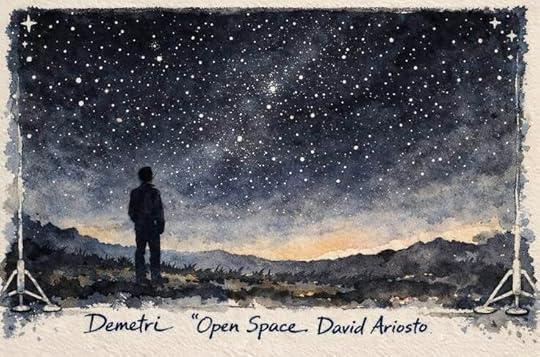
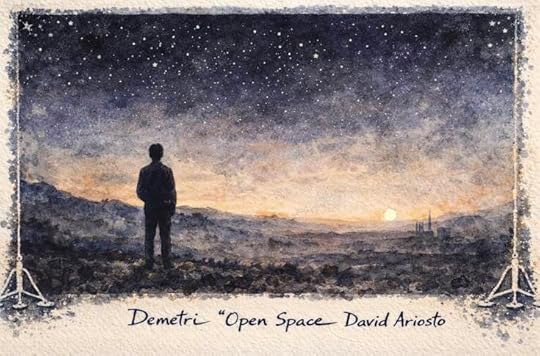
A solitary figure beneath a star-thick sky sets the tone for a book that begins in wonder before it turns to power, machinery and reach.
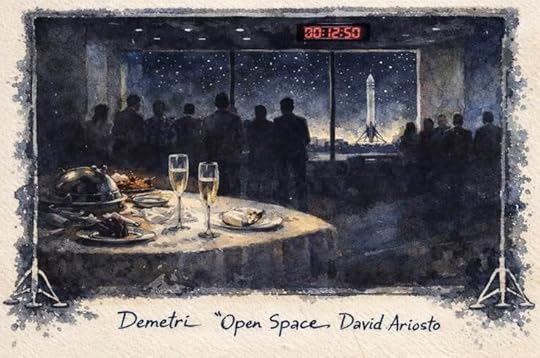
David Ariosto opens “Open Space” not with a theorem or a slogan but with a launch window. There is champagne. There is a countdown clock. There is a Falcon 9 waiting in the Florida dark. There is Kam Ghaffarian, billionaire co-founder of Intuitive Machines, looking toward the pad as if toward both a machine and an argument. It is an excellent opening because it tells you, at once, what sort of book this will be. Ariosto is not writing a technical manual, nor a hero’s march, nor a futurist fever dream. He is writing about the moment when wonder acquires procurement language – when the ancient habit of looking up becomes a matter of contracts, national strategy, methalox engines and who gets to arrive first with enough power to make their arrival stick.
In the dim light before liftoff, Ariosto finds the new space age exactly where awe meets procedure.
“Open Space: From Earth to Eternity – The Global Race to Explore and Conquer the Cosmos” argues that humanity has entered a second space age: broader than the Cold War contest, messier than the Apollo romance and far more revealing about how power works in the 21st century. Ariosto’s subject is not simply exploration. It is the conversion of space into infrastructure, theater, territory, market and mirror. His cast includes NASA officials, lunar startup founders, Chinese planners, orbital strategists, Mars advocates, antimatter physicists and the billionaire impresarios who now loom over launch cadence the way industrial titans once loomed over railroads. The question running beneath the whole enterprise is the right one: who sets the terms? Not who plants the flag, exactly, but who gets to define the rules, the routes, the acceptable risks and the economic grammar of the sky.
That ambition gives the book much of its electricity. It also gives it its strain. Ariosto wants to write several books at once – a reported account of the lunar return, a study of U.S.-China competition, a dispatch from the commercial launch boom, a meditation on Mars and planetary defense, a tour through deep-space aspiration and advanced physics, and finally a reflection on what kind of species humans become when they stop treating Earth as their only stage. Much of the time, impressively, he succeeds. When he is nearest to the present tense – nearest to launch pads, engine anomalies, geopolitical maneuver, or the hard practicalities of who will build what and where – “Open Space” is vivid, intelligent and deeply engrossing. When it lifts further into speculation, the grip loosens. The book remains interesting; it is simply less pressurized.
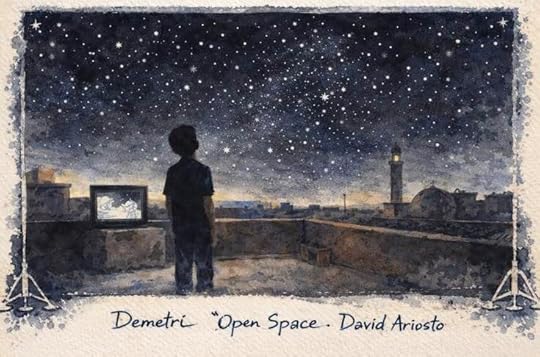
Long before rockets and contracts, the future began with a boy on a rooftop, looking up.
Its beating heart is Part I, “Return to the Moon,” where Ariosto is strongest as a reporter of systems under stress. He understands that the Moon has been reclassified. In the public imagination it still glows with Apollo afterlight, the old silver emblem of national prestige. In “Open Space,” though, the Moon is no longer chiefly symbolic. It is logistical. The south pole, with its permanently shadowed craters and the promise of trapped water ice, becomes the solar system’s most coveted cold-storage depot. Water means oxygen. Water means fuel. Water means permanence. Ariosto is excellent on this shift from romance to supply. He sees that the modern Moon race is not about reenacting Neil Armstrong but about building the first off-world node in a future transport and resource network. In his best pages, lunar exploration stops looking like a commemorative act and starts looking like the opening move in industrial geography.
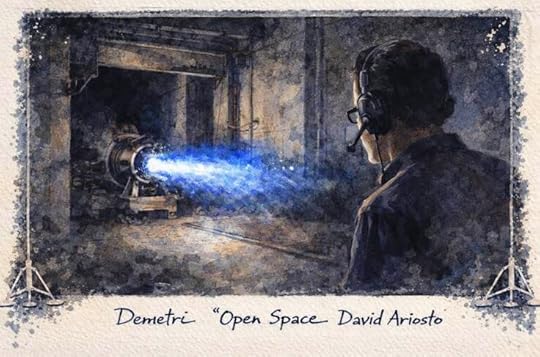
At the test stand, “Open Space” is at its best: ambition under pressure, technology on the verge of failure or flight.
This is also where Ariosto’s reporting has the greatest bite. The Intuitive Machines material, especially the scenes around launch and the anxieties over propulsion, gives the book texture that many broad space surveys lack. Engineers look tired. Investors circulate. Families hover at the edge of national ambition. The details matter because Ariosto knows that modern exploration is built not only from grand speeches but from ragged teams living on bad food, sleeping badly and hoping the engine behaves in vacuum the way it behaved in tests. The prose can still swell toward the cosmic, but it is tethered to observed reality, which is where Ariosto is most persuasive. He has an instinct for the exact point at which a technical problem reveals a political one.
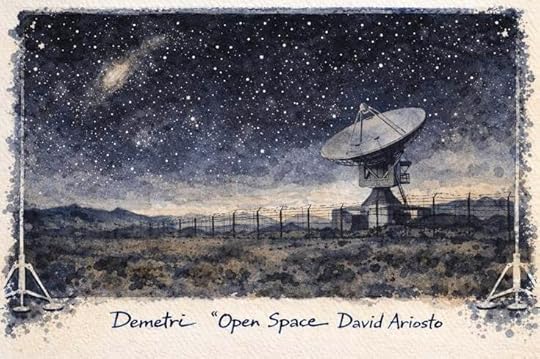
In the Patagonian dark, the book’s argument widens from rockets to routes, influence and the geopolitics of the sky.
His treatment of China is almost as strong. “Open Space” is particularly good at refusing the lazy habit of narrating the future of space as if it were still the private melodrama of American billionaires. Ariosto understands that no honest book about this century’s space order can leave Beijing at the margins. China here is not a foil but a parallel system: state-coordinated, patient, prestige-conscious, infrastructural and keenly aware that launch systems, lunar bases, relay satellites and tracking stations are never only scientific achievements. They are also announcements. Ariosto’s chapters on Chinese influence in Argentina and on the larger strategic logic of China’s ascent give the book some of its sharpest edges. Space, in his account, is not only a destination. It is a language through which states describe the futures they intend to dominate.
That is one reason the book feels so current without sounding opportunistic. Ariosto is writing in an era when the sky is already crowded with commercial ambition, when satellite constellations shape daily life on Earth, when reusable rockets have moved from stunt to operating principle and when the return to the Moon is no longer a museum idea but a live architectural and geopolitical project. He does not need to overstate relevance because relevance is built into the subject. The book understands that space is now tangled up with climate observation, communications infrastructure, cybervulnerability, military posture, industrial policy and energy demand. Its achievement is to make that tangle legible to a general reader without pretending it is neat.
Ariosto also has a feel for the properly absurd comedy of this age. “Open Space” is, among other things, a book about very serious people trying to prepare for futures that still sound faintly deranged when spoken aloud. How do you govern Mars before anyone lives there? How do you keep lunar commerce from becoming celestial enclosure? How do you build orbital systems at a scale large enough to matter without turning low-Earth orbit into a junkyard with a billing department? Ariosto does not flatten these questions into policy-white-paper prose. He lets some of their weirdness remain, which is wise. A great deal of modern space writing suffers from an adolescent inability to distinguish the visionary from the juvenile. Ariosto usually does better. He knows that ambition becomes more interesting, not less, when exposed to law, friction and institutional absurdity.
The prose has real force. Ariosto likes the sentence that begins in observed fact and ends in species-scale implication. Sometimes that method produces exactly the right note. The prologue’s insistence that this is a “course-setting moment” for humanity could have sounded inflated in a lesser book; here it lands because he quickly fills the claim with material evidence – launch systems, new forms of energy, rival state strategies, the practical pressures of living on orbit. He has a gift for moving from scene to system without making the seam obvious. That gift gives “Open Space” its lift.
But Ariosto’s weakness is closely related to his strength. He is drawn to amplitude. He likes the elevated phrase, the large horizon, the sentence that peers over the immediate problem toward destiny. At times, especially in the later sections, the prose runs a little hot. Not false, not empty, but overheated by its own appetite for scale. The book is at its most authoritative when Ariosto lets the reporting carry the grandeur. It is less convincing when every threshold must announce a civilizational transformation. The cosmos supplies enough sublimity on its own. The writer need not gild every star.
This becomes clearest as “Open Space” pushes beyond the Moon and Mars toward the more speculative stretches of Part II and especially Part III. The book remains lively here, and often genuinely exciting. Ariosto is good on the search for life, on ocean worlds, on planetary defense, on the way the James Webb era has sharpened the old question of whether Earth is exceptional or merely local. He has an eye for the strange dignity of science at the edge of knowledge. Yet the balance of the book changes. In the early chapters he is reporting what powerful institutions are building now. Later he is curating what physicists, futurists and long-range dreamers believe might one day be buildable. That shift matters. The chapters are not bad – some are elegant and some are moving – but they do not generate the same narrative voltage as the launch-centered sections or the China chapters. What had felt like a tense book about the present becomes, in part, a very intelligent catalogue of possible futures.
Still, even here Ariosto’s best instincts remain visible. He never fully surrenders to boosterism. He keeps asking what kind of order follows expansion. He worries, sensibly, about militarization, debris, strategic choke points, commercial concentration and the possibility that humanity may carry into orbit not only its ingenuity but its worst habits of extraction and hierarchy. Those worries give the book moral ballast. “Open Space” is not content to marvel at the new sky. It wants to know who will patrol it, price it, mine it, weaponize it, clutter it and narrate it. That makes it a more serious work than the usual future-of-space pageant.
It also places the book in interesting company. Readers who admired Christian Davenport’s “The Space Barons” will recognize the fascination with private launch culture, though Ariosto is less interested in founder mythology than in the statecraft those founders now disturb. Oliver Morton’s “The Moon: A History for the Future” is another useful point of comparison, especially in the treatment of the Moon as strategic terrain rather than nostalgic relic. And in its higher, more searching register, the book glances toward Carl Sagan’s “Pale Blue Dot” – though Ariosto is more bruised by procurement, more suspicious of power and more alert to the way the sublime now arrives accompanied by launch manifests, security doctrine and competing sovereign appetites. He is, in other words, writing the cosmic book after infrastructure.
What finally keeps “Open Space” from the highest rank is not lack of intelligence or relevance but a certain overabundance. The book could have used more pruning. Some chapters feel like satellites that should have been deorbited to preserve the clarity of the main architecture. Ariosto has so much material and so much curiosity that he occasionally mistakes inclusion for pressure. The result is a work that is consistently stimulating but not always equally shaped. One closes it admiring not only what it sees but what it cannot quite stop seeing.
Yet overreach, here, is the overreach of a serious mind trying to take the full measure of a historical turn before that turn has settled into consensus. Ariosto is writing about a moment when the Moon has become infrastructure, Mars has become a planning problem, China has become a permanent gravitational force in the story of space and private industry has moved from colorful adjunct to structural power. He is writing about a period in which human beings have begun to talk about orbital industry, lunar fuel, planetary defense and interstellar aspiration in the same broad breath. It would almost be stranger if a book of this kind were perfectly modest.
By the end of “Open Space,” the horizon itself feels changed – less earthly, less certain and more open than before.
I would place “Open Space” at 84 out of 100: ambitious, stylish, sharply reported, occasionally over-written, somewhat overextended and often genuinely thrilling. It is not the final word on the new space age, but it is one of the more intelligent and wide-angled attempts to describe what this era feels like from inside – the exhilaration, the competition, the absurdity, the scale and the unnerving possibility that the species is beginning, at last, to build futures faster than it can govern them. Ariosto sees that clearly, and it is the clearest thing in the book.
All watercolor illustrations accompanying this review are by Demetris Papadimitropoulos.
I preordered this book several months ago when I read a blurb online, then forgot all about it until it arrived at my house recently. I cracked it open to skim a few pages and get a sense of what to expect. But it was hard to put down.
While I happen to be a scientifically literate, advanced degree holder, this book covers such a breadth of topics that nobody alive possesses expert-level knowledge across the full range under discussion, and this is where Mr. David Ariosto really shines. Ariosto gained access to high-level experts across a broad spectrum of fields, and he leverages his keen ability to essentialize extraordinarily complex and intricate topics such that the reader can quickly understand the salient points of each and fit them like jigsaw pieces within the broader frame of the burgeoning space economy. He accomplishes this without making us sit through a dozen masterclasses detailing the “how” before we can get to the relevant “what” and “why” we need to wrap our minds around the grand perspective: modern space exploration and exploitation—why people do it, and how those threads weave through society and the economy.
My only criticisms of the book came when it touched on my own area of study and expertise; I found myself welling with frustration that he did not dive deeper into every interesting and exciting problem, controversy, and paradox I like to nerd out on. I can imagine this feeling holds true for professionals in each of the disciplines he features, though—and that is precisely why I realize he made the right choice in writing the way he did. A work like this could all too easily get lost in the weeds; painting such a broad, comprehensive picture already requires so many tangents that satisfying everyone’s arcane wishes would simply make it unreadable—or at least make it impossible to achieve its holistic goal.
Mr. Ariosto clearly put himself through dozens of highly technical crash courses so that we wouldn’t have to. He did his homework and used what he learned to provide a broad vantage point on an otherwise paralyzingly complex topic. And yet this still finds a way to be a page-turner; he writes with crisp wit and entertaining prose that pull the reader along on a thrilling ride. He is exceptionally well read, presenting complex topics in a warm, accessible manner. A reader could be forgiven for feeling immersed in the musings of Bill Bryson or Michael Pollan, with—dare I say—moments of David Sedaris-like sharp humor as they soak up the scientific landscape.
Mr. Ariosto took on the useful and practical, futurist-like role of fitting the interlocking pieces together—assembling a jigsaw puzzle that gives us a high-resolution window into the near future. In this way, his work is reminiscent of Ray Kurzweil at his best. This is an area where other recent related books have fallen short. In one particularly interesting, speculative chapter, Open Space even offers a glimpse into what humanity’s distant future might have in store. It boggles the mind and spurs the imagination. While Ariosto is quick to identify the present limits of technology and the controversies that abound in unsettled science, he is clearly a man who places his bets on human ingenuity, and he uses that optimism to illustrate the futuristic daydream chased by today’s space explorers and captains of industry. These are people who face “the impossible” with the understanding that—since the dawn of time—wherever mankind encounters a roadblock, it devises a way to either smash through it or circumvent it, rendering the ‘impossible’ obstacle irrelevant. The speculative technologies Mr. Ariosto projects forward in this chapter do exactly that, and with dizzying, world-forming imagination, he presents a vision of awe and wonder that serves as the cherry on top of this comprehensive work: hopeful possibilities a few centuries out that explain the effort, resources, and dedication increasingly being invested. It is the vision carried by those steering us away from a future that would otherwise resemble Blade Runner.
This book will bounce around in my mind for quite some time, and it is one I will no doubt revisit regularly as breakthroughs abound and new developments emerge.
David Astriole’s Open Space was one of the most engaging books on spaceflight I’ve read in quite some time—not because it focused on rockets themselves, but because it shifted the spotlight to the people and companies making today’s space race possible. Instead of retelling the familiar history of Apollo or dwelling on speculative visions of humanity’s distant future, Astriole explores the commercial ecosystem that has emerged around modern spaceflight. It is a refreshing perspective that made me appreciate how much innovation happens outside the launch pad.
What fascinated me most was the emphasis on the private companies competing, collaborating, and innovating in ways that have fundamentally changed access to space. The book illustrates that today’s “space race” is not simply a contest between nations, but a dynamic landscape of startups, aerospace giants, investors, engineers, and entrepreneurs, each contributing a piece to a rapidly evolving industry. Reading about reusable rockets, launch providers, satellite companies, and the infrastructure supporting orbital operations gave me a much broader understanding of what it actually takes to build a sustainable future in space.
One unexpected realization I had while reading was about my own interests. I’ve often considered myself interested in physics generally, but Open Space helped me recognize that I’m far more captivated by the practical and experimental side than by abstract theory. Discussions of orbital mechanics, launch windows, propulsion systems, engineering trade-offs, and mission design consistently grabbed my attention. Those topics felt tangible and exciting because they represent physics in action—real-world problems solved through careful engineering and experimentation.
By contrast, I found myself less drawn to purely theoretical discussions. That’s not a criticism of theoretical physics; it’s simply a recognition that I enjoy seeing scientific principles applied to accomplish something concrete. There’s something deeply satisfying about understanding why a spacecraft follows a particular trajectory, how engineers minimize fuel consumption, or why reusable boosters have transformed launch economics. Those concepts bridge science and engineering in a way I find incredibly compelling.
Astriole also deserves credit for making complex topics approachable without oversimplifying them. The book strikes a balance between technical depth and readability, making it accessible to readers who may not have an engineering background while still providing enough substance to satisfy those who want to understand how the industry actually works. I frequently found myself pausing to look up companies, missions, or technologies mentioned in the text, which is always a sign that a book has sparked genuine curiosity.
Overall, Open Space broadened my perspective on modern space exploration and helped me better understand where my own interests lie within the field. Rather than leaving me dreaming only about distant planets, it made me appreciate the incredible engineering, business innovation, and orbital mechanics that make every mission possible. For anyone interested in the modern commercial space industry—or for readers trying to understand how today’s space race differs from the one that defined the twentieth century—I would highly recommend Open Space. It is an informative, thought-provoking, and genuinely enjoyable read.
I checked out Open Space to get a better understanding of the emergence of the commercial space sector, inspired a bit by the recent launch of Artemis and a love of Apple TV’s For All Mankind series.
It reads as if the author initially planned to write about Intuitive Machines and the Odysseus lunar missions only to realize later that either the company had been eclipsed by bigger rivals like SpaceX or that the story couldn't quite hold up a book. He then seems to have patched together a narrative about competition in the wider industry (and with China), though in a way that feels uneven, choppy, and generally harder to follow than it should be, even for what admittedly can be a highly technical subject.
I did gain a few insights, including the somewhat surprising continuity between the Obama, Trump, and Biden administrations in shifting NASA toward commercial outsourcing in space. That story was well told, including its acknowledgement of the strong opposition to the change from respected figures like Buzz Aldrin. There are enough moments threads like this in the book that kept me reading almost to the end.
Yet there were areas that significantly diminished my enjoyment of the book. First, the author too often amplifies or hypes up unexpected developments rather than contextualizing them. One example is when a Chinese space startup founder said he was at the launch pad instead of the control room when his rocket lifted off. Yes, the author noted the difference between the United States and China, but mainly in a way that triple-underlined what a Really Big Deal this was. Readers instead might have benefited from the reminder that both countries have regulatory systems, but that those systems operate on different logics. In commercial aviation, for example, the FAA restricts certain areas and leaves most other airspace open; in China, specific lanes are open while all other airspace is closed by default. The same pattern applies to public use of waterways.
Along similar lines, he had a somewhat banal—sometimes even "Bro"-ish—sense of what to focus his attention on in his storytelling. The easy example to reach for is right in the subtitle of the book, "The Global Race to Explore and Conquer the Cosmos." He frames the current era of space exploration almost entirely as a zero-sum, chest-thumping geopolitical race between the U.S. and China, broken up into staccato-like chapters with manufactured cliffhanger endings. Meanwhile, as he relays these stories, he tends to go a bit ga-ga over the accounts told to him by industry insiders, presenting moments like an engineer talking to a moon lander with an unearned sense of profundity.
Finally, there were points where the prose was not just poorly constructed, but excruciating. He inexplicably starts one chapter by writing, "They did not want him to have sex." Eventually getting around to a reasonably accurate depiction of Zheng He's voyages in the Ming dynasty (that he goes on at some length about sea voyages from the early 1400s is still more evidence of the esoteric nature of his storytelling!), it's still a truly bizarre way to begin explaining that the admiral was a eunuch, not to mention a problematically othering ploy to gain his reader's interest.
So, in short: a few insights gleaned, but overall a plainly bad book.
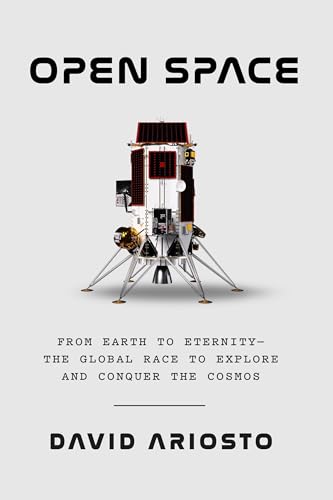
Don't judge a book by its cover does not apply to this book! The book's front page is that of the Nova C spacecraft which was the lunar lander that I worked on! Definitely caught my eye when I saw that! I can tell a whole story on how I encountered the book. I first saw it at Barnes and Nobles on May 4, 2026 shortly after eating tacos with my friend and former coworker Ryan Franz. He was later enthused to know that the author looks like him. Maybe one day I can introduce Ryan to the writer and they can decide if they resemble each other.
Inside this book are both black and white and color photos. At least one color photo has my picture in there. The caption does not mention me though but does mention Micaela Landivar, a coworker of mine who also has done mission control work for all the past Intuitive Machines (IM) missions. This semi self-promo aside, I think the book goes into a good description of the founding of new space companies and their challenges. I had no idea of the history of the founding of IM for instance. The author definitely did a good job interviewing the founders and the investors backers of new space companies like Intuitive Machines, Axiom, and Casimir.
He also tried his best to get some info on how the Chinese space industry is developing. Naturally since he doesn't speak Chinese and didn't actually tour Chinese space facilities, there's a degree of separation there. I was surprised that he was able to interact with at least one Chinese scientist to at least get some oral knowledge of cross-country collaboration and competition.
Overall, what is really missing is any of the exciting engineering and scientific details. He doesn't dive much into why we're going to the moon from the scientific perspective or how spacecraft navigation and orbit determination works and were serious concerns for at least the first IM mission. There's no scientific conference paper or journal references at all in this book. Since the author is not a scientist or engineer, maybe this would be expecting too much from him. Still, from my perspective, the other half of the coin was missing on the hard sciences; he covered the half on entrepreneurship and creative ideas quite well. It's still quite an entertaining read and since my picture is in there I'll give it a 4 out of 5.
On February 15, 2024, a SpaceX Falcon 9 rocket took off from Kennedy Space Center. On board was Odysseus, a moon lander built and operated by the American space exploration company Intuitive Machines (IM). When the lander successfully touched down near Malpert-A crater, 190 miles from the moon’s south pole, it became the first craft to soft land on the moon by a private company. It was also the first American spacecraft to land on the moon since Apollo 17 in 1972. Though it landed on an angled surface causing a 30-degree tilt of the lander, it remained functional and the mission was deemed a success.
Much of Open Space covers the current focus of space agencies around the world, and of the private space industry, on the importance of the moon. It is, once again, seen as a steppingstone to exploration of the rest of the solar system. The landing of Odysseus on the moon is the capstone of that portion of the book. It is, author David Ariosto says, a key part of an ongoing race to the moon between the US and China. He explores the current capabilities of the Chinese state run space program, and its main competitors. Those include NASA, of course, but his focus is on the host of private companies who today form the space exploration industry mostly based in the US.
Ariosto then looks at what might be next after conquering the moon. He explores current thinking (and capabilities) for journeying to Mars, and then potentially on into interstellar space. Most of what he reviews is hard science and technology and makes for interesting reading. The most “out there” is his coverage of the potential (and its currently ALL potential) for a Star Trek inspired “warp drive”.
The book is well researched and well laid out. For a science geek it’s a fascinating read. For anyone interested in the space industry it’s a worthwhile read, with the caveat that Ariosto’s deep dives may be a little too deep for casual readers. I was surprised, given the timing of its arrival, that there is comparatively little here about the Artemis program.
Read it for the deep dive into the current state of the space race, and the ongoing achievements that don’t get the headlines they deserve.
Well Documented Examination Of Space Tech Beyond Musk and Bezos. At least in the US (where both Ariosto and I are based), if you're talking space these days you're generally talking NASA, Elon Musk (SpaceX), or Jeff Bezos (Blue Origin). This book goes into the details of where space science and tech are *beyond* just those three entities, traveling all over the world showing how different people in different areas are contributing to pushing humanity beyond our home world - and why. While there are a lot of details here, including how nativist US policies ultimately both created China's space program decades ago and pushed it to new heights (both literally and figuratively) more recently, this is also more of a complete overview of the entire field than a deep dive on any particular tech or event. Even as some significant ones - including the race to have the first commercial lunar lander - are more heavily detailed than other aspects. (For example, while space craft of various forms are discussed heavily, I don't remember any mention whatsoever of space suit tech and only the barest mention of space food tech.)
Still, for all that it *does* cover, this book will actually better inform you of a lot of things that perhaps even some within the space exploration field may not be fully aware of (as I'm all too familiar with the idea even in my own field that a practitioner isn't always fully aware of newer developments even in their own field). At 22% documentation, it is also fairly well sourced and because it is primarily reporting on current and near future tech and the histories thereof, Sagan doesn't really apply here - making the 22% more than sufficient for this particular narrative.
Overall, this is an exploration of space exploration in its current forms that is clearly designed for mass appeal, and I do think this is one that most anyone even remotely interested in space tech and how we got where we currently are (beyond NASA, Musk, and Bezos) will find quite informative indeed.
On a topic such as “open space”, I liked the author’s conclusion “the East & West need not be enemies” much more than his first twenty chapters reminiscing the political divided between China & US while maintaining a sort of moral complex superiority over the rest of the world.
I get that US sees China as an adversary but the obvious double standards exemplified in the prior chapters were kind of a turn off. For example, the author states that China’s action in South China Sea was an example of how China was contemplating of overturning the Outer Space Treaty while SpaceX’s outright proclamation of Mars as “Free Planet” didn’t receive as much criticism.
And nowhere in the book did the author mentioned China actively shares its space program with the world by offering international access to its Tiangong space station, launching joint science satellites (such as the SMILE mission with the European Space Agency). In fact, it was the US that rejects a collaborative effort with China & the rest of the world. Barely anything was covered about India’s & Russia’s modern space efforts.
Nonetheless, I’m used to authors’ insistence of the adversarial approach towards the two countries as a norm these days.
Thankfully, I managed to learn a thing or two about the science of future interstellar travels & the recent commercialisation of US space industry to push the boundaries of humanity. The last two parts of the book were it saving grace.
I love space books. I picked this up because I wanted to understand the current race between the US and China, plus the rise of private companies like SpaceX and Intuitive Machines.
David Ariosto clearly did his homework. He got access to mission control, Chinese space officials, and an antimatter factory. The stories from the launch pad and the Mars Desert Research Station (yes, they eat bugs) were the best parts. I learned a lot about how close China actually is to catching up.
But here is my small issue. The book jumps between geopolitics and philosophy a lot. One chapter is about lunar landers. The next is about human eternity and our place in the cosmos. Both are interesting, but together they felt like two different books. I kept wanting more of the nuts-and-bolts reporting and less of the big-picture musings.
That said, David, if you ever write a follow-up focused just on the technology and the business race, more SpaceX, more China's supply chains, more asteroid mining, I would love to help. I can beta read, proofread, or just give honest feedback before you publish. And when the book is out, I can help you get it in front of the right readers.
This book was a dense, fascinating exploration (pun intended) of all things space. It was written very clearly and logically while being thoroughly researched and detailed. The organization was a bit hard to follow at first because it's not chronological, but rather it moves between technology, geopolitics, economics, and human exploration (thematic structure, rather than temporal). Once I got used to that, and it felt like the inertia started to kick in, then it was exciting to see what each chapter would hold and what kind of rabbit hole of things I didn't know I didn't know there would be. It did take a bit to get into it. This is not a short little what-is-space-x-and-who-is-elon, this book encompasses everything from what industries could make money in space to militarization of orbit to analog Mars research stations to the role of billionaires and startups. If you want a deep dive that is easy to follow, I would recommend this book. If you want something light and fast, this may not be your style. Thank you NetGalley and Knopf for this free advanced reader's copy; these opinions are purely my own.
This was an interesting book, with lots of compelling stories all talking about the evolution, and possible future, in space. It gave some new perspectives and painted rough visions for possible futures.
However, the way it was presented seemed a bit haphazard, intentionally breaking one story up over many chapters, with chapters on other topics woven in. Then, later it becomes more topical anecdotes.
So, it conveys a lot of good information, but the structure is odd and its vision is fragmented. It has promise but its impact is muted because of how its woven.
This was a fascinating and insightful read that weaves the historical background of the space race with the current space exploration industry. The writing is accessible and engaging with behind-the-scenes access. Ariosto also assesses the geopolitical aspect of space exploration, which makes for a well rounded nonfiction book.
Sincere thanks to NetGalley and Knopf, Pantheon, Vintage, and Anchor for an advanced reader copy in exchange for an honest review.
This was an interesting book ... more than I expected to find. Fascinated by the recent Artemis space launch, I picked it up thinking to read about the advanced technology involved in space exploration. What I found was much more ... a glimpse into the future and all the complexities that entails. I can only wonder what awaits manlike. A good read!
This is an ok book about space but is really more a collection of oversized essays on very specific assets of space. Technical aspects are non existent and it focuses primarily on people. Certainly more emphasis on China than any other book I've read on the subject.
(Audio) Really good up to date overview of the modern space race, especially with a global lens, and looking into the future of engineering and space. Felt a little cluttered in the first half, but covers a lot of ground
Did not finish. Got a few pages in. So grossly ameri-centric with obviously unchallenged biases. Yuck. I should’ve realized by the word “conquer” in the title, that’s on me.
I want to thank NetGalley for a free copy of Open Space by David Ariosto for my review. I'm still working through this book and I will create an update once I finish. This book is packed with information on the current global events surrounding the private space industry and the global race back to the moon and first time to mars. This book is an open dialogue on what the global options are with space exploration. Will we as a planet move forward as one to share in this important step in human history or will it continue to be a contentious border between governments especially the United States and China.
This book is packed with a ton of information, much I wasn't even aware of. It's a book to have a copy to reread or listen on audio book to return to soak up all the information. As someone who doesn't usually read book centered around the space exploration, this book is a bit over technical for me but the information is still extremely informative. I feel it is an important read to understanding the current events on a global scale ad how everything is interconnected deeper than we ever realize.
Unfortunately I didn't finish the book due to time constraints. It was so dense I wasn't able to read fast through it.
David Ariosto lays out the state of the space industry and makes it clear it is very much an industry, still political as ever, but much more about corporations than nations (even though nations are still a huge factor). It is also a deep dive into what the space industry could become as Ariosto explores the many, many opportunities for the rich to get richer off of exploring the resources of the solar systems. The book is exploration of how the fantastic, the fictional, and the extraordinary become mundane and ordinary as rules and regulations as well as shareholder reports and internal memos become a part of the realm of space exploration. Very thick and hard to wade into, but a good look at what is happening now to our approach to space and what might happen.