From the creator of the internationally acclaimed singer-songwriter project Girls in Trouble, a memoir following her journey from a secular Jewish childhood to becoming a modern queer woman owning ancient teachings and finding her own meanings in them, refracted through feminist interpretations of the lives of Biblical women.
“Alicia Jo Rabins writes as if she’s in conversation with the divine itself. . . .This isn’t merely a book to be read—it’s a scripture for the searching heart, a reminder that the border between the human and the holy is, and always has been, porous.” —Reza Aslan, author of The Life and Times of Jesus of Nazareth
As a self-described ‘90s suburban high school weirdo, Alicia Jo Rabins spent her time practicing violin and smoking cigarettes behind the mall while secretly dreaming of setting out on a spiritual quest no one around her seemed to understand. She often found herself drawn to the more ritualistic and rigorous Judaism that her parents had abandoned to assimilate and “become American.” In college, a chance meeting led her on a pilgrimage to Jerusalem to study rabbinical texts (and play bluegrass fiddle on the street for cash). But that two years of immersing herself in traditional observance was only the start of a journey full of twists and turns.
When We’re Born We Forget Everything follows Alicia’s relentless, often embarrassing, sometimes enlightening search for the sacred in everyday life as she tours America playing with a klezmer-punk band, falls in and out of love, scrapes through the initiations of motherhood, and witnesses the beauty—and danger—of mysticism. Rabins braids this personal narrative with the hidden stories of biblical women, uncovering a path of queer identity, feminist awakening, and spiritual self-invention. This lyrical, searching memoir is a meditation on longing, lineage, and what it takes to find meaning in a fractured world.
Alicia Jo Rabins is a writer, composer, musician, performer and Torah teacher based in Portland, Oregon.
DIVINITY SCHOOL, Alicia's first book, was awarded the prestigious 2015 American Poetry Review/Honickman First Book Prize, selected by C.D. Wright, and was a finalist for the Oregon Book Award. Her second book, FRUIT GEODE, is forthcoming from Augury Books/Brooklyn Arts Press in October 2018.
Alicia holds a MFA in Poetry from Warren Wilson College and a MA in Jewish Women's and Gender Studies from the Jewish Theological Seminary. She is the recipient of awards and scholarships from Lower Manhattan Cultural Council and Bread Loaf Writers Conference.
Alicia was born in Portland Oregon, moved to the East Coast at four months old, met and married a Portlander who was passing through Brooklyn, and now is back in her birthplace with her husband and their two little kids. Alicia is also an internationally touring singer, violinist and songwriter. Her musical projects include Girls in Trouble, her indie-folk song cycle about the women of Torah, and an original one-woman chamber-rock opera, A Kaddish for Bernie Madoff, which is now being made into a feature film. She loves coffee, gardening, herbal medicine, Torah, feminism, and peaty scotch, and is currently at work on a spiritual memoir.
This landed for me, I enjoy memoirs because they give a peak into someone else’s experience. Someone with different experiences than me. And this was written with a level of nuance that I really appreciated.
Thank you to Schocken for sending me a copy of this book in exchange for an honest review.
In recent years, I have been consciously choosing to read more books written by Jewish authors in all different genres. But I have a soft sport for memoirs. By nature, these books offer a direct look into someone’s lived experiences and thoughts and they can be funny, interesting, shocking, inspiring, and draw various emotions from the readers. I was already prepared to love this based on the summary, but I had no idea how deeply this memoir was going to resonate with me.
I’m only a few years younger than the author, and we both grew up in ‘90s suburbia not too distantly, although I was lucky enough to grow up in an area with a lot of other Jewish people. Reading this felt like reliving my own teen and young adult years and seeing what could have happened if my life had gone in a different direction—I found a real sense of being seen on these pages, and it led me to identify quite deeply with Rabins.
While reading, it felt like there was one constant that stayed present through all the different stages of Rabins’ life—her violin, and it opened all sorts of doors for her creativity to flow through. Going from classical training and learning how to fiddle and busk always left her with an outlet to grow through even as she journeys to find a spiritual outlet. Despite a secular upbringing, Rabins grew closer to her Jewish faith, only really learning about it as a teen, but then she went in a completely different direction. Living her own type of Eat, Pray, Love experience, her path took her to Jerusalem, living a strictly observant life while studying our sacred texts.
While the journey was one that would have had me engrossed anyway, I was even more blown away by the author’s ability to weave information from our sacred texts and not only make it interesting, she’s able to present it through a distinctly feminist lens. I liked getting to know about Rabins and her life, but I loved learning more about her spirituality, mysticism, and how she practices Judaism.
Overall, this was an outstanding memoir and might just be my favorite book of the year. It’s a story that reminds the reader that we are constantly inventing and reinventing ourselves and learning more about who we are, and that it is possible to live a life where so many different experiences accumulate and guide us. I loved so much about this book that it’s hard to pick a specific thing I liked best, but I thoroughly enjoyed the strong sense of nostalgia for growing up in the ‘90s, the hope that is maintained throughout her journey, and her continued openness to new opportunities and experiences. I honestly couldn’t find anything that I didn’t love about this book, and highly recommend it.
Bottom line: A memoir that focuses on learning, growing, and finding your own way to practice Judaism in such a fast-paced, constantly changing world full of conflicting messages.
i really enjoyed this!!! i’m becoming more interested in memoirs (esp jewish woman memoirs) and this one had so much interesting stuff in it. so much of her life/experiences/choices felt foreign to me in such a compelling way. some highlights for me were her experience with drugs as a teen, her dramatic arc from growing up secular to becoming incredibly knowledgeable about judaism, and her journey with music! i also liked the queer stuff, esp from someone my parents age, it was good to remember how different things were when they were growing up. also, this book straddles a really interesting line between looking back at her romanticization of jerusalem and her strong, moral standing against the genocide and colonization of palestinians (she doesn’t go super in depth about it, but she didn’t need to imo). i thought that was also super valuable. also she reminded me of my mom in a lot of ways haha. and my older sister. so that was fun. my mom in: yoga, basically learning all of judaism in her early 20s, and being in a relationship with a fucked up man (my dad…) and my sister with her love of torah and talmud and uh the other one (my brain is SO DEAD RN) that starts with an M… saffie if ur reading this pls help me and also the klezmer music stuff. finally, her interpretations and connections to female characters from the torah were sooooo interesting and taught me a lot of new stuff!!! overall, a really great memoir narrated by the author, with a little singing and violin playing in it!
In “When We’re Born We Forget Everything,” Alicia Jo Rabins Makes Holiness Out of Plumbing, Song, and the Fragile Gates of the Body By Demetris Papadimitropoulos | February 27th, 2026
Watercolor Piece by Demetris Papadimitropoulos
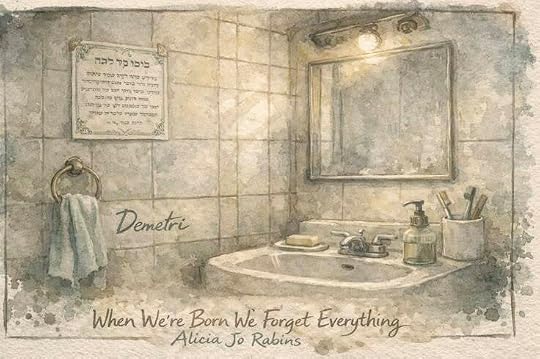
Alicia Jo Rabins’s memoir, “When We’re Born We Forget Everything,” opens not with a proclamation of belief but with plumbing – with the most anti-romantic fact of being alive: if the body’s passages clog, if one valve refuses its job, the self’s lofty aspirations collapse into panic. The blessing she learns to say after using the bathroom praises God for apertures and closures, for systems that mostly work until they don’t. It is an opening gambit that feels almost mischievous in its humility, and it quietly announces the book’s governing ethic: whatever the sacred is, it is not elsewhere. It lives in viscera, in breath, in hunger, in sex, in fear, in the astonishing ordinary. If religion is sometimes accused of making us leave our bodies behind, Rabins counters with the inverse claim: the body is where the argument begins.
This is a memoir of yearning that refuses to behave like a conversion narrative. Rabins does not march from secular emptiness to religious fullness, from disorder to doctrinal peace. Instead, she circles – approaching and retreating, running and returning, as if the soul were a tide line that cannot hold still. The subtitle you can almost hear humming beneath the pages is less “I found God” than “I kept looking for a structure sturdy enough to hold my aliveness.” That aliveness includes the spiritual hunger that drives her from suburban assimilation to Jerusalem’s study halls, but also the discomfiting truth that hunger itself can be dangerous. The desire for form can become the desire for safety at any cost; the desire for holiness can become the desire to disappear into someone else’s certainty. Rabins’s achievement is that she lets the reader feel the seduction of intensity without asking us to endorse its collateral damage.
The book’s architecture is its most distinctive signature. Rabins braids memoir chapters – childhood, adolescence, Jerusalem, love, disillusionment, reinvention, art, motherhood – with brief interludes that retell Biblical women’s stories. These are not decorative riffs. They behave like a chorus in an old play, interrupting the action to widen its moral and mythic dimensions, sometimes tenderly, sometimes like a blade. Jephthah’s daughter returns to the father who has vowed her life away. Miriam is punished for dissent. Hannah invents a form of prayer so raw it looks like drunkenness to the men who police the sanctuary. Vashti refuses a king’s sexual spectacle and is banished for the civic crime of dignity. Lilith arrives last, winged and ungovernable, carrying the dread and glamour civilizations have projected onto female autonomy. Rabins does not flatten these women into inspirational posters. Some are admirable, some are frightening, some are both. The point is not heroism. The point is survival, voice, consequence – the way women have always been made to live inside the interpretive gaps.
That phrase, interpretive gaps, is one of Rabins’s central subjects. “When We’re Born We Forget Everything” is obsessed with how meaning is made: through language, through ritual, through the stories a frightened mind invents, through the myths a culture assigns to desire. Rabins grows up in a suburban Jewish household where Jewishness is faint, something that flares around death and then recedes – a proverb of return rather than a daily practice. Her father, a psychiatrist, makes the brain a kind of domestic scripture; case histories become bedtime stories; questions become a family love language. God becomes, for the child, a placeholder for whatever science hasn’t yet solved. And yet she is not a tidy rationalist. She is, by her own account, too sensitive – the kind of kid who collects omens and fears, who senses a nameless power beyond the dining-room table. A reproduction of Bosch’s “The Garden of Earthly Delights” hangs in the house like a nightly portal: pleasure beside torture, the grotesque beside the sublime. Mystery feels less like wonder than like loneliness. The world is enormous, and the child is small, and no adult can quite translate the scale.
Adolescence arrives as a trilogy of initiations – blood, fire, bread – and here Rabins’s prose turns bodily in a way that is both intimate and analytic, as if she were reading her younger self with the same attention she later gives to sacred texts. Menstruation is anticipated as a threshold and experienced as an anticlimax, which is itself a lesson: the myth of transformation rarely matches the lived moment. Social humiliation becomes ignition, pushing her from a hierarchy of popular girls toward the misfit table where a cigarette is offered like a sacrament. And then comes the third initiation, more chilling in its familiarity: the whispered secret of thinness. Don’t eat. Control desire by refusing it. What begins as a teenage tactic becomes a spiritual template – an early training in asceticism that will later find a sanctioned cousin in religious fasting, and a dangerous cousin in the culture’s worship of self-erasure.
Rabins does not treat these years as mere prelude. They are her first monastery. The chapter with the deliberately comic title “Fasting, Recreational Drugs, and Other Practices of the Early Suburban Ascetics” reframes teen rebellion as clandestine devotion: fasting as discipline, psychedelics as revelation, concert parking lots as pilgrimage sites. The Deadhead scene is not nostalgic kitsch; it’s a portrait of a young person tasting community as miracle – strangers feeding each other, time bending, the ordinary world briefly suspended. The book is careful, too, about the cost: a classmate’s death, the body’s fragility, the moment when a romanticized ideal of control becomes unmistakably lethal.
Music runs alongside all of this as a second language for the sacred. Rabins’s violin is not a hobby but an engine of attention – hours of repetition, the disciplined listening required to find a note’s true center. Long before she can name prayer, she knows what it is to surrender the ego into sound, to become an instrument through which something larger passes. This is one of the book’s quiet arguments: spirituality is not only a matter of belief; it is a matter of training. People become capable of certain experiences because they practice being capable. The same is true, the memoir suggests, of love.
If childhood and adolescence are the apprenticeship in longing, Jerusalem is the apprenticeship in form. Rabins arrives at a pluralistic yeshiva near the millennium’s hinge – Y2K anxiety floating through the secular air while Jewish time ticks along, unbothered. In the study hall, men and women argue over texts; dissenting voices in the tradition flare like contraband truth. The book’s humor keeps puncturing piety – omnipresence debated through the question of whether God is watching you scratch your butt – but the humor never undercuts the seriousness beneath it. Rabins is trying to learn how to live inside a sacred grammar, how to make rules feel like a path rather than a cage.
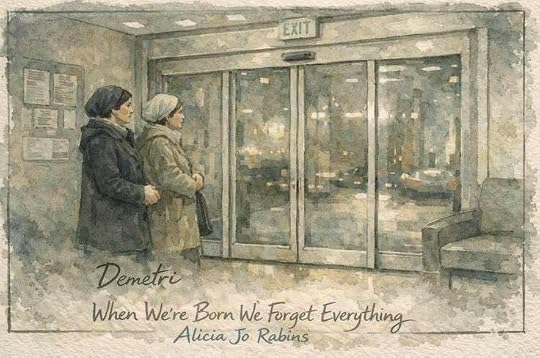
One of the memoir’s most vivid insights is that religion, at least in the forms Rabins seeks, is a matter of literacy. She is repeatedly confronted by her own unreadability – the way a land can be covered with signs you cannot interpret, the way a community can be thick with codes you don’t yet know. She learns on a train to an Orthodox home that she will be living for days without the devices and conveniences that make modern life feel frictionless. She watches Orthodox women waiting by sliding glass doors on Shabbat, needing someone else to trigger the sensor, and feels something in her mind click: holiness is not only inward. It is built into systems, architecture, objects, time. Rules can make the invisible visible. They can turn a day into a different day.
The memoir’s relationship to feminist critique is similarly complex. Rabins does not write as someone content to denounce the tradition and walk away, nor as someone willing to swallow its gendered constraints as divine order. She writes as someone inside the argument. Midrash becomes a method of survival: women inventing compassion within patriarchy; women petitioning law; women refusing commands. These episodes are not mere allegories; they become a set of moral muscles Rabins is building. If you want to survive inside inherited systems, you must learn how to argue with them – and how to recognize when argument is not enough.
Then comes Avniel, and the book becomes, for a time, a love story charged with prophecy. Rabins describes opening a door in her West Jerusalem apartment and seeing him standing there, late-afternoon light turned almost metaphysical – an encounter narrated as if the entire arc of joy and grief is already contained in the doorway’s air. It is one of those scenes that could easily tip into romantic kitsch, but Rabins’s voice has a particular tensile quality: she can be lyrical without being naïve. Avniel’s presence is not presented as salvation. It is presented as fate – and fate, in this book, is never uncomplicated.
Their intimacy unfolds inside the ritual architecture of Orthodox life – Shabbat meals, songs taught line by line until a room joins, the charged restraint of touch. Rabins is excellent on the sensuality of rules: desire sharpened by prohibition, the holiness that seems to hover in the gaps between allowed and not allowed. “Upside Down Coffee,” with its layered café hafuch in a glass mug, becomes a kind of sacrament of modern Jerusalem. Rabins’s treatment of sex is bracing in its refusal to separate the sacred from the sticky. When physical longing collides with religious choreography, the result is not a neat moral lesson but a mess that has to be lived through. The book’s tonal intelligence is to let embarrassment and reverence share the same room.
Watercolor Piece by Demetris Papadimitropoulos
But Jerusalem in Rabins’s telling is not only wine, song, and stone-lit romance. It is also the place where the outside world breaks in with a force that cannot be aestheticized: a friend killed in a bombing, grief arriving like a siren in the middle of a life being built. The memoir registers how quickly spiritual intensity can be punctured by violence, how thin the membrane is between prayer and fear.
Reading the Jerusalem chapters now, it’s hard not to feel an additional pressure in the air: the city is never only a private stage for a seeker’s ecstasy, but a contested geography where holiness and power share walls. Rabins is writing memoir, not policy, and her book’s allegiance is to the granular textures of one life – song in a room, rules in the body, love at a threshold. Still, the very interpretive practice she champions – noticing what inherited stories omit, listening for the unheard voice – invites a reader to sense what remains offstage in any intimate portrait of place, and to remember that spiritual longing does not dissolve the ethical weather of history.
The memoir’s most harrowing relationship material arrives after Jerusalem, when Avniel becomes Peter again in America and the romance turns claustrophobic. The shift is abrupt in the way real life is abrupt: the prophetic glow of a doorway scene gives way to the fluorescent realism of an apartment where the blinds stay drawn. Here Rabins writes with a steadier, colder light. The demand – If you don’t take my side, who will? – becomes the relationship’s coercive refrain. Suffering turns into a claim on reality; loyalty becomes the price of love. Rabins’s own spiritual training – her desire to be compassionate, to be large, to hold another’s pain – becomes part of what traps her. These chapters are psychologically exact: the way you begin to distrust your own perceptions, the way you confuse self-erasure with devotion, the way the world narrows until your life is measured by someone else’s storms. Tamar, in the adjacent interlude, forces recognition through a morally complex strategy – not as a model, but as permission to see that survival sometimes requires rupture.
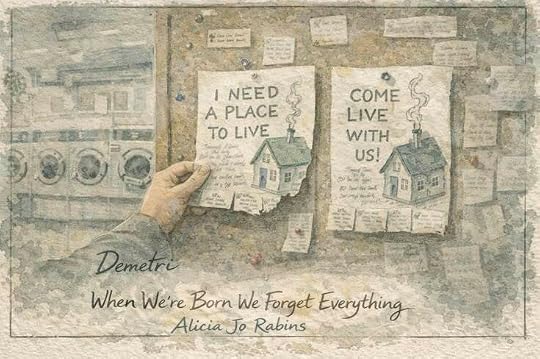
After leaving, the memoir shifts into rebuilding, and one of its most delightful scenes arrives like a small miracle: a hand-drawn flyer on a laundromat bulletin board offering a place to live, matching her own hand-drawn house as if the universe were answering in Sharpie. Rabins moves into a house that becomes a new kind of refuge – chosen family, herbalism, Shabbat dinners slowly becoming communal rather than private. The book’s earth-based chapters broaden the definition of ritual: the Jewish calendar as ecology, the kitchen as sanctuary. If Jerusalem is intensity, Northampton is endurance.
And then the music story surges into the foreground with the arrival of “Golem,” a klezmer-rock band that offers Rabins a different kind of tribe. These pages are among the memoir’s most joyful: the van life, the stage heat, the feeling of Yiddish in a room like a spell of survival. Rabins hears a klezmer album and asks, practically and metaphysically, how a violin can cry. Technique becomes theology. Micro-movements of bow and finger unlock ancestral grief. You can feel the memoir’s deeper argument here: the sacred is not preserved only by doctrine. It is preserved by sound. In an era when cultural inheritance is often reduced to identity performance, Rabins offers a more demanding alternative: inheritance as apprenticeship.
This musical arc culminates in the creation of “Girls in Trouble,” her songwriting project that reimagines Biblical women in contemporary song, performed in bars – a phrase that becomes a thesis statement for the whole book. Torah belongs wherever whole life happens: in dim rooms, in flirting, in whiskey breath, in art-in-process. If “The Red Tent” and “The Book of Longings” offered readers lush narrative reclamations of women’s sacred stories, Rabins offers something closer to living midrash – interpretation as an ongoing practice that can happen onstage as much as in study halls. The memoir’s modernity is that it refuses to keep the sacred quarantined.
Late in the book, motherhood arrives as the next initiation, and Rabins is unsparing about how unromantic it can be. The carefully planned homebirth becomes a hospital transfer and a C-section. The first night is institutional separation: the baby in a plastic bassinet, the mother awake in fragments. A framed Hebrew blessing in a corridor becomes a strange continuity – the letters following her into the clinical world. Then comes a move across the country, New York left behind, community and band life receding into the distance like a song you can still hear but cannot reach. Rabins’s depiction of postpartum loneliness has a contemporary sting, not because it name-checks headlines but because it touches the nerve so many people recognize: the isolation that can exist even inside a life that is “full.” Rabins does not offer platitudes. She offers ritual as scaffolding, and even that scaffolding is not a guarantee.
The book ends not with certainty but with a practice – teaching b’nai mitzvah students, passing on the keys, granting permission to argue. It is, in its way, a modest conclusion: the sacred is not an answer, it is a set of tools. The story of the fetus learning Torah in the womb and forgetting it at birth becomes a metaphor for the entire life: we arrive already wired for wonder, then spend decades relearning how to recognize it. The last interlude, Lilith, is not simply a feminist mic drop. It is a reminder that autonomy has always been coded as dangerous, especially when it touches sex and birth. Rabins does not tidy Lilith into empowerment alone; she lets the demonology remain as a record of fear – fear of female power, fear of vulnerable infants, fear of the night.
So how to speak about the book’s weaknesses without diminishing its singularity? At times, the memoir’s recursive structure can over-emphasize its thesis; some interludes feel more like polished set pieces than discoveries made in real time. Yet these soft spots are the byproduct of ambition: Rabins is not writing a diary of events but a crafted meditation on how a life becomes legible to itself.
To read Rabins well is to accept the book’s premise: the sacred is not a fixed location. It is a frequency. It can be tuned through rules and untuned through grief, found in a coffee glass or a bathroom stall, enacted in a study hall or a bar. The memoir’s most original contribution is not its argument for Judaism or against it, but its portrait of spiritual life as a craft – something learned through repetition, repaired through interpretation, and carried forward not by purity but by practice. It is the kind of book that makes you notice your own small rituals – how you touch your phone first thing in the morning, how you avoid certain thoughts, how you bless or curse the body that carries you – and it asks, gently and relentlessly, what kind of person those rituals are making you.
Rabins’s prose has the musician’s ear for cadence and the teacher’s instinct for making abstract ideas tactile. Her tone can be funny, reverent, unsparing, and tender in the span of a page. The book’s best passages shimmer with a particular kind of intimacy: the intimacy of a person who has spent years learning how to look, how to listen, how to name. “When We’re Born We Forget Everything” is not perfect – few lives are, and Rabins is not interested in pretending otherwise – but it is bracingly alive, a memoir that refuses to lie about what the sacred costs and what it gives. My rating: 88/100.
Alicia Jo Rabins grew up in a secular Jewish home, but, even as a young child, felt that something was missing from her life, that there was something different that she needed to make life feel complete. As she notes in her memoir “When We’re Born We Forget Everything” (Schocken Books), she first found that part of that missing element in music and then in Orthodox Judaism, before realizing that the best way to live her life was to find a balance between the sacred and secular. Or, more accurately, to see the sacred that exists in the secular and sacred worlds. Her work not only tells the story of her spiritual search, but offers chapters that contain her thoughts on biblical stories she found particularly meaningful. See the rest of my review at https://www.thereportergroup.org/book...
I'm a superfan of Alicia Jo Rabins -- her gorgeous music, her exquisite poetry, her children's book about Leonard Cohen-- and her memoir was wise, vulnerable, and brilliant. I'll be recommending to again and again.
Alicia Jo Rabins’ When We’re Born We Forget Everything is a layered and intellectually rich memoir that fuses personal narrative, spiritual inquiry, and feminist reinterpretation of biblical tradition into a cohesive and emotionally resonant whole. It is not structured as a linear life story so much as a reflective architecture of identity formation, built from memory, ritual, artistic practice, and theological questioning.
At its core, the book explores the tension between inherited tradition and self-authored meaning. Rabins situates her upbringing within a secular Jewish suburban context, then traces her gradual pull toward the ritual depth of Judaism she initially observed from a distance. This movement is not portrayed as conversion in the conventional sense, but as a continuous negotiation between belonging and estrangement, structure and freedom, belief and reinterpretation.
One of the book’s most compelling strengths lies in its integration of artistic life and spiritual development. Rabins’ experiences as a musician, particularly within experimental and folk-inflected performance contexts, are not treated as separate from her intellectual and spiritual journey, but as extensions of it. The memoir repeatedly demonstrates how artistic expression becomes a vehicle for theological exploration and emotional processing.
Equally significant is the way the text engages with biblical women’s narratives. Rather than treating them as static religious references, Rabins reframes them as living interpretive spaces through which contemporary questions of gender, agency, and embodiment can be examined. This interpretive approach gives the memoir a dual function: it is both autobiographical and hermeneutic, personal and analytical.
Stylistically, the writing balances poetic reflection with grounded autobiographical detail. The narrative does not rush toward resolution; instead, it embraces fragmentation, contradiction, and revisitation, mirroring the nature of spiritual searching itself. This structure allows the reader to experience uncertainty not as a problem to be solved, but as a legitimate mode of understanding.
Overall, When We’re Born We Forget Everything stands as a thoughtful contribution to contemporary memoir, particularly within the intersection of spirituality, feminist theory, and lived religious experience. It offers not definitive answers, but sustained inquiry, anchored in lived experience, artistic expression, and interpretive courage.
Every life has meaning and purpose. It is essential that each individual find that meaning and purpose and craft a life that emphasizes both the journey and the end result. When We’re Born We Forget Everything (New York: Schocken Books, 2026, 296 pgs, $30 US, $41.99 CAN), the latest effort by Alicia Jo Rabins, is an excellent road map for how to start and sustain life' s journey. This journey can be spiritual, religious, or even physical, and can leave an individual with a rich sense of fulfillment or a sense of sadness at having not met expectations. However, each individual must experience that journey for themselves. Rabins is a seeker. She describes her journey from being young and seeking friendship, to being a parent and realizing that the most important journey in life is one of legacy. Along the way, Rabins shares her struggles, successes, happiness, and sadness. The reader is taken to classrooms, musical realms, and seedy bars, where Rabins describes how her experiences have shaped her world and her character. Each journey has an ending that is both surprising and understood. When We’re Born has a religious and spiritual aspect. Rabins describes her desire to understand and incorporate her spiritual quests in her life journey. This need underscores Rabins’s attitude towards those around her and how they can benefit her and how she can help them along their own journey. Her faith is a difficult faith. It is fraught with self-doubt, a longing towards her own fulfillment, and a need to understand what her parents and grandparents have known but have distanced themselves from. When We’re Born is an excellent read. Rabins writes with kindness and a desire to share her world with others. The narrative is engaging because it does not hide Rabins’ inner struggles and creates a story that is easily identified with by the reader. The complex religious and spiritual terms that are encountered are easily and eagerly explained. These explanations can help the reader to transfer the quest for faith to their own idea of spirituality and religion. It is a welcome addition to the shelf of any reader looking to complete their own life journey.
When we’re Born we Forget Everything is a joy to read. The narrative is candid and approachable; Rabins seems to converse with her own perceived shortcomings as she lands (or sometimes crashes) on the stepping stones of what is sacred. Also, she’s cool and you’d want to be friends with someone who is an avant guard musician, undaunted by sexual desire and drugs, yet who is achingly open to the embrace of commitment, parenthood, being a lifelong teacher/learner and experiencing pain. For Rabins it seems that the mundane and the taboo enmesh themselves deeply within the sacred, and both are threaded throughout the connectedness that humans seek. She peppers her story with a recounting of historical women from the Torah, many of whom I didn’t know about. Rabins imagining of what these women's hearts might contain made her own journey seem firmly rooted, both ancient and of the moment.
I was so excited to return home and read this every night that I finished in just a few sittings. In fact, my only disappointment was that in focusing her story so distinctly, I was left wanting to know more. What else happened to her boyfriend? What kind of mom is she? What do her parents think now? Honestly, Alicia Rabins must be a beautiful and highly coveted (at least by me) dinner guest, but short of that, the memoir is a gift read.
P.S. If you or someone you know is unaware of the now robustly documented connection between marijuana use and psychosis, give yourself an Internet search.
In this memoir, the author looks back on the many phases of her life of seeking out the best ways to live with her Judaism and spiritual needs while staying true to her personal values and talents. The memoir takes us through her early years in high school and college as a Dead Head, a nightly user of LSD, a dedicated violinist, and a seeker of Jewish learning and observance. As she begins her religious learning, she ends up at a yeshiva in Israel for almost two years with other students who are studying daily and maintaining an Orthodox style of observance. The book then moves on to her return to the US, her relationship with a love-at-first-sight boyfriend and her return to a love of making music.
While I can understand why this author's life and its many phases can be the ingredients of a memoir, I never felt fully engaged in the book. It might be that she was covering too much territory of her life and only getting deeply into some of it, especially her final phases. I also never fully grew to like her and wasn't clear about how she ultimately overcame some of her emotional issues of anxiety and loneliness other than pursuing a traditional life as a married woman with children.
I was provided an ARC by the publisher via NetGalley.
What a beautiful book. I'm so glad I came across it as a writer contemplating similar themes of self, identity, belonging, and Jewish spirituality. I loved all the moments of pivot and transformation the author writes into with the confidence of clarity of reflection and hindsight, but not so neat and tidy that the mess doesn't appear. I also love the way she describes her love affair not only with people but with music, ideas, the Holy Land itself. We've had so many overlapping experiences—growing up Jewish in a mostly secular suburban lifestyle, loving the Grateful Dead as a spiritual awakening, finding words for the pain through writing and creative expression, wrestling with leaving and returning, and turning to the ancient wisdom of ancestors, especially women, to lead us through the inevitable darkness. I'm sitting on an unpublished manuscript with similar themes so it was very inspiring to see this book come out into the world and to know that there's an audience and readership for these stories. Thank you, Alicia! Absolutely moved by this book and I think anyone interested in spiritual memoirs and coming of age stories will appreciate the candor, tenderness, precision and clarity of this beautiful book.
This entire review has been hidden because of spoilers.
This book is about a woman who is finding her place in the world and feeling connected to the universe through her religion and spirituality. It was a really enjoyable memoir. I did not know who she was before getting the book but I just began reading it because it was interesting.
It is a great reminder that we are on a floating rock, there are 8 billion people on Earth, we are not the main character, and we are all connected. Those were my takeaways.
An engaging evaluation of a journey towards self-discovery. Rabins beautifully intertwines the biblical and the current to weave a story of how she found her way to authentic living holding a multitude of complex truths at once.
her life is so similar to my own and those of many people in my community (barnard , pardes , journey to rabbinate ) that i wasn't super compelled but enjoyed the lush storytelling