A deeply learned yet highly readable and entertaining history of Moscow, a city defined by its survival and reinvention, and whose rich history offers crucial insight into contemporary global politics
The city of Moscow stands at the center of a nation comprising eleven percent of the globe's landmass, 11 time zones and nearly 150 million people, some 13 million of whom live in the capital. In A Kingdom and a Village, acclaimed historian Simon Morrison offers a vividly rendered history of Russia's heart and soul, tracing its transformation from a "big village"--the demeaning nickname the St. Peterburg nobility gave to its provincial neighbor--into a spectacular metropolis of vast geopolitical import.
That arc is the stuff of dramatic, violent, stranger-than-fiction historical narrative: the last century alone has featured invasions and costly battles, the destruction (and reconstruction) of sacred cultural and religious landmarks, and the collapse of the Soviet republic--not to mention the rise of an authoritarian leader who is a keen student of Russian history. Morrison reaches back further still, to the founding of the place we now know as Moscow as a fortress on a river nearly a millennium ago. In the centuries that followed, any number of external forces--from Tatar Mongols and Swedes to Napoleon and Hitler--set their sights on Moscow, reinforcing its self-conception as both a glittering prize and a site of perpetual defense and resurrection.
Drawing on a rich array of archival materials, from the birchbark scrawls that record the oldest layer of Russian civilization to the articles in European newspapers heralding the opening of the magnificent Bolshoi theater, Morrison brings to life the bloody power struggles, cultural marvels, excruciating famines, droughts, storms, and fires that have shaped and re-shaped the city and reinforced its essential character. Having first visited Moscow in 1990 and made some thirty trips since, he excavates the city's truths from its fictions--while celebrating both--in a style that's at once deeply learned and deeply personal.
With A Kingdom and a Village, Morrison makes a persuasive, even impassioned case that to understand Moscow is not only to unlock the spellbinding mysteries of Russia's past but also, critically, to grasp the grim logic of its present. It is a magisterial biography of a place--and an essential guide to a people and a country that, for many readers, might have remained impenetrable.
Simon Morrison is Professor of Music History at Princeton, where he earned his PhD in musicology. A leading authority on composer Serge Prokofiev, he is the author of The People's Artist, along with numerous scholarly articles, and features for the New York Times. In 2011, Morrison was awarded a Guggenheim Fellowship.
This book has everything about the history of Moscow, and includes a lot of Russian history, from beginning to end.
Everything you could want or need to know will be found in these pages. I love the way Simon Morrison laid out historical facts and wrote them into this book. It's interesting and entertaining enough that it reads like fiction, however, with all of the history and background facts it contains, it's definitely a work of nonfiction.
If you enjoy history, you'll love this one! It's both informative and entertaining.
*As always this is just my opinion. You may have a different experience/point of view, with any book I review. Please read and judge for yourself. Thank you for reading!
*I gratefully received this book from the publisher and author in exchange for an honest review. Thank you!
The City That Kept Mistaking Itself for Destiny In Simon Morrison’s “A Kingdom and a Village,” Moscow rises from river mud and borrowed myth to become the stage on which Russia repeatedly rewrites itself. By Demetris Papadimitropoulos | March 15, 2026
Simon Morrison’s “A Kingdom and a Village: A One-Thousand-Year History of Moscow” is not merely a history of a city. It is a history of how a city becomes a method of rule – how a settlement on a river turns into a fortress, a shrine, a bureaucracy, an empire’s theater and, finally, a state’s preferred way of imagining itself. Morrison announces the stakes immediately. In the book’s opening pages, he argues that “Russia” is as much an imaginative construction as a political one, and that Moscow sits at the charged intersection of church and state, grievance and grandeur, conquest and self-mythology. Its authority, he insists, was built partly by taking from elsewhere, above all Kyiv. That claim gives the book its heat. This is not antiquarian pageantry. It is a long history written under the pressure of the present.
That pressure is also what makes the book unusually alive. Many millennium-spanning histories aspire to majesty and arrive at inertness. Morrison has written something much sharper: a biography of a metropolis that treats stone, ritual, topography, catastrophe and official memory as parts of a single political machine. The result belongs, loosely, to the company of Peter Ackroyd’s “London: The Biography” and Simon Sebag Montefiore’s “Jerusalem: The Biography,” though Morrison is less interested in civic abundance for its own sake than in the way Moscow converts vulnerability into authority. In his hands, the city becomes an engine for turning humiliation into expansion, invasion into destiny, and repetition into historical style.
One of the book’s quietest and best decisions is structural. Morrison divides his narrative into three large parts – “Before Russia,” “Second City,” and “Soviet Capital” – and gives the chapters titles that are more suggestive than merely chronological: “The River,” “Ash,” “Plague,” “Third Rome,” “Pretenders,” then later “Foreigners,” “Empresses and Thieves,” “Grand Theater,” “Zaryadye,” “Mystics of the Arbat,” “The Metro,” and “Swimming.” The arrangement tells you what kind of historian he is. He can proceed dynastically when necessary, but he knows that Moscow eventually becomes too layered, too self-revising and too symbolic to be narrated as a simple succession of rulers. From a certain point onward, the city must be read by neighborhood, ruin, façade and recurrence as much as by reign.
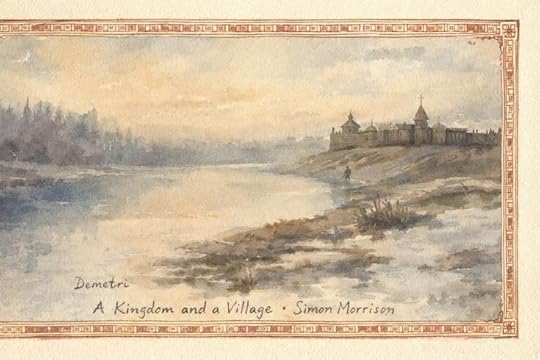
Watercolor I: Before Moscow was an idea, it was water, mud, timber, and the cold promise of survival.
The introduction, “Tanya,” is especially deft. Rather than entering through the pieties of origin, Morrison begins in late Soviet and post-Soviet disarray, with his own first trip to Moscow and with the figure of Tanya, an Intourist guide, carrying home leftover puréed potatoes for her cat. That detail is comic, melancholy and diagnostic all at once. It captures the book’s central doubleness: Moscow as a place of exhausted grandeur and private improvisation, official theater and domestic shortage, imperial posture and shabby survival. Morrison has spent decades studying and returning to the city, and that long acquaintance matters. He does not write like a passing explainer flown in to decode “Russia” for the puzzled West. He writes like someone who knows that cities are not solved but accumulated.
What he accumulates here is impressive. Morrison draws on birchbark texts, chronicles, icons, court records, military history, literature and music to trace Moscow’s improbable rise from peripheral settlement to sacred center and then to ideological capital. His larger argument is that Moscow’s ascendancy was not providential but constructed – through geography, Mongol arrangements, church ambition, dynastic violence, administrative ingenuity and relentless acts of symbolic repossession. Again and again, the city takes from elsewhere, sanctifies the theft and calls the result destiny. That through-line gives the book both force and coherence. Morrison is not merely telling us what happened in Moscow. He is showing how Moscow learned to narrate itself as inevitable.
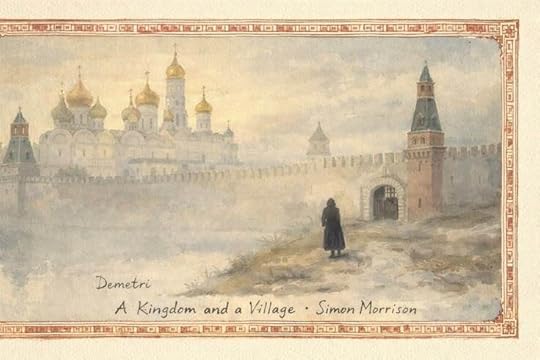
Watercolor II: White stone and domes turn a provincial stronghold into a sacred argument for permanence.
He is particularly strong on the politics of inheritance. “Third Rome” is not treated as a quaint medieval slogan but as one of the foundational strategies of Muscovite self-elevation. Moscow becomes great not only by consolidating territory but by annexing prestige – first from Kyiv, then from Byzantium, later from imperial victory, later still from Soviet sacrifice and triumph. Morrison understands that capitals become powerful not simply by issuing orders but by monopolizing symbols. The Kremlin matters in this book not only as a seat of government but as a durable technology of legitimacy. Regimes change; the center remains. That continuity is one of the book’s most unsettling subjects.
So is destruction. Fire, sack, plague, famine, invasion, purge, demolition, reconstruction – these are not interruptions in Moscow’s story but the means by which the city repeatedly remakes itself. Morrison is very good at showing how catastrophe in Moscow is converted into political advantage. The city burns and calls the rebuilding providential. It is invaded and calls the survival historical proof. It absorbs a rival and calls the act unity. This pattern runs from the medieval chapters through Napoleon’s 1812 campaign, through Stalinist reconstruction, and into the symbolic architecture of the present. Morrison never quite says that Moscow needs injury in order to recognize itself, but he comes close, and the thought illuminates a surprising amount.
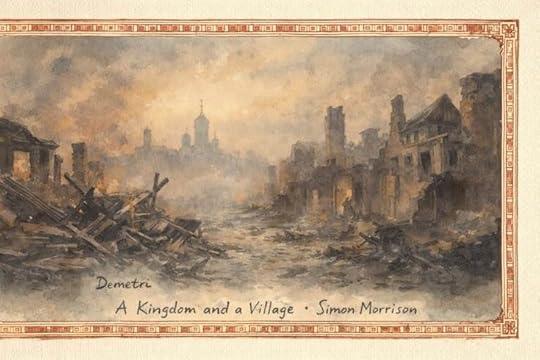
Watercolor III: In Moscow, ruin rarely ends a story – it prepares the city to tell it again more grandly.
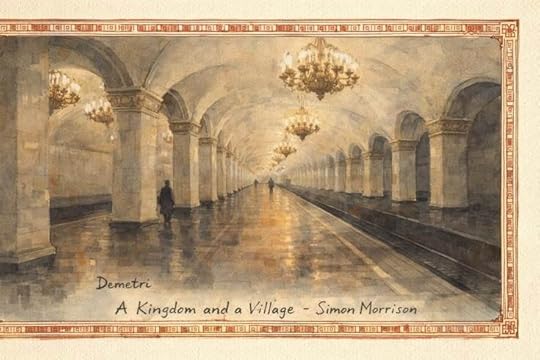
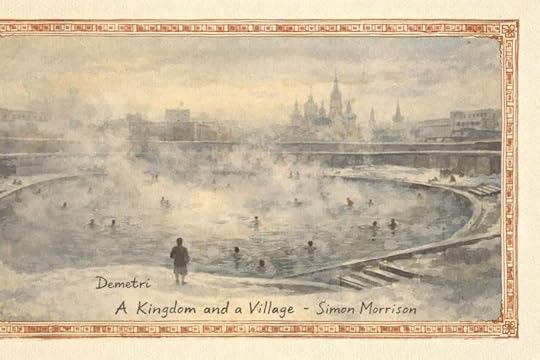
Yet the book would be far less persuasive if it were only a prosecution. Its great virtue is that it allows Moscow more than one register. Morrison knows that the city generated not only autocracy and surveillance but also theater, music, wit, sanctity, blasphemy, improvisation and style. The chapters on the Bolshoi, Zaryadye, the Arbat and the Metro are among the richest in the book because they show him reading urban space as a storage system for feeling as well as for power. The Metro, especially, becomes in his account a museum, bomb shelter, design manifesto and class system all at once – Soviet monumental aspiration continuing to carry post-Soviet inequality beneath the city’s feet. Likewise, the late chapter “Swimming,” with its layering of convent, cathedral, Palace of Soviets foundation and giant open-air pool, offers Morrison’s neatest emblem of Russian historical recursion: the same site restaged under incompatible faiths, each new order insisting it has finally made the place legible.
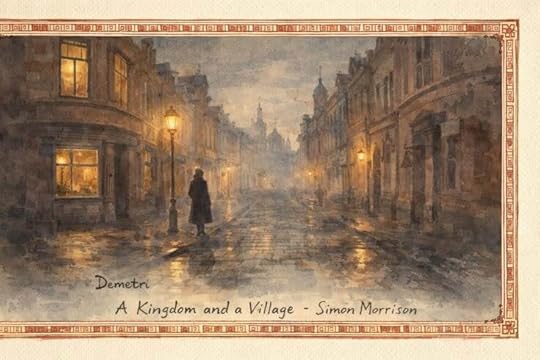
Watercolor V: Not all of Moscow speaks in decrees; some of it glows in windows, pavements, theaters, and solitary walks home.
Morrison’s prose is a major asset. He writes with clipped authority and boulevard wit, capable of moving from archival compression to mordant observation in a handful of sentences. He is not a decorative stylist in the usual sense. His sentences do not sprawl toward self-congratulation. But they do carry a cultivated sharpness – a willingness to puncture official solemnity with one exact image. He has the historian’s appetite for pattern and the essayist’s instinct for tonal surprise. A city biography requires that dual competence. Without it, the subject becomes either a gazetteer or a sermon.
Watercolor IV: Underground, beauty becomes discipline: grandeur in transit, ideology in marble and light.
It helps, too, that Morrison is alert to the small human indignities that grand narratives tend to smooth away. Even when he is writing about tsars, commissars and patriarchs, he retains a feel for the apartment, the market, the queue, the platform, the side street, the joke muttered under power rather than into it. One occasionally wishes for still more of that level of social noticing. This is, in the end, a history organized around rulers first and the ruled second. That may be unavoidable given the sources and the scale. Still, Morrison is so good when he stoops to the granular life of the city that the reader comes to want more of it – more tradespeople and laborers, more domestic improvisers, more of the people who kept Moscow from becoming a pure abstraction of statehood.
That points to one of the book’s few real limitations. Morrison’s argument is so vigorous, and so urgently connected to the present, that it can at times cast too long a retrospective shadow. Often this is clarifying. His insistence on Moscow’s long habit of appropriating the authority of Kyiv is central, persuasive and difficult to ignore. But there are moments when the thousand-year span threatens to resolve into too coherent a prehistory of the current Kremlin. The danger is not that Morrison is wrong to connect past and present. It is that a line drawn too firmly across centuries can begin to smooth away the genuine discontinuities, contingencies and dead ends that history also contains. Moscow has patterns; it also has accidents, blind alleys, ruptures and unintended consequences. Morrison knows this. The book is strongest when it trusts them.
The second half is also, now and then, richer in local brilliance than in cumulative momentum. This is partly a consequence of design. Once Moscow ceases to be simply a capital and becomes an overbuilt storehouse of competing meanings, a neighborhood-based approach makes far more sense than a strict march of events. Even so, there are stretches where the connective thread loosens a little and the book reads less like an inexorable civic biography than like a sequence of exceptionally smart urban essays. Those essays are often wonderful. They simply do not always gather force at the same rate.
Still, Morrison’s larger achievement is substantial. He has written a book that explains why Moscow matters without mystifying it. He rejects the old rhetoric of Russian inscrutability – the country as enigma, the capital as riddle – and replaces it with something more bracing. Moscow is not opaque, he suggests. It has advertised its governing habits for centuries. Centralization, sacralization, surveillance, symbolic overcompensation, the recycling of grievance into grandeur – these are not hidden codes. They are the city’s plain style. The difficulty has been not understanding them, but underestimating how durable they are.
Watercolor VI: Few images capture Moscow better than this one: faith erased, replaced, and returned in another form.
The conclusion, “Neverland,” is strong enough to reframe the whole book. Morrison returns there to Tanya, to the collapse of the Soviet Union, to Yeltsin on the tank, to the lowered Soviet flag, and then to the larger question of whether Russian history moves forward or loops back through altered forms. His answer is unmistakable. Moscow is a city of recurrences: buried rivers, restored churches, recycled emblems, repeated choreographies of state power. The Soviet Union, like the Golden Horde before it, does not so much collapse cleanly as bumble toward dissolution and then survive in afterimage. The book ends not on a note of fatalism exactly, but on the darker recognition that power in Moscow has a genius for reappearance. Documents burn. Monuments fall. The words, the reflexes and the settings remain.
If one insists on arithmetic, I would place “A Kingdom and a Village” at 91 out of 100: an erudite, stylish, deeply informed and often brilliant work whose interpretive confidence is mostly its strength, and only occasionally its excess. It is a book of unusual relevance, but its real distinction lies elsewhere – in the way it makes Moscow feel less like a backdrop to Russian history than like one of its chief instruments. Morrison has written the biography of a city that keeps mistaking recurrence for destiny, and of the people required to live inside that mistake.
All watercolor illustrations by Demetris Papadimitropoulos.
The very bloody history of Russia is a tough read but the sections set in the twentieth and twenty-first centuries were more interesting for me. History repeats itself is a prominent theme in this book! The section dealing with the ascendancy of Putin helps us to understand the history of the claim to the Ukraine and the incredible effect it has in Russia today. Overall, a chilling read!
A Kingdom and a Village by Simon Morrison is a thoughtful and emotionally layered work that explores history, identity, culture, and the impact of political change on ordinary people. Morrison combines detailed historical insight with deeply human storytelling, creating a book that feels both intellectually engaging and emotionally resonant.
The book examines the relationship between larger political systems and the lives of individuals living within small communities. Morrison uses the contrast between the “kingdom” and the “village” to symbolize the tension between power and everyday life, showing how historical events and political decisions can profoundly shape personal experiences. Through vivid descriptions and carefully developed narratives, the book captures the struggles, traditions, and resilience of people trying to preserve their identities during periods of uncertainty and transformation.
One of the strongest aspects of the book is Morrison’s writing style. His prose is elegant and descriptive without becoming overly complicated, allowing readers to connect emotionally with the material while also appreciating the historical and cultural depth. He skillfully balances broader historical analysis with intimate personal details, making the story feel both expansive and personal at the same time.
Another major strength is the book’s exploration of memory and cultural identity. Morrison emphasizes how communities preserve traditions, values, and stories even when faced with political upheaval or societal change. The themes of belonging, heritage, and resilience give the book emotional weight and make it relevant beyond its specific historical setting.
The pacing is generally steady, although some sections may feel slower due to the amount of historical and contextual detail included. Readers looking for fast-moving action may find parts of the narrative more reflective than dramatic. However, those interested in historical, cultural, or literary nonfiction will likely appreciate the depth and nuance Morrison brings to the subject.
Overall, A Kingdom and a Village is a compelling and reflective book that successfully combines history, culture, and human experience. Simon Morrison offers readers more than just a historical account; he provides a meaningful exploration of how ordinary lives are shaped by larger forces. The book is recommended for readers who enjoy thoughtful historical narratives, cultural analysis, and emotionally rich storytelling.
A thousand year history of a city could have been one of those before bedtime reads that put me to sleep. But not A Kingdom and a Village! Instead, I read it in the afternoons, stomach churning, nail biting, turning pages. Instead of soporific, the history is nightmarish. What violence! What brutes! Survival mean ruling with an iron hand, dealing out cruel deaths to enemies and mass destruction.
Sometimes history is stranger than fiction. A bell that peeled at the death of Dmitri, prince of Uglich, was punished with the lash and exile to Siberia! (Three hundred years later, the tsar pardoned it and it returned home!)
History reveals how we got to today.
Moscow began as a boggy, backwater trading post visited by Scandinavian boatsmen. Kyiv is older and where the Rus power was situated. Morrison writers that the “ancient connections” between the cities “partly explain Russia’s present-day efforts to prevent Ukraine from existing as an independent, European state.”
You will find more than the princes, tsars, and wars that made Moscow in these pages. Morrison enlightens us on the arts, architecture, the rise of neighborhoods, and the lives of ordinary folk.
A fascinating and entertaining biography of a city and a people.
A Kingdom and a Village is exactly the kind of history book the moment demands sweeping, deeply researched, and genuinely illuminating about a city and a nation that dominate our news cycle yet remain so poorly understood by most of the world. Simon Morrison writes with remarkable range and vividness. A thousand years of Moscow from a fortress on a river to a metropolis at the centre of global geopolitics told through bloody power struggles, cultural marvels, invasions, famines, fires, and the relentless cycle of destruction and resurrection that defines the city's very character. What elevates this beyond a standard city biography is Morrison's persuasive argument: that understanding Moscow is the key to understanding Russia's present, not just its past. By the final pages that case feels not just made but urgent. Erudite, entertaining, and essential. 🏰🌍📖
Fire is the biggest recurring theme in this book. Take a shot every time something burns down in Moscow and even a Russian will die of alcohol poisoning. Президент Зеленский вы знаете что вам надо делать.
Fascinating approach to history. . .that said, having listened to the well done audio book, I'd like to eventually add a physical copy to my shelves for future reference.
Morrison really achieved catching the soul of Moscow in his extensive history of the city. I loved reading it, although it helped me having quite some familiarity with Russian history. Also, Morrison had a very extensive focus on Moscow’s cultural history, to which I would have favored to read more about the physical-spatial development of the city.